RECYCLE AGGREGATE
CONCRETE
PRESENTED BY –
P.NAVEEN
CONTENTS :
• Introduction
• What is recycled aggregateconcrete.
• Characteristicsof RCA
• Classification of RCA.
• Properties of RCA
• Application of RCA
• Advantages and disadvantagesRCA
• Uses of RCA
INTRODUCTION
• Recycled aggregate concrete (RAC) is a sustainable alternative to
conventional concrete, which uses recycled materials as aggregate.
RAC has several environmental and economic benefits, such as
reducingwaste& lowering construction costs.
WHAT IS RECYCLE AGGREGATE
CONCRETE
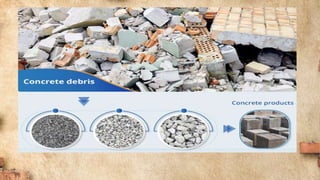
• Recycled aggregate concrete(RAC) is a type of concrete that of
concrete that is made using crushed materials from old building,
roads and other structures.
• RAC has environmental and economic benefits because it reduces
the demand for new materials and saves energy and resources.
• It can be used in many applications such as road construction and
buildings construction, and can be just as strong and durable as
traditional concrete if produced correctly.
Classification of recycled aggregate
concrete
• Material composition basis for classification of recycled concrete aggregate in two
main types-
1) Crushed concrete
2) Mixed concrete
PROPERTIES OF RAC
• The properties of recycled aggregate concrete may vary depending on the source
of the recycled aggregate its grading, and the mix design. However , RAC can
achieve similar properties as conventional concrete, such as strength and
durability.
CHARACTERISTICS OF RECYCLED
AGGREGATE CONCRETE
• Environmentallyfriendly: RAC is eco friendly because it reduced the amount
of waste material that goes to landfills and conserves natural resources.
• Lower strength: RAC is generally not strong as traditional concrete because
the recycled materials may contain some impurities.
• Porous: RAC can be more porous than traditional concrete because the
recycled materials may contain residual mortar or other contaminants.
APPLICATION OF RECYCLED
AGGREGATE CONCRETE
• Recycled aggregate concrete can help the environment and save money.
• It can be used to build things like roads, sidewalks, building foundation and walls, drainage
system, and landscaping features.
• It is strong, durable, and can handle heavy loads.
ADVANTAGES OF RECYCLED
AGGREGATE CONCRETE
• It is a high water absorption capacity.
• Decreases the cost of construction
• Preserve natural resources
• Conserves landfill space, reduces the need for new landfills and hence saving
more cost.
DISADVANTAGES OF RECYCLED
AGGREGATE CONCRETE
• It downgrades the quality of concrete
• Workability of concrete is decreased.
• It has lesser durability.
• It has less compressive strength.
• Using of RAC in earthquake zones can be harmful.
USES OF RCA
• It delivers a low cost alternative solution to thrashing natural raw materials
• Recycled concrete aggregate creates projects sustainable.
• It decreases the natural aggregate shortage
• Recycled aggregate concrete helps to decreases the construction cost.
Thank you

RECYCLE AGGREGATE CONCRETE_075612.pptx..

  • 1.
  • 2.
    CONTENTS : • Introduction •What is recycled aggregateconcrete. • Characteristicsof RCA • Classification of RCA. • Properties of RCA • Application of RCA • Advantages and disadvantagesRCA • Uses of RCA
  • 3.
    INTRODUCTION • Recycled aggregateconcrete (RAC) is a sustainable alternative to conventional concrete, which uses recycled materials as aggregate. RAC has several environmental and economic benefits, such as reducingwaste& lowering construction costs.
  • 4.
    WHAT IS RECYCLEAGGREGATE CONCRETE • Recycled aggregate concrete(RAC) is a type of concrete that of concrete that is made using crushed materials from old building, roads and other structures. • RAC has environmental and economic benefits because it reduces the demand for new materials and saves energy and resources. • It can be used in many applications such as road construction and buildings construction, and can be just as strong and durable as traditional concrete if produced correctly.
  • 6.
    Classification of recycledaggregate concrete • Material composition basis for classification of recycled concrete aggregate in two main types- 1) Crushed concrete 2) Mixed concrete
  • 7.
    PROPERTIES OF RAC •The properties of recycled aggregate concrete may vary depending on the source of the recycled aggregate its grading, and the mix design. However , RAC can achieve similar properties as conventional concrete, such as strength and durability.
  • 8.
    CHARACTERISTICS OF RECYCLED AGGREGATECONCRETE • Environmentallyfriendly: RAC is eco friendly because it reduced the amount of waste material that goes to landfills and conserves natural resources. • Lower strength: RAC is generally not strong as traditional concrete because the recycled materials may contain some impurities. • Porous: RAC can be more porous than traditional concrete because the recycled materials may contain residual mortar or other contaminants.
  • 9.
    APPLICATION OF RECYCLED AGGREGATECONCRETE • Recycled aggregate concrete can help the environment and save money. • It can be used to build things like roads, sidewalks, building foundation and walls, drainage system, and landscaping features. • It is strong, durable, and can handle heavy loads.
  • 10.
    ADVANTAGES OF RECYCLED AGGREGATECONCRETE • It is a high water absorption capacity. • Decreases the cost of construction • Preserve natural resources • Conserves landfill space, reduces the need for new landfills and hence saving more cost.
  • 11.
    DISADVANTAGES OF RECYCLED AGGREGATECONCRETE • It downgrades the quality of concrete • Workability of concrete is decreased. • It has lesser durability. • It has less compressive strength. • Using of RAC in earthquake zones can be harmful.
  • 12.
    USES OF RCA •It delivers a low cost alternative solution to thrashing natural raw materials • Recycled concrete aggregate creates projects sustainable. • It decreases the natural aggregate shortage • Recycled aggregate concrete helps to decreases the construction cost.
  • 13.