SMT.CHANDIBAI HIMATMAL MANSUKHANI COLLEGE
ULHASNAGAR- 421003
PROJECT REPORT ON
SUBMITTED BY
AKASH RANA
(ROLL NO: 46)
M.COM (SEM.I) : RECRUITMENT AND SELECTION IN BHARTI AIRTEL
SUBMITED TO
UNIVERSITY OF MUMBAI
2015-16
PROJECT GUIDE
Prof. MANISHA GUR
Page 1
Department of Commerce
Certificate
This is to certify that, Mr. AKASH RANA of M.Com.-I, Sem.-I (Roll NO-46) has successfully
completed the project titled “RECRUITMENT ANDSELECTIONIN BHARTI AIRTEL” under
my guidance for the Academic Year 2015-16. The information submitted is true and original as per
my knowledge.
Prof. Prakash N. Mulchandani
(Project Guide)
Prof. Gopi Shamnani Dr. Padma V. Deshmukh
(Coordinator, M. Com Course) ( I/C Principal)
External Examiner
Page 2
ACKNOWLEDGEMENT
I acknowledge the valuableassistance providedby SMT.CHANDIBAIHIMATMAL MANSUKHANI
COLLEGE, for twoyearsof degree course inM.Com.
I specially thank the principal Dr.Padma V. DeshmukhforAllowingusto use the facilities suchas
library, computerlaboratory, internetetc.
I sincerely thank the M.Comco-ordinator Prof. Gopi Shamnani forGuidingusin the rightdirection
go prepare the project.
I thankmy guide Prof. Manisha Gur whohas givenhis/hervaluable time, knowledgeandguidance
to complete the projectsuccessfully intime.
My family andpeerswere greatsource of inspiration throughoutmyprojecttheirsupportisdeeply
acknowledged.
Signature
Page 3
DECLARATION
I, AKASH RANA OF SMT.CHANDIBAI HIMATMAL MANSUKHANI COLLEGE OF
M.Com SEMESTER I, hereby declare that I have completed the project on ‘RECRUITMENT
AND SELECTION IN BHARTI AIRTEL’ in the academic year 2015-16. The information
submitted is true and original to the best of my knowledge.
(AKASH .P. RANA)
M.Com part-1, ROLL NO: 46
SEMESTER- I
Page 4
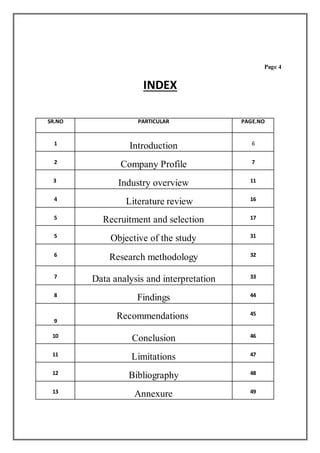
INDEX
SR.NO PARTICULAR PAGE.NO
1
Introduction 6
2
Company Profile 7
3
Industry overview 11
4
Literature review 16
5 Recruitment and selection 17
5
Objective of the study 31
6
Research methodology 32
7
Data analysis and interpretation 33
8
Findings 44
9
Recommendations 45
10
Conclusion 46
11
Limitations 47
12
Bibliography 48
13
Annexure 49
Page 5
Introduction
Recruitment is the process of attracting individuals on a timely basis in
sufficient numbers and with appropriate qualification, to apply for jobs within
an organization. The process of searching prospective employees with
multidimensional skills and experience that suits organization strategies in
fundamental to the growth of the organization, this demands more
comprehensive strategic perspective recruitment. Organizations require the
services of large number of personnel, these personnel occupies the various
positions created to the process of organization. Each position of the
organization has certain specific contributions to achieve the organizational
objectives. The recruitment process of the organizational has to be strong
enough to attract and select the potential candidates with right job
specification. The recruitment process begins with human resource planning
and concludes with the selection of required number of candidates, both HR
staff and operating managers have responsibilities in the process
Page 6
Company profile
Bharti Airtel Limited, commonly known as Airtel, is an Indian
telecommunications company that operates in 20 countries across South Asia, Africa
and the Channel Islands. It operates a GSM network in all countries,
providing 2G or 3G services depending upon the country of operation. Airtel is
the fifth largest telecom operator in the world with about 230.8 million subscribers
across 19 countries at the end of June 2011. It is the largest cellular service
provider in India, with over 169.18 million subscribers as of June 2011.Airtel is the
3rd largest in-country mobile operator by subscriber base, behind China Mobile and
China Unicom.
Airtel is the largest provider of mobile telephony and second largest provider
of fixed telephony in India, and is also a provider of broadband and subscription
television services. It offers its telecom services under the Airtel brand and is
headed by Sunil Bharti Mittal. Bharti Airtel is the first Indian telecom service
provider to achieve this Cisco Gold Certification. To earn Gold Certification, Bharti
Airtel had to meet rigorous standards for networking competency, service, support
and customer satisfaction set forth by Cisco. The company also provides land-line
telephone services and broadband Internet access (DSL) in over 96 cities in India. It
also acts as a carrier for national and international long distance communication
services. The company has a submarine cable landing station at Chennai, which
connects the submarine cable connecting Chennai and Singapore.
It is known for being the first mobile phone company in the world to outsource
everything except marketing and sales and finance. Its network (base stations,
microwave links, etc.) are maintained by Ericsson, Nokia Siemens
Network and Huawei, business support by IBM and transmission towers by another
company (Bharti Infratel Ltd. in India). Ericsson agreed for the first time, to be paid
by the minute for installation and maintenance of their equipment rather than being
paid up front. This enabled the company to provide pan-India phone call rates of Rs.
1/minute (U$0.02/minute). Call rates have come down much further. During the last
financial year [2009-10], Bharti has roped in a strategic partner Alcatel-Lucent to
manage the network infrastructure for the Tele media Business page 7
Incorporation and History
Bharti Airtel Limited (Bharti Airtel or ‘the Company’) (formerly Bharti Tele-
Ventures Limited - BTVL) was incorporated on July 7, 1995 under the laws of India
for promoting investments in telecommunication services. Bharti Airtel together
with its subsidiaries is here in after referred to as ‘the Group’. The Group is a
leading telecommunication service provider in India. The Groups principal
shareholders include Bharti Telecom Limited, Singapore Telecommunication
International Pvt. Limited and Vodafone International Holdings B. v .The shares of
the Company are listed on the National Stock Exchange (NSE) and the Mumbai
Stock Exchange (BSE), India. With effect from April 24, 2006, the name of the
Company has been changed from Bharti Tele-Ventures Limited (BTVL) to Bharti
Airtel Limited (Bharti Airtel).
Vision:
By 2015 Airtel will be the most loved brand, enriching the lives of millions.
“Enriching lives means putting the customer at the heart of everything we do. We
will meet their needs based on our deep understanding of their ambitions, wherever
they are. By having this focus we will enrich our own lives and those of our other
key stakeholders. Only then will we be thought of as exciting, innovation, on their
side and a truly world class company."
Page 8
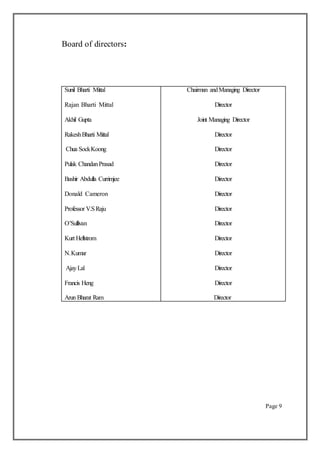
Board of directors:
Sunil Bharti Mittal
Rajan Bharti Mittal
Akhil Gupta
RakeshBharti Mittal
Chua SockKoong
Pulak ChandanPrasad
Bashir Abdulla Currimjee
Donald Cameron
Professor V.SRaju
O’Sullivan
Kurt Hellstrom
N.Kumar
AjayLal
Francis Heng
Arun Bharat Ram
Chairman andManaging Director
Director
Joint Managing Director
Director
Director
Director
Director
Director
Director
Director
Director
Director
Director
Director
Director
Page 9
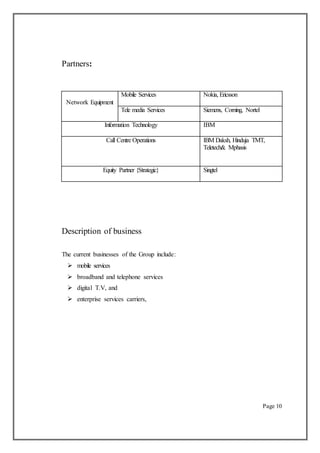
Partners:
Network Equipment
Mobile Services Nokia, Ericsson
Tele media Services Siemens, Corning, Nortel
Information Technology IBM
Call Centre Operations IBM Daksh, Hinduja TMT,
Teletech& Mphasis
Equity Partner {Strategic} Singtel
Description of business
The current businesses of the Group include:
 mobile services
 broadband and telephone services
 digital T.V, and
 enterprise services carriers,
Page 10
Industry overview and licensing structure:
The key regulations governing the Group’s businesses are detailed below:
Mobile services
In 1994, the telecommunications sector was partially deregulated for Cellular
Mobile Telephony Services (‘CMTS’).
The licenses were issued by the Department of Telecommunications (‘DoT’) to the
Group upon payment of fixed amounts as annual license fees and were valid for an
initial period of 10 years. In addition, the Group was required to pay a fixed amount
for wireless and spectrum charges to the Wireless Planning Commission (‘WPC’) ±
a section of the DoT. This regime is collectively referred to herein as the , “old license
fee regime “.
Bharti Airtel Limited (formerly Bharti Tele-Ventures Limited) Notes to
Consolidated Financial Statements (Amounts in thousands, except per share data
and as stated otherwise) In September 2001, the DoT fixed the license fees
payable by the mobile service providers at 12% of adjusted gross revenues (‘AGR’)
as defined in the regulation, in category A circles, 10% in category B circles and
8%in category C circles. AGR has been defined as the total income including service
revenues, finance income, and non-operating income, reduced by access and
interconnection costs, service tax and/or sales tax, if applicable. The rates
for payment of license fees have since been further revised and currently a licensee
is required to pay 10%, 8% and 6% of its AGR for A, B and C categories of circles,
respectively
Broadband and telephone Services
In September 1994, the GoI announced guidelines for private sector entry into the
fixed-line telecommunication services, which provided for the granting of licenses
for the provision of fixed line services to one new licensee in each of the
Page 11
telecommunication circles. Within each circle, the new licensees would compete
with Mahanagar Telephone Nigam Limited (‘MTNL’) (in Delhi and Mumbai) and
Bharat Sanchar Nigam Limited (BSNL) (in all other circles). The licenses would be
valid for a period of 15 years. The Group obtained the licenses from the DoT to
provide fixed line services in Madhya Pradesh, Delhi, Haryana,
Karnataka and Tamil Nadu circles. These licences were granted by the DoT on
anon-exclusive basis. The revenue share percentages have been fixed by the GoI at
10%, 8% and 6% of the AGR for A, B and C categories of circles, respectively.
Amendment to NTP 99: Introduction of a Unified Licensing Regime
In November 2003, the DoT decided to issue licenses for Unified Access (Basic and
Cellular) Services. The services under UASL license cover collection, transmission
and delivery of voice/non-voice messages in designated service areas and include
provision of all type of access services utilizing any type of network equipment.
Considering the option available to migrate to the new UASL regime, the Group
migrated its CMTS licenses in Chennai, Delhi,
Kolkata, Mumbai, Gujarat, Haryana, Himachal Pradesh,
Kerala, Madhya Pradesh, Maharashtra, Tamil Nadu, Uttar Pradesh (West), Andhra
Pradesh,
Karnataka and Punjab to UASL after obtaining the necessary approvals from the
DoT with effect from April 27, 2004.Further, the Group surrendered its Basic
Service Licenses in Delhi, Haryana, Karnataka and Tami Nadu effective October 1,
2004 and in Madhya Pradesh with effect from December 12, 2004. The Group
continues to provide basic services in these circles on the basis of the UASL that it
had received for these circles resulting from the conversion of the mobility licenses.
The service area, roll out obligations, bank guarantees and revenue share payable as
license fees by a UASL licensee are the same as specified for a fourth cellular
operator.
Page 12
Digital T.V
Airtel also provides the service of digital T.V to its customers. Its satellite service,
launched on 2008, transmits digital satellite television and audio to households in
India. It uses MPEG-4 digital compression with DVB-S2 technology, transmitting
using INSAT 4CR 74°E and SES 7 108.2°E. Airtel Digital TV service was launched
on, 8 October 2008.
Its primary competitors are cable television and other DTH service providers—
Reliance Big TV,DD Direct+, Dish TV, Tata Sky, Sun Direct, and Videocon D2H.
National and International Long Distance
On November 29, 2001, the Group entered into a license agreement with the DoT,
on a non-exclusive basis, to install, operate and maintain national long distance
services (‘NLD’) within India. The license is valid for a period of 20years
extendable for a period of 10 years. The Group commenced data services in
December 2001 and voice services in January 2002. In addition to the entry fees, the
annual license fees were in the form of a revenue share at 10% of its AGR plus a
prescribed contribution towards a Universal Service Obligation Fund (‘USO’) with a
maximum fee at 15% of its AGR. The rate for payment of license fee has been revised from 15%
to 6% with effect from January 1, 2006.In March 2002, the Group was awarded a
license to provide International Long Distance (‘ILD’) services. The license is valid
for a period of 20 years. The Group commenced ILD operations in July 2002. The
rate for payment of revenue share license fee has been revised from 15% to 6% with
effect from January 1, 2006.- 10 - Bharti Airtel Limited (formerly Bharti Tele-
Ventures Limited)Notes to Consolidated Financial Statements(Amounts in
thousands, except per share data and as stated otherwise)
Page 13
Interconnection between Operators
The Group has entered into interconnect agreements with BSNL and other private
sector operators for terminating outgoing calls from its network. The interconnection
agreements with BSNL require the Group to make payments based on the number of
points of connectivity with BSNL’s network and permit sharing of revenue
generated by outgoing calls. The Group’s interconnection agreements with other
private sector operators are based on mutually agreeable terms and conditions.
Interconnection between operators is now governed by the Interconnect Usage
Charges (‘IUC’) Regulation, released by the Telecom Regulatory Authority of India
(‘TRAI’ which defines charges payable on the principle of origination, carriage and
termination. The IUC Regulation has been revised by the TRAI from time totime.
Page 14
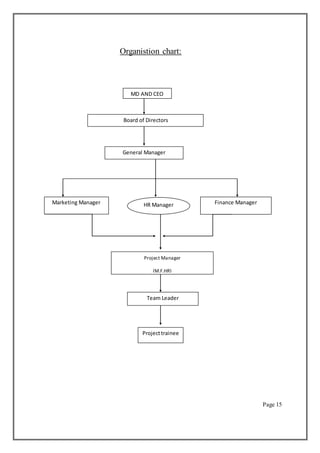
Organistion chart:
Page 15
MD AND CEO
Board of Directors
General Manager
Marketing Manager HR Manager Finance Manager
Project Manager
(M,F,HR)
Team Leader
Projecttrainee
Literature Review
People are integral part of an organisation today. No organisation can run without its human resource.
In today’s highly complex and competitive situation, choice of right person at the right place at the
right time has far implications for an organisation’s functioning. An employee well selected and well
placed would not only contribute to the efficient running of the organisation but also offer significant
potential for future replacement. Thus hiring is an important function. The process of hiring begins
with human resource planning which helps to determine the number and type of people an
organisation needs. Job analysis and job design enables to specify the task and duties of jobs and
qualifications expected from prospective job. HRP, job analysis and job design helps to identify the
kind of people required in an organisation and hence hiring. It should be noted that hiring is an ongoing
process and not confined to formative stages of an organisation. Employees leave the organisation in
search of greener pastures, some retire and some die in the saddle. More importantly an enterprise
grows, diversifies, take over the other units until all necessitating hiring of new men and women. In
fact the hiring function stopsonly when the organisation ceasestoexist.
Page 16
Recruitment and selection
According to Flippo, “Recruitment is the process of searching for prospective employees and
stimulating and encouraging them to apply for jobs in an organisation.” It is the activity which links the
employer and the jobseekers.
According to Yoder, “Recruitment is a process to discover the sources of manpower to meet the
requirements of the staffing schedule and to employ effective measures for attracting that manpower in
adequate number tofacilitate effective selection ofanefficient working force”.
“Recruitment is the development and maintenance of adequate manpower resources. It involves the
creation of a pool of available labour upon whom the organisation can draw when it needs additional
employees”.
Thus we cansaythat:
 Recruitment is the activity that links employer andjobseekers.
 It is a process of finding and attracting capable applicants for employment. It begins when
new recruits are sought and ends when their applications are submitted. The result is a poolof
application forms which new employees areselected.
 It is the process to discover sources of manpower to meet the requirements of staffing
schedule and to employ effective measures for attracting that manpower in adequate numbers
tofacilitate effective selection ofanefficient working force.
 Recruitment of candidates is the function preceding the selection, which helps to create a pool
of prospective employees for the organisation so that the management can select the right
candidate for the right job from this pool. The main objective of the recruitment process is to
expedite the selection process.
In sourcing:
Companies recruit the candidates and, employ them, train and develop them and
utilize the human resources of these candidates. This strategy is called In-sourcing.
Companies formulate and implement this strategy when the corporate strategy is
stable.
Page 17
Out sourcing:
Some service companies depend for their human resources on such external
organization whose core business is to provide human resources. This strategy is
called Out-sourcing. Out-sourcing strategy is more suitable for both the fast growing
and diversifying companies.
 Tosearchfor talent globally and not just within the company.
 Todesign entry paythat competes onquality but not onquantum.
 Toanticipate and final people for positions that donotexists yet.
Selection:
Selection process is a decision making process. This step consists a number of
activities. A candidate who fails to qualify for a particular step is not eligible for
appearing for the subsequent step. Employee selection is the process of putting right
men on the right job. It is a procedure of matching organisational requirements with
the skills and qualifications of people. Effective selection can be done only where
there is effective matching. By selecting best candidate for the required job, the
organisation will get quality performance of employees. Moreover, organisation will
face less absenteeism and employee turnover problems. By selecting right candidate
for the required job, organisation will also save time and money. Proper screening of
candidates takes place during selection procedure. All the potential candidates who
apply for the given job are tested.
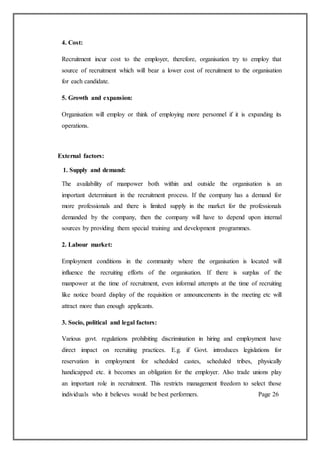
Recruitment and selection in Bharti Airtel:
Recruitment:
Recruitment techniques are the means or media by which the management
contacts prospective employees or provides necessary information or exchange of
ideas order to stimulate them to apply for jobs.
Page 18
1. Direct method:
Under direct recruitment scouting, employees contacts, and waiting lists are used. in
scouting, representatives of the organisation are sent to educational and training
institutions. these travelling recruiters exchange information with students, clarify
their doubts, simulate them to apply for jobs conduct campus interviews and short
list candidates for further screening.
2. Indirect method:
Advertisement in news paper, journals, on the radio and television are used to
publicise vacancies. A well thought out and clear advertisement enables candidates
to assess their suitability so that only those possessing the requisite qualification will
apply.
3. Third party method:
Various agencies can be used to recruit personnel. Public employment exchanges,
management consulting firms, professional societies, temporary help societies, trade
unions, labour contractors are the main agencies.
4. Internet recruitment:
Various job sites are now available on the internet. The organisation can create
profile on such sites so that various resumes of applicants can be viewed and
matched with the requirements of the job and as much as applicants can be called
because almost 25% of net users in India search for jobs through internet.
Page 19
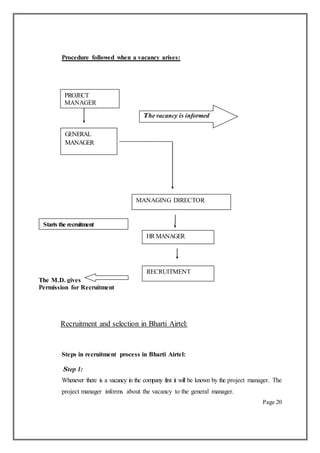
Procedure followed when a vacancy arises:
The M.D. gives
Permission for Recruitment
Recruitment and selection in Bharti Airtel:
Steps in recruitment process in Bharti Airtel:
Step 1:
Whenever there is a vacancy in the company first it will be known by the project manager. The
project manager informs about the vacancy to the general manager.
Page 20
PROJECT
MANAGER
GENERAL
MANAGER
The vacancy is informed
MANAGING DIRECTOR
HRMANAGER
Starts the recruitment
RECRUITMENT
Step 2:
Once the general manager comes to know about vacancy in the company he will inform it to the
chairman to get the approval of recruitment.
Step 3:
After getting the recruitment approval the process will be carried by the HRmanager. Moreover
the recruitment of the company internally, that is the existing employee will be given
first priority.
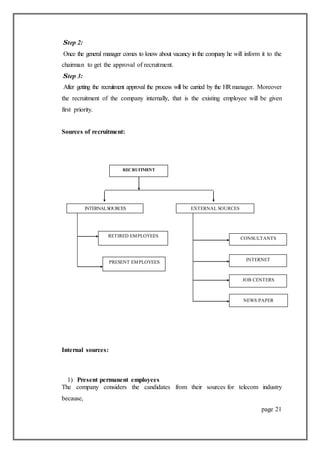
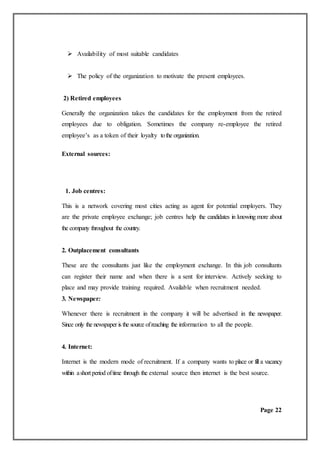
Sources of recruitment:
Internal sources:
1) Present permanent employees
The company considers the candidates from their sources for telecom industry
because,
page 21
RECRUITMENT
INTERNALSOURCES EXTERNAL SOURCES
PRESENT EMPLOYEES
RETIRED EMPLOYEES
NEWS PAPER
JOB CENTERS
INTERNET
CONSULTANTS
 Availability of most suitable candidates
 The policy of the organization to motivate the present employees.
2) Retired employees
Generally the organization takes the candidates for the employment from the retired
employees due to obligation. Sometimes the company re-employee the retired
employee’s as a token of their loyalty tothe organization.
External sources:
1. Job centres:
This is a network covering most cities acting as agent for potential employers. They
are the private employee exchange; job centres help the candidates in knowing more about
the company throughout the country.
2. Outplacement consultants
These are the consultants just like the employment exchange. In this job consultants
can register their name and when there is a sent for interview. Actively seeking to
place and may provide training required. Available when recruitment needed.
3. Newspaper:
Whenever there is recruitment in the company it will be advertised in the newspaper.
Since only the newspaper is the source ofreaching the information to all the people.
4. Internet:
Internet is the modern mode of recruitment. If a company wants to place or fill a vacancy
within ashort period oftime through the external source then internet is the best source.
Page 22
Reasons for selecting the sources:
1. Referrals:
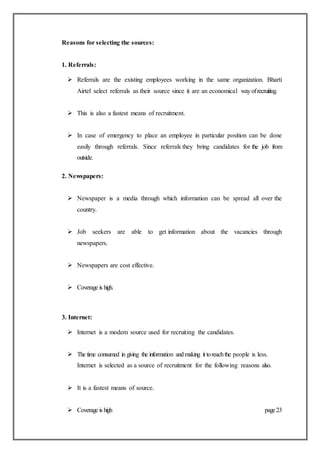
 Referrals are the existing employees working in the same organization. Bharti
Airtel select referrals as their source since it are an economical wayofrecruiting.
 This is also a fastest means of recruitment.
 In case of emergency to place an employee in particular position can be done
easily through referrals. Since referrals they bring candidates for the job from
outside.
2. Newspapers:
 Newspaper is a media through which information can be spread all over the
country.
 Job seekers are able to get information about the vacancies through
newspapers.
 Newspapers are cost effective.
 Coverage is high.
3. Internet:
 Internet is a modem source used for recruiting the candidates.
 The time consumed in giving the information andmaking it toreachthe people is less.
Internet is selected as a source of recruitment for the following reasons also.
 It is a fastest means of source.
 Coverage is high page23
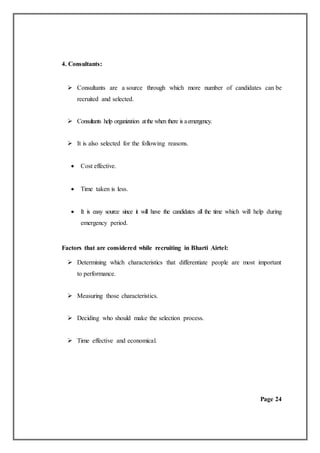
4. Consultants:
 Consultants are a source through which more number of candidates can be
recruited and selected.
 Consultants help organization atthe when there is aemergency.
 It is also selected for the following reasons.
 Cost effective.
 Time taken is less.
 It is easy source since it will have the candidates all the time which will help during
emergency period.
Factors that are considered while recruiting in Bharti Airtel:
 Determining which characteristics that differentiate people are most important
to performance.
 Measuring those characteristics.
 Deciding who should make the selection process.
 Time effective and economical.
Page 24
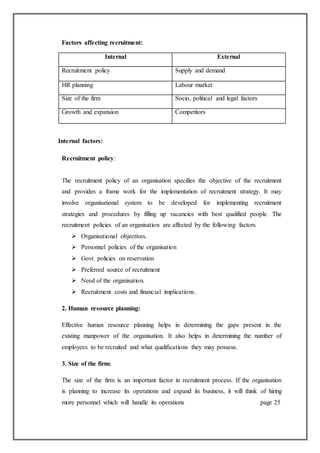
Factors affecting recruitment:
Internal External
Recruitment policy Supply and demand
HR planning Labour market
Size of the firm Socio, political and legal factors
Growth and expansion Competitors
Internal factors:
Recruitment policy:
The recruitment policy of an organisation specifies the objective of the recruitment
and provides a frame work for the implementation of recruitment strategy. It may
involve organisational system to be developed for implementing recruitment
strategies and procedures by filling up vacancies with best qualified people. The
recruitment policies of an organisation are affected by the following factors
 Organisational objectives.
 Personnel policies of the organisation
 Govt. policies on reservation
 Preferred source of recruitment
 Need of the organisation.
 Recruitment costs and financial implications.
2. Human resource planning:
Effective human resource planning helps in determining the gaps present in the
existing manpower of the organisation. It also helps in determining the number of
employees to be recruited and what qualifications they may possess.
3. Size of the firm:
The size of the firm is an important factor in recruitment process. If the organisation
is planning to increase its operations and expand its business, it will think of hiring
more personnel which will handle its operations page 25
4. Cost:
Recruitment incur cost to the employer, therefore, organisation try to employ that
source of recruitment which will bear a lower cost of recruitment to the organisation
for each candidate.
5. Growth and expansion:
Organisation will employ or think of employing more personnel if it is expanding its
operations.
External factors:
1. Supply and demand:
The availability of manpower both within and outside the organisation is an
important determinant in the recruitment process. If the company has a demand for
more professionals and there is limited supply in the market for the professionals
demanded by the company, then the company will have to depend upon internal
sources by providing them special training and development programmes.
2. Labour market:
Employment conditions in the community where the organisation is located will
influence the recruiting efforts of the organisation. If there is surplus of the
manpower at the time of recruitment, even informal attempts at the time of recruiting
like notice board display of the requisition or announcements in the meeting etc will
attract more than enough applicants.
3. Socio, political and legal factors:
Various govt. regulations prohibiting discrimination in hiring and employment have
direct impact on recruiting practices. E.g. if Govt. introduces legislations for
reservation in employment for scheduled castes, scheduled tribes, physically
handicapped etc. it becomes an obligation for the employer. Also trade unions play
an important role in recruitment. This restricts management freedom to select those
individuals who it believes would be best performers. Page 26
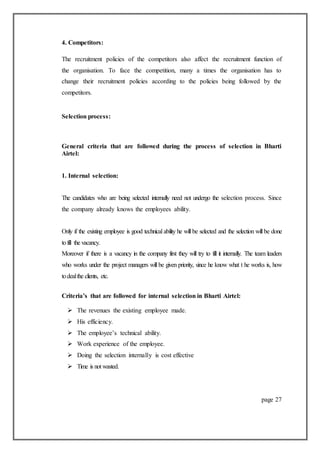
4. Competitors:
The recruitment policies of the competitors also affect the recruitment function of
the organisation. To face the competition, many a times the organisation has to
change their recruitment policies according to the policies being followed by the
competitors.
Selection process:
General criteria that are followed during the process of selection in Bharti
Airtel:
1. Internal selection:
The candidates who are being selected internally need not undergo the selection process. Since
the company already knows the employees ability.
Only if the existing employee is good technical ability he will be selected and the selection will be done
tofill the vacancy.
Moreover if there is a vacancy in the company first they will try to fill it internally. The team leaders
who works under the project managers will be given priority, since he know what t he works is, how
todealthe clients, etc.
Criteria’s that are followed for internal selection in Bharti Airtel:
 The revenues the existing employee made.
 His efficiency.
 The employee’s technical ability.
 Work experience of the employee.
 Doing the selection internally is cost effective
 Time is not wasted.
page 27
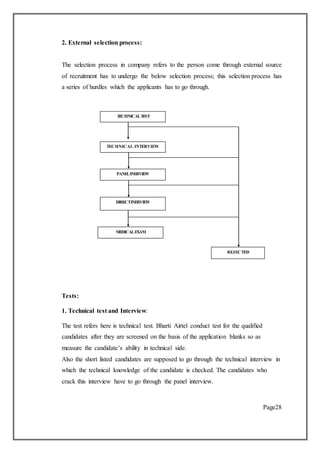
2. External selection process:
The selection process in company refers to the person come through external source
of recruitment has to undergo the below selection process; this selection process has
a series of hurdles which the applicants has to go through.
Tests:
1. Technical test and Interview:
The test refers here is technical test. Bharti Airtel conduct test for the qualified
candidates after they are screened on the basis of the application blanks so as
measure the candidate’s ability in technical side.
Also the short listed candidates are supposed to go through the technical interview in
which the technical knowledge of the candidate is checked. The candidates who
crack this interview have to go through the panel interview.
Page28
TECHNICAL INTERVIEW
PANELINERVIEW
DIRECTINERVIEW
MEDICALEXAM
REJECTED
TECHNICALTEST
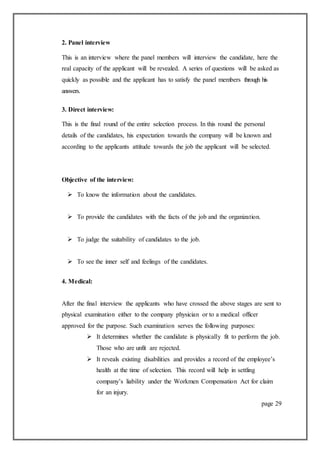
2. Panel interview
This is an interview where the panel members will interview the candidate, here the
real capacity of the applicant will be revealed. A series of questions will be asked as
quickly as possible and the applicant has to satisfy the panel members through his
answers.
3. Direct interview:
This is the final round of the entire selection process. In this round the personal
details of the candidates, his expectation towards the company will be known and
according to the applicants attitude towards the job the applicant will be selected.
Objective of the interview:
 To know the information about the candidates.
 To provide the candidates with the facts of the job and the organization.
 To judge the suitability of candidates to the job.
 To see the inner self and feelings of the candidates.
4. Medical:
After the final interview the applicants who have crossed the above stages are sent to
physical examination either to the company physician or to a medical officer
approved for the purpose. Such examination serves the following purposes:
 It determines whether the candidate is physically fit to perform the job.
Those who are unfit are rejected.
 It reveals existing disabilities and provides a record of the employee’s
health at the time of selection. This record will help in settling
company’s liability under the Workmen Compensation Act for claim
for an injury.
page 29
 It prevents the employment of people suffering from contagious
disease.
 It identifies candidates who are otherwise suitable but require specific
jobs due to physical handicaps and allergies.
Types of interviews that are adopted during selectionprocess in Bharti Airtel:
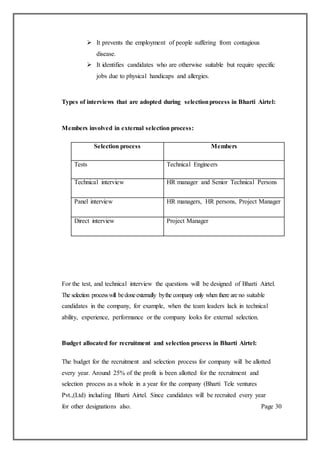
Members involved in external selection process:
For the test, and technical interview the questions will be designed of Bharti Airtel.
The selection processwill bedoneexternally bythe company only when there are no suitable
candidates in the company, for example, when the team leaders lack in technical
ability, experience, performance or the company looks for external selection.
Budget allocated for recruitment and selection process in Bharti Airtel:
The budget for the recruitment and selection process for company will be allotted
every year. Around 25% of the profit is been allotted for the recruitment and
selection process as a whole in a year for the company (Bharti Tele ventures
Pvt.,(Ltd) including Bharti Airtel. Since candidates will be recruited every year
for other designations also. Page 30
Selection process Members
Tests Technical Engineers
Technical interview HR manager and Senior Technical Persons
Panel interview HR managers, HR persons, Project Manager
Direct interview Project Manager
Objectives of the study
 The objective of the study is to analyse and evaluate selection process for
BHARTI AIRTEL.
 To know the perception of employees regarding recruitment and selection process.
Page 31
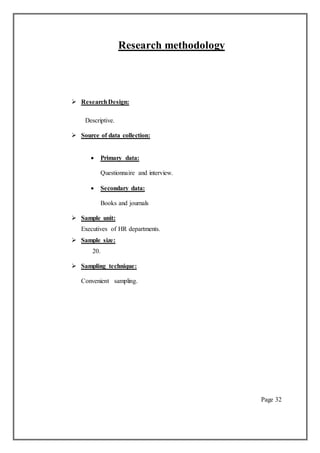
Research methodology
 ResearchDesign:
Descriptive.
 Source of data collection:
 Primary data:
Questionnaire and interview.
 Secondary data:
Books and journals
 Sample unit:
Executives of HR departments.
 Sample size:
20.
 Sampling technique:
Convenient sampling.
Page 32
Data analysis and interpretation
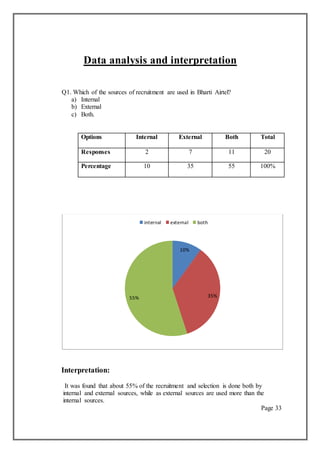
Q1. Which of the sources of recruitment are used in Bharti Airtel?
a) Internal
b) External
c) Both.
Options Internal External Both Total
Responses 2 7 11 20
Percentage 10 35 55 100%
Interpretation:
It was found that about 55% of the recruitment and selection is done both by
internal and external sources, while as external sources are used more than the
internal sources.
Page 33
10%
35%55%
internal external both
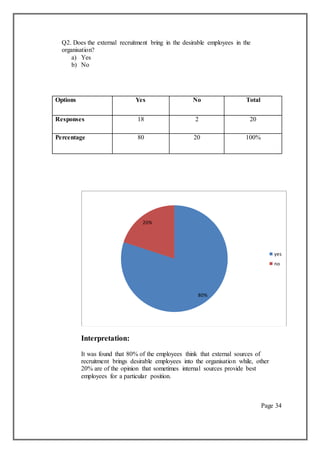
Q2. Does the external recruitment bring in the desirable employees in the
organisation?
a) Yes
b) No
Interpretation:
It was found that 80% of the employees think that external sources of
recruitment brings desirable employees into the organisation while, other
20% are of the opinion that sometimes internal sources provide best
employees for a particular position.
Page 34
80%
20%
yes
no
Options Yes No Total
Responses 18 2 20
Percentage 80 20 100%
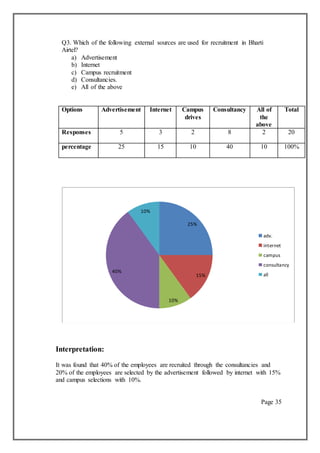
Q3. Which of the following external sources are used for recruitment in Bharti
Airtel?
a) Advertisement
b) Internet
c) Campus recruitment
d) Consultancies.
e) All of the above
Options Advertisement Internet Campus
drives
Consultancy All of
the
above
Total
Responses 5 3 2 8 2 20
percentage 25 15 10 40 10 100%
Interpretation:
It was found that 40% of the employees are recruited through the consultancies and
20% of the employees are selected by the advertisement followed by internet with 15%
and campus selections with 10%.
Page 35
25%
15%
10%
40%
10%
adv.
internet
campus
consultancy
all
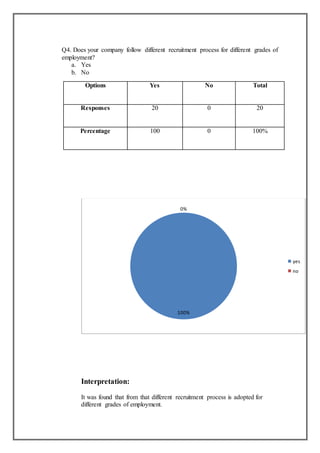
Q4. Does your company follow different recruitment process for different grades of
employment?
a. Yes
b. No
Interpretation:
It was found that from that different recruitment process is adopted for
different grades of employment.
100%
0%
yes
no
Options Yes No Total
Responses 20 0 20
Percentage 100 0 100%
Page 36
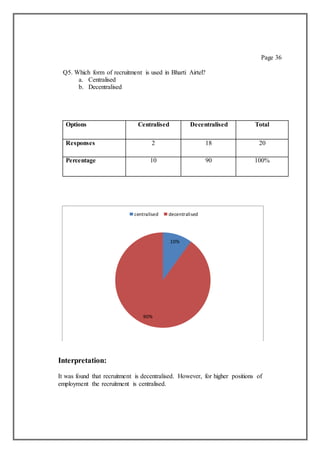
Q5. Which form of recruitment is used in Bharti Airtel?
a. Centralised
b. Decentralised
Options Centralised Decentralised Total
Responses 2 18 20
Percentage 10 90 100%
Interpretation:
It was found that recruitment is decentralised. However, for higher positions of
employment the recruitment is centralised.
10%
90%
centralised decentralised
Page 37
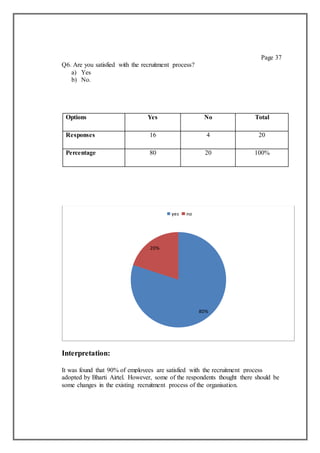
Q6. Are you satisfied with the recruitment process?
a) Yes
b) No.
Options Yes No Total
Responses 16 4 20
Percentage 80 20 100%
Interpretation:
It was found that 90% of employees are satisfied with the recruitment process
adopted by Bharti Airtel. However, some of the respondents thought there should be
some changes in the existing recruitment process of the organisation.
80%
20%
yes no
Page 38
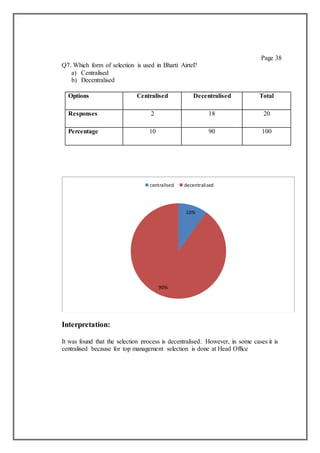
Q7. Which form of selection is used in Bharti Airtel?
a) Centralised
b) Decentralised
Options Centralised Decentralised Total
Responses 2 18 20
Percentage 10 90 100
Interpretation:
It was found that the selection process is decentralised. However, in some cases it is
centralised because for top management selection is done at Head Office
10%
90%
centralised decentralised
Page 39
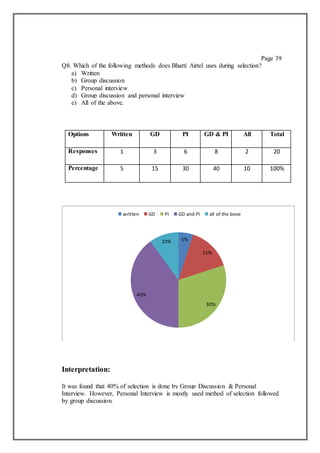
Q8. Which of the following methods does Bharti Airtel uses during selection?
a) Written
b) Group discussion
c) Personal interview
d) Group discussion and personal interview
e) All of the above.
Options Written GD PI GD & PI All Total
Responses 1 3 6 8 2 20
Percentage 5 15 30 40 10 100%
Interpretation:
It was found that 40% of selection is done by Group Discussion & Personal
Interview. However, Personal Interview is mostly used method of selection followed
by group discussion.
5%
15%
30%
40%
10%
written GD PI GD and PI all of the bove
Page 40
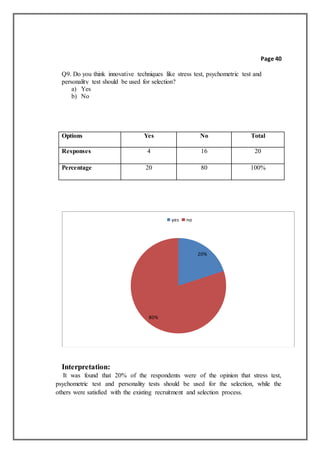
Q9. Do you think innovative techniques like stress test, psychometric test and
personality test should be used for selection?
a) Yes
b) No
Options Yes No Total
Responses 4 16 20
Percentage 20 80 100%
Interpretation:
It was found that 20% of the respondents were of the opinion that stress test,
psychometric test and personality tests should be used for the selection, while the
others were satisfied with the existing recruitment and selection process.
20%
80%
yes no
Page 41
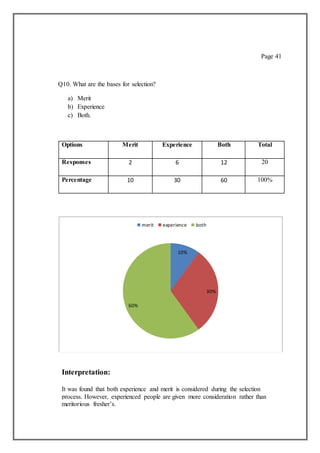
Q10. What are the bases for selection?
a) Merit
b) Experience
c) Both.
Options Merit Experience Both Total
Responses 2 6 12 20
Percentage 10 30 60 100%
Interpretation:
It was found that both experience and merit is considered during the selection
process. However, experienced people are given more consideration rather than
meritorious fresher’s.
10%
30%
60%
merit experience both
Page 42
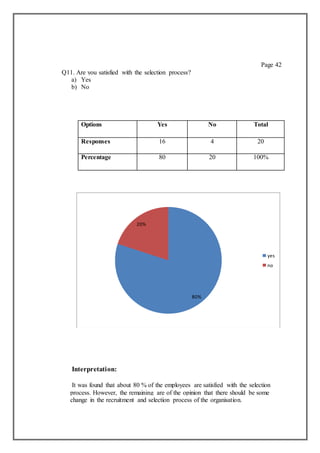
Q11. Are you satisfied with the selection process?
a) Yes
b) No
Options Yes No Total
Responses 16 4 20
Percentage 80 20 100%
Interpretation:
It was found that about 80 % of the employees are satisfied with the selection
process. However, the remaining are of the opinion that there should be some
change in the recruitment and selection process of the organisation.
80%
20%
yes
no
Page 43
Findings
After the data analysis and interpretation the findings are:
 Both internal as well as external sources of recruitment used.
 Consultancies (40%) and advertisement (25%) are the two main external
sources of recruitment.
 The recruitment and selection process is decentralised.
 About 80% of the employees are satisfied with recruitment and selection
process.
Page 44
Recommendations
From the findings I can suggest Bharti Airtel, Noida Branch following things for the
more effectiveness of recruitment and selection process:
 More emphasis should be given on internet and advertisement so that more
and more candidates apply for the jobs and it will be easy to find the right
employee among them.
 Company should try to use the internal recruitment process first because it
incurs less cost and acts as a motivational factor to the employees.
 Also company should adopt latest techniques like stress test, psychometric
test and personality test to find the right candidate suitable for the job.
Page 45
Conclusion
Recruitment as being one of the major topics is required by most of the organization.
Hence the study helped in understanding the various aspects of recruitment and
selection process. In the BHARTI AIRTEL the sources of recruitment is effective,
the internal selection of the organization also in an economical means which also
reduce costs, only after looking the efficiency of the existing employee towards the
company and his sincerity that employee will be selected, in BHARTI AIRTEL the
effective selection process is adopted in the last 5 years. It can be retained as such.
Also the employees of Bharti Airtel are satisfied with the recruitment and selection
process. Also they are well aware about the various sources and methods of
recruitment and selection.
Page 46
Limitations of the study
 The employees were busy with their daily schedule and it was very much
difficult for them to give time.
 Personal biasness of various employees may have supplied wrong data.
 Time and money was also an important constraint.
Page 47
Bibliography
Books:
1. K Ashwathapa, (1997) Human Resource and personnel Management,
Tata McGraw Hill 131-176.
2. C.B.Gupta, (1996) Human Resource Management, Sultan Chand &
Sons.
3. Dr. C.R Kothari,(2008) Research Methodology,
Magazines:
1. India today
2. Business world
Newspapers:
1. Times of India
2. The Hindustan times
3. The economic times.
Reports:
1. Annual report of Bharti Airtel 2010-2011
2. Annual report of Bharti Airtel 2005-2006.
Websites:
1. www.airtel.in
2. www.en.wikipedia.org
3. www.citehr.com
4. www.scribd.com
page 48
Annexure1.
Questionnaire:
Comparative assessment of recruitment and selection process in Bharti Airtel,
Noida.
This questionnaire survey is purely for academic purpose. Any information collected
through this survey is confidential and would not be shared with anyone other than
the people involved in this.
Name: ........................................................................................................................
Designation: ................................... Qualification: .................................................
Department: ........................................................... Age: .......................................
Answer the following questions: (kindly give your unbiased response).
Q1. Which of these sources of recruitment are used in Bharti Airtel?
a) Internal
b) External
c) Both.
Q2.Does external recruitment brings out the desirable employees in to the
organisation?
a) Yes
b) No
Q3. Which of the following external sources of recruitment are used in Bharti Airtel?
a) Advertisement
b) Internet
c) Campus drives
d) Consultancies
e) All of the above.
Q4. Does your company follow different recruitment process for different grades of
employees?
a) Yes
b) No. Page 49
Q5.Which form of recruitment is used in Bharti Airtel?
a) Centralised
b) Decentralised
Q6. Are you satisfied with the recruitment process?
a) Yes
b) No.
Q7.Which form of selection is used in Bharti Airtel?
a) Centralised
b) decentralised
Q8.Which of the following methods does your company uses during selection
process?
a) Written or aptitude test
b) Group discussion
c) Personal interview
d) Group discussion and personal interview
e) All of the above.
Q9.Do you think innovative techniques like stress test, psychometric test and
personality test should be used for selection?
a) Yes
b) No
Q10.What is the basis for selection?
a) Merit
b) Experience
c) Both.
Q11. Are you satisfied with the selection process?
a) Yes
b) No.
Page 50

recruitment and selection process

  • 1.
    SMT.CHANDIBAI HIMATMAL MANSUKHANICOLLEGE ULHASNAGAR- 421003 PROJECT REPORT ON SUBMITTED BY AKASH RANA (ROLL NO: 46) M.COM (SEM.I) : RECRUITMENT AND SELECTION IN BHARTI AIRTEL SUBMITED TO UNIVERSITY OF MUMBAI 2015-16 PROJECT GUIDE Prof. MANISHA GUR Page 1
  • 2.
    Department of Commerce Certificate Thisis to certify that, Mr. AKASH RANA of M.Com.-I, Sem.-I (Roll NO-46) has successfully completed the project titled “RECRUITMENT ANDSELECTIONIN BHARTI AIRTEL” under my guidance for the Academic Year 2015-16. The information submitted is true and original as per my knowledge. Prof. Prakash N. Mulchandani (Project Guide) Prof. Gopi Shamnani Dr. Padma V. Deshmukh (Coordinator, M. Com Course) ( I/C Principal)
  • 3.
    External Examiner Page 2 ACKNOWLEDGEMENT Iacknowledge the valuableassistance providedby SMT.CHANDIBAIHIMATMAL MANSUKHANI COLLEGE, for twoyearsof degree course inM.Com. I specially thank the principal Dr.Padma V. DeshmukhforAllowingusto use the facilities suchas library, computerlaboratory, internetetc. I sincerely thank the M.Comco-ordinator Prof. Gopi Shamnani forGuidingusin the rightdirection go prepare the project. I thankmy guide Prof. Manisha Gur whohas givenhis/hervaluable time, knowledgeandguidance to complete the projectsuccessfully intime. My family andpeerswere greatsource of inspiration throughoutmyprojecttheirsupportisdeeply acknowledged. Signature
  • 4.
    Page 3 DECLARATION I, AKASHRANA OF SMT.CHANDIBAI HIMATMAL MANSUKHANI COLLEGE OF M.Com SEMESTER I, hereby declare that I have completed the project on ‘RECRUITMENT AND SELECTION IN BHARTI AIRTEL’ in the academic year 2015-16. The information submitted is true and original to the best of my knowledge. (AKASH .P. RANA) M.Com part-1, ROLL NO: 46 SEMESTER- I
  • 5.
    Page 4 INDEX SR.NO PARTICULARPAGE.NO 1 Introduction 6 2 Company Profile 7 3 Industry overview 11 4 Literature review 16 5 Recruitment and selection 17 5 Objective of the study 31 6 Research methodology 32 7 Data analysis and interpretation 33 8 Findings 44 9 Recommendations 45 10 Conclusion 46 11 Limitations 47 12 Bibliography 48 13 Annexure 49
  • 6.
    Page 5 Introduction Recruitment isthe process of attracting individuals on a timely basis in sufficient numbers and with appropriate qualification, to apply for jobs within an organization. The process of searching prospective employees with multidimensional skills and experience that suits organization strategies in fundamental to the growth of the organization, this demands more comprehensive strategic perspective recruitment. Organizations require the services of large number of personnel, these personnel occupies the various positions created to the process of organization. Each position of the organization has certain specific contributions to achieve the organizational objectives. The recruitment process of the organizational has to be strong enough to attract and select the potential candidates with right job specification. The recruitment process begins with human resource planning and concludes with the selection of required number of candidates, both HR staff and operating managers have responsibilities in the process
  • 7.
  • 8.
    Company profile Bharti AirtelLimited, commonly known as Airtel, is an Indian telecommunications company that operates in 20 countries across South Asia, Africa and the Channel Islands. It operates a GSM network in all countries, providing 2G or 3G services depending upon the country of operation. Airtel is the fifth largest telecom operator in the world with about 230.8 million subscribers across 19 countries at the end of June 2011. It is the largest cellular service provider in India, with over 169.18 million subscribers as of June 2011.Airtel is the 3rd largest in-country mobile operator by subscriber base, behind China Mobile and China Unicom. Airtel is the largest provider of mobile telephony and second largest provider of fixed telephony in India, and is also a provider of broadband and subscription television services. It offers its telecom services under the Airtel brand and is headed by Sunil Bharti Mittal. Bharti Airtel is the first Indian telecom service provider to achieve this Cisco Gold Certification. To earn Gold Certification, Bharti Airtel had to meet rigorous standards for networking competency, service, support and customer satisfaction set forth by Cisco. The company also provides land-line telephone services and broadband Internet access (DSL) in over 96 cities in India. It also acts as a carrier for national and international long distance communication services. The company has a submarine cable landing station at Chennai, which connects the submarine cable connecting Chennai and Singapore. It is known for being the first mobile phone company in the world to outsource everything except marketing and sales and finance. Its network (base stations, microwave links, etc.) are maintained by Ericsson, Nokia Siemens Network and Huawei, business support by IBM and transmission towers by another company (Bharti Infratel Ltd. in India). Ericsson agreed for the first time, to be paid by the minute for installation and maintenance of their equipment rather than being paid up front. This enabled the company to provide pan-India phone call rates of Rs. 1/minute (U$0.02/minute). Call rates have come down much further. During the last financial year [2009-10], Bharti has roped in a strategic partner Alcatel-Lucent to manage the network infrastructure for the Tele media Business page 7
  • 9.
    Incorporation and History BhartiAirtel Limited (Bharti Airtel or ‘the Company’) (formerly Bharti Tele- Ventures Limited - BTVL) was incorporated on July 7, 1995 under the laws of India for promoting investments in telecommunication services. Bharti Airtel together with its subsidiaries is here in after referred to as ‘the Group’. The Group is a leading telecommunication service provider in India. The Groups principal shareholders include Bharti Telecom Limited, Singapore Telecommunication International Pvt. Limited and Vodafone International Holdings B. v .The shares of the Company are listed on the National Stock Exchange (NSE) and the Mumbai Stock Exchange (BSE), India. With effect from April 24, 2006, the name of the Company has been changed from Bharti Tele-Ventures Limited (BTVL) to Bharti Airtel Limited (Bharti Airtel). Vision: By 2015 Airtel will be the most loved brand, enriching the lives of millions. “Enriching lives means putting the customer at the heart of everything we do. We will meet their needs based on our deep understanding of their ambitions, wherever they are. By having this focus we will enrich our own lives and those of our other key stakeholders. Only then will we be thought of as exciting, innovation, on their side and a truly world class company." Page 8
  • 10.
    Board of directors: SunilBharti Mittal Rajan Bharti Mittal Akhil Gupta RakeshBharti Mittal Chua SockKoong Pulak ChandanPrasad Bashir Abdulla Currimjee Donald Cameron Professor V.SRaju O’Sullivan Kurt Hellstrom N.Kumar AjayLal Francis Heng Arun Bharat Ram Chairman andManaging Director Director Joint Managing Director Director Director Director Director Director Director Director Director Director Director Director Director Page 9
  • 11.
    Partners: Network Equipment Mobile ServicesNokia, Ericsson Tele media Services Siemens, Corning, Nortel Information Technology IBM Call Centre Operations IBM Daksh, Hinduja TMT, Teletech& Mphasis Equity Partner {Strategic} Singtel Description of business The current businesses of the Group include:  mobile services  broadband and telephone services  digital T.V, and  enterprise services carriers, Page 10
  • 12.
    Industry overview andlicensing structure: The key regulations governing the Group’s businesses are detailed below: Mobile services In 1994, the telecommunications sector was partially deregulated for Cellular Mobile Telephony Services (‘CMTS’). The licenses were issued by the Department of Telecommunications (‘DoT’) to the Group upon payment of fixed amounts as annual license fees and were valid for an initial period of 10 years. In addition, the Group was required to pay a fixed amount for wireless and spectrum charges to the Wireless Planning Commission (‘WPC’) ± a section of the DoT. This regime is collectively referred to herein as the , “old license fee regime “. Bharti Airtel Limited (formerly Bharti Tele-Ventures Limited) Notes to Consolidated Financial Statements (Amounts in thousands, except per share data and as stated otherwise) In September 2001, the DoT fixed the license fees payable by the mobile service providers at 12% of adjusted gross revenues (‘AGR’) as defined in the regulation, in category A circles, 10% in category B circles and 8%in category C circles. AGR has been defined as the total income including service revenues, finance income, and non-operating income, reduced by access and interconnection costs, service tax and/or sales tax, if applicable. The rates for payment of license fees have since been further revised and currently a licensee is required to pay 10%, 8% and 6% of its AGR for A, B and C categories of circles, respectively Broadband and telephone Services In September 1994, the GoI announced guidelines for private sector entry into the fixed-line telecommunication services, which provided for the granting of licenses for the provision of fixed line services to one new licensee in each of the Page 11
  • 13.
    telecommunication circles. Withineach circle, the new licensees would compete with Mahanagar Telephone Nigam Limited (‘MTNL’) (in Delhi and Mumbai) and Bharat Sanchar Nigam Limited (BSNL) (in all other circles). The licenses would be valid for a period of 15 years. The Group obtained the licenses from the DoT to provide fixed line services in Madhya Pradesh, Delhi, Haryana, Karnataka and Tamil Nadu circles. These licences were granted by the DoT on anon-exclusive basis. The revenue share percentages have been fixed by the GoI at 10%, 8% and 6% of the AGR for A, B and C categories of circles, respectively. Amendment to NTP 99: Introduction of a Unified Licensing Regime In November 2003, the DoT decided to issue licenses for Unified Access (Basic and Cellular) Services. The services under UASL license cover collection, transmission and delivery of voice/non-voice messages in designated service areas and include provision of all type of access services utilizing any type of network equipment. Considering the option available to migrate to the new UASL regime, the Group migrated its CMTS licenses in Chennai, Delhi, Kolkata, Mumbai, Gujarat, Haryana, Himachal Pradesh, Kerala, Madhya Pradesh, Maharashtra, Tamil Nadu, Uttar Pradesh (West), Andhra Pradesh, Karnataka and Punjab to UASL after obtaining the necessary approvals from the DoT with effect from April 27, 2004.Further, the Group surrendered its Basic Service Licenses in Delhi, Haryana, Karnataka and Tami Nadu effective October 1, 2004 and in Madhya Pradesh with effect from December 12, 2004. The Group continues to provide basic services in these circles on the basis of the UASL that it had received for these circles resulting from the conversion of the mobility licenses. The service area, roll out obligations, bank guarantees and revenue share payable as license fees by a UASL licensee are the same as specified for a fourth cellular operator. Page 12
  • 14.
    Digital T.V Airtel alsoprovides the service of digital T.V to its customers. Its satellite service, launched on 2008, transmits digital satellite television and audio to households in India. It uses MPEG-4 digital compression with DVB-S2 technology, transmitting using INSAT 4CR 74°E and SES 7 108.2°E. Airtel Digital TV service was launched on, 8 October 2008. Its primary competitors are cable television and other DTH service providers— Reliance Big TV,DD Direct+, Dish TV, Tata Sky, Sun Direct, and Videocon D2H. National and International Long Distance On November 29, 2001, the Group entered into a license agreement with the DoT, on a non-exclusive basis, to install, operate and maintain national long distance services (‘NLD’) within India. The license is valid for a period of 20years extendable for a period of 10 years. The Group commenced data services in December 2001 and voice services in January 2002. In addition to the entry fees, the annual license fees were in the form of a revenue share at 10% of its AGR plus a prescribed contribution towards a Universal Service Obligation Fund (‘USO’) with a maximum fee at 15% of its AGR. The rate for payment of license fee has been revised from 15% to 6% with effect from January 1, 2006.In March 2002, the Group was awarded a license to provide International Long Distance (‘ILD’) services. The license is valid for a period of 20 years. The Group commenced ILD operations in July 2002. The rate for payment of revenue share license fee has been revised from 15% to 6% with effect from January 1, 2006.- 10 - Bharti Airtel Limited (formerly Bharti Tele- Ventures Limited)Notes to Consolidated Financial Statements(Amounts in thousands, except per share data and as stated otherwise) Page 13
  • 15.
    Interconnection between Operators TheGroup has entered into interconnect agreements with BSNL and other private sector operators for terminating outgoing calls from its network. The interconnection agreements with BSNL require the Group to make payments based on the number of points of connectivity with BSNL’s network and permit sharing of revenue generated by outgoing calls. The Group’s interconnection agreements with other private sector operators are based on mutually agreeable terms and conditions. Interconnection between operators is now governed by the Interconnect Usage Charges (‘IUC’) Regulation, released by the Telecom Regulatory Authority of India (‘TRAI’ which defines charges payable on the principle of origination, carriage and termination. The IUC Regulation has been revised by the TRAI from time totime. Page 14
  • 16.
    Organistion chart: Page 15 MDAND CEO Board of Directors General Manager Marketing Manager HR Manager Finance Manager Project Manager (M,F,HR) Team Leader Projecttrainee
  • 17.
    Literature Review People areintegral part of an organisation today. No organisation can run without its human resource. In today’s highly complex and competitive situation, choice of right person at the right place at the right time has far implications for an organisation’s functioning. An employee well selected and well placed would not only contribute to the efficient running of the organisation but also offer significant potential for future replacement. Thus hiring is an important function. The process of hiring begins with human resource planning which helps to determine the number and type of people an organisation needs. Job analysis and job design enables to specify the task and duties of jobs and qualifications expected from prospective job. HRP, job analysis and job design helps to identify the kind of people required in an organisation and hence hiring. It should be noted that hiring is an ongoing process and not confined to formative stages of an organisation. Employees leave the organisation in search of greener pastures, some retire and some die in the saddle. More importantly an enterprise grows, diversifies, take over the other units until all necessitating hiring of new men and women. In fact the hiring function stopsonly when the organisation ceasestoexist. Page 16
  • 18.
    Recruitment and selection Accordingto Flippo, “Recruitment is the process of searching for prospective employees and stimulating and encouraging them to apply for jobs in an organisation.” It is the activity which links the employer and the jobseekers. According to Yoder, “Recruitment is a process to discover the sources of manpower to meet the requirements of the staffing schedule and to employ effective measures for attracting that manpower in adequate number tofacilitate effective selection ofanefficient working force”. “Recruitment is the development and maintenance of adequate manpower resources. It involves the creation of a pool of available labour upon whom the organisation can draw when it needs additional employees”. Thus we cansaythat:  Recruitment is the activity that links employer andjobseekers.  It is a process of finding and attracting capable applicants for employment. It begins when new recruits are sought and ends when their applications are submitted. The result is a poolof application forms which new employees areselected.  It is the process to discover sources of manpower to meet the requirements of staffing schedule and to employ effective measures for attracting that manpower in adequate numbers tofacilitate effective selection ofanefficient working force.  Recruitment of candidates is the function preceding the selection, which helps to create a pool of prospective employees for the organisation so that the management can select the right candidate for the right job from this pool. The main objective of the recruitment process is to expedite the selection process. In sourcing: Companies recruit the candidates and, employ them, train and develop them and utilize the human resources of these candidates. This strategy is called In-sourcing. Companies formulate and implement this strategy when the corporate strategy is stable. Page 17
  • 19.
    Out sourcing: Some servicecompanies depend for their human resources on such external organization whose core business is to provide human resources. This strategy is called Out-sourcing. Out-sourcing strategy is more suitable for both the fast growing and diversifying companies.  Tosearchfor talent globally and not just within the company.  Todesign entry paythat competes onquality but not onquantum.  Toanticipate and final people for positions that donotexists yet. Selection: Selection process is a decision making process. This step consists a number of activities. A candidate who fails to qualify for a particular step is not eligible for appearing for the subsequent step. Employee selection is the process of putting right men on the right job. It is a procedure of matching organisational requirements with the skills and qualifications of people. Effective selection can be done only where there is effective matching. By selecting best candidate for the required job, the organisation will get quality performance of employees. Moreover, organisation will face less absenteeism and employee turnover problems. By selecting right candidate for the required job, organisation will also save time and money. Proper screening of candidates takes place during selection procedure. All the potential candidates who apply for the given job are tested. Recruitment and selection in Bharti Airtel: Recruitment: Recruitment techniques are the means or media by which the management contacts prospective employees or provides necessary information or exchange of ideas order to stimulate them to apply for jobs. Page 18
  • 20.
    1. Direct method: Underdirect recruitment scouting, employees contacts, and waiting lists are used. in scouting, representatives of the organisation are sent to educational and training institutions. these travelling recruiters exchange information with students, clarify their doubts, simulate them to apply for jobs conduct campus interviews and short list candidates for further screening. 2. Indirect method: Advertisement in news paper, journals, on the radio and television are used to publicise vacancies. A well thought out and clear advertisement enables candidates to assess their suitability so that only those possessing the requisite qualification will apply. 3. Third party method: Various agencies can be used to recruit personnel. Public employment exchanges, management consulting firms, professional societies, temporary help societies, trade unions, labour contractors are the main agencies. 4. Internet recruitment: Various job sites are now available on the internet. The organisation can create profile on such sites so that various resumes of applicants can be viewed and matched with the requirements of the job and as much as applicants can be called because almost 25% of net users in India search for jobs through internet. Page 19
  • 21.
    Procedure followed whena vacancy arises: The M.D. gives Permission for Recruitment Recruitment and selection in Bharti Airtel: Steps in recruitment process in Bharti Airtel: Step 1: Whenever there is a vacancy in the company first it will be known by the project manager. The project manager informs about the vacancy to the general manager. Page 20 PROJECT MANAGER GENERAL MANAGER The vacancy is informed MANAGING DIRECTOR HRMANAGER Starts the recruitment RECRUITMENT
  • 22.
    Step 2: Once thegeneral manager comes to know about vacancy in the company he will inform it to the chairman to get the approval of recruitment. Step 3: After getting the recruitment approval the process will be carried by the HRmanager. Moreover the recruitment of the company internally, that is the existing employee will be given first priority. Sources of recruitment: Internal sources: 1) Present permanent employees The company considers the candidates from their sources for telecom industry because, page 21 RECRUITMENT INTERNALSOURCES EXTERNAL SOURCES PRESENT EMPLOYEES RETIRED EMPLOYEES NEWS PAPER JOB CENTERS INTERNET CONSULTANTS
  • 23.
     Availability ofmost suitable candidates  The policy of the organization to motivate the present employees. 2) Retired employees Generally the organization takes the candidates for the employment from the retired employees due to obligation. Sometimes the company re-employee the retired employee’s as a token of their loyalty tothe organization. External sources: 1. Job centres: This is a network covering most cities acting as agent for potential employers. They are the private employee exchange; job centres help the candidates in knowing more about the company throughout the country. 2. Outplacement consultants These are the consultants just like the employment exchange. In this job consultants can register their name and when there is a sent for interview. Actively seeking to place and may provide training required. Available when recruitment needed. 3. Newspaper: Whenever there is recruitment in the company it will be advertised in the newspaper. Since only the newspaper is the source ofreaching the information to all the people. 4. Internet: Internet is the modern mode of recruitment. If a company wants to place or fill a vacancy within ashort period oftime through the external source then internet is the best source. Page 22
  • 24.
    Reasons for selectingthe sources: 1. Referrals:  Referrals are the existing employees working in the same organization. Bharti Airtel select referrals as their source since it are an economical wayofrecruiting.  This is also a fastest means of recruitment.  In case of emergency to place an employee in particular position can be done easily through referrals. Since referrals they bring candidates for the job from outside. 2. Newspapers:  Newspaper is a media through which information can be spread all over the country.  Job seekers are able to get information about the vacancies through newspapers.  Newspapers are cost effective.  Coverage is high. 3. Internet:  Internet is a modem source used for recruiting the candidates.  The time consumed in giving the information andmaking it toreachthe people is less. Internet is selected as a source of recruitment for the following reasons also.  It is a fastest means of source.  Coverage is high page23
  • 25.
    4. Consultants:  Consultantsare a source through which more number of candidates can be recruited and selected.  Consultants help organization atthe when there is aemergency.  It is also selected for the following reasons.  Cost effective.  Time taken is less.  It is easy source since it will have the candidates all the time which will help during emergency period. Factors that are considered while recruiting in Bharti Airtel:  Determining which characteristics that differentiate people are most important to performance.  Measuring those characteristics.  Deciding who should make the selection process.  Time effective and economical. Page 24
  • 26.
    Factors affecting recruitment: InternalExternal Recruitment policy Supply and demand HR planning Labour market Size of the firm Socio, political and legal factors Growth and expansion Competitors Internal factors: Recruitment policy: The recruitment policy of an organisation specifies the objective of the recruitment and provides a frame work for the implementation of recruitment strategy. It may involve organisational system to be developed for implementing recruitment strategies and procedures by filling up vacancies with best qualified people. The recruitment policies of an organisation are affected by the following factors  Organisational objectives.  Personnel policies of the organisation  Govt. policies on reservation  Preferred source of recruitment  Need of the organisation.  Recruitment costs and financial implications. 2. Human resource planning: Effective human resource planning helps in determining the gaps present in the existing manpower of the organisation. It also helps in determining the number of employees to be recruited and what qualifications they may possess. 3. Size of the firm: The size of the firm is an important factor in recruitment process. If the organisation is planning to increase its operations and expand its business, it will think of hiring more personnel which will handle its operations page 25
  • 27.
    4. Cost: Recruitment incurcost to the employer, therefore, organisation try to employ that source of recruitment which will bear a lower cost of recruitment to the organisation for each candidate. 5. Growth and expansion: Organisation will employ or think of employing more personnel if it is expanding its operations. External factors: 1. Supply and demand: The availability of manpower both within and outside the organisation is an important determinant in the recruitment process. If the company has a demand for more professionals and there is limited supply in the market for the professionals demanded by the company, then the company will have to depend upon internal sources by providing them special training and development programmes. 2. Labour market: Employment conditions in the community where the organisation is located will influence the recruiting efforts of the organisation. If there is surplus of the manpower at the time of recruitment, even informal attempts at the time of recruiting like notice board display of the requisition or announcements in the meeting etc will attract more than enough applicants. 3. Socio, political and legal factors: Various govt. regulations prohibiting discrimination in hiring and employment have direct impact on recruiting practices. E.g. if Govt. introduces legislations for reservation in employment for scheduled castes, scheduled tribes, physically handicapped etc. it becomes an obligation for the employer. Also trade unions play an important role in recruitment. This restricts management freedom to select those individuals who it believes would be best performers. Page 26
  • 28.
    4. Competitors: The recruitmentpolicies of the competitors also affect the recruitment function of the organisation. To face the competition, many a times the organisation has to change their recruitment policies according to the policies being followed by the competitors. Selection process: General criteria that are followed during the process of selection in Bharti Airtel: 1. Internal selection: The candidates who are being selected internally need not undergo the selection process. Since the company already knows the employees ability. Only if the existing employee is good technical ability he will be selected and the selection will be done tofill the vacancy. Moreover if there is a vacancy in the company first they will try to fill it internally. The team leaders who works under the project managers will be given priority, since he know what t he works is, how todealthe clients, etc. Criteria’s that are followed for internal selection in Bharti Airtel:  The revenues the existing employee made.  His efficiency.  The employee’s technical ability.  Work experience of the employee.  Doing the selection internally is cost effective  Time is not wasted. page 27
  • 29.
    2. External selectionprocess: The selection process in company refers to the person come through external source of recruitment has to undergo the below selection process; this selection process has a series of hurdles which the applicants has to go through. Tests: 1. Technical test and Interview: The test refers here is technical test. Bharti Airtel conduct test for the qualified candidates after they are screened on the basis of the application blanks so as measure the candidate’s ability in technical side. Also the short listed candidates are supposed to go through the technical interview in which the technical knowledge of the candidate is checked. The candidates who crack this interview have to go through the panel interview. Page28 TECHNICAL INTERVIEW PANELINERVIEW DIRECTINERVIEW MEDICALEXAM REJECTED TECHNICALTEST
  • 30.
    2. Panel interview Thisis an interview where the panel members will interview the candidate, here the real capacity of the applicant will be revealed. A series of questions will be asked as quickly as possible and the applicant has to satisfy the panel members through his answers. 3. Direct interview: This is the final round of the entire selection process. In this round the personal details of the candidates, his expectation towards the company will be known and according to the applicants attitude towards the job the applicant will be selected. Objective of the interview:  To know the information about the candidates.  To provide the candidates with the facts of the job and the organization.  To judge the suitability of candidates to the job.  To see the inner self and feelings of the candidates. 4. Medical: After the final interview the applicants who have crossed the above stages are sent to physical examination either to the company physician or to a medical officer approved for the purpose. Such examination serves the following purposes:  It determines whether the candidate is physically fit to perform the job. Those who are unfit are rejected.  It reveals existing disabilities and provides a record of the employee’s health at the time of selection. This record will help in settling company’s liability under the Workmen Compensation Act for claim for an injury. page 29
  • 31.
     It preventsthe employment of people suffering from contagious disease.  It identifies candidates who are otherwise suitable but require specific jobs due to physical handicaps and allergies. Types of interviews that are adopted during selectionprocess in Bharti Airtel: Members involved in external selection process: For the test, and technical interview the questions will be designed of Bharti Airtel. The selection processwill bedoneexternally bythe company only when there are no suitable candidates in the company, for example, when the team leaders lack in technical ability, experience, performance or the company looks for external selection. Budget allocated for recruitment and selection process in Bharti Airtel: The budget for the recruitment and selection process for company will be allotted every year. Around 25% of the profit is been allotted for the recruitment and selection process as a whole in a year for the company (Bharti Tele ventures Pvt.,(Ltd) including Bharti Airtel. Since candidates will be recruited every year for other designations also. Page 30 Selection process Members Tests Technical Engineers Technical interview HR manager and Senior Technical Persons Panel interview HR managers, HR persons, Project Manager Direct interview Project Manager
  • 32.
    Objectives of thestudy  The objective of the study is to analyse and evaluate selection process for BHARTI AIRTEL.  To know the perception of employees regarding recruitment and selection process. Page 31
  • 33.
    Research methodology  ResearchDesign: Descriptive. Source of data collection:  Primary data: Questionnaire and interview.  Secondary data: Books and journals  Sample unit: Executives of HR departments.  Sample size: 20.  Sampling technique: Convenient sampling. Page 32
  • 34.
    Data analysis andinterpretation Q1. Which of the sources of recruitment are used in Bharti Airtel? a) Internal b) External c) Both. Options Internal External Both Total Responses 2 7 11 20 Percentage 10 35 55 100% Interpretation: It was found that about 55% of the recruitment and selection is done both by internal and external sources, while as external sources are used more than the internal sources. Page 33 10% 35%55% internal external both
  • 35.
    Q2. Does theexternal recruitment bring in the desirable employees in the organisation? a) Yes b) No Interpretation: It was found that 80% of the employees think that external sources of recruitment brings desirable employees into the organisation while, other 20% are of the opinion that sometimes internal sources provide best employees for a particular position. Page 34 80% 20% yes no Options Yes No Total Responses 18 2 20 Percentage 80 20 100%
  • 36.
    Q3. Which ofthe following external sources are used for recruitment in Bharti Airtel? a) Advertisement b) Internet c) Campus recruitment d) Consultancies. e) All of the above Options Advertisement Internet Campus drives Consultancy All of the above Total Responses 5 3 2 8 2 20 percentage 25 15 10 40 10 100% Interpretation: It was found that 40% of the employees are recruited through the consultancies and 20% of the employees are selected by the advertisement followed by internet with 15% and campus selections with 10%. Page 35 25% 15% 10% 40% 10% adv. internet campus consultancy all
  • 37.
    Q4. Does yourcompany follow different recruitment process for different grades of employment? a. Yes b. No Interpretation: It was found that from that different recruitment process is adopted for different grades of employment. 100% 0% yes no Options Yes No Total Responses 20 0 20 Percentage 100 0 100%
  • 38.
    Page 36 Q5. Whichform of recruitment is used in Bharti Airtel? a. Centralised b. Decentralised Options Centralised Decentralised Total Responses 2 18 20 Percentage 10 90 100% Interpretation: It was found that recruitment is decentralised. However, for higher positions of employment the recruitment is centralised. 10% 90% centralised decentralised
  • 39.
    Page 37 Q6. Areyou satisfied with the recruitment process? a) Yes b) No. Options Yes No Total Responses 16 4 20 Percentage 80 20 100% Interpretation: It was found that 90% of employees are satisfied with the recruitment process adopted by Bharti Airtel. However, some of the respondents thought there should be some changes in the existing recruitment process of the organisation. 80% 20% yes no
  • 40.
    Page 38 Q7. Whichform of selection is used in Bharti Airtel? a) Centralised b) Decentralised Options Centralised Decentralised Total Responses 2 18 20 Percentage 10 90 100 Interpretation: It was found that the selection process is decentralised. However, in some cases it is centralised because for top management selection is done at Head Office 10% 90% centralised decentralised
  • 41.
    Page 39 Q8. Whichof the following methods does Bharti Airtel uses during selection? a) Written b) Group discussion c) Personal interview d) Group discussion and personal interview e) All of the above. Options Written GD PI GD & PI All Total Responses 1 3 6 8 2 20 Percentage 5 15 30 40 10 100% Interpretation: It was found that 40% of selection is done by Group Discussion & Personal Interview. However, Personal Interview is mostly used method of selection followed by group discussion. 5% 15% 30% 40% 10% written GD PI GD and PI all of the bove
  • 42.
    Page 40 Q9. Doyou think innovative techniques like stress test, psychometric test and personality test should be used for selection? a) Yes b) No Options Yes No Total Responses 4 16 20 Percentage 20 80 100% Interpretation: It was found that 20% of the respondents were of the opinion that stress test, psychometric test and personality tests should be used for the selection, while the others were satisfied with the existing recruitment and selection process. 20% 80% yes no
  • 43.
    Page 41 Q10. Whatare the bases for selection? a) Merit b) Experience c) Both. Options Merit Experience Both Total Responses 2 6 12 20 Percentage 10 30 60 100% Interpretation: It was found that both experience and merit is considered during the selection process. However, experienced people are given more consideration rather than meritorious fresher’s. 10% 30% 60% merit experience both
  • 44.
    Page 42 Q11. Areyou satisfied with the selection process? a) Yes b) No Options Yes No Total Responses 16 4 20 Percentage 80 20 100% Interpretation: It was found that about 80 % of the employees are satisfied with the selection process. However, the remaining are of the opinion that there should be some change in the recruitment and selection process of the organisation. 80% 20% yes no
  • 45.
    Page 43 Findings After thedata analysis and interpretation the findings are:  Both internal as well as external sources of recruitment used.  Consultancies (40%) and advertisement (25%) are the two main external sources of recruitment.  The recruitment and selection process is decentralised.  About 80% of the employees are satisfied with recruitment and selection process.
  • 46.
    Page 44 Recommendations From thefindings I can suggest Bharti Airtel, Noida Branch following things for the more effectiveness of recruitment and selection process:  More emphasis should be given on internet and advertisement so that more and more candidates apply for the jobs and it will be easy to find the right employee among them.  Company should try to use the internal recruitment process first because it incurs less cost and acts as a motivational factor to the employees.  Also company should adopt latest techniques like stress test, psychometric test and personality test to find the right candidate suitable for the job.
  • 47.
    Page 45 Conclusion Recruitment asbeing one of the major topics is required by most of the organization. Hence the study helped in understanding the various aspects of recruitment and selection process. In the BHARTI AIRTEL the sources of recruitment is effective, the internal selection of the organization also in an economical means which also reduce costs, only after looking the efficiency of the existing employee towards the company and his sincerity that employee will be selected, in BHARTI AIRTEL the effective selection process is adopted in the last 5 years. It can be retained as such. Also the employees of Bharti Airtel are satisfied with the recruitment and selection process. Also they are well aware about the various sources and methods of recruitment and selection.
  • 48.
    Page 46 Limitations ofthe study  The employees were busy with their daily schedule and it was very much difficult for them to give time.  Personal biasness of various employees may have supplied wrong data.  Time and money was also an important constraint.
  • 49.
    Page 47 Bibliography Books: 1. KAshwathapa, (1997) Human Resource and personnel Management, Tata McGraw Hill 131-176. 2. C.B.Gupta, (1996) Human Resource Management, Sultan Chand & Sons. 3. Dr. C.R Kothari,(2008) Research Methodology, Magazines: 1. India today 2. Business world Newspapers: 1. Times of India 2. The Hindustan times 3. The economic times. Reports: 1. Annual report of Bharti Airtel 2010-2011 2. Annual report of Bharti Airtel 2005-2006. Websites: 1. www.airtel.in 2. www.en.wikipedia.org 3. www.citehr.com 4. www.scribd.com
  • 50.
    page 48 Annexure1. Questionnaire: Comparative assessmentof recruitment and selection process in Bharti Airtel, Noida. This questionnaire survey is purely for academic purpose. Any information collected through this survey is confidential and would not be shared with anyone other than the people involved in this. Name: ........................................................................................................................ Designation: ................................... Qualification: ................................................. Department: ........................................................... Age: ....................................... Answer the following questions: (kindly give your unbiased response). Q1. Which of these sources of recruitment are used in Bharti Airtel? a) Internal b) External c) Both. Q2.Does external recruitment brings out the desirable employees in to the organisation? a) Yes b) No Q3. Which of the following external sources of recruitment are used in Bharti Airtel? a) Advertisement b) Internet c) Campus drives d) Consultancies e) All of the above.
  • 51.
    Q4. Does yourcompany follow different recruitment process for different grades of employees? a) Yes b) No. Page 49 Q5.Which form of recruitment is used in Bharti Airtel? a) Centralised b) Decentralised Q6. Are you satisfied with the recruitment process? a) Yes b) No. Q7.Which form of selection is used in Bharti Airtel? a) Centralised b) decentralised Q8.Which of the following methods does your company uses during selection process? a) Written or aptitude test b) Group discussion c) Personal interview d) Group discussion and personal interview e) All of the above. Q9.Do you think innovative techniques like stress test, psychometric test and personality test should be used for selection? a) Yes b) No Q10.What is the basis for selection? a) Merit b) Experience c) Both. Q11. Are you satisfied with the selection process? a) Yes b) No.
  • 52.