Nursing documentation,
record keeping and
written communication
INTRODUCTION
Accurate record keeping and careful documentation is an essen-
tial part of nursing practice. The Nursing and Midwifery Council
(NMC 2002) state that ‘good record keeping helps to protect the
welfare of patients and clients’ – which of course is a fundamental
aim for nurses everywhere. You can look at the full Guidelines
for records and record keeping by visiting the NMC website
(www.nmc-uk.org).
It is equally important that you can also communicate by letter
and e-mail with other health and social care professionals, to
ensure that they understand exactly what you mean.
NURSING DOCUMENTATION AND RECORD KEEPING
High quality record keeping will help you give skilled and safe
care wherever you are working. Registered Nurses have a legal
and professional duty of care (see Code of Professional Conduct,
Ch. 1). According to the Nursing and Midwifery Council guide-
lines (NMC 2002) your record keeping and documentation should
demonstrate:
— a full description of your assessment and the care planned and
given
— relevant information about your patient or client at any given
time and what you did in response to their needs
— that you have understood and fulfilled your duty of care, that
you have taken all reasonable steps to care for the patient or
37
4
C3996_04.qxd 26/02/2004 13:53 Page 37
client and that any of your actions or things you failed to do
have not compromised their safety in any way
— ‘a record of any arrangement you have made for the continu-
ing care of a patient or client’.
Investigations into complaints about care will look at and use
the patient/client documents and records as evidence, so high
quality record keeping is essential. The hospital or care home, the
NMC, a court of law or the Health Service Commissioner may
investigate the complaint, so it makes sense to get the records
right. A court of law will tend to assume that if care has not been
recorded then it has not been given.
Documentation
You will see lots of different charts, forms and documentation.
Every hospital, care home and community nursing service will
have the same basic ones, but with small variations that work best
locally. The common documents that you will use include some
of the following.
Nursing assessment sheet
The nursing assessment sheet contains the patient’s biographical
details (e.g. name and age), the reason for admission, the nursing
needs and problems identified for the care plan, medication,
allergies and medical history.
Nursing care plan
The documents of the care plan will have space for:
— Patient/client needs and problems.
— Sometimes, nursing diagnoses will be documented but these
are not used as frequently as in North America.
— Planning to set care priorities and goals. Goal-setting should
follow the SMART system, i.e. the goal will be specific, meas-
urable, achievable and realistic, and time-oriented. For exam-
PARKINSON AND BROOKER: EVERYDAY ENGLISH FOR INTERNATIONAL NURSES
38
C3996_04.qxd 26/02/2004 13:53 Page 38
ple, a SMART goal would be that ‘Mr Lee will be able to drink
1.5 L of fluid by 22.00 hours’. Some goals, such as reducing
anxiety, are not easily measured and it is usual to ask patients
to describe how they feel about a problem that was causing
anxiety.
— The care/nursing interventions needed to achieve the goals.
— An evaluation of progress and the review date. This might
include evaluation notes, continuation sheets and discharge
plans. In some care areas you might record progress using a
Kardex system along with the care plan.
— Reassessing patient/client needs and changing the care plan as
needed.
Vital signs
The basic chart is used to record temperature, pulse, respiration
and possibly blood pressure. Sometimes the patient’s blood pres-
sure is recorded on a separate chart. Basic charts may also have
space to record urinalysis, weight, bowel action and the 24-hour
totals for fluid intake and output. More complex charts, such as
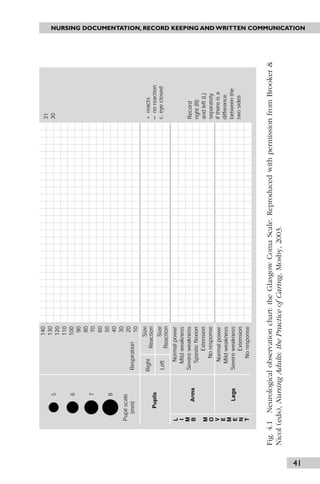
neurological observation charts, are used for recording vital signs
plus other specific observations, which include the Glasgow
Coma Scale score for level of consciousness, pupil size and reac-
tion to light, and limb movement (Fig. 4.1).
Fluid balance chart
This is often called a ‘fluid intake and output chart’ or sometimes
just ‘fluid chart’. It is used to record all fluid intake and fluid out-
put over a 24-hour period. The amounts may be totalled and the
balance calculated at 24.00 hours (midnight), or at 06.00 or
08.00 hours. Sometimes the amounts are totalled twice in every
24 hours (i.e. every 12 hours). Fluid intake includes oral, naso-
gastric, via a gastrostomy feeding tube, and infusions given intra-
venously, subcutaneously and rectally. Fluid output from urine,
vomit, aspirate from a nasogastric tube, diarrhoea, fluid from a
stoma or wound drain are all recorded (Fig. 4.2).
NURSING DOCUMENTATION, RECORD KEEPING AND WRITTEN COMMUNICATION
39
C3996_04.qxd 26/02/2004 13:53 Page 39
PARKINSON AND BROOKER: EVERYDAY ENGLISH FOR INTERNATIONAL NURSES
40


Eyes
open
Best
verbal
response
Best
motor
response
Spontaneously
To
speech
To
pain
None
Orientated
Confused
Inappropriate
words
Incomprehensible
sounds
None
Obey
commands
Localise
pain
Flexion
to
pain
Extension
pain
None
1
2
3
4
Blood
pressure
and
pulse
rate
240
230
220
210
200
190
180
170
160
150
40
39
38
37
36
35
34
33
32
Temperature
°
C
Usually
record
the
best
arm
response
Endotracheal
tube
or
tracheostomy
=
T
Eyes
closed
by
swelling
=
C
NAME:
HOSP.
No.:
AGE:
DATE:
TIME:
CONSULTANT:
C3996_04.qxd 26/02/2004 13:53 Page 40
NURSING DOCUMENTATION, RECORD KEEPING AND WRITTEN COMMUNICATION
41
Pupils


!
L
I
M
B
M
O
V
E
M
E
N
T
#

$%
#
'

#
(
)(


*
–
,

-


%

%
%

record keeping doc.pdf

  • 1.
    Nursing documentation, record keepingand written communication INTRODUCTION Accurate record keeping and careful documentation is an essen- tial part of nursing practice. The Nursing and Midwifery Council (NMC 2002) state that ‘good record keeping helps to protect the welfare of patients and clients’ – which of course is a fundamental aim for nurses everywhere. You can look at the full Guidelines for records and record keeping by visiting the NMC website (www.nmc-uk.org). It is equally important that you can also communicate by letter and e-mail with other health and social care professionals, to ensure that they understand exactly what you mean. NURSING DOCUMENTATION AND RECORD KEEPING High quality record keeping will help you give skilled and safe care wherever you are working. Registered Nurses have a legal and professional duty of care (see Code of Professional Conduct, Ch. 1). According to the Nursing and Midwifery Council guide- lines (NMC 2002) your record keeping and documentation should demonstrate: — a full description of your assessment and the care planned and given — relevant information about your patient or client at any given time and what you did in response to their needs — that you have understood and fulfilled your duty of care, that you have taken all reasonable steps to care for the patient or 37 4 C3996_04.qxd 26/02/2004 13:53 Page 37
  • 2.
    client and thatany of your actions or things you failed to do have not compromised their safety in any way — ‘a record of any arrangement you have made for the continu- ing care of a patient or client’. Investigations into complaints about care will look at and use the patient/client documents and records as evidence, so high quality record keeping is essential. The hospital or care home, the NMC, a court of law or the Health Service Commissioner may investigate the complaint, so it makes sense to get the records right. A court of law will tend to assume that if care has not been recorded then it has not been given. Documentation You will see lots of different charts, forms and documentation. Every hospital, care home and community nursing service will have the same basic ones, but with small variations that work best locally. The common documents that you will use include some of the following. Nursing assessment sheet The nursing assessment sheet contains the patient’s biographical details (e.g. name and age), the reason for admission, the nursing needs and problems identified for the care plan, medication, allergies and medical history. Nursing care plan The documents of the care plan will have space for: — Patient/client needs and problems. — Sometimes, nursing diagnoses will be documented but these are not used as frequently as in North America. — Planning to set care priorities and goals. Goal-setting should follow the SMART system, i.e. the goal will be specific, meas- urable, achievable and realistic, and time-oriented. For exam- PARKINSON AND BROOKER: EVERYDAY ENGLISH FOR INTERNATIONAL NURSES 38 C3996_04.qxd 26/02/2004 13:53 Page 38
  • 3.
    ple, a SMARTgoal would be that ‘Mr Lee will be able to drink 1.5 L of fluid by 22.00 hours’. Some goals, such as reducing anxiety, are not easily measured and it is usual to ask patients to describe how they feel about a problem that was causing anxiety. — The care/nursing interventions needed to achieve the goals. — An evaluation of progress and the review date. This might include evaluation notes, continuation sheets and discharge plans. In some care areas you might record progress using a Kardex system along with the care plan. — Reassessing patient/client needs and changing the care plan as needed. Vital signs The basic chart is used to record temperature, pulse, respiration and possibly blood pressure. Sometimes the patient’s blood pres- sure is recorded on a separate chart. Basic charts may also have space to record urinalysis, weight, bowel action and the 24-hour totals for fluid intake and output. More complex charts, such as neurological observation charts, are used for recording vital signs plus other specific observations, which include the Glasgow Coma Scale score for level of consciousness, pupil size and reac- tion to light, and limb movement (Fig. 4.1). Fluid balance chart This is often called a ‘fluid intake and output chart’ or sometimes just ‘fluid chart’. It is used to record all fluid intake and fluid out- put over a 24-hour period. The amounts may be totalled and the balance calculated at 24.00 hours (midnight), or at 06.00 or 08.00 hours. Sometimes the amounts are totalled twice in every 24 hours (i.e. every 12 hours). Fluid intake includes oral, naso- gastric, via a gastrostomy feeding tube, and infusions given intra- venously, subcutaneously and rectally. Fluid output from urine, vomit, aspirate from a nasogastric tube, diarrhoea, fluid from a stoma or wound drain are all recorded (Fig. 4.2). NURSING DOCUMENTATION, RECORD KEEPING AND WRITTEN COMMUNICATION 39 C3996_04.qxd 26/02/2004 13:53 Page 39
  • 4.
    PARKINSON AND BROOKER:EVERYDAY ENGLISH FOR INTERNATIONAL NURSES 40 Eyes open Best verbal response Best motor response Spontaneously To speech To pain None Orientated Confused Inappropriate words Incomprehensible sounds None Obey commands Localise pain Flexion to pain Extension pain None 1 2 3 4 Blood pressure and pulse rate 240 230 220 210 200 190 180 170 160 150 40 39 38 37 36 35 34 33 32 Temperature ° C Usually record the best arm response Endotracheal tube or tracheostomy = T Eyes closed by swelling = C NAME: HOSP. No.: AGE: DATE: TIME: CONSULTANT:
  • 5.
  • 6.
    NURSING DOCUMENTATION, RECORDKEEPING AND WRITTEN COMMUNICATION 41
  • 7.
  • 8.
  • 9.
  • 10.
  • 11.
  • 12.
  • 13.
  • 14.