Recognizing
Prepositions
Presented by Meridith G. Benlot
Midterm Lesson No. 5
Hello, classmates!
I am your first reporter
Meridith
Group Leader
Asil
Researcher
Cesar
Summarizer
Meet the Group
Margarito
Resource Collector
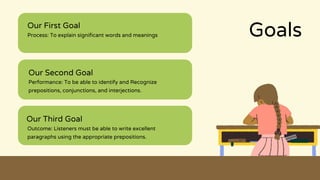
Goals
Our First Goal
Process: To explain significant words and meanings
Our Second Goal
Performance: To be able to identify and Recognize
prepositions, conjunctions, and interjections.
Our Third Goal
Outcome: Listeners must be able to write excellent
paragraphs using the appropriate prepositions.
● There are many thousands of different words in the English
language, but there are only eight different kinds of words.
● These eight kinds, which are called “parts of speech,” are the
noun, the pronoun, the adjective, the verb, the adverb, the
preposition, the conjunction, and the interjection.
● In this module, we will study these parts of speech from their
definitions, classes/kinds, functions in the sentence and their
significance
Introduction
espantojayr@gmail.com
Links nouns, pronoun, and phrases to the other words in a sentence.
It always precedes (pre-positioned) its object.
The word or phrase that the preposition introduces is called the object of
the preposition.
It usually indicates the: temporal, Spatial, logical relationship of its object
to the rest of the sentence as in the following examples: The laptop is on
the study table.
(“On” is the preposition and the “study table” is the object of the
preposition)
PREPOSITIONS
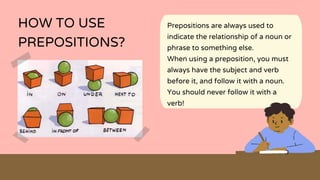
Prepositions are always used to
indicate the relationship of a noun or
phrase to something else.
When using a preposition, you must
always have the subject and verb
before it, and follow it with a noun.
You should never follow it with a
verb!
HOW TO USE
PREPOSITIONS?
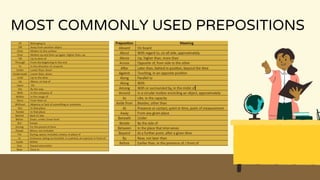
MOST COMMONLY USED PREPOSITIONS
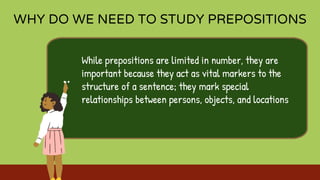
WHY DO WE NEED TO STUDY PREPOSITIONS?
While prepositions are limited in number, they are
important because they act as vital markers to the
structure of a sentence; they mark special
relationships between persons, objects, and locations
..

Recognizing Prepositions

  • 1.
    Recognizing Prepositions Presented by MeridithG. Benlot Midterm Lesson No. 5
  • 2.
    Hello, classmates! I amyour first reporter
  • 3.
  • 4.
    Goals Our First Goal Process:To explain significant words and meanings Our Second Goal Performance: To be able to identify and Recognize prepositions, conjunctions, and interjections. Our Third Goal Outcome: Listeners must be able to write excellent paragraphs using the appropriate prepositions.
  • 5.
    ● There aremany thousands of different words in the English language, but there are only eight different kinds of words. ● These eight kinds, which are called “parts of speech,” are the noun, the pronoun, the adjective, the verb, the adverb, the preposition, the conjunction, and the interjection. ● In this module, we will study these parts of speech from their definitions, classes/kinds, functions in the sentence and their significance Introduction espantojayr@gmail.com
  • 6.
    Links nouns, pronoun,and phrases to the other words in a sentence. It always precedes (pre-positioned) its object. The word or phrase that the preposition introduces is called the object of the preposition. It usually indicates the: temporal, Spatial, logical relationship of its object to the rest of the sentence as in the following examples: The laptop is on the study table. (“On” is the preposition and the “study table” is the object of the preposition) PREPOSITIONS
  • 7.
    Prepositions are alwaysused to indicate the relationship of a noun or phrase to something else. When using a preposition, you must always have the subject and verb before it, and follow it with a noun. You should never follow it with a verb! HOW TO USE PREPOSITIONS?
  • 8.
    MOST COMMONLY USEDPREPOSITIONS
  • 9.
    WHY DO WENEED TO STUDY PREPOSITIONS? While prepositions are limited in number, they are important because they act as vital markers to the structure of a sentence; they mark special relationships between persons, objects, and locations ..