Recognizing Culture &
Diversity in Occupational
Therapy Practice
Becky Jenkins, MS, OTR/L
It is the mark of the cultured man that he
is aware of the fact that equality is an
ethical and not a biological principle”
--------Ashley Montagu
What is culture to you?
Do you think about it?
Do others think about it?
“The nature of human nature is a
culturally constructed entity,
invisible to us, because we are
immersed in it.” ---Unknown
Culture by Definition
• Learned, shared experiences that provide
the individual and the group with effective
mechanisms for interacting with others
and the environment
• Examples?
– Values
– Attitudes
– Morals
– Customs
– Traditions
– Language
– Food
– Religion
– Socioeconomic status
– Sexual orientation
Let’s Look at Culture Terms
• Belief
– something held to be true or actual
• Values
– regarded as desirable, worthy, right,
ideal
• Morals
– conduct or character from the point of
view of right and wrong
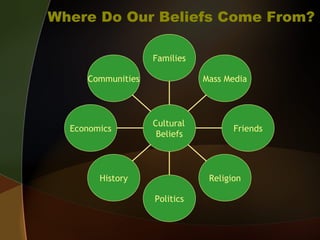
Where Do Our Beliefs Come From?
Communities
Economics
History
Politics
Religion
Friends
Mass Media
Families
Cultural
Beliefs
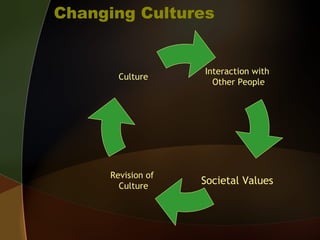
Changing Cultures
Interaction with
Other People
Societal Values
Revision of
Culture
Culture
Words
We Use When
Discussing Culture
Race
• One of the major subdivisions of man
• Regarded as having a common origin
and exhibiting a relatively constant
set of physical traits
• Is not the same as culture, historical
experience, or privilege
• Race can shape culture
• Great variation within and between
races
Ethnicity
“An ethnic group is a human
population whose members identify
with each other, usually on the basis
of a presumed common genealogy or
ancestry. Ethnic groups are also
usually united by common cultural,
behavioural, linguistic, or religious
practices. In this sense, an ethnic
group is also a cultural community”
----Wikipedia, November 27,
2006
• Myths
– unfounded or poorly founded beliefs
that are given uncritical acceptance by
members of a group
• Stereotypes
– mental pictures based on myths that
lead people to associate a characteristic
with particular groups of people
• Generalization
– to apply a concept broadly; avoids
details and specifics
• Are generalizations always negative?
• Are they all accurate?
• Xenophobia
– unreasonable fear or hatred of those
different from ourselves
Are these things learned or
inherent in our nature?
The Role of the OTA--Ethics
• OT Code of Ethics
– We are responsible for providing
services without regard to race, creed,
national origin, sex, age, handicap,
disease entity, social status, or religious
affiliation.
How Does Culture Affect our
Clients?
• Self esteem/self-worth
• Access to medical care, job choices,
leisure and activity resources
• Rights and opportunities/privileges
• Interactions with others
• Resources
• Health
• Discrimination
• Personal view of potential
The Role of the OTA
• Be self aware
• Look beyond knowledge base
• Collaborate with goal setting
• Individualize treatment
• Base assessments on the patient’s
culture, not yours
• Provide access to all services
• Improve equity, fairness, and
appropriateness of treatment
• Listen to client’s view of life
• Understand the social restraints
• Understand politics of healthcare
• Understand the reimbursement
system
• Expose yourself to different cultures

Recognizing culture & diversity in occupational therapy practice 2011

  • 1.
    Recognizing Culture & Diversityin Occupational Therapy Practice Becky Jenkins, MS, OTR/L
  • 2.
    It is themark of the cultured man that he is aware of the fact that equality is an ethical and not a biological principle” --------Ashley Montagu
  • 3.
    What is cultureto you? Do you think about it? Do others think about it? “The nature of human nature is a culturally constructed entity, invisible to us, because we are immersed in it.” ---Unknown
  • 4.
    Culture by Definition •Learned, shared experiences that provide the individual and the group with effective mechanisms for interacting with others and the environment • Examples? – Values – Attitudes – Morals – Customs – Traditions – Language – Food – Religion – Socioeconomic status – Sexual orientation
  • 5.
    Let’s Look atCulture Terms • Belief – something held to be true or actual • Values – regarded as desirable, worthy, right, ideal • Morals – conduct or character from the point of view of right and wrong
  • 6.
    Where Do OurBeliefs Come From? Communities Economics History Politics Religion Friends Mass Media Families Cultural Beliefs
  • 7.
    Changing Cultures Interaction with OtherPeople Societal Values Revision of Culture Culture
  • 8.
  • 9.
    Race • One ofthe major subdivisions of man • Regarded as having a common origin and exhibiting a relatively constant set of physical traits • Is not the same as culture, historical experience, or privilege • Race can shape culture • Great variation within and between races
  • 10.
    Ethnicity “An ethnic groupis a human population whose members identify with each other, usually on the basis of a presumed common genealogy or ancestry. Ethnic groups are also usually united by common cultural, behavioural, linguistic, or religious practices. In this sense, an ethnic group is also a cultural community” ----Wikipedia, November 27, 2006
  • 11.
    • Myths – unfoundedor poorly founded beliefs that are given uncritical acceptance by members of a group • Stereotypes – mental pictures based on myths that lead people to associate a characteristic with particular groups of people
  • 13.
    • Generalization – toapply a concept broadly; avoids details and specifics • Are generalizations always negative? • Are they all accurate? • Xenophobia – unreasonable fear or hatred of those different from ourselves
  • 15.
    Are these thingslearned or inherent in our nature?
  • 16.
    The Role ofthe OTA--Ethics • OT Code of Ethics – We are responsible for providing services without regard to race, creed, national origin, sex, age, handicap, disease entity, social status, or religious affiliation.
  • 17.
    How Does CultureAffect our Clients? • Self esteem/self-worth • Access to medical care, job choices, leisure and activity resources • Rights and opportunities/privileges • Interactions with others • Resources • Health • Discrimination • Personal view of potential
  • 18.
    The Role ofthe OTA • Be self aware • Look beyond knowledge base • Collaborate with goal setting • Individualize treatment • Base assessments on the patient’s culture, not yours • Provide access to all services • Improve equity, fairness, and appropriateness of treatment
  • 19.
    • Listen toclient’s view of life • Understand the social restraints • Understand politics of healthcare • Understand the reimbursement system • Expose yourself to different cultures

Editor's Notes

  • #4 Culture is invisible—taken for granted by those participating in it
  • #5 To belong to a culture is to become socialized Not the same thing as race or ethnicity
  • #7 Our cultural attitudes/behaviors/actions are shared socially—shared understanding of what certain things mean.
  • #10 Can shape culture because privilege and/or oppression based on this
  • #11 Can shape culture—not the same as race
  • #14 Read “Night”
  • #16 Once we hear something, we internalize it We more easily incorporate that information every time we hear a similar comment We inadvertently filter this information the same way every time