DUTIES OF A DIRECTOR OF A NEWLY
SET UP COMPANY
We outline the code of conduct for directors of private
limited companies following company formation.
A director of a new company registration has a wide
range of important duties after setting up a company
and as such it is important that any newly appointed
              director is aware of them.


 This presentation highlights the duties involved for
  new directors and also gives advice as to how to
       avoid being in breach of these duties.
GENERAL DUTIES


   Acting within their authority as directors

   Acting in a way which promotes the interest of the
    new company formation

   Exercising reasonable care, skill and diligence
CONSTITUTIONAL AND CONTRACTUAL
DUTIES
 Directors have a duty to act in accordance with any
   constitutional or contractual agreements.
 Examples of these include:
  Memorandum of Association

  Articles of Association

  Shareholder Agreements

  Employment Agreements

  Service Agreements

  Staff Handbooks

  Board Resolutions
DUTY TO EXERCISE INDEPENDENT JUDGMENT
  Broadly this means that directors cannot allow
  others to influence their decisions or to make
  decisions for them.
  A director will not breach this duty if they:
 act in accordance with an agreement entered into
  by the newly set up company which restricts the
  exercise of the directors’ discretion
 act in a way authorised by the companies’
  constitution
 rely on the advice or work of others in making their
  decisions
DUTY TO AVOID CONFLICTS OF INTEREST
  Directors have a duty to avoid conflicts of interest
   after they register a company.
  Where one may arise they will need to disclose this
   to non-conflicted directors and allow them to make
   the decision regarding the relevant transaction.
DUTY NOT TO ACCEPT BENEFITS FROM THIRD
PARTIES

  Directors must not accept benefits from third parties
  for being a director.


  However they will not be in breach of this duty if the
  acceptance of such benefit cannot reasonably be
  regarded as likely to give rise to a conflict of
  interest.
FIDUCIARY DUTIES

  Directors have a duty in law to act in good faith for
  the best interest of the company after it has taken
  part in the company registration process.

  This includes a duty to:
 Act properly

 Not make secret profits

 Avoid conflicts of interest.
MANAGEMENT DUTIES

               It is the duty of the directors to manage
                the company with care as soon as
                company formation has taken place.


               This generally means that all decisions
                and actions made after setting up a
                company should be taken that benefit the
                company.
COMPLIANCE DUTIES
 The directors are responsible for ensuring that
 compliance matters are dealt with both accurately
 and in a timely manner.

 This includes such things as:

  registering with the Information Commissioner
  taking out insurance

  completing the Companies House annual return

  maintaining the Company Register.
EMPLOYMENT DUTIES
   A director is responsible for the
    employment of his/her staff.


   This includes not only their
    contractual and statutory rights but
    also their general wellbeing and
    safety whilst at work.
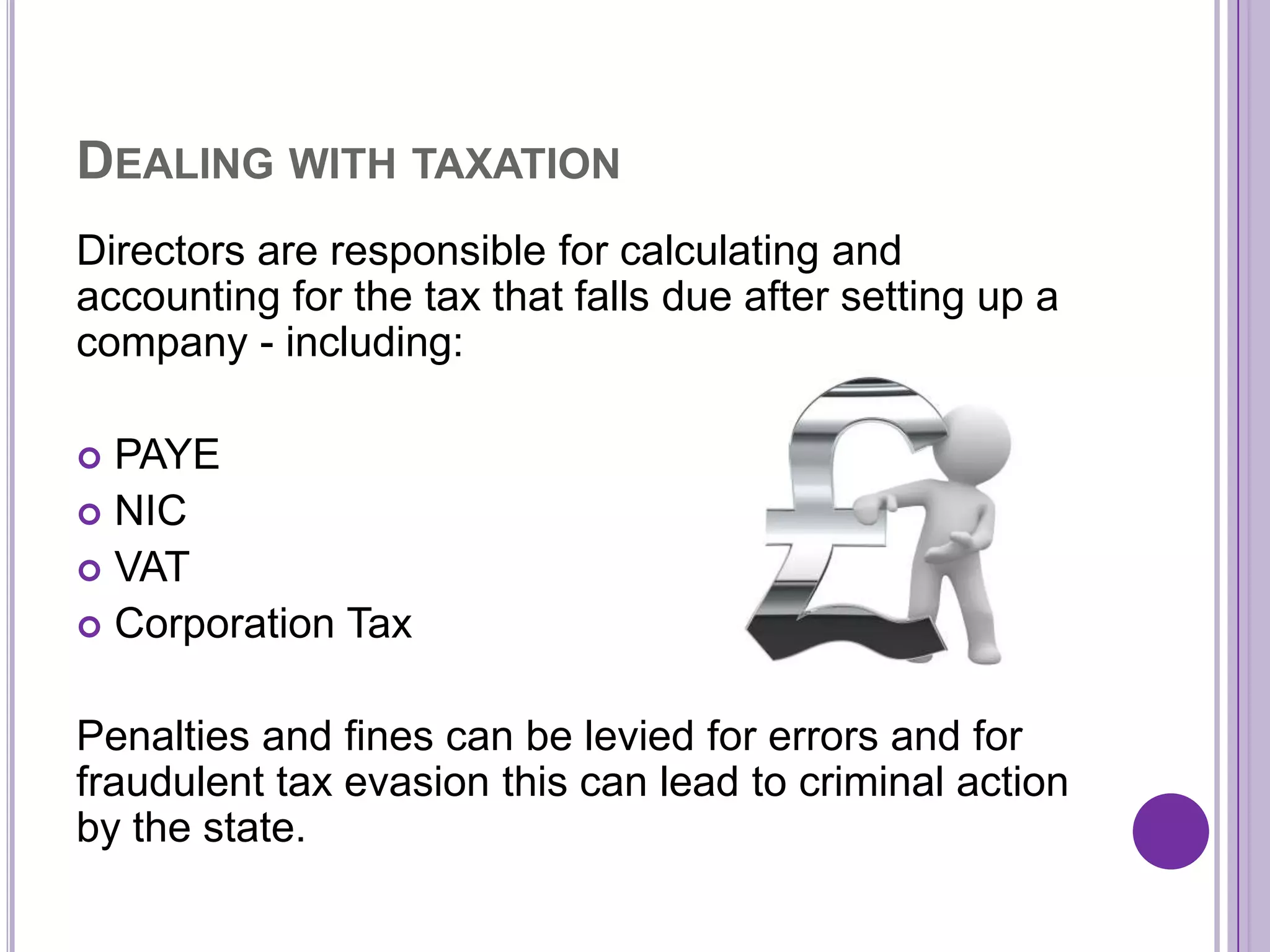
DEALING WITH TAXATION
Directors are responsible for calculating and
accounting for the tax that falls due after setting up a
company - including:

 PAYE
 NIC
 VAT
 Corporation Tax


Penalties and fines can be levied for errors and for
fraudulent tax evasion this can lead to criminal action
by the state.
INSOLVENCY
   The directors are responsible for ensuring that the
    company registration is trading whilst solvent.

    Once they know that the company is insolvent they
    can be committing a criminal offence.

   The director has a duty to minimise the potential
    losses of creditors if the company is in financial
    trouble otherwise the director could be liable to
    prosecution.
W: http://www.wisteriaformations.co.uk
@: formations@wisteria.co.uk
T: +44 (0)844 893 0808


  A BIT ABOUT WISTERIA FORMATIONS...
 UK Company Incorporation for £24.99.
 Easy 10-step application process online.
 Free consultation with business, tax and
 accounting experts to get your business off to
 the best start!

Duties of a director

  • 1.
    DUTIES OF ADIRECTOR OF A NEWLY SET UP COMPANY We outline the code of conduct for directors of private limited companies following company formation.
  • 2.
    A director ofa new company registration has a wide range of important duties after setting up a company and as such it is important that any newly appointed director is aware of them. This presentation highlights the duties involved for new directors and also gives advice as to how to avoid being in breach of these duties.
  • 3.
    GENERAL DUTIES  Acting within their authority as directors  Acting in a way which promotes the interest of the new company formation  Exercising reasonable care, skill and diligence
  • 4.
    CONSTITUTIONAL AND CONTRACTUAL DUTIES Directors have a duty to act in accordance with any constitutional or contractual agreements. Examples of these include:  Memorandum of Association  Articles of Association  Shareholder Agreements  Employment Agreements  Service Agreements  Staff Handbooks  Board Resolutions
  • 5.
    DUTY TO EXERCISEINDEPENDENT JUDGMENT Broadly this means that directors cannot allow others to influence their decisions or to make decisions for them. A director will not breach this duty if they:  act in accordance with an agreement entered into by the newly set up company which restricts the exercise of the directors’ discretion  act in a way authorised by the companies’ constitution  rely on the advice or work of others in making their decisions
  • 6.
    DUTY TO AVOIDCONFLICTS OF INTEREST  Directors have a duty to avoid conflicts of interest after they register a company.  Where one may arise they will need to disclose this to non-conflicted directors and allow them to make the decision regarding the relevant transaction.
  • 7.
    DUTY NOT TOACCEPT BENEFITS FROM THIRD PARTIES Directors must not accept benefits from third parties for being a director. However they will not be in breach of this duty if the acceptance of such benefit cannot reasonably be regarded as likely to give rise to a conflict of interest.
  • 8.
    FIDUCIARY DUTIES Directors have a duty in law to act in good faith for the best interest of the company after it has taken part in the company registration process. This includes a duty to:  Act properly  Not make secret profits  Avoid conflicts of interest.
  • 9.
    MANAGEMENT DUTIES  It is the duty of the directors to manage the company with care as soon as company formation has taken place.  This generally means that all decisions and actions made after setting up a company should be taken that benefit the company.
  • 10.
    COMPLIANCE DUTIES Thedirectors are responsible for ensuring that compliance matters are dealt with both accurately and in a timely manner. This includes such things as:  registering with the Information Commissioner  taking out insurance  completing the Companies House annual return  maintaining the Company Register.
  • 11.
    EMPLOYMENT DUTIES  A director is responsible for the employment of his/her staff.  This includes not only their contractual and statutory rights but also their general wellbeing and safety whilst at work.
  • 12.
    DEALING WITH TAXATION Directorsare responsible for calculating and accounting for the tax that falls due after setting up a company - including:  PAYE  NIC  VAT  Corporation Tax Penalties and fines can be levied for errors and for fraudulent tax evasion this can lead to criminal action by the state.
  • 13.
    INSOLVENCY  The directors are responsible for ensuring that the company registration is trading whilst solvent.  Once they know that the company is insolvent they can be committing a criminal offence.  The director has a duty to minimise the potential losses of creditors if the company is in financial trouble otherwise the director could be liable to prosecution.
  • 14.
    W: http://www.wisteriaformations.co.uk @: formations@wisteria.co.uk T:+44 (0)844 893 0808 A BIT ABOUT WISTERIA FORMATIONS... UK Company Incorporation for £24.99. Easy 10-step application process online. Free consultation with business, tax and accounting experts to get your business off to the best start!