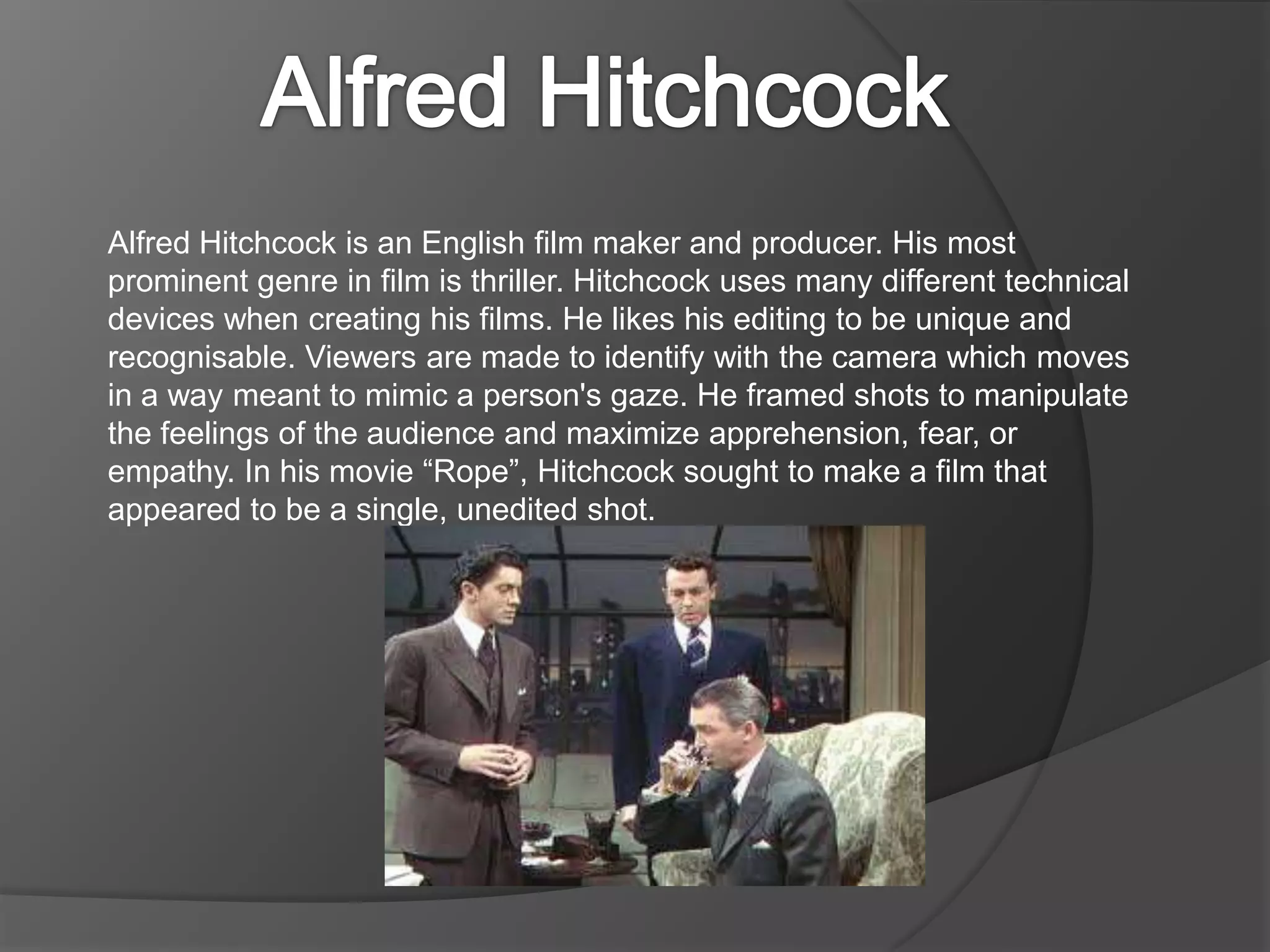
Alfred HitchcockAlfred Hitchcock is an English film maker and producer. His most prominent genre in film is thriller. Hitchcock uses many different technical devices when creating his films. He likes his editing to be unique and recognisable. Viewers are made to identify with the camera which moves in a way meant to mimic a person's gaze. He framed shots to manipulate the feelings of the audience and maximize apprehension, fear, or empathy. In his movie “Rope”, Hitchcock sought to make a film that appeared to be a single, unedited shot.
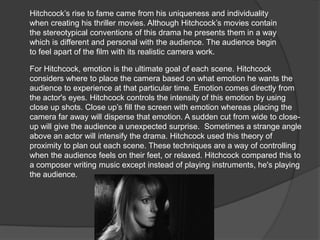
Hitchcock’s rise to fame came from his uniqueness and individuality when creating his thriller movies. Although Hitchcock’s movies contain the stereotypical conventions of this drama he presents them in a way which is different and personal with the audience. The audience begin to feel apart of the film with its realistic camera work.For Hitchcock, emotion is the ultimate goal of each scene. Hitchcock considers where to place the camera based on what emotion he wants the audience to experience at that particular time. Emotion comes directly from the actor's eyes. Hitchcock controls the intensity of this emotion by using close up shots. Close up’s fill the screen with emotion whereas placing the camera far away will disperse that emotion. A sudden cut from wide to close-up will give the audience a unexpected surprise.  Sometimes a strange angle above an actor will intensify the drama. Hitchcock used this theory of proximity to plan out each scene. These techniques are a way of controlling when the audience feels on their feet, or relaxed. Hitchcock compared this to a composer writing music except instead of playing instruments, he's playing the audience.
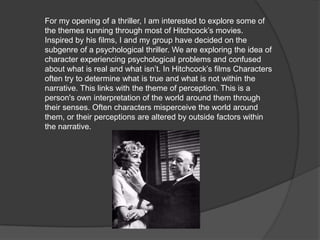
For my opening of a thriller, I am interested to explore some of the themes running through most of Hitchcock’s movies. Inspired by his films, I and my group have decided on the subgenre of a psychological thriller. We are exploring the idea of character experiencing psychological problems and confused about what is real and what isn’t. In Hitchcock’s films Characters often try to determine what is true and what is not within the narrative. This links with the theme of perception. This is a person's own interpretation of the world around them through their senses. Often characters misperceive the world around them, or their perceptions are altered by outside factors within the narrative.

Alfred hitchcock

  • 1.
    Alfred HitchcockAlfred Hitchcockis an English film maker and producer. His most prominent genre in film is thriller. Hitchcock uses many different technical devices when creating his films. He likes his editing to be unique and recognisable. Viewers are made to identify with the camera which moves in a way meant to mimic a person's gaze. He framed shots to manipulate the feelings of the audience and maximize apprehension, fear, or empathy. In his movie “Rope”, Hitchcock sought to make a film that appeared to be a single, unedited shot.
  • 2.
    Hitchcock’s rise tofame came from his uniqueness and individuality when creating his thriller movies. Although Hitchcock’s movies contain the stereotypical conventions of this drama he presents them in a way which is different and personal with the audience. The audience begin to feel apart of the film with its realistic camera work.For Hitchcock, emotion is the ultimate goal of each scene. Hitchcock considers where to place the camera based on what emotion he wants the audience to experience at that particular time. Emotion comes directly from the actor's eyes. Hitchcock controls the intensity of this emotion by using close up shots. Close up’s fill the screen with emotion whereas placing the camera far away will disperse that emotion. A sudden cut from wide to close-up will give the audience a unexpected surprise.  Sometimes a strange angle above an actor will intensify the drama. Hitchcock used this theory of proximity to plan out each scene. These techniques are a way of controlling when the audience feels on their feet, or relaxed. Hitchcock compared this to a composer writing music except instead of playing instruments, he's playing the audience.
  • 3.
    For my openingof a thriller, I am interested to explore some of the themes running through most of Hitchcock’s movies. Inspired by his films, I and my group have decided on the subgenre of a psychological thriller. We are exploring the idea of character experiencing psychological problems and confused about what is real and what isn’t. In Hitchcock’s films Characters often try to determine what is true and what is not within the narrative. This links with the theme of perception. This is a person's own interpretation of the world around them through their senses. Often characters misperceive the world around them, or their perceptions are altered by outside factors within the narrative.