The Real-Time Sign Language
Gesture Recognition
A B S T R AC T
Real-time sign language gesture recognition is a vital area of research
with significant implications for enhancing communication accessibility
for the hearing-impaired community. This abstract explores recent
advancements and methodologies in the development of real-time sign
language recognition systems, focusing on sensor-based approaches,
deep learning algorithms, and their integration into wearable devices.
Key challenges such as variability in signing styles, occlusions, and real-
time processing constraints are addressed, along with potential
applications in assistive technology, human-computer interaction, and
educational tools. Finally, future directions and opportunities for
improving the accuracy, efficiency, and usability of real-time sign
language gesture recognition systems are discussed.
S.N
O
Paper Name Author Name
Published
Date
1
Hear Sign Language: A Real-Time End-to-End Sign
Language Recognition System
Zhibo Wang, Tengda Zhao,Jinxin
Ma,Hongkai Chen,Kaixin Liu,Huajie
Shao,Qian Wang,Ju Ren
2022
2
Development of an End-to-End Deep Learning
framework for Sign Language
Recognition,Translation,and Video Generation
B.Natarajan,E.Rajalakshmi,R.Elakki
ya,Ketan Kotecha,Ajith
Abraham,Lubna Abdelkareim
Gabralla,V.Subramaniyaswamy
2022
3
Real-Time Gesture Recognition in the view of
Repeating characteristics of sign Languages
Minhyuk Lee,Joohbum Bae 2022
4
An Ultra-Efficient Approach for High-Resolution
MIMO Rader Imaging of Human Hand Poses
Johanna Brauing,Vanessa
Wirth,Christoph Kammel,Christian
Schubler,Mare
Stammminger,Martin Vossiek
2023
5
Design and Implementation of Gesture recognition
System Based on Flex Sensors
Deli Feng,Cheng Zhou,Jipeng
Huang,Gangyin Luo,XinWu
2023
P R O B L E M S TAT E M E N T
The communication barrier between the deaf or hard of hearing community
and the general population is a significant challenge. While sign language
serves as a primary mode of communication for many individuals within the
deaf community, there remains a gap in real-time recognition and
interpretation of sign language gestures. Current methods often lack
efficiency, accuracy, and real-time processing capabilities, hindering effective
communication between sign language users and non-signers.
Real-time sign language gesture recognition technology enables the
instantaneous translation of sign language into spoken or written language. It
plays a significant role in bridging communication barriers for the deaf and
hard of hearing, fostering inclusivity and accessibility in everyday interactions.
1. Develop a real-time sign language gesture recognition
system capable of accurately interpreting a wide range
of sign language gestures.
2.Minimize latency to ensure seamless communication
between signers and non-signers.
3.Enhance system adaptability to accommodate
variations in sign language gestures among individuals.
4.Integrate the system with user-friendly interfaces for
widespread accessibility.
5.Validate the system's effectiveness through extensive
testing and evaluation with diverse sign language
datasets.
Objectives
Module
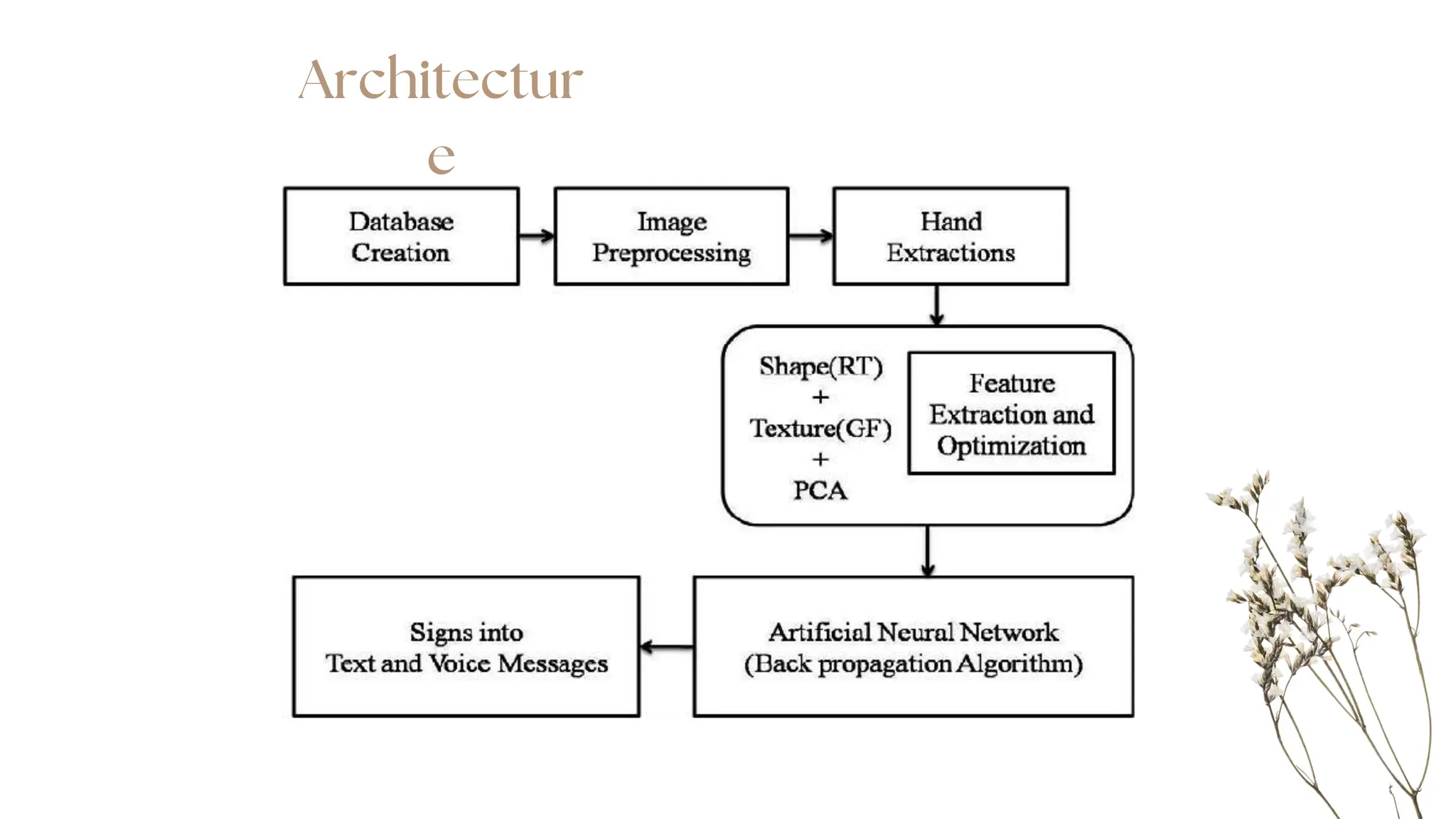
1. Data Preprocessing
2.Feature Extraction
3.Machine Learning Model Training
4.Real-time Gesture Recognition
5.Interface Development
6.Evaluation and Testing
• Software: Python programming language, TensorFlow or
PyTorch for machine learning, OpenCV for image
processing, and GUI frameworks for interface
development.
• Hardware: Standard computing hardware such as
CPUs/GPUs, depth sensors (e.g., Kinect), and cameras.
S O F T WA R E & H A R D WA R E S P E C I F I C AT I O N
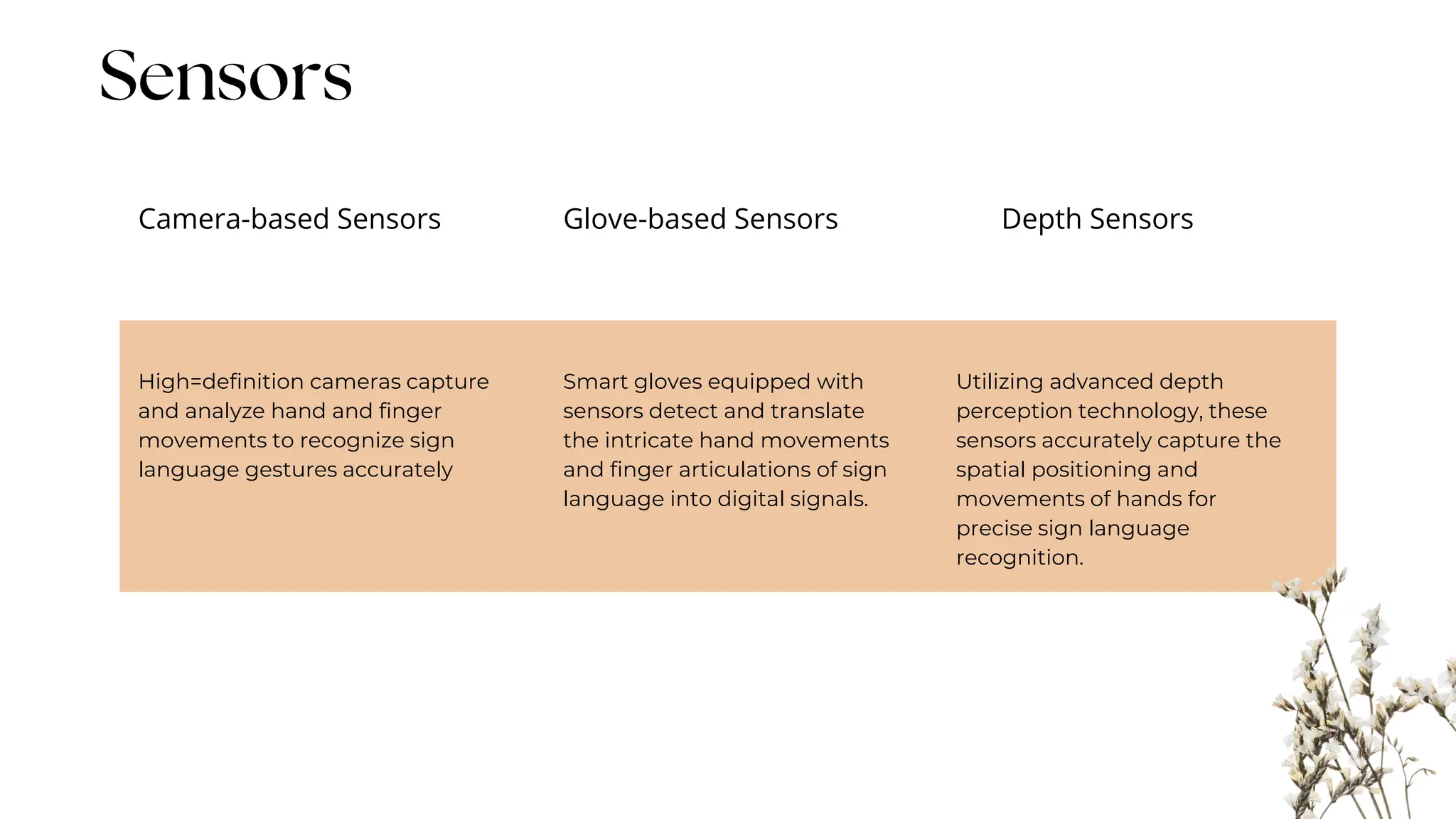
Camera-based Sensors Glove-based Sensors Depth Sensors
Smart gloves equipped with
sensors detect and translate
the intricate hand movements
and finger articulations of sign
language into digital signals.
Utilizing advanced depth
perception technology, these
sensors accurately capture the
spatial positioning and
movements of hands for
precise sign language
recognition.
High=definition cameras capture
and analyze hand and finger
movements to recognize sign
language gestures accurately
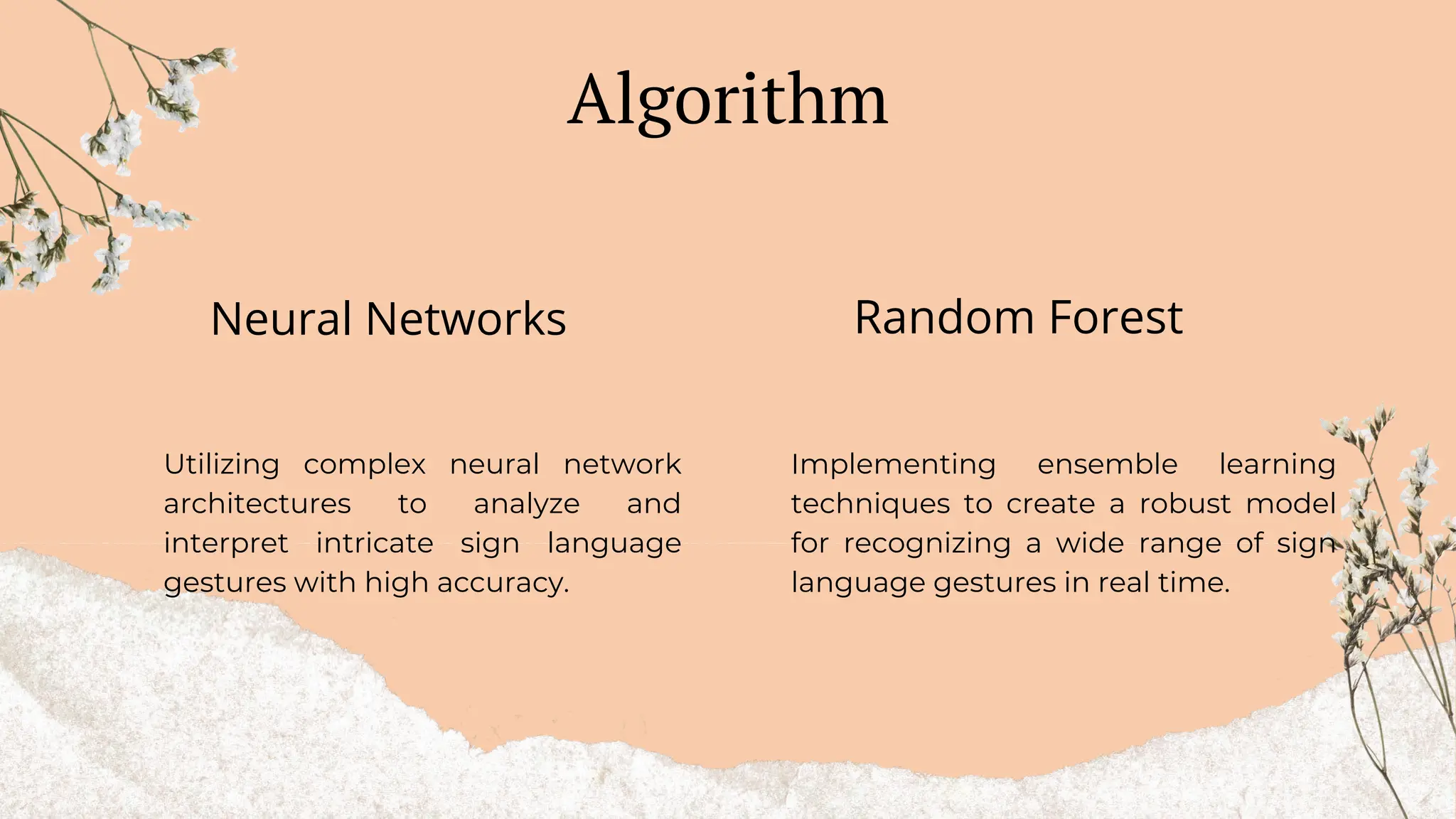
Neural Networks Random Forest
Algorithm
Utilizing complex neural network
architectures to analyze and
interpret intricate sign language
gestures with high accuracy.
Implementing ensemble learning
techniques to create a robust model
for recognizing a wide range of sign
language gestures in real time.
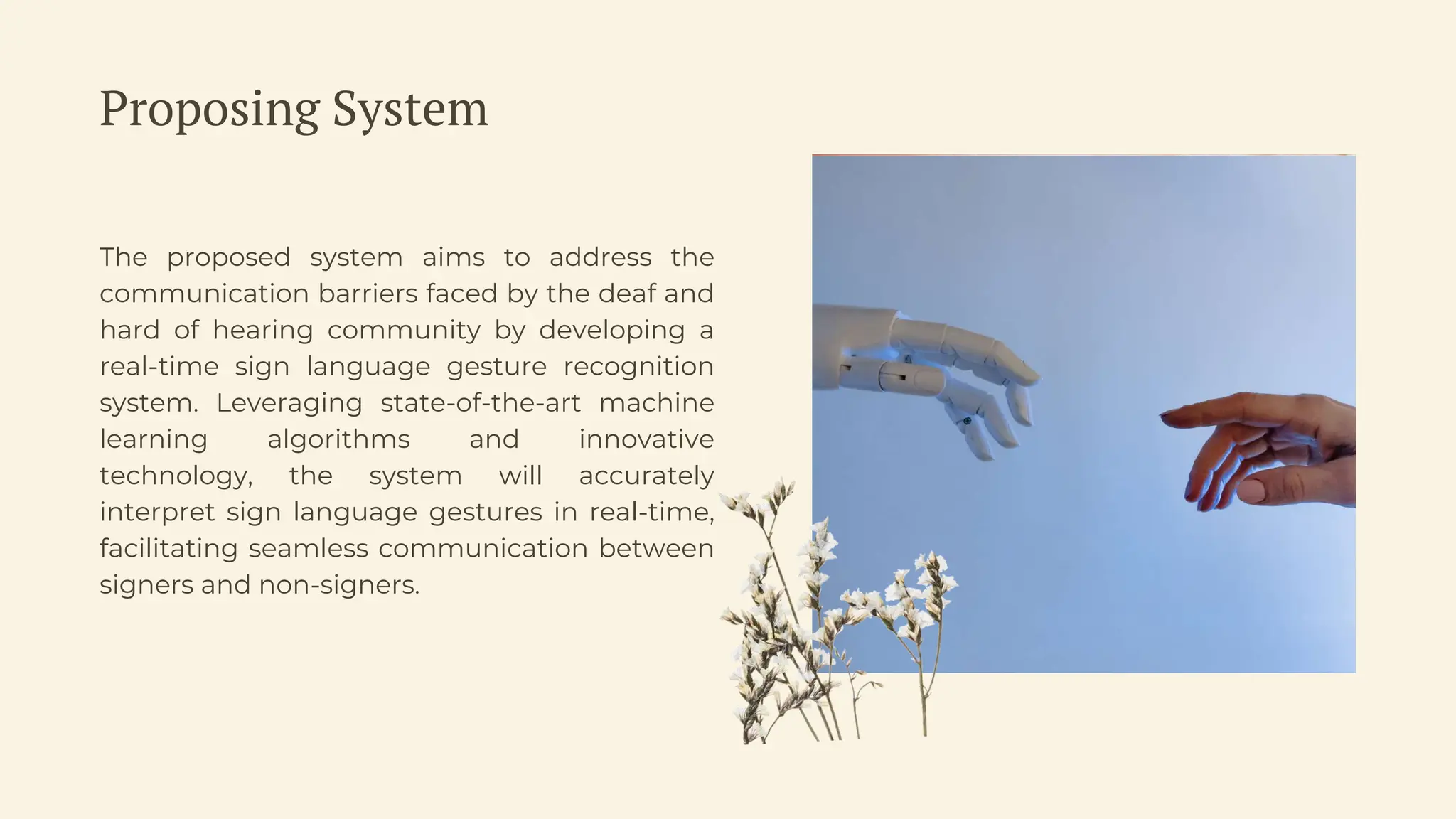
The proposed system aims to address the
communication barriers faced by the deaf and
hard of hearing community by developing a
real-time sign language gesture recognition
system. Leveraging state-of-the-art machine
learning algorithms and innovative
technology, the system will accurately
interpret sign language gestures in real-time,
facilitating seamless communication between
signers and non-signers.
Proposing System
Existing System
Existing systems often suffer from limitations in accuracy, real-time
processing, adaptability, and accessibility. While some systems utilize
traditional machine learning techniques, others leverage deep
learning approaches for improved performance. However, there
remains a need for more robust and efficient systems capable of
addressing the diverse challenges associated with real-time sign
language gesture recognition.
A P P L I C AT I O N
1.Education
Enabling seamless communication between educators and
students in the deaf and hard of hearing community.
2.Healthcare
Facilitating clear and effective communication between healthcare
professionals and patients who use sign language.
3.Public Services
Improving accessibility to public services and enhancing
interactions in government and public sectors.
Future Directions and Challenges
Enhanced User Experience
Overcoming Cultural and Linguistic Variances
Advancements in Gesture Recognition
Exploring cutting-edge technologies and techniques to enhance the accuracy and
speed of sign language recognition.
Developing user-friendly interfaces and systems that cater to the diverse needs of
the deaf and hard of hearing community.
Addressing the intricacies of diverse sign languages and regional variations to
ensure comprehensive recognition capabilities.
Real time Sign language gesture recognition

Real time Sign language gesture recognition

  • 1.
    The Real-Time SignLanguage Gesture Recognition
  • 2.
    A B ST R AC T Real-time sign language gesture recognition is a vital area of research with significant implications for enhancing communication accessibility for the hearing-impaired community. This abstract explores recent advancements and methodologies in the development of real-time sign language recognition systems, focusing on sensor-based approaches, deep learning algorithms, and their integration into wearable devices. Key challenges such as variability in signing styles, occlusions, and real- time processing constraints are addressed, along with potential applications in assistive technology, human-computer interaction, and educational tools. Finally, future directions and opportunities for improving the accuracy, efficiency, and usability of real-time sign language gesture recognition systems are discussed.
  • 3.
    S.N O Paper Name AuthorName Published Date 1 Hear Sign Language: A Real-Time End-to-End Sign Language Recognition System Zhibo Wang, Tengda Zhao,Jinxin Ma,Hongkai Chen,Kaixin Liu,Huajie Shao,Qian Wang,Ju Ren 2022 2 Development of an End-to-End Deep Learning framework for Sign Language Recognition,Translation,and Video Generation B.Natarajan,E.Rajalakshmi,R.Elakki ya,Ketan Kotecha,Ajith Abraham,Lubna Abdelkareim Gabralla,V.Subramaniyaswamy 2022 3 Real-Time Gesture Recognition in the view of Repeating characteristics of sign Languages Minhyuk Lee,Joohbum Bae 2022 4 An Ultra-Efficient Approach for High-Resolution MIMO Rader Imaging of Human Hand Poses Johanna Brauing,Vanessa Wirth,Christoph Kammel,Christian Schubler,Mare Stammminger,Martin Vossiek 2023 5 Design and Implementation of Gesture recognition System Based on Flex Sensors Deli Feng,Cheng Zhou,Jipeng Huang,Gangyin Luo,XinWu 2023
  • 4.
    P R OB L E M S TAT E M E N T The communication barrier between the deaf or hard of hearing community and the general population is a significant challenge. While sign language serves as a primary mode of communication for many individuals within the deaf community, there remains a gap in real-time recognition and interpretation of sign language gestures. Current methods often lack efficiency, accuracy, and real-time processing capabilities, hindering effective communication between sign language users and non-signers. Real-time sign language gesture recognition technology enables the instantaneous translation of sign language into spoken or written language. It plays a significant role in bridging communication barriers for the deaf and hard of hearing, fostering inclusivity and accessibility in everyday interactions.
  • 5.
    1. Develop areal-time sign language gesture recognition system capable of accurately interpreting a wide range of sign language gestures. 2.Minimize latency to ensure seamless communication between signers and non-signers. 3.Enhance system adaptability to accommodate variations in sign language gestures among individuals. 4.Integrate the system with user-friendly interfaces for widespread accessibility. 5.Validate the system's effectiveness through extensive testing and evaluation with diverse sign language datasets. Objectives
  • 6.
    Module 1. Data Preprocessing 2.FeatureExtraction 3.Machine Learning Model Training 4.Real-time Gesture Recognition 5.Interface Development 6.Evaluation and Testing
  • 8.
    • Software: Pythonprogramming language, TensorFlow or PyTorch for machine learning, OpenCV for image processing, and GUI frameworks for interface development. • Hardware: Standard computing hardware such as CPUs/GPUs, depth sensors (e.g., Kinect), and cameras. S O F T WA R E & H A R D WA R E S P E C I F I C AT I O N
  • 9.
    Camera-based Sensors Glove-basedSensors Depth Sensors Smart gloves equipped with sensors detect and translate the intricate hand movements and finger articulations of sign language into digital signals. Utilizing advanced depth perception technology, these sensors accurately capture the spatial positioning and movements of hands for precise sign language recognition. High=definition cameras capture and analyze hand and finger movements to recognize sign language gestures accurately
  • 10.
    Neural Networks RandomForest Algorithm Utilizing complex neural network architectures to analyze and interpret intricate sign language gestures with high accuracy. Implementing ensemble learning techniques to create a robust model for recognizing a wide range of sign language gestures in real time.
  • 11.
    The proposed systemaims to address the communication barriers faced by the deaf and hard of hearing community by developing a real-time sign language gesture recognition system. Leveraging state-of-the-art machine learning algorithms and innovative technology, the system will accurately interpret sign language gestures in real-time, facilitating seamless communication between signers and non-signers. Proposing System
  • 12.
    Existing System Existing systemsoften suffer from limitations in accuracy, real-time processing, adaptability, and accessibility. While some systems utilize traditional machine learning techniques, others leverage deep learning approaches for improved performance. However, there remains a need for more robust and efficient systems capable of addressing the diverse challenges associated with real-time sign language gesture recognition.
  • 13.
    A P PL I C AT I O N 1.Education Enabling seamless communication between educators and students in the deaf and hard of hearing community. 2.Healthcare Facilitating clear and effective communication between healthcare professionals and patients who use sign language. 3.Public Services Improving accessibility to public services and enhancing interactions in government and public sectors.
  • 14.
    Future Directions andChallenges Enhanced User Experience Overcoming Cultural and Linguistic Variances Advancements in Gesture Recognition Exploring cutting-edge technologies and techniques to enhance the accuracy and speed of sign language recognition. Developing user-friendly interfaces and systems that cater to the diverse needs of the deaf and hard of hearing community. Addressing the intricacies of diverse sign languages and regional variations to ensure comprehensive recognition capabilities.