NEXT GEN
EMPLOYABILITY
PROGRAM
CREATING A
FUTURE-READY
WORKFORCE
Student Name :Rahul Boddula
Student ID :STU63e5e06f035a61676009583
College Name :Balaji Institute of Technology and Science
CAPSTONE PROJECT SHOWCASE
Real Time Chat Application Using Django
Abstract | Problem Statement | Project Overview | Proposed Solution | Technology Used |
Modelling & Results | Conclusion | Q&A
Abstract
• The Real-Time Chat Application is a web-based communication
platform developed using the Django framework.This project
aims to provide users with a seamless and interactive chatting
experience by leveraging Django Channels for WebSocket
support.The application incorporates modern web technologies
to enable real-time messaging,ensuring instant communication
among users.
Reference link
Click here
Problem Statement
• In today's fast-paced digital landscape, efficient and real-time communication is vital for individuals and
businesses. While there are numerous chat applications available, there is a need for a customizable and
secure real-time chat platform tailored for specific use cases. The existing solutions often lack flexibility,
scalability, or robust integration with Django, a popular web framework for Python. To address these
shortcomings, our project aims to develop a Real-Time Chat Application using Django that overcomes
current limitations and provides a comprehensive solution for real-time communication needs.
Reference link
Click here
Project Overview
• In response to the growing demand for efficient and customizable real-time
communication solutions, this project proposes the development of a Real-Time
Chat Application using the Django web framework.
Objectives:
1.Django Integration: Seamlessly integrate the chat application with the Django
framework, allowing developers to leverage Django's features for building robust and
maintainable web applications.
2.Real-Time Communication: Implement WebSocket support to facilitate real-time
communication, ensuring instant message delivery and an interactive user experience.
3.Scalability: Design the application architecture to handle scalability efficiently,
allowing for a growing user base without compromising performance.
4.Security: Prioritize security measures, including end-to-end encryption, secure user
authentication, and protection against common web vulnerabilities.
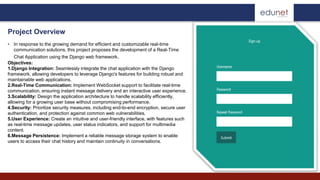
5.User Experience: Create an intuitive and user-friendly interface, with features such
as real-time message updates, user status indicators, and support for multimedia
content.
6.Message Persistence: Implement a reliable message storage system to enable
users to access their chat history and maintain continuity in conversations.
Reference link
Click here
Technology Used
->Django and Django Channels for backend development.
->HTML, CSS, and JavaScript for frontend development.
->WebSocket for real-time communication.
->PostgreSQL for data storage.
This Real-Time Chat Application serves as a demonstration
of how Django, coupled with WebSocket support, can be
employed to create a feature-rich, scalable, and secure
communication platform.
Reference link
Click here
Modelling & Results
a. Database Schema:
The application's data model includes entities such as User, ChatRoom, and
Message. Users are associated with ChatRooms, where messages are
exchanged. The database schema is designed to support message persistence
and user relationships.
b.WebSocket Communication
Django Channels is utilized for WebSocket support. Channels handle
asynchronous communication between the server and clients, enabling real-time
updates. The WebSocket consumer manages connections and broadcasts
messages to the appropriate chat rooms.
c. User Authentication:
Secure user authentication ensures that only authorized users can access the chat
application. This is achieved through Django's built-in authentication system, and
users must log in to participate in chat rooms.
d. User Interface:
The user interface is designed for ease of use, featuring real-time message
updates, user status indicators, and multimedia support. A responsive design
ensures a consistent and pleasant experience across various devices.
Reference link
Click here
Conclusion
• The Real-Time Chat Application using
Django aims to fill the gap in the market by
providing a versatile and Django-integrated
solution for real-time communication. By
addressing key challenges and
emphasizing security, scalability, and user
experience, the project aims to deliver a
robust and customizable chat platform that
aligns with the best practices of Django web
development.
Reference link
Click here
Thank You!

REAL TIME CHAT APPLICATION USING DJANGO.pptx

  • 1.
  • 2.
    Student Name :RahulBoddula Student ID :STU63e5e06f035a61676009583 College Name :Balaji Institute of Technology and Science
  • 3.
    CAPSTONE PROJECT SHOWCASE RealTime Chat Application Using Django Abstract | Problem Statement | Project Overview | Proposed Solution | Technology Used | Modelling & Results | Conclusion | Q&A
  • 4.
    Abstract • The Real-TimeChat Application is a web-based communication platform developed using the Django framework.This project aims to provide users with a seamless and interactive chatting experience by leveraging Django Channels for WebSocket support.The application incorporates modern web technologies to enable real-time messaging,ensuring instant communication among users. Reference link Click here
  • 5.
    Problem Statement • Intoday's fast-paced digital landscape, efficient and real-time communication is vital for individuals and businesses. While there are numerous chat applications available, there is a need for a customizable and secure real-time chat platform tailored for specific use cases. The existing solutions often lack flexibility, scalability, or robust integration with Django, a popular web framework for Python. To address these shortcomings, our project aims to develop a Real-Time Chat Application using Django that overcomes current limitations and provides a comprehensive solution for real-time communication needs. Reference link Click here
  • 6.
    Project Overview • Inresponse to the growing demand for efficient and customizable real-time communication solutions, this project proposes the development of a Real-Time Chat Application using the Django web framework. Objectives: 1.Django Integration: Seamlessly integrate the chat application with the Django framework, allowing developers to leverage Django's features for building robust and maintainable web applications. 2.Real-Time Communication: Implement WebSocket support to facilitate real-time communication, ensuring instant message delivery and an interactive user experience. 3.Scalability: Design the application architecture to handle scalability efficiently, allowing for a growing user base without compromising performance. 4.Security: Prioritize security measures, including end-to-end encryption, secure user authentication, and protection against common web vulnerabilities. 5.User Experience: Create an intuitive and user-friendly interface, with features such as real-time message updates, user status indicators, and support for multimedia content. 6.Message Persistence: Implement a reliable message storage system to enable users to access their chat history and maintain continuity in conversations. Reference link Click here
  • 7.
    Technology Used ->Django andDjango Channels for backend development. ->HTML, CSS, and JavaScript for frontend development. ->WebSocket for real-time communication. ->PostgreSQL for data storage. This Real-Time Chat Application serves as a demonstration of how Django, coupled with WebSocket support, can be employed to create a feature-rich, scalable, and secure communication platform. Reference link Click here
  • 8.
    Modelling & Results a.Database Schema: The application's data model includes entities such as User, ChatRoom, and Message. Users are associated with ChatRooms, where messages are exchanged. The database schema is designed to support message persistence and user relationships. b.WebSocket Communication Django Channels is utilized for WebSocket support. Channels handle asynchronous communication between the server and clients, enabling real-time updates. The WebSocket consumer manages connections and broadcasts messages to the appropriate chat rooms. c. User Authentication: Secure user authentication ensures that only authorized users can access the chat application. This is achieved through Django's built-in authentication system, and users must log in to participate in chat rooms. d. User Interface: The user interface is designed for ease of use, featuring real-time message updates, user status indicators, and multimedia support. A responsive design ensures a consistent and pleasant experience across various devices. Reference link Click here
  • 9.
    Conclusion • The Real-TimeChat Application using Django aims to fill the gap in the market by providing a versatile and Django-integrated solution for real-time communication. By addressing key challenges and emphasizing security, scalability, and user experience, the project aims to deliver a robust and customizable chat platform that aligns with the best practices of Django web development. Reference link Click here
  • 10.