The value of “Real Research”Glen GilchristSTL Science, Newport High School
Research...“The very purpose of research is to do something no one has done before”Oliver Johnson – Bristol University to PhD conferenceSelf evident – but not what we actually do with learners in the class room
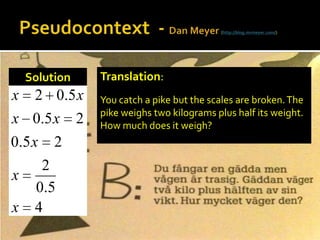
Pseudocontext  - Dan Meyer (http://blog.mrmeyer.com/)Translation:You catch a pike but the scales are broken. The pike weighs two kilograms plus half its weight. How much does it weigh?Solution
Pseudocontextcontext that is flatly untrue or implausible: “John and Ceri are discussing their experiment.  John thinks that he has made it a fair test by repeating his results, Ceri thinks he is wrong. Who is right and why?	Imagine you are describing a CAT to an alien......context that is irrelevant: Bill investigates the effect of the enzyme catalase.He uses the enzyme to break down hydrogen peroxide into oxygen and water.He measures the rate of the reaction by timing how long it takes to collect 10 cm3 of oxygen.He repeats the reaction at different pH values.The table shows his results.All 5 marks are to do with the table ONLY
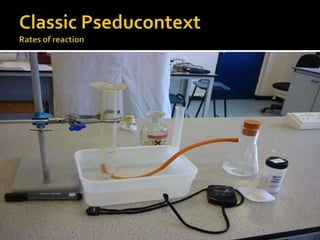
Classic PseducontextRates of reaction
Classic PseudocontextRates of reactionReaction of marble chips and hydrochloric acidLovely experiment, lots of scientific principalsSurface area, concentration, temperature, skills100% PseduocontextWhen will a student ever come across this in the real world?  If they really want to know the answer, Google or Wikipedia will provide it
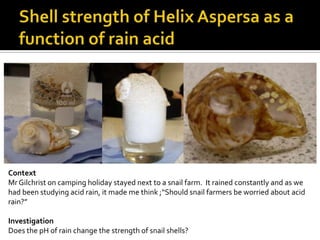
Shell strength of Helix Aspersa as a function of rain acidContextMr Gilchrist on camping holiday stayed next to a snail farm.  It rained constantly and as we had been studying acid rain, it made me think ;“Should snail farmers be worried about acid rain?”InvestigationDoes the pH of rain change the strength of snail shells?
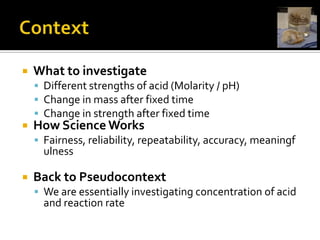
ContextBackground researchSnail shells made from calcium carbonate in the form of aragonite or calcite, bound together with a protein outer layer to reduce solubility  (Google, Wikipedia)What research has already been done?Affects of minerals in soil on strength, geographical variation and trends over time.  No one seems to have investigated acid rain on shell strength. (Google, University Library) Would anyone be interested?Class wrote to snail farmers and got a positive response.ContextWhat to investigateDifferent strengths of acid (Molarity / pH)Change in mass after fixed timeChange in strength after fixed timeHow Science WorksFairness, reliability, repeatability, accuracy, meaningfulness Back to PseudocontextWe are essentially investigating concentration of acid and reaction rate
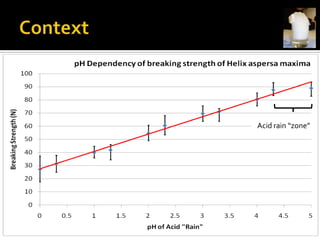
ContextAcid rain “zone”
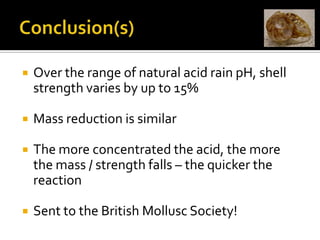
Conclusion(s)Over the range of natural acid rain pH, shell strength varies by up to 15%Mass reduction is similarThe more concentrated the acid, the more the mass / strength falls – the quicker the reactionSent to the British Mollusc Society!
Conclusions (Pedagogy)Abandon “pseudocontext”Students can see through itLet students really research somethingSet realistic problemsLearn something new
The value of “Real Research”Glen GilchristSTL Science, Newport High School
Real Research in School

Real Research in School

  • 1.
    The value of“Real Research”Glen GilchristSTL Science, Newport High School
  • 2.
    Research...“The very purposeof research is to do something no one has done before”Oliver Johnson – Bristol University to PhD conferenceSelf evident – but not what we actually do with learners in the class room
  • 3.
    Pseudocontext -Dan Meyer (http://blog.mrmeyer.com/)Translation:You catch a pike but the scales are broken. The pike weighs two kilograms plus half its weight. How much does it weigh?Solution
  • 4.
    Pseudocontextcontext that isflatly untrue or implausible: “John and Ceri are discussing their experiment. John thinks that he has made it a fair test by repeating his results, Ceri thinks he is wrong. Who is right and why? Imagine you are describing a CAT to an alien......context that is irrelevant: Bill investigates the effect of the enzyme catalase.He uses the enzyme to break down hydrogen peroxide into oxygen and water.He measures the rate of the reaction by timing how long it takes to collect 10 cm3 of oxygen.He repeats the reaction at different pH values.The table shows his results.All 5 marks are to do with the table ONLY
  • 5.
  • 6.
    Classic PseudocontextRates ofreactionReaction of marble chips and hydrochloric acidLovely experiment, lots of scientific principalsSurface area, concentration, temperature, skills100% PseduocontextWhen will a student ever come across this in the real world? If they really want to know the answer, Google or Wikipedia will provide it
  • 7.
    Shell strength ofHelix Aspersa as a function of rain acidContextMr Gilchrist on camping holiday stayed next to a snail farm. It rained constantly and as we had been studying acid rain, it made me think ;“Should snail farmers be worried about acid rain?”InvestigationDoes the pH of rain change the strength of snail shells?
  • 8.
    ContextBackground researchSnail shellsmade from calcium carbonate in the form of aragonite or calcite, bound together with a protein outer layer to reduce solubility (Google, Wikipedia)What research has already been done?Affects of minerals in soil on strength, geographical variation and trends over time. No one seems to have investigated acid rain on shell strength. (Google, University Library) Would anyone be interested?Class wrote to snail farmers and got a positive response.ContextWhat to investigateDifferent strengths of acid (Molarity / pH)Change in mass after fixed timeChange in strength after fixed timeHow Science WorksFairness, reliability, repeatability, accuracy, meaningfulness Back to PseudocontextWe are essentially investigating concentration of acid and reaction rate
  • 9.
  • 10.
    Conclusion(s)Over the rangeof natural acid rain pH, shell strength varies by up to 15%Mass reduction is similarThe more concentrated the acid, the more the mass / strength falls – the quicker the reactionSent to the British Mollusc Society!
  • 11.
    Conclusions (Pedagogy)Abandon “pseudocontext”Studentscan see through itLet students really research somethingSet realistic problemsLearn something new
  • 12.
    The value of“Real Research”Glen GilchristSTL Science, Newport High School