R.E.A.L. Training Real Estate Agent Loan Training
Purpose of Class Changing Times  Credit standards tighter Difficulties with Underwriting Education is Vital for Clients Understand basic loan concepts Learn questions to ask Grasp value of enhanced team concept
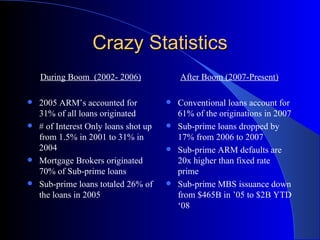
Crazy Statistics During Boom  (2002- 2006) 2005 ARM’s accounted for 31% of all loans originated # of Interest Only loans shot up from 1.5% in 2001 to 31% in 2004 Mortgage Brokers originated 70% of Sub-prime loans Sub-prime loans totaled 26% of the loans in 2005 After Boom (2007-Present) Conventional loans account for 61% of the originations in 2007 Sub-prime loans dropped by 17% from 2006 to 2007 Sub-prime ARM defaults are 20x higher than fixed rate prime Sub-prime MBS issuance down from $465B in ’05 to $2B YTD ‘08
Loan Options  Conventional (Fannie Mae, Freddie Mac) Loan Limits, Programs Jumbo, ARM’s Caps, Margin, Index FHA, HUD $100, VA DTI, Down Payment, Credit Score, Gifts
General Consumer Profiles: Where do they fit? FTHB – First Time Home Buyers Move-Up Buyers Self-Employed Borrowers Working Professionals
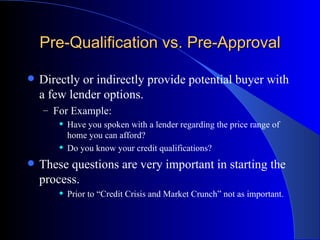
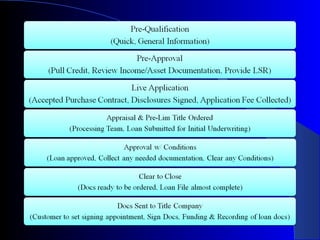
Pre-Qualification vs. Pre-Approval Directly or indirectly provide potential buyer with a few lender options. For Example: Have you spoken with a lender regarding the price range of home you can afford? Do you know your credit qualifications? These questions are very important in starting the process. Prior to “Credit Crisis and Market Crunch” not as important.
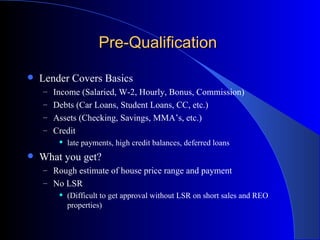
Pre-Qualification  Lender Covers Basics  Income (Salaried, W-2, Hourly, Bonus, Commission) Debts (Car Loans, Student Loans, CC, etc.) Assets (Checking, Savings, MMA’s, etc.) Credit  late payments, high credit balances, deferred loans What you get? Rough estimate of house price range and payment No LSR  (Difficult to get approval without LSR on short sales and REO properties)
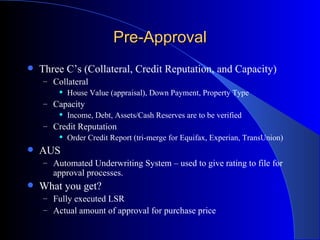
Pre-Approval Three C’s (Collateral, Credit Reputation, and Capacity) Collateral House Value (appraisal), Down Payment, Property Type Capacity Income, Debt, Assets/Cash Reserves are to be verified Credit Reputation Order Credit Report (tri-merge for Equifax, Experian, TransUnion) AUS Automated Underwriting System – used to give rating to file for approval processes. What you get? Fully executed LSR Actual amount of approval for purchase price
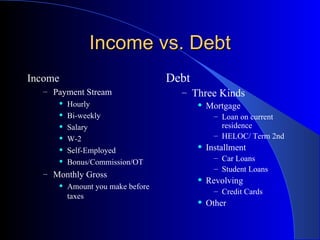
Income vs. Debt Income Payment Stream Hourly Bi-weekly Salary W-2 Self-Employed Bonus/Commission/OT Monthly Gross Amount you make before taxes Debt Three Kinds Mortgage Loan on current residence HELOC/ Term 2nd Installment Car Loans Student Loans Revolving Credit Cards Other
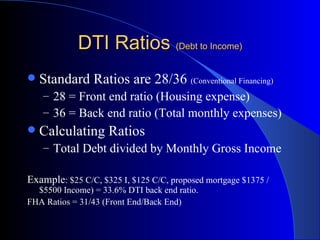
DTI Ratios  (Debt to Income) Standard Ratios are 28/36  (Conventional Financing) 28 = Front end ratio (Housing expense) 36 = Back end ratio (Total monthly expenses) Calculating Ratios Total Debt divided by Monthly Gross Income Example : $25 C/C, $325 I, $125 C/C, proposed mortgage $1375 / $5500 Income) = 33.6% DTI back end ratio. FHA Ratios = 31/43 (Front End/Back End)
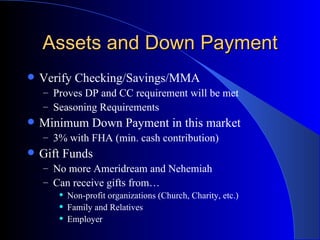
Assets and Down Payment Verify Checking/Savings/MMA  Proves DP and CC requirement will be met Seasoning Requirements Minimum Down Payment in this market 3% with FHA (min. cash contribution) Gift Funds No more Ameridream and Nehemiah Can receive gifts from… Non-profit organizations (Church, Charity, etc.) Family and Relatives Employer
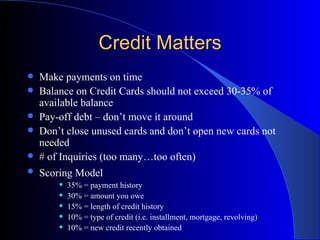
Credit Matters Make payments on time Balance on Credit Cards should not exceed 30-35% of available balance Pay-off debt – don’t move it around Don’t close unused cards and don’t open new cards not needed # of Inquiries (too many…too often) Scoring Model   35% = payment history 30% = amount you owe 15% = length of credit history 10% = type of credit (i.e. installment, mortgage, revolving) 10% = new credit recently obtained
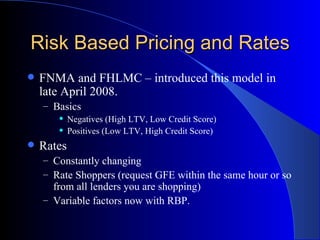
Risk Based Pricing and Rates FNMA and FHLMC – introduced this model in late April 2008. Basics Negatives (High LTV, Low Credit Score) Positives (Low LTV, High Credit Score) Rates Constantly changing Rate Shoppers (request GFE within the same hour or so from all lenders you are shopping) Variable factors now with RBP.
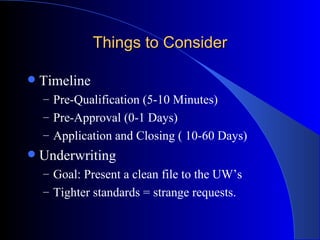
Things to Consider Timeline Pre-Qualification (5-10 Minutes) Pre-Approval (0-1 Days) Application and Closing ( 10-60 Days) Underwriting Goal: Present a clean file to the UW’s Tighter standards = strange requests.
 
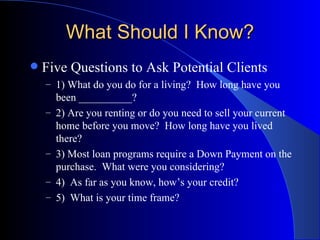
What Should I Know? Five Questions to Ask Potential Clients 1) What do you do for a living?  How long have you been __________? 2) Are you renting or do you need to sell your current home before you move?  How long have you lived there? 3) Most loan programs require a Down Payment on the purchase.  What were you considering? 4)  As far as you know, how’s your credit? 5)  What is your time frame?
What should I expect from my Mortgage Consultant? Communication Professionalism Timeliness Honesty Integrity Work for you and your client
References and Resources www.emurriettalending.blogspot.com http://epic.org/privacy/creditscoring/ http://www.freddiemac.com/ http://www.mortgageratesreport.com/

R.E.A.L.

  • 1.
    R.E.A.L. Training RealEstate Agent Loan Training
  • 2.
    Purpose of ClassChanging Times Credit standards tighter Difficulties with Underwriting Education is Vital for Clients Understand basic loan concepts Learn questions to ask Grasp value of enhanced team concept
  • 3.
    Crazy Statistics DuringBoom (2002- 2006) 2005 ARM’s accounted for 31% of all loans originated # of Interest Only loans shot up from 1.5% in 2001 to 31% in 2004 Mortgage Brokers originated 70% of Sub-prime loans Sub-prime loans totaled 26% of the loans in 2005 After Boom (2007-Present) Conventional loans account for 61% of the originations in 2007 Sub-prime loans dropped by 17% from 2006 to 2007 Sub-prime ARM defaults are 20x higher than fixed rate prime Sub-prime MBS issuance down from $465B in ’05 to $2B YTD ‘08
  • 4.
    Loan Options Conventional (Fannie Mae, Freddie Mac) Loan Limits, Programs Jumbo, ARM’s Caps, Margin, Index FHA, HUD $100, VA DTI, Down Payment, Credit Score, Gifts
  • 5.
    General Consumer Profiles:Where do they fit? FTHB – First Time Home Buyers Move-Up Buyers Self-Employed Borrowers Working Professionals
  • 6.
    Pre-Qualification vs. Pre-ApprovalDirectly or indirectly provide potential buyer with a few lender options. For Example: Have you spoken with a lender regarding the price range of home you can afford? Do you know your credit qualifications? These questions are very important in starting the process. Prior to “Credit Crisis and Market Crunch” not as important.
  • 7.
    Pre-Qualification LenderCovers Basics Income (Salaried, W-2, Hourly, Bonus, Commission) Debts (Car Loans, Student Loans, CC, etc.) Assets (Checking, Savings, MMA’s, etc.) Credit late payments, high credit balances, deferred loans What you get? Rough estimate of house price range and payment No LSR (Difficult to get approval without LSR on short sales and REO properties)
  • 8.
    Pre-Approval Three C’s(Collateral, Credit Reputation, and Capacity) Collateral House Value (appraisal), Down Payment, Property Type Capacity Income, Debt, Assets/Cash Reserves are to be verified Credit Reputation Order Credit Report (tri-merge for Equifax, Experian, TransUnion) AUS Automated Underwriting System – used to give rating to file for approval processes. What you get? Fully executed LSR Actual amount of approval for purchase price
  • 9.
    Income vs. DebtIncome Payment Stream Hourly Bi-weekly Salary W-2 Self-Employed Bonus/Commission/OT Monthly Gross Amount you make before taxes Debt Three Kinds Mortgage Loan on current residence HELOC/ Term 2nd Installment Car Loans Student Loans Revolving Credit Cards Other
  • 10.
    DTI Ratios (Debt to Income) Standard Ratios are 28/36 (Conventional Financing) 28 = Front end ratio (Housing expense) 36 = Back end ratio (Total monthly expenses) Calculating Ratios Total Debt divided by Monthly Gross Income Example : $25 C/C, $325 I, $125 C/C, proposed mortgage $1375 / $5500 Income) = 33.6% DTI back end ratio. FHA Ratios = 31/43 (Front End/Back End)
  • 11.
    Assets and DownPayment Verify Checking/Savings/MMA Proves DP and CC requirement will be met Seasoning Requirements Minimum Down Payment in this market 3% with FHA (min. cash contribution) Gift Funds No more Ameridream and Nehemiah Can receive gifts from… Non-profit organizations (Church, Charity, etc.) Family and Relatives Employer
  • 12.
    Credit Matters Makepayments on time Balance on Credit Cards should not exceed 30-35% of available balance Pay-off debt – don’t move it around Don’t close unused cards and don’t open new cards not needed # of Inquiries (too many…too often) Scoring Model 35% = payment history 30% = amount you owe 15% = length of credit history 10% = type of credit (i.e. installment, mortgage, revolving) 10% = new credit recently obtained
  • 13.
    Risk Based Pricingand Rates FNMA and FHLMC – introduced this model in late April 2008. Basics Negatives (High LTV, Low Credit Score) Positives (Low LTV, High Credit Score) Rates Constantly changing Rate Shoppers (request GFE within the same hour or so from all lenders you are shopping) Variable factors now with RBP.
  • 14.
    Things to ConsiderTimeline Pre-Qualification (5-10 Minutes) Pre-Approval (0-1 Days) Application and Closing ( 10-60 Days) Underwriting Goal: Present a clean file to the UW’s Tighter standards = strange requests.
  • 15.
  • 16.
    What Should IKnow? Five Questions to Ask Potential Clients 1) What do you do for a living? How long have you been __________? 2) Are you renting or do you need to sell your current home before you move? How long have you lived there? 3) Most loan programs require a Down Payment on the purchase. What were you considering? 4) As far as you know, how’s your credit? 5) What is your time frame?
  • 17.
    What should Iexpect from my Mortgage Consultant? Communication Professionalism Timeliness Honesty Integrity Work for you and your client
  • 18.
    References and Resourceswww.emurriettalending.blogspot.com http://epic.org/privacy/creditscoring/ http://www.freddiemac.com/ http://www.mortgageratesreport.com/