Reading Ecosystem
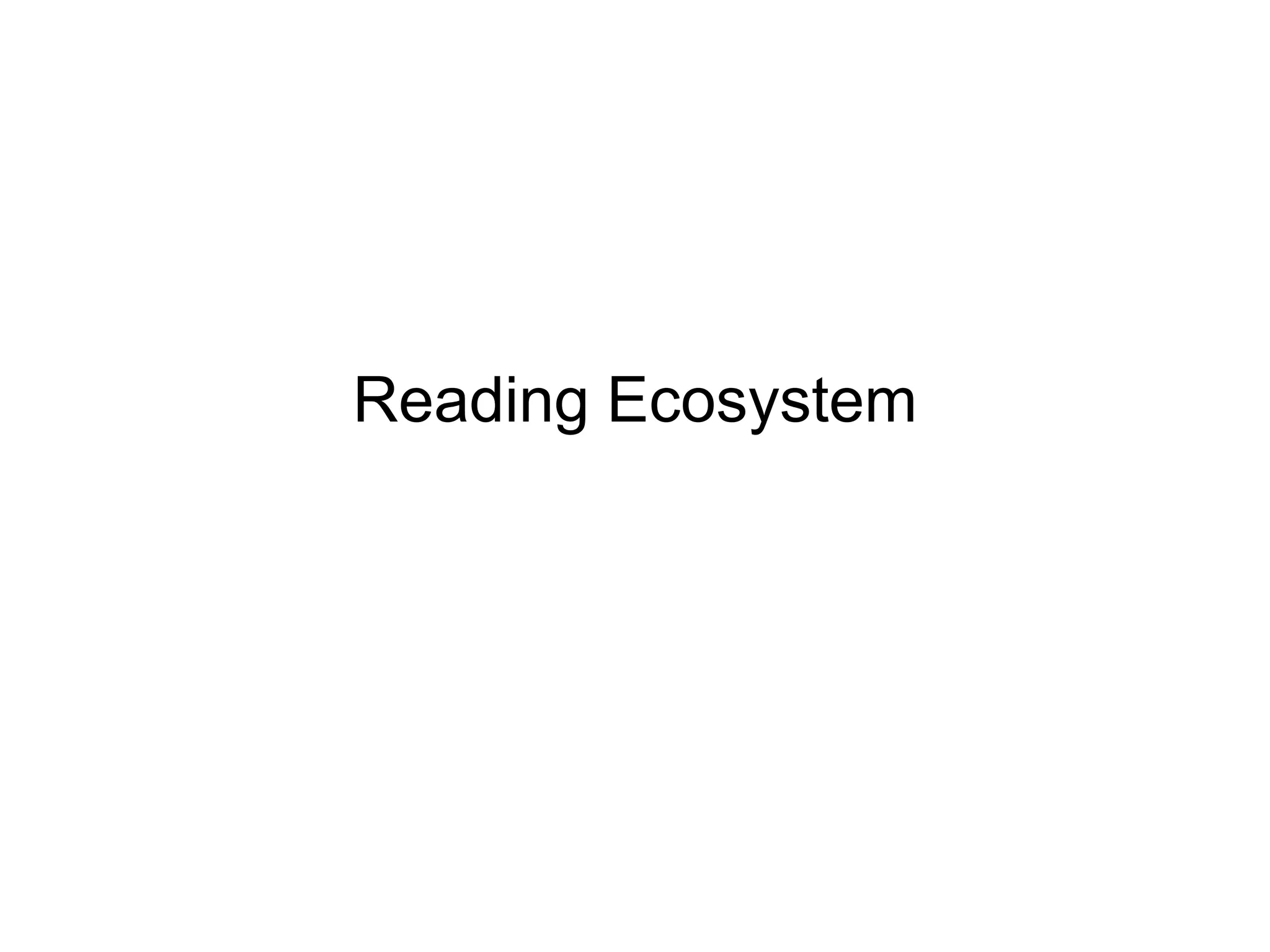
© Through the Magic Door2Let us tenderly and kindly cherish, therefore, the means of knowledge. Let us dare to read, think, speak, and write. - John AdamsIf you want your children to be intelligent, read them fairy tales. If you want them to be more intelligent, read them more fairy tales.- Albert EinsteinEither write something worth reading or do something worth writing.- Benjamin FranklinPrepare for the unknown by studying how others in the past have coped with the unforeseeable and the unpredictable. - George S. Patton
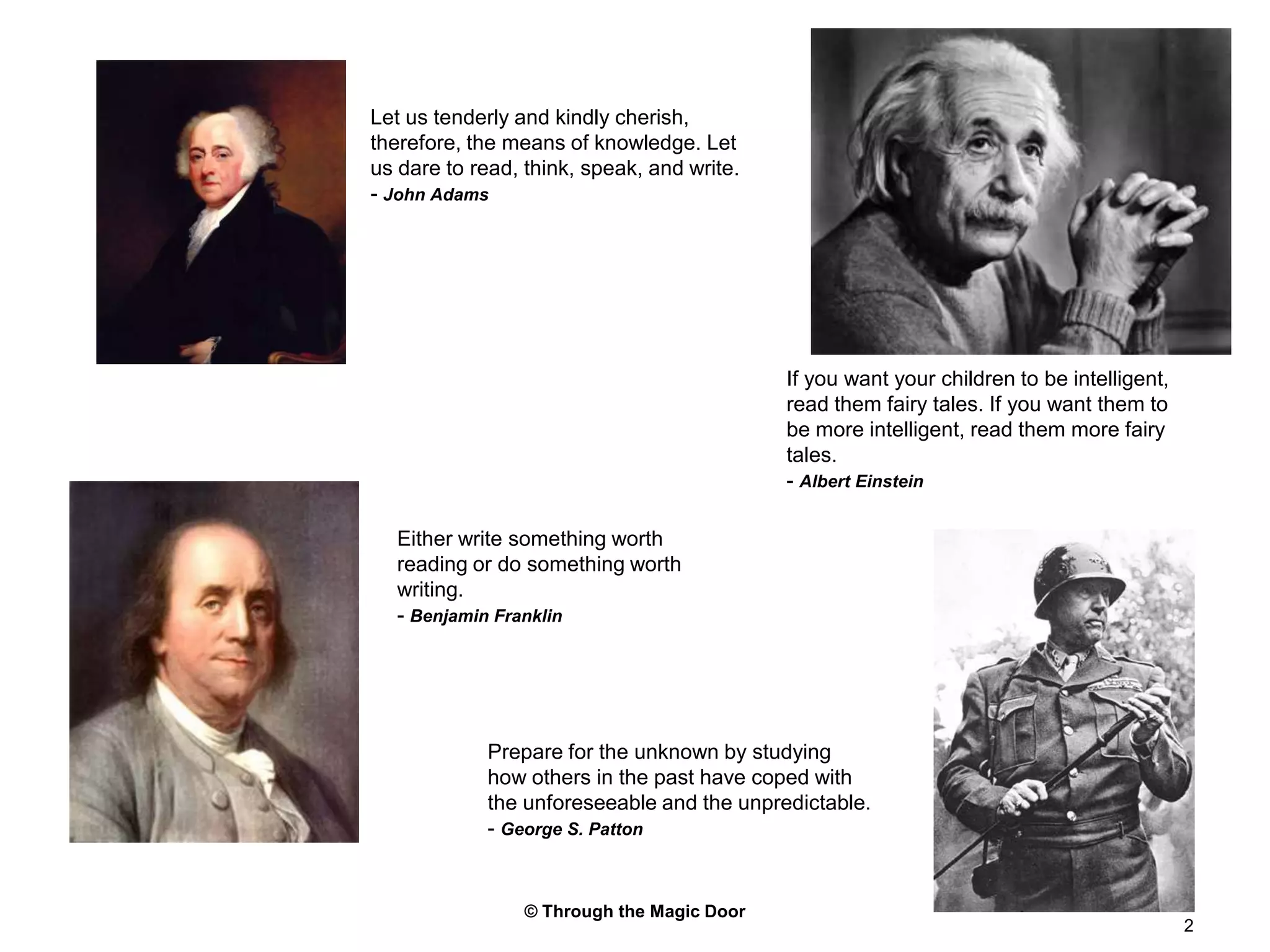
© Through the Magic Door3I cannot live without books- Thomas JeffersonA little learning, indeed, may be a dangerous thing, but the want of learning is a calamity to any people.- Frederick DouglassWhen I get a little money, I buy books; and if any is left I buy food and clothes.- Desiderius ErasmusIt is a good thing for an uneducated man to read a book of quotations.- Winston ChurchillAny reading not of a vicious species must be a good substitute for the amusements too apt to fill up the leisure of the labouring classes.- James Madison
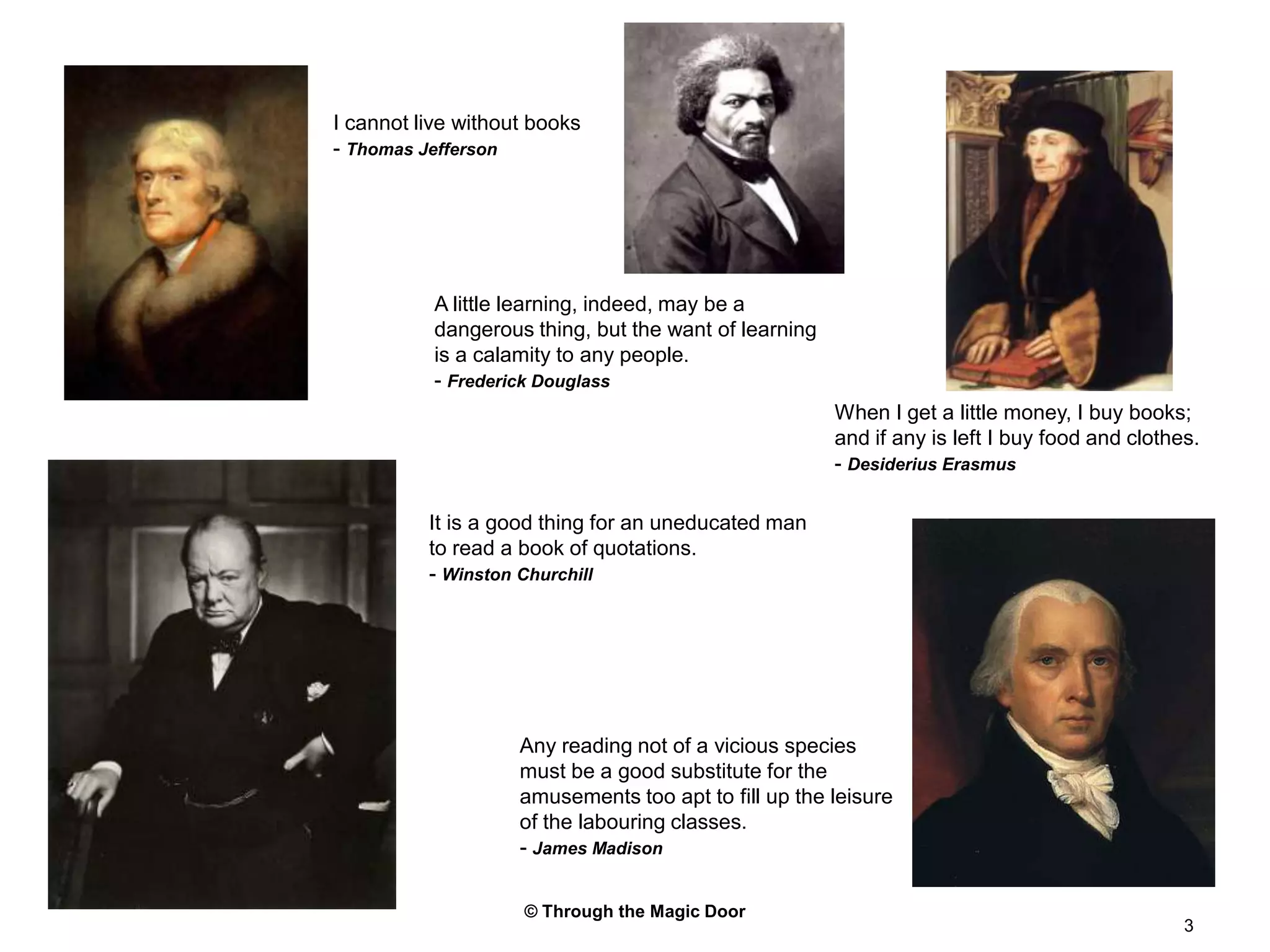
© Through the Magic Door4It is wonderful that even today, with all the competition of radio, television, films and records, the book has kept its precious character.  A book is somehow precious.- John SteinbeckThe things I want to know are in books; my best friend is the man who'll get me a book I ain't read.- Abraham LincolnAnyone who has a library and a garden wants for nothing.- CiceroThere is not such a cradle of democracy upon the earth as the Free Public Library, this republic of letters, where neither rank, office, nor wealth receives the slightest consideration.- Andrew CarnegieIt is a great thing to start life with a small number of really good books which are your very own.- Sir Arthur Conan Doyle
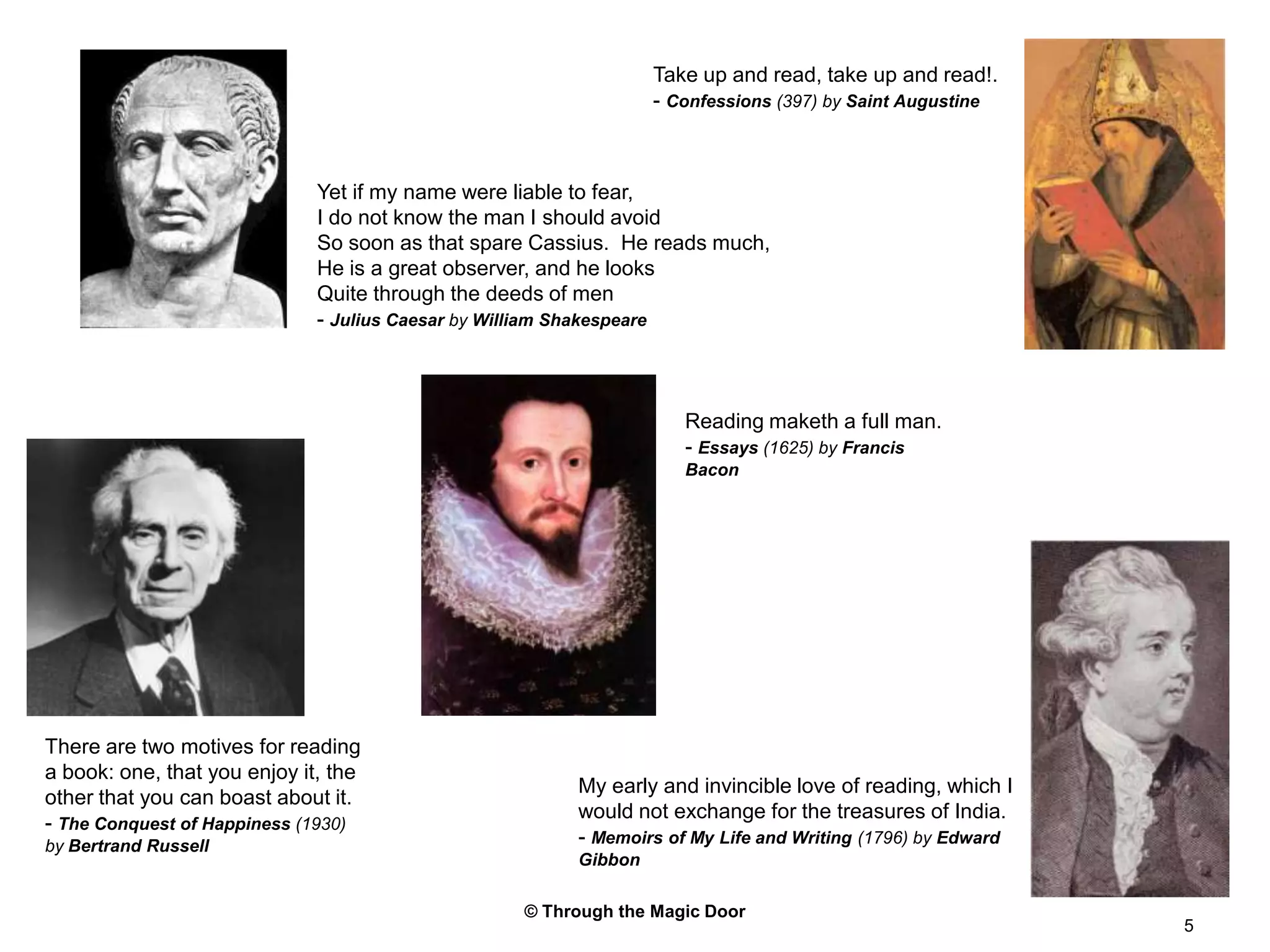
© Through the Magic Door5Take up and read, take up and read!.- Confessions (397) by Saint AugustineYet if my name were liable to fear,I do not know the man I should avoidSo soon as that spare Cassius.  He reads much,He is a great observer, and he looksQuite through the deeds of men- Julius Caesar by William ShakespeareReading maketh a full man.- Essays (1625) by Francis BaconThere are two motives for reading a book: one, that you enjoy it, the other that you can boast about it.- The Conquest of Happiness (1930) by Bertrand RussellMy early and invincible love of reading, which I would not exchange for the treasures of India.- Memoirs of My Life and Writing (1796) by Edward Gibbon
© Through the Magic Door6ContextThis document solely focuses on those parties that have an interest in the fostering of a vibrant and enthusiastic reading culture.  Specifically, we are not examining education at large, schools in particular, assigning blame or seeking to advance any particular agenda, pedagogical technique, policy or solution.The effort here is to agree on some boundaries of the issue (how to define and measure), identify root causes for any perceived shortfall, propose solutions to rectify those root causes, and determine where there might be opportunities for the various stakeholders to collaboratively work towards a a shared goal of a larger population of Self-Motivated and Self-Supported Habitual Readers.
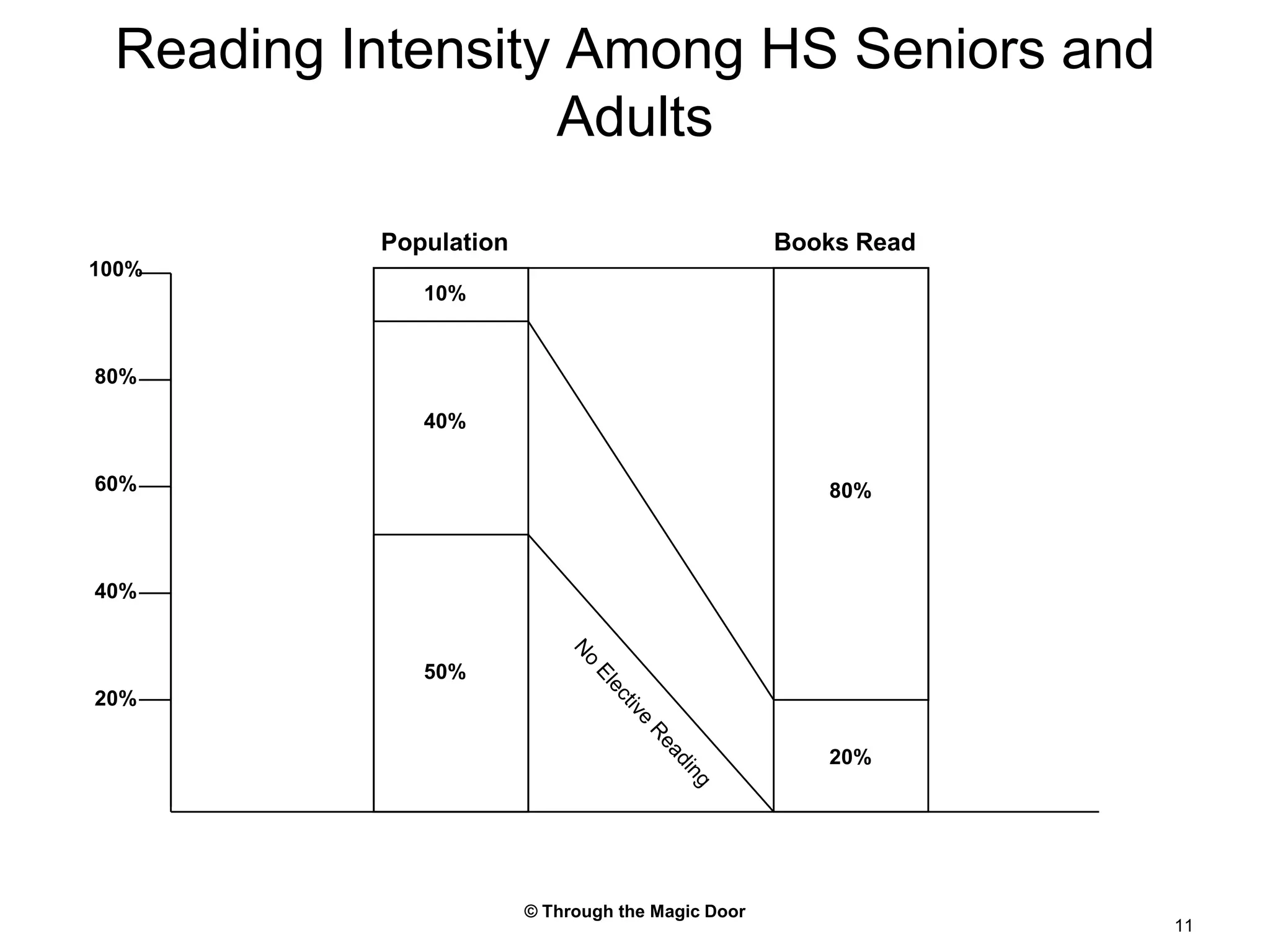
© Through the Magic Door7Situation10% of the population does 80% of the reading.50% do no elective reading in a given year.Aside from the personal loss this represents to individuals, this high concentration of reading bodes ill for effective participation in an economic and world environment predicated on high levels of knowledge, imagination, empathy/collaboration, critical and analytical thinking, and social and moral judgment; all attributes fostered by habitual reading.
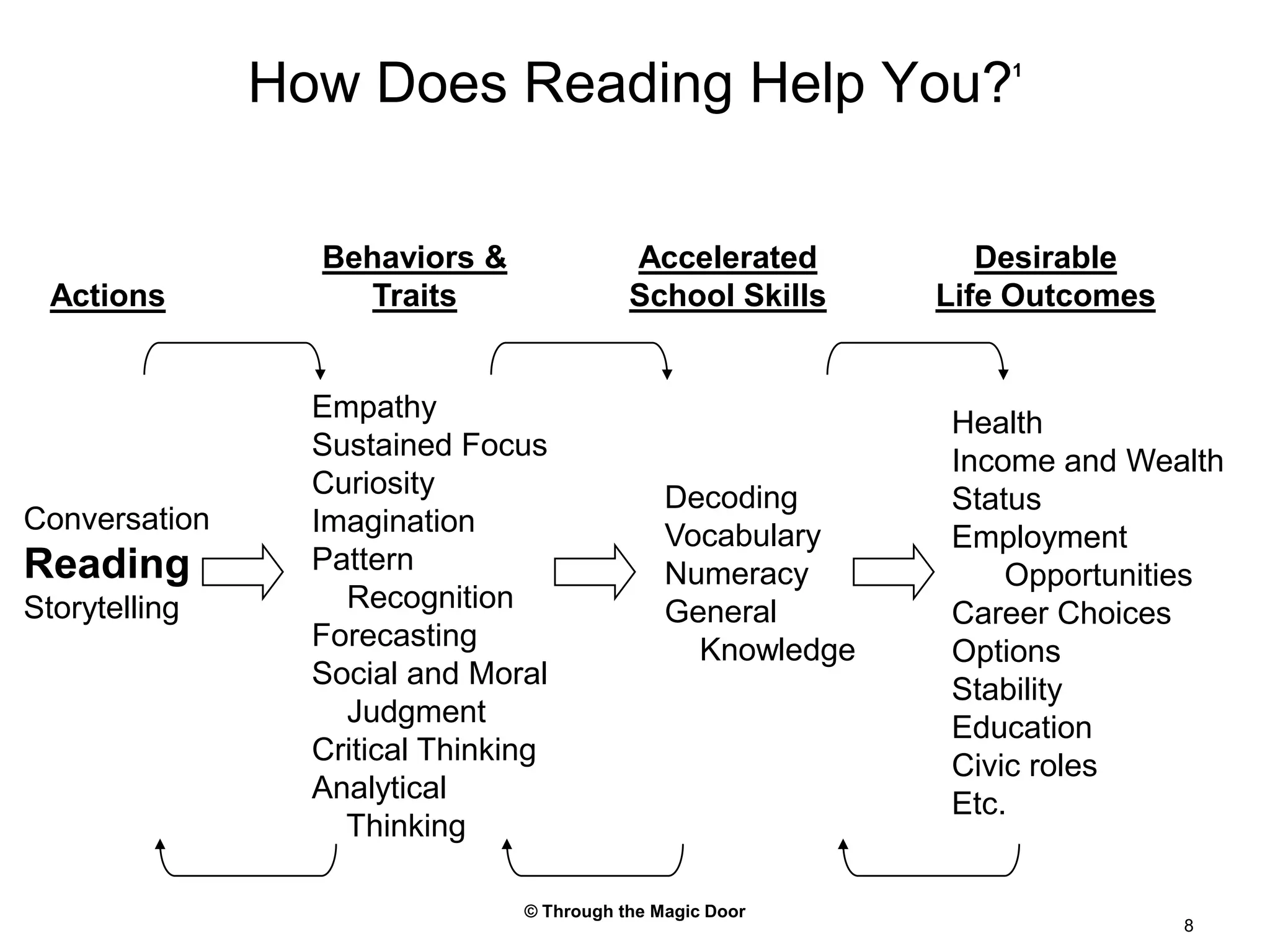
© Through the Magic Door8How Does Reading Help You?1DesirableLife OutcomesBehaviors &TraitsAcceleratedSchool SkillsActionsEmpathySustained FocusCuriosityImaginationPattern    RecognitionForecastingSocial and Moral    JudgmentCritical ThinkingAnalytical    Thinking	HealthIncome and WealthStatusEmployment       OpportunitiesCareer ChoicesOptionsStabilityEducationCivic rolesEtc.DecodingVocabularyNumeracyGeneral    KnowledgeConversationReadingStorytelling
Proposed Problem Statement
Too few children (and adults) are self-motivated and self-reliant habitual readers.
© Through the Magic Door11Reading Intensity Among HS Seniors and AdultsPopulationBooks Read100%10%80%40%60%80%40%50%20%No Elective Reading20%
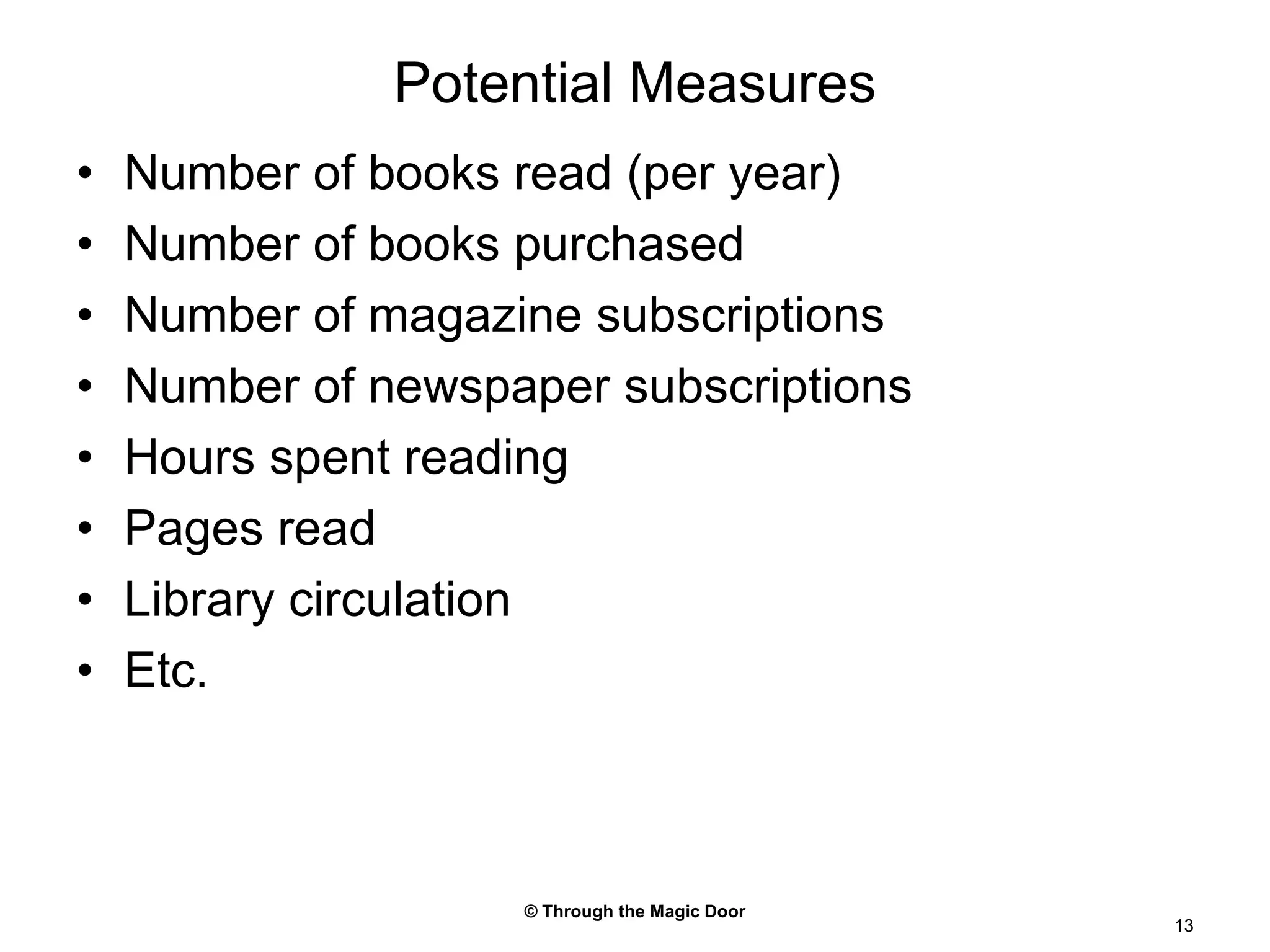
Potential Measures of Progress
© Through the Magic Door13Potential MeasuresNumber of books read (per year)Number of books purchasedNumber of magazine subscriptionsNumber of newspaper subscriptionsHours spent readingPages readLibrary circulationEtc.
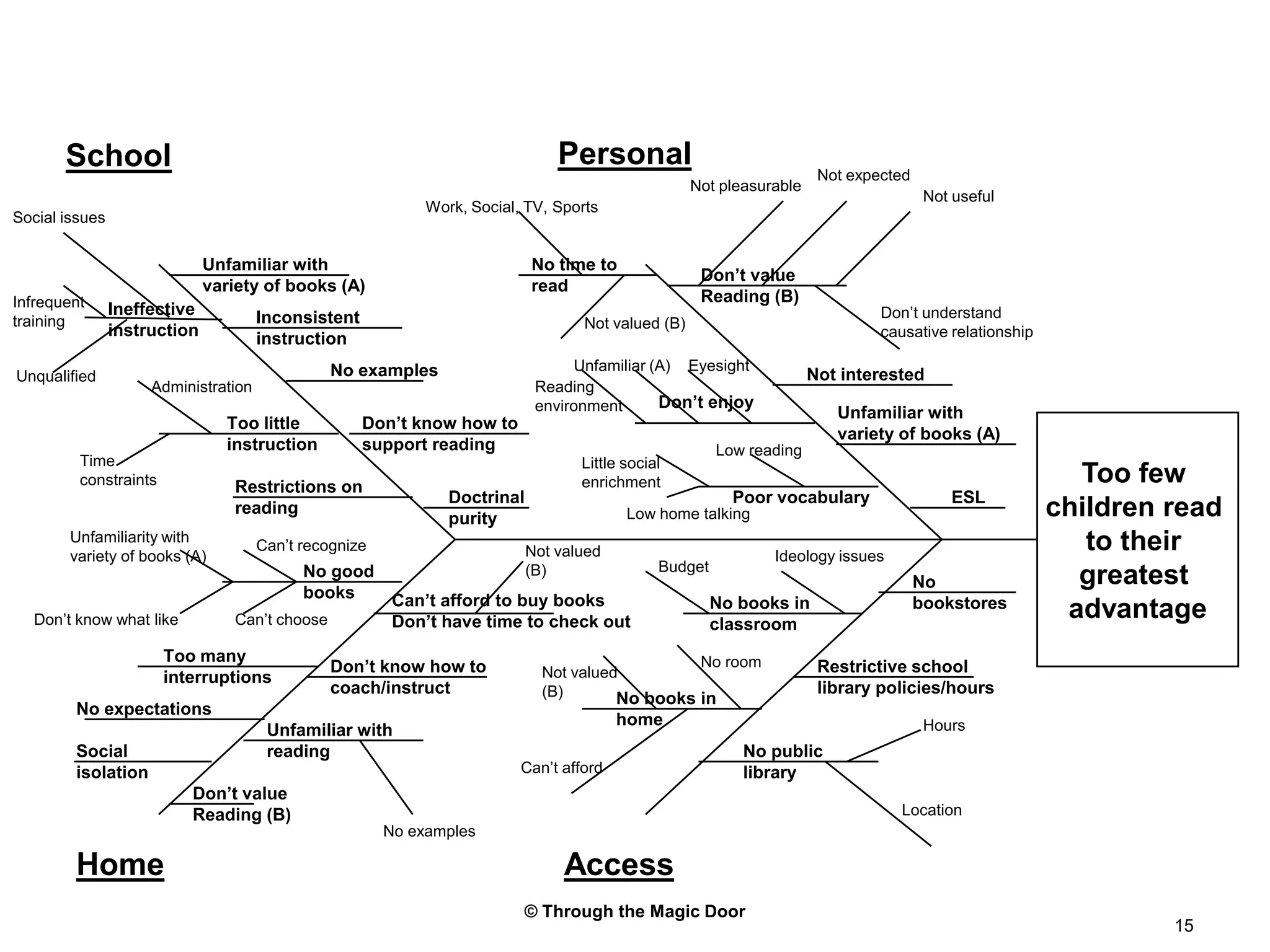
Potential Root Causes
© Through the Magic Door15PersonalSchoolNot expectedNot pleasurableNot usefulWork, Social, TV, SportsSocial issuesNo time to readUnfamiliar withvariety of books (A)Don’t value Reading (B)Infrequent  trainingIneffective instructionDon’t understandcausative relationshipInconsistentinstructionNot valued (B)EyesightUnfamiliar (A)No examplesNot interestedUnqualifiedReadingenvironmentAdministrationDon’t enjoyUnfamiliar withvariety of books (A)Don’t know how tosupport readingToo little instructionToo few children read to their greatest advantageLow readingTime constraintsLittle social enrichmentRestrictions onreadingESLPoor vocabularyDoctrinal purityLow home talkingUnfamiliarity with variety of books (A)Can’t recognizeNot valued(B)Ideology issuesBudgetNo goodbooksNo bookstoresCan’t afford to buy booksDon’t have time to check outNo books inclassroomDon’t know what likeCan’t chooseToo manyinterruptionsNo roomRestrictive schoollibrary policies/hoursDon’t know how tocoach/instructNot valued(B)No books inhomeNo expectationsHoursUnfamiliar withreadingNo publiclibrarySocialisolationCan’t affordDon’t value Reading (B)LocationNo examplesHomeAccess
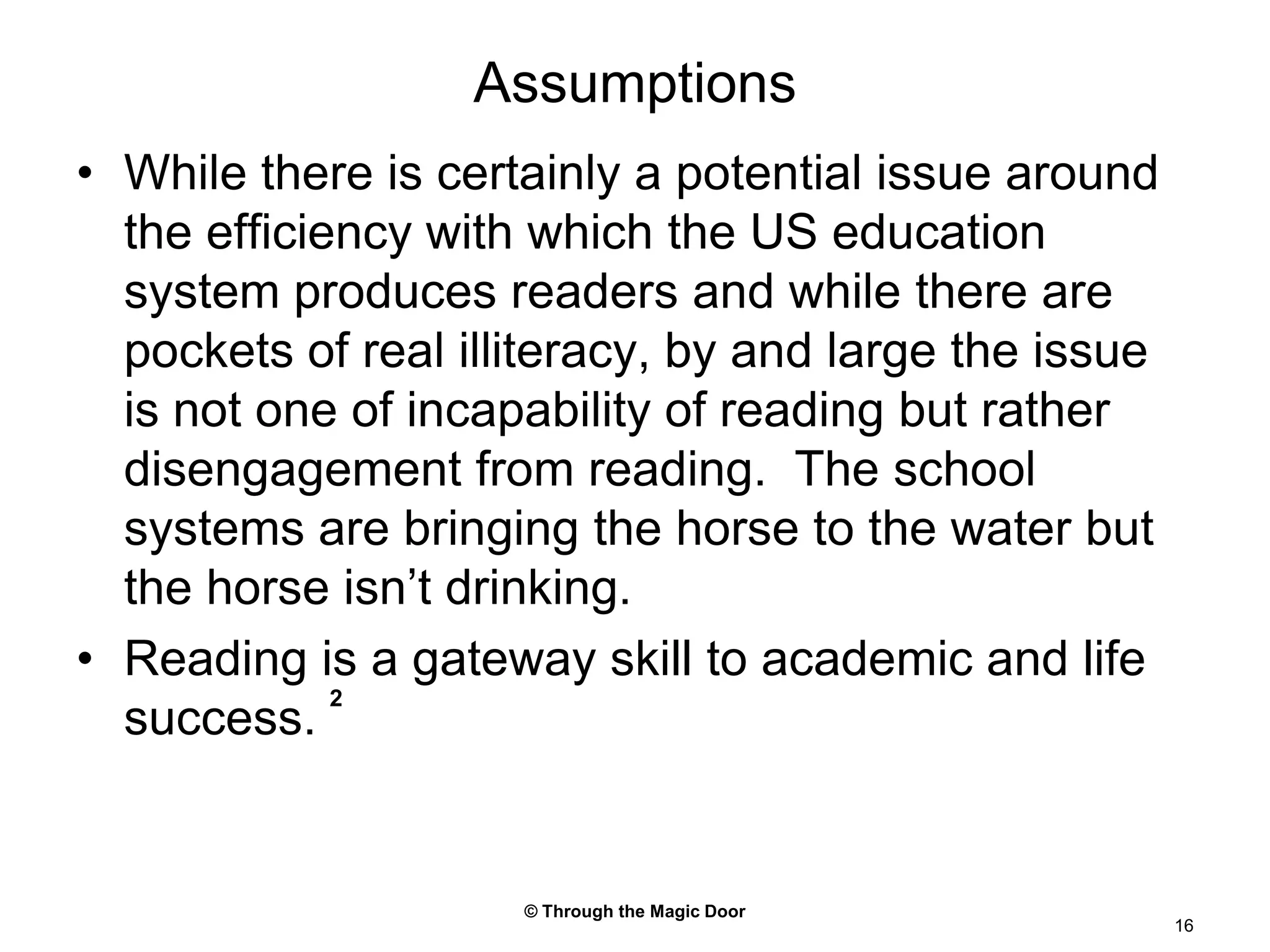
© Through the Magic Door16AssumptionsWhile there is certainly a potential issue around the efficiency with which the US education system produces readers and while there are pockets of real illiteracy, by and large the issue is not one of incapability of reading but rather disengagement from reading.  The school systems are bringing the horse to the water but the horse isn’t drinking.Reading is a gateway skill to academic and life success. 2
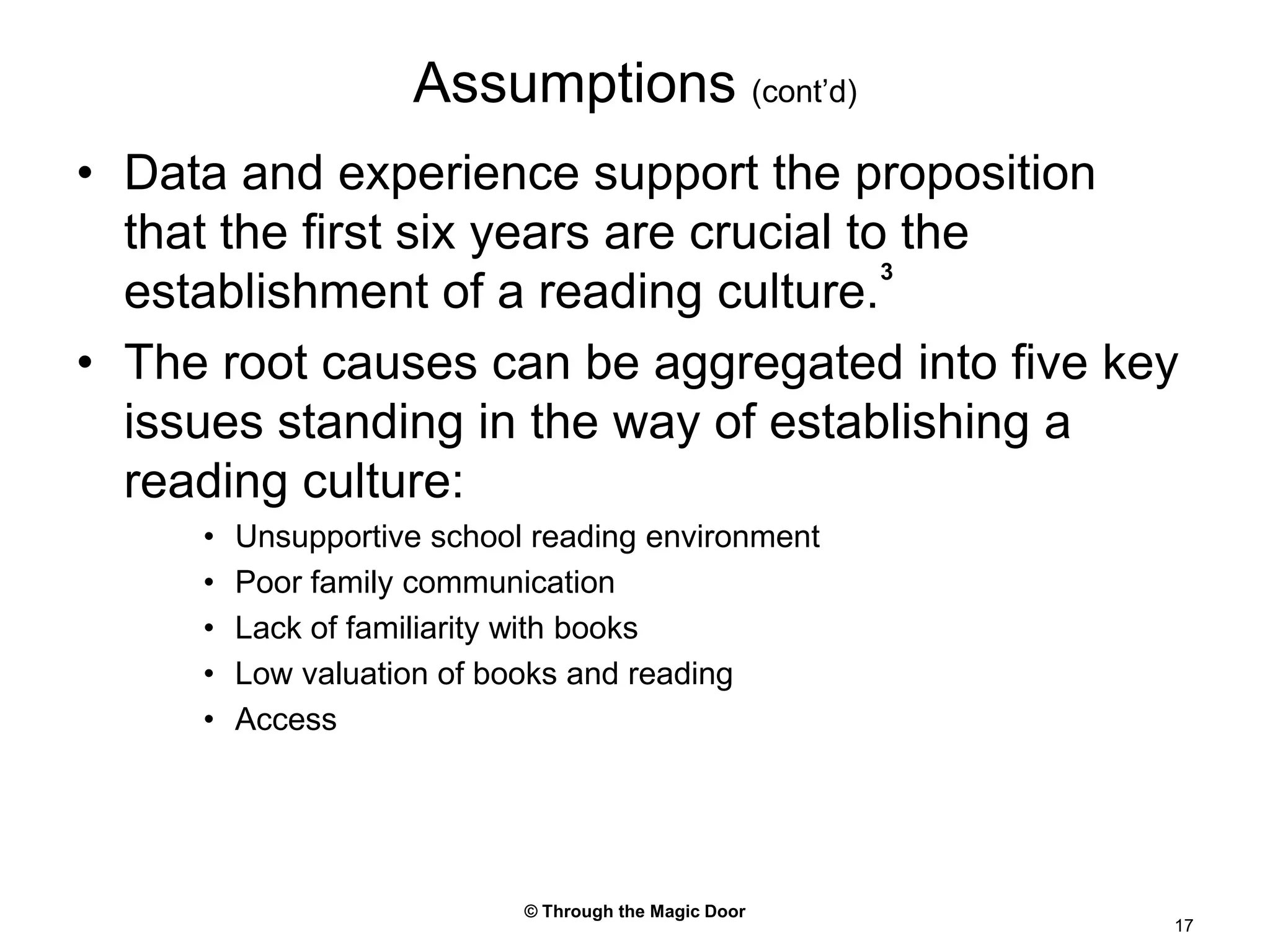
© Through the Magic Door17Assumptions (cont’d)Data and experience support the proposition that the first six years are crucial to the establishment of a reading culture.3The root causes can be aggregated into five key issues standing in the way of establishing a reading culture:Unsupportive school reading environmentPoor family communicationLack of familiarity with booksLow valuation of books and readingAccess
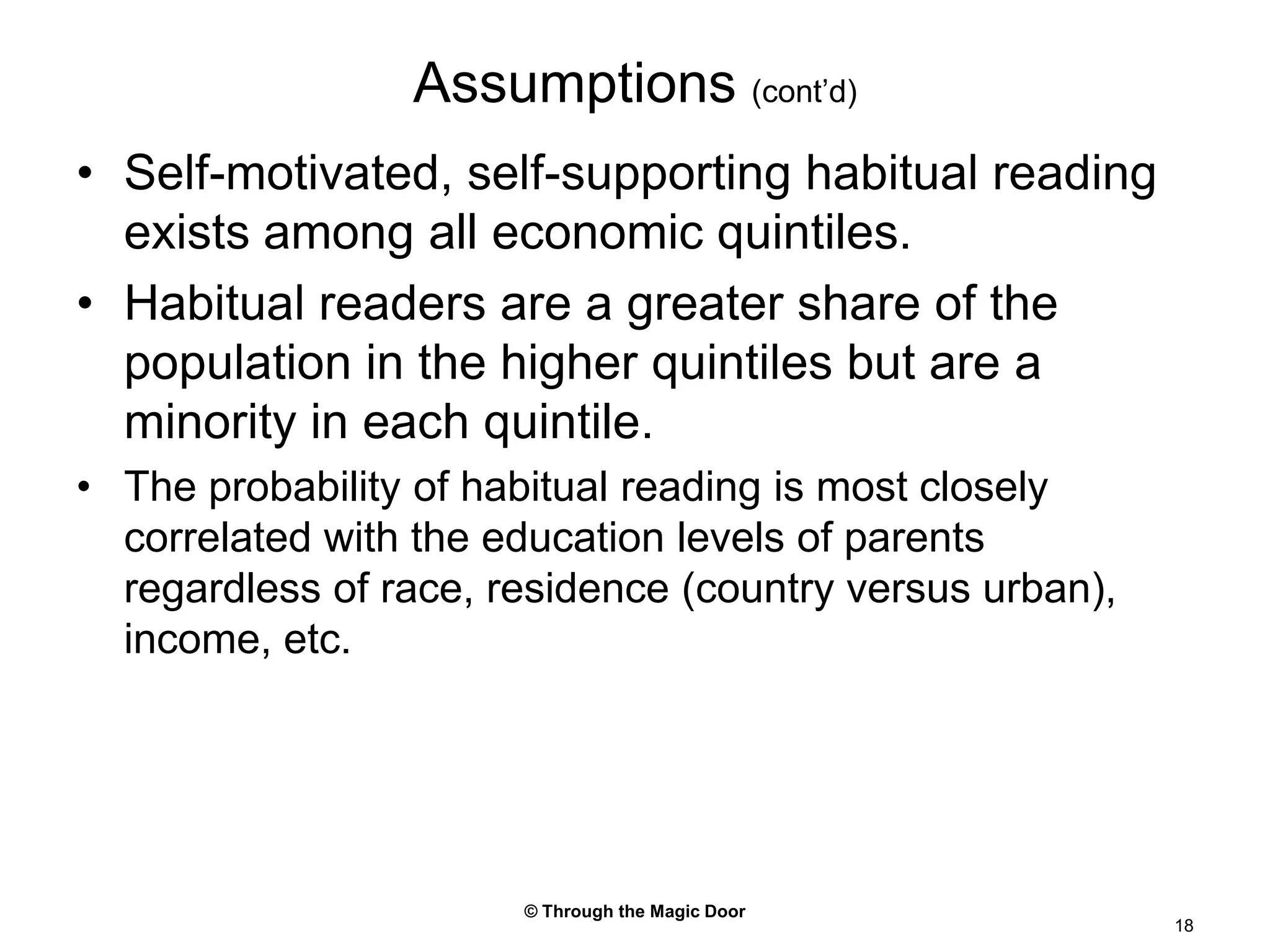
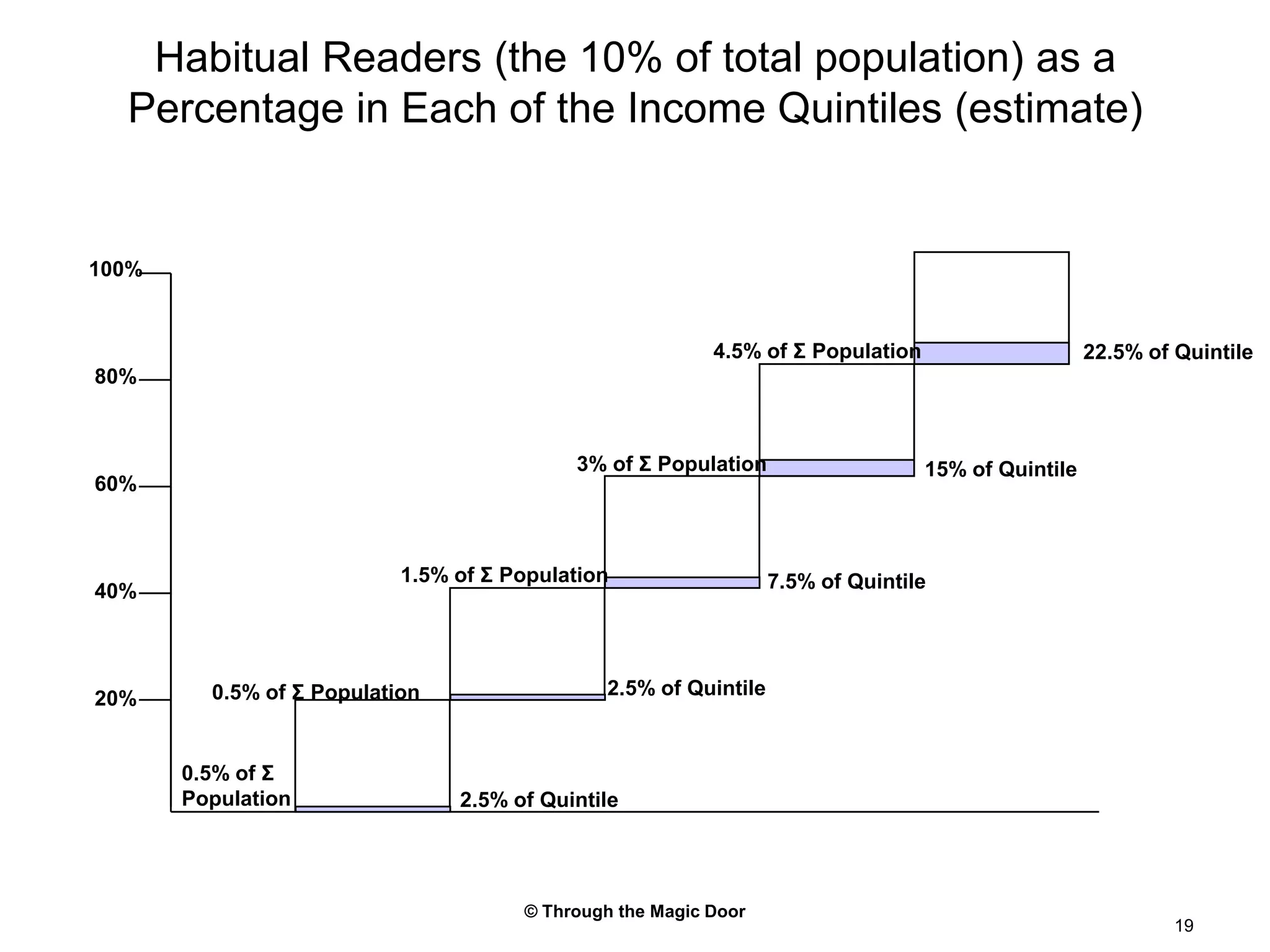
© Through the Magic Door18Assumptions (cont’d)Self-motivated, self-supporting habitual reading exists among all economic quintiles.Habitual readers are a greater share of the population in the higher quintiles but are a minority in each quintile.The probability of habitual reading is most closely correlated with the education levels of parents regardless of race, residence (country versus urban), income, etc.
© Through the Magic Door19Habitual Readers (the 10% of total population) as a Percentage in Each of the Income Quintiles (estimate)100%4.5% of ΣPopulation22.5% of Quintile80%3% of ΣPopulation15% of Quintile60%1.5% of ΣPopulation7.5% of Quintile40%2.5% of Quintile0.5% of ΣPopulation20%0.5% of ΣPopulation2.5% of Quintile
Reading Ecosystem
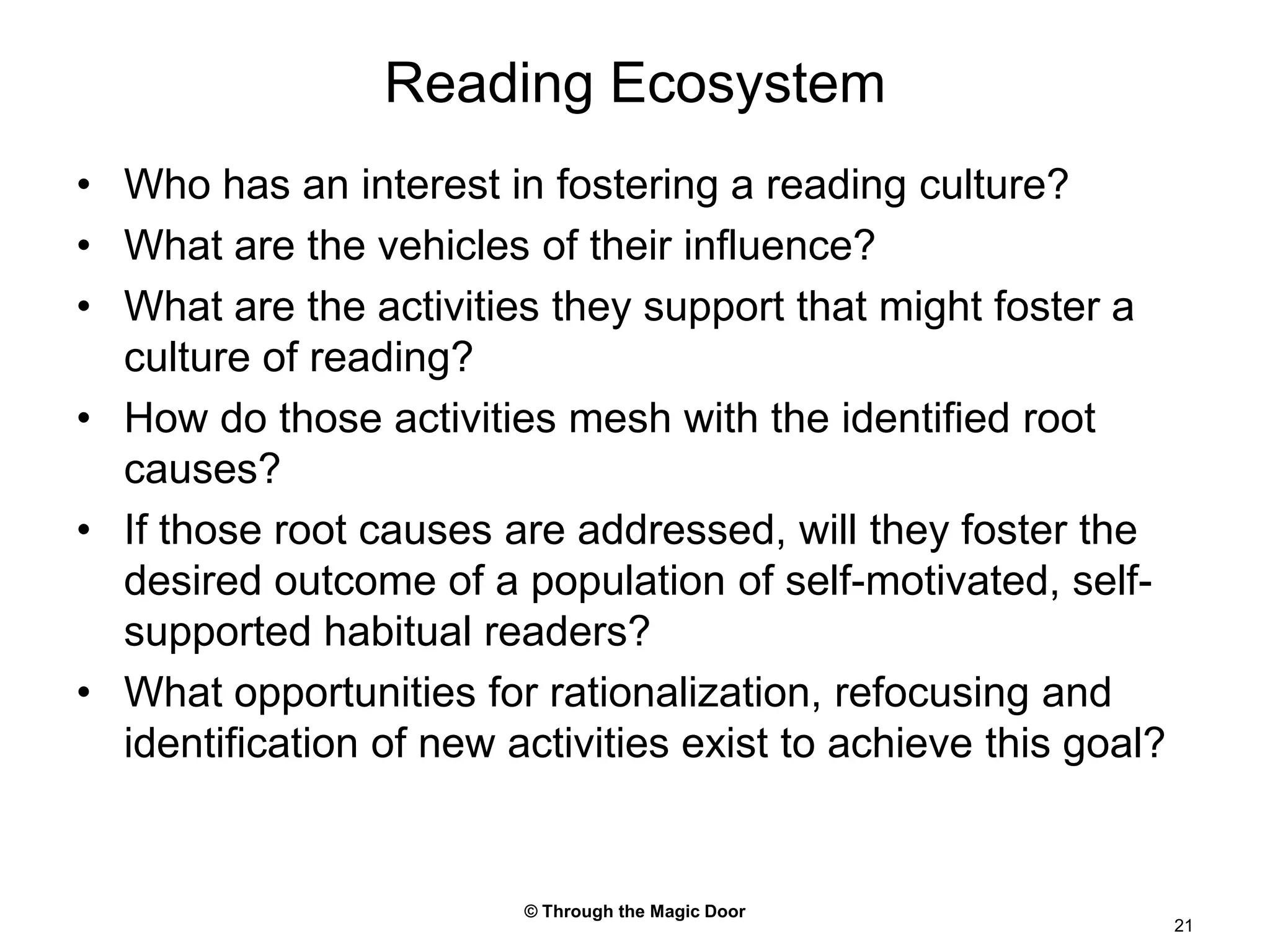
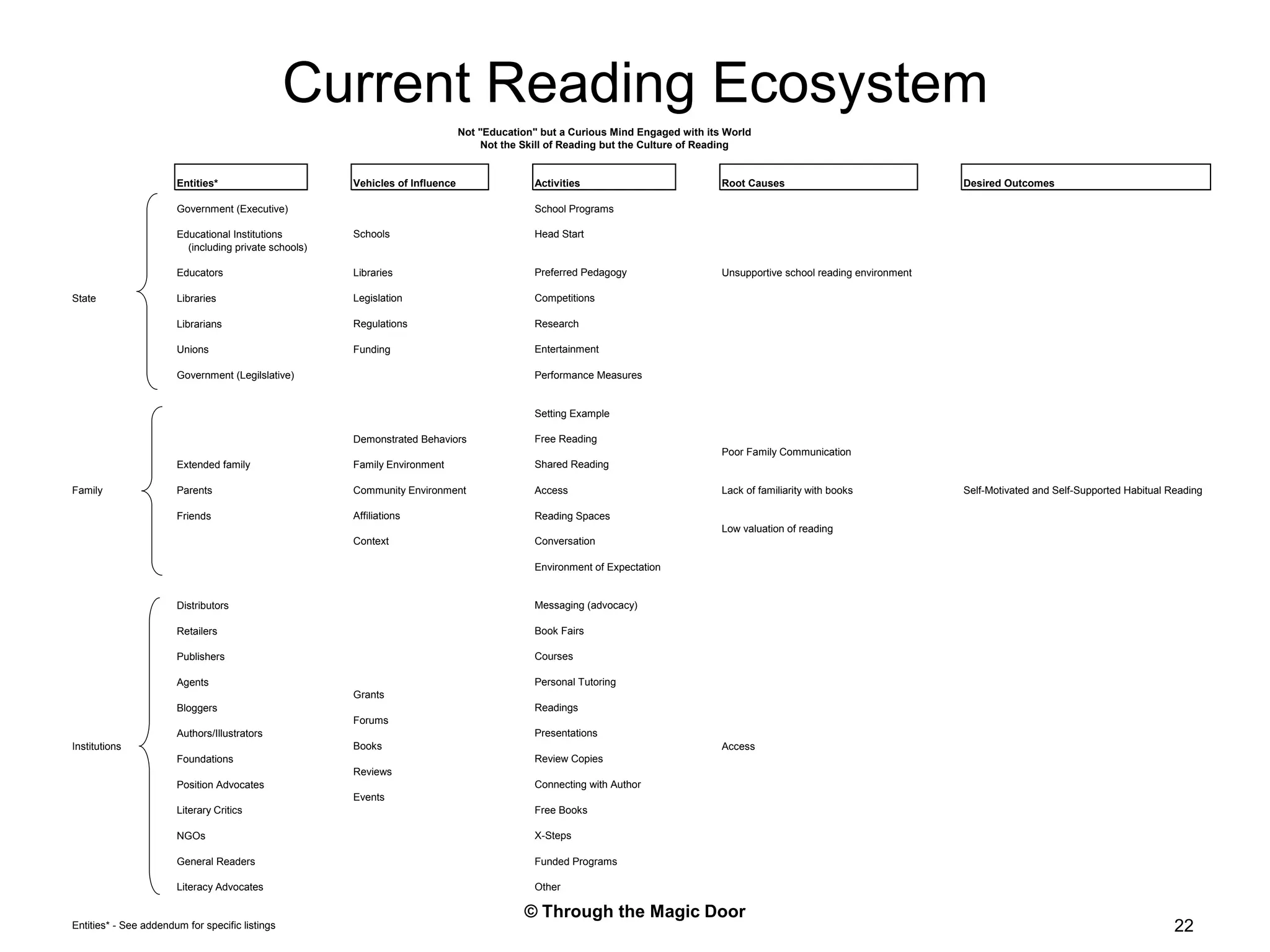
© Through the Magic Door21Reading EcosystemWho has an interest in fostering a reading culture?What are the vehicles of their influence?What are the activities they support that might foster a culture of reading?How do those activities mesh with the identified root causes?If those root causes are addressed, will they foster the desired outcome of a population of self-motivated, self-supported habitual readers?What opportunities for rationalization, refocusing and identification of new activities exist to achieve this goal?
© Through the Magic Door22Current Reading Ecosystem
Assessment of Reading Culture Activities
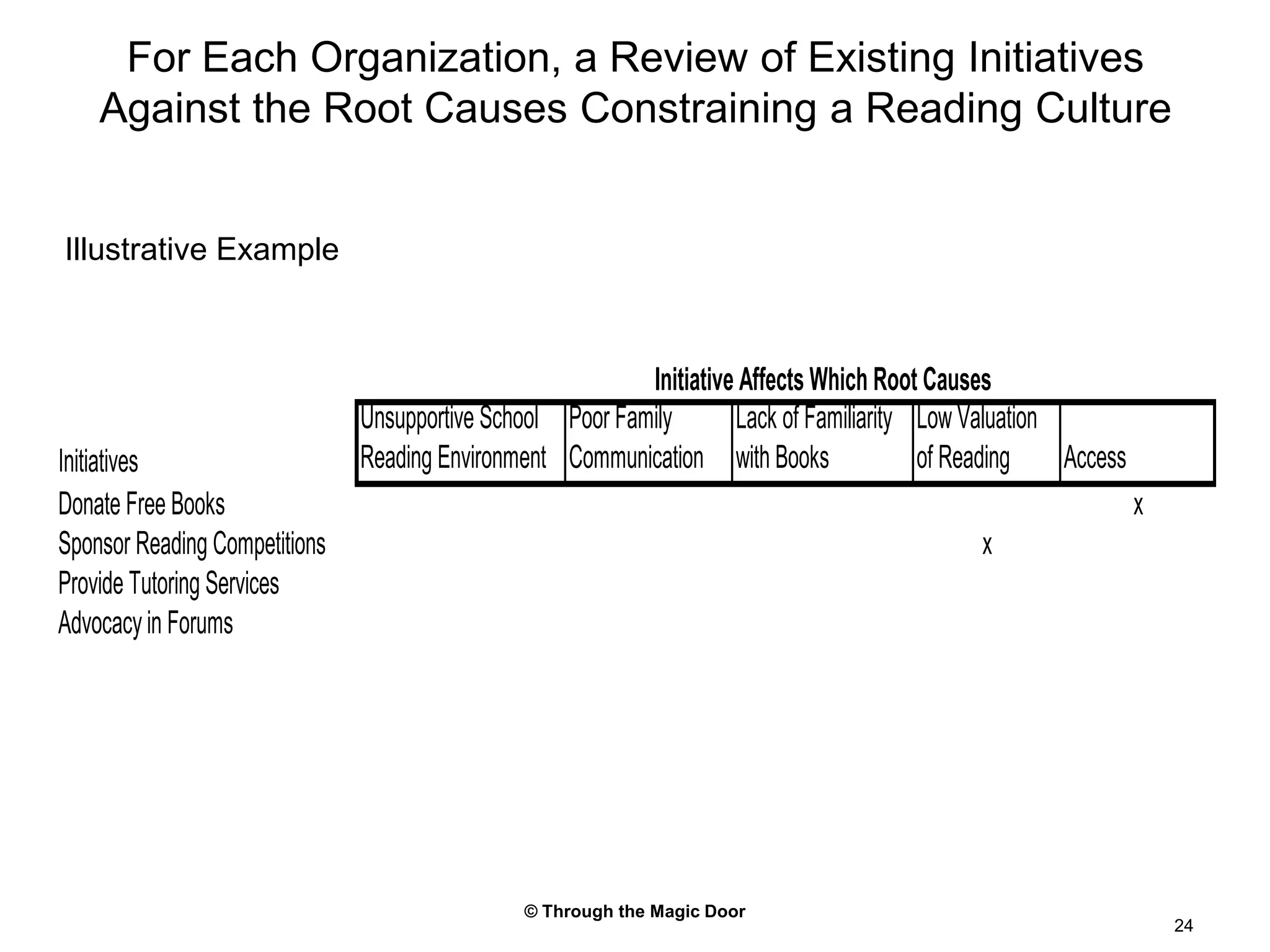
© Through the Magic Door24For Each Organization, a Review of Existing Initiatives Against the Root Causes Constraining a Reading CultureIllustrative Example
© Through the Magic Door25FootnotesSee Why Habitual Reading is Important, Through the Magic Door, 2008.See Why Habitual Reading is Important, Through the Magic Door, 2008 and Growing a Reading Culture, Through the Magic Door, 2009 for citations to research.Ibid.
© Through the Magic Door26Contact InformationShould you have any questions about this presentation, please contact us.Charles BaylessThrough the Magic Door®1579 Monroe DriveSuite F150Atlanta, Georgia 30324E-mail:  charles.bayless@ttmd.comOffice:  (404) 898-9096

Reading Ecosystem

  • 1.
  • 2.
    © Through theMagic Door2Let us tenderly and kindly cherish, therefore, the means of knowledge. Let us dare to read, think, speak, and write. - John AdamsIf you want your children to be intelligent, read them fairy tales. If you want them to be more intelligent, read them more fairy tales.- Albert EinsteinEither write something worth reading or do something worth writing.- Benjamin FranklinPrepare for the unknown by studying how others in the past have coped with the unforeseeable and the unpredictable. - George S. Patton
  • 3.
    © Through theMagic Door3I cannot live without books- Thomas JeffersonA little learning, indeed, may be a dangerous thing, but the want of learning is a calamity to any people.- Frederick DouglassWhen I get a little money, I buy books; and if any is left I buy food and clothes.- Desiderius ErasmusIt is a good thing for an uneducated man to read a book of quotations.- Winston ChurchillAny reading not of a vicious species must be a good substitute for the amusements too apt to fill up the leisure of the labouring classes.- James Madison
  • 4.
    © Through theMagic Door4It is wonderful that even today, with all the competition of radio, television, films and records, the book has kept its precious character. A book is somehow precious.- John SteinbeckThe things I want to know are in books; my best friend is the man who'll get me a book I ain't read.- Abraham LincolnAnyone who has a library and a garden wants for nothing.- CiceroThere is not such a cradle of democracy upon the earth as the Free Public Library, this republic of letters, where neither rank, office, nor wealth receives the slightest consideration.- Andrew CarnegieIt is a great thing to start life with a small number of really good books which are your very own.- Sir Arthur Conan Doyle
  • 5.
    © Through theMagic Door5Take up and read, take up and read!.- Confessions (397) by Saint AugustineYet if my name were liable to fear,I do not know the man I should avoidSo soon as that spare Cassius. He reads much,He is a great observer, and he looksQuite through the deeds of men- Julius Caesar by William ShakespeareReading maketh a full man.- Essays (1625) by Francis BaconThere are two motives for reading a book: one, that you enjoy it, the other that you can boast about it.- The Conquest of Happiness (1930) by Bertrand RussellMy early and invincible love of reading, which I would not exchange for the treasures of India.- Memoirs of My Life and Writing (1796) by Edward Gibbon
  • 6.
    © Through theMagic Door6ContextThis document solely focuses on those parties that have an interest in the fostering of a vibrant and enthusiastic reading culture. Specifically, we are not examining education at large, schools in particular, assigning blame or seeking to advance any particular agenda, pedagogical technique, policy or solution.The effort here is to agree on some boundaries of the issue (how to define and measure), identify root causes for any perceived shortfall, propose solutions to rectify those root causes, and determine where there might be opportunities for the various stakeholders to collaboratively work towards a a shared goal of a larger population of Self-Motivated and Self-Supported Habitual Readers.
  • 7.
    © Through theMagic Door7Situation10% of the population does 80% of the reading.50% do no elective reading in a given year.Aside from the personal loss this represents to individuals, this high concentration of reading bodes ill for effective participation in an economic and world environment predicated on high levels of knowledge, imagination, empathy/collaboration, critical and analytical thinking, and social and moral judgment; all attributes fostered by habitual reading.
  • 8.
    © Through theMagic Door8How Does Reading Help You?1DesirableLife OutcomesBehaviors &TraitsAcceleratedSchool SkillsActionsEmpathySustained FocusCuriosityImaginationPattern RecognitionForecastingSocial and Moral JudgmentCritical ThinkingAnalytical Thinking HealthIncome and WealthStatusEmployment OpportunitiesCareer ChoicesOptionsStabilityEducationCivic rolesEtc.DecodingVocabularyNumeracyGeneral KnowledgeConversationReadingStorytelling
  • 9.
  • 10.
    Too few children(and adults) are self-motivated and self-reliant habitual readers.
  • 11.
    © Through theMagic Door11Reading Intensity Among HS Seniors and AdultsPopulationBooks Read100%10%80%40%60%80%40%50%20%No Elective Reading20%
  • 12.
  • 13.
    © Through theMagic Door13Potential MeasuresNumber of books read (per year)Number of books purchasedNumber of magazine subscriptionsNumber of newspaper subscriptionsHours spent readingPages readLibrary circulationEtc.
  • 14.
  • 15.
    © Through theMagic Door15PersonalSchoolNot expectedNot pleasurableNot usefulWork, Social, TV, SportsSocial issuesNo time to readUnfamiliar withvariety of books (A)Don’t value Reading (B)Infrequent trainingIneffective instructionDon’t understandcausative relationshipInconsistentinstructionNot valued (B)EyesightUnfamiliar (A)No examplesNot interestedUnqualifiedReadingenvironmentAdministrationDon’t enjoyUnfamiliar withvariety of books (A)Don’t know how tosupport readingToo little instructionToo few children read to their greatest advantageLow readingTime constraintsLittle social enrichmentRestrictions onreadingESLPoor vocabularyDoctrinal purityLow home talkingUnfamiliarity with variety of books (A)Can’t recognizeNot valued(B)Ideology issuesBudgetNo goodbooksNo bookstoresCan’t afford to buy booksDon’t have time to check outNo books inclassroomDon’t know what likeCan’t chooseToo manyinterruptionsNo roomRestrictive schoollibrary policies/hoursDon’t know how tocoach/instructNot valued(B)No books inhomeNo expectationsHoursUnfamiliar withreadingNo publiclibrarySocialisolationCan’t affordDon’t value Reading (B)LocationNo examplesHomeAccess
  • 16.
    © Through theMagic Door16AssumptionsWhile there is certainly a potential issue around the efficiency with which the US education system produces readers and while there are pockets of real illiteracy, by and large the issue is not one of incapability of reading but rather disengagement from reading. The school systems are bringing the horse to the water but the horse isn’t drinking.Reading is a gateway skill to academic and life success. 2
  • 17.
    © Through theMagic Door17Assumptions (cont’d)Data and experience support the proposition that the first six years are crucial to the establishment of a reading culture.3The root causes can be aggregated into five key issues standing in the way of establishing a reading culture:Unsupportive school reading environmentPoor family communicationLack of familiarity with booksLow valuation of books and readingAccess
  • 18.
    © Through theMagic Door18Assumptions (cont’d)Self-motivated, self-supporting habitual reading exists among all economic quintiles.Habitual readers are a greater share of the population in the higher quintiles but are a minority in each quintile.The probability of habitual reading is most closely correlated with the education levels of parents regardless of race, residence (country versus urban), income, etc.
  • 19.
    © Through theMagic Door19Habitual Readers (the 10% of total population) as a Percentage in Each of the Income Quintiles (estimate)100%4.5% of ΣPopulation22.5% of Quintile80%3% of ΣPopulation15% of Quintile60%1.5% of ΣPopulation7.5% of Quintile40%2.5% of Quintile0.5% of ΣPopulation20%0.5% of ΣPopulation2.5% of Quintile
  • 20.
  • 21.
    © Through theMagic Door21Reading EcosystemWho has an interest in fostering a reading culture?What are the vehicles of their influence?What are the activities they support that might foster a culture of reading?How do those activities mesh with the identified root causes?If those root causes are addressed, will they foster the desired outcome of a population of self-motivated, self-supported habitual readers?What opportunities for rationalization, refocusing and identification of new activities exist to achieve this goal?
  • 22.
    © Through theMagic Door22Current Reading Ecosystem
  • 23.
    Assessment of ReadingCulture Activities
  • 24.
    © Through theMagic Door24For Each Organization, a Review of Existing Initiatives Against the Root Causes Constraining a Reading CultureIllustrative Example
  • 25.
    © Through theMagic Door25FootnotesSee Why Habitual Reading is Important, Through the Magic Door, 2008.See Why Habitual Reading is Important, Through the Magic Door, 2008 and Growing a Reading Culture, Through the Magic Door, 2009 for citations to research.Ibid.
  • 26.
    © Through theMagic Door26Contact InformationShould you have any questions about this presentation, please contact us.Charles BaylessThrough the Magic Door®1579 Monroe DriveSuite F150Atlanta, Georgia 30324E-mail: charles.bayless@ttmd.comOffice: (404) 898-9096