Escuela de Educación Continua


Repaso para la Prueba de Evaluación
     y Admisión Universitaria
         (College Board)


       INGLÉS
Reading Comprehension
      Cognates


                Preparado por
     Prof. Carmen Cembalest, Enero 1994
                 Revisado por
   Prof. Thelvenitsie Hernández, Junio 2006
Este manual es propiedad del Campus Virtual de la Escuela de
 Educación Continua de la Universidad Metropolitana. El mismo
no puede ser reproducido parcial ni totalmente sin la autorización
 expresa del Decano Asociado del Campus Virtual de la Escuela
    de Educación Continua de la Universidad Metropolitana.
        Escuela de Educación Continua de UMET, enero 2012
Reading Comprehension:
The explanation and exercises that follow are geared to test your ability to read
and understand a passage. When you read a paragraph or an essay, you must
follow certain guidelines that will help you understand and analyze the ideas
brought up by the writer.

a. Context Clues – These are words (that you know the meaning of) around the
   words you are reading, that help you determine the meaning of the new word.

b. Synonyms – Words with the same or nearly the same meaning.

c. Antonyms – Words with opposite

d. Cognates – Words that are spelled alike or almost alike, sound alike and have
   the same meaning in English and Spanish. False cognate, then, are words that
   sound alike, but do not have the same meaning.

e. Inference – You draw conclusions or deduct from the information given.

f.   Transitional devices – Establish a bridge between two ideas. They also help the
     reader to find out the kinds of developmental paragraphs in an essay.

g. Prefixes and suffixes –

         A prefix is a word part added to the beginning of a base word or word
          root. Ex. discover (prefix)
         A suffix is a word part added to the end of a base word or word root. Ex.
          speechless (suffix)

h. Analogies – expresses an agreement of likeness between things in some
   circumstances. This relationship is between the meaning and or the usage of
   English words, and is usually offered as a sentence written in an abbreviated
   form.
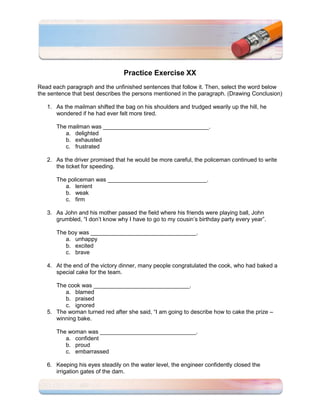
Practice Exercise XX
Read each paragraph and the unfinished sentences that follow it. Then, select the word below
the sentence that best describes the persons mentioned in the paragraph. (Drawing Conclusion)

   1. As the mailman shifted the bag on his shoulders and trudged wearily up the hill, he
      wondered if he had ever felt more tired.

       The mailman was _________________________________.
          a. delighted
          b. exhausted
          c. frustrated

   2. As the driver promised that he would be more careful, the policeman continued to write
      the ticket for speeding.

       The policeman was _______________________________.
          a. lenient
          b. weak
          c. firm

   3. As John and his mother passed the field where his friends were playing ball, John
      grumbled, “I don’t know why I have to go to my cousin’s birthday party every year”.

       The boy was _________________________________.
          a. unhappy
          b. excited
          c. brave

   4. At the end of the victory dinner, many people congratulated the cook, who had baked a
      special cake for the team.

      The cook was ______________________________.
         a. blamed
         b. praised
         c. ignored
   5. The woman turned red after she said, “I am going to describe how to cake the prize –
      winning bake.

       The woman was ______________________________.
          a. confident
          b. proud
          c. embarrassed

   6. Keeping his eyes steadily on the water level, the engineer confidently closed the
      irrigation gates of the dam.
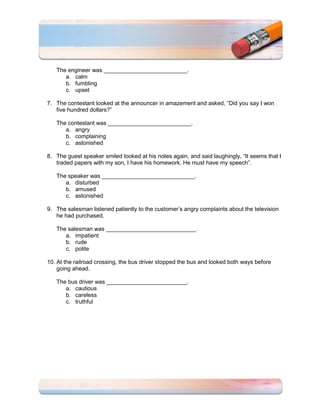
The engineer was __________________________.
      a. calm
      b. fumbling
      c. upset

7. The contestant looked at the announcer in amazement and asked, “Did you say I won
   five hundred dollars?”

   The contestant was __________________________.
      a. angry
      b. complaining
      c. astonished

8. The guest speaker smiled looked at his notes again, and said laughingly, “It seems that I
   traded papers with my son, I have his homework. He must have my speech”.

   The speaker was _____________________________.
      a. disturbed
      b. amused
      c. astonished

9. The salesman listened patiently to the customer’s angry complaints about the television
   he had purchased.

   The salesman was ____________________________.
      a. impatient
      b. rude
      c. polite

10. At the railroad crossing, the bus driver stopped the bus and looked both ways before
    going ahead.

   The bus driver was _________________________.
      a. cautious
      b. careless
      c. truthful
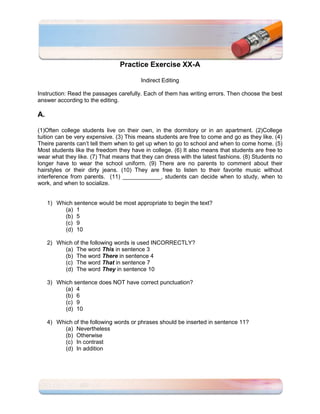
Practice Exercise XX-A

                                        Indirect Editing

Instruction: Read the passages carefully. Each of them has writing errors. Then choose the best
answer according to the editing.

A.

(1)Often college students live on their own, in the dormitory or in an apartment. (2)College
tuition can be very expensive. (3) This means students are free to come and go as they like. (4)
Theire parents can’t tell them when to get up when to go to school and when to come home. (5)
Most students like the freedom they have in college. (6) It also means that students are free to
wear what they like. (7) That means that they can dress with the latest fashions. (8) Students no
longer have to wear the school uniform. (9) There are no parents to comment about their
hairstyles or their dirty jeans. (10) They are free to listen to their favorite music without
interference from parents. (11) ____________, students can decide when to study, when to
work, and when to socialize.


     1) Which sentence would be most appropriate to begin the text?
           (a) 1
           (b) 5
           (c) 9
           (d) 10

     2) Which of the following words is used INCORRECTLY?
           (a) The word This in sentence 3
           (b) The word There in sentence 4
           (c) The word That in sentence 7
           (d) The word They in sentence 10

     3) Which sentence does NOT have correct punctuation?
           (a) 4
           (b) 6
           (c) 9
           (d) 10

     4) Which of the following words or phrases should be inserted in sentence 11?
           (a) Nevertheless
           (b) Otherwise
           (c) In contrast
           (d) In addition
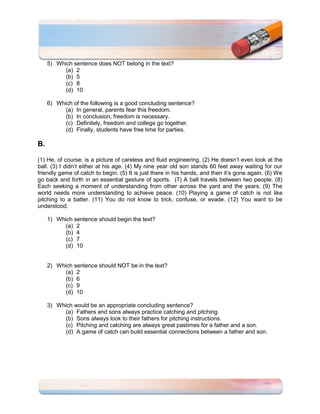
5) Which sentence does NOT belong in the text?
           (a) 2
           (b) 5
           (c) 8
           (d) 10

     6) Which of the following is a good concluding sentence?
           (a) In general, parents fear this freedom.
           (b) In conclusion, freedom is necessary.
           (c) Definitely, freedom and college go together.
           (d) Finally, students have free time for parties.

B.

(1) He, of course, is a picture of careless and fluid engineering. (2) He doesn’t even look at the
ball. (3) I didn’t either at his age. (4) My nine year old son stands 60 feet away waiting for our
friendly game of catch to begin. (5) It is just there in his hands, and then it’s gone again. (6) We
go back and forth in an essential gesture of sports. (7) A ball travels between two people. (8)
Each seeking a moment of understanding from other across the yard and the years. (9) The
world needs more understanding to achieve peace. (10) Playing a game of catch is not like
pitching to a batter. (11) You do not know to trick, confuse, or evade. (12) You want to be
understood.

     1) Which sentence should begin the text?
           (a) 2
           (b) 4
           (c) 7
           (d) 10


     2) Which sentence should NOT be in the text?
           (a) 2
           (b) 6
           (c) 9
           (d) 10

     3) Which would be an appropriate concluding sentence?
           (a) Fathers and sons always practice catching and pitching.
           (b) Sons always look to their fathers for pitching instructions.
           (c) Pitching and catching are always great pastimes for a father and a son.
           (d) A game of catch can build essential connections between a father and son.
C.

(1) Long ago people spent most of their time looking for food. (2) _____________ really ate
anything available. (3) Some live mostly on plants. (4)They ate the fruit, stems, and leaves of
some plants and the roots of others. (5) When food was scarce, they ate the bark of trees. (6) If
they were lucky they would find a birds nest with eggs. (7) I remember the first time I saw a
bird’s nest at the park. (8) All the people who lived near the water ate fish. (9) They ate anything
that washed ashore. (10) They even ate rotten whales. (11) Some people also ate insects and
small animals like lizards that were easy to kill. (12) Later, people learned to make weapons.
(13) With weapons, they could kill larger animals for meat.

     1) Which sentence does NOT belong in the text?
           (a) 3
           (b) 5
           (c) 7
           (d) 13


     2) Which word should be inserted in the blank in sentence 2?
           (a) He
           (b) It
           (c) They
           (d) Them
           (e)

     3) Which sentence is most appropriate to end the text?
           (a) They left their land to find food.
           (b) Life was a little better then.
           (c) Early people had big appetites.
           (d) They made the weapons for war.

     4) Which sentence is INCORRECTLY punctuated?
           (a) 4
           (b) 5
           (c) 6
           (d) 7


     5) Which is the best way of combining sentences 8, 9, and 10?
           (a) All the people who lived near the water ate fish, but they even ate rotten whales
               and anything that washed ashore.
           (b) People who lived near the water ate anything, even rotten whales and they ate
               fish that washed ashore.
           (c) All the people living near the water ate even rotten fish, and anything that
               washed ashore.
           (d) People who lived near the water ate fish or anything that washed ashore, even
               rotten whales.

Reading Comprehension Cognates

  • 1.
    Escuela de EducaciónContinua Repaso para la Prueba de Evaluación y Admisión Universitaria (College Board) INGLÉS Reading Comprehension Cognates Preparado por Prof. Carmen Cembalest, Enero 1994 Revisado por Prof. Thelvenitsie Hernández, Junio 2006
  • 2.
    Este manual espropiedad del Campus Virtual de la Escuela de Educación Continua de la Universidad Metropolitana. El mismo no puede ser reproducido parcial ni totalmente sin la autorización expresa del Decano Asociado del Campus Virtual de la Escuela de Educación Continua de la Universidad Metropolitana. Escuela de Educación Continua de UMET, enero 2012
  • 3.
    Reading Comprehension: The explanationand exercises that follow are geared to test your ability to read and understand a passage. When you read a paragraph or an essay, you must follow certain guidelines that will help you understand and analyze the ideas brought up by the writer. a. Context Clues – These are words (that you know the meaning of) around the words you are reading, that help you determine the meaning of the new word. b. Synonyms – Words with the same or nearly the same meaning. c. Antonyms – Words with opposite d. Cognates – Words that are spelled alike or almost alike, sound alike and have the same meaning in English and Spanish. False cognate, then, are words that sound alike, but do not have the same meaning. e. Inference – You draw conclusions or deduct from the information given. f. Transitional devices – Establish a bridge between two ideas. They also help the reader to find out the kinds of developmental paragraphs in an essay. g. Prefixes and suffixes –  A prefix is a word part added to the beginning of a base word or word root. Ex. discover (prefix)  A suffix is a word part added to the end of a base word or word root. Ex. speechless (suffix) h. Analogies – expresses an agreement of likeness between things in some circumstances. This relationship is between the meaning and or the usage of English words, and is usually offered as a sentence written in an abbreviated form.
  • 4.
    Practice Exercise XX Readeach paragraph and the unfinished sentences that follow it. Then, select the word below the sentence that best describes the persons mentioned in the paragraph. (Drawing Conclusion) 1. As the mailman shifted the bag on his shoulders and trudged wearily up the hill, he wondered if he had ever felt more tired. The mailman was _________________________________. a. delighted b. exhausted c. frustrated 2. As the driver promised that he would be more careful, the policeman continued to write the ticket for speeding. The policeman was _______________________________. a. lenient b. weak c. firm 3. As John and his mother passed the field where his friends were playing ball, John grumbled, “I don’t know why I have to go to my cousin’s birthday party every year”. The boy was _________________________________. a. unhappy b. excited c. brave 4. At the end of the victory dinner, many people congratulated the cook, who had baked a special cake for the team. The cook was ______________________________. a. blamed b. praised c. ignored 5. The woman turned red after she said, “I am going to describe how to cake the prize – winning bake. The woman was ______________________________. a. confident b. proud c. embarrassed 6. Keeping his eyes steadily on the water level, the engineer confidently closed the irrigation gates of the dam.
  • 5.
    The engineer was__________________________. a. calm b. fumbling c. upset 7. The contestant looked at the announcer in amazement and asked, “Did you say I won five hundred dollars?” The contestant was __________________________. a. angry b. complaining c. astonished 8. The guest speaker smiled looked at his notes again, and said laughingly, “It seems that I traded papers with my son, I have his homework. He must have my speech”. The speaker was _____________________________. a. disturbed b. amused c. astonished 9. The salesman listened patiently to the customer’s angry complaints about the television he had purchased. The salesman was ____________________________. a. impatient b. rude c. polite 10. At the railroad crossing, the bus driver stopped the bus and looked both ways before going ahead. The bus driver was _________________________. a. cautious b. careless c. truthful
  • 6.
    Practice Exercise XX-A Indirect Editing Instruction: Read the passages carefully. Each of them has writing errors. Then choose the best answer according to the editing. A. (1)Often college students live on their own, in the dormitory or in an apartment. (2)College tuition can be very expensive. (3) This means students are free to come and go as they like. (4) Theire parents can’t tell them when to get up when to go to school and when to come home. (5) Most students like the freedom they have in college. (6) It also means that students are free to wear what they like. (7) That means that they can dress with the latest fashions. (8) Students no longer have to wear the school uniform. (9) There are no parents to comment about their hairstyles or their dirty jeans. (10) They are free to listen to their favorite music without interference from parents. (11) ____________, students can decide when to study, when to work, and when to socialize. 1) Which sentence would be most appropriate to begin the text? (a) 1 (b) 5 (c) 9 (d) 10 2) Which of the following words is used INCORRECTLY? (a) The word This in sentence 3 (b) The word There in sentence 4 (c) The word That in sentence 7 (d) The word They in sentence 10 3) Which sentence does NOT have correct punctuation? (a) 4 (b) 6 (c) 9 (d) 10 4) Which of the following words or phrases should be inserted in sentence 11? (a) Nevertheless (b) Otherwise (c) In contrast (d) In addition
  • 7.
    5) Which sentencedoes NOT belong in the text? (a) 2 (b) 5 (c) 8 (d) 10 6) Which of the following is a good concluding sentence? (a) In general, parents fear this freedom. (b) In conclusion, freedom is necessary. (c) Definitely, freedom and college go together. (d) Finally, students have free time for parties. B. (1) He, of course, is a picture of careless and fluid engineering. (2) He doesn’t even look at the ball. (3) I didn’t either at his age. (4) My nine year old son stands 60 feet away waiting for our friendly game of catch to begin. (5) It is just there in his hands, and then it’s gone again. (6) We go back and forth in an essential gesture of sports. (7) A ball travels between two people. (8) Each seeking a moment of understanding from other across the yard and the years. (9) The world needs more understanding to achieve peace. (10) Playing a game of catch is not like pitching to a batter. (11) You do not know to trick, confuse, or evade. (12) You want to be understood. 1) Which sentence should begin the text? (a) 2 (b) 4 (c) 7 (d) 10 2) Which sentence should NOT be in the text? (a) 2 (b) 6 (c) 9 (d) 10 3) Which would be an appropriate concluding sentence? (a) Fathers and sons always practice catching and pitching. (b) Sons always look to their fathers for pitching instructions. (c) Pitching and catching are always great pastimes for a father and a son. (d) A game of catch can build essential connections between a father and son.
  • 8.
    C. (1) Long agopeople spent most of their time looking for food. (2) _____________ really ate anything available. (3) Some live mostly on plants. (4)They ate the fruit, stems, and leaves of some plants and the roots of others. (5) When food was scarce, they ate the bark of trees. (6) If they were lucky they would find a birds nest with eggs. (7) I remember the first time I saw a bird’s nest at the park. (8) All the people who lived near the water ate fish. (9) They ate anything that washed ashore. (10) They even ate rotten whales. (11) Some people also ate insects and small animals like lizards that were easy to kill. (12) Later, people learned to make weapons. (13) With weapons, they could kill larger animals for meat. 1) Which sentence does NOT belong in the text? (a) 3 (b) 5 (c) 7 (d) 13 2) Which word should be inserted in the blank in sentence 2? (a) He (b) It (c) They (d) Them (e) 3) Which sentence is most appropriate to end the text? (a) They left their land to find food. (b) Life was a little better then. (c) Early people had big appetites. (d) They made the weapons for war. 4) Which sentence is INCORRECTLY punctuated? (a) 4 (b) 5 (c) 6 (d) 7 5) Which is the best way of combining sentences 8, 9, and 10? (a) All the people who lived near the water ate fish, but they even ate rotten whales and anything that washed ashore. (b) People who lived near the water ate anything, even rotten whales and they ate fish that washed ashore. (c) All the people living near the water ate even rotten fish, and anything that washed ashore. (d) People who lived near the water ate fish or anything that washed ashore, even rotten whales.