Cause and Effect
 We learn about cause and effect
because we like to understand how
events are related to one another.
 Cause/Effect relationships help
explain why things happen.
 A cause is the reason something
happens.
 An effect is the thing that happens
as a result of the cause.
Example: Since I babysat during the
summer, I was able to buy a new
bike.
 How was she able to buy the bike?
(effect)
 She babysat during the summer.
(cause)
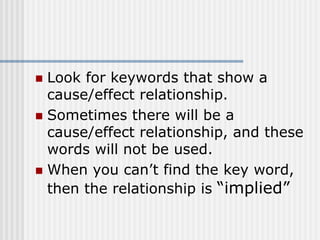
 Look for keywords that show a
cause/effect relationship.
 Sometimes there will be a
cause/effect relationship, and these
words will not be used.
 When you can’t find the key word,
then the relationship is “implied”
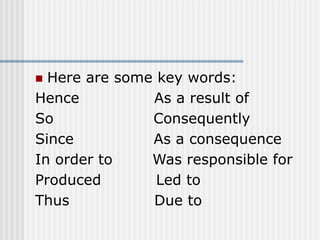
 Here are some key words:
Hence As a result of
So Consequently
Since As a consequence
In order to Was responsible for
Produced Led to
Thus Due to
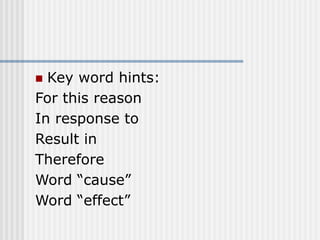
 Key word hints:
For this reason
In response to
Result in
Therefore
Word “cause”
Word “effect”
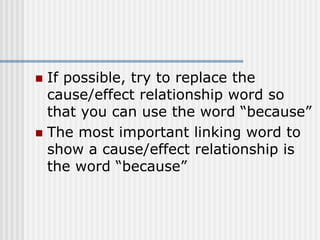
 If possible, try to replace the
cause/effect relationship word so
that you can use the word “because”
 The most important linking word to
show a cause/effect relationship is
the word “because”
 If you change your sentences
around so their meaning does not
change and you can add “because”
to the events, you probably have the
correct cause/effect answer.
 Example:
Jerry did not study for his test. He
knew that he had to pass the test.
Jerry wasn’t surprised when he
failed the test.
 Jerry failed his test because he
didn’t study.
 Cause: He did not study
 Effect: He failed his test
 Sometimes cause/effect linking
words are “understood”
 This happens when writers leave out
the key words that define a
cause/effect relationship.
 Example:
Ben was running late for school, but it
was a beautiful morning, so he
wanted to walk. Ben saw his
neighbor chasing his wild, little
puppy. Ben knew he had to help.
Why was Ben late?
(effect)
1st cause: he walked to school
2nd cause: he helped his neighbor
Both of these are causes/effects that
could have related to his being late.
 Sometimes cause/effect
relationships are only “implied” and
must be “inferred” by the reader.
 If the cause/effect is not directly
stated, you will have to infer:
Look for details
Use logical reasoning or common
sence
 Example
Ben got up early enough to get ready
for school, but he knew he didn’t
write his English paper. He dreaded
going because his teacher would be
very disappointed.
 Why would Ben not go to school?
 It is implied that he would not go to
school (effect) since he didn’t turn in
his English paper (cause).
 When you are looking for
cause/effect relationships, there will
be other information with it.
 For example, when you are reading
a passage, textbook, or newspaper,
you will have cause/effect
relationships, but you will have
other information that you will have
to understand, too.
Answering Cause/Effect
Questions
 1. Read the passage carefully
 2. Figure out the question. What is
it asking for?
 3. Did you notice key words?
 4. Find your proof or support in the
passage.
Reading Cause and Effect 1.ppt

Reading Cause and Effect 1.ppt

  • 1.
    Cause and Effect We learn about cause and effect because we like to understand how events are related to one another.  Cause/Effect relationships help explain why things happen.
  • 2.
     A causeis the reason something happens.  An effect is the thing that happens as a result of the cause. Example: Since I babysat during the summer, I was able to buy a new bike.
  • 3.
     How wasshe able to buy the bike? (effect)  She babysat during the summer. (cause)
  • 4.
     Look forkeywords that show a cause/effect relationship.  Sometimes there will be a cause/effect relationship, and these words will not be used.  When you can’t find the key word, then the relationship is “implied”
  • 5.
     Here aresome key words: Hence As a result of So Consequently Since As a consequence In order to Was responsible for Produced Led to Thus Due to
  • 6.
     Key wordhints: For this reason In response to Result in Therefore Word “cause” Word “effect”
  • 7.
     If possible,try to replace the cause/effect relationship word so that you can use the word “because”  The most important linking word to show a cause/effect relationship is the word “because”
  • 8.
     If youchange your sentences around so their meaning does not change and you can add “because” to the events, you probably have the correct cause/effect answer.
  • 9.
     Example: Jerry didnot study for his test. He knew that he had to pass the test. Jerry wasn’t surprised when he failed the test.
  • 10.
     Jerry failedhis test because he didn’t study.  Cause: He did not study  Effect: He failed his test
  • 11.
     Sometimes cause/effectlinking words are “understood”  This happens when writers leave out the key words that define a cause/effect relationship.
  • 12.
     Example: Ben wasrunning late for school, but it was a beautiful morning, so he wanted to walk. Ben saw his neighbor chasing his wild, little puppy. Ben knew he had to help.
  • 13.
    Why was Benlate? (effect) 1st cause: he walked to school 2nd cause: he helped his neighbor Both of these are causes/effects that could have related to his being late.
  • 14.
     Sometimes cause/effect relationshipsare only “implied” and must be “inferred” by the reader.  If the cause/effect is not directly stated, you will have to infer: Look for details Use logical reasoning or common sence
  • 15.
     Example Ben gotup early enough to get ready for school, but he knew he didn’t write his English paper. He dreaded going because his teacher would be very disappointed.
  • 16.
     Why wouldBen not go to school?  It is implied that he would not go to school (effect) since he didn’t turn in his English paper (cause).
  • 17.
     When youare looking for cause/effect relationships, there will be other information with it.  For example, when you are reading a passage, textbook, or newspaper, you will have cause/effect relationships, but you will have other information that you will have to understand, too.
  • 18.
    Answering Cause/Effect Questions  1.Read the passage carefully  2. Figure out the question. What is it asking for?  3. Did you notice key words?  4. Find your proof or support in the passage.