Data-Driven Requirements
Engineering: Principles, Methods
and Challenges
Xavier Franch
Universitat Politècnica de Catalunya (UPC-BarcelonaTech)
Tutorial at RCIS’20, September
(virtually) Limassol, Cyprus
2
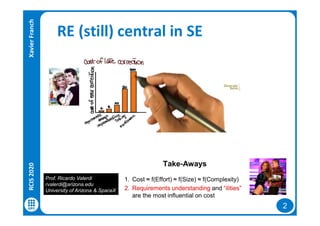
RE (still) central in SERCIS2020XavierFranch
3
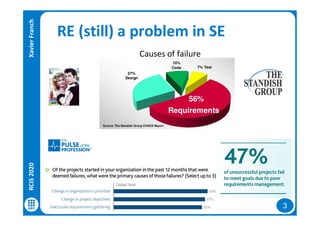
RE (still) a problem in SE
Causes of failure
RCIS2020XavierFranch
4
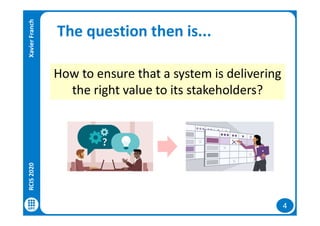
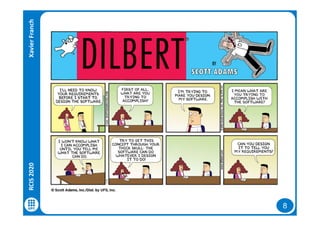
The question then is...
How to ensure that a system is delivering
the right value to its stakeholders?
RCIS2020XavierFranch
5
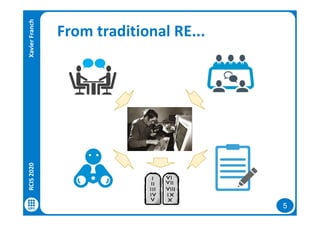
From traditional RE...RCIS2020XavierFranch
6
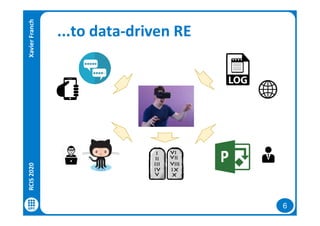
...to data-driven RERCIS2020XavierFranch
7
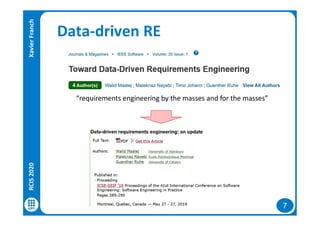
Data-driven RE
“requirements engineering by the masses and for the masses”
RCIS2020XavierFranch
8
RCIS2020XavierFranch
9
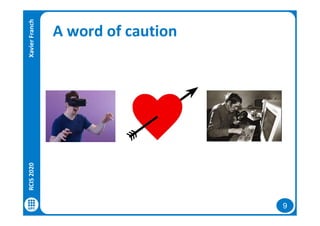
A word of cautionRCIS2020XavierFranch
10
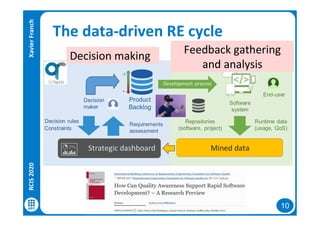
The data-driven RE cycleRCIS2020XavierFranch
Feedback gathering
and analysis
Decision making
11
EXPLICIT FEEDBACK
RCIS2020XavierFranch
12
Explicit Feedback
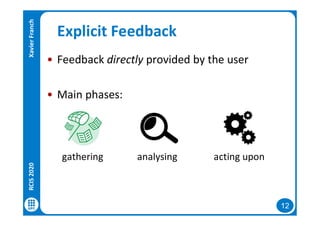
• Feedback directly provided by the user
• Main phases:
gathering analysing acting upon
RCIS2020XavierFranch
13
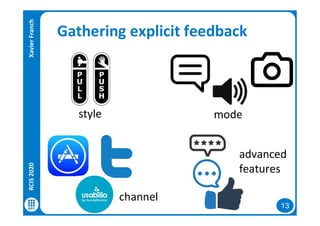
Gathering explicit feedbackRCIS2020XavierFranch
style mode
advanced
features
channel
14
Explicit feedback analysis
• Preprocessing
• Categorization
• Sentiment analysis
• Topic modeling
RCIS2020XavierFranch
15
Behind the curtains
• NLP: processing textual information
• ML: learning from data
RCIS2020XavierFranch
16
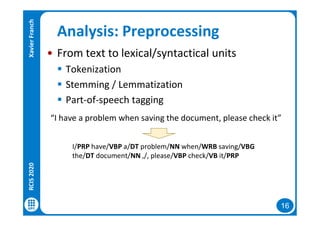
Analysis: Preprocessing
• From text to lexical/syntactical units
 Tokenization
 Stemming / Lemmatization
 Part-of-speech tagging
“I have a problem when saving the document, please check it”
I/PRP have/VBP a/DT problem/NN when/WRB saving/VBG
the/DT document/NN ,/, please/VBP check/VB it/PRP
RCIS2020XavierFranch
17
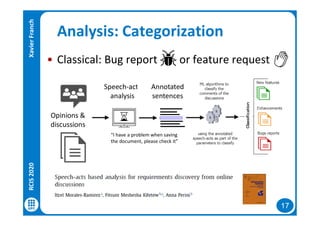
Analysis: Categorization
• Classical: Bug report or feature request
Speech-actt
analysis
Opinions &
discussions
Annotated
sentences
“I have a problem when saving
the document, please check it”
RCIS2020XavierFranch
18
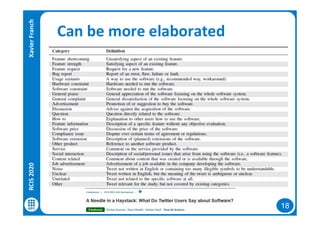
Can be more elaboratedRCIS2020XavierFranch
19
Analysis: Sentiment analysis
Deciding if a piece of text expresses a particular affect or mood
But of course, not easy...:
“Great, I like this feature that gives me this lovely headache”
had fun using it before but now it is really horrible :( help!!
+2 -2-1 -1 -1[+2,-5]
uploading pictures with the app is so annoying!
pleeeeeeease add an unlike button and I will love you forever!!
[+1,-3]
[+5,-1]
Approaches: use of dictionaries and ML/DL techniques
RCIS2020XavierFranch
20
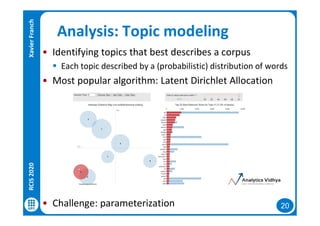
Analysis: Topic modeling
• Identifying topics that best describes a corpus
 Each topic described by a (probabilistic) distribution of words
• Most popular algorithm: Latent Dirichlet Allocation
• Challenge: parameterization
RCIS2020XavierFranch
21
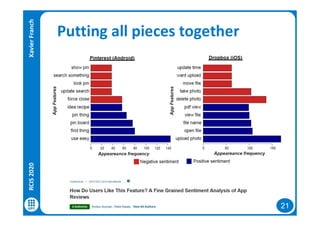
Putting all pieces togetherRCIS2020XavierFranch
22
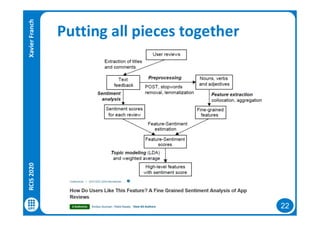
Putting all pieces togetherRCIS2020XavierFranch
23
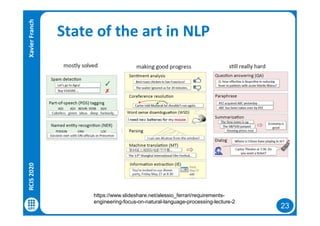
State of the art in NLP
https://www.slideshare.net/alessio_ferrari/requirements-
engineering-focus-on-natural-language-processing-lecture-2
RCIS2020XavierFranch
24
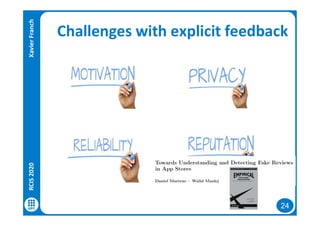
Challenges with explicit feedbackRCIS2020XavierFranch
25
IMPLICIT FEEDBACK
RCIS2020XavierFranch
26
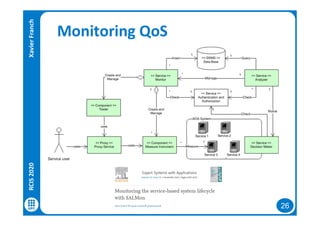
Monitoring QoSRCIS2020XavierFranch
27
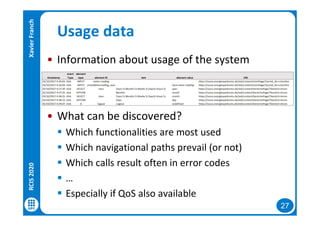
Usage data
• Information about usage of the system
• What can be discovered?
 Which functionalities are most used
 Which navigational paths prevail (or not)
 Which calls result often in error codes
 …
 Especially if QoS also available
RCIS2020XavierFranch
28
Challenges with usage logs
• Data noise
• Incomplete data
• Concept of session
• Evolution
• Anonymization
• …
RCIS2020XavierFranch
29
Boosting in IoT and mobile devicesRCIS2020XavierFranch
30
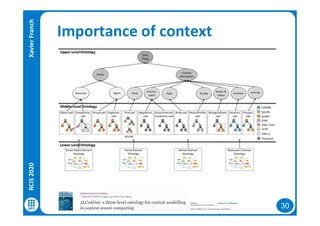
Importance of contextRCIS2020XavierFranch
31
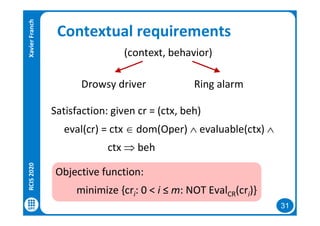
Contextual requirements
(context, behavior)
Drowsy driver Ring alarm
Satisfaction: given cr = (ctx, beh)
eval(cr) = ctx  dom(Oper)  evaluable(ctx) 
ctx  beh
Objective function:
minimize {cri: 0 < i ≤ m: NOT EvalCR(cri)}
RCIS2020XavierFranch
32
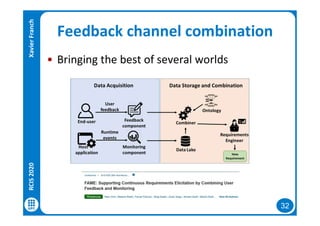
Feedback channel combinationRCIS2020XavierFranch
• Bringing the best of several worlds
33
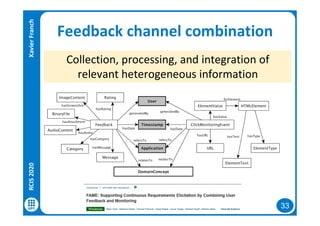
Collection, processing, and integration of
relevant heterogeneous information
RCIS2020XavierFranch Feedback channel combination
34
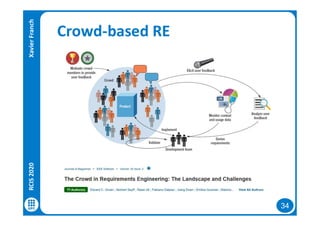
Crowd-based RERCIS2020XavierFranch
35
DECISION MAKING
RCIS2020XavierFranch
36
Keys to decision making
software analytics
release planning
RCIS2020XavierFranch
37
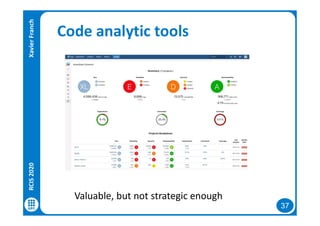
Code analytic tools
Valuable, but not strategic enough
RCIS2020XavierFranch
38
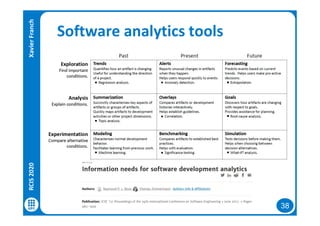
Software analytics toolsRCIS2020XavierFranch
39
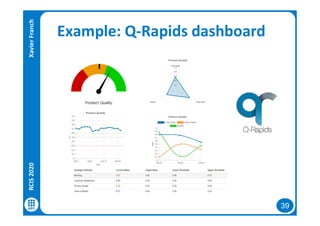
Example: Q-Rapids dashboardRCIS2020XavierFranch
40
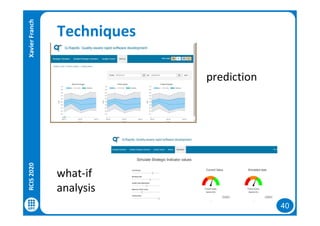
Techniques
prediction
what-if
analysis
RCIS2020XavierFranch
41
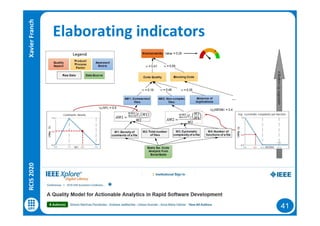
Elaborating indicatorsRCIS2020XavierFranch
42
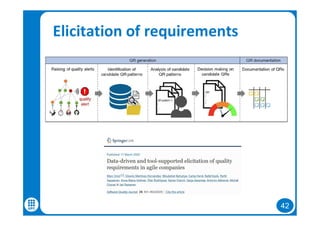
Elicitation of requirements
43
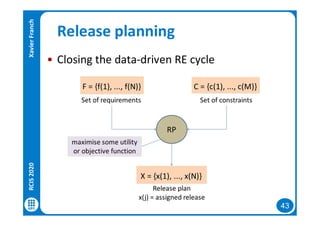
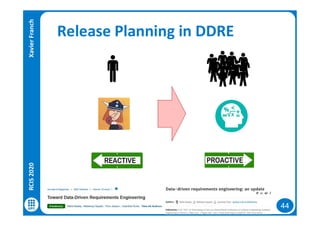
Release planning
• Closing the data-driven RE cycle
RCIS2020XavierFranch
44
Release Planning in DDRERCIS2020XavierFranch
45
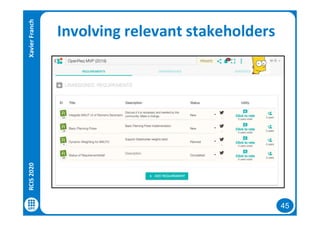
Involving relevant stakeholdersRCIS2020XavierFranch
46
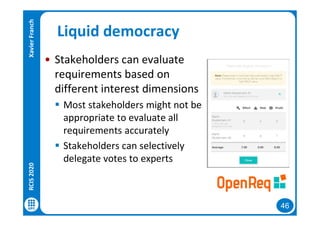
Liquid democracy
• Stakeholders can evaluate
requirements based on
different interest dimensions
 Most stakeholders might not be
appropriate to evaluate all
requirements accurately
 Stakeholders can selectively
delegate votes to experts
RCIS2020XavierFranch
47
THE WAY AHEAD
RCIS2020XavierFranch
48
The way ahead
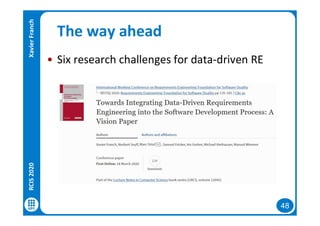
• Six research challenges for data-driven RE
RCIS2020XavierFranch
49
Challenge 1
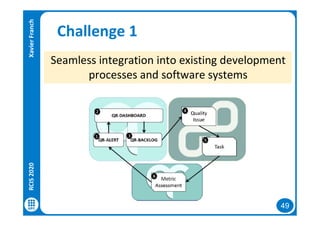
Seamless integration into existing development
processes and software systems
RCIS2020XavierFranch
50
Challenge 1
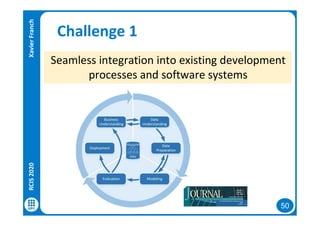
Seamless integration into existing development
processes and software systems
RCIS2020XavierFranch
51
Challenge 2
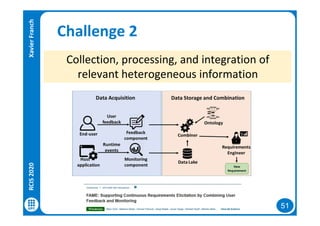
Collection, processing, and integration of
relevant heterogeneous information
RCIS2020XavierFranch
52
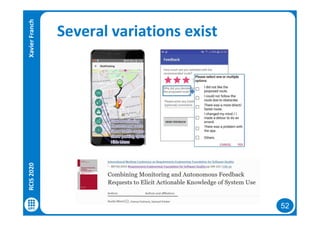
Several variations existRCIS2020XavierFranch
53
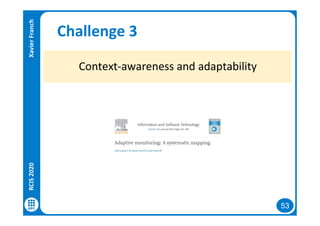
Challenge 3
Context-awareness and adaptability
RCIS2020XavierFranch
54
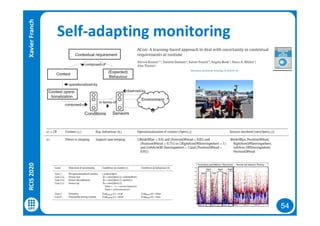
Self-adapting monitoringRCIS2020XavierFranch
55
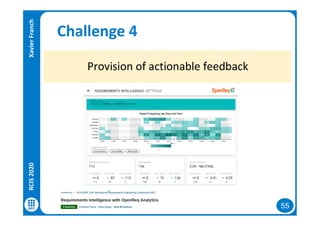
Challenge 4
Provision of actionable feedback
RCIS2020XavierFranch
56
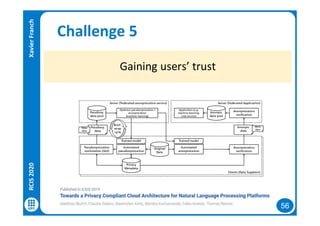
Challenge 5
Gaining users’ trust
RCIS2020XavierFranch
57
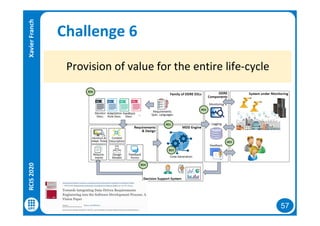
Challenge 6
Provision of value for the entire life-cycle
RCIS2020XavierFranch
58
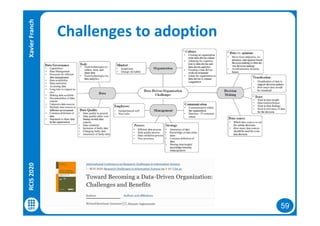
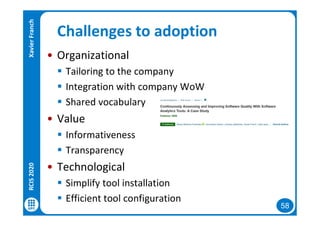
Challenges to adoption
• Organizational
 Tailoring to the company
 Integration with company WoW
 Shared vocabulary
• Value
 Informativeness
 Transparency
• Technological
 Simplify tool installation
 Efficient tool configuration
RCIS2020XavierFranch
59
Challenges to adoptionRCIS2020XavierFranch
60
Lessons learned (I)
• Not for free
 Adapt process and mindset
 Develop infrastructure
• Different for every company
 Processes need to be customizable
• Expertise needed
 Specialized roles (e.g. data scientists)
RCIS2020XavierFranch
61
Lessons learned (II)
• Needs to be implemented incrementally
 Gradually master intricacies
 Create awareness in the organization
• Transparency as a must
 Clear rationale behind decisions
 Shown to relevant stakeholders
RCIS2020XavierFranch
62
CONCLUSIONS
RCIS2020XavierFranch
63
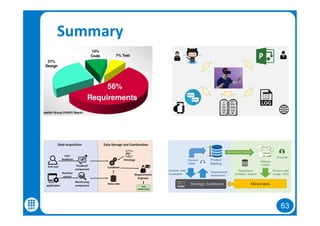
Summary
64
Final considerations
• Offers a great opportunity for delivering more
business value to systems’ stakeholders
• Some considerations
 Not a hammer for every nail
 Data-driven  needs data
• Still traditional methods at least to start with
• The role of traditional RE in the loop is worth considering
 New, but maybe not as much
• E.g., compare to online experimentation
– A/B tests, fake door tests, …
• Other areas: UCD, process mining, MSR, …
RCIS2020XavierFranch
65
Thanks to...
• Anna Perini, Fabiano Dalpiaz, Marc Oriol,
Silverio Martínez for comments on early
versions and associated documents
RCIS2020XavierFranch
Summary at:
Franch, X.: Data-Driven Requirements Engineering: Principles, Methods
and Challenges. In Proceedings of the 14th International Conference on
Research Challenges in Information Science (RCIS 2020). LNBIP 385:
625-626, Springer, 2020.
Available at:
https://www.researchgate.net/publication/344328110_Data_Driven_Requi
rements_Engineering_Principles_Methods_and_Challenges
66
Images All other images labelled for reuse
Data-Driven Requirements
Engineering: Principles, Methods
and Challenges
Xavier Franch
Universitat Politècnica de Catalunya (UPC-BarcelonaTech)
Tutorial at RCIS’20, September
(virtually) Limassol, Cyprus

RCIS 2020 tutorial DDRE