PR­640­01 
History and Theory 
of Preservation 
Prof. Nadya Nenadich 
Rodrigo Balarezo 
Research topic: 
Restoration of the Central City Alvar Aalto Library in Vyborg 
“Intuition can sometimes be astonishingly rational” 
-Alvar Aalto 
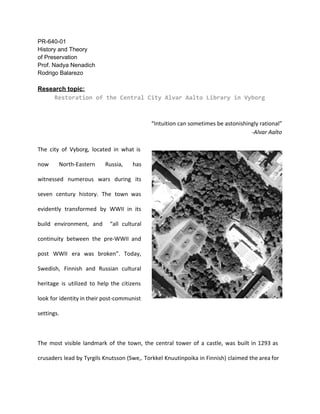
The city of Vyborg, located in what is 
now North-Eastern Russia, has 
witnessed numerous wars during its 
seven century history. The town was 
evidently transformed by WWII in its 
build environment, and “all cultural 
continuity between the pre-WWII and 
post WWII era was broken”. Today, 
Swedish, Finnish and Russian cultural 
heritage is utilized to help the citizens 
look for identity in their post-communist 
settings. 
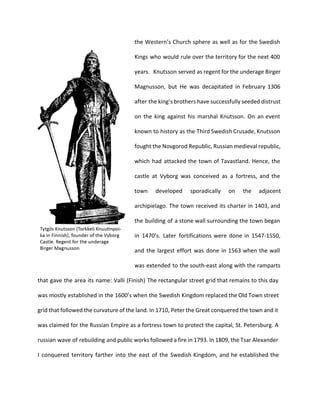
The most visible landmark of the town, the central tower of a castle, was built in 1293 as 
crusaders lead by Tyrgils Knutsson (Swe,. Torkkel Knuutinpoika in Finnish) claimed the area for
the Western’s Church sphere as well as for the Swedish 
Kings who would rule over the territory for the next 400 
years. Knutsson served as regent for the underage Birger 
Magnusson, but He was decapitated in February 1306 
after the king’s brothers have successfully seeded distrust 
on the king against his marshal Knutsson. On an event 
known to history as the Third Swedish Crusade, Knutsson 
fought the Novgorod Republic, Russian medieval republic, 
which had attacked the town of Tavastland. Hence, the 
castle at Vyborg was conceived as a fortress, and the 
town developed sporadically on the adjacent 
archipielago. The town received its charter in 1403, and 
the building of a stone wall surrounding the town began 
in 1470’s. Later fortifications were done in 1547-1550, 
and the largest effort was done in 1563 when the wall 
was extended to the south-east along with the ramparts 
that gave the area its name: Valli (Finish) The rectangular street grid that remains to this day 
was mostly established in the 1600’s when the Swedish Kingdom replaced the Old Town street 
grid that followed the curvature of the land. In 1710, Peter the Great conquered the town and it 
was claimed for the Russian Empire as a fortress town to protect the capital, St. Petersburg. A 
russian wave of rebuilding and public works followed a fire in 1793. In 1809, the Tsar Alexander 
I conquered territory farther into the east of the Swedish Kingdom, and he established the
Grand Duchy of Finland to which Vyborg was joined in 
1812. At this time, the town was still a fortress town 
composed by: the castle, the main fortress (surrounding 
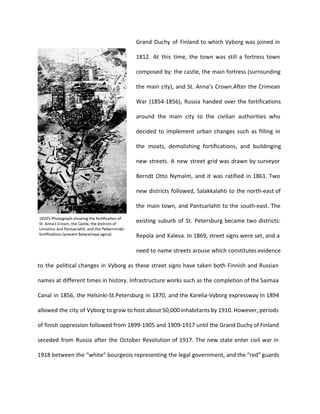
the main city), and St. Anna’s Crown.After the Crimean 
War (1854-1856), Russia handed over the fortifications 
around the main city to the civilian authorities who 
decided to implement urban changes such as filling in 
the moats, demolishing fortifications, and buildinging 
new streets. A new street grid was drawn by surveyor 
Berndt Otto Nymalm, and it was ratified in 1861. Two 
new districts followed, Salakkalahti to the north-east of 
the main town, and Pantsarlahti to the south-east. The 
existing suburb of St. Petersburg became two districts: 
Repola and Kaleva. In 1869, street signs were set, and a 
need to name streets arouse which constitutes evidence 
to the political changes in Vyborg as these street signs have taken both Finnish and Russian 
names at different times in history. Infrastructure works such as the completion of the Saimaa 
Canal in 1856, the Helsinki-St.Petersburg in 1870, and the Karelia-Vyborg expressway in 1894 
allowed the city of Vyborg to grow to host about 50,000 inhabitants by 1910. However, periods 
of finish oppression followed from 1899-1905 and 1909-1917 until the Grand Duchy of Finland 
seceded from Russia after the October Revolution of 1917. The new state enter civil war in 
1918 between the “white” bourgeois representing the legal government, and the “red” guards
hoping to create a socialist republic. The town of Vyborg was conquered by the white army in 
April 1918 with reds fleeting to St. Petersburg. At this time Vyborg was considered a bastion of 
western culture at the fringe of communist Russia. In 1923, Maria Lalukka, the widow of Juho 
Lalukka, donated funds for the construction of a municipal library, and an architectural 
competition was established in 1927. Alvar Aalto won the competition, with a classicist scheme, 
as it was announced in February 1928. However, a list of considerations were given to the 
architect which spurred the development of numerous schemes until 1929. In 1929, the first 
cycle of street name changes occurred as some of the street names were changed from Russian 
to Finish in order to represent the new cultural values and in order to forget old Russian 
oppression. Coincidentally, the recession at this time caused the project to be delayed until 
October 1933 when the location of the library changed, and Aalto was required to submit new 
and final drawings which lead to the library’s completion in 1935. 
According to some of Aalto’s description of the project the form and design resulted from the 
change in the library’s location which allowed him to “freed the design from the constraints of 
external formality”. The three main elements were: the library itself with its various 
departments which form the main massing with interdependent relationships focused on 
serving the human eye; the socially active part of library such as clubrooms, smaller spaces and 
offices “open to the exterior, and light in construction” focused on the human ear, and the 
internal circulation network which becomes the “medium combining the above psychological 
conditions”. The entrance to the kid’s library was at a lower level whereas the main entrance
was at the intersection of a group of meandering paths, and the newsroom was accessible 
directly from the street. 
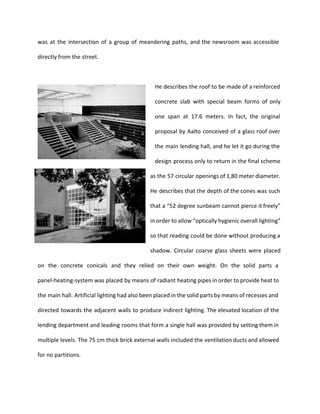
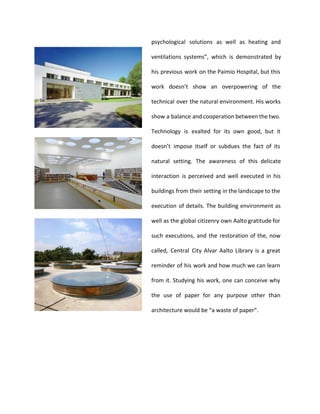
He describes the roof to be made of a reinforced 
concrete slab with special beam forms of only 
one span at 17.6 meters. In fact, the original 
proposal by Aalto conceived of a glass roof over 
the main lending hall, and he let it go during the 
design process only to return in the final scheme 
as the 57 circular openings of 1,80 meter diameter. 
He describes that the depth of the cones was such 
that a “52 degree sunbeam cannot pierce it freely” 
in order to allow “optically hygienic overall lighting” 
so that reading could be done without producing a 
shadow. Circular coarse glass sheets were placed 
on the concrete conicals and they relied on their own weight. On the solid parts a 
panel-heating-system was placed by means of radiant heating pipes in order to provide heat to 
the main hall. Artificial lighting had also been placed in the solid parts by means of recesses and 
directed towards the adjacent walls to produce indirect lighting. The elevated location of the 
lending department and leading rooms that form a single hall was provided by setting them in 
multiple levels. The 75 cm thick brick external walls included the ventilation ducts and allowed 
for no partitions.
The clubroom and office wing had a steel frame construction, and the floors were massive 
concrete slabs where the floor finished was fixed directly on the slab with sound insulation 
provided by the heaviness of the slab and soft fibre boards insulite. The roofs were insulated 
with a fabric which had a lead membrane between two bitumen layers, and it didn’t have filling 
as in the hall. Roof outlets for rainwater drainage and flashings were made of copper. Since the 
human ear was the main concern, the lecture hall’s undulating lamellas were used so that 
sound could be emitted and received at any location in the hall, and not just at one location as 
it’s the case in a concert hall. The windows were steel frame covered with teak on the inside. 
Different woods had been placed in different locations depending on the possibility of wear: 
karelian red pine in the clubrooms, sycamore in the entrance hall, oak, birch in the children’s 
library and teak in the furniture, red beech and karelian pine (most durable) in the actual 
library. The central heating was made of the “panel-heating”system which produced radiant 
heat to warm up the concrete and plaster surfaces by a “dense network of pipes” thus 
providing no conflict between shelves and the heating system. Additionally, the central 
ventilation system was produced by fresh air distributed by ventilations pipes thought the 
different parts of the building. the distributing branches of these were glazed fire clay or cast 
iron. Textiles also played an important role in the buildings as curtains, door and wall coverings, 
and elements separating different spaces. The natural lime painted surface remain in order to 
make reference to natural materials. Thus, the main color scheme is made in reference to 
materials. In 1938, the Museum of Modern art displayed drawings for the Viipuri (Vyborg)
Library, the Turum Sanomat Building, and the Paimio Sanatorium in its first exhibition of an 
International Style Architect consolidating Alvar Aalto’s international fame. 
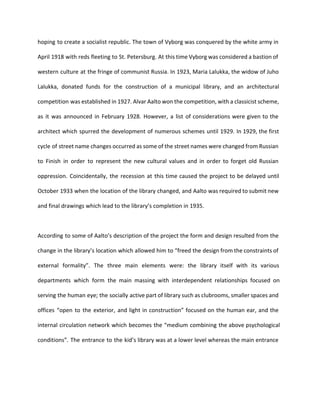
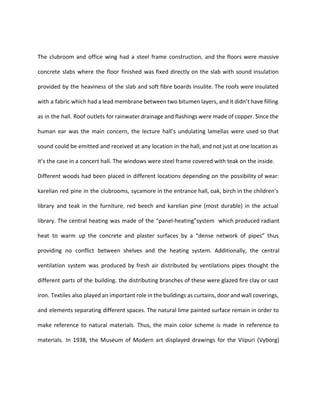
By the WWII, Vyborg was 
the second largest city in 
Finland with around 75,000 
to 80,000 inhabitants. 
However, in November 
1939, Russia attacked 
Finland at the beginning of 
what became known as the 
Winter War, and bombing raids began over Vyburg whose population was forced to escape. At 
the end of the hostilities, Finland was forced to hand over part of its eastern territory along 
with Vyborg to Russia. Hence, the second cycle of changes occurred to street names, this time 
turning Finish street signs to Russian. After the Continuation War in 1941, the finish recaptured 
Vyborg. and They started a resettlement program that brought its population back to 30,000 in 
three years along with new street name changes. However, the finns were again forced to 
evacuate after a massive Red Army attack in 1944. At this time, Finland and Russia signed a 
peace treaty which conceded Vyborg to Russia, and the town which was once considered a 
bastion of western civilization officially became a Soviet border town which continues to be 
until the present day. The library, which was not greatly damaged by the wars, was left empty 
and unattended for the following 10 years as the new Russian inhabitants labored to rebuild 
this then ghost town.
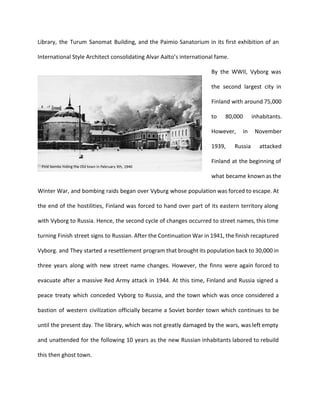
In 1955, the first of a series of restorations to the 
library began. Aleksandr Mihailovich Shver lead the 
first Russian restoration, but the government denied 
his request, due to the political climate, for Finish 
original drawings and other Finish bought elements 
such as the circular glass panels for the oculi, and 
the air-conditioning equipment. The flat roof pitch 
was altered by inclining the concrete pouring by two 
brick rows, and the windows of the main lecture hall 
were reduced about 8 in in high because glass 
wasn’t manufactured at that dimension in the Soviet 
Union at this time. However, the lecture hall was not 
altered to host a movie theater as proposed, the curved paneling of the ceiling was restored 
using spruce timber, old pictures and paint marks on the wall, and the library continued to 
operate as such. 
Then, around 1970s concerns were raised about the condition of the library and appeals were 
sent to the the Russian Government. In May 1989, after these appeals were not answered, a 
group of twenty leading architects and professors sent a letter to the then president of Finland, 
Mauno Koivisto, in an effort to preserve the library. However, the political environment at the 
time didn’t allow for any effective change, until March 1991 when the Finnish Ministry of the
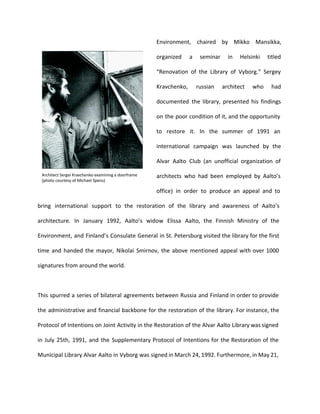
Environment, chaired by Mikko Mansikka, 
organized a seminar in Helsinki titled 
“Renovation of the Library of Vyborg.” Sergey 
Kravchenko, russian architect who had 
documented the library, presented his findings 
on the poor condition of it, and the opportunity 
to restore it. In the summer of 1991 an 
international campaign was launched by the 
Alvar Aalto Club (an unofficial organization of 
architects who had been employed by Aalto’s 
office) in order to produce an appeal and to 
bring international support to the restoration of the library and awareness of Aalto’s 
architecture. In January 1992, Aalto’s widow Elissa Aalto, the Finnish Ministry of the 
Environment, and Finland’s Consulate General in St. Petersburg visited the library for the first 
time and handed the mayor, Nikolai Smirnov, the above mentioned appeal with over 1000 
signatures from around the world. 
This spurred a series of bilateral agreements between Russia and Finland in order to provide 
the administrative and financial backbone for the restoration of the library. For instance, the 
Protocol of Intentions on Joint Activity in the Restoration of the Alvar Aalto Library was signed 
in July 25th, 1991, and the Supplementary Protocol of Intentions for the Restoration of the 
Municipal Library Alvar Aalto in Vyborg was signed in March 24, 1992. Furthermore, in May 21,
1993, the St. Petersburg Union of Architects, the St. Petersburg Cultural Foundation, the Finnish 
Committee for the Restoration of Viipuri Library (Founded by Elissa Aalto, the Alvar Aalto & Co. 
Architectural Office, and The Finnish Ministry of the Environment), and the Finnish Association 
of Architects signed an agreement on the use of Donations and other contributions to the joint 
Russian-Finnish Restoration Project. For the management of the project, three different 
managers were employed mirroring the three different channels of funding. First, the Cultural 
Commision of the Leningrad Oblast, which is part of the Ministry of Culture of the Russian 
Federation, has a Department of Architectural Monuments which receives drawings and 
specifications from the Finnish Committee for the Restoration of the Viipuri Library, in charge of 
architectural design and restoration, choses a contractor from a call for tenders, inspects and 
manages its projects. Second, The city of Vyborg funds and manages its own projects along with 
consultation with the the Finnish Committee for the Restoration of the Viipuri Library and the 
director of the library. Again drawings and specifications are provided by the committee, and 
the contractor is chosen by the city out of a list of tenders. Third, works financed by the the 
Finnish Committee for the Restoration of the Viipuri Library, which are financed by Finland and 
contributions abroad, are managed by the library. The committee delivers drawings and 
specifications, and the library chooses a contractor from a call for tenders. 
International organizations, exhibitions, conventions, and academic studies were organized 
over the decades in order to raise awareness of Aalto’s architecture as well as to raise funds for 
the restoration of the library in Vyborg. For instance, the Friends of Viipuri established in 1995 
an International Honorary Committee with close to 100 members from 22 countries, the Aktion
Viipuri in Switzerland provided fundraising as well as Alvar Aalto Gesellschaft in Austria, 
Germany and Switzerland, Comitato Italiano Aalto/Viipuri in Italy, Alvar Aalto Sallskapet in 
Sweden, and the Charitable Trust of the Friends of the Viipuri Library in the UK. International 
conferences included: one at the Milan Triennale in November 1996 organized by the Comitato 
Italiano Aalto/Viipuri, “The Viipuri Library - Saving a Modern Masterpiece” organized by Friends 
of the Viipuri LIbrary, the Finnish Committee for the restoration of Viipuri library, and MOMA, 
and “Lit by Aalto Skylights” in March 2003 organized by the Finnish Committee. A touring 
exhibition of the library in its original form was presented in the summer of 1994 during the 
Alvar Aalto Symposium in Jyväskylä, Finland and it toured the world for 14 years until its final 
exhibition in Jyväskylä in October 2008 during the Finnish-Russian Cultural Forum. Other 
donations came from the Omega Foundation in Switzerland, and the Getty Foundation in the 
United States which allowed for a studio course on preservation headed by the Helsinki 
university of Technology and and training program dealing with management, site practices, 
quality demands, contractor’s responsibility and working methods for the Russian partners. 
Scientific studies were also made by the Royal Danish Academy of Fine Arts in Copenhagen, and 
the Netherlands Department of Conservation in Zeist whose paint studies, headed by architect 
Mariel Polman, were very instrumental to the restoration. 
The restoration as presented by the committee had a total budget of 6.5 million Euros. One 
common principle of the restoration process was to start a project only when there were 
enough funds to bring it to completion. Additionally, decisions were made to retain the 
alterations done on the 1956-1961 restoration as a historical layer, and to consider the modern
requirements of the library operations such as technology, security, energy savings, etc. 
Restoring modern buildings some of the challenges that are found are: that many of the details 
created in the modern movement are extremely vulnerable due to movement’s concern for 
minimal use of materials and for functionality, buildings are presently in use and this may cause 
conflicts again due to the functionalist focus of their conception, original drawings may differ 
from actual construction due to architects’ on-site final detail changes i.e. Alvar Aalto used to 
sketch final details on a PAP tobacco box. 
The restoration was divided in multiple subprojects in order to facilitate the continuing 
operation of the library. These were: 
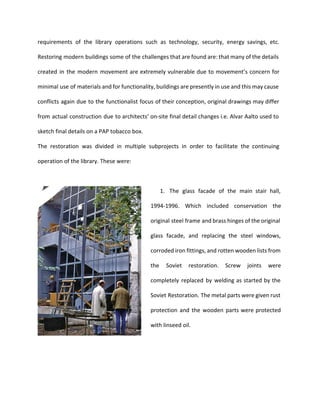
1. The glass facade of the main stair hall, 
1994-1996. Which included conservation the 
original steel frame and brass hinges of the original 
glass facade, and replacing the steel windows, 
corroded iron fittings, and rotten wooden lists from 
the Soviet restoration. Screw joints were 
completely replaced by welding as started by the 
Soviet Restoration. The metal parts were given rust 
protection and the wooden parts were protected 
with linseed oil.
2. The library caretaker’s apartment 1997-2000. Provided the opportunity to test the 
interior materials and details to be used in the rest of the library. All surface materials 
were removed to the bare structure. The walls and ceilings were plastered with lime and 
painted with Sax Tempera, the floor was leveled and covered with parquet and 
linoleum, and the new doors were rebuilt according to original specifications. 
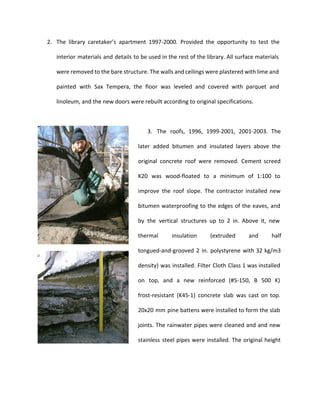
3. The roofs, 1996, 1999-2001, 2001-2003. The 
later added bitumen and insulated layers above the 
original concrete roof were removed. Cement screed 
K20 was wood-floated to a minimum of 1:100 to 
improve the roof slope. The contractor installed new 
bitumen waterproofing to the edges of the eaves, and 
by the vertical structures up to 2 in. Above it, new 
thermal insulation (extruded and half 
tongued-and-grooved 2 in. polystyrene with 32 kg/m3 
density) was installed. Filter Cloth Class 1 was installed 
on top, and a new reinforced (#5-150, B 500 K) 
frost-resistant (K45-1) concrete slab was cast on top. 
20x20 mm pine battens were installed to form the slab 
joints. The rainwater pipes were cleaned and and new 
stainless steel pipes were installed. The original height
of the parapets were established and copper copings were installed. 
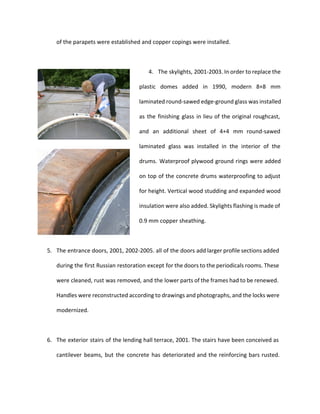
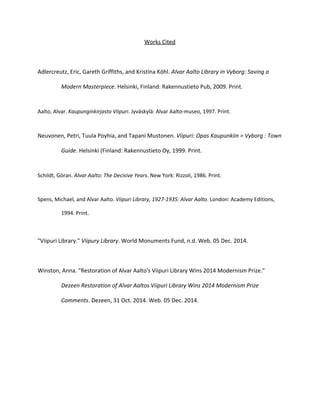
4. The skylights, 2001-2003. In order to replace the 
plastic domes added in 1990, modern 8+8 mm 
laminated round-sawed edge-ground glass was installed 
as the finishing glass in lieu of the original roughcast, 
and an additional sheet of 4+4 mm round-sawed 
laminated glass was installed in the interior of the 
drums. Waterproof plywood ground rings were added 
on top of the concrete drums waterproofing to adjust 
for height. Vertical wood studding and expanded wood 
insulation were also added. Skylights flashing is made of 
0.9 mm copper sheathing. 
5. The entrance doors, 2001, 2002-2005. all of the doors add larger profile sections added 
during the first Russian restoration except for the doors to the periodicals rooms. These 
were cleaned, rust was removed, and the lower parts of the frames had to be renewed. 
Handles were reconstructed according to drawings and photographs, and the locks were 
modernized. 
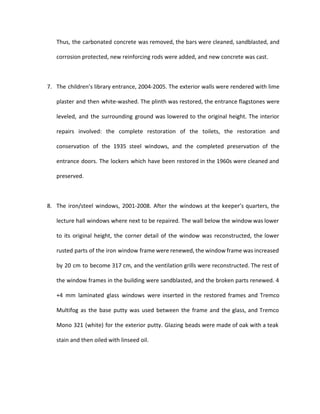
6. The exterior stairs of the lending hall terrace, 2001. The stairs have been conceived as 
cantilever beams, but the concrete has deteriorated and the reinforcing bars rusted.
Thus, the carbonated concrete was removed, the bars were cleaned, sandblasted, and 
corrosion protected, new reinforcing rods were added, and new concrete was cast. 
7. The children’s library entrance, 2004-2005. The exterior walls were rendered with lime 
plaster and then white-washed. The plinth was restored, the entrance flagstones were 
leveled, and the surrounding ground was lowered to the original height. The interior 
repairs involved: the complete restoration of the toilets, the restoration and 
conservation of the 1935 steel windows, and the completed preservation of the 
entrance doors. The lockers which have been restored in the 1960s were cleaned and 
preserved. 
8. The iron/steel windows, 2001-2008. After the windows at the keeper’s quarters, the 
lecture hall windows where next to be repaired. The wall below the window was lower 
to its original height, the corner detail of the window was reconstructed, the lower 
rusted parts of the iron window frame were renewed, the window frame was increased 
by 20 cm to become 317 cm, and the ventilation grills were reconstructed. The rest of 
the window frames in the building were sandblasted, and the broken parts renewed. 4 
+4 mm laminated glass windows were inserted in the restored frames and Tremco 
Multifog as the base putty was used between the frame and the glass, and Tremco 
Mono 321 (white) for the exterior putty. Glazing beads were made of oak with a teak 
stain and then oiled with linseed oil.
9. The periodicals reading room, 2004-2005. At this room all of the surfaces were 
renovated. The electrical and lighting methods and conduits followed the original routes 
and designs, and they were replicated as much as possible. The walls were painted with 
Tikkurila White semi-gloss alkyd paint. One of the doors that was removed during the 
Russian restoration was replaced, its details and specifications were replicated, and 
handles were chrome coated. The floors were covered with 2,5 mm marble-figured 
Norament Vario Rubber Carpet. 
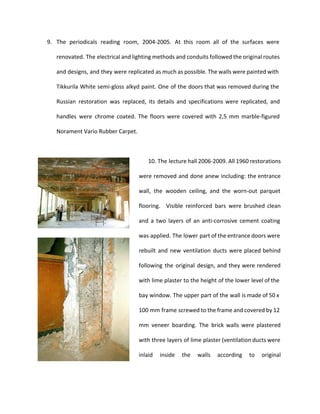
10. The lecture hall 2006-2009. All 1960 restorations 
were removed and done anew including: the entrance 
wall, the wooden ceiling, and the worn-out parquet 
flooring. Visible reinforced bars were brushed clean 
and a two layers of an anti-corrosive cement coating 
was applied. The lower part of the entrance doors were 
rebuilt and new ventilation ducts were placed behind 
following the original design, and they were rendered 
with lime plaster to the height of the lower level of the 
bay window. The upper part of the wall is made of 50 x 
100 mm frame screwed to the frame and covered by 12 
mm veneer boarding. The brick walls were plastered 
with three layers of lime plaster (ventilation ducts were 
inlaid inside the walls according to original
specifications), beams were plastered with three layers of lime-cement plaster. All walls 
were given a lime wash finish. Steel pillars were brushed clean, given corrosion 
protection, covered with steel nettings, given three layers of lime cement plaster, and 
then finished with natural oil paint. All floor layers were removed down to the original 
slab which was vacuum cleaned, and moist for two days to assure adherence to the new 
concrete layer which consisted of 1 part cement, 2 parts fine gravel from 3-6mm, and 1 
part screened sand, and which was cured carefully, vibrated, and wood floated. Fescon 
Coarse Floor leveling compound was sued for uneven areas less than 40mm and final 
levelling was done with concrete pour finish. The final material of the floor was new oak 
parquet according to original specifications. Simultaneously, the side corridor was 
restored, and all surfaces were treated similarly except for the floor which was covered 
with gray rubber carpeting. 
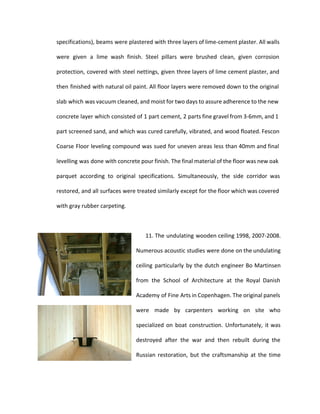
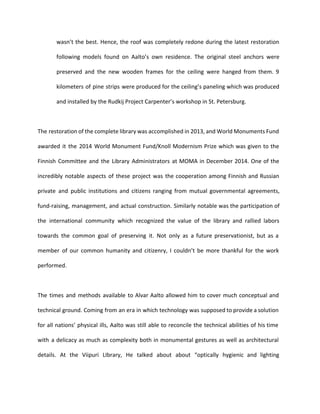
11. The undulating wooden ceiling 1998, 2007-2008. 
Numerous acoustic studies were done on the undulating 
ceiling particularly by the dutch engineer Bo Martinsen 
from the School of Architecture at the Royal Danish 
Academy of Fine Arts in Copenhagen. The original panels 
were made by carpenters working on site who 
specialized on boat construction. Unfortunately, it was 
destroyed after the war and then rebuilt during the 
Russian restoration, but the craftsmanship at the time
wasn’t the best. Hence, the roof was completely redone during the latest restoration 
following models found on Aalto’s own residence. The original steel anchors were 
preserved and the new wooden frames for the ceiling were hanged from them. 9 
kilometers of pine strips were produced for the ceiling’s paneling which was produced 
and installed by the Rudkij Project Carpenter’s workshop in St. Petersburg. 
The restoration of the complete library was accomplished in 2013, and World Monuments Fund 
awarded it the 2014 World Monument Fund/Knoll Modernism Prize which was given to the 
Finnish Committee and the Library Administrators at MOMA in December 2014. One of the 
incredibly notable aspects of these project was the cooperation among Finnish and Russian 
private and public institutions and citizens ranging from mutual governmental agreements, 
fund-raising, management, and actual construction. Similarly notable was the participation of 
the international community which recognized the value of the library and rallied labors 
towards the common goal of preserving it. Not only as a future preservationist, but as a 
member of our common humanity and citizenry, I couldn’t be more thankful for the work 
performed. 
The times and methods available to Alvar Aalto allowed him to cover much conceptual and 
technical ground. Coming from an era in which technology was supposed to provide a solution 
for all nations’ physical ills, Aalto was still able to reconcile the technical abilities of his time 
with a delicacy as much as complexity both in monumental gestures as well as architectural 
details. At the Viipuri LIbrary, He talked about about “optically hygienic and lighting
psychological solutions as well as heating and 
ventilations systems”, which is demonstrated by 
his previous work on the Paimio Hospital, but this 
work doesn’t show an overpowering of the 
technical over the natural environment. His works 
show a balance and cooperation between the two. 
Technology is exalted for its own good, but it 
doesn’t impose itself or subdues the fact of its 
natural setting. The awareness of this delicate 
interaction is perceived and well executed in his 
buildings from their setting in the landscape to the 
execution of details. The building environment as 
well as the global citizenry own Aalto gratitude for 
such executions, and the restoration of the, now 
called, Central City Alvar Aalto Library is a great 
reminder of his work and how much we can learn 
from it. Studying his work, one can conceive why 
the use of paper for any purpose other than 
architecture would be “a waste of paper”.
Works Cited 
Adlercreutz, Eric, Gareth Griffiths, and Kristina Köhl. Alvar Aalto Library in Vyborg: Saving a 
Modern Masterpiece. Helsinki, Finland: Rakennustieto Pub, 2009. Print. 
Aalto, Alvar. Kaupunginkirjasto Viipuri. Jyväskylä: Alvar Aalto-museo, 1997. Print. 
Neuvonen, Petri, Tuula Poyhia, and Tapani Mustonen. Viipuri: Opas Kaupunkiin = Vyborg : Town 
Guide. Helsinki (Finland: Rakennustieto Oy, 1999. Print. 
Schildt, Göran. Alvar Aalto: The Decisive Years. New York: Rizzoli, 1986. Print. 
Spens, Michael, and Alvar Aalto. Viipuri Library, 1927-1935: Alvar Aalto. London: Academy Editions, 
1994. Print. 
"Viipuri Library." Viipury Library. World Monuments Fund, n.d. Web. 05 Dec. 2014. 
Winston, Anna. "Restoration of Alvar Aalto's Viipuri Library Wins 2014 Modernism Prize." 
Dezeen Restoration of Alvar Aaltos Viipuri Library Wins 2014 Modernism Prize 
Comments. Dezeen, 31 Oct. 2014. Web. 05 Dec. 2014.

RB_RestorationoftheViipuriLibrary

  • 1.
    PR­640­01 History andTheory of Preservation Prof. Nadya Nenadich Rodrigo Balarezo Research topic: Restoration of the Central City Alvar Aalto Library in Vyborg “Intuition can sometimes be astonishingly rational” -Alvar Aalto The city of Vyborg, located in what is now North-Eastern Russia, has witnessed numerous wars during its seven century history. The town was evidently transformed by WWII in its build environment, and “all cultural continuity between the pre-WWII and post WWII era was broken”. Today, Swedish, Finnish and Russian cultural heritage is utilized to help the citizens look for identity in their post-communist settings. The most visible landmark of the town, the central tower of a castle, was built in 1293 as crusaders lead by Tyrgils Knutsson (Swe,. Torkkel Knuutinpoika in Finnish) claimed the area for
  • 2.
    the Western’s Churchsphere as well as for the Swedish Kings who would rule over the territory for the next 400 years. Knutsson served as regent for the underage Birger Magnusson, but He was decapitated in February 1306 after the king’s brothers have successfully seeded distrust on the king against his marshal Knutsson. On an event known to history as the Third Swedish Crusade, Knutsson fought the Novgorod Republic, Russian medieval republic, which had attacked the town of Tavastland. Hence, the castle at Vyborg was conceived as a fortress, and the town developed sporadically on the adjacent archipielago. The town received its charter in 1403, and the building of a stone wall surrounding the town began in 1470’s. Later fortifications were done in 1547-1550, and the largest effort was done in 1563 when the wall was extended to the south-east along with the ramparts that gave the area its name: Valli (Finish) The rectangular street grid that remains to this day was mostly established in the 1600’s when the Swedish Kingdom replaced the Old Town street grid that followed the curvature of the land. In 1710, Peter the Great conquered the town and it was claimed for the Russian Empire as a fortress town to protect the capital, St. Petersburg. A russian wave of rebuilding and public works followed a fire in 1793. In 1809, the Tsar Alexander I conquered territory farther into the east of the Swedish Kingdom, and he established the
  • 3.
    Grand Duchy ofFinland to which Vyborg was joined in 1812. At this time, the town was still a fortress town composed by: the castle, the main fortress (surrounding the main city), and St. Anna’s Crown.After the Crimean War (1854-1856), Russia handed over the fortifications around the main city to the civilian authorities who decided to implement urban changes such as filling in the moats, demolishing fortifications, and buildinging new streets. A new street grid was drawn by surveyor Berndt Otto Nymalm, and it was ratified in 1861. Two new districts followed, Salakkalahti to the north-east of the main town, and Pantsarlahti to the south-east. The existing suburb of St. Petersburg became two districts: Repola and Kaleva. In 1869, street signs were set, and a need to name streets arouse which constitutes evidence to the political changes in Vyborg as these street signs have taken both Finnish and Russian names at different times in history. Infrastructure works such as the completion of the Saimaa Canal in 1856, the Helsinki-St.Petersburg in 1870, and the Karelia-Vyborg expressway in 1894 allowed the city of Vyborg to grow to host about 50,000 inhabitants by 1910. However, periods of finish oppression followed from 1899-1905 and 1909-1917 until the Grand Duchy of Finland seceded from Russia after the October Revolution of 1917. The new state enter civil war in 1918 between the “white” bourgeois representing the legal government, and the “red” guards
  • 4.
    hoping to createa socialist republic. The town of Vyborg was conquered by the white army in April 1918 with reds fleeting to St. Petersburg. At this time Vyborg was considered a bastion of western culture at the fringe of communist Russia. In 1923, Maria Lalukka, the widow of Juho Lalukka, donated funds for the construction of a municipal library, and an architectural competition was established in 1927. Alvar Aalto won the competition, with a classicist scheme, as it was announced in February 1928. However, a list of considerations were given to the architect which spurred the development of numerous schemes until 1929. In 1929, the first cycle of street name changes occurred as some of the street names were changed from Russian to Finish in order to represent the new cultural values and in order to forget old Russian oppression. Coincidentally, the recession at this time caused the project to be delayed until October 1933 when the location of the library changed, and Aalto was required to submit new and final drawings which lead to the library’s completion in 1935. According to some of Aalto’s description of the project the form and design resulted from the change in the library’s location which allowed him to “freed the design from the constraints of external formality”. The three main elements were: the library itself with its various departments which form the main massing with interdependent relationships focused on serving the human eye; the socially active part of library such as clubrooms, smaller spaces and offices “open to the exterior, and light in construction” focused on the human ear, and the internal circulation network which becomes the “medium combining the above psychological conditions”. The entrance to the kid’s library was at a lower level whereas the main entrance
  • 5.
    was at theintersection of a group of meandering paths, and the newsroom was accessible directly from the street. He describes the roof to be made of a reinforced concrete slab with special beam forms of only one span at 17.6 meters. In fact, the original proposal by Aalto conceived of a glass roof over the main lending hall, and he let it go during the design process only to return in the final scheme as the 57 circular openings of 1,80 meter diameter. He describes that the depth of the cones was such that a “52 degree sunbeam cannot pierce it freely” in order to allow “optically hygienic overall lighting” so that reading could be done without producing a shadow. Circular coarse glass sheets were placed on the concrete conicals and they relied on their own weight. On the solid parts a panel-heating-system was placed by means of radiant heating pipes in order to provide heat to the main hall. Artificial lighting had also been placed in the solid parts by means of recesses and directed towards the adjacent walls to produce indirect lighting. The elevated location of the lending department and leading rooms that form a single hall was provided by setting them in multiple levels. The 75 cm thick brick external walls included the ventilation ducts and allowed for no partitions.
  • 6.
    The clubroom andoffice wing had a steel frame construction, and the floors were massive concrete slabs where the floor finished was fixed directly on the slab with sound insulation provided by the heaviness of the slab and soft fibre boards insulite. The roofs were insulated with a fabric which had a lead membrane between two bitumen layers, and it didn’t have filling as in the hall. Roof outlets for rainwater drainage and flashings were made of copper. Since the human ear was the main concern, the lecture hall’s undulating lamellas were used so that sound could be emitted and received at any location in the hall, and not just at one location as it’s the case in a concert hall. The windows were steel frame covered with teak on the inside. Different woods had been placed in different locations depending on the possibility of wear: karelian red pine in the clubrooms, sycamore in the entrance hall, oak, birch in the children’s library and teak in the furniture, red beech and karelian pine (most durable) in the actual library. The central heating was made of the “panel-heating”system which produced radiant heat to warm up the concrete and plaster surfaces by a “dense network of pipes” thus providing no conflict between shelves and the heating system. Additionally, the central ventilation system was produced by fresh air distributed by ventilations pipes thought the different parts of the building. the distributing branches of these were glazed fire clay or cast iron. Textiles also played an important role in the buildings as curtains, door and wall coverings, and elements separating different spaces. The natural lime painted surface remain in order to make reference to natural materials. Thus, the main color scheme is made in reference to materials. In 1938, the Museum of Modern art displayed drawings for the Viipuri (Vyborg)
  • 7.
    Library, the TurumSanomat Building, and the Paimio Sanatorium in its first exhibition of an International Style Architect consolidating Alvar Aalto’s international fame. By the WWII, Vyborg was the second largest city in Finland with around 75,000 to 80,000 inhabitants. However, in November 1939, Russia attacked Finland at the beginning of what became known as the Winter War, and bombing raids began over Vyburg whose population was forced to escape. At the end of the hostilities, Finland was forced to hand over part of its eastern territory along with Vyborg to Russia. Hence, the second cycle of changes occurred to street names, this time turning Finish street signs to Russian. After the Continuation War in 1941, the finish recaptured Vyborg. and They started a resettlement program that brought its population back to 30,000 in three years along with new street name changes. However, the finns were again forced to evacuate after a massive Red Army attack in 1944. At this time, Finland and Russia signed a peace treaty which conceded Vyborg to Russia, and the town which was once considered a bastion of western civilization officially became a Soviet border town which continues to be until the present day. The library, which was not greatly damaged by the wars, was left empty and unattended for the following 10 years as the new Russian inhabitants labored to rebuild this then ghost town.
  • 8.
    In 1955, thefirst of a series of restorations to the library began. Aleksandr Mihailovich Shver lead the first Russian restoration, but the government denied his request, due to the political climate, for Finish original drawings and other Finish bought elements such as the circular glass panels for the oculi, and the air-conditioning equipment. The flat roof pitch was altered by inclining the concrete pouring by two brick rows, and the windows of the main lecture hall were reduced about 8 in in high because glass wasn’t manufactured at that dimension in the Soviet Union at this time. However, the lecture hall was not altered to host a movie theater as proposed, the curved paneling of the ceiling was restored using spruce timber, old pictures and paint marks on the wall, and the library continued to operate as such. Then, around 1970s concerns were raised about the condition of the library and appeals were sent to the the Russian Government. In May 1989, after these appeals were not answered, a group of twenty leading architects and professors sent a letter to the then president of Finland, Mauno Koivisto, in an effort to preserve the library. However, the political environment at the time didn’t allow for any effective change, until March 1991 when the Finnish Ministry of the
  • 9.
    Environment, chaired byMikko Mansikka, organized a seminar in Helsinki titled “Renovation of the Library of Vyborg.” Sergey Kravchenko, russian architect who had documented the library, presented his findings on the poor condition of it, and the opportunity to restore it. In the summer of 1991 an international campaign was launched by the Alvar Aalto Club (an unofficial organization of architects who had been employed by Aalto’s office) in order to produce an appeal and to bring international support to the restoration of the library and awareness of Aalto’s architecture. In January 1992, Aalto’s widow Elissa Aalto, the Finnish Ministry of the Environment, and Finland’s Consulate General in St. Petersburg visited the library for the first time and handed the mayor, Nikolai Smirnov, the above mentioned appeal with over 1000 signatures from around the world. This spurred a series of bilateral agreements between Russia and Finland in order to provide the administrative and financial backbone for the restoration of the library. For instance, the Protocol of Intentions on Joint Activity in the Restoration of the Alvar Aalto Library was signed in July 25th, 1991, and the Supplementary Protocol of Intentions for the Restoration of the Municipal Library Alvar Aalto in Vyborg was signed in March 24, 1992. Furthermore, in May 21,
  • 10.
    1993, the St.Petersburg Union of Architects, the St. Petersburg Cultural Foundation, the Finnish Committee for the Restoration of Viipuri Library (Founded by Elissa Aalto, the Alvar Aalto & Co. Architectural Office, and The Finnish Ministry of the Environment), and the Finnish Association of Architects signed an agreement on the use of Donations and other contributions to the joint Russian-Finnish Restoration Project. For the management of the project, three different managers were employed mirroring the three different channels of funding. First, the Cultural Commision of the Leningrad Oblast, which is part of the Ministry of Culture of the Russian Federation, has a Department of Architectural Monuments which receives drawings and specifications from the Finnish Committee for the Restoration of the Viipuri Library, in charge of architectural design and restoration, choses a contractor from a call for tenders, inspects and manages its projects. Second, The city of Vyborg funds and manages its own projects along with consultation with the the Finnish Committee for the Restoration of the Viipuri Library and the director of the library. Again drawings and specifications are provided by the committee, and the contractor is chosen by the city out of a list of tenders. Third, works financed by the the Finnish Committee for the Restoration of the Viipuri Library, which are financed by Finland and contributions abroad, are managed by the library. The committee delivers drawings and specifications, and the library chooses a contractor from a call for tenders. International organizations, exhibitions, conventions, and academic studies were organized over the decades in order to raise awareness of Aalto’s architecture as well as to raise funds for the restoration of the library in Vyborg. For instance, the Friends of Viipuri established in 1995 an International Honorary Committee with close to 100 members from 22 countries, the Aktion
  • 11.
    Viipuri in Switzerlandprovided fundraising as well as Alvar Aalto Gesellschaft in Austria, Germany and Switzerland, Comitato Italiano Aalto/Viipuri in Italy, Alvar Aalto Sallskapet in Sweden, and the Charitable Trust of the Friends of the Viipuri Library in the UK. International conferences included: one at the Milan Triennale in November 1996 organized by the Comitato Italiano Aalto/Viipuri, “The Viipuri Library - Saving a Modern Masterpiece” organized by Friends of the Viipuri LIbrary, the Finnish Committee for the restoration of Viipuri library, and MOMA, and “Lit by Aalto Skylights” in March 2003 organized by the Finnish Committee. A touring exhibition of the library in its original form was presented in the summer of 1994 during the Alvar Aalto Symposium in Jyväskylä, Finland and it toured the world for 14 years until its final exhibition in Jyväskylä in October 2008 during the Finnish-Russian Cultural Forum. Other donations came from the Omega Foundation in Switzerland, and the Getty Foundation in the United States which allowed for a studio course on preservation headed by the Helsinki university of Technology and and training program dealing with management, site practices, quality demands, contractor’s responsibility and working methods for the Russian partners. Scientific studies were also made by the Royal Danish Academy of Fine Arts in Copenhagen, and the Netherlands Department of Conservation in Zeist whose paint studies, headed by architect Mariel Polman, were very instrumental to the restoration. The restoration as presented by the committee had a total budget of 6.5 million Euros. One common principle of the restoration process was to start a project only when there were enough funds to bring it to completion. Additionally, decisions were made to retain the alterations done on the 1956-1961 restoration as a historical layer, and to consider the modern
  • 12.
    requirements of thelibrary operations such as technology, security, energy savings, etc. Restoring modern buildings some of the challenges that are found are: that many of the details created in the modern movement are extremely vulnerable due to movement’s concern for minimal use of materials and for functionality, buildings are presently in use and this may cause conflicts again due to the functionalist focus of their conception, original drawings may differ from actual construction due to architects’ on-site final detail changes i.e. Alvar Aalto used to sketch final details on a PAP tobacco box. The restoration was divided in multiple subprojects in order to facilitate the continuing operation of the library. These were: 1. The glass facade of the main stair hall, 1994-1996. Which included conservation the original steel frame and brass hinges of the original glass facade, and replacing the steel windows, corroded iron fittings, and rotten wooden lists from the Soviet restoration. Screw joints were completely replaced by welding as started by the Soviet Restoration. The metal parts were given rust protection and the wooden parts were protected with linseed oil.
  • 13.
    2. The librarycaretaker’s apartment 1997-2000. Provided the opportunity to test the interior materials and details to be used in the rest of the library. All surface materials were removed to the bare structure. The walls and ceilings were plastered with lime and painted with Sax Tempera, the floor was leveled and covered with parquet and linoleum, and the new doors were rebuilt according to original specifications. 3. The roofs, 1996, 1999-2001, 2001-2003. The later added bitumen and insulated layers above the original concrete roof were removed. Cement screed K20 was wood-floated to a minimum of 1:100 to improve the roof slope. The contractor installed new bitumen waterproofing to the edges of the eaves, and by the vertical structures up to 2 in. Above it, new thermal insulation (extruded and half tongued-and-grooved 2 in. polystyrene with 32 kg/m3 density) was installed. Filter Cloth Class 1 was installed on top, and a new reinforced (#5-150, B 500 K) frost-resistant (K45-1) concrete slab was cast on top. 20x20 mm pine battens were installed to form the slab joints. The rainwater pipes were cleaned and and new stainless steel pipes were installed. The original height
  • 14.
    of the parapetswere established and copper copings were installed. 4. The skylights, 2001-2003. In order to replace the plastic domes added in 1990, modern 8+8 mm laminated round-sawed edge-ground glass was installed as the finishing glass in lieu of the original roughcast, and an additional sheet of 4+4 mm round-sawed laminated glass was installed in the interior of the drums. Waterproof plywood ground rings were added on top of the concrete drums waterproofing to adjust for height. Vertical wood studding and expanded wood insulation were also added. Skylights flashing is made of 0.9 mm copper sheathing. 5. The entrance doors, 2001, 2002-2005. all of the doors add larger profile sections added during the first Russian restoration except for the doors to the periodicals rooms. These were cleaned, rust was removed, and the lower parts of the frames had to be renewed. Handles were reconstructed according to drawings and photographs, and the locks were modernized. 6. The exterior stairs of the lending hall terrace, 2001. The stairs have been conceived as cantilever beams, but the concrete has deteriorated and the reinforcing bars rusted.
  • 15.
    Thus, the carbonatedconcrete was removed, the bars were cleaned, sandblasted, and corrosion protected, new reinforcing rods were added, and new concrete was cast. 7. The children’s library entrance, 2004-2005. The exterior walls were rendered with lime plaster and then white-washed. The plinth was restored, the entrance flagstones were leveled, and the surrounding ground was lowered to the original height. The interior repairs involved: the complete restoration of the toilets, the restoration and conservation of the 1935 steel windows, and the completed preservation of the entrance doors. The lockers which have been restored in the 1960s were cleaned and preserved. 8. The iron/steel windows, 2001-2008. After the windows at the keeper’s quarters, the lecture hall windows where next to be repaired. The wall below the window was lower to its original height, the corner detail of the window was reconstructed, the lower rusted parts of the iron window frame were renewed, the window frame was increased by 20 cm to become 317 cm, and the ventilation grills were reconstructed. The rest of the window frames in the building were sandblasted, and the broken parts renewed. 4 +4 mm laminated glass windows were inserted in the restored frames and Tremco Multifog as the base putty was used between the frame and the glass, and Tremco Mono 321 (white) for the exterior putty. Glazing beads were made of oak with a teak stain and then oiled with linseed oil.
  • 16.
    9. The periodicalsreading room, 2004-2005. At this room all of the surfaces were renovated. The electrical and lighting methods and conduits followed the original routes and designs, and they were replicated as much as possible. The walls were painted with Tikkurila White semi-gloss alkyd paint. One of the doors that was removed during the Russian restoration was replaced, its details and specifications were replicated, and handles were chrome coated. The floors were covered with 2,5 mm marble-figured Norament Vario Rubber Carpet. 10. The lecture hall 2006-2009. All 1960 restorations were removed and done anew including: the entrance wall, the wooden ceiling, and the worn-out parquet flooring. Visible reinforced bars were brushed clean and a two layers of an anti-corrosive cement coating was applied. The lower part of the entrance doors were rebuilt and new ventilation ducts were placed behind following the original design, and they were rendered with lime plaster to the height of the lower level of the bay window. The upper part of the wall is made of 50 x 100 mm frame screwed to the frame and covered by 12 mm veneer boarding. The brick walls were plastered with three layers of lime plaster (ventilation ducts were inlaid inside the walls according to original
  • 17.
    specifications), beams wereplastered with three layers of lime-cement plaster. All walls were given a lime wash finish. Steel pillars were brushed clean, given corrosion protection, covered with steel nettings, given three layers of lime cement plaster, and then finished with natural oil paint. All floor layers were removed down to the original slab which was vacuum cleaned, and moist for two days to assure adherence to the new concrete layer which consisted of 1 part cement, 2 parts fine gravel from 3-6mm, and 1 part screened sand, and which was cured carefully, vibrated, and wood floated. Fescon Coarse Floor leveling compound was sued for uneven areas less than 40mm and final levelling was done with concrete pour finish. The final material of the floor was new oak parquet according to original specifications. Simultaneously, the side corridor was restored, and all surfaces were treated similarly except for the floor which was covered with gray rubber carpeting. 11. The undulating wooden ceiling 1998, 2007-2008. Numerous acoustic studies were done on the undulating ceiling particularly by the dutch engineer Bo Martinsen from the School of Architecture at the Royal Danish Academy of Fine Arts in Copenhagen. The original panels were made by carpenters working on site who specialized on boat construction. Unfortunately, it was destroyed after the war and then rebuilt during the Russian restoration, but the craftsmanship at the time
  • 18.
    wasn’t the best.Hence, the roof was completely redone during the latest restoration following models found on Aalto’s own residence. The original steel anchors were preserved and the new wooden frames for the ceiling were hanged from them. 9 kilometers of pine strips were produced for the ceiling’s paneling which was produced and installed by the Rudkij Project Carpenter’s workshop in St. Petersburg. The restoration of the complete library was accomplished in 2013, and World Monuments Fund awarded it the 2014 World Monument Fund/Knoll Modernism Prize which was given to the Finnish Committee and the Library Administrators at MOMA in December 2014. One of the incredibly notable aspects of these project was the cooperation among Finnish and Russian private and public institutions and citizens ranging from mutual governmental agreements, fund-raising, management, and actual construction. Similarly notable was the participation of the international community which recognized the value of the library and rallied labors towards the common goal of preserving it. Not only as a future preservationist, but as a member of our common humanity and citizenry, I couldn’t be more thankful for the work performed. The times and methods available to Alvar Aalto allowed him to cover much conceptual and technical ground. Coming from an era in which technology was supposed to provide a solution for all nations’ physical ills, Aalto was still able to reconcile the technical abilities of his time with a delicacy as much as complexity both in monumental gestures as well as architectural details. At the Viipuri LIbrary, He talked about about “optically hygienic and lighting
  • 19.
    psychological solutions aswell as heating and ventilations systems”, which is demonstrated by his previous work on the Paimio Hospital, but this work doesn’t show an overpowering of the technical over the natural environment. His works show a balance and cooperation between the two. Technology is exalted for its own good, but it doesn’t impose itself or subdues the fact of its natural setting. The awareness of this delicate interaction is perceived and well executed in his buildings from their setting in the landscape to the execution of details. The building environment as well as the global citizenry own Aalto gratitude for such executions, and the restoration of the, now called, Central City Alvar Aalto Library is a great reminder of his work and how much we can learn from it. Studying his work, one can conceive why the use of paper for any purpose other than architecture would be “a waste of paper”.
  • 20.
    Works Cited Adlercreutz,Eric, Gareth Griffiths, and Kristina Köhl. Alvar Aalto Library in Vyborg: Saving a Modern Masterpiece. Helsinki, Finland: Rakennustieto Pub, 2009. Print. Aalto, Alvar. Kaupunginkirjasto Viipuri. Jyväskylä: Alvar Aalto-museo, 1997. Print. Neuvonen, Petri, Tuula Poyhia, and Tapani Mustonen. Viipuri: Opas Kaupunkiin = Vyborg : Town Guide. Helsinki (Finland: Rakennustieto Oy, 1999. Print. Schildt, Göran. Alvar Aalto: The Decisive Years. New York: Rizzoli, 1986. Print. Spens, Michael, and Alvar Aalto. Viipuri Library, 1927-1935: Alvar Aalto. London: Academy Editions, 1994. Print. "Viipuri Library." Viipury Library. World Monuments Fund, n.d. Web. 05 Dec. 2014. Winston, Anna. "Restoration of Alvar Aalto's Viipuri Library Wins 2014 Modernism Prize." Dezeen Restoration of Alvar Aaltos Viipuri Library Wins 2014 Modernism Prize Comments. Dezeen, 31 Oct. 2014. Web. 05 Dec. 2014.