Rayo for XMPP Folks


      Ben Langfeld
      @benlangfeld
blangfeld@mojolingo.com


                          PAGE
WHAT IS ADHEARSION?
                      •Middle man between
                       phone calls and the real
                       world
                      •Does not process any
                       media or handle
                       signaling directly
                      •Exercises third-party call
                       control (3PCC)
                      •All Ruby
                      •High-level API


                                                     2
                                                    PAGE
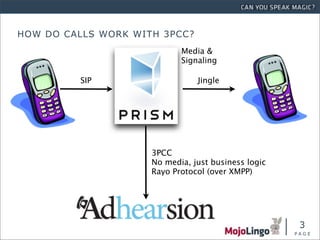
HOW DO CALLS WORK WITH 3PCC?
                            Media &
                            Signaling

         SIP                    Jingle


                     3PCC
                     No media, just business logic
                     Rayo Protocol (over XMPP)


                                                      3
                                                     PAGE
•   Background info @ http://rayo.org
•   Draft spec @ http://rayo.org/xep
•   Source @ http://github.com/rayo/xmpp
•   Issue queue @ http://github.com/rayo/xmpp/issues


                                                        4
                                                       PAGE
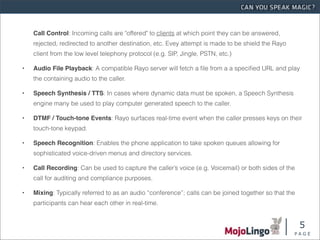
Call Control: Incoming calls are "offered" to clients at which point they can be answered,
    rejected, redirected to another destination, etc. Evey attempt is made to be shield the Rayo
    client from the low level telephony protocol (e.g. SIP, Jingle, PSTN, etc.)

•   Audio File Playback: A compatible Rayo server will fetch a file from a a specified URL and play
    the containing audio to the caller.

•   Speech Synthesis / TTS: In cases where dynamic data must be spoken, a Speech Synthesis
    engine many be used to play computer generated speech to the caller.

•   DTMF / Touch-tone Events: Rayo surfaces real-time event when the caller presses keys on their
    touch-tone keypad.

•   Speech Recognition: Enables the phone application to take spoken queues allowing for
    sophisticated voice-driven menus and directory services.

•   Call Recording: Can be used to capture the caller’s voice (e.g. Voicemail) or both sides of the
    call for auditing and compliance purposes.

•   Mixing: Typically referred to as an audio “conference”; calls can be joined together so that the
    participants can hear each other in real-time.


                                                                                                       5
                                                                                                   PAGE
WHY ANOTHER PROTOCOL?
    Simple client library implementation - XMPP client libraries exist in all modern
    languages, and many are of a high standard of quality and maturity.
•   Cross-platform standard - The protocol must not expose any platform specifics and all
    elements should be candidates for implementation on any suitable platform. Additionally,
    the protocol must be ratified as a standard following a community discussion.
•   Asynchronous interface - The protocol should present an asynchronous interface for the
    purposes of performance and flexibility in performing parallel operations.
•   Consistent - The protocol must provide a considered, unobtrusive, logically and
    philosophically consistent interface.
•   Federated - The protocol must support communication between client and server entities
    on separately owned, operated and addressed networks.
•   Flexible routing - The protocol must lend itself to routing across wide networks such as
    the internet, and to potential complex routing such as proxying or redirection. Additionally,
    the client and server should each be aware of the presence of the other and be able to use
    such information to make routing decisions.
•   Extensible - The protocol must provide for the possibility of extra functionality being added
    by future specifications or an individual implementation.
•   Secure - The protocol should include appropriate measures for authentication and
    authorization of participants, as well as preventing third-parties from intercepting control
    messages.

                                                                                                6
                                                                                              PAGE
• Primitives: Offer, Accept, Answer, Reject, Hangup, Join/Unjoin
• Media components:

   • Output (audio playback, text-to-speech)
   • Input (DTMF, speech recognition)

   • Record
• Currently voice only, but extensible to video


                                                                    7
                                                                   PAGE
QUESTIONS?


     @benlangfeld
blangfeld@mojolingo.com


                          PAGE

Rayo for XMPP Folks

  • 1.
    Rayo for XMPPFolks Ben Langfeld @benlangfeld blangfeld@mojolingo.com PAGE
  • 2.
    WHAT IS ADHEARSION? •Middle man between phone calls and the real world •Does not process any media or handle signaling directly •Exercises third-party call control (3PCC) •All Ruby •High-level API 2 PAGE
  • 3.
    HOW DO CALLSWORK WITH 3PCC? Media & Signaling SIP Jingle 3PCC No media, just business logic Rayo Protocol (over XMPP) 3 PAGE
  • 4.
    Background info @ http://rayo.org • Draft spec @ http://rayo.org/xep • Source @ http://github.com/rayo/xmpp • Issue queue @ http://github.com/rayo/xmpp/issues 4 PAGE
  • 5.
    Call Control: Incomingcalls are "offered" to clients at which point they can be answered, rejected, redirected to another destination, etc. Evey attempt is made to be shield the Rayo client from the low level telephony protocol (e.g. SIP, Jingle, PSTN, etc.) • Audio File Playback: A compatible Rayo server will fetch a file from a a specified URL and play the containing audio to the caller. • Speech Synthesis / TTS: In cases where dynamic data must be spoken, a Speech Synthesis engine many be used to play computer generated speech to the caller. • DTMF / Touch-tone Events: Rayo surfaces real-time event when the caller presses keys on their touch-tone keypad. • Speech Recognition: Enables the phone application to take spoken queues allowing for sophisticated voice-driven menus and directory services. • Call Recording: Can be used to capture the caller’s voice (e.g. Voicemail) or both sides of the call for auditing and compliance purposes. • Mixing: Typically referred to as an audio “conference”; calls can be joined together so that the participants can hear each other in real-time. 5 PAGE
  • 6.
    WHY ANOTHER PROTOCOL? Simple client library implementation - XMPP client libraries exist in all modern languages, and many are of a high standard of quality and maturity. • Cross-platform standard - The protocol must not expose any platform specifics and all elements should be candidates for implementation on any suitable platform. Additionally, the protocol must be ratified as a standard following a community discussion. • Asynchronous interface - The protocol should present an asynchronous interface for the purposes of performance and flexibility in performing parallel operations. • Consistent - The protocol must provide a considered, unobtrusive, logically and philosophically consistent interface. • Federated - The protocol must support communication between client and server entities on separately owned, operated and addressed networks. • Flexible routing - The protocol must lend itself to routing across wide networks such as the internet, and to potential complex routing such as proxying or redirection. Additionally, the client and server should each be aware of the presence of the other and be able to use such information to make routing decisions. • Extensible - The protocol must provide for the possibility of extra functionality being added by future specifications or an individual implementation. • Secure - The protocol should include appropriate measures for authentication and authorization of participants, as well as preventing third-parties from intercepting control messages. 6 PAGE
  • 7.
    • Primitives: Offer,Accept, Answer, Reject, Hangup, Join/Unjoin • Media components: • Output (audio playback, text-to-speech) • Input (DTMF, speech recognition) • Record • Currently voice only, but extensible to video 7 PAGE
  • 8.
    QUESTIONS? @benlangfeld blangfeld@mojolingo.com PAGE