Ratio Proportion
Ratio Proportion
Janta Airline has a free luggage allowance for its passengers. If any
passenger carries excess luggage, it is charged at a constant rate per
kg. The total luggage charge paid by Ravind Jekriwal and Pranas
Shubhan is Rs. 1100. If both Ravind and Pranas had carried luggage
twice the weight than they actually did, their luggage charges would
have been Rs. 2000 and Rs. 1000 respectively. What was the charge
levied on Ravind’s luggage?
(a) Rs. 800 (b) Rs. 700
(c) Rs. 600 (d) Rs. 900
Ratio Proportion
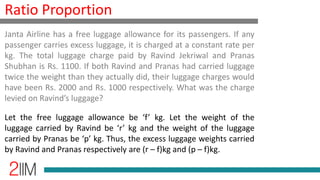
Let the free luggage allowance be ‘f’ kg. Let the weight of the
luggage carried by Ravind be ‘r’ kg and the weight of the luggage
carried by Pranas be ‘p’ kg. Thus, the excess luggage weights carried
by Ravind and Pranas respectively are (r – f)kg and (p – f)kg.
Janta Airline has a free luggage allowance for its passengers. If any
passenger carries excess luggage, it is charged at a constant rate per
kg. The total luggage charge paid by Ravind Jekriwal and Pranas
Shubhan is Rs. 1100. If both Ravind and Pranas had carried luggage
twice the weight than they actually did, their luggage charges would
have been Rs. 2000 and Rs. 1000 respectively. What was the charge
levied on Ravind’s luggage?
Ratio Proportion
Thus, the total luggage charge for both would be (r – f)k + (p – f)k if k
is the charge per kg.
Thus, (r – f)k + (p – f)k = 1100.
(r + p – 2f) k = 1100 ...........(1)
If Ravind carried twice the luggage weight he actually did, i.e., if he
carried 2r kg, then the excess luggage weight he carried would have
been 2r – f and the corresponding charge would have been (2r – f) k.
Therefore, (2r – f) k = 2000 ...........(2)
What was the charge levied on Ravind’s luggage?
Ratio Proportion
Likewise, If Pranas carried twice the luggage he actually did i.e., if he
carried 2p kg, then the excess luggage he carried would have been
2p –f and the corresponding charge would have been (2p – f) k.
Therefore, (2p – f) k = 1000 ...........(3)
Adding (2) and (3) and simplifying, we get,
(r + p – f) k = 1500 ...........(4)
What was the charge levied on Ravind’s luggage?
Ratio Proportion
Dividing (4) by (1) and simplifying, we get,
19f = 4r + 4p ...........(5)
Dividing (2) by (3) and simplifying, we get,
– f = 2r – 4p ...........(6)
Solving (5) and (6) for r, we get,
r = 3f ...........(7)
What was the charge levied on Ravind’s luggage?
Ratio Proportion
Subtracting (1) from (4) and simplifying, we get,
fk = 400.
Ravind’s luggage charge = (r – f)k.
But, according to equation (7), r = 3f. Therefore, Ravind’s luggage
charge = 2fk
But, fk = 400. Therefore, Ravind’s luggage charge = Rs. 800.
Answer choice (a)
What was the charge levied on Ravind’s luggage?
Prepare for the CAT from anywhere, at
anytime, and at your pace. Visit
online.2iim.com

Ratios linear Equations

  • 1.
  • 2.
    Ratio Proportion Janta Airlinehas a free luggage allowance for its passengers. If any passenger carries excess luggage, it is charged at a constant rate per kg. The total luggage charge paid by Ravind Jekriwal and Pranas Shubhan is Rs. 1100. If both Ravind and Pranas had carried luggage twice the weight than they actually did, their luggage charges would have been Rs. 2000 and Rs. 1000 respectively. What was the charge levied on Ravind’s luggage? (a) Rs. 800 (b) Rs. 700 (c) Rs. 600 (d) Rs. 900
  • 3.
    Ratio Proportion Let thefree luggage allowance be ‘f’ kg. Let the weight of the luggage carried by Ravind be ‘r’ kg and the weight of the luggage carried by Pranas be ‘p’ kg. Thus, the excess luggage weights carried by Ravind and Pranas respectively are (r – f)kg and (p – f)kg. Janta Airline has a free luggage allowance for its passengers. If any passenger carries excess luggage, it is charged at a constant rate per kg. The total luggage charge paid by Ravind Jekriwal and Pranas Shubhan is Rs. 1100. If both Ravind and Pranas had carried luggage twice the weight than they actually did, their luggage charges would have been Rs. 2000 and Rs. 1000 respectively. What was the charge levied on Ravind’s luggage?
  • 4.
    Ratio Proportion Thus, thetotal luggage charge for both would be (r – f)k + (p – f)k if k is the charge per kg. Thus, (r – f)k + (p – f)k = 1100. (r + p – 2f) k = 1100 ...........(1) If Ravind carried twice the luggage weight he actually did, i.e., if he carried 2r kg, then the excess luggage weight he carried would have been 2r – f and the corresponding charge would have been (2r – f) k. Therefore, (2r – f) k = 2000 ...........(2) What was the charge levied on Ravind’s luggage?
  • 5.
    Ratio Proportion Likewise, IfPranas carried twice the luggage he actually did i.e., if he carried 2p kg, then the excess luggage he carried would have been 2p –f and the corresponding charge would have been (2p – f) k. Therefore, (2p – f) k = 1000 ...........(3) Adding (2) and (3) and simplifying, we get, (r + p – f) k = 1500 ...........(4) What was the charge levied on Ravind’s luggage?
  • 6.
    Ratio Proportion Dividing (4)by (1) and simplifying, we get, 19f = 4r + 4p ...........(5) Dividing (2) by (3) and simplifying, we get, – f = 2r – 4p ...........(6) Solving (5) and (6) for r, we get, r = 3f ...........(7) What was the charge levied on Ravind’s luggage?
  • 7.
    Ratio Proportion Subtracting (1)from (4) and simplifying, we get, fk = 400. Ravind’s luggage charge = (r – f)k. But, according to equation (7), r = 3f. Therefore, Ravind’s luggage charge = 2fk But, fk = 400. Therefore, Ravind’s luggage charge = Rs. 800. Answer choice (a) What was the charge levied on Ravind’s luggage?
  • 8.
    Prepare for theCAT from anywhere, at anytime, and at your pace. Visit online.2iim.com