Knowledge Isotopes Pvt. Ltd.
Writing that makes you THINK
TM
www. knowledgeisotopes.com
2
KNOWLEDGE ISOTOPES SPREADING AWARENESS
ON “WORLD RARE DISORDER DAY (28TH FEB
2018)”
FOR THE CHALLENGES, HOPES, AND NEEDS OF
THOSE LIVING WITH RARE DISEASES.
Alone we are rare, together we are strong
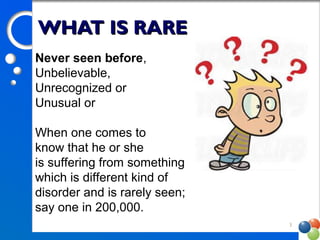
WHAT IS RAREWHAT IS RARE
3
Never seen before,
Unbelievable,
Unrecognized or
Unusual or
When one comes to
know that he or she
is suffering from something
which is different kind of
disorder and is rarely seen;
say one in 200,000.
I AM RARE- THE QUESTIONSI AM RARE- THE QUESTIONS
OCCUPIES ONE’S MINDOCCUPIES ONE’S MIND
4
•Am I unlucky to be cursed with this disorder?
•Am I correctly diagnosed?
•Is this curable?
•If so, how expensive is the treatment?
•What will be the success rate of my treatment?
RARE AND ORPHANRARE AND ORPHAN
Poorly Diagnosed
Heavy cost of treatment
Neglected
Untreated
Abandoned/Orphan
People with rare disorders
and their families often
suffer isolation, frustration,
depression, and
abandonment. 5
FACTS TO KNOW ABOUT RAREFACTS TO KNOW ABOUT RARE
DISORDERS (RDs)DISORDERS (RDs)
6
There are approximately 7,000 different types of RDs, with more
being discovered each day.
About 30 million people are living with RDs in the United States alone.
It is estimated that 350 million people worldwide suffer from RDs.
In India, there are nearly 7 crore people (1 in 20 Indians) affected
with a RD.
In the state of Karnataka alone, there are around 30­40 lakhs affected
persons
Contd…Contd…
7
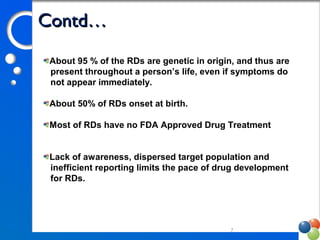
About 95 % of the RDs are genetic in origin, and thus are
present throughout a person’s life, even if symptoms do
not appear immediately.
About 50% of RDs onset at birth.
Most of RDs have no FDA Approved Drug Treatment
Lack of awareness, dispersed target population and
inefficient reporting limits the pace of drug development
for RDs.
8
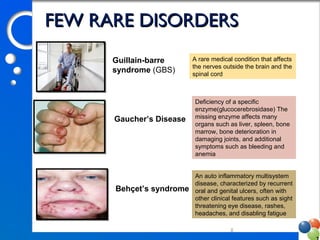
A rare medical condition that affects
the nerves outside the brain and the
spinal cord
Deficiency of a specific
enzyme(glucocerebrosidase) The
missing enzyme affects many
organs such as liver, spleen, bone
marrow, bone deterioration in
damaging joints, and additional
symptoms such as bleeding and
anemia
An auto inflammatory multisystem
disease, characterized by recurrent
oral and genital ulcers, often with
other clinical features such as sight
threatening eye disease, rashes,
headaches, and disabling fatigue
FEW RARE DISORDERSFEW RARE DISORDERS
Guillain­barre
syndrome (GBS)
Gaucher’s Disease
Behçet’s syndrome
99
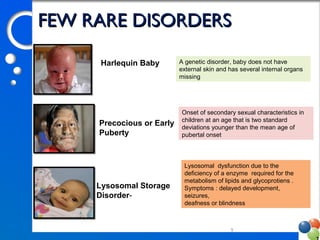
A genetic disorder, baby does not have
external skin and has several internal organs
missing
Onset of secondary sexual characteristics in
children at an age that is two standard
deviations younger than the mean age of
pubertal onset
Lysosomal dysfunction due to the
deficiency of a enzyme required for the
metabolism of lipids and glycoprotiens .
Symptoms : delayed development,
seizures,
deafness or blindness
Harlequin Baby
Precocious or Early
Puberty
Lysosomal Storage
Disorder-
FEW RARE DISORDERSFEW RARE DISORDERS
10
BOLLYWOOD QUIZ: GUESS THEBOLLYWOOD QUIZ: GUESS THE
MOVIEMOVIE
Progeria-Progeria-
11
Paa- 2009
Progeria is an extremely rare genetic disorder in which symptoms 
resembling aspects of aging are manifested at a very early age.
Those born with progeria typically live to their mid teens to early 
twenties
Not curable/treatable
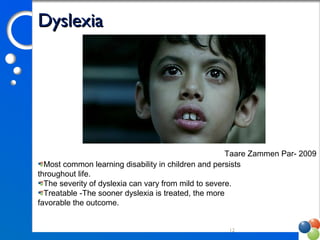
DyslexiaDyslexia
12
Taare Zammen Par- 2009
Most common learning disability in children and persists 
throughout life. 
The severity of dyslexia can vary from mild to severe. 
Treatable -The sooner dyslexia is treated, the more 
favorable the outcome. 
AmnesiaAmnesia
13
Loss of memories, such as facts, information and experiences- 
accidental cases, injuries in brain
Usually lucid and know who they are, but may have trouble learning 
new information and forming new memories
No specific treatment, but techniques for enhancing memory and 
psychological support can help people with amnesia
Ghajini -2008
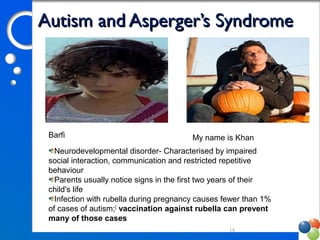
Autism and Asperger’s SyndromeAutism and Asperger’s Syndrome
14
Barfi My name is Khan
Neurodevelopmental disorder- Characterised by impaired 
social interaction, communication and restricted repetitive 
behaviour
Parents usually notice signs in the first two years of their 
child's life
Infection with rubella during pregnancy causes fewer than 1% 
of cases of autism;[
 vaccination against rubella can prevent
many of those cases
15
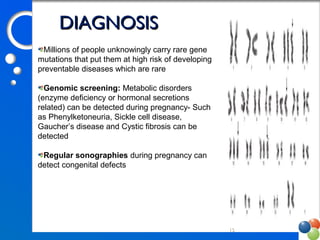
DIAGNOSISDIAGNOSIS
Millions of people unknowingly carry rare gene 
mutations that put them at high risk of developing 
preventable diseases which are rare
Genomic screening: Metabolic disorders 
(enzyme deficiency or hormonal secretions 
related) can be detected during pregnancy- Such 
as Phenylketoneuria, Sickle cell disease, 
Gaucher’s disease and Cystic fibrosis can be 
detected
Regular sonographies during pregnancy can 
detect congenital defects
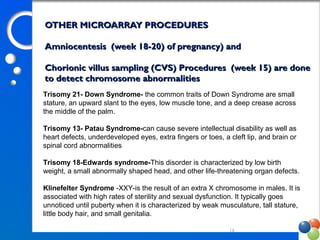
OTHER MICROARRAY PROCEDURESOTHER MICROARRAY PROCEDURES
Amniocentesis (week 18-20) of pregnancy) andAmniocentesis (week 18-20) of pregnancy) and
Chorionic villus sampling (CVS) Procedures (week 15) are doneChorionic villus sampling (CVS) Procedures (week 15) are done
to detect chromosome abnormalitiesto detect chromosome abnormalities
16
Trisomy 21- Down Syndrome- the common traits of Down Syndrome are small
stature, an upward slant to the eyes, low muscle tone, and a deep crease across
the middle of the palm.
Trisomy 13- Patau Syndrome-can cause severe intellectual disability as well as
heart defects, underdeveloped eyes, extra fingers or toes, a cleft lip, and brain or
spinal cord abnormalities
Trisomy 18-Edwards syndrome-This disorder is characterized by low birth
weight, a small abnormally shaped head, and other life-threatening organ defects.
Klinefelter Syndrome -XXY-is the result of an extra X chromosome in males. It is
associated with high rates of sterility and sexual dysfunction. It typically goes
unnoticed until puberty when it is characterized by weak musculature, tall stature,
little body hair, and small genitalia.
IRONY OF GENE MUTATIONSIRONY OF GENE MUTATIONS
Not All the RDs are detectable and
curable
17
18

Rare Disorders