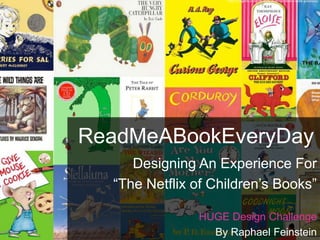
ReadMeABookEveryDay
Designing An Experience For
“The Netflix of Children’s Books”
HUGE Design Challenge
By Raphael Feinstein
http://megfish.com/2010/03/march-childrens-book-giveaway/
Problem
Most parents have trouble finding
books that match their children’s
interests, comprehension level and
attention level
Kids are usually curious, looking to
explore and understand the world
Books are a great way to explore a
child’s curiosity because they can
take a child deep into the jungle,
over the moon or to a kind, talking
tree
Reading any book with a child
does not foster a love of reading
Problem
http://commons.wikimedia.org/wiki/File:Empty_book.jpg
Creates a smarter,
literate youth
Gets parents involved in
children’s lives
Keeps the lights on at
ReadMeABookEveryDay
Problem
Lenses
Intrinsic Motivation and Simplicity
The Experience
Insights
A child is more likely to learn and retain information
when s/he believes that s/he is pleasing his/herself
It is difficult for parents to help find an appropriate
challenge while still allowing the choice to be the
child's
When children can see the result of their actions as a
reward they are motivated to continue those actions
- National Association of School Psychologists
Insights
Children approximately as young as 10 months are
able to understand directions and can choose books
they like
Some parents just want their child to read, it does not
matter what the content is.
- Interview with mother of 19 month old child
Stakeholders
The Child The Parent The Business
Children between 3-6
years old.
Curious about the
world.
Working parents that may
not have the time to go
searching for books but are
willing to sit down at night
and read a few books with
their child.
Create a user base and
retain families as children
grow up
Solution
Sort by Age and Theme
Keeps the challenge of finding the right
book on the business
Removes cognitive load from Parents
Themes create an encompassing lesson,
moral or idea for the child to explore
Age determines the approximate
development stage, setting criteria for book
types
Solution
Child Chooses Interest
The child is more interested in reading if
s/he chooses the topic
The wide range of interests allow children
to explore and discover
The child has set their own challenge, so
they are reading for themselves
Solution
Parent Approval Process
Parent can pre-screen the
themed book selection
If they do not like a book,
it can be replaced
Reduces parent effort but
keeps them involved and
in control
Solution
Supporting Tools
Creates a collaborative learning
experience after the reading is
complete
Children can see object or activity as a
reward that will come with the books,
but it is an extension of what they read
that can be taken into the world for
continued learning
Forms culminating experience of their
own actions, motivating them to
continue these actions
Strategies
Technical: Web and Phone Application
So busy parents can keep the books coming for their
knowledge hungry children
Strategies
Business: If it needed to be broken down into implementation phases
Web application for
parents to set age and
browse themes
Add functionality for
book approval and child
interest
Expand into phone
application,
incorporating the
supporting tools
30%
60%
100%
Strategies
Social:
Children do better in
school
They go farther Seek out and solve harder
problems in the world
The Experience
Kids Choose Parents ApproveBusiness Works Extend the Experience
Kids Incentivized
&
Parents at Ease
Kids Form Relationship
with Reading
Business Continues to
Iterate on Process
Stakeholders are
Happier
Pictures:
Allorge, Lionel. Empty Book. Digital image. Wikimedia Commons. N.p., 25 Jan. 2011. Web. 17 Mar. 2015.
<http://commons.wikimedia.org/wiki/File:Empty_book.jpg>.
Fish, Meg. Children's Books Collage. Digital image. Meg Fish & Co. N.p., 29 Mar. 2010. Web. 7 Feb. 2015.
<http://megfish.com/2010/03/march-childrens-book-giveaway/>.
Westover, Rebekah. Andrea and Her Boys. Digital image. Pinterest, 11 Oct. 2010. Web. 17 Mar. 2015.
<https://www.pinterest.com/libbymtaylor/photography/>.
Research:
Braun, Effie. "Children's Interaction with Books." Online interview. 6 Feb. 2015.
"Browse the Oyster Library." Oyster. N.p., 2015. Web. 07 Feb. 2015. <https://www.oysterbooks.com/library>.
"DEVELOPMENTAL STAGES OF CHILDREN (0-6 YEARS)." Superior Court of California County of Placer. N.p., 2013. Web.
6 Feb. 2015. <http://www.placer.courts.ca.gov/family/family_op_0-6.html>.
"Motivating Learning in Young Children." Motivating Learning in Young Children. NASP, n.d. Web. 06 Feb. 2015.
<http://www.nasponline.org/resources/home_school/earlychildmotiv_ho.aspx>.
Perez, Sarah. "Sproutkin Launches A “Netflix For Children’s Books”." TechCrunch. Livefyre, 7 Mar. 2013. Web. 06 Feb. 2015.
<http://techcrunch.com/2013/03/07/sproutkin-launches-a-netflix-for-childrens-books/>.
Perry, Jack W. "Time for Ebook Subscriptions for Children’s Titles." Digital Book World. N.p., 6 Feb. 2014. Web. 6 Feb. 2015.
<http://www.digitalbookworld.com/2014/time-for-ebook-subscriptions-for-childrens-titles/>.
Research & References
Thank you
Questions?
Persona
Name: Jackie
Age: 31
Location: Indianapolis, IN
Background: Jackie is from Illinois but moved
to Indianapolis when she got married to her
husband. Her husband works as a manager
in a construction business.
She is a working mother, so she does not
spend as much time as she would like to
with her child. She works in a bank. She has
a 4 year old boy with her husband. They are
always trying to save because they know
that the world is becoming more expensive.
They want to give their child the best
chance to succeed and so they have
already worked to make sure he is in a good
pre-school. He goes to daycare when he is
not at school and while Jackie and her
husband are at work.
They try to read at least one book to him
each night and are working on his reading
abilities. Unfortunately, they did not start
reading consistently with him until about a
year and a half ago because they did not
understand the benefits.
https://www.pinterest.com/libbymtaylor/photography/
Interview Report
The participant is female, 29 years old and works in finance. She lives in Studio City, California in a condo with her
husband who is 30 years old and a lawyer. They have a 19 month old male child with another child on the way. They
have a nanny read books to their child every day and the participant reads a book or two each night before putting the
child to sleep. The child was able to identify books he liked from 10 months old, but did not do it himself until 12 month,
around the time he could walk to the bookshelf. They have been reading to him from the time he was 2-3 months old
but has not yet started to read words himself just yet.
The questions asked during the interview are as follows:
• What reading activities do you partake in with your child?
• How do you choose the books?
• How did you get him interested in books?
• Where did you get the books? How did you find them?
• What is the frequency at which you introduce new books?
• Do you try to push the level of the books when you buy new ones?
• At what age did he start choosing books for himself?
• If you could get 1-5 new books each week (not considering money) that would be of interest to your child, would
that be something you would consider?
• Is there anything you do not want him to read?
Answers to these questions may be released if necessary.
Research & References
Concept Generation
Plus One Seed Book: This concept utilized the idea that the reward for reading should be more reading. The
concept was to add in another book on top of the 1, 3 or 5 books ordered that would be in some way different from
the books ordered. That way the service would be giving the child an opportunity to read something else taking the
child outside of their usually genres.
Concept Generation
Challenge Books: This concept
played on the idea of different
levels of reading in a single order.
When the parents ordered 1, 3 or
5 books, each book would be a
specified difficulty so the parents
could push the limits of each
child’s reading ability, but start
with something easy
Concept Generation
Follow Up Cards: This concept was inspired by the real company SproutKin. It is a card that comes with the box
of books that has a list of questions and activities that parents and children can do together. This continues the
learning past the book and keeps the parents involved in the child’s reading, as long as the card is used.
Concept Generation
Parent Crowdsourcing Approved Books: The idea is to bring parents onto the website and approve of books
that they have read and liked. This way other parents know if the book has been read and if they should or should
not ask for it to be part of their order. By crowdsourcing, parents can help other parents. Books can be filtered by
amount of approvals and feel comfortable that their child is reading quality content.
Concept Generation
Recommendations Based on Past Purchases: Like Amazon, this idea would show parents books based in past
orders. Books would be recommended using an algorithm to get the parent to order familiar books as well as
books that they would not consider regularly.
Concept Generation
See What Other Parents are Choosing: This concept is exactly what it sounds like. Parents would be able to
see what other parents are ordering, giving them an idea of different kinds of books and removing the cognitive
effort necessary to sort through books. This idea is good for trying to find new books but requires some parents to
do all the work and others can freeload.

Raphael_feinstein huge_design_challenge

  • 1.
    ReadMeABookEveryDay Designing An ExperienceFor “The Netflix of Children’s Books” HUGE Design Challenge By Raphael Feinstein http://megfish.com/2010/03/march-childrens-book-giveaway/
  • 2.
    Problem Most parents havetrouble finding books that match their children’s interests, comprehension level and attention level Kids are usually curious, looking to explore and understand the world Books are a great way to explore a child’s curiosity because they can take a child deep into the jungle, over the moon or to a kind, talking tree
  • 3.
    Reading any bookwith a child does not foster a love of reading Problem http://commons.wikimedia.org/wiki/File:Empty_book.jpg
  • 4.
    Creates a smarter, literateyouth Gets parents involved in children’s lives Keeps the lights on at ReadMeABookEveryDay Problem
  • 5.
  • 6.
  • 7.
    Insights A child ismore likely to learn and retain information when s/he believes that s/he is pleasing his/herself It is difficult for parents to help find an appropriate challenge while still allowing the choice to be the child's When children can see the result of their actions as a reward they are motivated to continue those actions - National Association of School Psychologists
  • 8.
    Insights Children approximately asyoung as 10 months are able to understand directions and can choose books they like Some parents just want their child to read, it does not matter what the content is. - Interview with mother of 19 month old child
  • 9.
    Stakeholders The Child TheParent The Business Children between 3-6 years old. Curious about the world. Working parents that may not have the time to go searching for books but are willing to sit down at night and read a few books with their child. Create a user base and retain families as children grow up
  • 10.
    Solution Sort by Ageand Theme Keeps the challenge of finding the right book on the business Removes cognitive load from Parents Themes create an encompassing lesson, moral or idea for the child to explore Age determines the approximate development stage, setting criteria for book types
  • 11.
    Solution Child Chooses Interest Thechild is more interested in reading if s/he chooses the topic The wide range of interests allow children to explore and discover The child has set their own challenge, so they are reading for themselves
  • 12.
    Solution Parent Approval Process Parentcan pre-screen the themed book selection If they do not like a book, it can be replaced Reduces parent effort but keeps them involved and in control
  • 13.
    Solution Supporting Tools Creates acollaborative learning experience after the reading is complete Children can see object or activity as a reward that will come with the books, but it is an extension of what they read that can be taken into the world for continued learning Forms culminating experience of their own actions, motivating them to continue these actions
  • 14.
    Strategies Technical: Web andPhone Application So busy parents can keep the books coming for their knowledge hungry children
  • 15.
    Strategies Business: If itneeded to be broken down into implementation phases Web application for parents to set age and browse themes Add functionality for book approval and child interest Expand into phone application, incorporating the supporting tools 30% 60% 100%
  • 16.
    Strategies Social: Children do betterin school They go farther Seek out and solve harder problems in the world
  • 17.
    The Experience Kids ChooseParents ApproveBusiness Works Extend the Experience Kids Incentivized & Parents at Ease Kids Form Relationship with Reading Business Continues to Iterate on Process Stakeholders are Happier
  • 18.
    Pictures: Allorge, Lionel. EmptyBook. Digital image. Wikimedia Commons. N.p., 25 Jan. 2011. Web. 17 Mar. 2015. <http://commons.wikimedia.org/wiki/File:Empty_book.jpg>. Fish, Meg. Children's Books Collage. Digital image. Meg Fish & Co. N.p., 29 Mar. 2010. Web. 7 Feb. 2015. <http://megfish.com/2010/03/march-childrens-book-giveaway/>. Westover, Rebekah. Andrea and Her Boys. Digital image. Pinterest, 11 Oct. 2010. Web. 17 Mar. 2015. <https://www.pinterest.com/libbymtaylor/photography/>. Research: Braun, Effie. "Children's Interaction with Books." Online interview. 6 Feb. 2015. "Browse the Oyster Library." Oyster. N.p., 2015. Web. 07 Feb. 2015. <https://www.oysterbooks.com/library>. "DEVELOPMENTAL STAGES OF CHILDREN (0-6 YEARS)." Superior Court of California County of Placer. N.p., 2013. Web. 6 Feb. 2015. <http://www.placer.courts.ca.gov/family/family_op_0-6.html>. "Motivating Learning in Young Children." Motivating Learning in Young Children. NASP, n.d. Web. 06 Feb. 2015. <http://www.nasponline.org/resources/home_school/earlychildmotiv_ho.aspx>. Perez, Sarah. "Sproutkin Launches A “Netflix For Children’s Books”." TechCrunch. Livefyre, 7 Mar. 2013. Web. 06 Feb. 2015. <http://techcrunch.com/2013/03/07/sproutkin-launches-a-netflix-for-childrens-books/>. Perry, Jack W. "Time for Ebook Subscriptions for Children’s Titles." Digital Book World. N.p., 6 Feb. 2014. Web. 6 Feb. 2015. <http://www.digitalbookworld.com/2014/time-for-ebook-subscriptions-for-childrens-titles/>. Research & References
  • 19.
  • 20.
    Persona Name: Jackie Age: 31 Location:Indianapolis, IN Background: Jackie is from Illinois but moved to Indianapolis when she got married to her husband. Her husband works as a manager in a construction business. She is a working mother, so she does not spend as much time as she would like to with her child. She works in a bank. She has a 4 year old boy with her husband. They are always trying to save because they know that the world is becoming more expensive. They want to give their child the best chance to succeed and so they have already worked to make sure he is in a good pre-school. He goes to daycare when he is not at school and while Jackie and her husband are at work. They try to read at least one book to him each night and are working on his reading abilities. Unfortunately, they did not start reading consistently with him until about a year and a half ago because they did not understand the benefits. https://www.pinterest.com/libbymtaylor/photography/
  • 21.
    Interview Report The participantis female, 29 years old and works in finance. She lives in Studio City, California in a condo with her husband who is 30 years old and a lawyer. They have a 19 month old male child with another child on the way. They have a nanny read books to their child every day and the participant reads a book or two each night before putting the child to sleep. The child was able to identify books he liked from 10 months old, but did not do it himself until 12 month, around the time he could walk to the bookshelf. They have been reading to him from the time he was 2-3 months old but has not yet started to read words himself just yet. The questions asked during the interview are as follows: • What reading activities do you partake in with your child? • How do you choose the books? • How did you get him interested in books? • Where did you get the books? How did you find them? • What is the frequency at which you introduce new books? • Do you try to push the level of the books when you buy new ones? • At what age did he start choosing books for himself? • If you could get 1-5 new books each week (not considering money) that would be of interest to your child, would that be something you would consider? • Is there anything you do not want him to read? Answers to these questions may be released if necessary. Research & References
  • 22.
    Concept Generation Plus OneSeed Book: This concept utilized the idea that the reward for reading should be more reading. The concept was to add in another book on top of the 1, 3 or 5 books ordered that would be in some way different from the books ordered. That way the service would be giving the child an opportunity to read something else taking the child outside of their usually genres.
  • 23.
    Concept Generation Challenge Books:This concept played on the idea of different levels of reading in a single order. When the parents ordered 1, 3 or 5 books, each book would be a specified difficulty so the parents could push the limits of each child’s reading ability, but start with something easy
  • 24.
    Concept Generation Follow UpCards: This concept was inspired by the real company SproutKin. It is a card that comes with the box of books that has a list of questions and activities that parents and children can do together. This continues the learning past the book and keeps the parents involved in the child’s reading, as long as the card is used.
  • 25.
    Concept Generation Parent CrowdsourcingApproved Books: The idea is to bring parents onto the website and approve of books that they have read and liked. This way other parents know if the book has been read and if they should or should not ask for it to be part of their order. By crowdsourcing, parents can help other parents. Books can be filtered by amount of approvals and feel comfortable that their child is reading quality content.
  • 26.
    Concept Generation Recommendations Basedon Past Purchases: Like Amazon, this idea would show parents books based in past orders. Books would be recommended using an algorithm to get the parent to order familiar books as well as books that they would not consider regularly.
  • 27.
    Concept Generation See WhatOther Parents are Choosing: This concept is exactly what it sounds like. Parents would be able to see what other parents are ordering, giving them an idea of different kinds of books and removing the cognitive effort necessary to sort through books. This idea is good for trying to find new books but requires some parents to do all the work and others can freeload.

Editor's Notes

  • #4 but
  • #5 And we need to foster a love for reading because
  • #6 We will be using 2 lenses to find a solution
  • #7 Our experience begins with…
  • #10 But this experience is not for everyone, the users we are looking at are …
  • #11 Lets break down the experience, we have 4 key features in this solution