
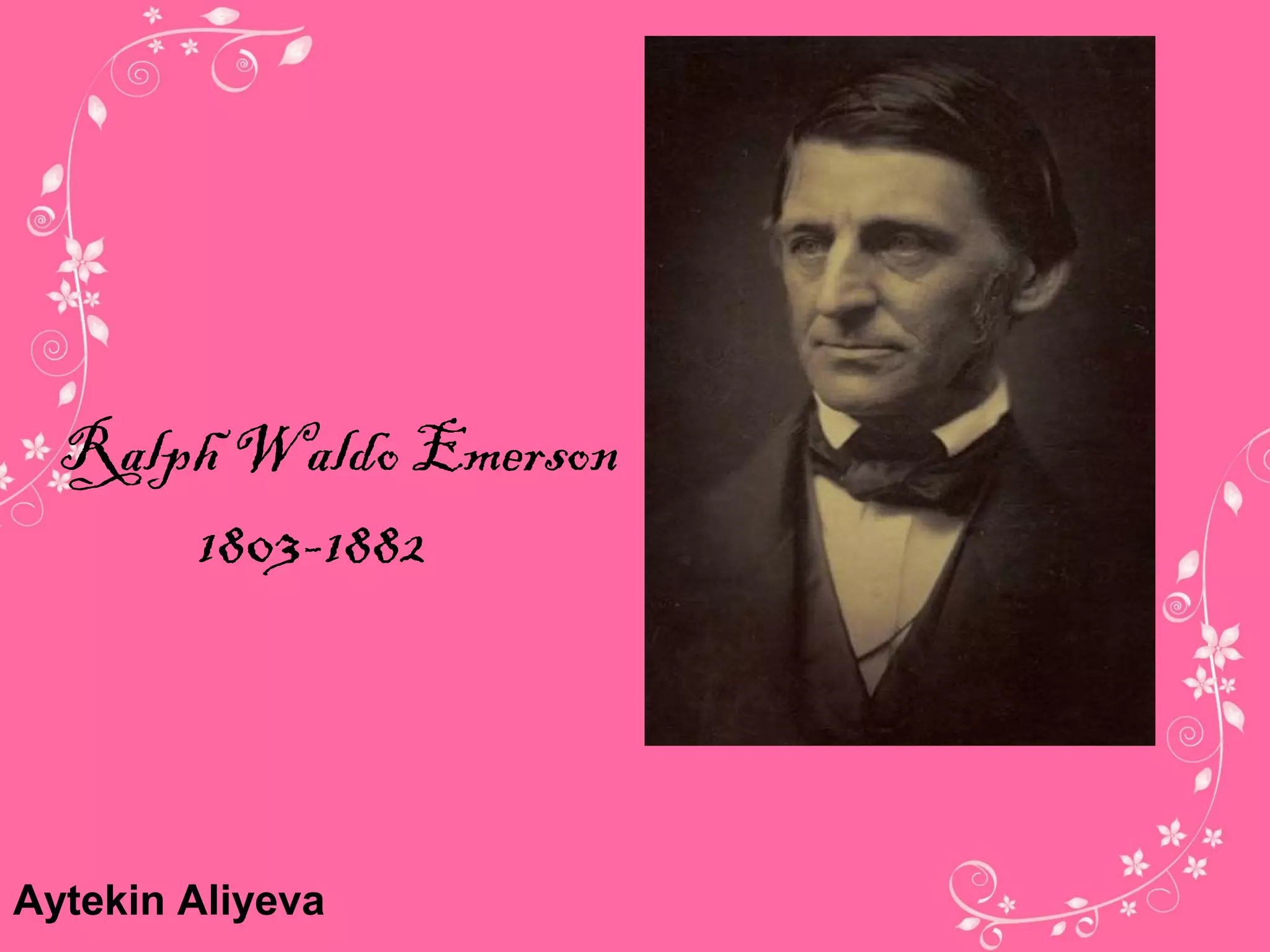

Ralph Waldo Emerson
        1803-1882


Aytekin Aliyeva
Transcendentalism
• It is any system of philosophy, that emphasizes intuition as
  a means to knowledge or the importance of the search for
  the divine
• Transcendentalism was a group of new ideas in literature,
  religion, culture, and philosophy that emerged in New
  England in the early to middle 19th century. It is sometimes
  called American transcendentalism to distinguish it from
  other uses of the word transcendental.
• Transcendentalism began as a protest against the general
  state of culture and society, and in particular, the state of
  intellectualism at Harvard and the doctrine of the Unitarian
  church taught at Harvard Divinity School. Among
  transcendentalists' core beliefs was an ideal spiritual state
  that 'transcends' the physical and empirical and is only
  realized through the individual's intuition, rather than
  through the doctrines of established religions
Influence on other
          movements
• Transcendentalists were strong believers in the power of
  the individual and divine messages. Their beliefs are
  closely linked with those of the Romantics.
• The movement directly influenced the growing
  movement of Mental Sciences of the mid 1800s which
  would later become known as the New Thought
  movement. New Thought draws directly from the
  transcendentalists, particularly Emerson. New Thought
  considers Emerson its intellectual father.
Days
Daughters of Time, the hypocritic Days,
Muffled and dumb like barefoot dervishes,
And marching single in an endless file,
Bring diadems and fagots in their hands.
To each they offer gifts after his will,
Bread, kingdoms, stars, and sky that holds them all.
I, in my pleached garden, watched the pomp,
Forgot my morning wishes, hastily
Took a few herbs and apples, and the Day
Turned and departed silent. I, too late,
Under her solemn fillet saw the scorn.
•
                         Analysis attract attention,
    This tiny Emerson poem continues to
  because of the ambiguity of the word "hypocritic." Readers
  choose sides in the debate according to the meaning of
  "hypocritic days." One side claims that the days are "actors";
  while the other argues that they are "deceivers."
• Actually, the two terms are not mutually exclusive. In a sense
  actors are deceiving, because they are pretending to be other
  than they are, but some people suggest the real significance of
  the term, as well as the total meaning of the poem, depends
  upon the human perception of things in the poem. It is the
  human mind that conceives the notion of days as "daughters
  of time." The speaker has learned something by the end of the
  poem-something that perhaps has taken him a lifetime. He
  has learned that he has taken from life according to his own
  will-"To each they offer gifts after his own will."
• After this realization, the speaker looks back, and
  in order to give others a clear image of what he has
  learned, he personifies the passage of time as
  "daughters of time." In qualifying the definition of
  days, the speaker calls them "hypocritic." The
  "days" are surely actors since the speaker has
  personified them and portrayed them in a specific
  role: they act like "barefoot dervishes"; they march
  "in an endless file"; they "bring diadems and fagots
  in their hands"; and by the end of the poem, the
  speaker has even attributed to one of the daughters
  an attitude, because he sees scorn on her brow-"I,
  too late, Under her solemn fillet saw the scorn."
• As actors, the days are merely playing a role.
  They apparently are neutral and thus play no
  part in hypocrisy, but to the human mind that
  wants and expects some nudge in the right
  direction, such a neutral actor might be
  considered hypocritical; one might reason: "if I
  could have the 'diadems' as easily as the 'fagots'
  and all I had to do was will it-then why didn't
  someone tell me?" And this attitude, suggested
  to be the heart of the poem. Learning to use our
  will is not so easy, and that is why we settle for
  lesser "gifts." But when we learn the truth that
  the speaker learns, we indeed feel tricked. We
  feel that these acting "daughters of time" have
  been hypocritical in not urging us to demand
  more than a "few herbs and apples."
• It is suggested that the synthesis of the two
  meanings places primary emphasis on the human
  being, not on the days. After all, it is the human
  mind that creates the concept of a day. The
  human mind conceives the ideas of acting and
  deceiving; the days, as daughters of time, take on
  the human projections of action and deception,
  but the speaker in the poem is the one who
  determines their identity, and the speaker is the
  one who changes. The days cannot be any more
  than "muffled and dumb," but the speaker who is
  human contains both concepts of action and
  deception, as well as the ability to talk about his
  experience in human terms.

Ralph Waldo Emerson

  • 1.
    Ralph Waldo Emerson 1803-1882 Aytekin Aliyeva
  • 2.
    Transcendentalism • It isany system of philosophy, that emphasizes intuition as a means to knowledge or the importance of the search for the divine • Transcendentalism was a group of new ideas in literature, religion, culture, and philosophy that emerged in New England in the early to middle 19th century. It is sometimes called American transcendentalism to distinguish it from other uses of the word transcendental. • Transcendentalism began as a protest against the general state of culture and society, and in particular, the state of intellectualism at Harvard and the doctrine of the Unitarian church taught at Harvard Divinity School. Among transcendentalists' core beliefs was an ideal spiritual state that 'transcends' the physical and empirical and is only realized through the individual's intuition, rather than through the doctrines of established religions
  • 3.
    Influence on other movements • Transcendentalists were strong believers in the power of the individual and divine messages. Their beliefs are closely linked with those of the Romantics. • The movement directly influenced the growing movement of Mental Sciences of the mid 1800s which would later become known as the New Thought movement. New Thought draws directly from the transcendentalists, particularly Emerson. New Thought considers Emerson its intellectual father.
  • 4.
    Days Daughters of Time,the hypocritic Days, Muffled and dumb like barefoot dervishes, And marching single in an endless file, Bring diadems and fagots in their hands. To each they offer gifts after his will, Bread, kingdoms, stars, and sky that holds them all. I, in my pleached garden, watched the pomp, Forgot my morning wishes, hastily Took a few herbs and apples, and the Day Turned and departed silent. I, too late, Under her solemn fillet saw the scorn.
  • 5.
    Analysis attract attention, This tiny Emerson poem continues to because of the ambiguity of the word "hypocritic." Readers choose sides in the debate according to the meaning of "hypocritic days." One side claims that the days are "actors"; while the other argues that they are "deceivers." • Actually, the two terms are not mutually exclusive. In a sense actors are deceiving, because they are pretending to be other than they are, but some people suggest the real significance of the term, as well as the total meaning of the poem, depends upon the human perception of things in the poem. It is the human mind that conceives the notion of days as "daughters of time." The speaker has learned something by the end of the poem-something that perhaps has taken him a lifetime. He has learned that he has taken from life according to his own will-"To each they offer gifts after his own will."
  • 6.
    • After thisrealization, the speaker looks back, and in order to give others a clear image of what he has learned, he personifies the passage of time as "daughters of time." In qualifying the definition of days, the speaker calls them "hypocritic." The "days" are surely actors since the speaker has personified them and portrayed them in a specific role: they act like "barefoot dervishes"; they march "in an endless file"; they "bring diadems and fagots in their hands"; and by the end of the poem, the speaker has even attributed to one of the daughters an attitude, because he sees scorn on her brow-"I, too late, Under her solemn fillet saw the scorn."
  • 7.
    • As actors,the days are merely playing a role. They apparently are neutral and thus play no part in hypocrisy, but to the human mind that wants and expects some nudge in the right direction, such a neutral actor might be considered hypocritical; one might reason: "if I could have the 'diadems' as easily as the 'fagots' and all I had to do was will it-then why didn't someone tell me?" And this attitude, suggested to be the heart of the poem. Learning to use our will is not so easy, and that is why we settle for lesser "gifts." But when we learn the truth that the speaker learns, we indeed feel tricked. We feel that these acting "daughters of time" have been hypocritical in not urging us to demand more than a "few herbs and apples."
  • 8.
    • It issuggested that the synthesis of the two meanings places primary emphasis on the human being, not on the days. After all, it is the human mind that creates the concept of a day. The human mind conceives the ideas of acting and deceiving; the days, as daughters of time, take on the human projections of action and deception, but the speaker in the poem is the one who determines their identity, and the speaker is the one who changes. The days cannot be any more than "muffled and dumb," but the speaker who is human contains both concepts of action and deception, as well as the ability to talk about his experience in human terms.