Submitted By:-
1.Rajat Chaskar 3433 3.Abhishek Ingale 3434
2.Onkar lawate 3413 4.Balaji Kapse 3435
 ACKNOWLEDGEMENT
• With deep sense of gratitude we would like to thank all the teachers who have lead our
path with their kind guidance. We are very grateful to these intellectuals who did their
best to help during our semester period.
• It is our proud privilege to express deep sense of gratitude to our ENTC Project Guide
Mrs. M. V. Vibhute (HOD of Electronics and Communication) for his continuous
guidance and support throughout our project.
 C O N T E N T
1 . I N T R O D U C T I O N
2 . P R O P O S E D M E T H O D O L O G Y
3 . H A R D WA R E S P E C I F I C AT I O N S
4 . S O F T WA R E S P E C I F I C AT I O N S
5 . C O N C L U S I O N
6 . R E F E R E N C E S
 INTRODUCTION
• Most educational institutions administrators are concerned about student
irregular attendance,therefore RFID based attendance system is one of
the solutions to this problem
• RFID based attendance system consists of RFID Reader, RFID Tag, LCD
Display and microcontroller unit. RFID can be interfaced to microcontroller
through USART. Data is transferred from RFID cards to reader and from
there to microcontroller.
 PROPOSED METHODOLOGY
• Every authorized student is provided with a unique RFID tag/card with
his/her details fed in it. The tag consists of a built in integrated circuit that
stores this data through modulating and demodulating transmitted radio
frequency signals. The data thus stored in this card is the unique
identification of that person. As soon as the card is placed in front of the
RFID reader, the data in it is read and attendance for that student is
registered.
• This is done with the help of an 8051 microcontroller interfaced with the
reader. If it is a registered student, then a confirmation is displayed on an
LCD screen, else a rejection message isshown that denies the
attendance.
• All student attendance status can be later obtained from the system when the
status button interfaced with the microcontroller is pressed. This saves a lot of
time and effort in student attendance registration.
• When a person put their RFID tag to RFID reader then RFID reads tag’s data
and send it to 8051 microcontroller and then microcontroller compares this data
with defined data or information. If data is matched with defined data then
microcontroller increment the attendance by one of the tag’s person and if
matched is not occurred then microcontroller shows invalid card on LCD and
buzzer is beeping continuously for some time.
RFID tags are of two types – 1) Passive Tags
2) Active Tags.
• Passive tags:- Contain 13 digit number tag inbuilt in it.
• Active tag:-Is read/write tag i.e. one can read from the tag and write to the tag
This project uses passive tag.
• RFID reader contains a copper winding in it. This winding acts as an antenna
. When the tag is placed near the reader, due to the induced mutual inductance
energy, data is transferred to reader.
Reader then transfers data to the microntroller. Microcontroller checks for the
data continuously, if any data is received, microcontroller compares the data in
data base.
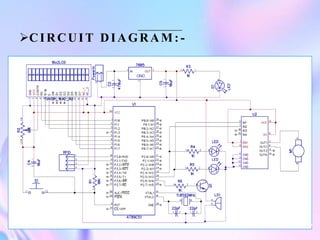
CIRCUIT DIAGRAM: -
 HARDWARE SPECIFICATIONS
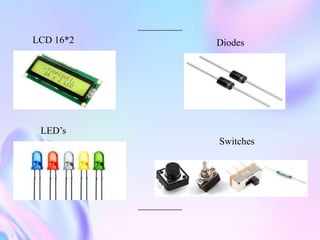
8051 Microcontroller EM 18 RFID Reader
LCD 16*2 Diodes
LED’s
Switches
 SOFTWARE SPECIFICATIONS
• Arduino Compiler
• Programming Language: C
• Flowchart
 RESULTS
 C O N C L U S I O N
• In terms of performance and efficiency, this project has provided a convenient
method of attendance marking compared to the traditional method of
attendance system. By using databases, the data is more organized. This
system is also a user friendly system as data manipulation and retrieval can be
done via the interface, making it a universal attendance system. Thus, it can
be implemented in either an academic institution or in organizations.
 REFERENCES
• https://circuitdigest.com/fullimage i=circuitdiagram_mic/RFID-Attendance-
System-Circuit
• . T.S. Lim, S.C. Sim and M.M. Mansor, ―RFID Based Attendance System‖
2009 IEEE Symposium on Industrial Electronics and Applications.
• Dhanalakshmi M and Uppala Mamatha, ―RFID Based Library Management
System‖ Proceedings of ASCNT, CDAC,
• www.google.com
Thank You

rajat cpp ppt.pptx

  • 1.
    Submitted By:- 1.Rajat Chaskar3433 3.Abhishek Ingale 3434 2.Onkar lawate 3413 4.Balaji Kapse 3435
  • 2.
     ACKNOWLEDGEMENT • Withdeep sense of gratitude we would like to thank all the teachers who have lead our path with their kind guidance. We are very grateful to these intellectuals who did their best to help during our semester period. • It is our proud privilege to express deep sense of gratitude to our ENTC Project Guide Mrs. M. V. Vibhute (HOD of Electronics and Communication) for his continuous guidance and support throughout our project.
  • 3.
     C ON T E N T 1 . I N T R O D U C T I O N 2 . P R O P O S E D M E T H O D O L O G Y 3 . H A R D WA R E S P E C I F I C AT I O N S 4 . S O F T WA R E S P E C I F I C AT I O N S 5 . C O N C L U S I O N 6 . R E F E R E N C E S
  • 4.
     INTRODUCTION • Mosteducational institutions administrators are concerned about student irregular attendance,therefore RFID based attendance system is one of the solutions to this problem • RFID based attendance system consists of RFID Reader, RFID Tag, LCD Display and microcontroller unit. RFID can be interfaced to microcontroller through USART. Data is transferred from RFID cards to reader and from there to microcontroller.
  • 5.
     PROPOSED METHODOLOGY •Every authorized student is provided with a unique RFID tag/card with his/her details fed in it. The tag consists of a built in integrated circuit that stores this data through modulating and demodulating transmitted radio frequency signals. The data thus stored in this card is the unique identification of that person. As soon as the card is placed in front of the RFID reader, the data in it is read and attendance for that student is registered. • This is done with the help of an 8051 microcontroller interfaced with the reader. If it is a registered student, then a confirmation is displayed on an LCD screen, else a rejection message isshown that denies the attendance.
  • 6.
    • All studentattendance status can be later obtained from the system when the status button interfaced with the microcontroller is pressed. This saves a lot of time and effort in student attendance registration. • When a person put their RFID tag to RFID reader then RFID reads tag’s data and send it to 8051 microcontroller and then microcontroller compares this data with defined data or information. If data is matched with defined data then microcontroller increment the attendance by one of the tag’s person and if matched is not occurred then microcontroller shows invalid card on LCD and buzzer is beeping continuously for some time.
  • 7.
    RFID tags areof two types – 1) Passive Tags 2) Active Tags. • Passive tags:- Contain 13 digit number tag inbuilt in it. • Active tag:-Is read/write tag i.e. one can read from the tag and write to the tag This project uses passive tag. • RFID reader contains a copper winding in it. This winding acts as an antenna . When the tag is placed near the reader, due to the induced mutual inductance energy, data is transferred to reader. Reader then transfers data to the microntroller. Microcontroller checks for the data continuously, if any data is received, microcontroller compares the data in data base.
  • 8.
  • 9.
     HARDWARE SPECIFICATIONS 8051Microcontroller EM 18 RFID Reader
  • 10.
  • 11.
     SOFTWARE SPECIFICATIONS •Arduino Compiler • Programming Language: C • Flowchart
  • 12.
  • 13.
     C ON C L U S I O N • In terms of performance and efficiency, this project has provided a convenient method of attendance marking compared to the traditional method of attendance system. By using databases, the data is more organized. This system is also a user friendly system as data manipulation and retrieval can be done via the interface, making it a universal attendance system. Thus, it can be implemented in either an academic institution or in organizations.
  • 14.
     REFERENCES • https://circuitdigest.com/fullimagei=circuitdiagram_mic/RFID-Attendance- System-Circuit • . T.S. Lim, S.C. Sim and M.M. Mansor, ―RFID Based Attendance System‖ 2009 IEEE Symposium on Industrial Electronics and Applications. • Dhanalakshmi M and Uppala Mamatha, ―RFID Based Library Management System‖ Proceedings of ASCNT, CDAC, • www.google.com
  • 15.