PRESENTATION
ATTENDANCE SYSTEM DEVELOPMENT USING RADIO FREQUENCY
IDENTIFICATION (RFID)
SUPERVISED BY: PRESENTED BY:
TS. NAJMI HAZIQ BADRULHISAM MICHA MBENGA PRIMO
BEEE18096070
CONTENT
INTRODUCTION
LITERATURE REVIEW
METHODOLOGY
EXECUTION
ADVANTAGES
DISADVANTAGES
FUTURE SCOPE
REFERENCES
INTRODUCTION
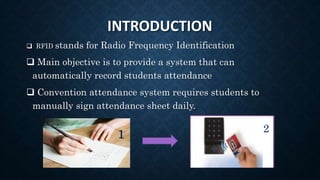
 RFID stands for Radio Frequency Identification
 Main objective is to provide a system that can
automatically record students attendance
 Convention attendance system requires students to
manually sign attendance sheet daily.
1
2
LITERATURE REVIEW
DEVELOPMENT OF RFID
CONCEPT
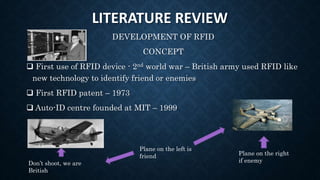
 First use of RFID device - 2nd world war – British army used RFID like
new technology to identify friend or enemies
 First RFID patent – 1973
 Auto-ID centre founded at MIT – 1999
Don’t shoot, we are
British
Plane on the right
if enemy
Plane on the left is
friend
METHODOLOGY
INTRODUCTION TO RFID
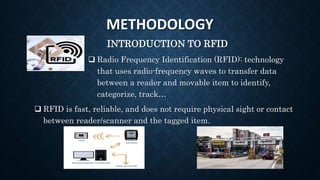
 Radio Frequency Identification (RFID): technology
that uses radio-frequency waves to transfer data
between a reader and movable item to identify,
categorize, track…
 RFID is fast, reliable, and does not require physical sight or contact
between reader/scanner and the tagged item.
CONTINUE
 Later, companies developed a low-frequency (12kHz)
system, featuring smaller transponders.
 A transponder encapsulate in glass could be injected
under the cow’s skin
 Today, 13.56MHz FRID system are used for access control,
payment systems, anti-theft device in car.
KEY COMPONENTS USED
• Microcontroller board (Arduino Mega 2560)
• RFID reader module (Adafruit PN532 RFID/NFC Shield)
• RFID cards (Mifare card)
• Memory card module (Sparkfun MicroSD shield)
• 1GB SanDisk MicroSD card
• RFID tags
• 4x20 LCD screen
• DS 3231 Real Time Clock
• Arduino Integrated Development Environment (IDE) software.
FEATURES OF RFID BASED ATTENDANCE
SYSTEM
 Capability to store maximum records in real time
 In – built real time clock
 In – built communication interface for interpretation and
processing of data
 Maximum reading range, transmitting signals at certain
frequencies
 Auto attendance of students as soon as students enter
school, university premise / class
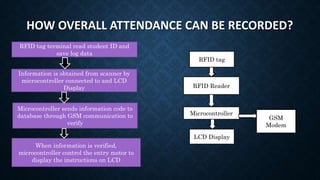
HOW OVERALL ATTENDANCE CAN BE RECORDED?
RFID tag terminal read student ID and
save log data
Information is obtained from scanner by
microcontroller connected to and LCD
Display
Microcontroller sends information code to
database through GSM communication to
verify
When information is verified,
microcontroller control the entry motor to
display the instructions on LCD
RFID tag
RFID Reader
Microcontroller
LCD Display
GSM
Modem
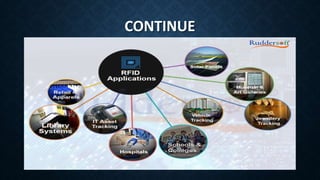
APPLICATIONS
 Used in any educational institutions
 It can be implement for government sector also
 It can be used for companies for recording the timing of
entrance and exit of employees
 System provides valuable online facilities for easy
recording maintenance offered not only to lecturers but also
to related academic management staffs especially for the
purpose of students’ progress monitoring.
CONTINUE
ADVANTAGES
 It takes less time as compared to conventional attendance system.
 We can keep record of every lecture just by scanning the ID card
 Ability to read data without visual access
 Ability to read data from moving objects
 Ability to secure the tag data
 Ability to read data at distance, from 3cm to 100metres
 Ability to have the tag form to suit the application
DISADVANTAGES
 It is difficult for an RFID reader to read the information in case of RFID tags
installed in liquids and metal products
 RFID technology has been referred to as invasive technology
 Many countries have different range of frequencies that allow RFID tags
function
 RFID technology involves software that allows all each user to be identified
by a central database.
 Poor read can occur when reader and receiver are not properly aligned
 In case when multiple tags and readers are at work simultaneously, double
charges may occur
FUTURE SCOPE
 Some further improvements can be made on this RFID in order to
increase its reliability and effectiveness. An indicator can be
incorporated into the system to indicate when any unregistered card
is scanned.
 An IP camera can be integrated to this system to monitor the actions
like buddy-punching where in a person cheats by scanning for another
person
 This attendance system can be improved by adding a feature where
the attendance system indicates when a student is late for class as
case maybe
CONCLUSION
 Hence, the study of attendance system development using
RFID is may to be successfully achieved.
 In terms of performance and efficiency, this project will provide
a convenience method of attendance recording compared to the
traditional method of attendance system.
 By using database, the data is more organized.
 This system is also a user friendly system as data
manipulation and retrieval can be done via the interface,
making it a universal attendance system.
REFERENCES
1. J.Gavan, “Transponders for the detection and identification of
remote targets,” in Int. Symp. MTT Dig., San Diego, CA, May 1994,
pp. 229–232.
2. N.C. Karmakar, S.M. Roy, S. Preradovic, T.D. Vo, and S. Jenvey,
IEEE Development of low-cost active RFID tag at 2.4 GHz,” in Proc.
36th European Microwave Conf., Manchester, U.K., 10–15 Sept.
2006, pp. 1602–1605.
3. F. Kocer, P.M. Walsh, and M.P. Flynn, “Wireless, remotely powered
telemetry in 0.25 μm CMOS,” in Proc. IEEE Radio Frequency
Integrated Circuits Symp., Fort Worth, TX, June 2004, pp. 339–342.
Attendance system development using RFID

Attendance system development using RFID

  • 1.
    PRESENTATION ATTENDANCE SYSTEM DEVELOPMENTUSING RADIO FREQUENCY IDENTIFICATION (RFID) SUPERVISED BY: PRESENTED BY: TS. NAJMI HAZIQ BADRULHISAM MICHA MBENGA PRIMO BEEE18096070
  • 2.
  • 3.
    INTRODUCTION  RFID standsfor Radio Frequency Identification  Main objective is to provide a system that can automatically record students attendance  Convention attendance system requires students to manually sign attendance sheet daily. 1 2
  • 4.
    LITERATURE REVIEW DEVELOPMENT OFRFID CONCEPT  First use of RFID device - 2nd world war – British army used RFID like new technology to identify friend or enemies  First RFID patent – 1973  Auto-ID centre founded at MIT – 1999 Don’t shoot, we are British Plane on the right if enemy Plane on the left is friend
  • 5.
    METHODOLOGY INTRODUCTION TO RFID Radio Frequency Identification (RFID): technology that uses radio-frequency waves to transfer data between a reader and movable item to identify, categorize, track…  RFID is fast, reliable, and does not require physical sight or contact between reader/scanner and the tagged item.
  • 6.
    CONTINUE  Later, companiesdeveloped a low-frequency (12kHz) system, featuring smaller transponders.  A transponder encapsulate in glass could be injected under the cow’s skin  Today, 13.56MHz FRID system are used for access control, payment systems, anti-theft device in car.
  • 7.
    KEY COMPONENTS USED •Microcontroller board (Arduino Mega 2560) • RFID reader module (Adafruit PN532 RFID/NFC Shield) • RFID cards (Mifare card) • Memory card module (Sparkfun MicroSD shield) • 1GB SanDisk MicroSD card • RFID tags • 4x20 LCD screen • DS 3231 Real Time Clock • Arduino Integrated Development Environment (IDE) software.
  • 8.
    FEATURES OF RFIDBASED ATTENDANCE SYSTEM  Capability to store maximum records in real time  In – built real time clock  In – built communication interface for interpretation and processing of data  Maximum reading range, transmitting signals at certain frequencies  Auto attendance of students as soon as students enter school, university premise / class
  • 9.
    HOW OVERALL ATTENDANCECAN BE RECORDED? RFID tag terminal read student ID and save log data Information is obtained from scanner by microcontroller connected to and LCD Display Microcontroller sends information code to database through GSM communication to verify When information is verified, microcontroller control the entry motor to display the instructions on LCD RFID tag RFID Reader Microcontroller LCD Display GSM Modem
  • 10.
    APPLICATIONS  Used inany educational institutions  It can be implement for government sector also  It can be used for companies for recording the timing of entrance and exit of employees  System provides valuable online facilities for easy recording maintenance offered not only to lecturers but also to related academic management staffs especially for the purpose of students’ progress monitoring.
  • 11.
  • 12.
    ADVANTAGES  It takesless time as compared to conventional attendance system.  We can keep record of every lecture just by scanning the ID card  Ability to read data without visual access  Ability to read data from moving objects  Ability to secure the tag data  Ability to read data at distance, from 3cm to 100metres  Ability to have the tag form to suit the application
  • 13.
    DISADVANTAGES  It isdifficult for an RFID reader to read the information in case of RFID tags installed in liquids and metal products  RFID technology has been referred to as invasive technology  Many countries have different range of frequencies that allow RFID tags function  RFID technology involves software that allows all each user to be identified by a central database.  Poor read can occur when reader and receiver are not properly aligned  In case when multiple tags and readers are at work simultaneously, double charges may occur
  • 14.
    FUTURE SCOPE  Somefurther improvements can be made on this RFID in order to increase its reliability and effectiveness. An indicator can be incorporated into the system to indicate when any unregistered card is scanned.  An IP camera can be integrated to this system to monitor the actions like buddy-punching where in a person cheats by scanning for another person  This attendance system can be improved by adding a feature where the attendance system indicates when a student is late for class as case maybe
  • 15.
    CONCLUSION  Hence, thestudy of attendance system development using RFID is may to be successfully achieved.  In terms of performance and efficiency, this project will provide a convenience method of attendance recording compared to the traditional method of attendance system.  By using database, the data is more organized.  This system is also a user friendly system as data manipulation and retrieval can be done via the interface, making it a universal attendance system.
  • 16.
    REFERENCES 1. J.Gavan, “Transpondersfor the detection and identification of remote targets,” in Int. Symp. MTT Dig., San Diego, CA, May 1994, pp. 229–232. 2. N.C. Karmakar, S.M. Roy, S. Preradovic, T.D. Vo, and S. Jenvey, IEEE Development of low-cost active RFID tag at 2.4 GHz,” in Proc. 36th European Microwave Conf., Manchester, U.K., 10–15 Sept. 2006, pp. 1602–1605. 3. F. Kocer, P.M. Walsh, and M.P. Flynn, “Wireless, remotely powered telemetry in 0.25 μm CMOS,” in Proc. IEEE Radio Frequency Integrated Circuits Symp., Fort Worth, TX, June 2004, pp. 339–342.