4
reasons to improve
employee engagement
by anthony raja devadoss
and Charles Bedard
Why worry about
employee engagement?


With all the numbers and statistics that pass   So, if you’d like to live in a world where more   There are four key reasons to get
across executives’ desks, it’s no wonder the    of your employees do all of these things, this    engagement right in your organisation:
employee engagement score feels like one        paper gives you the tools to make it happen.
drop in a very large ocean.                                                                        1	   to raise productivity
                                                No matter what your legacy issues may be,
But it’s not. Employee engagement is a          or what your employee engagement results           2	   to improve service

business measurement like no other.             have been in the past, it is possible to create
                                                                                                   3	   to reduce turnover, and
                                                a highly engaged workforce quickly, easily
‘Engaged’ employees work harder, stay           and without disproportionate investment in         4	   to get the most out of workers
longer with their organisation and deliver      time, money or technology.                              across all generations.
better customer service. The greater the
proportion of your staff that make it into      Engagement is NOT an annual survey.               Here’s how to do it.
the ‘engaged’ category, the higher your         Engagement is frequent, relevant and
performance is likely to be on almost           meaningful feedback and recognition. And
every count.                                    the right tools will deliver exactly this.


                                                                                                                                           2
1    raise your productivity
Engaged employees are two times more productive than satisfied employees.


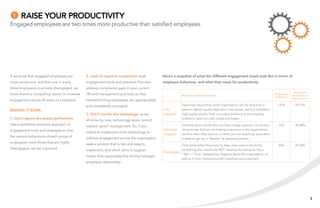
If we know that engaged employees are          2. Look to improve compliance: seek            Here’s a snapshot of what the different engagement levels look like in terms of
more productive, and that one in every         engagement tools and practices that also       employee behaviour, and what they mean for productivity.
three employees is actively disengaged, we     address compliance gaps in your current
                                                                                                                                                                                                  Average %
know there’s a compelling reason to increase   HR and management practices so that                        Behaviours/attitudes to work
                                                                                                                                                                                    Output per
                                                                                                                                                                                                 employees in
                                                                                                                                                                                    employee
                                                                                                                                                                                                 organisations
engagement across all areas of a business.     low-performing employees are appropriately
                                               and consistently managed.                                  Passionate about their work/ organisation; will do what ever it             122%         10-15%
Making it work:                                                                               Fully       takes to deliver results; feels like a true owner; delivers consistent,
                                               3. Don’t overdo the technology: as we          engaged     high quality results; finds innovative solutions to the toughest
1. Don’t ignore the lowest performers:         all know by now, technology alone cannot                   problems; seen as a role model and leader

take a workforce solutions approach to         replace ‘good’ management. So, if you                      Selective about where they put their energy; spends a lot of time           75%          30-40%
engagement tools and strategies so that                                                       Somewhat    doing things that are not helping customers or the organisation;
                                               intend to implement more technology to
                                                                                               engaged    delivers when they have to, or when you are watching; does what
the various behaviours of each group of        address engagement across the organisation,                it takes to get by; a “Master” at distracting others
employees, even those that are highly          seek a solution that is fast and easy to                  Only works when they have to, they really want to be doing                   50%          20-30%
disengaged, can be improved.                   implement, and which aims to support                      something else; results are NOT meeting the standard; has a
                                                                                              Disengaged
                                                                                                         “We”—“They” perspective; negative about the organisation, as
                                               (rather than supersede) the exiting manager-
                                                                                                         well as in their interactions with coworkers and customers
                                               employee relationship.


                                                                                                                                                                                                                 3
2     reduce your turnover
Four out of every five employees is dissatisfied with their
performance review and feedback processes.


Most of the reasons people leave                  they use. Eighty per cent of employees say        (not just the goals their manager may have
organisations are solvable.                       they do not get the feedback they need to         given them) and exactly where things are        Sustainable engagement segments
                                                                                                                                                    across the global workforce
                                                  perform, and this is a serious impediment         going wrong. This will improve objectivity
It’s often said that employees don’t leave
organisations, they leave managers, and
                                                  to engagement. If you can improve the
                                                  feedback mechanisms, you can improve the
                                                                                                    and ensure high-performers really get the
                                                                                                    tools they need even when management is
                                                                                                                                                       highly engaged                              35%
around one-third of employees say they leave      experience of 80% of your staff immediately.      lacking.
because of poor line management.
                                                                                                                                                       unsupported             22%
                                                                                                    2. Beware the warning sign: if you’re
                                                  Making it work:
Turnover is often a symptom of deep
                                                  1. Make it employee driven: any solution to
                                                                                                    already having requests to speed up the on-        detached       17%
disengagement between managers and                                                                  boarding and off-boarding processes in your
                                                  successfully reduce turnover must be driven
their staff. Solving this requires more than
                                                  by the employee. Many solutions look to add
                                                                                                    organisation, and this can’t all be explained      disengaged                     26%
just great leadership training. It requires the                                                     by business growth, consider how you might
                                                  tools to the HR toolkit, but do not necessarily   address engagement at the same time. Some       Source: Towers Watson Global Workforce Study
tools and mechanisms to facilitate a more
                                                  provide a solution to empower the employee        tools allow you to do both: improve your
productive and helpful relationship between
                                                  to succeed. Don’t add a new ‘process’             employee engagement while improving the
managers and their staff.
                                                  or technology unless it’s going to help           oversight and ease of on-boarding and off-
To reduce turnover, organisations must            employees understand exactly how they’re          boarding at the same time.
seek to improve the feedback mechanisms           performing against the corporate plan/goals


                                                                                                                                                                                                         4
3     Improve your customer service
Less than 1 in 5 managers is a coach.


Hiring the right person does not mean               Many organisations rely upon developing        2. Look for a solution that coaches in
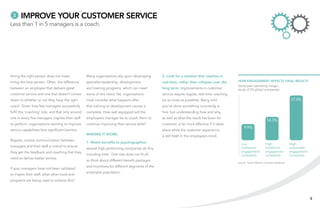
hiring the best person. Often, the difference       specialist leadership, development             real-time, rather than critiques over the     How engagement affects final results
                                                                                                                                                 Same-year operating margin:
between an employee that delivers great             and training programs, which can meet          long term: improvements in customer           study of 50 global companies
customer service and one that doesn’t comes         some of this need. Yet, organisations          service require regular, real-time coaching
down to whether or not they have the right          must consider what happens after               (or as close as possible). Being told                                                     27.4%
coach. Given how few managers successfully          that training or development course is         you’ve done something incorrectly is
fulfil this ‘coaching’ role, and that only around   complete. How well equipped will the           fine, but understanding how and why,
one in every five managers inspires their staff     employee’s manager be to coach them to         as well as what the result has been for
                                                                                                                                                                         14.3%
to perform, organisations wanting to improve        continue improving their service skills?       customer, is far more effective if it takes
                                                                                                                                                      9.9%
service capabilities face significant barriers.                                                    place while the customer experience
                                                    Making it work:                                is still fresh in the employee’s mind.
Regular, routine communication between
                                                    1. Match benefits to psychographics:                                                           Low                  High                High
managers and their staff is critical to ensure                                                                                                     traditional          traditional         sustainable
                                                    several high-performing companies do this,
they get the feedback and coaching that they                                                                                                       engagement           engagement          engagement
                                                    including Intel. One size does not fit all,                                                    companies            companies           companies
need to deliver better service.
                                                    so think about different benefit packages
                                                                                                                                                 Source: Towers Watson normative database
                                                    and incentives for different segments of the
If your managers have not been validated
                                                    employee population.
to inspire their staff, what other tools and
programs are being used to achieve this?


                                                                                                                                                                                                          5
4Engage every employee,
regardless of age or experience level
Millennials will constitute 40-45% of the workforce by 2014.


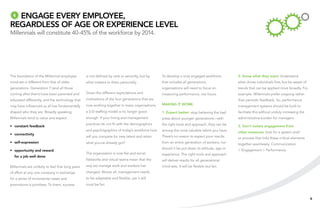
The foundation of the Millennial employee          is not defined by rank or seniority, but by    To develop a truly engaged workforce        2. Know what they want: Understand
mind-set is different from that of older           what matters to them personally.               that includes all generations,              what drives individuals first, but be aware of
generations. Generation Y (and all those                                                          organisations will need to focus on         trends that can be applied more broadly. For
coming after them) have been parented and          Given the different expectations and           measuring performance, not hours.           example, Millennials prefer ongoing rather
educated differently, and the technology that      motivations of the four generations that are                                               than periodic feedback. So, performance
may have influenced us all has fundamentally       now working together in many organisations,    Making it work:                             management systems should be built to
shaped who they are. Broadly speaking,             a 2-D staffing model is no longer good         1. Expect better: stop believing the bad    facilitate this without unduly increasing the
Millennials tend to value and expect:              enough. If your hiring and management          press about younger generations—with        administrative burden for managers.
                                                   practices do not fit with the demographics     the right tools and approach, they can be
•	 constant feedback                                                                                                                          3. Don’t isolate engagement from
                                                   and psychographics of today’s workforce how    among the most valuable talent you have.    other measures: look for a system and/
•	 connectivity
                                                   will you compete for new talent and retain     There’s no reason to expect poor results    or process that links these critical elements
•	 self-expression                                 what you›ve already got?                       from an entire generation of workers, nor   together seamlessly: Communication
                                                                                                  should it be put down to attitude, age or   > Engagement > Performance.
•	 opportunity and reward
                                                   The organization is now flat and social.       experience. The right tools and approach
  for a job well done
                                                   Networks and virtual teams mean that the       will deliver results for all generational
Millennials are unlikely to feel that long years   way we manage work and workers has             mind-sets. It will be flexible but fair.
of effort at any one company in exchange           changed. Above all, management needs
for a series of incremental raises and             to be adaptable and flexible, yet it still
promotions is pointless. To them, success          must be fair.


                                                                                                                                                                                               6
Our story (what worked for us)


We have been talking with our clients about
the challenges they face with employee          Kelly client corporate performance compared to public indexes

engagement for some time. We are always         20%

looking for tools and approaches that help
solve productivity, turnover and service
                                                                                                                Kelly 2+ Year
challenges, so we often test solutions on
                                                15%                                                             Client Average
ourselves first.

In 2010, we started using the
BullseyeEvalutation system in both Asia-        10%
Pacific and the Americas. This is the
                                                                                                                S&P 500
employee engagement and productivity
tool that we rely on to drive results for our
                                                                                                                Dow Jones
business, and the numbers here will             5%
                                                                                                                Average
show you why.
                                                                                                                GDP Average
                                                                                                                Performer

                                                0%


                                                                                                                                 7
references
2012 Global Workforce Study from Towers Watson http://www.towerswatson.com/research/7177         Towers Perrin.  See the 2006 report, Ten Steps to Creating an Engaged Workforce:
                                                                                                 Towers Perrin Global Workforce Survey.  http://www.towersperrin.com/gws
US Census Bureau http://www.census.gov/newsroom/releases/
                                                                                                 Towers Perrin.  (2008).  Employee engagement underpins business transformation. Stamford,
Mercer June 2011 http://www.mercer.com/press-releases/1418665                                    CT:  Author.  Accessed online on March 1, 2009 from www.towersperrin.com/tp/getwebcachedoc?
                                                                                                 country=gbr&webc=GBR/2008/200807/TP_ISR_July08.pdf
Globoforce 2012 report based on SHRM membership study http://go.globoforce.com/rs/
globoforce/images/SHRMWinter2012Report.PDF                                                       2011 survey of sustainability executives by Green Research. http://greenresearch.com/2011/11/30/
                                                                                                 corporate-sustainability-leaders-to-focus-on-employee-engagement-and-supply-chain-in-2012/
The Importance Being Known from BlessingWhite http://www.thesocialworkplace.com/
2012/08/21/the-importance-of-being-known/                                                        US Bureau of Labor Statistics http://www.bls.gov/news.release/jolts.t04.htm

BlessingWhite.  (2008).  The state of employment engagement – 2008:  North American overview.    Quote from Terry Stockham (SPHR, GPHR) during “The Future of Work” presentation.
Princeton, NJ:  Author. Accessed online on March 1, 2009 from www.blessingwhite.com/             http://www.linkedin.com/pub/terry-stockham/11/8a8/bb2 http://blog.bullseyeevaluation.
EEE__report.asp                                                                                  com/?tag=the-future-of-work

“The Relationship Between Engagement at Work and Organizational Outcomes.” August 2009.          A study by Reuters found that 80 percent of workers are dissatisfied with their performance
A 2009 Gallup Inc. study of over 1,000 U.S. based employees shows the impact of different        reviews and would like to see them better reflect their real work.  http://www.reuters.com/
kinds of feedback on employees. http://gmj.gallup.com/content/124214/driving-engagement-         article/2009/04/15/us-usa-workplace-reviews-idUSTRE53D6WV20090415
focusing-strengths.aspx http://www.gallup.com/poll/150383/majority-american-workers-not-
engaged-jobs.aspx                                                                                The Social Workplace Blog: What is a Disengaged Employee Costing You? http://www.
                                                                                                 thesocialworkplace.com/2012/03/06/when-employese-arent-happy-then-the-company-isnt-happy/ 
 “Employee Work Engagement: Best Practices for Employers.” June 2009 Volume 1 Issue 2,
from Research Works, a Partnership for Workplace Mental Health Journal. http://www.concern-      http://www.thesocialworkplace.com/2011/08/08/social-knows-employee-engagement-statistics-
eap.com/LinkClick.aspx?fileticket=XTwQrS0tLvQ%3D&tabid=69                                        august-2011-edition/


                                                                                                                                                                                                    8
About the Authors

Anthony Raja Devadoss is currently the Vice President—APAC with the Outsourcing & Consulting Group of Kelly Services. From
network services, engineering to e-business solutions, Anthony Raja has worked in both India and Malaysia, within technical roles to
the Chief Executive Officer. He has received his Bachelors degree in Science and his MBA in Marketing & Postgraduate Diploma in
Computing. He holds membership in various local and international associations such as the MIM, Human Capital Institute & Association
of Career Professionals International. He is the Head of Policy Enablement & Government Liaison with Outsourcing Malaysia and a
member of the Industry Advisory Board for the Graduate School of Business, UNIRAZAK. He has been recently appointed to the HR
Capacity Building task force by the Ministry of Human Resources, Govt of Malaysia. Anthony is also a member of the HROA APAC
Chapter Board.        http://my.linkedin.com/in/anthonyraja          http://twitter.com/anthonyraja


Charles BEDARD has extensive knowledge of technology and outsourcing options for today’s business.  He serves as a Strategic
Advisor, Chief Strategy Officer, and Global Strategist to B2B technology and outsourcing providers. Previously, Charles served as a
Director for multiple fast-growth companies in BPO, IT, HR/Human Capital/HRO, Technology/Software, and Professional Services.  He has
earned his Bachelor of Arts from Southwestern University and his Masters of Business Administration from Texas Christian University.


About KellyOCG
KellyOCG® is the Outsourcing and Consulting Group of workforce solutions provider, Kelly Services, Inc. KellyOCG is a global leader
in innovative talent management solutions in the areas of Recruitment Process Outsourcing (RPO), Business Process Outsourcing
(BPO), Contingent Workforce Outsourcing (CWO), including Independent Contractor Solutions, Human Resources Consulting, Career
Transition and Executive Coaching, and Executive Search.

                 KellyOCG was named to the International Association of Outsourcing Professionals® 2012 Global Outsourcing 100®
                 list, an annual ranking of the world’s best outsourcing service providers and advisors.

Further information about KellyOCG may be found at kellyocg.com.


                                                                                                                                        EXIT

Raising employee engagement

  • 1.
    4 reasons to improve employeeengagement by anthony raja devadoss and Charles Bedard
  • 2.
    Why worry about employeeengagement? With all the numbers and statistics that pass So, if you’d like to live in a world where more There are four key reasons to get across executives’ desks, it’s no wonder the of your employees do all of these things, this engagement right in your organisation: employee engagement score feels like one paper gives you the tools to make it happen. drop in a very large ocean. 1 to raise productivity No matter what your legacy issues may be, But it’s not. Employee engagement is a or what your employee engagement results 2 to improve service business measurement like no other. have been in the past, it is possible to create 3 to reduce turnover, and a highly engaged workforce quickly, easily ‘Engaged’ employees work harder, stay and without disproportionate investment in 4 to get the most out of workers longer with their organisation and deliver time, money or technology. across all generations. better customer service. The greater the proportion of your staff that make it into Engagement is NOT an annual survey. Here’s how to do it. the ‘engaged’ category, the higher your Engagement is frequent, relevant and performance is likely to be on almost meaningful feedback and recognition. And every count. the right tools will deliver exactly this. 2
  • 3.
    1 raise your productivity Engaged employees are two times more productive than satisfied employees. If we know that engaged employees are 2. Look to improve compliance: seek Here’s a snapshot of what the different engagement levels look like in terms of more productive, and that one in every engagement tools and practices that also employee behaviour, and what they mean for productivity. three employees is actively disengaged, we address compliance gaps in your current Average % know there’s a compelling reason to increase HR and management practices so that Behaviours/attitudes to work Output per employees in employee organisations engagement across all areas of a business. low-performing employees are appropriately and consistently managed. Passionate about their work/ organisation; will do what ever it 122% 10-15% Making it work: Fully takes to deliver results; feels like a true owner; delivers consistent, 3. Don’t overdo the technology: as we engaged high quality results; finds innovative solutions to the toughest 1. Don’t ignore the lowest performers: all know by now, technology alone cannot problems; seen as a role model and leader take a workforce solutions approach to replace ‘good’ management. So, if you Selective about where they put their energy; spends a lot of time 75% 30-40% engagement tools and strategies so that Somewhat doing things that are not helping customers or the organisation; intend to implement more technology to engaged delivers when they have to, or when you are watching; does what the various behaviours of each group of address engagement across the organisation, it takes to get by; a “Master” at distracting others employees, even those that are highly seek a solution that is fast and easy to Only works when they have to, they really want to be doing 50% 20-30% disengaged, can be improved. implement, and which aims to support something else; results are NOT meeting the standard; has a Disengaged “We”—“They” perspective; negative about the organisation, as (rather than supersede) the exiting manager- well as in their interactions with coworkers and customers employee relationship. 3
  • 4.
    2 reduce your turnover Four out of every five employees is dissatisfied with their performance review and feedback processes. Most of the reasons people leave they use. Eighty per cent of employees say (not just the goals their manager may have organisations are solvable. they do not get the feedback they need to given them) and exactly where things are Sustainable engagement segments across the global workforce perform, and this is a serious impediment going wrong. This will improve objectivity It’s often said that employees don’t leave organisations, they leave managers, and to engagement. If you can improve the feedback mechanisms, you can improve the and ensure high-performers really get the tools they need even when management is highly engaged 35% around one-third of employees say they leave experience of 80% of your staff immediately. lacking. because of poor line management. unsupported 22% 2. Beware the warning sign: if you’re Making it work: Turnover is often a symptom of deep 1. Make it employee driven: any solution to already having requests to speed up the on- detached 17% disengagement between managers and boarding and off-boarding processes in your successfully reduce turnover must be driven their staff. Solving this requires more than by the employee. Many solutions look to add organisation, and this can’t all be explained disengaged 26% just great leadership training. It requires the by business growth, consider how you might tools to the HR toolkit, but do not necessarily address engagement at the same time. Some Source: Towers Watson Global Workforce Study tools and mechanisms to facilitate a more provide a solution to empower the employee tools allow you to do both: improve your productive and helpful relationship between to succeed. Don’t add a new ‘process’ employee engagement while improving the managers and their staff. or technology unless it’s going to help oversight and ease of on-boarding and off- To reduce turnover, organisations must employees understand exactly how they’re boarding at the same time. seek to improve the feedback mechanisms performing against the corporate plan/goals 4
  • 5.
    3 Improve your customer service Less than 1 in 5 managers is a coach. Hiring the right person does not mean Many organisations rely upon developing 2. Look for a solution that coaches in hiring the best person. Often, the difference specialist leadership, development real-time, rather than critiques over the How engagement affects final results Same-year operating margin: between an employee that delivers great and training programs, which can meet long term: improvements in customer study of 50 global companies customer service and one that doesn’t comes some of this need. Yet, organisations service require regular, real-time coaching down to whether or not they have the right must consider what happens after (or as close as possible). Being told 27.4% coach. Given how few managers successfully that training or development course is you’ve done something incorrectly is fulfil this ‘coaching’ role, and that only around complete. How well equipped will the fine, but understanding how and why, one in every five managers inspires their staff employee’s manager be to coach them to as well as what the result has been for 14.3% to perform, organisations wanting to improve continue improving their service skills? customer, is far more effective if it takes 9.9% service capabilities face significant barriers. place while the customer experience Making it work: is still fresh in the employee’s mind. Regular, routine communication between 1. Match benefits to psychographics: Low High High managers and their staff is critical to ensure traditional traditional sustainable several high-performing companies do this, they get the feedback and coaching that they engagement engagement engagement including Intel. One size does not fit all, companies companies companies need to deliver better service. so think about different benefit packages Source: Towers Watson normative database and incentives for different segments of the If your managers have not been validated employee population. to inspire their staff, what other tools and programs are being used to achieve this? 5
  • 6.
    4Engage every employee, regardlessof age or experience level Millennials will constitute 40-45% of the workforce by 2014. The foundation of the Millennial employee is not defined by rank or seniority, but by To develop a truly engaged workforce 2. Know what they want: Understand mind-set is different from that of older what matters to them personally. that includes all generations, what drives individuals first, but be aware of generations. Generation Y (and all those organisations will need to focus on trends that can be applied more broadly. For coming after them) have been parented and Given the different expectations and measuring performance, not hours. example, Millennials prefer ongoing rather educated differently, and the technology that motivations of the four generations that are than periodic feedback. So, performance may have influenced us all has fundamentally now working together in many organisations, Making it work: management systems should be built to shaped who they are. Broadly speaking, a 2-D staffing model is no longer good 1. Expect better: stop believing the bad facilitate this without unduly increasing the Millennials tend to value and expect: enough. If your hiring and management press about younger generations—with administrative burden for managers. practices do not fit with the demographics the right tools and approach, they can be • constant feedback 3. Don’t isolate engagement from and psychographics of today’s workforce how among the most valuable talent you have. other measures: look for a system and/ • connectivity will you compete for new talent and retain There’s no reason to expect poor results or process that links these critical elements • self-expression what you›ve already got? from an entire generation of workers, nor together seamlessly: Communication should it be put down to attitude, age or > Engagement > Performance. • opportunity and reward The organization is now flat and social. experience. The right tools and approach for a job well done Networks and virtual teams mean that the will deliver results for all generational Millennials are unlikely to feel that long years way we manage work and workers has mind-sets. It will be flexible but fair. of effort at any one company in exchange changed. Above all, management needs for a series of incremental raises and to be adaptable and flexible, yet it still promotions is pointless. To them, success  must be fair. 6
  • 7.
    Our story (whatworked for us) We have been talking with our clients about the challenges they face with employee Kelly client corporate performance compared to public indexes engagement for some time. We are always 20% looking for tools and approaches that help solve productivity, turnover and service Kelly 2+ Year challenges, so we often test solutions on 15% Client Average ourselves first. In 2010, we started using the BullseyeEvalutation system in both Asia- 10% Pacific and the Americas. This is the S&P 500 employee engagement and productivity tool that we rely on to drive results for our Dow Jones business, and the numbers here will 5% Average show you why. GDP Average Performer 0% 7
  • 8.
    references 2012 Global WorkforceStudy from Towers Watson http://www.towerswatson.com/research/7177 Towers Perrin.  See the 2006 report, Ten Steps to Creating an Engaged Workforce: Towers Perrin Global Workforce Survey.  http://www.towersperrin.com/gws US Census Bureau http://www.census.gov/newsroom/releases/ Towers Perrin.  (2008).  Employee engagement underpins business transformation. Stamford, Mercer June 2011 http://www.mercer.com/press-releases/1418665 CT:  Author.  Accessed online on March 1, 2009 from www.towersperrin.com/tp/getwebcachedoc? country=gbr&webc=GBR/2008/200807/TP_ISR_July08.pdf Globoforce 2012 report based on SHRM membership study http://go.globoforce.com/rs/ globoforce/images/SHRMWinter2012Report.PDF 2011 survey of sustainability executives by Green Research. http://greenresearch.com/2011/11/30/ corporate-sustainability-leaders-to-focus-on-employee-engagement-and-supply-chain-in-2012/ The Importance Being Known from BlessingWhite http://www.thesocialworkplace.com/ 2012/08/21/the-importance-of-being-known/ US Bureau of Labor Statistics http://www.bls.gov/news.release/jolts.t04.htm BlessingWhite.  (2008).  The state of employment engagement – 2008:  North American overview.  Quote from Terry Stockham (SPHR, GPHR) during “The Future of Work” presentation. Princeton, NJ:  Author. Accessed online on March 1, 2009 from www.blessingwhite.com/ http://www.linkedin.com/pub/terry-stockham/11/8a8/bb2 http://blog.bullseyeevaluation. EEE__report.asp com/?tag=the-future-of-work “The Relationship Between Engagement at Work and Organizational Outcomes.” August 2009. A study by Reuters found that 80 percent of workers are dissatisfied with their performance A 2009 Gallup Inc. study of over 1,000 U.S. based employees shows the impact of different reviews and would like to see them better reflect their real work.  http://www.reuters.com/ kinds of feedback on employees. http://gmj.gallup.com/content/124214/driving-engagement- article/2009/04/15/us-usa-workplace-reviews-idUSTRE53D6WV20090415 focusing-strengths.aspx http://www.gallup.com/poll/150383/majority-american-workers-not- engaged-jobs.aspx The Social Workplace Blog: What is a Disengaged Employee Costing You? http://www. thesocialworkplace.com/2012/03/06/when-employese-arent-happy-then-the-company-isnt-happy/   “Employee Work Engagement: Best Practices for Employers.” June 2009 Volume 1 Issue 2, from Research Works, a Partnership for Workplace Mental Health Journal. http://www.concern- http://www.thesocialworkplace.com/2011/08/08/social-knows-employee-engagement-statistics- eap.com/LinkClick.aspx?fileticket=XTwQrS0tLvQ%3D&tabid=69 august-2011-edition/ 8
  • 9.
    About the Authors AnthonyRaja Devadoss is currently the Vice President—APAC with the Outsourcing & Consulting Group of Kelly Services. From network services, engineering to e-business solutions, Anthony Raja has worked in both India and Malaysia, within technical roles to the Chief Executive Officer. He has received his Bachelors degree in Science and his MBA in Marketing & Postgraduate Diploma in Computing. He holds membership in various local and international associations such as the MIM, Human Capital Institute & Association of Career Professionals International. He is the Head of Policy Enablement & Government Liaison with Outsourcing Malaysia and a member of the Industry Advisory Board for the Graduate School of Business, UNIRAZAK. He has been recently appointed to the HR Capacity Building task force by the Ministry of Human Resources, Govt of Malaysia. Anthony is also a member of the HROA APAC Chapter Board. http://my.linkedin.com/in/anthonyraja http://twitter.com/anthonyraja Charles BEDARD has extensive knowledge of technology and outsourcing options for today’s business.  He serves as a Strategic Advisor, Chief Strategy Officer, and Global Strategist to B2B technology and outsourcing providers. Previously, Charles served as a Director for multiple fast-growth companies in BPO, IT, HR/Human Capital/HRO, Technology/Software, and Professional Services.  He has earned his Bachelor of Arts from Southwestern University and his Masters of Business Administration from Texas Christian University. About KellyOCG KellyOCG® is the Outsourcing and Consulting Group of workforce solutions provider, Kelly Services, Inc. KellyOCG is a global leader in innovative talent management solutions in the areas of Recruitment Process Outsourcing (RPO), Business Process Outsourcing (BPO), Contingent Workforce Outsourcing (CWO), including Independent Contractor Solutions, Human Resources Consulting, Career Transition and Executive Coaching, and Executive Search. KellyOCG was named to the International Association of Outsourcing Professionals® 2012 Global Outsourcing 100® list, an annual ranking of the world’s best outsourcing service providers and advisors. Further information about KellyOCG may be found at kellyocg.com. EXIT