Make Seattle Happy Report:
A Blueprint for Raising
Awareness in Your Community
about the importance of happiness as a guide
for the future of our nation, neighborhoods
and personal life
PART THREE: POLICY RECOMMENDATIONS
Part Three:
Policy Recommendations
Three recommendation emerging from the
Raising Awareness - Make Seattle
Happy Project
Policy Recommendations
1) Gross National Happiness Policy Screening
Tool, including research and grassroots
application
2) A Happiness Policy Library to inspire and aid
progress by policy makers and the
community members
3) Crucible for the Gross National Happiness
Index and its uses: a litmus test to refine
and develop the GNH Index
Gross National Happiness Project and Policy
Screening Tool
With the support of the government of Bhutan, we
drafted a policy screening tool based on the ones
Bhutan is using.
How it works:
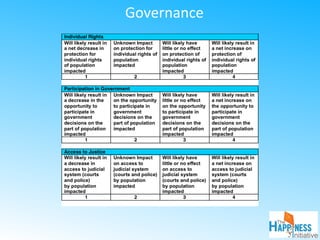
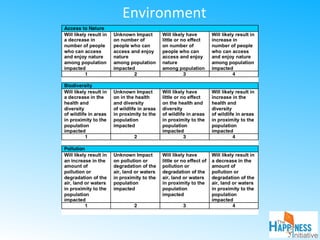
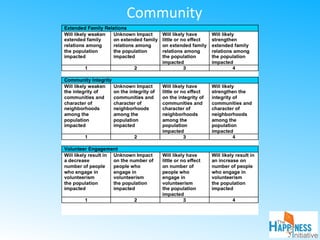
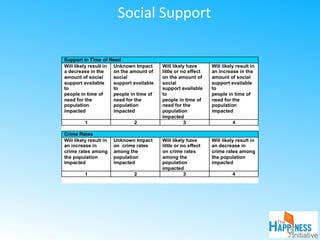
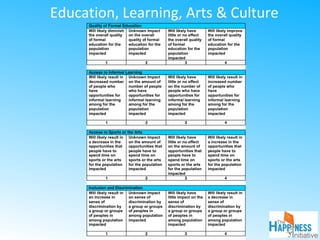
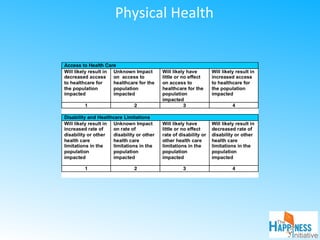
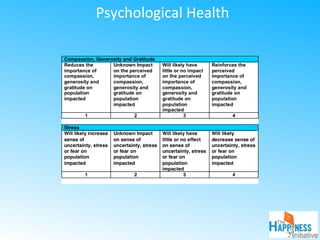
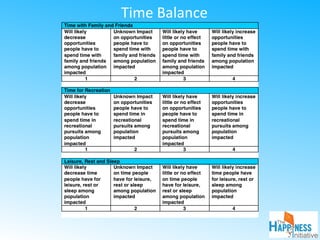
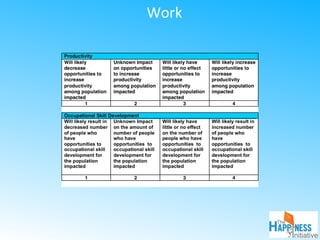
A project of policy is rated on a scale of 1-4 for the
screening factors relevant to that policy or policy
A positive score is 4X the number of screening questions
A neutral score is 3X the number of screening questions
If a policy is positive or neutral, it is recommended to the
decision makers
Gross National Happiness Project and Policy
Screening Tool
Who uses the tool? A committee, group or selection of
individuals who are:
qualified to evaluate the project or policy and its impacts
knowledgeable about the subject matter and
circumstances of a project or policy
respected by the community
neutral to the outcome
Example
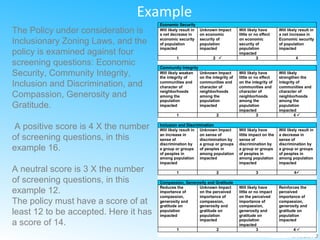
The Policy under consideration is
Inclusionary Zoning Laws, and the
policy is examined against four
screening questions: Economic
Security, Community Integrity,
Inclusion and Discrimination, and
Compassion, Generosity and
Gratitude.
A positive score is 4 X the number
of screening questions, in this
example 16.
A neutral score is 3 X the number
of screening questions, in this
example 12.
The policy must have a score of at
least 12 to be accepted. Here it has
a score of 14.
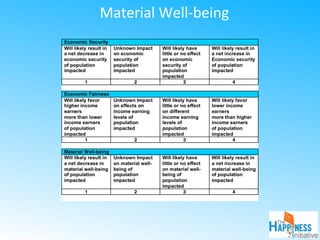
Material Well-being
Governance
Environment
Community
Social Support
Education, Learning, Arts & Culture
Physical Health
Psychological Health
Time Balance
Work
The Gross National Happiness
Policy and Project Screening tool
is available online in a word
document
visit happycounts.org/raiseawarenessreport
please give attribution to The Happiness Initiative/Happy Counts.
A Happiness Policy Library
We recommend the development of a library of
policies relevant to the domains of happiness to
inspire and aid progress.
These include policies and practices that cities,
community members and other agents have
implemented to improve one or more domains of
happiness.
A Happiness Policy Library
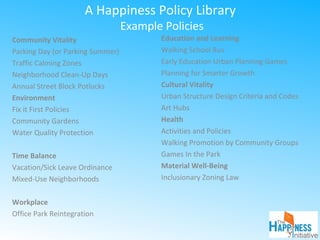
Example Policies
Community Vitality
Parking Day (or Parking Summer)
Traffic Calming Zones
Neighborhood Clean-Up Days
Annual Street Block Potlucks
Environment
Fix it First Policies
Community Gardens
Water Quality Protection
Time Balance
Vacation/Sick Leave Ordinance
Mixed-Use Neighborhoods
Workplace
Office Park Reintegration
Education and Learning
Walking School Bus
Early Education Urban Planning Games
Planning for Smarter Growth
Cultural Vitality
Urban Structure Design Criteria and Codes
Art Hubs
Health
Activities and Policies
Walking Promotion by Community Groups
Games In the Park
Material Well-Being
Inclusionary Zoning Law
A Happiness Policy and Action
Library in progress is available
online
visit happycounts.org/happypolicy
We are collecting policies and actions.
Please send suggestions to info@happycounts.org
Crucible
We recommend a crucible – a litmus test to
refine and develop the GNH Index.
We recommend two phases:
Crucible I: Use the Gross National Happiness Index in two areas in
order to gauge the happiness and wellbeing of an area that has
implemented a policy or action compared to an area that has not.
Crucible II: Use the Gross National Happiness Index in one area
before and after implementing a policy or action to gauge the
impact on people’s happiness and wellbeing.
Learning from the crucible will be used to refine and
develop the Gross National Happiness Index and its use.
Make Seattle Happy: A Blueprint for Raising
Awareness in Your Community.
Please use these materials to raise awareness about the
importance of happiness and well-being, the happiness
movement and the aim of a new economic paradigm.
These materials may be used or reproduced for any non-
commercial use. For more information, inquiries or
comments, please email info@happycounts.org or visit
happycounts.org
Report compiled by: Laura Musikanski, JD, MBA
Editing team: Eldan Goldenberg, James Bradbury
Copyright © The Happiness Initiative 2013

Raising awareness blueprint pt 3

  • 1.
    Make Seattle HappyReport: A Blueprint for Raising Awareness in Your Community about the importance of happiness as a guide for the future of our nation, neighborhoods and personal life PART THREE: POLICY RECOMMENDATIONS
  • 2.
    Part Three: Policy Recommendations Threerecommendation emerging from the Raising Awareness - Make Seattle Happy Project
  • 3.
    Policy Recommendations 1) GrossNational Happiness Policy Screening Tool, including research and grassroots application 2) A Happiness Policy Library to inspire and aid progress by policy makers and the community members 3) Crucible for the Gross National Happiness Index and its uses: a litmus test to refine and develop the GNH Index
  • 4.
    Gross National HappinessProject and Policy Screening Tool With the support of the government of Bhutan, we drafted a policy screening tool based on the ones Bhutan is using. How it works: A project of policy is rated on a scale of 1-4 for the screening factors relevant to that policy or policy A positive score is 4X the number of screening questions A neutral score is 3X the number of screening questions If a policy is positive or neutral, it is recommended to the decision makers
  • 5.
    Gross National HappinessProject and Policy Screening Tool Who uses the tool? A committee, group or selection of individuals who are: qualified to evaluate the project or policy and its impacts knowledgeable about the subject matter and circumstances of a project or policy respected by the community neutral to the outcome
  • 6.
    Example The Policy underconsideration is Inclusionary Zoning Laws, and the policy is examined against four screening questions: Economic Security, Community Integrity, Inclusion and Discrimination, and Compassion, Generosity and Gratitude. A positive score is 4 X the number of screening questions, in this example 16. A neutral score is 3 X the number of screening questions, in this example 12. The policy must have a score of at least 12 to be accepted. Here it has a score of 14.
  • 7.
  • 8.
  • 9.
  • 10.
  • 11.
  • 12.
  • 13.
  • 14.
  • 15.
  • 16.
  • 17.
    The Gross NationalHappiness Policy and Project Screening tool is available online in a word document visit happycounts.org/raiseawarenessreport please give attribution to The Happiness Initiative/Happy Counts.
  • 18.
    A Happiness PolicyLibrary We recommend the development of a library of policies relevant to the domains of happiness to inspire and aid progress. These include policies and practices that cities, community members and other agents have implemented to improve one or more domains of happiness.
  • 19.
    A Happiness PolicyLibrary Example Policies Community Vitality Parking Day (or Parking Summer) Traffic Calming Zones Neighborhood Clean-Up Days Annual Street Block Potlucks Environment Fix it First Policies Community Gardens Water Quality Protection Time Balance Vacation/Sick Leave Ordinance Mixed-Use Neighborhoods Workplace Office Park Reintegration Education and Learning Walking School Bus Early Education Urban Planning Games Planning for Smarter Growth Cultural Vitality Urban Structure Design Criteria and Codes Art Hubs Health Activities and Policies Walking Promotion by Community Groups Games In the Park Material Well-Being Inclusionary Zoning Law
  • 20.
    A Happiness Policyand Action Library in progress is available online visit happycounts.org/happypolicy We are collecting policies and actions. Please send suggestions to info@happycounts.org
  • 21.
    Crucible We recommend acrucible – a litmus test to refine and develop the GNH Index. We recommend two phases: Crucible I: Use the Gross National Happiness Index in two areas in order to gauge the happiness and wellbeing of an area that has implemented a policy or action compared to an area that has not. Crucible II: Use the Gross National Happiness Index in one area before and after implementing a policy or action to gauge the impact on people’s happiness and wellbeing. Learning from the crucible will be used to refine and develop the Gross National Happiness Index and its use.
  • 22.
    Make Seattle Happy:A Blueprint for Raising Awareness in Your Community. Please use these materials to raise awareness about the importance of happiness and well-being, the happiness movement and the aim of a new economic paradigm. These materials may be used or reproduced for any non- commercial use. For more information, inquiries or comments, please email info@happycounts.org or visit happycounts.org Report compiled by: Laura Musikanski, JD, MBA Editing team: Eldan Goldenberg, James Bradbury Copyright © The Happiness Initiative 2013