Rails’ Next Top Model
   Adam Keys, expert typist at Gowalla
   http://therealadam.com
   @therealadam
   RailsConf 2010


Hi, I’m Adam Keys. I’m an expert typist at Gowalla and an amateur language lawyer. Today
I’m going to talk about what I consider the most intriguing part of the reimagination of Rails
that is Rails 3. Namely, I want to explore how ActiveRecord was extracted from itself into
ActiveModel and ActiveRelation.
k s !
                                                         L oo
                                     ea                t
                                 G r
                     u r
         F o

*   Extractions reduce friction in building little languages on top of data stores
*   Reduce the boilerplate code involved in bringing up a data layer
*   Make it easier to add some of the things we’ve come to take for granted
*   Allow developers to focus on building better APIs for data
Clean up your domain                            ActiveSupport fanciness
                         objects


*   ActiveSupport, the oft-maligned cake on top of ActiveRecord and Rails are built
*   Smaller and less cumbersome in Rails 3, cherry-pick the functionality you want
*   Use ActiveSupport instead of rolling your own extensions or copy-paste reuse
*   Tighten up your classes by extracting concerns
require 'common'
            require 'active_support/inflector'
            require 'active_support/cache'

            class User

                attr_accessor :name

                def friends
                  cache.fetch("user-#{name}-friends") do
                    %w{ Peter Egon Winston }
                  end
                end

                protected

                def cache
                  ActiveSupport::Cache::MemCacheStore.new
                end

            end

* Not too different from the user model in your own applications
* `cache` is the simplest thing that might work, but could we make it better and cleaner?
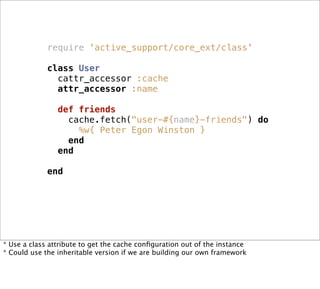
require 'active_support/core_ext/class'

             class User
               cattr_accessor :cache
               attr_accessor :name

                def friends
                  cache.fetch("user-#{name}-friends") do
                    %w{ Peter Egon Winston }
                  end
                end

             end


* Use a class attribute to get the cache configuration out of the instance
* Could use the inheritable version if we are building our own framework
User.cache = ActiveSupport::Cache::MemCacheStore.new


* In our application setup, create a cache instance and assign it to whatever classes need it
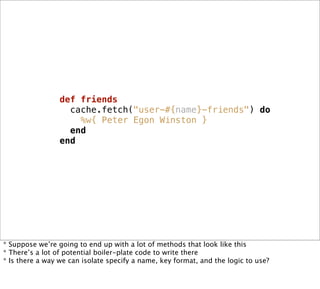
def friends
                   cache.fetch("user-#{name}-friends") do
                     %w{ Peter Egon Winston }
                   end
                 end


* Suppose we’re going to end up with a lot of methods that look like this
* There’s a lot of potential boiler-plate code to write there
* Is there a way we can isolate specify a name, key format, and the logic to use?
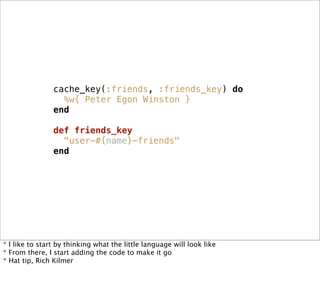
cache_key(:friends, :friends_key) do
                  %w{ Peter Egon Winston }
                end

                def friends_key
                  "user-#{name}-friends"
                end


* I like to start by thinking what the little language will look like
* From there, I start adding the code to make it go
* Hat tip, Rich Kilmer
cattr_accessor :cache_lookups, :cache_keys do
              {}
            end

            def self.cache_key(name, key, &block)
              class_eval %Q{
                cache_lookups[name] = block
                cache_keys[name] = key

                  def #{name}
                    return @#{name} if @#{name}.present?
                    key = method(cache_keys[:#{name}]).call
                    @#{name} = cache.fetch(key) do
                      block.call
                    end
                  end
              }
            end


*   Add a couple class attributes to keep track of things, this time with default values
*   Write a class method that adds a method for each cache key we add
*   Look up the the cache key to fetch from, look up the body to call to populate it, off we go
*   The catch: block is bound to class rather than instance
class User
                    cattr_accessor :cache
                    attr_accessor :name

                    cattr_accessor :cache_lookups, :cache_keys do
                      {}
                    end

                    def self.cache_key(name, key, &block)
                      class_eval %Q{
                        cache_lookups[name] = block
                        cache_keys[name] = key

                          def #{name}
                            return @#{name} if @#{name}.present?
                            key = method(cache_keys[:#{name}]).call
                            @#{name} = cache.fetch(key) do
                              block.call
                            end
                          end
                      }
                    end

                    cache_key(:friends, :friends_key) do
                      %w{ Peter Egon Winston }
                    end

                    def friends_key
                      "user-#{name}-friends"
                    end

                  end


* Downside: now our class won’t fit nicely on one slide; is this a smell?
* ActiveSupport enables a nice little refactoring I’ve started calling “extract concern”
class User
                    cattr_accessor :cache
                    attr_accessor :name

                    cattr_accessor :cache_lookups, :cache_keys do
                      {}
                    end

                    def self.cache_key(name, key, &block)
                      class_eval %Q{
                        cache_lookups[name] = block
                        cache_keys[name] = key

                          def #{name}
                            return @#{name} if @#{name}.present?
                            key = method(cache_keys[:#{name}]).call
                            @#{name} = cache.fetch(key) do
                              block.call
                            end
                          end
                      }
                    end

                    cache_key(:friends, :friends_key) do
                      %w{ Peter Egon Winston }
                    end

                    def friends_key
                      "user-#{name}-friends"
                    end

                  end


* Downside: now our class won’t fit nicely on one slide; is this a smell?
* ActiveSupport enables a nice little refactoring I’ve started calling “extract concern”
require 'active_support/concern'

           module Cacheabilly
             extend ActiveSupport::Concern

             included do
               cattr_accessor :cache

                cattr_accessor :cache_lookups, :cache_keys do
                  {}
                end

                def self.cache_key(name, key, &block)
                  cache_lookups[name] = block
                  cache_keys[name] = key

                  class_eval %Q{

                         def #{name}
                           return @#{name} if @#{name}.present?
                           key = method(cache_keys[:#{name}]).call
                           @#{name} = cache.fetch(key) do
                             block.call
                           end
                         end
                     }
               end
             end
           end

* We pick up all the machinery involved in making `cache_key` work and move into a module
* Then we wrap that bit in the included hook and extend ActiveSupport::Concern
* Easier to read than the old convention of modules included in, ala plugins
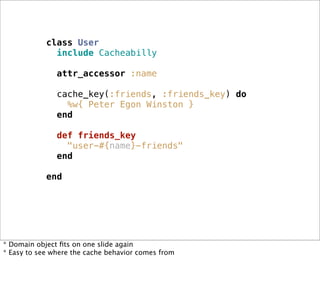
class User
              include Cacheabilly

               attr_accessor :name

               cache_key(:friends, :friends_key) do
                 %w{ Peter Egon Winston }
               end

               def friends_key
                 "user-#{name}-friends"
               end

            end


* Domain object fits on one slide again
* Easy to see where the cache behavior comes from
Accessors + concerns = slimming effect


*   ActiveSupport can help remove tedious code from your logic
*   ActiveSupport can make your classes simpler to reason about
*   Also look out for handy helper classes like MessageVerifier/Encryper, SecureRandom, etc.
*   Give it a fresh look, even if it’s previously stabbed you in the face
Models that look good                               ActiveModel validations
     and want to talk good too


* ActiveModel is the result of extracting much of the goodness of ActiveRecord
* If you’ve ever wanted validations, callbacks, dirty tracking, or serialization, this is your jam
* Better still, ActiveModel is cherry-pickable like ActiveSupport
include ActiveModel::Validations

  validates_presence_of :name
  validates_length_of :name,
    :minimum => 3,
    :message => 'Names with less than 3 characters are dumb'


* Adding validations to our user model is easy
* These are one in the same with what you’re using in AR
* No methods needed to get this functionality; just include and you’re on your way
class GhostbusterValidator < ActiveModel::Validator

       def validate(record)
         names = %w{ Peter Ray Egon Winston }
         return if names.include?(record.name)
         record.errors[:base] << "Not a Ghostbuster :("
       end

    end


* With ActiveModel, we can also implement validation logic in external classes
* Nice for sharing between projects or extracting involved validation
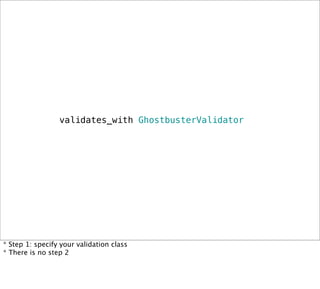
validates_with GhostbusterValidator


* Step 1: specify your validation class
* There is no step 2
class User
            include Cacheabilly

             attr_accessor :name

             cache_key(:friends, :friends_key) do
               %w{ Peter Egon Winston }
             end

             def friends_key
               "user-#{name}-friends"
             end

             include ActiveModel::Validations

            validates_presence_of :name
            validates_length_of :name,
              :minimum => 3,
              :message => 'Names with less than 3
          characters are dumb'
            validates_with GhostbusterValidator

          end
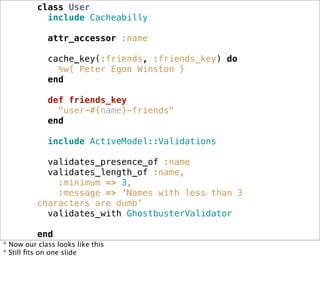
* Now our class looks like this
* Still fits on one slide
class User
            include Cacheabilly

             attr_accessor :name

             cache_key(:friends, :friends_key) do
               %w{ Peter Egon Winston }
             end

             def friends_key
               "user-#{name}-friends"
             end

             include ActiveModel::Validations

            validates_presence_of :name
            validates_length_of :name,
              :minimum => 3,
              :message => 'Names with less than 3
          characters are dumb'
            validates_with GhostbusterValidator

          end
* Now our class looks like this
* Still fits on one slide
>> u = User.new
 => #<User:0x103a56f28>
 >> u.valid?
 => false
 >> u.errors
 => #<OrderedHash {:base=>["Not a Ghostbuster :("], :name=>["can't be
 blank", "can't be blank", "Names with less than 3 characters are
 dumb", "can't be blank", "Names with less than 3 characters are
 dumb"]}>


Using the validations, no surprise, looks just like AR
>>   u.name = 'Ron'
  =>   "Ron"
  >>   u.valid?
  =>   false
  >>   u.errors
  =>   #<OrderedHash {:base=>["Not a Ghostbuster :("]}>


Ron Evans is a cool dude, but he’s no Ghostbuster
>>   u.name = 'Ray'
       =>   "Ray"
       >>   u.valid?
       =>   true


Ray is a bonafide Ghostbuster
Serialize your objects,                            ActiveModel lifecycle helpers
                       your way


* Validations are cool and easy
* What if we want to encode our object as JSON or XML
* Tyra is not so sure she wants to write that code herself
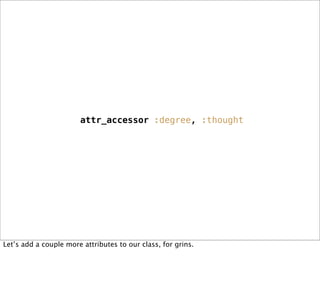
attr_accessor :degree, :thought


Let’s add a couple more attributes to our class, for grins.
def attributes
        @attributes ||= {'name' => name,
                         'degree' => degree,
                         'thought' => thought}
      end

      def attributes=(hash)
        self.name = hash['name']
        self.degree = hash['degree']
        self.thought = hash['thought']
      end


* If we add `attributes`, AMo knows what attributes to serialize when it encodes your object
* If we implement `attributes=`, we can specify how a serialized object gets decoded
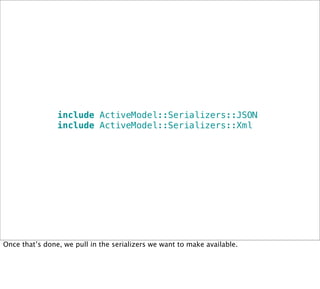
include ActiveModel::Serializers::JSON
                include ActiveModel::Serializers::Xml


Once that’s done, we pull in the serializers we want to make available.
>> u.serializable_hash
=> {"name"=>"Ray Stanz", "degree"=>"Parapsychology", "thought"=>"The
Stay-Puft Marshmallow Man"}
>> u.to_json
=> "{"name":"Ray Stanz","degree":"Parapsychology","thought
":"The Stay-Puft Marshmallow Man"}"
>> u.to_xml
=> "<?xml version="1.0" encoding="UTF-8"?>n<user>n
<degree>Parapsychology</degree>n <name>Ray Stanz</name>n
<thought>The Stay-Puft Marshmallow Man</thought>n</user>n"


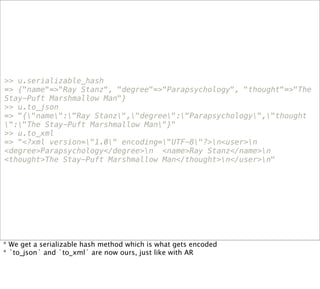
* We get a serializable hash method which is what gets encoded
* `to_json` and `to_xml` are now ours, just like with AR
>> json = u.to_json
=> "{"name":"Ray Stanz","degree":"Parapsychology","thought
":"The Stay-Puft Marshmallow Man"}"
>> new_user = User.new
=> #<User:0x103166378>
>> new_user.from_json(json)
=> #<User:0x103166378 @name="Ray Stanz", @degree="Parapsychology",
@thought="The Stay-Puft Marshmallow Man">


We can even use `from_json` and `from_xml`!
Persistence and queries,                               ActiveRelation persistence
                  like a boss


* In Rails 2, AR contains a bunch of logic for banging string together to form queries
* In Rails 3, that’s been abstracted into a library that models the relational algebra that
databases use
* But, Arel makes it possible to use the same API to query all your data sources
include Arel::Relation

                              cattr_accessor :engine


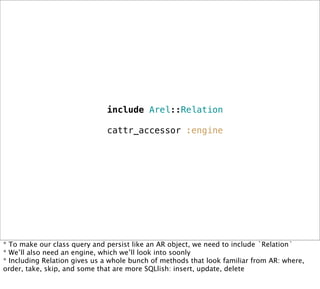
* To make our class query and persist like an AR object, we need to include `Relation`
* We’ll also need an engine, which we’ll look into soonly
* Including Relation gives us a whole bunch of methods that look familiar from AR: where,
order, take, skip, and some that are more SQLlish: insert, update, delete
def save
                      insert(self)
                    end

                    def find(name)
                      key = name.downcase.gsub(' ', '_')
                      where("user-#{key}").call
                    end


* Since our goal is to be somewhat like AR, we’ll add some sugar on top of the Relation
* Our save isn’t as clever as AR’s, in that it only creates records, but we could add dirty
tracking later
* Find is just sugar on top of `where`, which is quite similar to how we use it in AR
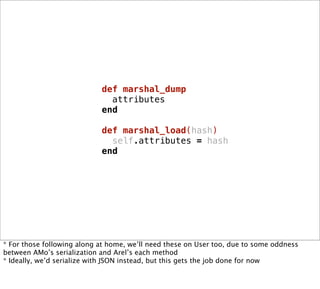
def marshal_dump
                              attributes
                            end

                            def marshal_load(hash)
                              self.attributes = hash
                            end


* For those following along at home, we’ll need these on User too, due to some oddness
between AMo’s serialization and Arel’s each method
* Ideally, we’d serialize with JSON instead, but this gets the job done for now
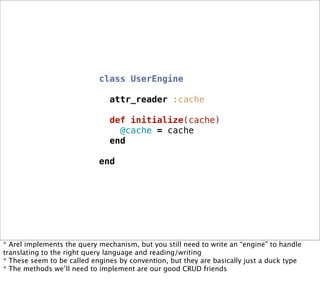
class UserEngine

                               attr_reader :cache

                               def initialize(cache)
                                 @cache = cache
                               end

                            end


* Arel implements the query mechanism, but you still need to write an “engine” to handle
translating to the right query language and reading/writing
* These seem to be called engines by convention, but they are basically just a duck type
* The methods we’ll need to implement are our good CRUD friends
def create(insert)
                      record = insert.relation
                      key = record.cache_key
                      value = record
                      cache.write(key, value)
                    end


*   Getting these engines up is mostly a matter of grokking what is in an ARel relation
*   Everything is passed a relation
*   The insert object has a relation that represents the record we want to create
*   Uses Marshal, JSON or YAML would be nicer
def read(select)
     raise ArgumentError.new("#{select.class} not
       supported") unless select.is_a?(Arel::Where)
     key = select.predicates.first.value
     cache.read(key)
   end


* Reads are where we query the datastore
* The select object contains the last method in whatever query chain we called
* Our memcached-based gizmo only supports `where` but we could get a `project`, `take`,
`order` etc.
* Spend lots of time poking the insides of these various objects to grab the data you need to
construct a query
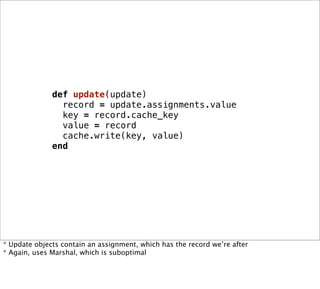
def update(update)
                record = update.assignments.value
                key = record.cache_key
                value = record
                cache.write(key, value)
              end


* Update objects contain an assignment, which has the record we’re after
* Again, uses Marshal, which is suboptimal
def delete(delete)
                      key = delete.relation.cache_key
                      cache.delete(key)
                    end


* Delete passes the relation we’re going to remove; not much going on here
class UserEngine

        attr_reader :cache

        def initialize(cache)
          @cache = cache
        end

        def create(insert)
          record = insert.relation
          key = record.cache_key
          value = record
          cache.write(key, value)
        end

        def read(select)
          raise ArgumentError.new("#{select.class} not supported") unless select.is_a?
      (Arel::Where)
          key = select.predicates.first.value
          cache.read(key)
        end

        def update(update)
          record = relation.assignments.value
          key = record.cache_key
          value = record
          cache.write(key, value)
        end

        def delete(delete)
          key = delete.relation.cache_key
          cache.delete(key)
        end

      end


* The entirety of our engine
* Use this as a starting point for your datastore; it’s probably not entirely right for what you
want to do, but it’s better than trying to figure things out from scratch
* Read the in-memory engine that comes with ARel or look at arel-mongo
User.cache = ActiveSupport::Cache::MemCacheStore.new
    User.engine = UserEngine.new(User.cache)


Here’s how we set up our engine
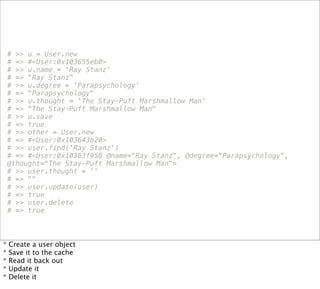
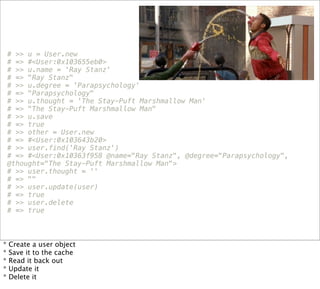
# >> u = User.new
    # => #<User:0x103655eb0>
    # >> u.name = 'Ray Stanz'
    # => "Ray Stanz"
    # >> u.degree = 'Parapsychology'
    # => "Parapsychology"
    # >> u.thought = 'The Stay-Puft Marshmallow Man'
    # => "The Stay-Puft Marshmallow Man"
    # >> u.save
    # => true
    # >> other = User.new
    # => #<User:0x103643b20>
    # >> user.find('Ray Stanz')
    # => #<User:0x10363f958 @name="Ray Stanz", @degree="Parapsychology",
    @thought="The Stay-Puft Marshmallow Man">
    # >> user.thought = ''
    # => ""
    # >> user.update(user)
    # => true
    # >> user.delete
    # => true


*   Create a user object
*   Save it to the cache
*   Read it back out
*   Update it
*   Delete it
# >> u = User.new
    # => #<User:0x103655eb0>
    # >> u.name = 'Ray Stanz'
    # => "Ray Stanz"
    # >> u.degree = 'Parapsychology'
    # => "Parapsychology"
    # >> u.thought = 'The Stay-Puft Marshmallow Man'
    # => "The Stay-Puft Marshmallow Man"
    # >> u.save
    # => true
    # >> other = User.new
    # => #<User:0x103643b20>
    # >> user.find('Ray Stanz')
    # => #<User:0x10363f958 @name="Ray Stanz", @degree="Parapsychology",
    @thought="The Stay-Puft Marshmallow Man">
    # >> user.thought = ''
    # => ""
    # >> user.update(user)
    # => true
    # >> user.delete
    # => true


*   Create a user object
*   Save it to the cache
*   Read it back out
*   Update it
*   Delete it
# >> u = User.new
    # => #<User:0x103655eb0>
    # >> u.name = 'Ray Stanz'
    # => "Ray Stanz"
    # >> u.degree = 'Parapsychology'
    # => "Parapsychology"
    # >> u.thought = 'The Stay-Puft Marshmallow Man'
    # => "The Stay-Puft Marshmallow Man"
    # >> u.save
    # => true
    # >> other = User.new
    # => #<User:0x103643b20>
    # >> user.find('Ray Stanz')
    # => #<User:0x10363f958 @name="Ray Stanz", @degree="Parapsychology",
    @thought="The Stay-Puft Marshmallow Man">
    # >> user.thought = ''
    # => ""
    # >> user.update(user)
    # => true
    # >> user.delete
    # => true


*   Create a user object
*   Save it to the cache
*   Read it back out
*   Update it
*   Delete it
~15 collars, BTW


* One dude, one pair of shades, one fleshbeard, fifteen collars
* We’ve popped a lot of collars, but we got a lot of functionality too
class User
  include Cacheabilly

 attr_accessor :name

 cache_key(:friends, :friends_key) do
   %w{ Peter Egon Winston }
 end

 def friends_key
   "user-#{name}-friends"
 end

 include ActiveModel::Validations

  validates_presence_of :name
  validates_length_of :name, :minimum => 3, :message => 'Names with less than 3 characters are dumb'
  validates_with GhostbusterValidator

 include ActiveModel::Serialization

 attr_accessor :degree, :thought

 def attributes
   @attributes ||= {'name' => name, 'degree' => degree, 'thought' => thought}
 end

 def attributes=(hash)
   self.name = hash['name']
   self.degree = hash['degree']
   self.thought = hash['thought']
 end

 include ActiveModel::Serializers::JSON
 include ActiveModel::Serializers::Xml

 include Arel::Relation

  cattr_accessor :engine

 # Our engine uses this method to infer the record's key
 def cache_key
   "user-#{name.downcase.gsub(' ', '_')}"
 end

 def marshal_dump
   attributes
 end

 def marshal_load(hash)
   self.attributes = hash
 end

 def save
   # HAX: use dirty tracking to call insert or update here
   insert(self)
 end

 def find(name)
   key = name.downcase.gsub(' ', '_')
   where("user-#{key}").call
 end

end


* Here’s our domain model and here’s all the support code
* What we get: declarative lazy caching, validations, serialization, persistence, querying
require   'common'
                                                                                                       require   'active_support/concern'
                                                                                                       require   'active_support/core_ext/class'
                                                                                                       require   'active_support/inflector'
                                                                                                       require   'active_support/cache'
                                                                                                       require   'active_model'
                                                                                                       require   'arel'

                                                                                                       module Cacheabilly
                                                                                                         extend ActiveSupport::Concern

                                                                                                         included do
                                                                                                           cattr_accessor :cache
class User
  include Cacheabilly
                                                                                                             cattr_accessor :cache_lookups, :cache_keys do
                                                                                                               {}
 attr_accessor :name
                                                                                                             end
 cache_key(:friends, :friends_key) do
                                                                                                             def self.cache_key(name, key, &block)
   %w{ Peter Egon Winston }
                                                                                                               cache_lookups[name] = block
 end
                                                                                                               cache_keys[name] = key
 def friends_key
                                                                                                               class_eval %Q{
   "user-#{name}-friends"
 end
                                                                                                                     def #{name}
                                                                                                                       return @#{name} if @#{name}.present?
 include ActiveModel::Validations
                                                                                                                       key = method(cache_keys[:#{name}]).call
                                                                                                                       @#{name} = cache.fetch(key) do
  validates_presence_of :name
                                                                                                                         block.call
  validates_length_of :name, :minimum => 3, :message => 'Names with less than 3 characters are dumb'
                                                                                                                       end
  validates_with GhostbusterValidator
                                                                                                                     end
                                                                                                                 }
 include ActiveModel::Serialization
                                                                                                           end
                                                                                                         end
 attr_accessor :degree, :thought
                                                                                                       end
 def attributes
                                                                                                       class GhostbusterValidator < ActiveModel::Validator
   @attributes ||= {'name' => name, 'degree' => degree, 'thought' => thought}
 end
                                                                                                        def validate(record)
                                                                                                          return if %w{ Peter Ray Egon Winston }.include?(record.name)
 def attributes=(hash)
                                                                                                          record.errors[:base] << "Not a Ghostbuster :("
   self.name = hash['name']
                                                                                                        end
   self.degree = hash['degree']
   self.thought = hash['thought']
                                                                                                       end
 end

 include ActiveModel::Serializers::JSON
 include ActiveModel::Serializers::Xml

 include Arel::Relation

  cattr_accessor :engine

 # Our engine uses this method to infer the record's key
 def cache_key
   "user-#{name.downcase.gsub(' ', '_')}"
 end

 def marshal_dump
   attributes
 end

 def marshal_load(hash)
   self.attributes = hash
 end

 def save
   # HAX: use dirty tracking to call insert or update here
   insert(self)
 end

 def find(name)
   key = name.downcase.gsub(' ', '_')
   where("user-#{key}").call
 end

end


* Here’s our domain model and here’s all the support code
* What we get: declarative lazy caching, validations, serialization, persistence, querying
require   'common'
                                                                                                       require   'active_support/concern'
                                                                                                       require   'active_support/core_ext/class'
                                                                                                       require   'active_support/inflector'
                                                                                                       require   'active_support/cache'
                                                                                                       require   'active_model'
                                                                                                       require   'arel'

                                                                                                       module Cacheabilly
                                                                                                         extend ActiveSupport::Concern

                                                                                                         included do
                                                                                                           cattr_accessor :cache
class User
  include Cacheabilly
                                                                                                             cattr_accessor :cache_lookups, :cache_keys do
                                                                                                               {}
 attr_accessor :name
                                                                                                             end
 cache_key(:friends, :friends_key) do
                                                                                                             def self.cache_key(name, key, &block)
   %w{ Peter Egon Winston }
                                                                                                               cache_lookups[name] = block
 end
                                                                                                               cache_keys[name] = key
 def friends_key
                                                                                                               class_eval %Q{
   "user-#{name}-friends"
 end
                                                                                                                     def #{name}
                                                                                                                       return @#{name} if @#{name}.present?
 include ActiveModel::Validations
                                                                                                                       key = method(cache_keys[:#{name}]).call
                                                                                                                       @#{name} = cache.fetch(key) do
  validates_presence_of :name
                                                                                                                         block.call
  validates_length_of :name, :minimum => 3, :message => 'Names with less than 3 characters are dumb'
                                                                                                                       end
  validates_with GhostbusterValidator
                                                                                                                     end
                                                                                                                 }
 include ActiveModel::Serialization
                                                                                                           end
                                                                                                         end
 attr_accessor :degree, :thought
                                                                                                       end
 def attributes
                                                                                                       class GhostbusterValidator < ActiveModel::Validator
   @attributes ||= {'name' => name, 'degree' => degree, 'thought' => thought}
 end
                                                                                                         def validate(record)
                                                                                                           return if %w{ Peter Ray Egon Winston }.include?(record.name)
 def attributes=(hash)
                                                                                                           record.errors[:base] << "Not a Ghostbuster :("
   self.name = hash['name']
                                                                                                         end
   self.degree = hash['degree']
   self.thought = hash['thought']
                                                                                                       end
 end
                                                                                                       class UserEngine
 include ActiveModel::Serializers::JSON
 include ActiveModel::Serializers::Xml
                                                                                                         attr_reader :cache
 include Arel::Relation
                                                                                                         def initialize(cache)
                                                                                                           @cache = cache
  cattr_accessor :engine
                                                                                                         end
 # Our engine uses this method to infer the record's key
                                                                                                         def create(insert)
 def cache_key
                                                                                                           record = insert.relation
   "user-#{name.downcase.gsub(' ', '_')}"
                                                                                                           key = record.cache_key
 end
                                                                                                           value = record # Note: this uses Marshal, b/c to_json w/ arel is buggy
                                                                                                           cache.write(key, value)
 def marshal_dump
                                                                                                         end
   attributes
 end
                                                                                                         # Ignores chained queries, i.e. take(n).where(...)
                                                                                                         def read(select)
 def marshal_load(hash)
                                                                                                           raise ArgumentError.new("#{select.class} not supported") unless select.is_a?(Arel::Where)
   self.attributes = hash
                                                                                                           key = select.predicates.first.value
 end
                                                                                                           cache.read(key)
                                                                                                         end
 def save
   # HAX: use dirty tracking to call insert or update here
                                                                                                         def update(update)
   insert(self)
                                                                                                           record = relation.assignments.value
 end
                                                                                                           key = record.cache_key
                                                                                                           value = record
 def find(name)
                                                                                                           cache.write(key, value)
   key = name.downcase.gsub(' ', '_')
                                                                                                         end
   where("user-#{key}").call
 end
                                                                                                         def delete(delete)
                                                                                                           key = delete.relation.cache_key
end
                                                                                                           cache.delete(key)
                                                                                                         end

                                                                                                       end

                                                                                                       User.cache = ActiveSupport::Cache::MemCacheStore.new('localhost')
                                                                                                       User.engine = UserEngine.new(User.cache)


* Here’s our domain model and here’s all the support code
* What we get: declarative lazy caching, validations, serialization, persistence, querying
“Keys” to success
๏ give ActiveSupport a try
๏ fancy up your classes with AMo

๏ build data layers with ARel

๏ make better codes
Thanks!


I hope you all got something out of this talk. I’ll post the slides and example code on my
website, therealadam.com, soon. Thanks for coming!

Rails' Next Top Model

  • 1.
    Rails’ Next TopModel Adam Keys, expert typist at Gowalla http://therealadam.com @therealadam RailsConf 2010 Hi, I’m Adam Keys. I’m an expert typist at Gowalla and an amateur language lawyer. Today I’m going to talk about what I consider the most intriguing part of the reimagination of Rails that is Rails 3. Namely, I want to explore how ActiveRecord was extracted from itself into ActiveModel and ActiveRelation.
  • 2.
    k s ! L oo ea t G r u r F o * Extractions reduce friction in building little languages on top of data stores * Reduce the boilerplate code involved in bringing up a data layer * Make it easier to add some of the things we’ve come to take for granted * Allow developers to focus on building better APIs for data
  • 3.
    Clean up yourdomain ActiveSupport fanciness objects * ActiveSupport, the oft-maligned cake on top of ActiveRecord and Rails are built * Smaller and less cumbersome in Rails 3, cherry-pick the functionality you want * Use ActiveSupport instead of rolling your own extensions or copy-paste reuse * Tighten up your classes by extracting concerns
  • 4.
    require 'common' require 'active_support/inflector' require 'active_support/cache' class User attr_accessor :name def friends cache.fetch("user-#{name}-friends") do %w{ Peter Egon Winston } end end protected def cache ActiveSupport::Cache::MemCacheStore.new end end * Not too different from the user model in your own applications * `cache` is the simplest thing that might work, but could we make it better and cleaner?
  • 5.
    require 'active_support/core_ext/class' class User cattr_accessor :cache attr_accessor :name def friends cache.fetch("user-#{name}-friends") do %w{ Peter Egon Winston } end end end * Use a class attribute to get the cache configuration out of the instance * Could use the inheritable version if we are building our own framework
  • 6.
    User.cache = ActiveSupport::Cache::MemCacheStore.new *In our application setup, create a cache instance and assign it to whatever classes need it
  • 7.
    def friends cache.fetch("user-#{name}-friends") do %w{ Peter Egon Winston } end end * Suppose we’re going to end up with a lot of methods that look like this * There’s a lot of potential boiler-plate code to write there * Is there a way we can isolate specify a name, key format, and the logic to use?
  • 8.
    cache_key(:friends, :friends_key) do %w{ Peter Egon Winston } end def friends_key "user-#{name}-friends" end * I like to start by thinking what the little language will look like * From there, I start adding the code to make it go * Hat tip, Rich Kilmer
  • 9.
    cattr_accessor :cache_lookups, :cache_keysdo {} end def self.cache_key(name, key, &block) class_eval %Q{ cache_lookups[name] = block cache_keys[name] = key def #{name} return @#{name} if @#{name}.present? key = method(cache_keys[:#{name}]).call @#{name} = cache.fetch(key) do block.call end end } end * Add a couple class attributes to keep track of things, this time with default values * Write a class method that adds a method for each cache key we add * Look up the the cache key to fetch from, look up the body to call to populate it, off we go * The catch: block is bound to class rather than instance
  • 10.
    class User cattr_accessor :cache attr_accessor :name cattr_accessor :cache_lookups, :cache_keys do {} end def self.cache_key(name, key, &block) class_eval %Q{ cache_lookups[name] = block cache_keys[name] = key def #{name} return @#{name} if @#{name}.present? key = method(cache_keys[:#{name}]).call @#{name} = cache.fetch(key) do block.call end end } end cache_key(:friends, :friends_key) do %w{ Peter Egon Winston } end def friends_key "user-#{name}-friends" end end * Downside: now our class won’t fit nicely on one slide; is this a smell? * ActiveSupport enables a nice little refactoring I’ve started calling “extract concern”
  • 11.
    class User cattr_accessor :cache attr_accessor :name cattr_accessor :cache_lookups, :cache_keys do {} end def self.cache_key(name, key, &block) class_eval %Q{ cache_lookups[name] = block cache_keys[name] = key def #{name} return @#{name} if @#{name}.present? key = method(cache_keys[:#{name}]).call @#{name} = cache.fetch(key) do block.call end end } end cache_key(:friends, :friends_key) do %w{ Peter Egon Winston } end def friends_key "user-#{name}-friends" end end * Downside: now our class won’t fit nicely on one slide; is this a smell? * ActiveSupport enables a nice little refactoring I’ve started calling “extract concern”
  • 12.
    require 'active_support/concern' module Cacheabilly extend ActiveSupport::Concern included do cattr_accessor :cache cattr_accessor :cache_lookups, :cache_keys do {} end def self.cache_key(name, key, &block) cache_lookups[name] = block cache_keys[name] = key class_eval %Q{ def #{name} return @#{name} if @#{name}.present? key = method(cache_keys[:#{name}]).call @#{name} = cache.fetch(key) do block.call end end } end end end * We pick up all the machinery involved in making `cache_key` work and move into a module * Then we wrap that bit in the included hook and extend ActiveSupport::Concern * Easier to read than the old convention of modules included in, ala plugins
  • 13.
    class User include Cacheabilly attr_accessor :name cache_key(:friends, :friends_key) do %w{ Peter Egon Winston } end def friends_key "user-#{name}-friends" end end * Domain object fits on one slide again * Easy to see where the cache behavior comes from
  • 14.
    Accessors + concerns= slimming effect * ActiveSupport can help remove tedious code from your logic * ActiveSupport can make your classes simpler to reason about * Also look out for handy helper classes like MessageVerifier/Encryper, SecureRandom, etc. * Give it a fresh look, even if it’s previously stabbed you in the face
  • 15.
    Models that lookgood ActiveModel validations and want to talk good too * ActiveModel is the result of extracting much of the goodness of ActiveRecord * If you’ve ever wanted validations, callbacks, dirty tracking, or serialization, this is your jam * Better still, ActiveModel is cherry-pickable like ActiveSupport
  • 16.
    include ActiveModel::Validations validates_presence_of :name validates_length_of :name, :minimum => 3, :message => 'Names with less than 3 characters are dumb' * Adding validations to our user model is easy * These are one in the same with what you’re using in AR * No methods needed to get this functionality; just include and you’re on your way
  • 17.
    class GhostbusterValidator <ActiveModel::Validator def validate(record) names = %w{ Peter Ray Egon Winston } return if names.include?(record.name) record.errors[:base] << "Not a Ghostbuster :(" end end * With ActiveModel, we can also implement validation logic in external classes * Nice for sharing between projects or extracting involved validation
  • 18.
    validates_with GhostbusterValidator * Step1: specify your validation class * There is no step 2
  • 19.
    class User include Cacheabilly attr_accessor :name cache_key(:friends, :friends_key) do %w{ Peter Egon Winston } end def friends_key "user-#{name}-friends" end include ActiveModel::Validations validates_presence_of :name validates_length_of :name, :minimum => 3, :message => 'Names with less than 3 characters are dumb' validates_with GhostbusterValidator end * Now our class looks like this * Still fits on one slide
  • 20.
    class User include Cacheabilly attr_accessor :name cache_key(:friends, :friends_key) do %w{ Peter Egon Winston } end def friends_key "user-#{name}-friends" end include ActiveModel::Validations validates_presence_of :name validates_length_of :name, :minimum => 3, :message => 'Names with less than 3 characters are dumb' validates_with GhostbusterValidator end * Now our class looks like this * Still fits on one slide
  • 21.
    >> u =User.new => #<User:0x103a56f28> >> u.valid? => false >> u.errors => #<OrderedHash {:base=>["Not a Ghostbuster :("], :name=>["can't be blank", "can't be blank", "Names with less than 3 characters are dumb", "can't be blank", "Names with less than 3 characters are dumb"]}> Using the validations, no surprise, looks just like AR
  • 22.
    >> u.name = 'Ron' => "Ron" >> u.valid? => false >> u.errors => #<OrderedHash {:base=>["Not a Ghostbuster :("]}> Ron Evans is a cool dude, but he’s no Ghostbuster
  • 23.
    >> u.name = 'Ray' => "Ray" >> u.valid? => true Ray is a bonafide Ghostbuster
  • 24.
    Serialize your objects, ActiveModel lifecycle helpers your way * Validations are cool and easy * What if we want to encode our object as JSON or XML * Tyra is not so sure she wants to write that code herself
  • 25.
    attr_accessor :degree, :thought Let’sadd a couple more attributes to our class, for grins.
  • 26.
    def attributes @attributes ||= {'name' => name, 'degree' => degree, 'thought' => thought} end def attributes=(hash) self.name = hash['name'] self.degree = hash['degree'] self.thought = hash['thought'] end * If we add `attributes`, AMo knows what attributes to serialize when it encodes your object * If we implement `attributes=`, we can specify how a serialized object gets decoded
  • 27.
    include ActiveModel::Serializers::JSON include ActiveModel::Serializers::Xml Once that’s done, we pull in the serializers we want to make available.
  • 28.
    >> u.serializable_hash => {"name"=>"RayStanz", "degree"=>"Parapsychology", "thought"=>"The Stay-Puft Marshmallow Man"} >> u.to_json => "{"name":"Ray Stanz","degree":"Parapsychology","thought ":"The Stay-Puft Marshmallow Man"}" >> u.to_xml => "<?xml version="1.0" encoding="UTF-8"?>n<user>n <degree>Parapsychology</degree>n <name>Ray Stanz</name>n <thought>The Stay-Puft Marshmallow Man</thought>n</user>n" * We get a serializable hash method which is what gets encoded * `to_json` and `to_xml` are now ours, just like with AR
  • 29.
    >> json =u.to_json => "{"name":"Ray Stanz","degree":"Parapsychology","thought ":"The Stay-Puft Marshmallow Man"}" >> new_user = User.new => #<User:0x103166378> >> new_user.from_json(json) => #<User:0x103166378 @name="Ray Stanz", @degree="Parapsychology", @thought="The Stay-Puft Marshmallow Man"> We can even use `from_json` and `from_xml`!
  • 30.
    Persistence and queries, ActiveRelation persistence like a boss * In Rails 2, AR contains a bunch of logic for banging string together to form queries * In Rails 3, that’s been abstracted into a library that models the relational algebra that databases use * But, Arel makes it possible to use the same API to query all your data sources
  • 31.
    include Arel::Relation cattr_accessor :engine * To make our class query and persist like an AR object, we need to include `Relation` * We’ll also need an engine, which we’ll look into soonly * Including Relation gives us a whole bunch of methods that look familiar from AR: where, order, take, skip, and some that are more SQLlish: insert, update, delete
  • 32.
    def save insert(self) end def find(name) key = name.downcase.gsub(' ', '_') where("user-#{key}").call end * Since our goal is to be somewhat like AR, we’ll add some sugar on top of the Relation * Our save isn’t as clever as AR’s, in that it only creates records, but we could add dirty tracking later * Find is just sugar on top of `where`, which is quite similar to how we use it in AR
  • 33.
    def marshal_dump attributes end def marshal_load(hash) self.attributes = hash end * For those following along at home, we’ll need these on User too, due to some oddness between AMo’s serialization and Arel’s each method * Ideally, we’d serialize with JSON instead, but this gets the job done for now
  • 34.
    class UserEngine attr_reader :cache def initialize(cache) @cache = cache end end * Arel implements the query mechanism, but you still need to write an “engine” to handle translating to the right query language and reading/writing * These seem to be called engines by convention, but they are basically just a duck type * The methods we’ll need to implement are our good CRUD friends
  • 35.
    def create(insert) record = insert.relation key = record.cache_key value = record cache.write(key, value) end * Getting these engines up is mostly a matter of grokking what is in an ARel relation * Everything is passed a relation * The insert object has a relation that represents the record we want to create * Uses Marshal, JSON or YAML would be nicer
  • 36.
    def read(select) raise ArgumentError.new("#{select.class} not supported") unless select.is_a?(Arel::Where) key = select.predicates.first.value cache.read(key) end * Reads are where we query the datastore * The select object contains the last method in whatever query chain we called * Our memcached-based gizmo only supports `where` but we could get a `project`, `take`, `order` etc. * Spend lots of time poking the insides of these various objects to grab the data you need to construct a query
  • 37.
    def update(update) record = update.assignments.value key = record.cache_key value = record cache.write(key, value) end * Update objects contain an assignment, which has the record we’re after * Again, uses Marshal, which is suboptimal
  • 38.
    def delete(delete) key = delete.relation.cache_key cache.delete(key) end * Delete passes the relation we’re going to remove; not much going on here
  • 39.
    class UserEngine attr_reader :cache def initialize(cache) @cache = cache end def create(insert) record = insert.relation key = record.cache_key value = record cache.write(key, value) end def read(select) raise ArgumentError.new("#{select.class} not supported") unless select.is_a? (Arel::Where) key = select.predicates.first.value cache.read(key) end def update(update) record = relation.assignments.value key = record.cache_key value = record cache.write(key, value) end def delete(delete) key = delete.relation.cache_key cache.delete(key) end end * The entirety of our engine * Use this as a starting point for your datastore; it’s probably not entirely right for what you want to do, but it’s better than trying to figure things out from scratch * Read the in-memory engine that comes with ARel or look at arel-mongo
  • 40.
    User.cache = ActiveSupport::Cache::MemCacheStore.new User.engine = UserEngine.new(User.cache) Here’s how we set up our engine
  • 41.
    # >> u= User.new # => #<User:0x103655eb0> # >> u.name = 'Ray Stanz' # => "Ray Stanz" # >> u.degree = 'Parapsychology' # => "Parapsychology" # >> u.thought = 'The Stay-Puft Marshmallow Man' # => "The Stay-Puft Marshmallow Man" # >> u.save # => true # >> other = User.new # => #<User:0x103643b20> # >> user.find('Ray Stanz') # => #<User:0x10363f958 @name="Ray Stanz", @degree="Parapsychology", @thought="The Stay-Puft Marshmallow Man"> # >> user.thought = '' # => "" # >> user.update(user) # => true # >> user.delete # => true * Create a user object * Save it to the cache * Read it back out * Update it * Delete it
  • 42.
    # >> u= User.new # => #<User:0x103655eb0> # >> u.name = 'Ray Stanz' # => "Ray Stanz" # >> u.degree = 'Parapsychology' # => "Parapsychology" # >> u.thought = 'The Stay-Puft Marshmallow Man' # => "The Stay-Puft Marshmallow Man" # >> u.save # => true # >> other = User.new # => #<User:0x103643b20> # >> user.find('Ray Stanz') # => #<User:0x10363f958 @name="Ray Stanz", @degree="Parapsychology", @thought="The Stay-Puft Marshmallow Man"> # >> user.thought = '' # => "" # >> user.update(user) # => true # >> user.delete # => true * Create a user object * Save it to the cache * Read it back out * Update it * Delete it
  • 43.
    # >> u= User.new # => #<User:0x103655eb0> # >> u.name = 'Ray Stanz' # => "Ray Stanz" # >> u.degree = 'Parapsychology' # => "Parapsychology" # >> u.thought = 'The Stay-Puft Marshmallow Man' # => "The Stay-Puft Marshmallow Man" # >> u.save # => true # >> other = User.new # => #<User:0x103643b20> # >> user.find('Ray Stanz') # => #<User:0x10363f958 @name="Ray Stanz", @degree="Parapsychology", @thought="The Stay-Puft Marshmallow Man"> # >> user.thought = '' # => "" # >> user.update(user) # => true # >> user.delete # => true * Create a user object * Save it to the cache * Read it back out * Update it * Delete it
  • 44.
    ~15 collars, BTW *One dude, one pair of shades, one fleshbeard, fifteen collars * We’ve popped a lot of collars, but we got a lot of functionality too
  • 45.
    class User include Cacheabilly attr_accessor :name cache_key(:friends, :friends_key) do %w{ Peter Egon Winston } end def friends_key "user-#{name}-friends" end include ActiveModel::Validations validates_presence_of :name validates_length_of :name, :minimum => 3, :message => 'Names with less than 3 characters are dumb' validates_with GhostbusterValidator include ActiveModel::Serialization attr_accessor :degree, :thought def attributes @attributes ||= {'name' => name, 'degree' => degree, 'thought' => thought} end def attributes=(hash) self.name = hash['name'] self.degree = hash['degree'] self.thought = hash['thought'] end include ActiveModel::Serializers::JSON include ActiveModel::Serializers::Xml include Arel::Relation cattr_accessor :engine # Our engine uses this method to infer the record's key def cache_key "user-#{name.downcase.gsub(' ', '_')}" end def marshal_dump attributes end def marshal_load(hash) self.attributes = hash end def save # HAX: use dirty tracking to call insert or update here insert(self) end def find(name) key = name.downcase.gsub(' ', '_') where("user-#{key}").call end end * Here’s our domain model and here’s all the support code * What we get: declarative lazy caching, validations, serialization, persistence, querying
  • 46.
    require 'common' require 'active_support/concern' require 'active_support/core_ext/class' require 'active_support/inflector' require 'active_support/cache' require 'active_model' require 'arel' module Cacheabilly extend ActiveSupport::Concern included do cattr_accessor :cache class User include Cacheabilly cattr_accessor :cache_lookups, :cache_keys do {} attr_accessor :name end cache_key(:friends, :friends_key) do def self.cache_key(name, key, &block) %w{ Peter Egon Winston } cache_lookups[name] = block end cache_keys[name] = key def friends_key class_eval %Q{ "user-#{name}-friends" end def #{name} return @#{name} if @#{name}.present? include ActiveModel::Validations key = method(cache_keys[:#{name}]).call @#{name} = cache.fetch(key) do validates_presence_of :name block.call validates_length_of :name, :minimum => 3, :message => 'Names with less than 3 characters are dumb' end validates_with GhostbusterValidator end } include ActiveModel::Serialization end end attr_accessor :degree, :thought end def attributes class GhostbusterValidator < ActiveModel::Validator @attributes ||= {'name' => name, 'degree' => degree, 'thought' => thought} end def validate(record) return if %w{ Peter Ray Egon Winston }.include?(record.name) def attributes=(hash) record.errors[:base] << "Not a Ghostbuster :(" self.name = hash['name'] end self.degree = hash['degree'] self.thought = hash['thought'] end end include ActiveModel::Serializers::JSON include ActiveModel::Serializers::Xml include Arel::Relation cattr_accessor :engine # Our engine uses this method to infer the record's key def cache_key "user-#{name.downcase.gsub(' ', '_')}" end def marshal_dump attributes end def marshal_load(hash) self.attributes = hash end def save # HAX: use dirty tracking to call insert or update here insert(self) end def find(name) key = name.downcase.gsub(' ', '_') where("user-#{key}").call end end * Here’s our domain model and here’s all the support code * What we get: declarative lazy caching, validations, serialization, persistence, querying
  • 47.
    require 'common' require 'active_support/concern' require 'active_support/core_ext/class' require 'active_support/inflector' require 'active_support/cache' require 'active_model' require 'arel' module Cacheabilly extend ActiveSupport::Concern included do cattr_accessor :cache class User include Cacheabilly cattr_accessor :cache_lookups, :cache_keys do {} attr_accessor :name end cache_key(:friends, :friends_key) do def self.cache_key(name, key, &block) %w{ Peter Egon Winston } cache_lookups[name] = block end cache_keys[name] = key def friends_key class_eval %Q{ "user-#{name}-friends" end def #{name} return @#{name} if @#{name}.present? include ActiveModel::Validations key = method(cache_keys[:#{name}]).call @#{name} = cache.fetch(key) do validates_presence_of :name block.call validates_length_of :name, :minimum => 3, :message => 'Names with less than 3 characters are dumb' end validates_with GhostbusterValidator end } include ActiveModel::Serialization end end attr_accessor :degree, :thought end def attributes class GhostbusterValidator < ActiveModel::Validator @attributes ||= {'name' => name, 'degree' => degree, 'thought' => thought} end def validate(record) return if %w{ Peter Ray Egon Winston }.include?(record.name) def attributes=(hash) record.errors[:base] << "Not a Ghostbuster :(" self.name = hash['name'] end self.degree = hash['degree'] self.thought = hash['thought'] end end class UserEngine include ActiveModel::Serializers::JSON include ActiveModel::Serializers::Xml attr_reader :cache include Arel::Relation def initialize(cache) @cache = cache cattr_accessor :engine end # Our engine uses this method to infer the record's key def create(insert) def cache_key record = insert.relation "user-#{name.downcase.gsub(' ', '_')}" key = record.cache_key end value = record # Note: this uses Marshal, b/c to_json w/ arel is buggy cache.write(key, value) def marshal_dump end attributes end # Ignores chained queries, i.e. take(n).where(...) def read(select) def marshal_load(hash) raise ArgumentError.new("#{select.class} not supported") unless select.is_a?(Arel::Where) self.attributes = hash key = select.predicates.first.value end cache.read(key) end def save # HAX: use dirty tracking to call insert or update here def update(update) insert(self) record = relation.assignments.value end key = record.cache_key value = record def find(name) cache.write(key, value) key = name.downcase.gsub(' ', '_') end where("user-#{key}").call end def delete(delete) key = delete.relation.cache_key end cache.delete(key) end end User.cache = ActiveSupport::Cache::MemCacheStore.new('localhost') User.engine = UserEngine.new(User.cache) * Here’s our domain model and here’s all the support code * What we get: declarative lazy caching, validations, serialization, persistence, querying
  • 48.
    “Keys” to success ๏give ActiveSupport a try ๏ fancy up your classes with AMo ๏ build data layers with ARel ๏ make better codes
  • 49.
    Thanks! I hope youall got something out of this talk. I’ll post the slides and example code on my website, therealadam.com, soon. Thanks for coming!