Drupal 8: Sample ModuleDrupal 8: Sample Module
Introducing Block Plugins & Configuration FormsIntroducing Block Plugins & Configuration Forms
Drupal Meetup StuttgartDrupal Meetup Stuttgart
03/05/2015
1. Tell Drupal about the1. Tell Drupal about the
modulemodule
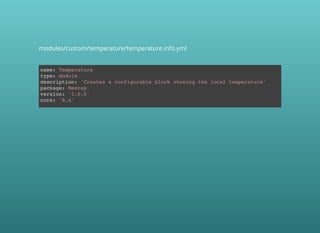
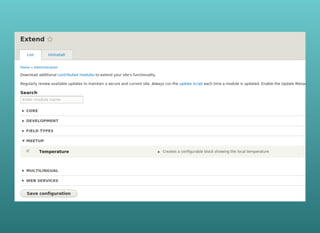
name: Temperature
type: module
description: 'Creates a configurable block showing the local temperature'
package: Meetup
version: '1.0.0'
core: '8.x'
modules/custom/temperature/temperature.info.yml
2. Create a simple block2. Create a simple block
pluginplugin
<?php
/**
* @file
* Contains DrupaltemperaturePluginBlockTemperatureBlock.
*/
namespace DrupaltemperaturePluginBlock;
use DrupalCoreBlockBlockBase;
/**
* Provides a 'Temperature' block.
*
* @Block(
* id = "temperature",
* admin_label = @Translation("Local temperature"),
* category = @Translation("Meetup")
* )
*/
class TemperatureBlock extends BlockBase {
public function build() {
return [
'#markup' => 'Seems cold outside!',
];
}
}
modules/custom/temperature/src/Plugin/Block/TemperatureBlock.php
use GuzzleHttpClient;
class TemperatureBlock extends BlockBase {
public function build() {
$city = 'Stuttgart, DE'
$client = new Client();
$response = $client->get("http://api.openweathermap.org/data/2.5/weather?q=$city");
if ($response->getStatusCode() == '200') {
$result = json_decode($response->getBody());
$markup = "Current temperature in<br>$city:<br>";
$markup .= round($result->main->temp - 273.15) . '° C';
}
else {
$markup = 'Sorry, something went wrong!';
}
return [
'#markup' => $markup,
];
}
}
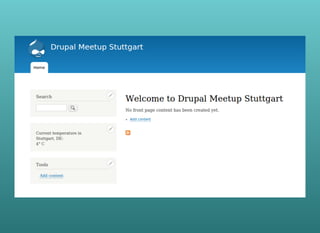
Adding the "real" content
3. Make block instances3. Make block instances
configurableconfigurable
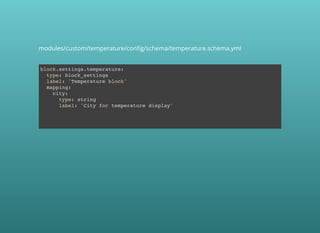
block.settings.temperature:
type: block_settings
label: 'Temperature block'
mapping:
city:
type: string
label: 'City for temperature display'
modules/custom/temperature/config/schema/temperature.schema.yml
use DrupalCoreBlockBlockBase;
use DrupalCoreFormFormStateInterface;
class TemperatureBlock extends BlockBase {
public function build() {
$city = $this->configuration['city'];
...
}
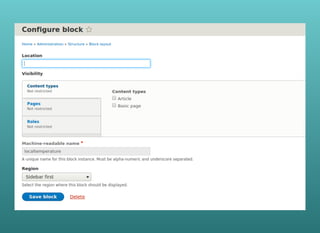
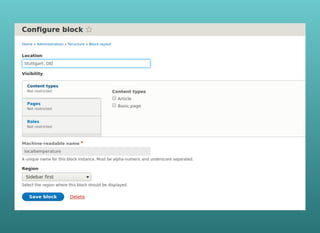
public function buildConfigurationForm(array $form, FormStateInterface $form_state) {
$form['city'] = array(
'#title' => 'Location',
'#type' => 'textfield',
'#default_value' => $this->configuration['city'],
);
return $form;
}
public function submitConfigurationForm(array &$form, FormStateInterface $form_state) {
$this->configuration['city'] = $form_state->getValue('city');
$this->blockSubmit($form, $form_state);
}
}
modules/custom/temperature/src/Plugin/Block/TemperatureBlock.php
4. Provide a default4. Provide a default
configurationconfiguration
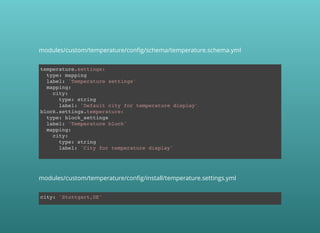
temperature.settings:
type: mapping
label: 'Temperature settings'
mapping:
city:
type: string
label: 'Default city for temperature display'
block.settings.temperature:
type: block_settings
label: 'Temperature block'
mapping:
city:
type: string
label: 'City for temperature display'
modules/custom/temperature/config/schema/temperature.schema.yml
modules/custom/temperature/config/install/temperature.settings.yml
city: 'Stuttgart,DE'
...
class TemperatureBlock extends BlockBase {
public function defaultConfiguration() {
$config = Drupal::config('temperature.settings')->get();
return $config;
}
public function build() {
...
}
public function buildConfigurationForm(array $form, FormStateInterface $form_state) {
$form['city'] = array(
'#title' => 'Location',
'#type' => 'textfield',
'#default_value' => $this->configuration['city'],
);
return $form;
}
public function submitConfigurationForm(array &$form, FormStateInterface $form_state) {
$this->configuration['city'] = $form_state->getValue('city');
$this->blockSubmit($form, $form_state);
}
}
modules/custom/temperature/src/Plugin/Block/TemperatureBlock.php
5. Make default5. Make default
configuration editableconfiguration editable
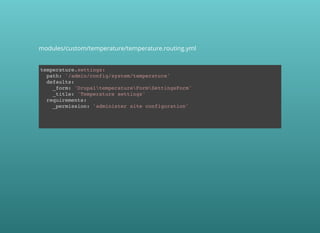
temperature.settings:
path: '/admin/config/system/temperature'
defaults:
_form: 'DrupaltemperatureFormSettingsForm'
_title: 'Temperature settings'
requirements:
_permission: 'administer site configuration'
modules/custom/temperature/temperature.routing.yml
<?php
/**
* @file
* Contains DrupaltemperatureFormSettingsForm
*/
namespace DrupaltemperatureForm;
use DrupalCoreFormConfigFormBase;
use DrupalCoreFormFormStateInterface;
class SettingsForm extends ConfigFormBase {
public function buildForm(array $form, FormStateInterface $form_state) {
$form = parent::buildForm($form, $form_state);
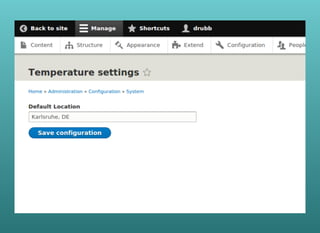
$form['city'] = [
'#title' => 'Default Location',
'#type' => 'textfield',
'#default_value' => $this->config('temperature.settings')->get('city'),
];
return $form;
}
public function submitForm(array &$form, FormStateInterface $form_state) {
$this->config('temperature.settings')
->set('city', $form_state->getValue('city'))
->save();
parent::submitForm($form, $form_state);
}
protected function getEditableConfigNames() {
return ['temperature.settings'];
}
public function getFormId() {
return 'temperature_settings';
}
}
modules/custom/temperature/src/Form/SettingsForm.php
Thank You!Thank You!
http://slides.com/drubb
http://slideshare.net/drubb

Drupal 8 Sample Module

  • 1.
    Drupal 8: SampleModuleDrupal 8: Sample Module Introducing Block Plugins & Configuration FormsIntroducing Block Plugins & Configuration Forms Drupal Meetup StuttgartDrupal Meetup Stuttgart 03/05/2015
  • 2.
    1. Tell Drupalabout the1. Tell Drupal about the modulemodule
  • 3.
    name: Temperature type: module description:'Creates a configurable block showing the local temperature' package: Meetup version: '1.0.0' core: '8.x' modules/custom/temperature/temperature.info.yml
  • 5.
    2. Create asimple block2. Create a simple block pluginplugin
  • 6.
    <?php /** * @file * ContainsDrupaltemperaturePluginBlockTemperatureBlock. */ namespace DrupaltemperaturePluginBlock; use DrupalCoreBlockBlockBase; /** * Provides a 'Temperature' block. * * @Block( * id = "temperature", * admin_label = @Translation("Local temperature"), * category = @Translation("Meetup") * ) */ class TemperatureBlock extends BlockBase { public function build() { return [ '#markup' => 'Seems cold outside!', ]; } } modules/custom/temperature/src/Plugin/Block/TemperatureBlock.php
  • 7.
    use GuzzleHttpClient; class TemperatureBlockextends BlockBase { public function build() { $city = 'Stuttgart, DE' $client = new Client(); $response = $client->get("http://api.openweathermap.org/data/2.5/weather?q=$city"); if ($response->getStatusCode() == '200') { $result = json_decode($response->getBody()); $markup = "Current temperature in<br>$city:<br>"; $markup .= round($result->main->temp - 273.15) . '° C'; } else { $markup = 'Sorry, something went wrong!'; } return [ '#markup' => $markup, ]; } } Adding the "real" content
  • 9.
    3. Make blockinstances3. Make block instances configurableconfigurable
  • 10.
    block.settings.temperature: type: block_settings label: 'Temperatureblock' mapping: city: type: string label: 'City for temperature display' modules/custom/temperature/config/schema/temperature.schema.yml
  • 11.
    use DrupalCoreBlockBlockBase; use DrupalCoreFormFormStateInterface; classTemperatureBlock extends BlockBase { public function build() { $city = $this->configuration['city']; ... } public function buildConfigurationForm(array $form, FormStateInterface $form_state) { $form['city'] = array( '#title' => 'Location', '#type' => 'textfield', '#default_value' => $this->configuration['city'], ); return $form; } public function submitConfigurationForm(array &$form, FormStateInterface $form_state) { $this->configuration['city'] = $form_state->getValue('city'); $this->blockSubmit($form, $form_state); } } modules/custom/temperature/src/Plugin/Block/TemperatureBlock.php
  • 13.
    4. Provide adefault4. Provide a default configurationconfiguration
  • 14.
    temperature.settings: type: mapping label: 'Temperaturesettings' mapping: city: type: string label: 'Default city for temperature display' block.settings.temperature: type: block_settings label: 'Temperature block' mapping: city: type: string label: 'City for temperature display' modules/custom/temperature/config/schema/temperature.schema.yml modules/custom/temperature/config/install/temperature.settings.yml city: 'Stuttgart,DE'
  • 15.
    ... class TemperatureBlock extendsBlockBase { public function defaultConfiguration() { $config = Drupal::config('temperature.settings')->get(); return $config; } public function build() { ... } public function buildConfigurationForm(array $form, FormStateInterface $form_state) { $form['city'] = array( '#title' => 'Location', '#type' => 'textfield', '#default_value' => $this->configuration['city'], ); return $form; } public function submitConfigurationForm(array &$form, FormStateInterface $form_state) { $this->configuration['city'] = $form_state->getValue('city'); $this->blockSubmit($form, $form_state); } } modules/custom/temperature/src/Plugin/Block/TemperatureBlock.php
  • 17.
    5. Make default5.Make default configuration editableconfiguration editable
  • 18.
    temperature.settings: path: '/admin/config/system/temperature' defaults: _form: 'DrupaltemperatureFormSettingsForm' _title:'Temperature settings' requirements: _permission: 'administer site configuration' modules/custom/temperature/temperature.routing.yml
  • 19.
    <?php /** * @file * ContainsDrupaltemperatureFormSettingsForm */ namespace DrupaltemperatureForm; use DrupalCoreFormConfigFormBase; use DrupalCoreFormFormStateInterface; class SettingsForm extends ConfigFormBase { public function buildForm(array $form, FormStateInterface $form_state) { $form = parent::buildForm($form, $form_state); $form['city'] = [ '#title' => 'Default Location', '#type' => 'textfield', '#default_value' => $this->config('temperature.settings')->get('city'), ]; return $form; } public function submitForm(array &$form, FormStateInterface $form_state) { $this->config('temperature.settings') ->set('city', $form_state->getValue('city')) ->save(); parent::submitForm($form, $form_state); } protected function getEditableConfigNames() { return ['temperature.settings']; } public function getFormId() { return 'temperature_settings'; } } modules/custom/temperature/src/Form/SettingsForm.php
  • 21.