Classification
English Name: Radish
BotanicalName: Raphanus sativus L.
Family: Cruciferae
Origin:
The exact origin of radishes is unknown but they are thought to
be originated in the region of West Asia and Europe
Climate and GeneralDescription
Cool season popular vegetable.
Can be ready within 3-6 weeks.
Mostly cultivated around cities.
Annual and Biannual. In 1st
season roots and then seeds.
Long days + cool season is fit for seed stock development.
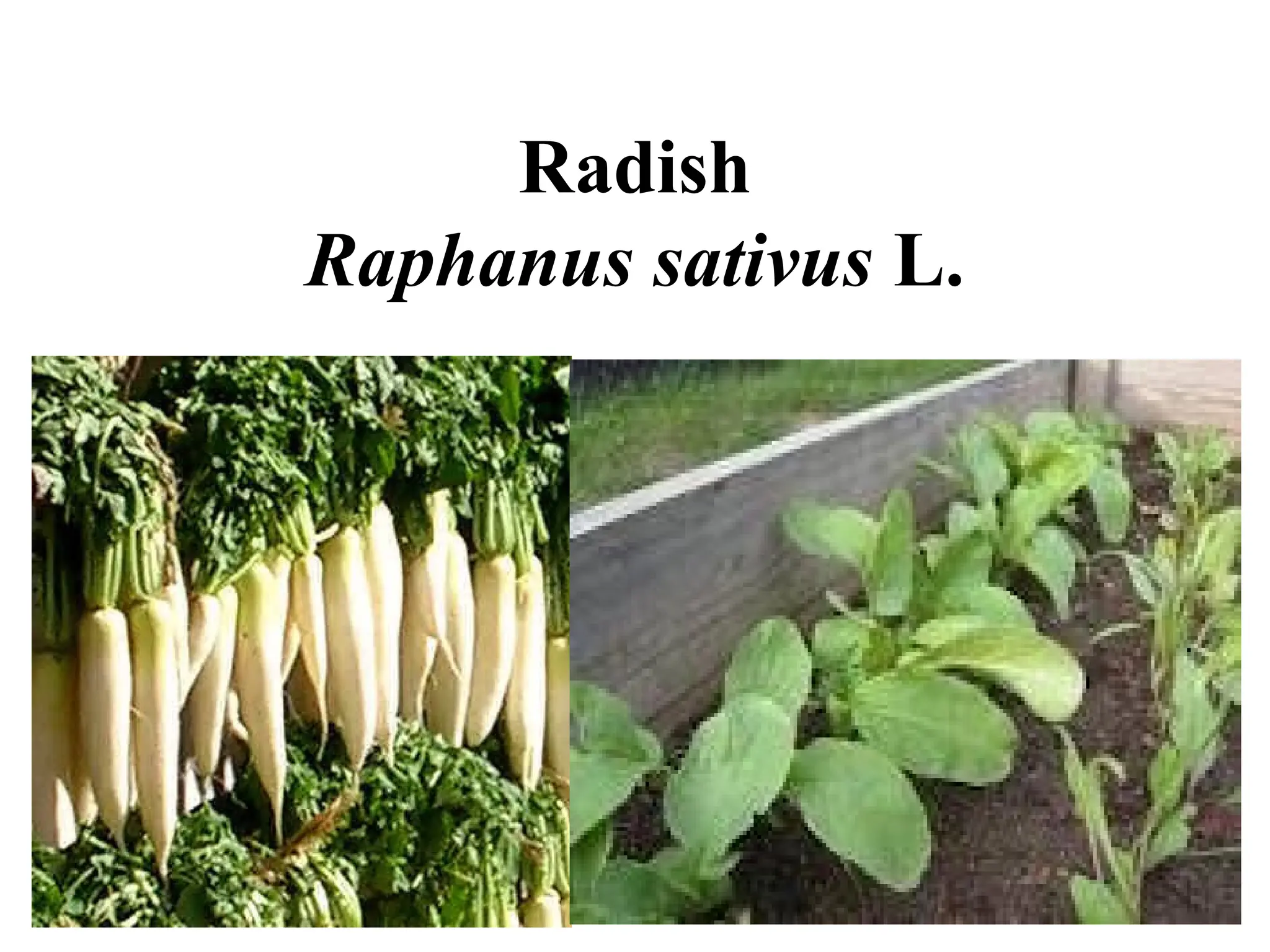
Root, root hairs, leaves with cuts.
Green Color of leaves. Leaves are in a circle growing from
centre to outward.
Root and Fruit size, shape and color varied according to
variety.
5.
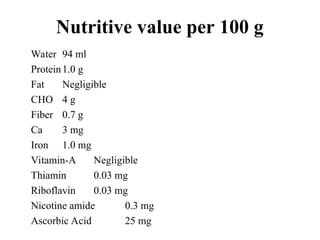
Nutritive value per100 g
Water 94 ml
Protein1.0 g
Fat Negligible
CHO 4 g
Fiber 0.7 g
Ca 3 mg
Iron 1.0 mg
Vitamin-A Negligible
Thiamin 0.03 mg
Riboflavin 0.03 mg
Nicotine amide 0.3 mg
Ascorbic Acid 25 mg
6.
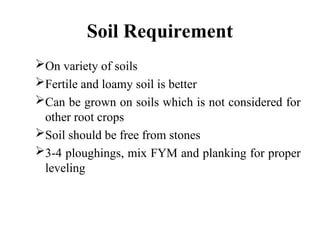
Soil Requirement
On varietyof soils
Fertile and loamy soil is better
Can be grown on soils which is not considered for
other root crops
Soil should be free from stones
3-4 ploughings, mix FYM and planking for proper
leveling
7.
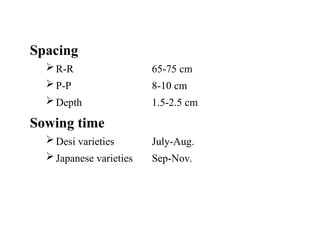
Spacing
R-R 65-75 cm
P-P8-10 cm
Depth 1.5-2.5 cm
Sowing time
Desi varieties July-Aug.
Japanese varieties Sep-Nov.
8.
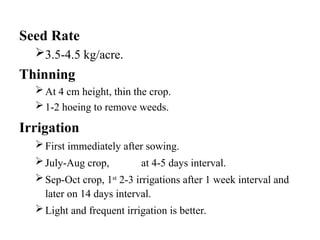
Seed Rate
3.5-4.5 kg/acre.
Thinning
At4 cm height, thin the crop.
1-2 hoeing to remove weeds.
Irrigation
First immediately after sowing.
July-Aug crop, at 4-5 days interval.
Sep-Oct crop, 1st
2-3 irrigations after 1 week interval and
later on 14 days interval.
Light and frequent irrigation is better.
9.
Varieties
European or temperateTypes
Used for salad purpose and small in size.
Asian or tropical varieties
High yielding
Early varieties
Round or Turnip Shape
Half long, olive or oval shape
Long
Summer Types
Round and Long
Winter Types
Pungent Large planted in Autumn.
Mostly Grown Varieties
Local Red, Local White, Round Red, Shamora, Manochi, Lal Pari,
Shaomai, Yokohama, Averest, Green Neck.
10.
Time of maturity
25-40days according to variety.
Fertilizer
NPK @ 20-20-25 kg/acre.
1 bag DAP and 1 bag potash for an acre.
Propagation
Through seed on ridges/beds by Kera method.
Through ducks
Ducks are planted in Nov-Dec.
11.
Harvesting
Harvest when rootsattain marketable size.
With hand pulled, washed and bundles are made.
They are placed in baskets.
Machine may also be used to harvest.
Transparent bags are used for marketing.
Yield
8-10 tons/acre.
20000-30000 kg/ha.
12.
Seed Production
Selfincompatible
Pollination through wind or insect
Different varieties should be at a distance of 500 m
Select the radishes for ducks. If any variability, reject roots per plant for
ducks
Make 2-3 visits of field
Use FYM in early crop
Select Healthy ducks without Pith
Ducks Having leaves 5 cm
Total length of duck should be 10-12 cm
13.
Uses
Favorite crop ofhome gardeners.
Fresh leaves and roots are used as salad.
Cooking alone or mixed with other vegetable.
Pickles.
Fruit is very delicious and popular.
Leaves rich in vitamin A and C.
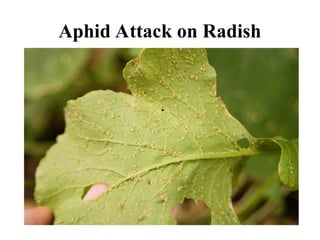
Aphids
Aphids can stuntand distort the growth of
radish
Cause wilting
Aphids can also spread plant viruses.
Aphid numbers are generally highest in spring
when conditions are favorable.
Control:
Spray proper insecticide at regular intervals
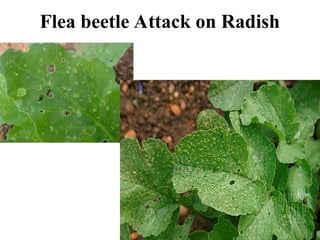
Flea Beetles
Tinyholes appeared on leaves after chewing of adult
insect.
Slender, whitish, cylindrical larvae feed in or on roots
but root damage is generally minimal.
Mainly leaves are affected
Control:
Dust with Rotenone.
Keep debris removed.
Rotate location of planting from year to year.
Downy mildew
Initial symptomsof downy mildew appear on
leaves as light green to yellow spots
Stunted growth
Control:
Use resistant varieties
Ensure that the right control measures are
implemented for the right time and conditions
20.
Root rot
Itis a bacterial disease, which spreads through
implements and irrigation water.
Symptoms appear as rotting of pith tissues resulting
in cavity formation and wilting of plants.
The disease spreads when the roots are transplanted
for seed production.
Control:
Seed treatment at the time of sowing is effective in
checking the disease