Radio Waves
Manpreet Sandhu – P11280447
• Radio waves are a type of electromagnetic radiation with
  wavelengths in the electromagnetic spectrum longer than
  infrared light. - Wikipedia


What are Radio Waves?
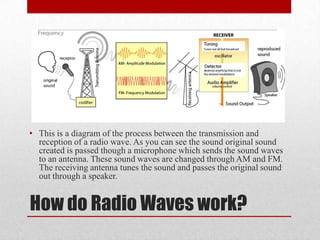
• This is a diagram of the process between the transmission and
  reception of a radio wave. As you can see the sound original sound
  created is passed though a microphone which sends the sound waves
  to an antenna. These sound waves are changed through AM and FM.
  The receiving antenna tunes the sound and passes the original sound
  out through a speaker.


How do Radio Waves work?
Carbon Monoxide (CO) gases in our Milky Way galaxy.

• In 1932 it was discovered that many astronomical objects let out radio
  waves. Astronomers then developed high tech systems that allow them
  to make pictures from the radio waves emitted by astronomical objects.

• Radio telescopes look up far into the sky at planets and comets, giant
  clouds of gas and dust, and stars and galaxies. Astronomers can now
  learn more about the composition, structure and motion of the sky by
  studying the radio waves they encounter.


What do Radio Waves
show us?
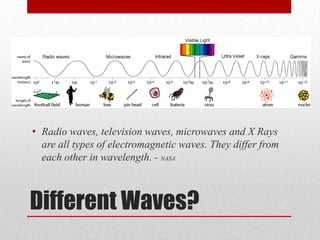
• Radio waves, television waves, microwaves and X Rays
  are all types of electromagnetic waves. They differ from
  each other in wavelength. - NASA


Different Waves?
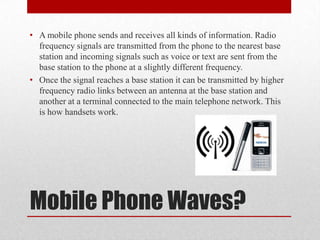
• A mobile phone sends and receives all kinds of information. Radio
  frequency signals are transmitted from the phone to the nearest base
  station and incoming signals such as voice or text are sent from the
  base station to the phone at a slightly different frequency.
• Once the signal reaches a base station it can be transmitted by higher
  frequency radio links between an antenna at the base station and
  another at a terminal connected to the main telephone network. This
  is how handsets work.


Mobile Phone Waves?
• X-rays are very high frequency waves, and carry a lot of energy.
  They are given off by stars. An X-ray machine works by firing a
  beam of electrons at a "target". If we fire the electrons with enough
  energy, X-rays will be produced. This X Rays allow doctors to see
  inside people. They pass easily through soft tissues, but not so easily
  through bones. We send a beam of X-Rays through the patient and
  onto a piece of film.


X Ray Waves?
•   NASA. (March 27, 2007 ). Electromagnetic Waves have different wavelengths .
    Available: http://science.hq.nasa.gov/kids/imagers/ems/waves3.html. Last accessed
    29/01/2012.
•   Wikipedia. (26 January 2012 ). Radio Waves. Available:
    http://en.wikipedia.org/wiki/Radio_waves. Last accessed 29/01/2012.
•   Wikipedia. (2005). File:Radio transmition diagram en.png. Available:
    http://en.wikipedia.org/wiki/File:Radio_transmition_diagram_en.png. Last accessed
    29/01/2012.
•   Radiocommunications Agency. (2001). Mobile Phone Base Stations - How Mobile
    Phone Networks Work . Available:
    http://www.ofcom.org.uk/static/archive/ra/topics/mpsafety/school-
    audit/mobilework.htm. Last accessed 29/01/2012.
•   Andy Darvill. (). X Rays. Available: http://www.darvill.clara.net/emag/emagxray.htm.
    Last accessed 29/12/2012.


Bibliography
THANKYOU


Radio waves

  • 1.
  • 2.
    • Radio wavesare a type of electromagnetic radiation with wavelengths in the electromagnetic spectrum longer than infrared light. - Wikipedia What are Radio Waves?
  • 3.
    • This isa diagram of the process between the transmission and reception of a radio wave. As you can see the sound original sound created is passed though a microphone which sends the sound waves to an antenna. These sound waves are changed through AM and FM. The receiving antenna tunes the sound and passes the original sound out through a speaker. How do Radio Waves work?
  • 4.
    Carbon Monoxide (CO)gases in our Milky Way galaxy. • In 1932 it was discovered that many astronomical objects let out radio waves. Astronomers then developed high tech systems that allow them to make pictures from the radio waves emitted by astronomical objects. • Radio telescopes look up far into the sky at planets and comets, giant clouds of gas and dust, and stars and galaxies. Astronomers can now learn more about the composition, structure and motion of the sky by studying the radio waves they encounter. What do Radio Waves show us?
  • 5.
    • Radio waves,television waves, microwaves and X Rays are all types of electromagnetic waves. They differ from each other in wavelength. - NASA Different Waves?
  • 6.
    • A mobilephone sends and receives all kinds of information. Radio frequency signals are transmitted from the phone to the nearest base station and incoming signals such as voice or text are sent from the base station to the phone at a slightly different frequency. • Once the signal reaches a base station it can be transmitted by higher frequency radio links between an antenna at the base station and another at a terminal connected to the main telephone network. This is how handsets work. Mobile Phone Waves?
  • 7.
    • X-rays arevery high frequency waves, and carry a lot of energy. They are given off by stars. An X-ray machine works by firing a beam of electrons at a "target". If we fire the electrons with enough energy, X-rays will be produced. This X Rays allow doctors to see inside people. They pass easily through soft tissues, but not so easily through bones. We send a beam of X-Rays through the patient and onto a piece of film. X Ray Waves?
  • 8.
    NASA. (March 27, 2007 ). Electromagnetic Waves have different wavelengths . Available: http://science.hq.nasa.gov/kids/imagers/ems/waves3.html. Last accessed 29/01/2012. • Wikipedia. (26 January 2012 ). Radio Waves. Available: http://en.wikipedia.org/wiki/Radio_waves. Last accessed 29/01/2012. • Wikipedia. (2005). File:Radio transmition diagram en.png. Available: http://en.wikipedia.org/wiki/File:Radio_transmition_diagram_en.png. Last accessed 29/01/2012. • Radiocommunications Agency. (2001). Mobile Phone Base Stations - How Mobile Phone Networks Work . Available: http://www.ofcom.org.uk/static/archive/ra/topics/mpsafety/school- audit/mobilework.htm. Last accessed 29/01/2012. • Andy Darvill. (). X Rays. Available: http://www.darvill.clara.net/emag/emagxray.htm. Last accessed 29/12/2012. Bibliography
  • 9.