Racing The Web
Security Consultant at Security Compass
Professor of Application Security at
Georgian College
Software developer
Former sysadmin
etc.
Aaron Hnatiw
twitter: @insp3ctre
Why am I here?
Race conditions
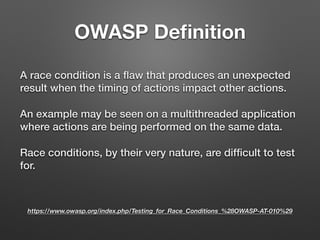
OWASP Definition
A race condition is a flaw that produces an unexpected
result when the timing of actions impact other actions.
An example may be seen on a multithreaded application
where actions are being performed on the same data.
Race conditions, by their very nature, are difficult to test
for.
https://www.owasp.org/index.php/Testing_for_Race_Conditions_%28OWASP-AT-010%29
CWE-362: Concurrent Execution
using Shared Resource with Improper
Synchronization ('Race Condition’)
https://cwe.mitre.org/data/definitions/362.html
Basically, when you bet on
the wrong horse.
(or even “bet” at all)
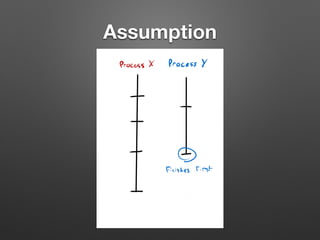
Assumption
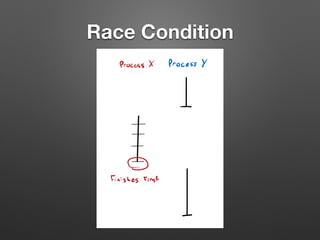
Race Condition
When does this become a
security issue?
“One time use” coupon
codes
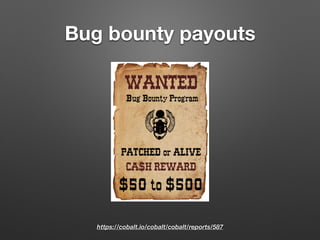
Bug bounty payouts
https://cobalt.io/cobalt/cobalt/reports/587
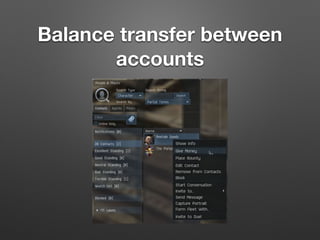
Balance transfer between
accounts
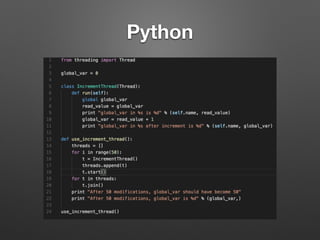
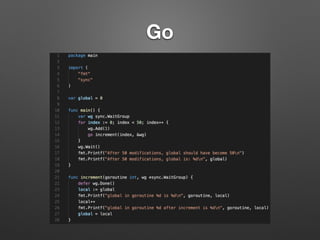
What does a race condition
look like?
Python
Go
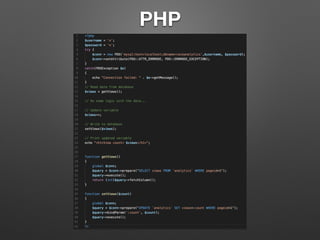
Surprise…
PHP
Testing for race conditions in
web applications
Usual whitebox method
1. Identify all shared data
2. Identify where that shared data is accessed across
systems
3. Find where that data access is not synchronized
4. Make a TON of requests
There’s a better way…
Introducing: Race-The-Web
(RTW)
A tool that automates race condition discovery
Simple configuration (TOML)
Open-source
Written in Go
Demo time
Try it out yourself!
RaceTheWeb.io
Comparison vs Burp Intruder
Speed
• Intruder setup:
• 10 threads (default is 5)
• 3 retries after network failure (2000 ms pause before
retry)- default
• Redirect: always
• 1000 requests (withdraw $1 x 1000)
Speed (cont’d)
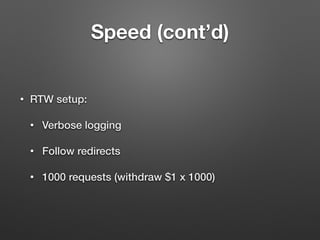
• RTW setup:
• Verbose logging
• Follow redirects
• 1000 requests (withdraw $1 x 1000)
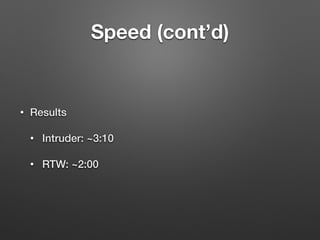
Speed (cont’d)
• Results
• Intruder: ~3:10
• RTW: ~2:00
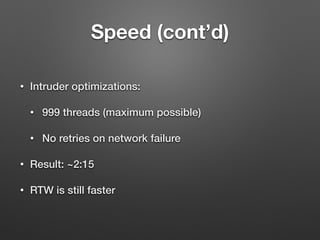
Speed (cont’d)
• Intruder optimizations:
• 999 threads (maximum possible)
• No retries on network failure
• Result: ~2:15
• RTW is still faster
Key difference:
Built-in response comparison in
RTW
// TODO
• Add “proxy” option to config file
• Clean up codebase
• Write Burp plugin
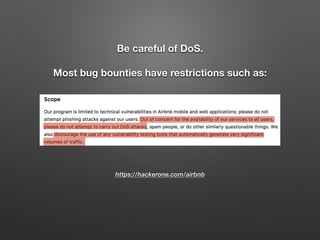
Be careful of DoS.
Most bug bounties have restrictions such as:
https://hackerone.com/airbnb
Useful tip: check for CRUD
functionality.
(especially with remote resources)
Let’s talk about defence
Most effective: Locks
Use with shared resources
Lock #1:
Application-level
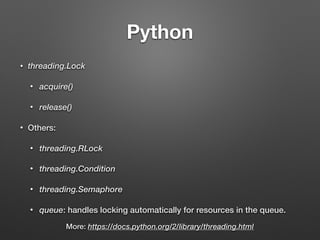
Python
• threading.Lock
• acquire()
• release()
• Others:
• threading.RLock
• threading.Condition
• threading.Semaphore
• queue: handles locking automatically for resources in the queue.
More: https://docs.python.org/2/library/threading.html
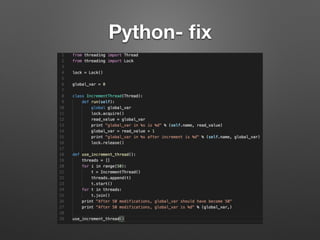
Python- fix
Go
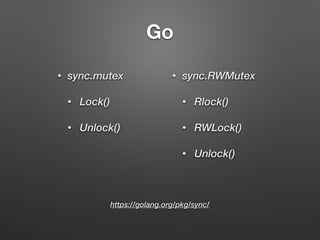
• sync.mutex
• Lock()
• Unlock()
• sync.RWMutex
• Rlock()
• RWLock()
• Unlock()
https://golang.org/pkg/sync/
Go
Channels:
“Do not communicate by sharing memory; instead,
share memory by communicating.”
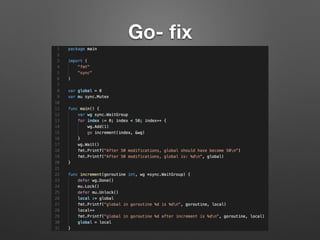
Go- fix
PHP
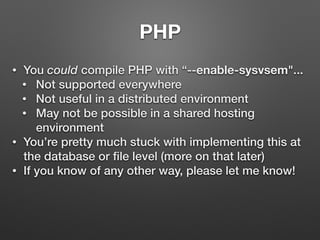
• You could compile PHP with “--enable-sysvsem"...
• Not supported everywhere
• Not useful in a distributed environment
• May not be possible in a shared hosting
environment
• You’re pretty much stuck with implementing this at
the database or file level (more on that later)
• If you know of any other way, please let me know!
Lock #2:
Database-level
Database MUST be ACID-
compliant
ACID-Compliant Databases
• Atomicity: All or nothing. A transaction either succeeds or
rolls back.
• Consistency: On the completion of a transaction, the
database is structurally sound. Otherwise, it reverts back to
the previous sound state.
• Isolation: Transactions do not interfere with each other.
• This point is KEY.
• Durability: The results of applying a transaction are
permanent, even in the presence of failures.
Isolation
• Highest level: serializable.
• Transactions essentially occur serially (one after another), rather
than concurrently.
• Next level: repeatable read.
• Close, but still allows race conditions.
• Be prepared to retry transactions often, because in most cases, these
isolation levels can result in a large number of transaction failures.
• Obvious downside- using higher levels of isolation can slow down
your application.
Solution- MySQL
• From the documentation: "MySQL Server (version
3.23-max and all versions 4.0 and above) supports
transactions with the InnoDB transactional storage
engine. InnoDB provides full ACID compliance."
• Use SERIALIZABLE isolation level
• Default is REPEATABLE-READ
• Can be set globally, for a session, or for individual
transactions
More info: https://dev.mysql.com/doc/refman/5.5/en/innodb-transaction-isolation-
levels.html
MySQL (cont’d)
• System variable: 

SET GLOBAL @@GLOBAL.tx_isolation=`SERIALIZABLE`;
• Command-line option at mysqld startup: 

--transaction-isolation=SERIALIZABLE
• Option file:

[mysqld]

transaction-isolation = SERIALIZABLE
• Command-line, BEFORE starting a transaction:

SET TRANSACTION ISOLATION LEVEL SERIALIZABLE;
More Info: https://dev.mysql.com/doc/refman/5.5/en/set-transaction.html
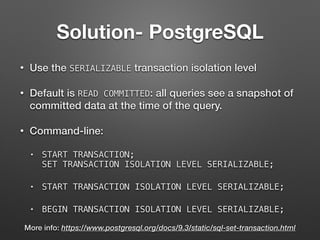
Solution- PostgreSQL
• Use the SERIALIZABLE transaction isolation level
• Default is READ COMMITTED: all queries see a snapshot of
committed data at the time of the query.
• Command-line:
• START TRANSACTION;

SET TRANSACTION ISOLATION LEVEL SERIALIZABLE;
• START TRANSACTION ISOLATION LEVEL SERIALIZABLE;
• BEGIN TRANSACTION ISOLATION LEVEL SERIALIZABLE;
More info: https://www.postgresql.org/docs/9.3/static/sql-set-transaction.html
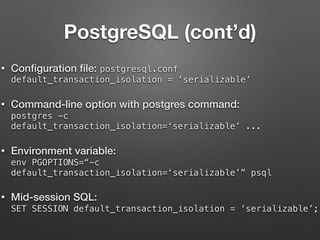
PostgreSQL (cont’d)
• Configuration file: postgresql.conf

default_transaction_isolation = ‘serializable’
• Command-line option with postgres command:

postgres -c
default_transaction_isolation=‘serializable’ ...
• Environment variable:

env PGOPTIONS=“-c
default_transaction_isolation=‘serializable’” psql
• Mid-session SQL:

SET SESSION default_transaction_isolation = ‘serializable’;
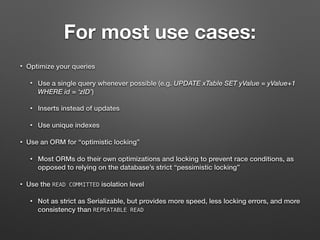
Realistic compromise
For most use cases:
• Optimize your queries
• Use a single query whenever possible (e.g. UPDATE xTable SET yValue = yValue+1
WHERE id = ‘zID’)
• Inserts instead of updates
• Use unique indexes
• Use an ORM for “optimistic locking”
• Most ORMs do their own optimizations and locking to prevent race conditions, as
opposed to relying on the database’s strict “pessimistic locking”
• Use the READ COMMITTED isolation level
• Not as strict as Serializable, but provides more speed, less locking errors, and more
consistency than REPEATABLE READ
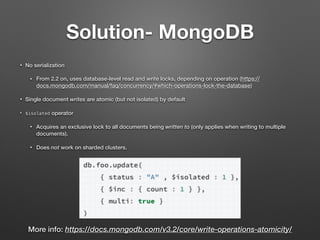
Solution- MongoDB
• No serialization
• From 2.2 on, uses database-level read and write locks, depending on operation (https://
docs.mongodb.com/manual/faq/concurrency/#which-operations-lock-the-database)
• Single document writes are atomic (but not isolated) by default
• $isolated operator
• Acquires an exclusive lock to all documents being written to (only applies when writing to multiple
documents).
• Does not work on sharded clusters.
More info: https://docs.mongodb.com/v3.2/core/write-operations-atomicity/
Lock #3:
File-level
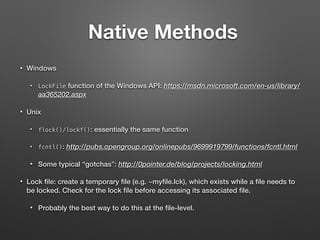
Native Methods
• Windows
• LockFile function of the Windows API: https://msdn.microsoft.com/en-us/library/
aa365202.aspx
• Unix
• flock()/lockf(): essentially the same function
• fcntl(): http://pubs.opengroup.org/onlinepubs/9699919799/functions/fcntl.html
• Some typical “gotchas”: http://0pointer.de/blog/projects/locking.html
• Lock file: create a temporary file (e.g. ~myfile.lck), which exists while a file needs to
be locked. Check for the lock file before accessing its associated file.
• Probably the best way to do this at the file-level.
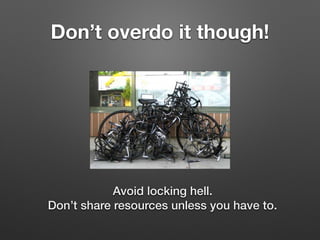
Don’t overdo it though!
Avoid locking hell.
Don’t share resources unless you have to.
Best Practices
Ensure your database can
keep up
• Often the slowest point in the application logic chain
• Database speed should keep at pace with the speed
of users making requests to your web application
• Best bet- host on the same network
• Not the same server though- tiered architecture is
best
• This provides defence-in-depth; not a panacea
Fetch data only right as you
need it
Again, defence-in-depth. This is by no means a
complete solution on its own.
CSRF Tokens
• You can’t automate a bunch of requests if they require
a unique token every time
• More of a client-side solution, does not necessarily
address the root cause of a race condition
• Do this even for non-sensitive actions
• Attacker’s perspective- found a CSRF vuln? Try
leveraging that into a race condition as well!
Further Reading
• https://www.josipfranjkovic.com/blog/race-conditions-on-web
• http://sakurity.com/blog/2015/05/21/starbucks.html
• https://defuse.ca/race-conditions-in-web-applications.htm
• Web Application Hacker’s Handbook, 2nd Ed.; chapter 11, "Example 12:
Racing Against the Login" (page 426)
• http://www.hakim.ws/BHUSA08/speakers/
Stender_Vidergar_Concurrency_Attacks/
BH_US_08_Stender_Vidergar_Concurrency_Attacks_in_Web_Applications
_Presentation.pdf
• https://www.owasp.org/index.php/Reviewing_Code_for_Race_Conditions
You’ve got another tool in
your tool belt
Now go and race the web!
http://RaceTheWeb.io

Racing The Web - Hackfest 2016

  • 1.
  • 2.
    Security Consultant atSecurity Compass Professor of Application Security at Georgian College Software developer Former sysadmin etc. Aaron Hnatiw twitter: @insp3ctre
  • 3.
    Why am Ihere?
  • 4.
  • 5.
    OWASP Definition A racecondition is a flaw that produces an unexpected result when the timing of actions impact other actions. An example may be seen on a multithreaded application where actions are being performed on the same data. Race conditions, by their very nature, are difficult to test for. https://www.owasp.org/index.php/Testing_for_Race_Conditions_%28OWASP-AT-010%29
  • 6.
    CWE-362: Concurrent Execution using SharedResource with Improper Synchronization ('Race Condition’) https://cwe.mitre.org/data/definitions/362.html
  • 7.
    Basically, when youbet on the wrong horse. (or even “bet” at all)
  • 8.
  • 9.
  • 10.
    When does thisbecome a security issue?
  • 11.
    “One time use”coupon codes
  • 12.
  • 13.
  • 14.
    What does arace condition look like?
  • 16.
  • 17.
  • 18.
  • 19.
  • 20.
    Testing for raceconditions in web applications
  • 21.
    Usual whitebox method 1.Identify all shared data 2. Identify where that shared data is accessed across systems 3. Find where that data access is not synchronized 4. Make a TON of requests
  • 22.
  • 23.
    Introducing: Race-The-Web (RTW) A toolthat automates race condition discovery Simple configuration (TOML) Open-source Written in Go
  • 24.
  • 25.
    Try it outyourself! RaceTheWeb.io
  • 26.
  • 27.
    Speed • Intruder setup: •10 threads (default is 5) • 3 retries after network failure (2000 ms pause before retry)- default • Redirect: always • 1000 requests (withdraw $1 x 1000)
  • 28.
    Speed (cont’d) • RTWsetup: • Verbose logging • Follow redirects • 1000 requests (withdraw $1 x 1000)
  • 29.
    Speed (cont’d) • Results •Intruder: ~3:10 • RTW: ~2:00
  • 30.
    Speed (cont’d) • Intruderoptimizations: • 999 threads (maximum possible) • No retries on network failure • Result: ~2:15 • RTW is still faster
  • 31.
  • 32.
    // TODO • Add“proxy” option to config file • Clean up codebase • Write Burp plugin
  • 34.
    Be careful ofDoS. Most bug bounties have restrictions such as: https://hackerone.com/airbnb
  • 35.
    Useful tip: checkfor CRUD functionality. (especially with remote resources)
  • 36.
  • 37.
    Most effective: Locks Usewith shared resources
  • 38.
  • 39.
    Python • threading.Lock • acquire() •release() • Others: • threading.RLock • threading.Condition • threading.Semaphore • queue: handles locking automatically for resources in the queue. More: https://docs.python.org/2/library/threading.html
  • 40.
  • 41.
    Go • sync.mutex • Lock() •Unlock() • sync.RWMutex • Rlock() • RWLock() • Unlock() https://golang.org/pkg/sync/
  • 42.
    Go Channels: “Do not communicateby sharing memory; instead, share memory by communicating.”
  • 43.
  • 44.
    PHP • You couldcompile PHP with “--enable-sysvsem"... • Not supported everywhere • Not useful in a distributed environment • May not be possible in a shared hosting environment • You’re pretty much stuck with implementing this at the database or file level (more on that later) • If you know of any other way, please let me know!
  • 45.
  • 46.
    Database MUST beACID- compliant
  • 47.
    ACID-Compliant Databases • Atomicity:All or nothing. A transaction either succeeds or rolls back. • Consistency: On the completion of a transaction, the database is structurally sound. Otherwise, it reverts back to the previous sound state. • Isolation: Transactions do not interfere with each other. • This point is KEY. • Durability: The results of applying a transaction are permanent, even in the presence of failures.
  • 48.
    Isolation • Highest level:serializable. • Transactions essentially occur serially (one after another), rather than concurrently. • Next level: repeatable read. • Close, but still allows race conditions. • Be prepared to retry transactions often, because in most cases, these isolation levels can result in a large number of transaction failures. • Obvious downside- using higher levels of isolation can slow down your application.
  • 49.
    Solution- MySQL • Fromthe documentation: "MySQL Server (version 3.23-max and all versions 4.0 and above) supports transactions with the InnoDB transactional storage engine. InnoDB provides full ACID compliance." • Use SERIALIZABLE isolation level • Default is REPEATABLE-READ • Can be set globally, for a session, or for individual transactions More info: https://dev.mysql.com/doc/refman/5.5/en/innodb-transaction-isolation- levels.html
  • 50.
    MySQL (cont’d) • Systemvariable: 
 SET GLOBAL @@GLOBAL.tx_isolation=`SERIALIZABLE`; • Command-line option at mysqld startup: 
 --transaction-isolation=SERIALIZABLE • Option file:
 [mysqld]
 transaction-isolation = SERIALIZABLE • Command-line, BEFORE starting a transaction:
 SET TRANSACTION ISOLATION LEVEL SERIALIZABLE; More Info: https://dev.mysql.com/doc/refman/5.5/en/set-transaction.html
  • 51.
    Solution- PostgreSQL • Usethe SERIALIZABLE transaction isolation level • Default is READ COMMITTED: all queries see a snapshot of committed data at the time of the query. • Command-line: • START TRANSACTION;
 SET TRANSACTION ISOLATION LEVEL SERIALIZABLE; • START TRANSACTION ISOLATION LEVEL SERIALIZABLE; • BEGIN TRANSACTION ISOLATION LEVEL SERIALIZABLE; More info: https://www.postgresql.org/docs/9.3/static/sql-set-transaction.html
  • 52.
    PostgreSQL (cont’d) • Configurationfile: postgresql.conf
 default_transaction_isolation = ‘serializable’ • Command-line option with postgres command:
 postgres -c default_transaction_isolation=‘serializable’ ... • Environment variable:
 env PGOPTIONS=“-c default_transaction_isolation=‘serializable’” psql • Mid-session SQL:
 SET SESSION default_transaction_isolation = ‘serializable’;
  • 53.
  • 54.
    For most usecases: • Optimize your queries • Use a single query whenever possible (e.g. UPDATE xTable SET yValue = yValue+1 WHERE id = ‘zID’) • Inserts instead of updates • Use unique indexes • Use an ORM for “optimistic locking” • Most ORMs do their own optimizations and locking to prevent race conditions, as opposed to relying on the database’s strict “pessimistic locking” • Use the READ COMMITTED isolation level • Not as strict as Serializable, but provides more speed, less locking errors, and more consistency than REPEATABLE READ
  • 55.
    Solution- MongoDB • Noserialization • From 2.2 on, uses database-level read and write locks, depending on operation (https:// docs.mongodb.com/manual/faq/concurrency/#which-operations-lock-the-database) • Single document writes are atomic (but not isolated) by default • $isolated operator • Acquires an exclusive lock to all documents being written to (only applies when writing to multiple documents). • Does not work on sharded clusters. More info: https://docs.mongodb.com/v3.2/core/write-operations-atomicity/
  • 56.
  • 57.
    Native Methods • Windows •LockFile function of the Windows API: https://msdn.microsoft.com/en-us/library/ aa365202.aspx • Unix • flock()/lockf(): essentially the same function • fcntl(): http://pubs.opengroup.org/onlinepubs/9699919799/functions/fcntl.html • Some typical “gotchas”: http://0pointer.de/blog/projects/locking.html • Lock file: create a temporary file (e.g. ~myfile.lck), which exists while a file needs to be locked. Check for the lock file before accessing its associated file. • Probably the best way to do this at the file-level.
  • 58.
    Don’t overdo itthough! Avoid locking hell. Don’t share resources unless you have to.
  • 59.
  • 60.
    Ensure your databasecan keep up • Often the slowest point in the application logic chain • Database speed should keep at pace with the speed of users making requests to your web application • Best bet- host on the same network • Not the same server though- tiered architecture is best • This provides defence-in-depth; not a panacea
  • 61.
    Fetch data onlyright as you need it Again, defence-in-depth. This is by no means a complete solution on its own.
  • 62.
    CSRF Tokens • Youcan’t automate a bunch of requests if they require a unique token every time • More of a client-side solution, does not necessarily address the root cause of a race condition • Do this even for non-sensitive actions • Attacker’s perspective- found a CSRF vuln? Try leveraging that into a race condition as well!
  • 63.
    Further Reading • https://www.josipfranjkovic.com/blog/race-conditions-on-web •http://sakurity.com/blog/2015/05/21/starbucks.html • https://defuse.ca/race-conditions-in-web-applications.htm • Web Application Hacker’s Handbook, 2nd Ed.; chapter 11, "Example 12: Racing Against the Login" (page 426) • http://www.hakim.ws/BHUSA08/speakers/ Stender_Vidergar_Concurrency_Attacks/ BH_US_08_Stender_Vidergar_Concurrency_Attacks_in_Web_Applications _Presentation.pdf • https://www.owasp.org/index.php/Reviewing_Code_for_Race_Conditions
  • 64.
    You’ve got anothertool in your tool belt
  • 65.
    Now go andrace the web! http://RaceTheWeb.io