R.A 10931 and Its Implementing
Rules and Regulations
R.A 10931 and Its
Implementing Rules and
Regulations
1. Free education, free tuition and free miscellaneous fees to
students in –
A. state universities and colleges (SUCs
B. CHED-accredited local universities and colleges (LUCs)
2. Free Technical and Vocational Education and Training
(TVET)
3. Scholarship grants for students of both public and private
college and universities.
4. A new and improved student loan program, where students can
apply for financing for other education expenses.
*Students taking post-graduate studies can also avail of the
student loan program and scholarships under the law.
WHAT THE LAW PROVIDES:
FREE HIGHER EDUCATION
Date of Implementation: AY 2018-2019 onwards
BENEFITS
A)Free Tuition for all courses/subjects/classes
B)Free miscellaneous, other school fees defined by
law
1
WHO ARE COVERED?
All Filipino students who are either
currently enrolled or shall enroll at
the State Universities and Local
Colleges/Universities
Source: Rule II, Section 4, IRR
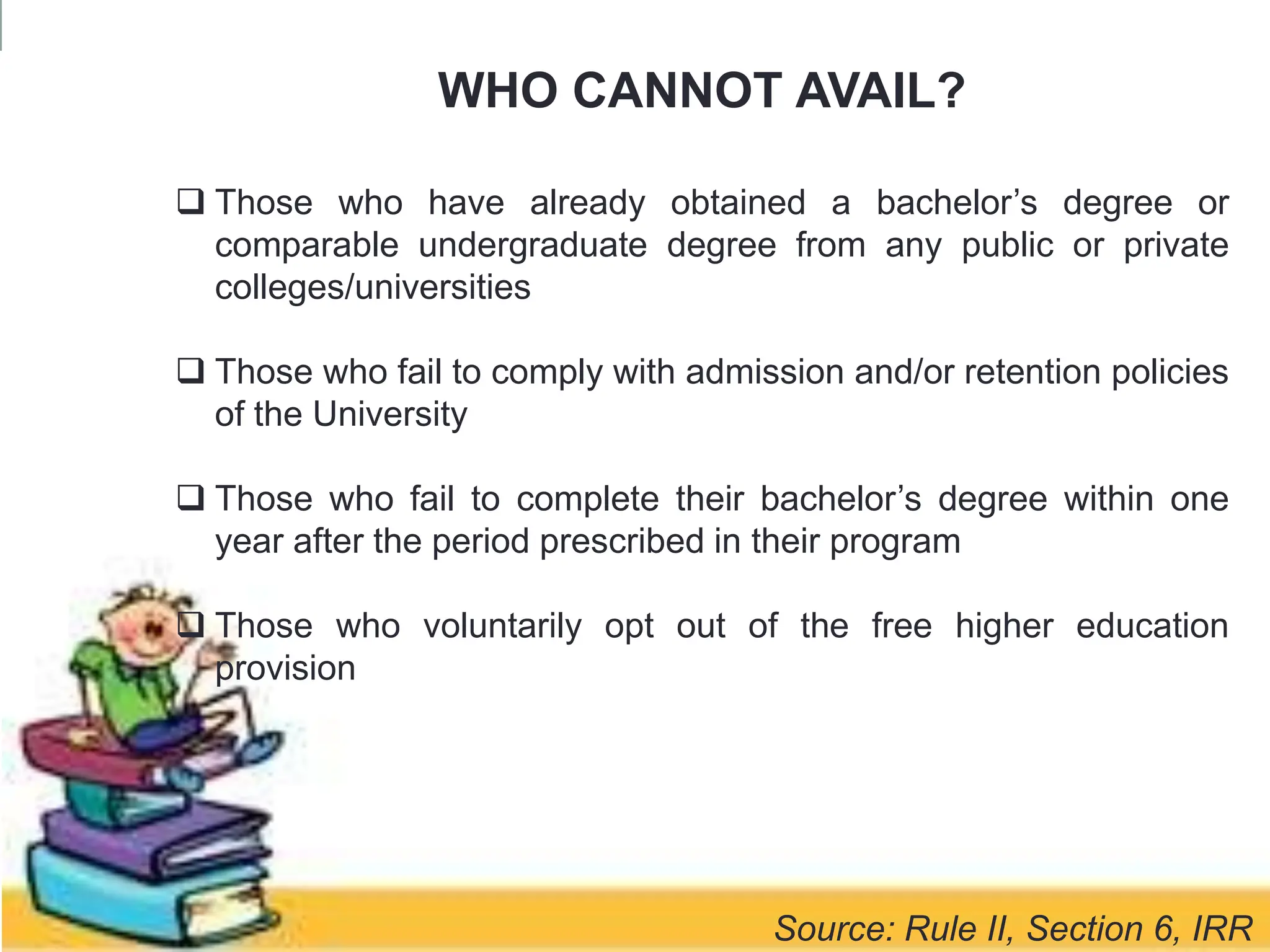
WHO CANNOT AVAIL?
 Those who have already obtained a bachelor’s degree or
comparable undergraduate degree from any public or private
colleges/universities
 Those who fail to comply with admission and/or retention policies
of the University
 Those who fail to complete their bachelor’s degree within one
year after the period prescribed in their program
 Those who voluntarily opt out of the free higher education
provision
Source: Rule II, Section 6, IRR
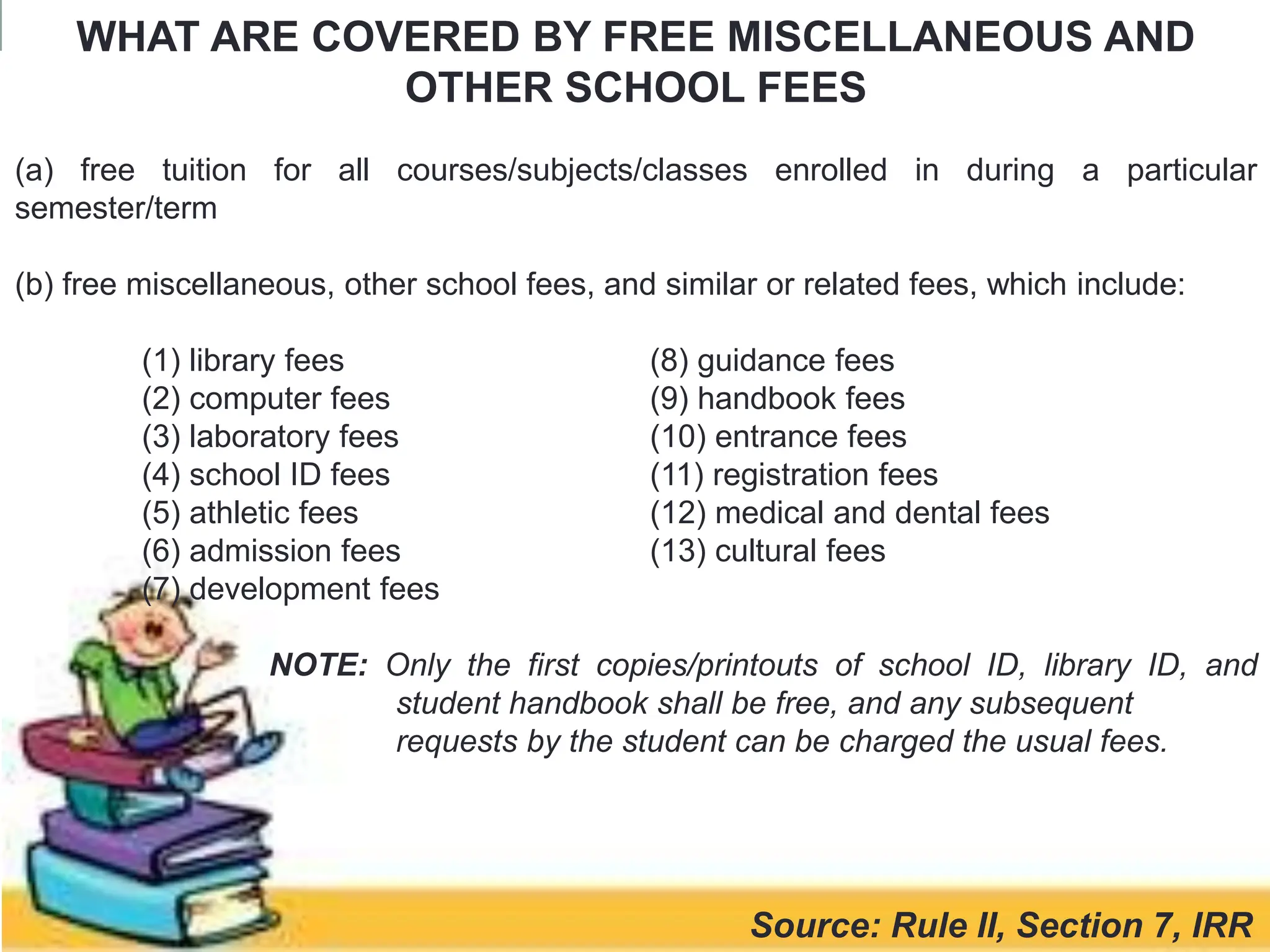
WHAT ARE COVERED BY FREE MISCELLANEOUS AND
OTHER SCHOOL FEES
(a) free tuition for all courses/subjects/classes enrolled in during a particular
semester/term
(b) free miscellaneous, other school fees, and similar or related fees, which include:
(1) library fees (8) guidance fees
(2) computer fees (9) handbook fees
(3) laboratory fees (10) entrance fees
(4) school ID fees (11) registration fees
(5) athletic fees (12) medical and dental fees
(6) admission fees (13) cultural fees
(7) development fees
NOTE: Only the first copies/printouts of school ID, library ID, and
student handbook shall be free, and any subsequent
requests by the student can be charged the usual fees.
Source: Rule II, Section 7, IRR
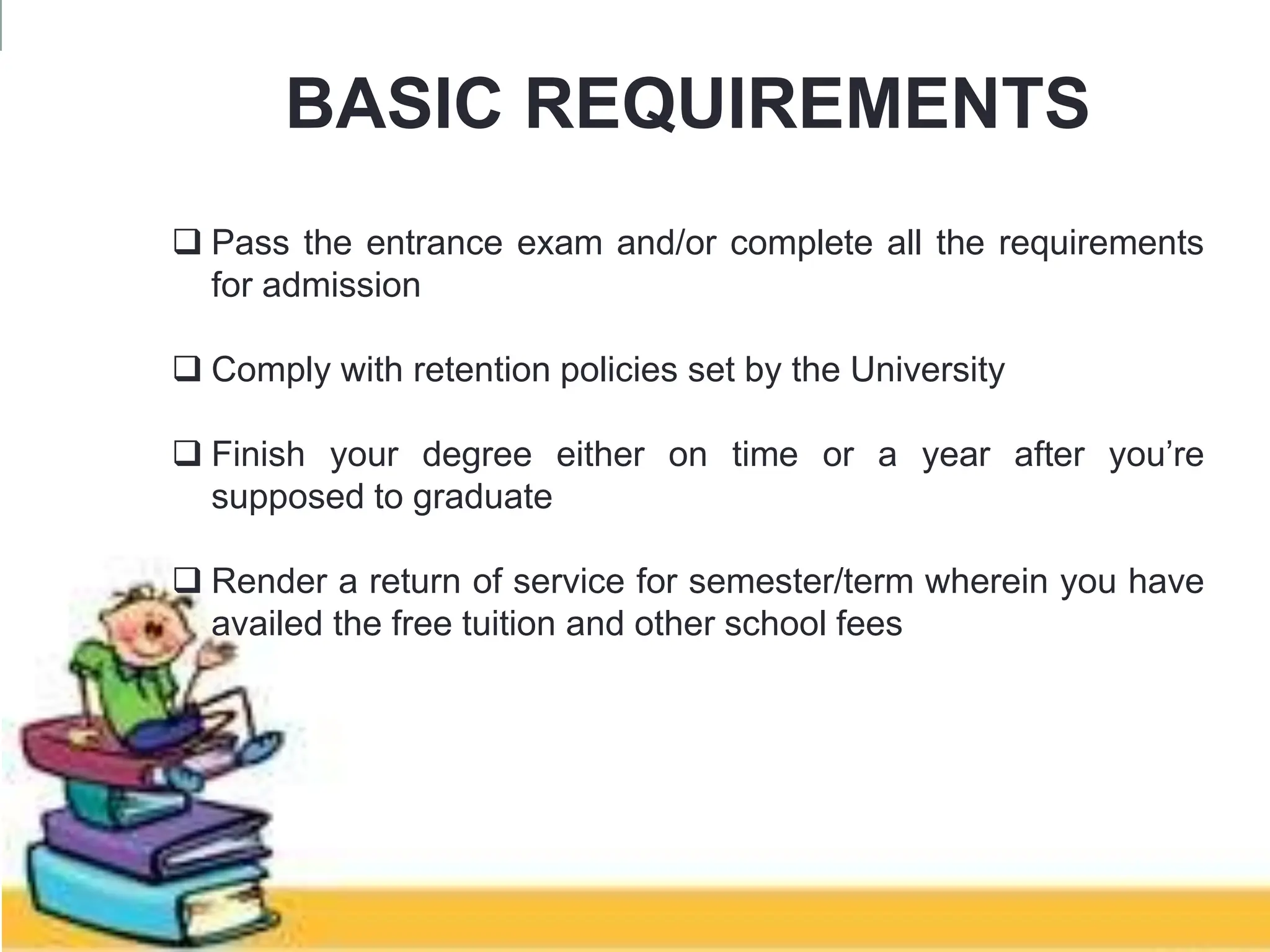
BASIC REQUIREMENTS
 Pass the entrance exam and/or complete all the requirements
for admission
 Comply with retention policies set by the University
 Finish your degree either on time or a year after you’re
supposed to graduate
 Render a return of service for semester/term wherein you have
availed the free tuition and other school fees
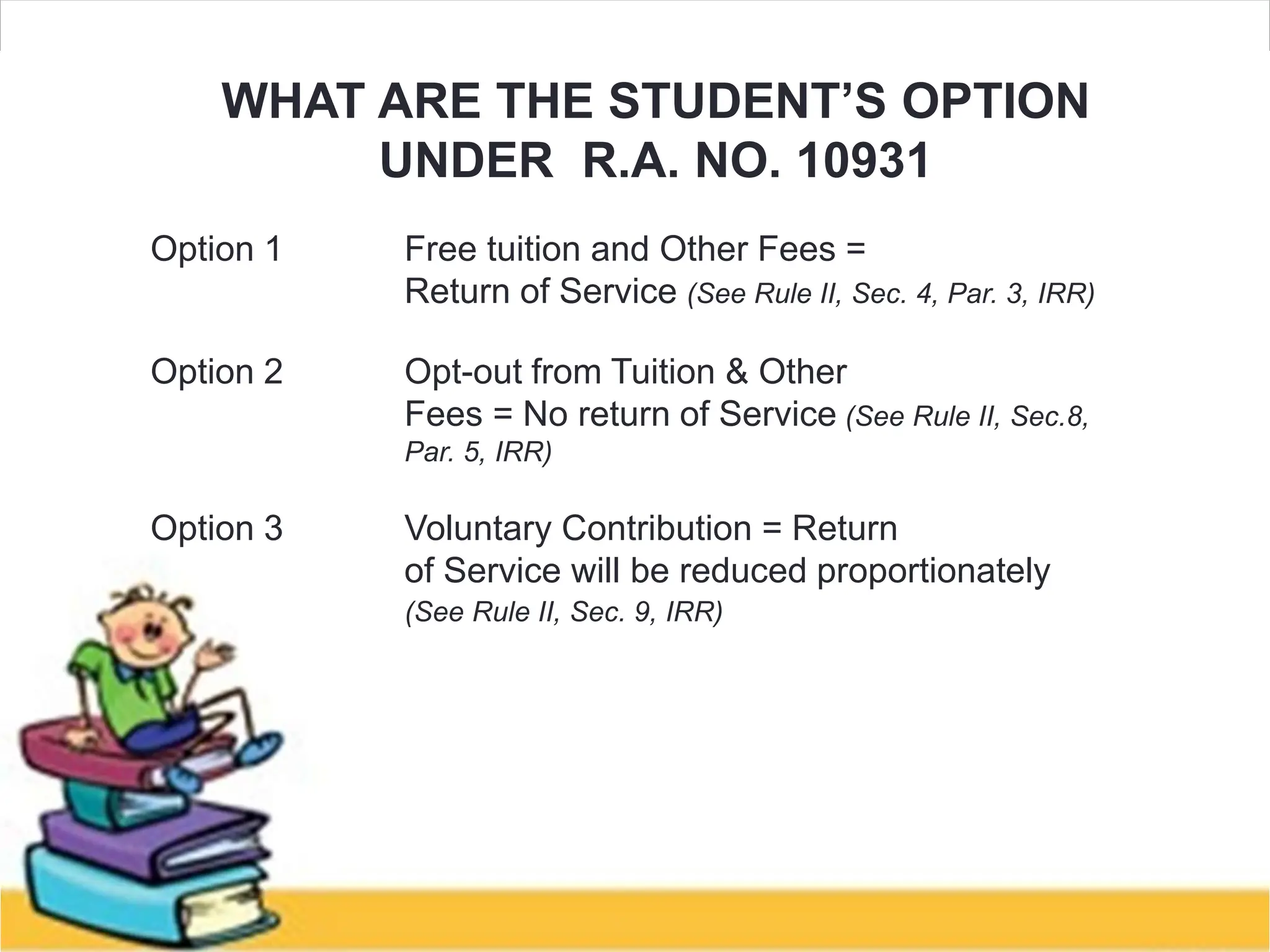
WHAT ARE THE STUDENT’S OPTION
UNDER R.A. NO. 10931
Option 1 Free tuition and Other Fees =
Return of Service (See Rule II, Sec. 4, Par. 3, IRR)
Option 2 Opt-out from Tuition & Other
Fees = No return of Service (See Rule II, Sec.8,
Par. 5, IRR)
Option 3 Voluntary Contribution = Return
of Service will be reduced proportionately
(See Rule II, Sec. 9, IRR)
FREE TVET
Date of Implementation: July 2018
BENEFITS
Free training and training-related expenses:
living allowance, starter toolkit, cost of
accreditation
2
WHO ARE COVERED?
All Filipino learners in a TESDA-registered
TVET program leading to a non-degree
certificate or diploma, including diploma
courses and bundled programs, and offered
by State-run TVIs, subject to
admission/retention policies of the institution
and existing residency rules of the STVIs
Source: Rule III, Section 13, IRR
WHO CANNOT AVAIL?
 Those who have obtained a bachelor’s degree;
 Those who are already holders of a certificate or diploma for a technical-
vocational course equivalent to National Certificate Level III or higher,
unless the trainee is enrolled in bundled courses or programs in Level IV
or Diploma;
 Those who fail in any public TVET course since the effectivity of the Act;
 Those enrolled in TVET programs not registered under TESDA; and
 Those who voluntarily opt out of the free TVET provision.
*Those who are not eligible to avail of the Free TVET
benefit shall be charged the training cost and other training-
related costs determined by TESDA based on the policy of
composite fees formulated by the UniFAST Board, subject
to the transitory provisions in Section 54 of the IRR.
Source: Rule III, Section 15, IRR
BENEFITS:
 consumables
 cost of utilities
 cost of facilities, equipment and tools maintenance
 honorarium of trainers
 living allowance
 miscellaneous fee
 National Competency Assessment fee
 instructional materials allowance
 starter toolkit
Source: Rule III, Section 16, IRR
TES
Date of Implementation: AY 2018-2019 onwards
BENEFITS
Tuition and other fees for private HEIs (TES1)
Other educational expenses (TES2)
Special expenses, if necessary (TES3)
3
WHO ARE COVERED?
(a) for Higher Education: first undergraduate post-secondary
programs offered in SUCs, LUCs, and private HEIs, subject to
prioritization and availability of funds
(b) for Technical-Vocational Education and Training: post-
secondary TVET programs registered under TESDA and offered
in all TESDA-recognized TVIs, subject to prioritization and
availability
of funds.
Source: Rule III, Section 22, IRR
WHO CANNOT AVAIL?
For Higher Education:
(1)students who did not qualify under the admission and
retention requirements of eligible SUCs, LUCs, and private
HEIs or under any other future qualification policies that the
UniFAST Board may mandate;
(2) students in eligible SUCs, LUCs, and private HEIs who have
exceeded the Maximum Residency Rule of their programs; and
(3) students enrolled in programs and/or in HEIs not included in
the Registry, subject to the transitory provisions in Section 57 of
the IRR.
Source: Rule III, Section 28, IRR
For Technical-Vocational Education and Training
(1) students enrolled in TESDA-registered programs in any TVI
who availed of government-funded StuFAPs other than the
Free TVET provision;
(2) students who did not undertake and/or qualify under the TVIs’
screening/assessment procedure, trade test, or skills
competency evaluation; and
(3) students enrolled in TVET programs not included in the
Registry, subject to the transitory provisions in Section 57 of
the IRR.
Source: Rule III, Section 28, IRR
Student Loans Program
Date of Implementation:
• Short-term Loans: AY 2018-2019 onwards
• Long-term Loans: AY 2019-2020
BENEFITS
Loan proceeds for educational purposes
4
WHO ARE COVERED?
All tertiary-level Filipino students
qualified/enrolled in programs/institutions in
the Registry
Source: Rule IV, Section 29, IRR
PROVIDERS:
To be administered by the UniFAST,
together with its implementation partners

RA 10931 AND ITS IMPLEMENTING RULES AND REGULATIONS

  • 1.
    R.A 10931 andIts Implementing Rules and Regulations R.A 10931 and Its Implementing Rules and Regulations
  • 2.
    1. Free education,free tuition and free miscellaneous fees to students in – A. state universities and colleges (SUCs B. CHED-accredited local universities and colleges (LUCs) 2. Free Technical and Vocational Education and Training (TVET) 3. Scholarship grants for students of both public and private college and universities. 4. A new and improved student loan program, where students can apply for financing for other education expenses. *Students taking post-graduate studies can also avail of the student loan program and scholarships under the law. WHAT THE LAW PROVIDES:
  • 3.
    FREE HIGHER EDUCATION Dateof Implementation: AY 2018-2019 onwards BENEFITS A)Free Tuition for all courses/subjects/classes B)Free miscellaneous, other school fees defined by law 1
  • 4.
    WHO ARE COVERED? AllFilipino students who are either currently enrolled or shall enroll at the State Universities and Local Colleges/Universities Source: Rule II, Section 4, IRR
  • 5.
    WHO CANNOT AVAIL? Those who have already obtained a bachelor’s degree or comparable undergraduate degree from any public or private colleges/universities  Those who fail to comply with admission and/or retention policies of the University  Those who fail to complete their bachelor’s degree within one year after the period prescribed in their program  Those who voluntarily opt out of the free higher education provision Source: Rule II, Section 6, IRR
  • 6.
    WHAT ARE COVEREDBY FREE MISCELLANEOUS AND OTHER SCHOOL FEES (a) free tuition for all courses/subjects/classes enrolled in during a particular semester/term (b) free miscellaneous, other school fees, and similar or related fees, which include: (1) library fees (8) guidance fees (2) computer fees (9) handbook fees (3) laboratory fees (10) entrance fees (4) school ID fees (11) registration fees (5) athletic fees (12) medical and dental fees (6) admission fees (13) cultural fees (7) development fees NOTE: Only the first copies/printouts of school ID, library ID, and student handbook shall be free, and any subsequent requests by the student can be charged the usual fees. Source: Rule II, Section 7, IRR
  • 7.
    BASIC REQUIREMENTS  Passthe entrance exam and/or complete all the requirements for admission  Comply with retention policies set by the University  Finish your degree either on time or a year after you’re supposed to graduate  Render a return of service for semester/term wherein you have availed the free tuition and other school fees
  • 8.
    WHAT ARE THESTUDENT’S OPTION UNDER R.A. NO. 10931 Option 1 Free tuition and Other Fees = Return of Service (See Rule II, Sec. 4, Par. 3, IRR) Option 2 Opt-out from Tuition & Other Fees = No return of Service (See Rule II, Sec.8, Par. 5, IRR) Option 3 Voluntary Contribution = Return of Service will be reduced proportionately (See Rule II, Sec. 9, IRR)
  • 9.
    FREE TVET Date ofImplementation: July 2018 BENEFITS Free training and training-related expenses: living allowance, starter toolkit, cost of accreditation 2
  • 10.
    WHO ARE COVERED? AllFilipino learners in a TESDA-registered TVET program leading to a non-degree certificate or diploma, including diploma courses and bundled programs, and offered by State-run TVIs, subject to admission/retention policies of the institution and existing residency rules of the STVIs Source: Rule III, Section 13, IRR
  • 11.
    WHO CANNOT AVAIL? Those who have obtained a bachelor’s degree;  Those who are already holders of a certificate or diploma for a technical- vocational course equivalent to National Certificate Level III or higher, unless the trainee is enrolled in bundled courses or programs in Level IV or Diploma;  Those who fail in any public TVET course since the effectivity of the Act;  Those enrolled in TVET programs not registered under TESDA; and  Those who voluntarily opt out of the free TVET provision. *Those who are not eligible to avail of the Free TVET benefit shall be charged the training cost and other training- related costs determined by TESDA based on the policy of composite fees formulated by the UniFAST Board, subject to the transitory provisions in Section 54 of the IRR. Source: Rule III, Section 15, IRR
  • 12.
    BENEFITS:  consumables  costof utilities  cost of facilities, equipment and tools maintenance  honorarium of trainers  living allowance  miscellaneous fee  National Competency Assessment fee  instructional materials allowance  starter toolkit Source: Rule III, Section 16, IRR
  • 13.
    TES Date of Implementation:AY 2018-2019 onwards BENEFITS Tuition and other fees for private HEIs (TES1) Other educational expenses (TES2) Special expenses, if necessary (TES3) 3
  • 14.
    WHO ARE COVERED? (a)for Higher Education: first undergraduate post-secondary programs offered in SUCs, LUCs, and private HEIs, subject to prioritization and availability of funds (b) for Technical-Vocational Education and Training: post- secondary TVET programs registered under TESDA and offered in all TESDA-recognized TVIs, subject to prioritization and availability of funds. Source: Rule III, Section 22, IRR
  • 15.
    WHO CANNOT AVAIL? ForHigher Education: (1)students who did not qualify under the admission and retention requirements of eligible SUCs, LUCs, and private HEIs or under any other future qualification policies that the UniFAST Board may mandate; (2) students in eligible SUCs, LUCs, and private HEIs who have exceeded the Maximum Residency Rule of their programs; and (3) students enrolled in programs and/or in HEIs not included in the Registry, subject to the transitory provisions in Section 57 of the IRR. Source: Rule III, Section 28, IRR
  • 16.
    For Technical-Vocational Educationand Training (1) students enrolled in TESDA-registered programs in any TVI who availed of government-funded StuFAPs other than the Free TVET provision; (2) students who did not undertake and/or qualify under the TVIs’ screening/assessment procedure, trade test, or skills competency evaluation; and (3) students enrolled in TVET programs not included in the Registry, subject to the transitory provisions in Section 57 of the IRR. Source: Rule III, Section 28, IRR
  • 17.
    Student Loans Program Dateof Implementation: • Short-term Loans: AY 2018-2019 onwards • Long-term Loans: AY 2019-2020 BENEFITS Loan proceeds for educational purposes 4
  • 18.
    WHO ARE COVERED? Alltertiary-level Filipino students qualified/enrolled in programs/institutions in the Registry Source: Rule IV, Section 29, IRR
  • 19.
    PROVIDERS: To be administeredby the UniFAST, together with its implementation partners