THE   OREGON
Rain Garden Guide
A STEP-BY-STEP GUIDE TO
Landscaping FOR Clean Water AND Healthy Streams
The Oregon Rain Garden Guide:
                         Landscaping for Clean Water and Healthy Streams

                         Text by Robert Emanuel and Derek Godwin, Oregon Sea Grant Extension, Oregon State University (OSU);
                         and Candace Stoughton, East Multnomah Soil and Water Conservation District.

                         Sample rain garden layouts by Heidi Brill. Plant list compiled and edited by Teresa Huntsinger, Oregon Environmental
                         Council. Other significant contributors include Angela Boudro, Jackson Soil and Water Conservation District; Linda
                         McMahan, OSU Extension Service, Yamhill County; Joy Jones, OSU Extension Service, Tillamook County; and Neil
                         Bell, OSU Extension Service, Marion County. Editing by Rick Cooper, graphic design by Patricia Andersson, Oregon Sea
                         Grant, OSU.

                         Cover artwork: “Rain Garden” painted by John C. Pitcher © Good Nature Publishing 2009.
                         www.goodnaturepublishing.com 800-631-3086

                         This project has been funded in part by the United States Environmental Protection Agency under assistance agree-
                         ment CP-0045105 to the Oregon Department of Environmental Quality. The contents of this document do not
                         necessarily reflect the views and policies of the Environmental Protection Agency, nor does mention of trade names
                         or commercial products constitute endorsement or recommendation for use.

                         Many thanks to those who reviewed this document, plant lists, and sample planting designs for accuracy and appro-
                         priateness. Special thanks to those who made contributions of photos or text.

                         © 2010 by Oregon State University. This publication may be photocopied or reprinted in its entirety for noncom-
                         mercial purposes. To order additional copies of this publication, call 541-737-4849. This publication is available in an
                         accessible format on our Web site at http://seagrant.oregonstate.edu/sgpubs/onlinepubs.html

                         For a complete list of Oregon Sea Grant publications, visit http://seagrant.oregonstate.edu/sgpubs

                         This report was prepared by Oregon Sea Grant under award number NA06OAR4170010 (project number E/BET-02-
                         PD) from the National Oceanic and Atmospheric Administration’s National Sea Grant College Program, U.S. Depart-
                         ment of Commerce, and by appropriations made by the Oregon State legislature. The statements, findings, conclu-
                         sions, and recommendations are those of the authors and do not necessarily reflect the views of these funders.


                         The production of this guide was part of Stormwater Solutions,
                         a collective public education effort involving several partners.
                         Partners responsible for the production of this guide include
                         the following:


Oregon Sea Grant, Corvallis, Oregon ORESU-H-10-001
2                                                                    The Oregon Rain Garden Guide: Landscaping for Clean Water and Healthy Streams
Contents


                              Introduction . . . . . . . . . . . . . . . . . . . . . . . . . . . . . . . . . . . . . . . . . . . . . . . . . . . . . . 4
                                  The purpose of this guide . . . . . . . . . . . . . . . . . . . . . . . . . . . . . . . . . . . . . . . . . 4
                                  What is a rain garden? . . . . . . . . . . . . . . . . . . . . . . . . . . . . . . . . . . . . . . . . . . . . 4
                                  Why build a rain garden? . . . . . . . . . . . . . . . . . . . . . . . . . . . . . . . . . . . . . . . . . . .5
                              Building a Rain Garden: A Step-by-Step Approach . . . . . . . . . . . . . . . . . . . . 6
                                  STEP 1: Observe and map your site . . . . . . . . . . . . . . . . . . . . . . . . . . . . . . . . 6
                                     Determine how much area the rain garden will treat. . . . . . . . . . . . . . . . . 6
                                  STEP 2: Determine the location of the rain garden . . . . . . . . . . . . . . . . . . .                             6
                                     Go with the flow . . . . . . . . . . . . . . . . . . . . . . . . . . . . . . . . . . . . . . . . . . . . . .     6
                                     Respect the flow . . . . . . . . . . . . . . . . . . . . . . . . . . . . . . . . . . . . . . . . . . . . . .     7
                                     Divert the flow . . . . . . . . . . . . . . . . . . . . . . . . . . . . . . . . . . . . . . . . . . . . . . .    7
                                     Regulations, permits, and design modifications . . . . . . . . . . . . . . . . . . . .                           8
                                     Measure the slope . . . . . . . . . . . . . . . . . . . . . . . . . . . . . . . . . . . . . . . . . . . .        8
                                  STEP 3: Assess soil . . . . . . . . . . . . . . . . . . . . . . . . . . . . . . . . . . . . . . . . . . . . . . 9
                                     Testing infiltration . . . . . . . . . . . . . . . . . . . . . . . . . . . . . . . . . . . . . . . . . . . . . 9
                                     Determining soil texture . . . . . . . . . . . . . . . . . . . . . . . . . . . . . . . . . . . . . . 10
                                     Interpreting the infiltration test . . . . . . . . . . . . . . . . . . . . . . . . . . . . . . . . . . 11
                                  STEP 4: Determine the size of the rain garden . . . . . . . . . . . . . . . . . . . . . . . 11
                                     Rain garden depth . . . . . . . . . . . . . . . . . . . . . . . . . . . . . . . . . . . . . . . . . . . .12
                                     Dig safely! . . . . . . . . . . . . . . . . . . . . . . . . . . . . . . . . . . . . . . . . . . . . . . . . . . . 13
                                     Delineate the rain garden . . . . . . . . . . . . . . . . . . . . . . . . . . . . . . . . . . . . . . . 13
                                     Getting water to the rain garden . . . . . . . . . . . . . . . . . . . . . . . . . . . . . . . . . 13
                                     Disconnecting downspouts . . . . . . . . . . . . . . . . . . . . . . . . . . . . . . . . . . . . . 15
                                     Designing for overflow . . . . . . . . . . . . . . . . . . . . . . . . . . . . . . . . . . . . . . . . 16
                                     Keys to success . . . . . . . . . . . . . . . . . . . . . . . . . . . . . . . . . . . . . . . . . . . . . . .17
                                  STEP 5: Constructing a rain garden . . . . . . . . . . . . . . . . . . . . . . . . . . . . . . . .17
                                     Excavating, grading, and berms. . . . . . . . . . . . . . . . . . . . . . . . . . . . . . . . . .17
                                     Grading . . . . . . . . . . . . . . . . . . . . . . . . . . . . . . . . . . . . . . . . . . . . . . . . . . . . .18
                                     Plumbing the rain garden. . . . . . . . . . . . . . . . . . . . . . . . . . . . . . . . . . . . . . .18
                                     To amend or not to amend? . . . . . . . . . . . . . . . . . . . . . . . . . . . . . . . . . . . .19
                                  STEP 6: Choose the “right plant for the right place” . . . . . . . . . . . . . . . . . 20
                                     Planting zones and plant selection . . . . . . . . . . . . . . . . . . . . . . . . . . . . . . 20
                                     Compost . . . . . . . . . . . . . . . . . . . . . . . . . . . . . . . . . . . . . . . . . . . . . . . . . . . 20
                                     Key plant characteristics . . . . . . . . . . . . . . . . . . . . . . . . . . . . . . . . . . . . . . 22
                                     Planting tips . . . . . . . . . . . . . . . . . . . . . . . . . . . . . . . . . . . . . . . . . . . . . . . . 22
                                     A note about invasive species . . . . . . . . . . . . . . . . . . . . . . . . . . . . . . . . . . 22
                                     Mulching . . . . . . . . . . . . . . . . . . . . . . . . . . . . . . . . . . . . . . . . . . . . . . . . . . . .23
                                     Watering a rain garden . . . . . . . . . . . . . . . . . . . . . . . . . . . . . . . . . . . . . . . . 24
                                  STEP 7: Maintenance . . . . . . . . . . . . . . . . . . . . . . . . . . . . . . . . . . . . . . . . . . . 24
                                     Weeding, pruning, and mulching . . . . . . . . . . . . . . . . . . . . . . . . . . . . . . . 24
                                     Don’t drown your plants! . . . . . . . . . . . . . . . . . . . . . . . . . . . . . . . . . . . . . 26
                                  A note about Oregon’s regions . . . . . . . . . . . . . . . . . . . . . . . . . . . . . . . . . . . 26
                              Sample Rain Garden Layouts . . . . . . . . . . . . . . . . . . . . . . . . . . . . . . . . . . . . . . 28
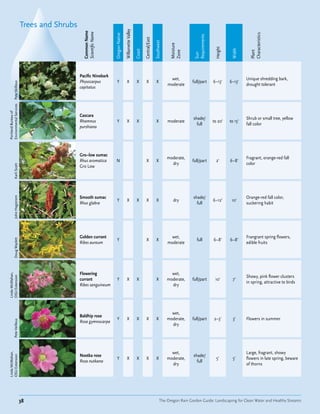
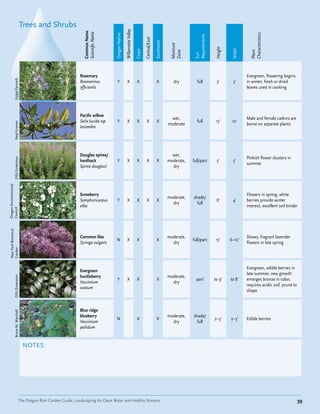
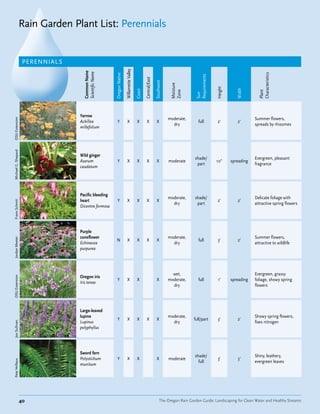
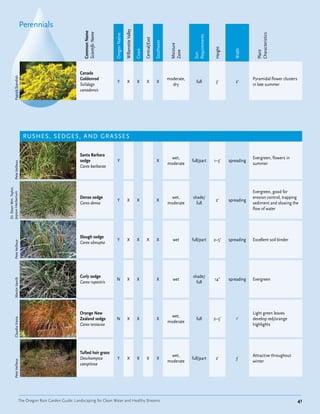
                              Rain Garden Plant List . . . . . . . . . . . . . . . . . . . . . . . . . . . . . . . . . . . . . . . . . . . . 36
                                  For more information . . . . . . . . . . . . . . . . . . . . . . . . . . . . . . . . . . . . . . . . . . . 43

The Oregon Rain Garden Guide: Landscaping for Clean Water and Healthy Streams                                                                               3
Introduction


                                  The purpose of this guide                                  What is a rain garden?
                                  The Oregon Rain Garden Guide was written to help           A rain garden is a sunken, generally flat-bottomed
                                  Oregonians learn how to design and build rain gar-         garden bed that collects and treats stormwater
                                  dens to treat the stormwater runoff from their own         runoff from rooftops, driveways, sidewalks, parking
                                  homes or businesses. Rain gardens are “gardens             lots, and streets. Rain gardens help mimic natural
                                  with a purpose”; they help reduce the amount of ex-        forest, meadow, or prairie conditions by infiltrat-
                                  cess water and associated pollutants reaching local        ing stormwater from hard surfaces. A variety of
                                  lakes, streams, and bays. Ultimately this results in       planting plans are included in this manual for your
                                  healthier waterways, fish, other wildlife, and people.     reference.

                                  This how-to guide provides information specific            Rain gardens keep our watersheds healthy by…
                                  to Oregon’s conditions, including the rainfall and
                                  appropriate plants for your site. You don’t have to        ■   reducing flooding by absorbing rain water from
                                  be a stormwater, garden, or landscape professional             hard surfaces
                                  to use this guide. It provides the necessary infor-        ■   filtering oil, grease, and toxic materials before
                                  mation to safely build and maintain a rain garden,             they can pollute streams, lakes, and bays
                                  along with references for more detailed guidance           ■   recharging groundwater aquifers by allowing
                                  for special conditions. You may also contact the               water to soak into the ground
                                  authors and partners directly for more information.
                                                                                             ■   providing beneficial wildlife habitat


Figure 1: Cross-section of a
typical rain garden.
(Graphic by East Multnomah Soil
and Water Conservation District
[EMSWCD])


                                     RAIN GARDEN DICTIONARY:
                                     Impervious surfaces are areas that do not allow rain or snowmelt to infiltrate or soak into the soil
                                     below the surface (for example, roofs, driveways, roads, sidewalks, and patios). Some ground areas
                                     that have been severely compacted from heavy equipment or foot traffic may also be considered
                                     impervious if most of the water runs off the surface when it rains.


4                                                                          The Oregon Rain Garden Guide: Landscaping for Clean Water and Healthy Streams
Why build a rain garden?
When the Pacific Northwest was covered with
forests and prairies, rainfall slowly dripped through
branches and vegetation, seeped through duff,
and sank into the ground as it slowly percolated to
nearby water bodies. As parts of our landscapes


                                                                                    Robert Emanuel, OSU
became more developed, the rainfall that lands on
hard surfaces was routed into pipes, ditches, and
storm drains. Much of that runoff is routed directly
to streams or into the sewer system. The result?
Too much water flowing in a short amount of
time, carrying pollutants that negatively affect the
health of our streams, lakes, and estuaries. Today,
managing stormwater runoff by infiltrating it into
the ground is one of the simplest ways to actively
protect our streams. Rain gardens help us restore
the natural water cycle in the landscape, which is
critical to ensure healthy streams in both small
towns and large cities.


  Do rain gardens attract or breed
  mosquitoes?
  No. For reproduction, mosquito larvae require


                                                                                    Candace Stoughton, EMSWCD
  a number of days in standing water. Most
  urban mosquitoes breed in places like junk
  piles where there are old tires or tin cans. In a
  well-designed rain garden, water is rarely stand-
  ing long enough for mosquito reproduction.
  Ideally, a rain garden should drain so that water
  won’t be standing in it for more than 48 hours.
  For more information, see “Mosquitoes” at
  entomology.oregonstate.edu/urbanent/.


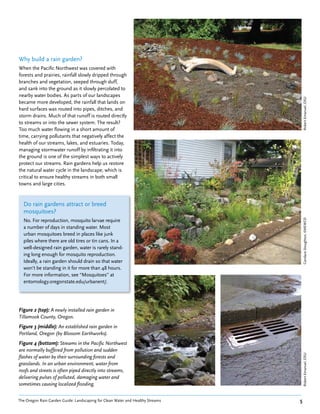
Figure 2 (top): A newly installed rain garden in
Tillamook County, Oregon.
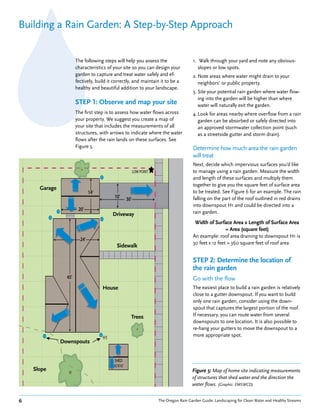
Figure 3 (middle): An established rain garden in
Portland, Oregon (by Blossom Earthworks).
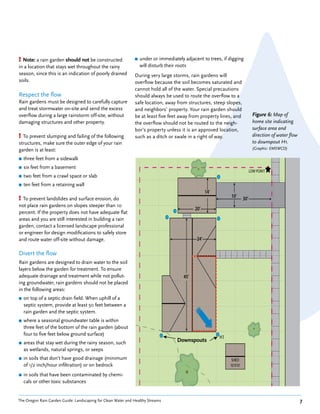
Figure 4 (bottom): Streams in the Pacific Northwest
are normally buffered from pollution and sudden
                                                                                    Robert Emanuel, OSU


flashes of water by their surrounding forests and
grasslands. In an urban environment, water from
roofs and streets is often piped directly into streams,
delivering pulses of polluted, damaging water and
sometimes causing localized flooding.


The Oregon Rain Garden Guide: Landscaping for Clean Water and Healthy Streams   5
Building a Rain Garden: A Step-by-Step Approach


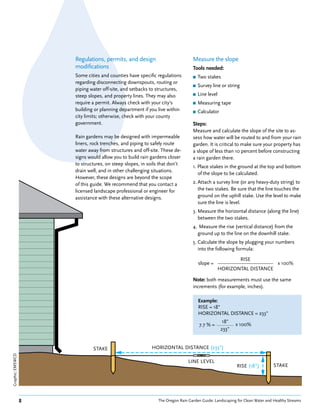
                                 The following steps will help you assess the                            1. Walk through your yard and note any obvious-
                                 characteristics of your site so you can design your                        slopes or low spots.
                                 garden to capture and treat water safely and ef-                        2. Note areas where water might drain to your
                                 fectively, build it correctly, and maintain it to be a                     neighbors’ or public property.
                                 healthy and beautiful addition to your landscape.
                                                                                                         3. Site your potential rain garden where water flow-
                                                                                                            ing into the garden will be higher than where
                                 STEP 1: Observe and map your site                                          water will naturally exit the garden.
                                 The first step is to assess how water flows across                      4. Look for areas nearby where overflow from a rain
                                 your property. We suggest you create a map of                              garden can be absorbed or safely directed into
                                 your site that includes the measurements of all                            an approved stormwater collection point (such
                                 structures, with arrows to indicate where the water                        as a streetside gutter and storm drain).
                                 flows after the rain lands on these surfaces. See
                                 Figure 5.                                                               Determine how much area the rain garden
                                                                                                         will treat
                                                                                                         Next, decide which impervious surfaces you’d like
                                                                           LOW POINT
                                                                           LOW O NT
                                                                            O
                                                                            OW     T                     to manage using a rain garden. Measure the width
                                                                                                         and length of these surfaces and multiply them
                      
                                                                                  together to give you the square feet of surface area
      Garage                                                           

                                            14’
                                            14
                                             4’                                                          to be treated. See Figure 6 for an example. The rain
                                                           10’
                                                           10
                                                            0        30’
                                                                     30                                  falling on the part of the roof outlined in red drains
                                                                                                         into downspout H1 and could be directed into a
                                     20
                                     20’
                                                           Driveway                                      rain garden.
                                 
                                                                        Width of Surface Area x Length of Surface Area
                 
                                                                                                        = Area (square feet)
                                                                                                         An example: roof area draining to downspout H1 is
                                      24’
                                      24
                                      24
                                       4’
                                                                                                         30 feet x 12 feet = 360 square feet of roof area
                                                             Sidewalk

                                                                                                         STEP 2: Determine the location of
                                                                                                         the rain garden
                          45’’
                          45
                          45                                                                             Go with the flow


                                                  House                                                  The easiest place to build a rain garden is relatively
                                                                                                         close to a gutter downspout. If you want to build
                                                                                                         only one rain garden, consider using the down-
                                                                                                         spout that captures the largest portion of the roof.
             
                                                                                           If necessary, you can route water from several
                                                                       Trees
                                                                                                         downspouts to one location. It is also possible to
                                                                                                         re-hang your gutters to move the downspout to a
                                                  H1
                                                  H1                                                     more appropriate spot.
         
           Downspouts
                                                       

                                                            SHED
                                                            SHED
                                                             HD
                                                             HED
                                                           10’X10’
                                                           10 X10
                                                              X10
    Slope                                                                                                Figure 5: Map of home site indicating measurements
                                                                                                         of structures that shed water and the direction the
                                                                                                         water flows. (Graphic: EMSWCD)


6                                                                                      The Oregon Rain Garden Guide: Landscaping for Clean Water and Healthy Streams
         E
      OP
! Note: a rain garden should not be constructed               ■   under or immediately adjacent to trees, if digging
in a location that stays wet throughout the rainy                 will disturb their roots
season, since this is an indication of poorly drained         During very large storms, rain gardens will
soils.                                                        overflow because the soil becomes saturated and
                                                              cannot hold all of the water. Special precautions
Respect the flow                                              should always be used to route the overflow to a
Rain gardens must be designed to carefully capture            safe location, away from structures, steep slopes,
and treat stormwater on-site and send the excess              and neighbors’ property. Your rain garden should
overflow during a large rainstorm off-site, without           be at least five feet away from property lines, and                     Figure 6: Map of
damaging structures and other property.                       the overflow should not be routed to the neigh-                         home site indicating
                                                              bor’s property unless it is an approved location,                       surface area and
! To prevent slumping and failing of the following            such as a ditch or swale in a right of way.                             direction of water flow
structures, make sure the outer edge of your rain                                                                                     to downspout H1.
garden is at least:                                                                                                                   (Graphic: EMSWCD)

■   three feet from a sidewalk
■   six feet from a basement
                                                                                                                                    LOW POINT
                                                                                                                                    LOW O NT
                                                                                                                                     O
                                                                                                                                     OW     T
■   two feet from a crawl space or slab
■   ten feet from a retaining wall
                                                                                                         14’
                                                                                                         14
                                                                                                          4’
! To prevent landslides and surface erosion, do                                                                     10’
                                                                                                                    10
                                                                                                                     0        30’
                                                                                                                              30
not place rain gardens on slopes steeper than 10
                                                                                                  20
                                                                                                  20’
percent. If the property does not have adequate flat
areas and you are still interested in building a rain
garden, contact a licensed landscape professional
or engineer for design modifications to safely store
and route water off-site without damage.                                                           24’
                                                                                                   24
                                                                                                   24
                                                                                                    4’

Divert the flow
Rain gardens are designed to drain water to the soil                                          

layers below the garden for treatment. To ensure
adequate drainage and treatment while not pollut-                                      45’’
                                                                                       45
                                                                                       45
ing groundwater, rain gardens should not be placed
in the following areas:
■   on top of a septic drain field. When uphill of a
    septic system, provide at least 50 feet between a
    rain garden and the septic system.
■   where a seasonal groundwater table is within
    three feet of the bottom of the rain garden (about
    four to five feet below ground surface)
                                                                                
                              H1
                                                                                                               H1
■   areas that stay wet during the rainy season, such                               Downspouts
    as wetlands, natural springs, or seeps
■   in soils that don’t have good drainage (minimum                                                                  SHED
                                                                                                                     SHED
                                                                                                                      HD
                                                                                                                      HED
    of 1/2 inch/hour infiltration) or on bedrock                                                                    10’X10’
                                                                                                                    10 X10
                                                                                                                       X10

■   in soils that have been contaminated by chemi-
    cals or other toxic substances


The Oregon Rain Garden Guide: Landscaping for Clean Water and Healthy Streams                                                                                   7
                                                                             E
                                                                         LOP
Regulations, permits, and design                         Measure the slope
                      modifications                                            Tools needed:
                      Some cities and counties have specific regulations       ■   Two stakes
                      regarding disconnecting downspouts, routing or
                                                                               ■   Survey line or string
                      piping water off-site, and setbacks to structures,
                      steep slopes, and property lines. They may also          ■   Line level
                      require a permit. Always check with your city’s          ■   Measuring tape
                      building or planning department if you live within       ■   Calculator
                      city limits; otherwise, check with your county
                      government.                                              Steps:
                                                                               Measure and calculate the slope of the site to as-
                      Rain gardens may be designed with impermeable            sess how water will be routed to and from your rain
                      liners, rock trenches, and piping to safely route        garden. It is critical to make sure your property has
                      water away from structures and off-site. These de-       a slope of less than 10 percent before constructing
                      signs would allow you to build rain gardens closer       a rain garden there.
                      to structures, on steep slopes, in soils that don’t
                                                                               1. Place stakes in the ground at the top and bottom
                      drain well, and in other challenging situations.
                                                                                  of the slope to be calculated.
                      However, these designs are beyond the scope
                      of this guide. We recommend that you contact a           2. Attach a survey line (or any heavy-duty string) to
                      licensed landscape professional or engineer for             the two stakes. Be sure that the line touches the
                      assistance with these alternative designs.                  ground on the uphill stake. Use the level to make
                                                                                  sure the line is level.
                                                                               3. Measure the horizontal distance (along the line)
                                                                                  between the two stakes.
                                                                               4. Measure the rise (vertical distance) from the
                                                                                 ground up to the line on the downhill stake.
                                                                               5. Calculate the slope by plugging your numbers
                                                                                  into the following formula:
                                                                                                           RISE
                                                                                   slope =                                   x 100%
                                                                                                HORIZONTAL DISTANCE

                                                                               Note: both measurements must use the same
                                                                               increments (for example, inches).

                                                                                   Example:
                                                                                   RISE = 18"
                                                                                   HORIZONTAL DISTANCE = 233"
                                                                                                 18"
                                                                                   7.7 % =             x 100%
                                                                                                233"


                              STAKE                       HORIZONTAL DISTANCE (233”)
Graphic: EMSWCD


                                                                             LINE LEVEL
                                                                                                       RISE (18”)          STAKE


                  8                                          The Oregon Rain Garden Guide: Landscaping for Clean Water and Healthy Streams
STEP 3: Assess soil
The ability of soil to drain water is one of the most
important considerations for understanding the
site and properly sizing a rain garden. An infiltration
and texture test will help you determine the soil’s
capacity to absorb and percolate water down into
the lower layers.

Testing infiltration
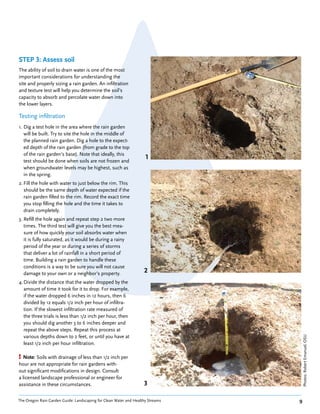
1. Dig a test hole in the area where the rain garden
   will be built. Try to site the hole in the middle of
   the planned rain garden. Dig a hole to the expect-
   ed depth of the rain garden (from grade to the top
   of the rain garden’s base). Note that ideally, this
                                                                    1
   test should be done when soils are not frozen and
   when groundwater levels may be highest, such as
   in the spring.
2. Fill the hole with water to just below the rim. This
   should be the same depth of water expected if the
   rain garden filled to the rim. Record the exact time
   you stop filling the hole and the time it takes to
   drain completely.
3. Refill the hole again and repeat step 2 two more
   times. The third test will give you the best mea-
   sure of how quickly your soil absorbs water when
   it is fully saturated, as it would be during a rainy
   period of the year or during a series of storms
   that deliver a lot of rainfall in a short period of
   time. Building a rain garden to handle these
   conditions is a way to be sure you will not cause
   damage to your own or a neighbor’s property.                    2
4. Divide the distance that the water dropped by the
   amount of time it took for it to drop. For example,
   if the water dropped 6 inches in 12 hours, then 6
   divided by 12 equals 1/2 inch per hour of infiltra-
   tion. If the slowest infiltration rate measured of
   the three trials is less than 1/2 inch per hour, then
   you should dig another 3 to 6 inches deeper and
   repeat the above steps. Repeat this process at
   various depths down to 2 feet, or until you have at
                                                                                    Photos: Robert Emanuel, OSU


   least 1/2 inch per hour infiltration.

! Note: Soils with drainage of less than 1/2 inch per
hour are not appropriate for rain gardens with-
out significant modifications in design. Consult
a licensed landscape professional or engineer for
assistance in these circumstances.                                 3

The Oregon Rain Garden Guide: Landscaping for Clean Water and Healthy Streams   9
Determining soil texture
                                                                                           1. Take a handful of the soil you have excavated
                                                                                              from your infiltration test. Pulverize it in your
                                                                                              hand and remove any bits of organic matter or
                                                                                              obvious rocks.
                                                                                           2. Wet it with a small amount of water and rub it
                                                                                              between your thumb and index finger. Don’t
                                                                                              saturate it until it is runny mud. You might feel
                                                                                              stickiness, grittiness, or smoothness. The grittier
                                                                                              the feel, the more sand is present in your soil.
                                                                                              The slicker the soil, the more clay in it. Smooth
Figure 7a: Conducting a soil feel test by making a ball with the moistened soil, to
                                                                                              soils are sometimes an indicator of a fine silt or
see how easily it falls apart as well as what texture it has (sticky, silky, or gritty).
                                                                                              loam. Discard the soil.
(Photo: Gina Emanuel)
                                                                                           3. Next, take another sample in your hand. Wet it
                                                                                              until it has the consistency of dough. You should
                                                                                              be able to form a ball that holds together with
                                                                                              the soil in your palm. If you cannot get the ball to
                                                                                              form, then your soil is very sandy. In most soils,
                                                                                              however, you should be able to create a rough
                                                                                              ball.
                                                                                           4. Knead the soil together between your thumb and
                                                                                              fingers and attempt to form a ribbon. As you
                                                                                              build the ribbon, it will either hold together or
                                                                                              break off. If the soil breaks quickly in the process,
                                                                                              then it likely has a high sand content. If the rib-
                                                                                              bon forms quickly and stays strong, it has more
                                                                                              clay.

                                                                                           ■   If the soil forms a ribbon less than 1 inch in
                                                                                               length before it breaks, the soil is sandy or silty.
                                                                                           ■   If the soil makes a ribbon 1 to 2 inches in length
Figure 7b: Using a soil ribbon to test soil for clay, loam, or sand content. The               before it breaks, the soil is clayey.
longer and firmer the ribbon, the more clay content in the soil. (Photo: Gina Emanuel)     ■   If the soil makes a ribbon greater than 2 inches
                                                                                               before it breaks, it may not be suitable for a rain
                                                                                               garden constructed without professional help,
                                                                                               depending on how fast the soil drains during the
                                                                                               infiltration test.


10                                                                        The Oregon Rain Garden Guide: Landscaping for Clean Water and Healthy Streams
Interpreting the infiltration test

  Drainage rate                             Recommendation

  Less than 1/2 inch per hour               Do not build a rain garden on this site without professional
                                            assistance.

                                            Low infiltration for a rain garden. Homeowners may want to build
  Between 1/2 and 1 inch/hour
                                            a larger or deeper garden, or likewise plan for additional overflow
                                            during high-rainfall storms.

                                            Adequate infiltration for a rain garden. Plan for sufficient overflow
  Between 1 and 1 1/2 inches/hour
                                            during high-rainfall storms.

                                            Adequate infiltration for a rain garden. Plan for sufficient overflow
  Between 1 1/2 and 2 inches/hour
                                            during high-rainfall storms.

                                            High infiltration for a rain garden. Design should feature fewer
  Faster than 2 inches/hour                 moisture-loving and more drought-tolerant plants. The rain garden
                                            may also be sized to hold smaller amounts of water, have a deeper
                                            mulch layer, or have denser plantings.


                                                               STEP 4: Determine the size
  Building a better soil                                       of the rain garden
  Amending with compost is recommended to                      Always check with your local planning department,
  improve initial plant and microbial health. If               public works, or stormwater utility before design-
  your soil has high clay content, soil amend-                 ing your rain garden. If your local jurisdiction does
  ments may be needed to improve conditions                    not have a recommended size calculation for a
  for good plant health. Sites with very high clay             rain garden, then we recommend the size of the
  content and low drainage are usually inappro-                rain garden be at least 10 percent of the impervi-
  priate for the types of rain gardens described               ous surface draining to the garden. Rain gardens
  in this guide, without significantly altering the            should ideally be between 6 and 24 inches deep.
  design for better drainage (such as adding
  subsurface drain pipes and drain rock).                      To use this number, your soil should drain at least
                                                               1/2 inch per hour or greater. Compare the result of
  If you plan to amend the soil, a typical soil                your soil infiltration test with the table above, for
  mixture contains 20 to 40 percent organic                    a good idea of how your soil influences the size of
  material (compost); 30 to 50 percent clean,                  the rain garden. Rain gardens of 10 percent and 1/2
  coarse sand; and 20 to 30 percent top soil.                  inch minimum infiltration rate should treat a large
                                                               majority of storms in Oregon.
  Note: do not add sand to a highly clayey soil.
  Soils are commonly amended to a depth of                     Using the area of impervious surface that you
  18–24 inches.                                                calculated in Step 1, multiply this by 0.10 (or 10
                                                               percent). The result will be the area of the rain
                                                               garden in square feet. The calculation is:


The Oregon Rain Garden Guide: Landscaping for Clean Water and Healthy Streams                                          11
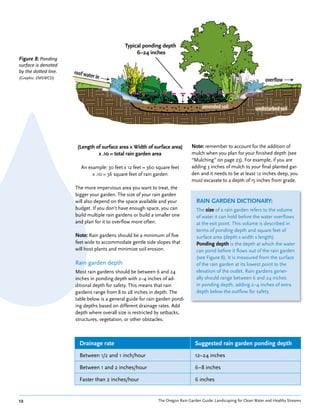
Typical ponding depth
                                                  6–24 inches
Figure 8: Ponding
surface is denoted
by the dotted line.
(Graphic: EMSWCD)


                       (Length of surface area x Width of surface area)       Note: remember to account for the addition of
                                x .10 = total rain garden area                mulch when you plan for your finished depth (see
                                                                              “Mulching” on page 23). For example, if you are
                        An example: 30 feet x 12 feet = 360 square feet       adding 3 inches of mulch to your final planted gar-
                             x .10 = 36 square feet of rain garden            den and it needs to be at least 12 inches deep, you
                                                                              must excavate to a depth of 15 inches from grade.
                      The more impervious area you want to treat, the
                      bigger your garden. The size of your rain garden
                      will also depend on the space available and your           RAIN GARDEN DICTIONARY:
                      budget. If you don’t have enough space, you can            The size of a rain garden refers to the volume
                      build multiple rain gardens or build a smaller one         of water it can hold before the water overflows
                      and plan for it to overflow more often.                    at the exit point. This volume is described in
                                                                                 terms of ponding depth and square feet of
                      Note: Rain gardens should be a minimum of five             surface area (depth x width x length).
                      feet wide to accommodate gentle side slopes that           Ponding depth is the depth at which the water
                      will host plants and minimize soil erosion.                can pond before it flows out of the rain garden
                                                                                 (see Figure 8). It is measured from the surface
                      Rain garden depth                                          of the rain garden at its lowest point to the
                      Most rain gardens should be between 6 and 24               elevation of the outlet. Rain gardens gener-
                      inches in ponding depth with 2–4 inches of ad-             ally should range between 6 and 24 inches
                      ditional depth for safety. This means that rain            in ponding depth, adding 2–4 inches of extra
                      gardens range from 8 to 28 inches in depth. The            depth below the outflow for safety.
                      table below is a general guide for rain garden pond-
                      ing depths based on different drainage rates. Add
                      depth where overall size is restricted by setbacks,
                      structures, vegetation, or other obstacles.


                        Drainage rate                                           Suggested rain garden ponding depth
                        Between 1/2 and 1 inch/hour                             12–24 inches

                        Between 1 and 2 inches/hour                             6–8 inches

                        Faster than 2 inches/hour                               6 inches


12                                                           The Oregon Rain Garden Guide: Landscaping for Clean Water and Healthy Streams
Dig safely!
It’s the law in the state of Oregon to call the Utility
Notification Center by dialing 811 or 1-800-332-2344
before beginning any excavation. The service is
free and convenient for homeowners, contractors,
excavators, landscapers, etc. Anyone planning to
dig must contact the Center at least two business
days prior to digging, in order for the underground
utilities to be located and accurately marked using
color-coded paint. For more information on
digging safely, visit the OUNC Web site:
www.digsafelyoregon.com.

Delineate the rain garden
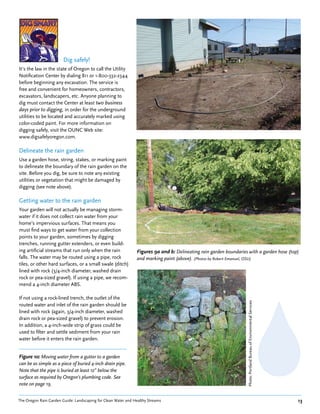
Use a garden hose, string, stakes, or marking paint
to delineate the boundary of the rain garden on the
site. Before you dig, be sure to note any existing
utilities or vegetation that might be damaged by
digging (see note above).

Getting water to the rain garden
Your garden will not actually be managing storm-
water if it does not collect rain water from your
home’s impervious surfaces. That means you
must find ways to get water from your collection
points to your garden, sometimes by digging
trenches, running gutter extenders, or even build-
ing artificial streams that run only when the rain             Figures 9a and b: Delineating rain garden boundaries with a garden hose (top)
falls. The water may be routed using a pipe, rock              and marking paint (above). (Photos by Robert Emanuel, OSU)
tiles, or other hard surfaces, or a small swale (ditch)
lined with rock (3/4-inch diameter, washed drain
rock or pea-sized gravel). If using a pipe, we recom-
mend a 4-inch diameter ABS.

If not using a rock-lined trench, the outlet of the
                                                                                                                   Photo: Portland Bureau of Environmental Services


routed water and inlet of the rain garden should be
lined with rock (again, 3/4-inch diameter, washed
drain rock or pea-sized gravel) to prevent erosion.
In addition, a 4-inch-wide strip of grass could be
used to filter and settle sediment from your rain
water before it enters the rain garden.


Figure 10: Moving water from a gutter to a garden
can be as simple as a piece of buried 4-inch drain pipe.
Note that the pipe is buried at least 12” below the
surface as required by Oregon’s plumbing code. See
note on page 19.


The Oregon Rain Garden Guide: Landscaping for Clean Water and Healthy Streams                                                                                         13
Figure 11: Using a rock-lined trench to convey water across a walkway (Photo: Portland Bureau of Environmental Services [BES])


Figure 12: Trench drain through a sidewalk at a building in Portland.
(Photo: Derek Godwin, OSU)


Figure 13 (right): A “dry” stream bed conveys water across a surface before it
enters a rain garden. (Photo: Judy Scott, OSU)


14                                                                       The Oregon Rain Garden Guide: Landscaping for Clean Water and Healthy Streams
Disconnecting downspouts                                    7. Remember that each section should funnel into
                                                                   the one below it. All parts should be securely
    Disconnecting downspouts is an important part
                                                                   fastened together with sheet-metal screws.
    of rain garden construction. Avoid creating safety
    and structural problems when disconnecting any
                                                                Be sure to maintain your gutter system. Inspect
    downspouts from your storm sewer by following
                                                                it regularly for leaks, sagging, holes, or other
    these safety guidelines:
                                                                problems. It is a good idea to annually inspect
    ■   Don’t disconnect a downspout in an area that            and clear debris from gutters, elbows, and other
        is too small to drain the water properly.               connections before the rains arrive.
    ■   Disconnected downspouts must be extended
        to discharge water at least 6 feet from a struc-        This material is condensed from “How to Manage
        ture with a basement or 2 feet from a crawl             Stormwater: Downspout Disconnection,” City of
        space or slab foundation.                               Portland Bureau of Environmental Services
    ■   Direct water away from your structure, a retain-        publication BS 07011. It is used here with permission
        ing wall (by at least 10 feet), a septic drain field,   of the City of Portland, BES. The full document can
        or an underground storage tank.                         be found at www.portlandonline.com/bes/index.
    ■   The end of the downspout extension must be              cfm?c=46962&a=188637.
        at least 5 feet away from a neighboring property
        and 3 feet from a public sidewalk. Do not direct
        water toward a neighboring property, especially
        on a steep slope.

    Steps for disconnecting:
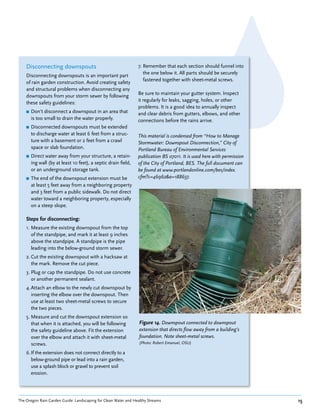
    1. Measure the existing downspout from the top
       of the standpipe, and mark it at least 9 inches
       above the standpipe. A standpipe is the pipe
       leading into the below-ground storm sewer.
    2. Cut the existing downspout with a hacksaw at
       the mark. Remove the cut piece.
    3. Plug or cap the standpipe. Do not use concrete
       or another permanent sealant.
    4. Attach an elbow to the newly cut downspout by
       inserting the elbow over the downspout. Then
       use at least two sheet-metal screws to secure
       the two pieces.
    5. Measure and cut the downspout extension so
       that when it is attached, you will be following           Figure 14. Downspout connected to downspout
       the safety guideline above. Fit the extension             extension that directs flow away from a building’s
       over the elbow and attach it with sheet-metal             foundation. Note sheet-metal screws.
       screws.                                                   (Photo: Robert Emanuel, OSU)

    6. If the extension does not connect directly to a
       below-ground pipe or lead into a rain garden,
       use a splash block or gravel to prevent soil
       erosion.


The Oregon Rain Garden Guide: Landscaping for Clean Water and Healthy Streams                                           15
Designing for overflow                                      ■   a flat area in your home landscape where water
                                                                                             can be safely absorbed,
                             When properly sized, a rain garden is designed
                             to handle roughly 80–90 percent of the water                ■   another rain garden,
                             that falls on a given impervious surface. There-            ■   a French drain or rock-filled soakage trench,
                             fore, extreme events should be considered when
                                                                                         ■   a swale or drainage ditch, or
                             designing your garden. For this reason, it is critical
                             to include plans for overflow. This should be a             ■   return stormwater to its original destination be-
                             notch or a pipe in the berm, at least 2 inches lower            fore the rain garden was built (such as a public
                             than the berm. The overflow could lead to one of                sewer, street gutter, storm drain, or pipes and
                             several options:                                                catch basin).

                                                                                         Be sure to discuss your plans for overflow with
                                                                                         your local planning department. They typically
                                                                                         have specific, approved locations for draining the
                                                                                         overflow off-site. They may also require a permit
                                                                                         for a rain garden.


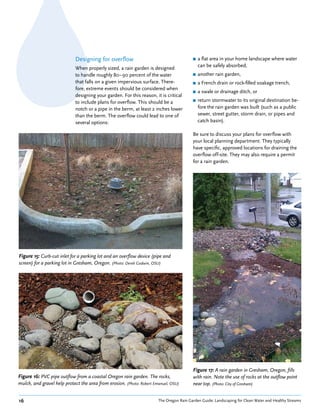
Figure 15: Curb-cut inlet for a parking lot and an overflow device (pipe and
screen) for a parking lot in Gresham, Oregon. (Photo: Derek Godwin, OSU)


                                                                                         Figure 17: A rain garden in Gresham, Oregon, fills
Figure 16: PVC pipe outflow from a coastal Oregon rain garden. The rocks,                with rain. Note the use of rocks at the outflow point
mulch, and gravel help protect the area from erosion. (Photo: Robert Emanuel, OSU)       near top. (Photo: City of Gresham)


16                                                                     The Oregon Rain Garden Guide: Landscaping for Clean Water and Healthy Streams
Note: For smaller gardens, or gardens in high rain-            STEP 5: Constructing a rain garden
fall areas with soils with low infiltration rates, you
will need to take extra care in routing the overflow           Excavation, grading, and berms
away from the garden in a safe manner.                         Plan to place the spoils to the outside edge of the
                                                               garden and away from the inflow point. Use the
Keys to success                                                spoils and any excess soil amendments to form
Permits and design modifications:                              the berm that bounds the rain garden on one
Check with your local government (city or county               or more sides, depending on the terrain. Berms
planning department) to                                        should be built to have at least 2 inches of height
                                                               above the elevation of the outlet.
■   find out whether you can legally build a rain
    garden (and whether you need a permit)                     Whether digging by hand or machine, excavate
■   get information on disconnecting downspouts                the soil from the outer edge of the rain garden to
    or routing water off the site                              minimize soil compaction.
■   learn about any design requirements or setbacks
                                                               We recommend that the slope on the rain garden
You may decide that you need the help of a licensed            berm be at least 18 inches of horizontal length to
landscape professional or engineer.                            6 inches of vertical height (3:1) or flatter on both
                                                               sides of the berm. If the rain garden is 12 inches in
Be kind to trees:                                              depth, you will need to have 36 inches of slope on
It’s a good idea to avoid placing a rain garden                either side of the berm.
beneath the drip line of large trees. The tree roots
will be damaged by the excavation and may also be
overwhelmed by the amount of water that pools
beneath them.

When is the best time to build?
The following schedule is recommended to pre-
vent soil compaction, maintain the soil’s ability to
infiltrate stormwater, and minimize the need for
watering the plants:
■   Conduct site assessments and design the gar-
    den in the fall, winter, and spring when the soil is
    wet but not frozen;
■   Excavate and build the garden when the soil is
    dry enough to work with easily; and
■   Plant vegetation in the fall and as early as pos-
    sible the following spring.


                                                               Figure 18: Excavator is located outside of the rain garden in order
                                                               to make sure the machine does not compact soil in the rain garden.
                                                               (Photo: Robert Emanuel, OSU)


The Oregon Rain Garden Guide: Landscaping for Clean Water and Healthy Streams                                                        17
Grading
     The rain garden sizing process assumes the bottom
     of the garden is level and the sides are graded to a
     3:1 slope. Even if the rain garden is constructed on
     a slight slope, the bottom of the garden should be
     approximately level to allow water to be distributed
     evenly throughout. We recommend you use a line
     level, stakes, and measuring tape to ensure that
     the total surface area and depth (storage volume)
     are built as designed in Step 3. Do this by placing
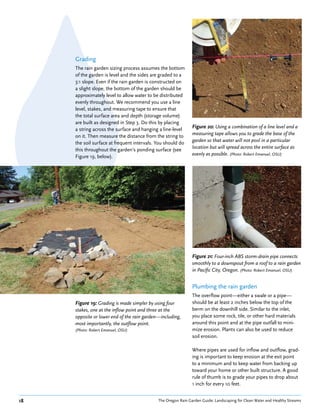
     a string across the surface and hanging a line-level      Figure 20: Using a combination of a line level and a
     on it. Then measure the distance from the string to       measuring tape allows you to grade the base of the
     the soil surface at frequent intervals. You should do     garden so that water will not pool in a particular
     this throughout the garden’s ponding surface (see         location but will spread across the entire surface as
     Figure 19, below).                                        evenly as possible. (Photo: Robert Emanuel, OSU)


                                                               Figure 21: Four-inch ABS storm-drain pipe connects
                                                               smoothly to a downspout from a roof to a rain garden
                                                               in Pacific City, Oregon. (Photo: Robert Emanuel, OSU)


                                                               Plumbing the rain garden
                                                               The overflow point—either a swale or a pipe—
     Figure 19: Grading is made simpler by using four          should be at least 2 inches below the top of the
     stakes, one at the inflow point and three at the          berm on the downhill side. Similar to the inlet,
     opposite or lower end of the rain garden—including,       you place some rock, tile, or other hard materials
     most importantly, the outflow point.                      around this point and at the pipe outfall to mini-
     (Photo: Robert Emanuel, OSU)                              mize erosion. Plants can also be used to reduce
                                                               soil erosion.

                                                               Where pipes are used for inflow and outflow, grad-
                                                               ing is important to keep erosion at the exit point
                                                               to a minimum and to keep water from backing up
                                                               toward your home or other built structure. A good
                                                               rule of thumb is to grade your pipes to drop about
                                                               1 inch for every 10 feet.


18                                           The Oregon Rain Garden Guide: Landscaping for Clean Water and Healthy Streams
Note: Oregon State Plumbing Code requires that
any buried utility pipe should be at least 12˝ below
the soil level starting at the downspout. It also
requires underground plumbing to be a durable
material such as Schedule 40 ABS or PVC. While
corrugated plastic pipes are frequently found in
rain gardens (including some photographed in this
guide), these materials may not last, especially in
colder climates. If using an inflow pipe buried 12
inches deep, a rain garden’s finished depth will
need to be between 14 and 18 inches.

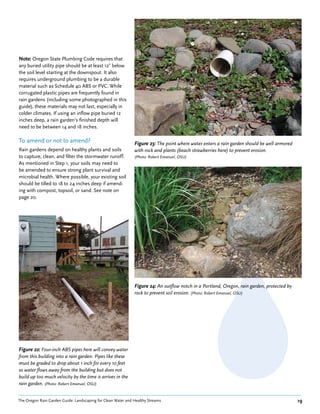
To amend or not to amend?                                     Figure 23: The point where water enters a rain garden should be well armored
Rain gardens depend on healthy plants and soils               with rock and plants (beach strawberries here) to prevent erosion.
to capture, clean, and filter the stormwater runoff.          (Photo: Robert Emanuel, OSU)
As mentioned in Step 1, your soils may need to
be amended to ensure strong plant survival and
microbial health. Where possible, your existing soil
should be tilled to 18 to 24 inches deep if amend-
ing with compost, topsoil, or sand. See note on
page 20.


                                                              Figure 24: An outflow notch in a Portland, Oregon, rain garden, protected by
                                                              rock to prevent soil erosion. (Photo: Robert Emanuel, OSU)


Figure 22: Four-inch ABS pipes here will convey water
from this building into a rain garden. Pipes like these
must be graded to drop about 1 inch for every 10 feet
so water flows away from the building but does not
build up too much velocity by the time is arrives in the
rain garden. (Photo: Robert Emanuel, OSU)


The Oregon Rain Garden Guide: Landscaping for Clean Water and Healthy Streams                                                                19
STEP 6: Choose the “right plant                            Compost
                              for the right place”                                       Compost helps the soil hold moisture, increase
                                                                                         microbial activity, improve its ability to filter and
                              Fertilizers and pesticides often contribute to storm-
                                                                                         adsorb pollutants, and increase plant survival in the
                              water pollution in streams and lakes. Since rain
                                                                                         first few years as it slowly biodegrades. Be sure to
                              gardens are designed to treat stormwater runoff, it
                                                                                         use weed-free mixes.
                              is very important to choose plants that can survive
                              and thrive without chemical inputs. It is also good
                              practice to choose plants and design your garden to        ! Note: Rain garden plants do not have to be wet-
                              require minimal to no extra water.                         land or water plants. In fact, they should be able to
                                                                                         tolerate drying out for long periods with little to no
                                                                                         supplemental irrigation, depending on where you
                              Planting zones and plant selection                         live in Oregon and how long the plants have been
                              Plants vary in their tolerance of certain conditions,      established.
                              such as shade, flooding, moisture, and cold tem-
                              peratures, while maintaining their ability to survive      Rain gardens can be divided into three zones, rela-
                              and grow. Rain gardens have zones that vary in             tive to their wet and dry conditions: moist, moderate,
                              wet and dry conditions and possibly sunlight and           and dry. If you select plants from the lists provided in
                              shade; therefore, plants need to be selected based         this guide, be sure to pay attention to their designa-
                              on their tolerance to these conditions and placed          tion as tolerant of “moist,” “moderate,” and “dry”
                              in the corresponding zone to survive and thrive.           soil conditions. Use plants that are designated as
                              Furthermore, plants need to be chosen based on             doing best in “moderate” and “dry” conditions only
                              their ability to survive in the climate relative to the    on the slopes or otherwise dry parts of the garden.
                              region in Oregon in which they are planted (that is,       Do not put a plant that cannot tolerate “wet feet” in
                              Willamette Valley, coast, southwest, central, and          the bottom or wettest part of your garden, because it
                              east). Rain gardens are generally meant to be low          could drown during rainy periods.
                              maintenance.
                                                                                         Soil type will also influence the plants and the size
                                                                                         of different moisture zones. For example, rain gar-
                                                                                         dens built in high-clay or slow-draining soils should
                                                                                         be planted with more plants that tolerate “wet
                                                                                         feet,” while rain gardens in sandy or fast-draining
                                                                                         soil can be planted with more dry-adapted plants
                                                                                         (listed here with “moderate” or “dry” designations).
                                                                                         In fast-draining rain gardens, group your moisture-
                                                                                         loving plants within a few feet of the inflow points.


                                                                                           RAIN GARDEN DICTIONARY:
                                                                                           Zones of wet and dry conditions
                                                                                           ■   Moist: plant prefers moist soil and tolerates
                                                                                               dry soil other times of the year.
                                                                                           ■   Moderate: plant can tolerate moist and dry
                                                                                               soils equally.
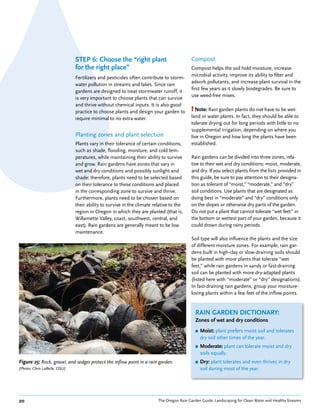
Figure 25: Rock, gravel, and sedges protect the inflow point in a rain garden.             ■   Dry: plant tolerates and even thrives in dry
(Photo: Chris LaBelle, OSU)                                                                    soil during most of the year.


20                                                                      The Oregon Rain Garden Guide: Landscaping for Clean Water and Healthy Streams
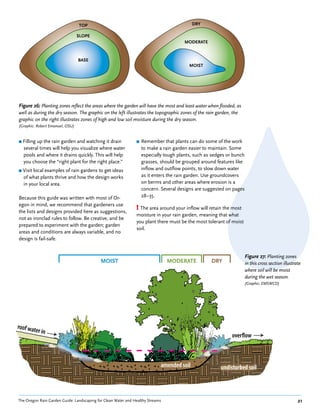
Figure 26: Planting zones reflect the areas where the garden will have the most and least water when flooded, as
well as during the dry season. The graphic on the left illustrates the topographic zones of the rain garden, the
graphic on the right illustrates zones of high and low soil moisture during the dry season.
(Graphic: Robert Emanuel, OSU)


■   Filling up the rain garden and watching it drain           ■   Remember that plants can do some of the work
    several times will help you visualize where water              to make a rain garden easier to maintain. Some
    pools and where it drains quickly. This will help              especially tough plants, such as sedges or bunch
    you choose the “right plant for the right place.”              grasses, should be grouped around features like
■   Visit local examples of rain gardens to get ideas              inflow and outflow points, to slow down water
    of what plants thrive and how the design works                 as it enters the rain garden. Use groundcovers
    in your local area.                                            on berms and other areas where erosion is a
                                                                   concern. Several designs are suggested on pages
Because this guide was written with most of Or-                    28–35.
egon in mind, we recommend that gardeners use
                                                               ! The area around your inflow will retain the most
the lists and designs provided here as suggestions,
                                                               moisture in your rain garden, meaning that what
not as ironclad rules to follow. Be creative, and be
                                                               you plant there must be the most tolerant of moist
prepared to experiment with the garden; garden
                                                               soil.
areas and conditions are always variable, and no
design is fail-safe.


                                                                                                                      Figure 27: Planting zones
                                                                                                                      in this cross section illustrate
                                                                                                                      where soil will be moist
                                                                                                                      during the wet season.
                                                                                                                      (Graphic: EMSWCD)


The Oregon Rain Garden Guide: Landscaping for Clean Water and Healthy Streams                                                                       21
Key plant characteristics                                    Backfill your hole with well-drained soil rich in
                                                                  compost, being careful to make sure you do not
     Other plant characteristics and plant selection
                                                                  cover the crown of the plant if it was exposed in
     While rain gardeners should focus on selecting
                                                                  the original container. Be sure to firm the soil
     and placing plants that may tolerate more or less
                                                                  around the plant and water well with a slow stream
     water, there are other characteristics to note.
                                                                  of water or soaker attachment.
     Remember, rain gardens can and should be attrac-
     tive features in your landscape, rather than just
     places to treat stormwater. Other characteristics to
     consider include:                                                                      A note about
     ■   What is the plant’s height and width?                                              invasive species
     ■   Does the plant have attractive foliage, flowers, or                               Invasive plants such as
         fruit?                                                                            English Ivy, Japanese
                                                                                           knotweed, spurge laurel,
     ■   Does it attract beneficial insects and wildlife?            or butterfly bush cost Oregonians millions
     ■   Does it look good with neighboring plants and               of dollars in control, prevention, and direct
         landscape?                                                  economic losses. An invasive plant is one that
     ■   Seasonality                                                 escapes cultivation and multiplies in other
                                                                     habitats, to the near exclusion of species that
     ■   Shade tolerance
                                                                     would occur naturally.
     ■   Temperature requirements
                                                                     Gardens and gardeners are among the most
     ! Remember that plants grow! This simple fact                   important pathways for invasive plants to
     should keep you from overplanting your rain gar-                move into new places. You can help stop
     den or placing plants too close together. Respect               the biological invasion by eliminating known
     their ultimate size requirements and keep in mind               invasive plants from your garden; preventing
     that these vary throughout Oregon.                              the introduction of new, aggressive plants;
                                                                     and replacing nonnative invaders with friendly
     Planting tips                                                   native plants in your landscape.
     When planting, be sure to dig a planting hole at
     least as big as the pot, if the soil has been amend-            For common invasive plants to avoid as well
     ed. If you are planting into unamended soil, dig                as some excellent alternatives, consult the
     a hole that is at least twice the diameter but the              publication GardenSmart Oregon, available at
     same depth as the pot. Most native and nonna-                   www.oregoninvasivespecieshotline.org and
     tive plants need to be planted at the same depth                through your local Soil and Water Conserva-
     as they were growing in their pots. Leave some                  tion District or OSU Extension Service office.
     compost and soil mixture mounded at the bottom,
     as appropriate, to keep your plant at the same level
     as it was in its original container.

     Carefully remove the plant from its container. If the
     plant roots have formed a solid mass around the
     outside of the pot, gently loosen them or carefully
     score the outside layer with a sharp knife. Lower the
     root ball into the planting hole slowly, to prevent
     cracking or breaking of the soil around the roots.
     If the root ball was opened up, spread some of the
     roots over the mound in the center of your hole.


22                                              The Oregon Rain Garden Guide: Landscaping for Clean Water and Healthy Streams
Mulching                                                       How much mulch?
Mulch is another important part of the rain                    To calculate the total cubic yards of mulch needed
garden. It will help shade the soil and keep it cool           for your rain garden project, follow these steps:
and may increase soil moisture during the dry                  1. Multiply the length of your rain garden by the
summer and fall months. The right mulch can also                  width to find the square footage.
help control weeds. More importantly, microbial
                                                               2. Multiply that square footage by 0.25, which will
activity in the mulch helps to break down some
                                                                  equate to 3 inches of mulch.
of the common pollutants in stormwater. For this
reason, we recommend always applying mulch to                  3. Divide that value by 27 to yield cubic yards of
new rain gardens and maintaining some mulch in                    mulch needed for your project.
established ones.
                                                               The steps above can be used to quickly estimate
Double-shredded conifer bark mulch (also known as              the necessary amount of mulch to purchase based
“bark dust”) is probably the most commonly used                on various depths of mulch. Remember not to
in landscape plantings in the Pacific Northwest.               pile mulch alongside the stem of plants. Mulch
Douglas-fir and hemlock are the most commonly                  is moist and can lead to rotting around the stem.
sold barks, although pine bark is also available. Bark         Also, remember to break up any mulch that may
mulch is available in a range of grades, from fine             be dry or clumped together as you spread it over
through medium to large bark nuggets. We recom-                your rain garden.
mend using fine-grade bark mulch rather than nug-
gets, as the latter will float. We do not recommend            For more information on mulches, please consult:
using sawdust or grass clippings, as these materials           Bell, N., D. M. Sullivan, and T. Cook. 2009. Mulch-
will alter your soil chemistry and can affect the abil-        ing Woody Ornamentals with Organic Materials.
ity of the garden to support healthy plants.                   EC 1629-E. extension.oregonstate.edu/catalog/pdf/
                                                               ec/ec1629-e.pdf
Apply mulch at a rate of 2–3 inches evenly across
the rain garden on the edges or slopes of your rain
garden. If you choose not to use bark mulch in the                   Cubic                    Rain garden square feet and
lowest point of the garden, then be sure to apply a                 yards of                 mulch coverage based on depth
2- to 3-inch depth of compost instead.                               mulch
                                                                                           1˝                       2˝          3˝
Rocks and gravel are often used at inflow and outflow                    1            338 sq. ft.           158 sq. ft.     108 sq. ft.
areas to dissipate energy from water and prevent
erosion. They will also make maintenance in the rain                    2             676 sq. ft.           316 sq. ft.     216 sq. ft.
garden easier. Rock and gravel are important design
elements that can add interest to the rain garden.                       3           1,014 sq. ft.          474 sq. ft.     342 sq. ft.
Washed pea gravel is an attractive small-grade rock                     4            1,352 sq. ft.          632 sq. ft.     432 sq. ft.
for use in the base of the rain garden.
                                                                         5           1,690 sq. ft.          790 sq. ft.    540 sq. ft.
Compost is another alternative for covering the
base of the rain garden. It will not suppress weeds                     6            2,028 sq. ft.          948 sq. ft.    648 sq. ft.
as well as wood chips or other materials, but it will                   7            2,366 sq. ft.         1,106 sq. ft.    756 sq. ft.
succeed in adding fertility to the soil and in filter-
ing pollutants. More finely textured compost is                         8            2,704 sq. ft.         1,264 sq. ft.   864 sq. ft.
less likely to float in heavy rains. Apply compost at
the same rate as indicated in the chart to the right.                   9            3,042 sq. ft.         1,422 sq. ft.    972 sq. ft.
                                                                        10           3,380 sq. ft.         1,580 sq. ft.   1,080 sq. ft.


The Oregon Rain Garden Guide: Landscaping for Clean Water and Healthy Streams                                                              23
Watering a rain garden
                                                                                       Even after you have chosen and carefully planted
                                                                                       “the right plant in the right place” and mulched
                                                                                       the garden, it is important to make sure new plants
                                                                                       get sufficient water during their first and possibly
                                                                                       second dry summer season, until they are fully
                                                                                       established. This is especially true if the rain garden
                                                                                       was planted in the spring or summer.

                                                                                       As with any watering regime, water deeply and
                                                                                       slowly during the coolest time of the day (evenings
                                                                                       if possible). Soaker attachments or soaker hoses
                                                                                       are particularly useful for this purpose. Use a soil
                                                                                       probe or stick to check whether moisture is pres-
                                                                                       ent in the rain garden at a depth greater than 2–3
                                                                                       inches.

                                                                                       After the first or second dry season, depending
                                                                                       upon how good the plants look and how hardy they
                                                                                       are, you may be able to stop watering altogether
                                                                                       and depend on rain entirely. Remember that the
                                                                                       more native plants you use in your rain garden and
                                                                                       landscape, the less supplemental water you’ll need
                                                                                       to apply during drought periods.

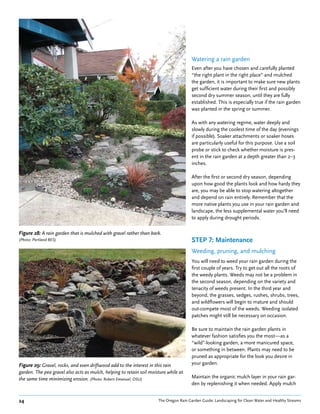
Figure 28: A rain garden that is mulched with gravel rather than bark.
(Photo: Portland BES)                                                                  STEP 7: Maintenance
                                                                                       Weeding, pruning, and mulching
                                                                                       You will need to weed your rain garden during the
                                                                                       first couple of years. Try to get out all the roots of
                                                                                       the weedy plants. Weeds may not be a problem in
                                                                                       the second season, depending on the variety and
                                                                                       tenacity of weeds present. In the third year and
                                                                                       beyond, the grasses, sedges, rushes, shrubs, trees,
                                                                                       and wildflowers will begin to mature and should
                                                                                       out-compete most of the weeds. Weeding isolated
                                                                                       patches might still be necessary on occasion.

                                                                                       Be sure to maintain the rain garden plants in
                                                                                       whatever fashion satisfies you the most—as a
                                                                                       “wild”-looking garden, a more manicured space,
                                                                                       or something in between. Plants may need to be
                                                                                       pruned as appropriate for the look you desire in
Figure 29: Gravel, rocks, and even driftwood add to the interest in this rain          your garden.
garden. The pea gravel also acts as mulch, helping to retain soil moisture while at
the same time minimizing erosion. (Photo: Robert Emanuel, OSU)                         Maintain the organic mulch layer in your rain gar-
                                                                                       den by replenishing it when needed. Apply mulch


24                                                                    The Oregon Rain Garden Guide: Landscaping for Clean Water and Healthy Streams
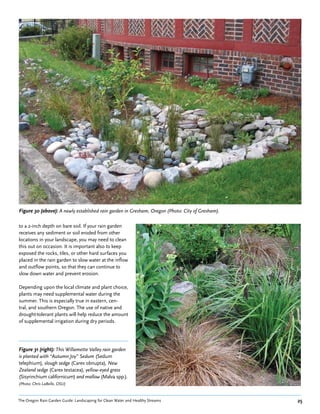
Figure 30 (above): A newly established rain garden in Gresham, Oregon (Photo: City of Gresham).

to a 2-inch depth on bare soil. If your rain garden
receives any sediment or soil eroded from other
locations in your landscape, you may need to clean
this out on occasion. It is important also to keep
exposed the rocks, tiles, or other hard surfaces you
placed in the rain garden to slow water at the inflow
and outflow points, so that they can continue to
slow down water and prevent erosion.

Depending upon the local climate and plant choice,
plants may need supplemental water during the
summer. This is especially true in eastern, cen-
tral, and southern Oregon. The use of native and
drought-tolerant plants will help reduce the amount
of supplemental irrigation during dry periods.


Figure 31 (right): This Willamette Valley rain garden
is planted with “Autumn Joy” Sedum (Sedum
telephium), slough sedge (Carex obnupta), New
Zealand sedge (Carex testacea), yellow-eyed grass
(Sisyrinchium californicum) and mallow (Malva spp.).
(Photo: Chris LaBelle, OSU)


The Oregon Rain Garden Guide: Landscaping for Clean Water and Healthy Streams                     25
Don’t drown your plants!                                     A note about Oregon’s regions
                            Another consideration is to make sure your plants            Oregon is a much more geographically diverse state
                            in the base don’t drown in their first winter. Plants        than most. Climates and soils can vary significantly
                            need air in the soil, so when the rain garden stays          between the coast, Willamette Valley, Cascades,
                            consistently flooded for long, wet winters, it may           eastern high desert, and southwestern mountains.
                            become necessary to notch the berm at the outlet             Below are a few tips on region-specific items to be
                            to a lower elevation or add more notches to the              aware of in designing, building, or maintaining a
                            berm. This will help the rain garden drain a little          rain garden.
                            faster and give the plants a chance to establish
                            healthy roots. After the first winter, fill in the notch-    Willamette Valley:
                            es and allow it to function normally. Some profes-
                                                                                         Most of the materials—including many of the plant
                            sionals and gardeners even advocate diverting
                                                                                         selections in this guide—will help rain gardeners
                            stormwater from the rain garden for the first year or
                                                                                         in the Willamette Valley. With its generally mild
                            two while plants become established, especially in
                                                                                         seasons, good soils, and mostly flat territory, the
                            heavy soils.
                                                                                         Willamette Valley presents few obstacles for rain
                                                                                         gardeners. When planning your rain garden for the
                                                                                         Willamette Valley, keep these things in mind:
                                                                                         ■   Summertime temperatures can occasionally
                                                                                             exceed 90 degrees; thus, some plants in sunny
                                                                                             locations with fast-draining soils will need supple-
                                                                                             mental irrigation—at least for the first two or
                                                                                             three years while roots are becoming established.
                                                                                         ■   Wintertime temperatures in some locations can
                                                                                             drop well below freezing and thus create prob-
                                                                                             lems for more tender or sensitive plants. It is
                                                                                             important to choose plants adapted to both sum-
                                                                                             mer and winter conditions in your area.
                                                                                         ■   The Willamette Valley contains the state’s biggest
                                                                                             cities, each of which may have their own require-
                                                                                             ments for on-site stormwater management
                                                                                             (and rain gardens). If you live in Salem, Eugene,
                                                                                             Gresham, or Portland, contact your local govern-
                                                                                             ment for more information.

                                                                                         Coastal Oregon:
                                                                                         With the influence of strong Pacific winds, abun-
                                                                                         dant rainfall, and generally milder temperatures, the
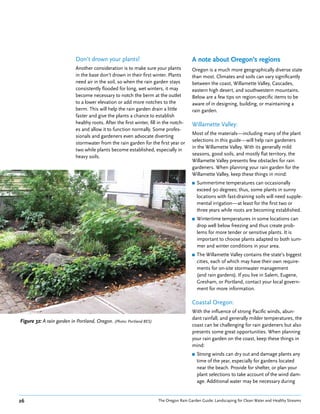
Figure 32: A rain garden in Portland, Oregon. (Photo: Portland BES)
                                                                                         coast can be challenging for rain gardeners but also
                                                                                         presents some great opportunities. When planning
                                                                                         your rain garden on the coast, keep these things in
                                                                                         mind:
                                                                                         ■   Strong winds can dry out and damage plants any
                                                                                             time of the year, especially for gardens located
                                                                                             near the beach. Provide for shelter, or plan your
                                                                                             plant selections to take account of the wind dam-
                                                                                             age. Additional water may be necessary during


26                                                                     The Oregon Rain Garden Guide: Landscaping for Clean Water and Healthy Streams
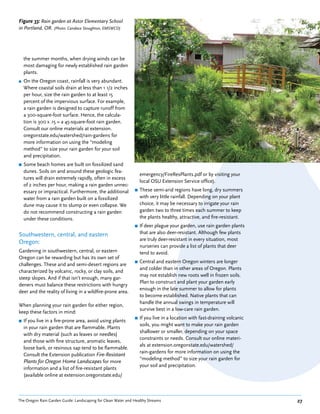
Figure 33: Rain garden at Astor Elementary School
in Portland, OR. (Photo: Candace Stoughton, EMSWCD)


    the summer months, when drying winds can be
    most damaging for newly established rain garden
    plants.
■   On the Oregon coast, rainfall is very abundant.
    Where coastal soils drain at less than 1 1/2 inches
    per hour, size the rain garden to at least 15
    percent of the impervious surface. For example,
    a rain garden is designed to capture runoff from
    a 300-square-foot surface. Hence, the calcula-
    tion is 300 x .15 = a 45-square-foot rain garden.
    Consult our online materials at extension.
    oregonstate.edu/watershed/rain-gardens for
    more information on using the “modeling
    method” to size your rain garden for your soil
    and precipitation.
■   Some beach homes are built on fossilized sand
    dunes. Soils on and around these geologic fea-
                                                                  emergency/FireResPlants.pdf or by visiting your
    tures will drain extremely rapidly, often in excess
                                                                  local OSU Extension Service office).
    of 2 inches per hour, making a rain garden unnec-
    essary or impractical. Furthermore, the additional        ■   These semi-arid regions have long, dry summers
    water from a rain garden built on a fossilized                with very little rainfall. Depending on your plant
    dune may cause it to slump or even collapse. We               choice, it may be necessary to irrigate your rain
    do not recommend constructing a rain garden                   garden two to three times each summer to keep
    under these conditions.                                       the plants healthy, attractive, and fire-resistant.
                                                              ■   If deer plague your garden, use rain garden plants
Southwestern, central, and eastern                                that are also deer-resistant. Although few plants
                                                                  are truly deer-resistant in every situation, most
Oregon:
                                                                  nurseries can provide a list of plants that deer
Gardening in southwestern, central, or eastern                    tend to avoid.
Oregon can be rewarding but has its own set of
                                                              ■   Central and eastern Oregon winters are longer
challenges. These arid and semi-desert regions are
                                                                  and colder than in other areas of Oregon. Plants
characterized by volcanic, rocky, or clay soils, and
                                                                  may not establish new roots well in frozen soils.
steep slopes. And if that isn’t enough, many gar-
                                                                  Plan to construct and plant your garden early
deners must balance these restrictions with hungry
                                                                  enough in the late summer to allow for plants
deer and the reality of living in a wildfire-prone area.
                                                                  to become established. Native plants that can
                                                                  handle the annual swings in temperature will
When planning your rain garden for either region,
                                                                  survive best in a low-care rain garden.
keep these factors in mind:
                                                              ■   If you live in a location with fast-draining volcanic
■   If you live in a fire-prone area, avoid using plants
                                                                  soils, you might want to make your rain garden
    in your rain garden that are flammable. Plants
                                                                  shallower or smaller, depending on your space
    with dry material (such as leaves or needles)
                                                                  constraints or needs. Consult our online materi-
    and those with fine structure, aromatic leaves,
                                                                  als at extension.oregonstate.edu/watershed/
    loose bark, or resinous sap tend to be flammable.
                                                                  rain-gardens for more information on using the
    Consult the Extension publication Fire-Resistant
                                                                  “modeling method” to size your rain garden for
    Plants for Oregon Home Landscapes for more
                                                                  your soil and precipitation.
    information and a list of fire-resistant plants
    (available online at extension.oregonstate.edu/


The Oregon Rain Garden Guide: Landscaping for Clean Water and Healthy Streams                                             27
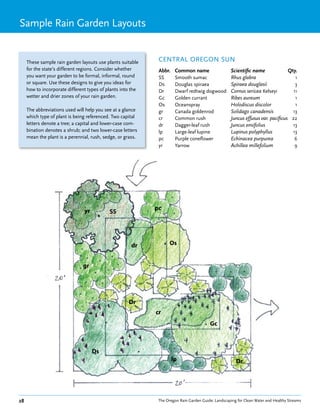
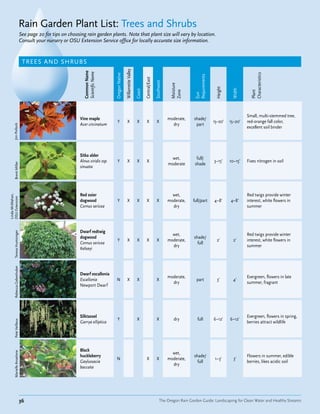
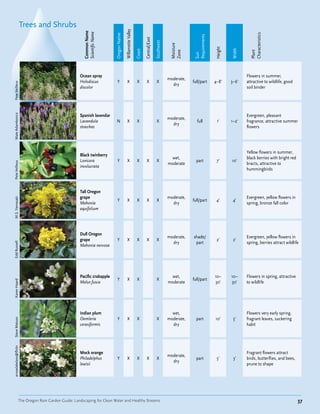
Sample Rain Garden Layouts


     These sample rain garden layouts use plants suitable     CENTRAL OREGON SUN
     for the state’s different regions. Consider whether      Abbr.    Common name                   Scientific name              Qty.
     you want your garden to be formal, informal, round       SS       Smooth sumac                  Rhus glabra                     1
     or square. Use these designs to give you ideas for       Ds       Douglas spiraea               Spiraea douglasii               3
     how to incorporate different types of plants into the    Dr       Dwarf redtwig dogwood         Cornus sericea Kelseyi         11
     wetter and drier zones of your rain garden.              Gc       Golden currant                Ribes aureum                    1
                                                              Os       Oceanspray                    Holodiscus discolor             1
     The abbreviations used will help you see at a glance     gr       Canada goldenrod              Solidago canadensis            13
     which type of plant is being referenced. Two capital     cr       Common rush                   Juncus effusus var. pacificus 22
     letters denote a tree; a capital and lower-case com-     dr       Dagger-leaf rush              Juncus ensifolius              13
     bination denotes a shrub; and two lower-case letters     lp       Large-leaf lupine             Lupinus polyphyllus            13
     mean the plant is a perennial, rush, sedge, or grass.    pc       Purple coneflower             Echinacea purpurea              6
                                                              yr       Yarrow                        Achillea millefolium            9


                                yr                           pc
                                            SS


                                                       dr           Os


                                gr


                                                      Dr
                                                             cr
                                                                                         Gc


                                     Ds
                                                                      lp                               Dr


28                                                            The Oregon Rain Garden Guide: Landscaping for Clean Water and Healthy Streams
Sample Rain Garden Layouts


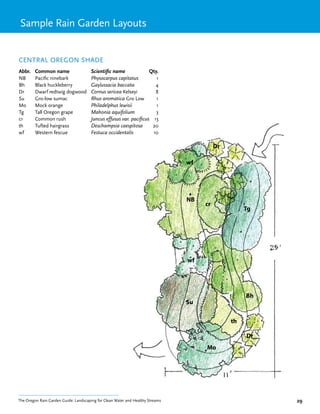
CENTRAL OREGON SHADE
Abbr.    Common name                   Scientific name              Qty.
NB       Pacific ninebark              Physocarpus capitatus           1
Bh       Black huckleberry             Gaylussacia baccata            4
Dr       Dwarf redtwig dogwood         Cornus sericea Kelseyi         8
Su       Gro-low sumac                 Rhus aromatica Gro Low          1
Mo       Mock orange                   Philadelphus lewisii            1
Tg       Tall Oregon grape             Mahonia aquifolium              3
cr       Common rush                   Juncus effusus var. pacificus 13
th       Tufted hairgrass              Deschampsia caespitosa        20
wf       Western fescue                Festuca occidentalis          10

                                                                                          Dr

                                                                                wf


                                                                                NB
                                                                                     cr
                                                                                                    Tg


                                                                                wf


                                                                                                    Bh
                                                                                Su


                                                                                               th

                                                                                                    Dr
                                                                                     Mo


The Oregon Rain Garden Guide: Landscaping for Clean Water and Healthy Streams                            29
Sample Rain Garden Layouts


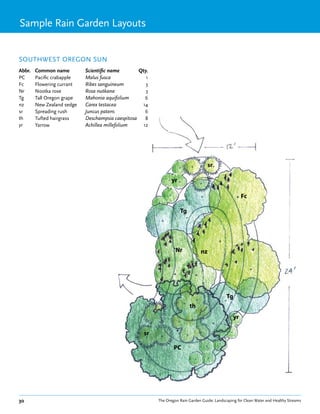
SOUTHWEST OREGON SUN
Abbr.   Common name         Scientific name        Qty.
PC      Pacific crabapple   Malus fusca               1
Fc      Flowering currant   Ribes sanguineum          3
Nr      Nootka rose         Rosa nutkana              3
Tg      Tall Oregon grape   Mahonia aquifolium       6
nz      New Zealand sedge   Carex testacea          14
sr      Spreading rush      Juncus patens            6
th      Tufted hairgrass    Deschampsia caespitosa   8
yr      Yarrow              Achillea millefolium    12


                                                                                     sr

                                                                 yr

                                                                                                       Fc

                                                                      Tg


                                                                   Nr           nz


                                                                                              Tg
                                                                           th
                                                                                                  yr

                                                     sr

                                                                  PC


30                                                        The Oregon Rain Garden Guide: Landscaping for Clean Water and Healthy Streams
Sample Rain Garden Layouts


SOUTHWEST OREGON SHADE
Abbr.    Common name                   Scientific name            Qty.
CA       Cascara                       Rhamnus purshiana             1
Bt       Black twinberry               Lonicera involucrata         6
Eh       Evergreen huckleberry         Vaccinium ovatum             8
Nr       Nootka rose                   Rosa nutkana                 6
Tg       Tall Oregon grape             Mahonia aquifolium           2
lp       Large-leaf lupine             Lupinus polyphyllus          2
sb       Santa Barbara sedge           Carex barbarae              16
wg       Wild ginger                   Asarum caudatum             12


                                  Eh                                                       Eh

                                                                                CA


                                             Bt                                 sb    Bt

                                 lp                                                         lp


                                                Tg                                   Tg

                                   wg                                                      wg


                                                                                Nr


The Oregon Rain Garden Guide: Landscaping for Clean Water and Healthy Streams                    31
Sample Rain Garden Layouts


WILLAMETTE VALLEY SUN
Abbr.   Common name          Scientific name              Qty.
SA      Sitka alder          Alnus viridis ssp. sinuata      1
Bh      Baldhip rose         Rosa gymnocarpa                6
Ro      Red osier dogwood    Cornus sericea                  3
Rm      Rosemary             Rosemarinus officianalis       4
dr      Dagger-leaf rush     Juncus ensifolius             25
tt      Taper-tipped rush    Juncus acuminatus             10
wf      Western fescue       Festuca occidentalis           6


                                                                   Ro
                                                                                                        Ro


                            wf                                                            Bh

                                                    Bh

                                         dr
                                                                                                           Bh
                                                                                  SA

                                                                                tt
                                          Rm               Bh                                                           Ro


                                                                             Bh           Bh


                                                                                                             Rm
                                                                                     Rm

                                                                                                            wf


32                                                               The Oregon Rain Garden Guide: Landscaping for Clean Water and Healthy Streams
Sample Rain Garden Layouts


WILLAMETTE VALLEY SHADE
Abbr.    Common name                   Scientific name        Qty.
VM       Vine maple                    Acer circinatum           1
Dg       Dull Oregon grape             Mahonia nervosa         14
Dr       Dwarf redtwig dogwood         Cornus sericea Kelseyi    9
Sb       Snowberry                     Symphoricarpus alba       3
ds       Dense sedge                   Carex densa              13
br       Small-fruited bulrush         Scirpus microcarpus      11


                                                                                           Sb
                                                                   Dg


                                                                                br


                                                                                     ds
                                                                   Dr                           VM


                                                                                          Dg


The Oregon Rain Garden Guide: Landscaping for Clean Water and Healthy Streams                        33
Sample Rain Garden Layouts


OREGON COAST SUN
Abbr.   Common name        Scientific name             Qty.
PW      Pacific willow     Salix lucida ssp. lasiandra    1
Es      Dwarf escallonia   Escallonia Newport Dwarf       4
St      Silktassel         Garrya elliptica               1
cs      Curly sedge        Carex rupestris              32
oi      Oregon iris        Iris tenax                    11
sl      Spanish lavender   Lavandula stoechas            13
sf      Sword fern         Polystichum munitum            3


                                                              sl                               Es


                                                 oi                   cs                                   sl


                                                         St                  sf


                                                                                  oi                       Es

                                                                    PW


34                                                            The Oregon Rain Garden Guide: Landscaping for Clean Water and Healthy Streams
Sample Rain Garden Layouts


OREGON COAST SHADE
Abbr.    Common name                   Scientific name              Qty.
IP       Indian plum                   Oemleria cerasiformis           1
Bb       Blue-ridge blueberry          Vaccinium pallidum              3
Cl       Common lilac                  Syringa vulgaris                1
Dr       Dwarf redtwig dogwood         Cornus sericea Kelseyi          6
cr       Common rush                   Juncus effusus var. pacificus 8
bh       Pacific bleeding heart        Dicentra formosa               13
ss       Slough sedge                  Carex obnupta                  13
sf       Sword fern                    Polystichum munitum             6


                                                                                      Dr

                                                                Bb                     sf

                                                                                                     bh

                                                                                 ss

                               bh
                                           IP              cr


                                                Dr
                                                                            sf                  Cl


                                                                                           bh


The Oregon Rain Garden Guide: Landscaping for Clean Water and Healthy Streams                             35
Rain Garden Plant List: Trees and Shrubs
                            See page 20 for tips on choosing rain garden plants. Note that plant size will vary by location.
                            Consult your nursery or OSU Extension Service office for locally accurate size information.


                             TREES AND SHRUBS


                                                                                              Willamette Valley
                                                           Common Name
                                                           Scientific Name


                                                                                                                                                                                                      Characteristics
                                                                              Oregon Native


                                                                                                                                                                  Requirements
                                                                                                                          Central/East

                                                                                                                                         Southwest


                                                                                                                                                      Moisture


                                                                                                                                                                                  Height


                                                                                                                                                                                            Width
                                                                                                                  Coast


                                                                                                                                                      Zone


                                                                                                                                                                                                      Plant
                                                                                                                                                                  Sun
                                                                                                                                                                                                    Small, multi-stemmed tree,
                                                         Vine maple                                                                                  moderate,   shade/
                                                                                Y                X                 X        X             X                                      15–20'    15–20'   red-orange fall color,
                                                         Acer circinatum                                                                               dry        part
      Jim Pollock


                                                                                                                                                                                                    excellent soil binder


                                                         Sitka alder
                                                                                                                                                       wet,        full/
                                                         Alnus viridis ssp.     Y                X                 X        X                                                    3–15'     10–15'   Fixes nitrogen in soil
                                                                                                                                                     moderate     shade
       Brent Miller


                                                         sinuata


                                                         Red osier                                                                                     wet,                                         Red twigs provide winter
Linda McMahan,
OSU Extension


                                                         dogwood                Y                X                 X        X             X          moderate,   full/part       4–8'      4–8'     interest, white flowers in
                                                         Cornus sericea                                                                                dry                                          summer


                                                         Dwarf redtwig
       Teresa Huntsinger


                                                                                                                                                       wet,                                         Red twigs provide winter
                                                         dogwood                                                                                                 shade/
                                                                                Y                X                 X        X             X          moderate,                     2'        2'     interest, white flowers in
                                                         Cornus sericea                                                                                            full
                                                                                                                                                       dry                                          summer
                                                         Kelseyi
       Rebecca Gebeshuber


                                                         Dwarf escallonia
                                                                                                                                                     moderate,                                      Evergreen, flowers in late
                                                         Escallonia            N                 X                 X                      X                        part            3'        4'
                                                                                                                                                       dry                                          summer, fragrant
                                                         Newport Dwarf


                                                         Silktassel                                                                                                                                 Evergreen, flowers in spring,
                                                                                Y                                  X                      X             dry         full         6–12'     6–12'
       Pete Veilleux


                                                         Garrya elliptica                                                                                                                           berries attract wildlife


                                                         Black
       Marielle Anzelone


                                                                                                                                                       wet,
                                                         huckleberry                                                                                             shade/                             Flowers in summer, edible
                                                                               N                                            X             X          moderate,                    1–3'       3'
                                                         Gaylussacia                                                                                               full                             berries, likes acidic soil
                                                                                                                                                       dry
                                                         baccata


                            36                                                                                                                The Oregon Rain Garden Guide: Landscaping for Clean Water and Healthy Streams
Trees and Shrubs


                                                                                      Willamette Valley
                                                    Common Name
                                                    Scientific Name


                                                                                                                                                                                            Characteristics
                                                                      Oregon Native


                                                                                                                                                          Requirements
                                                                                                                  Central/East

                                                                                                                                 Southwest


                                                                                                                                              Moisture


                                                                                                                                                                         Height


                                                                                                                                                                                  Width
                                                                                                          Coast


                                                                                                                                              Zone


                                                                                                                                                                                            Plant
                                                                                                                                                          Sun
                                                  Ocean spray                                                                                                                             Flowers in summer,
                                                                                                                                             moderate,
                                                  Holodiscus            Y                X                 X        X             X                      full/part       4–8'     3–6'    attractive to wildlife, good
Pete Veilleux


                                                                                                                                               dry
                                                  discolor                                                                                                                                soil binder
Mate Adamkovics


                                                  Spanish lavendar                                                                                                                        Evergreen, pleasant
                                                                                                                                             moderate,
                                                  Lavandula            N                 X                 X                      X                         full          1'      1–2'    fragrance, attractive summer
                                                                                                                                               dry
                                                  stoechas                                                                                                                                flowers


                                                                                                                                                                                          Yellow flowers in summer,
                                                  Black twinberry
                                                                                                                                               wet,                                       black berries with bright red
                                                  Lonicera              Y                X                 X        X             X                        part           7'      10'
Pete Veilleux


                                                                                                                                             moderate                                     bracts, attractive to
                                                  involucrata
                                                                                                                                                                                          hummingbirds


                                                  Tall Oregon
                                                  grape                                                                                      moderate,                                    Evergreen, yellow flowers in
M.S. Yamasaki


                                                                        Y                X                 X        X             X                      full/part        4'       4'
                                                  Mahonia                                                                                      dry                                        spring, bronze fall color
                                                  aquifolium


                                                  Dull Oregon
                                                                                                                                             moderate,   shade/                           Evergreen, yellow flowers in
                                                  grape                 Y                X                 X        X             X                                       2'       2'
                                                                                                                                               dry        part                            spring, berries attract wildlife
Edd Russell


                                                  Mahonia nervosa


                                                  Pacific crabapple                                                                            wet,                      10–      10–     Flowers in spring, attractive
                                                                        Y                X                 X                      X                      full/part
Karen Haard


                                                  Malus fusca                                                                                moderate                    30'      30'     to wildlife


                                                  Indian plum                                                                                  wet,                                       Flowers very early spring,
                                                  Oemleria              Y                X                 X                      X          moderate,     part          10'       5'     fragrant leaves, suckering
Steve Matson


                                                  cerasiformis                                                                                 dry                                        habit
arrowlakelass@flickr


                                                  Mock orange                                                                                                                             Fragrant flowers attract
                                                                                                                                             moderate,
                                                  Philadelphus          Y                X                 X        X             X                        part           5'       3'     birds, butterflies, and bees,
                                                                                                                                               dry
                                                  lewisii                                                                                                                                 prune to shape


                 The Oregon Rain Garden Guide: Landscaping for Clean Water and Healthy Streams                                                                                                                            37
Trees and Shrubs


                                                                                  Willamette Valley
                                                Common Name
                                                Scientific Name


                                                                                                                                                                                          Characteristics
                                                                  Oregon Native


                                                                                                                                                      Requirements
                                                                                                              Central/East

                                                                                                                             Southwest


                                                                                                                                          Moisture


                                                                                                                                                                      Height


                                                                                                                                                                                Width
                                                                                                      Coast


                                                                                                                                          Zone


                                                                                                                                                                                          Plant
                                                                                                                                                      Sun
                                              Pacific Ninebark
                                                                                                                                           wet,                                         Unique shredding bark,
                                              Physocarpus           Y                X                 X        X             X                      full/part       6–13'     6–13'
           Pete Veilleux


                                                                                                                                         moderate                                       drought tolerant
                                              capitatus
Environmental Services
Portland Bureau of


                                              Cascara
                                                                                                                                                     shade/                             Shrub or small tree, yellow
                                              Rhamnus               Y                X                 X                      X          moderate                    to 20'    to 15'
                                                                                                                                                       full                             fall color
                                              purshiana


                                              Gro–low sumac
                                                                                                                                         moderate,                                      Fragrant, orange-red fall
                                              Rhus aromatica       N                                            X             X                      full/part         2'      6–8'
                                                                                                                                           dry                                          color
           Karli Scott


                                              Gro Low


                                              Smooth sumac                                                                                           shade/                             Orange-red fall color,
           John Hagstrom


                                                                    Y                X                 X        X             X             dry                      6–12'      10'
                                              Rhus glabra                                                                                              full                             suckering habit


                                              Golden currant                                                                               wet,                                         Frangrant spring flowers,
                                                                    Y                                           X             X                         full         6–8'      6–8'
           Doug Waylett


                                              Ribes aureum                                                                               moderate                                       edible fruits


                                              Flowering                                                                                    wet,
Linda McMahan,


                                                                                                                                                                                        Showy, pink flower clusters
OSU Extension


                                              currant               Y                X                 X                      X          moderate,   full/part        10'       7'
                                                                                                                                                                                        in spring, attractive to birds
                                              Ribes sanguineum                                                                             dry


                                                                                                                                           wet,
                                              Baldhip rose
                                                                    Y                X                 X        X             X          moderate,   full/part       2–3'        3'     Flowers in summer
           Pete Veilleux


                                              Rosa gymnocarpa
                                                                                                                                           dry


                                                                                                                                           wet,                                         Large, fragrant, showy
Linda McMahan,


                                              Nootka rose                                                                                            shade/
OSU Extension


                                                                    Y                X                 X        X             X          moderate,                     5'        5'     flowers in late spring, beware
                                              Rosa nutkana                                                                                             full
                                                                                                                                           dry                                          of thorns


                           38                                                                                                      The Oregon Rain Garden Guide: Landscaping for Clean Water and Healthy Streams
Trees and Shrubs


                                                                                               Willamette Valley
                                                             Common Name
                                                             Scientific Name


                                                                                                                                                                                                       Characteristics
                                                                               Oregon Native


                                                                                                                                                                   Requirements
                                                                                                                           Central/East

                                                                                                                                          Southwest


                                                                                                                                                       Moisture


                                                                                                                                                                                   Height


                                                                                                                                                                                             Width
                                                                                                                   Coast


                                                                                                                                                       Zone


                                                                                                                                                                                                       Plant
                                                                                                                                                                   Sun
                                                           Rosemary                                                                                                                                  Evergreen, flowering begins
           Victor Farinelli


                                                           Rosmarinus            Y                X                 X                      X             dry         full           3'       3'      in winter, fresh or dried
                                                           officianlis                                                                                                                               leaves used in cooking


                                                           Pacific willow
                                                                                                                                                        wet,                                         Male and female catkins are
                                                           Salix lucida ssp.     Y                X                 X        X             X                         full          13'       10'
           Neal Kramer


                                                                                                                                                      moderate                                       borne on separate plants
                                                           lasiandra


                                                           Douglas spirea/                                                                              wet,
                                                                                                                                                                                                     Pinkish flower clusters in
           OSU Extension


                                                           hardhack              Y                X                 X        X             X          moderate,   full/part         5'       5'
                                                                                                                                                                                                     summer
                                                           Spirea douglasii                                                                             dry
Oregon Environmental


                                                           Snowberry                                                                                                                                 Flowers in spring, white
                                                                                                                                                      moderate,   shade/
                                                           Symphoricarpus        Y                X                 X        X             X                                       6'        4'      berries provide winter
                                                                                                                                                        dry         full
                                                           alba                                                                                                                                      interest, excellent soil binder
Council
 New York Botanical


                                                           Common lilac                                                                               moderate,                                      Showy, fragrant lavender
                                                                                N                 X                 X                      X                      full/part        15'      6–12'
                                                           Syringa vulgaris                                                                             dry                                          flowers in late spring
 Garden


                                                                                                                                                                                                     Evergreen, edible berries in
                                                           Evergreen
                                                                                                                                                                                                     late summer, new growth
                                                           huckleberry                                                                                moderate,
           OSU Extension


                                                                                 Y                X                 X                      X                        part          to 9'     to 8'    emerges bronze in color,
                                                           Vaccinium                                                                                    dry
                                                                                                                                                                                                     requires acidic soil, prune to
                                                           ovatum
                                                                                                                                                                                                     shape


                                                           Blue ridge
           Bruce M. Marshall


                                                           blueberry                                                                                  moderate,   shade/
                                                                                N                                   X                      X                                      2–3'      2–3'     Edible berries
                                                           Vaccinium                                                                                    dry         full
                                                           pallidum


                                NOTES:


                          The Oregon Rain Garden Guide: Landscaping for Clean Water and Healthy Streams                                                                                                                               39
Rain Garden Plant List: Perennials


                      PERENNIAL S


                                                                        Willamette Valley
                                      Common Name
                                      Scientific Name


                                                                                                                                                                                  Characteristics
                                                        Oregon Native


                                                                                                                                            Requirements
                                                                                                    Central/East

                                                                                                                   Southwest


                                                                                                                                Moisture


                                                                                                                                                           Height


                                                                                                                                                                       Width
                                                                                            Coast


                                                                                                                                Zone


                                                                                                                                                                                  Plant
                                                                                                                                            Sun
                                    Yarrow
                                                                                                                               moderate,                                        Summer flowers,
OSU Extension


                                    Achillea              Y                X                 X        X             X                         full         2'          2'
                                                                                                                                 dry                                            spreads by rhizomes
                                    millefolium
Michael G. Shepard


                                    Wild ginger
                                                                                                                                           shade/                               Evergreen, pleasant
                                    Asarum                Y                X                 X        X             X          moderate                    10"      spreading
                                                                                                                                            part                                fragrance
                                    caudatum


                                    Pacific bleeding
                                                                                                                               moderate,   shade/                               Delicate foliage with
                                    heart                 Y                X                 X        X             X                                      2'          2'
Frans Schmit


                                                                                                                                 dry        part                                attractive spring flowers
                                    Dicentra formosa


                                    Purple
                                    coneflower                                                                                 moderate,                                        Summer flowers,
Jordan Meeter


                                                         N                 X                 X        X             X                         full          3'         2'
                                    Echinacea                                                                                    dry                                            attractive to wildlife
                                    purpurea


                                                                                                                                 wet,                                           Evergreen, grassy
                                    Oregon iris
OSU Extension


                                                          Y                X                 X                      X          moderate,      full          1'      spreading   foliage, showy spring
                                    Iris tenax
                                                                                                                                 dry                                            flowers


                                    Large-leaved
                                    lupine                                                                                     moderate,                                        Showy spring flowers,
                                                          Y                X                 X        X             X                      full/part        3'         2'
                                    Lupinus                                                                                      dry                                            fixes nitrogen
Jon Sullivan


                                    polyphyllus


                                    Sword fern
                                                                                                                                           shade/                               Shiny, leathery,
                                    Polystichum           Y                X                 X                      X          moderate                     3'         3'
Pete Veilleux


                                                                                                                                             full                               evergreen leaves
                                    munitum


                     40                                                                                                 The Oregon Rain Garden Guide: Landscaping for Clean Water and Healthy Streams
Perennials


                                                                                              Willamette Valley
                                                            Common Name
                                                            Scientific Name


                                                                                                                                                                                                        Characteristics
                                                                              Oregon Native


                                                                                                                                                                  Requirements
                                                                                                                          Central/East

                                                                                                                                         Southwest


                                                                                                                                                      Moisture


                                                                                                                                                                                 Height


                                                                                                                                                                                             Width
                                                                                                                  Coast


                                                                                                                                                      Zone


                                                                                                                                                                                                        Plant
                                                                                                                                                                  Sun
                                                          Canada
           Patrick Standish


                                                          Goldenrod                                                                                  moderate,                                        Pyramidal flower clusters
                                                                                Y                X                 X        X             X                         full          3'         2'
                                                          Solidago                                                                                     dry                                            in late summer
                                                          canadensis


                               RUSHES, SEDGES, AND GR A SSES

                                                          Santa Barbara
                                                                                                                                                       wet,                                           Evergreen, flowers in
                                                          sedge                 Y                                                         X                      full/part       1–3'     spreading
           Pete Veilleux


                                                                                                                                                     moderate                                         summer
                                                          Carex barbarae
Dr. Dean Wm. Taylor,


                                                                                                                                                                                                      Evergreen, good for
Jepson Herbarium


                                                          Dense sedge                                                                                  wet,      shade/                               erosion control, trapping
                                                                                Y                X                 X                      X                                       2'      spreading
                                                          Carex densa                                                                                moderate      full                               sediment and slowing the
                                                                                                                                                                                                      flow of water


                                                          Slough sedge
                                                                                Y                X                 X        X             X            wet       full/part       2–5'     spreading   Excellent soil binder
           Pete Veilleux


                                                          Carex obnupta


                                                          Curly sedge                                                                                            shade/
                                                                               N                 X                 X                      X            wet                       14"      spreading   Evergreen
           Martin Vavrík


                                                          Carex rupestris                                                                                          full


                                                          Orange New                                                                                                                                  Light green leaves
                                                                                                                                                       wet,
                                                          Zealand sedge        N                 X                 X                      X                         full         2–5'        1'       develop red/orange
           Claudia Vieira


                                                                                                                                                     moderate
                                                          Carex testacea                                                                                                                              highlights


                                                          Tufted hair grass
                                                                                                                                                       wet,                                           Attractive throughout
                                                          Deschampsia           Y                X                 X        X             X                      full/part        2'         3'
                                                                                                                                                     moderate                                         winter
           Pete Veilleux


                                                          caespitosa


                         The Oregon Rain Garden Guide: Landscaping for Clean Water and Healthy Streams                                                                                                                            41
Rushes, Sedges, and Grasses


                                                                                        Willamette Valley
                                                      Common Name
                                                      Scientific Name


                                                                                                                                                                                                  Characteristics
                                                                        Oregon Native


                                                                                                                                                            Requirements
                                                                                                                    Central/East

                                                                                                                                   Southwest


                                                                                                                                                Moisture


                                                                                                                                                                           Height


                                                                                                                                                                                       Width
                                                                                                            Coast


                                                                                                                                                Zone


                                                                                                                                                                                                  Plant
                                                                                                                                                            Sun
                                                    Western fescue                                                                                                                              Inconspicuous yellow
                                                                                                                                               moderate,
                                                    Festuca               Y                X                 X        X             X                        part          1–3'       1–3'      flowers and brown seeds.
                                                                                                                                                 dry
                       Keir Morse


                                                    occidentalis                                                                                                                                Short-lived (20 years)
Robert H. Mohlenbrock,


                                                    Taper-tipped
                                                    rush
                                                                          Y                X                 X        X             X            wet       full/part        3'      spreading   Drought tolerant
USDA–NRCS


                                                    Juncus
                                                    acuminatus


                                                                                                                                                                                                Tolerant of polluted
Environmental Services


                                                                                                                                                                                                conditions. Note that
Portland Bureau of


                                                    Common rush
                                                                                                                                                 wet,                                           European soft rush ( J.
                                                    Juncus effusus        Y                X                 X        X             X                      full/part       3–5'     spreading
                                                                                                                                               moderate                                         effusus var. effusus) can
                                                    var. pacificus
                                                                                                                                                                                                be invasive. Please use
                                                                                                                                                                                                the native Pacific variety.


                                                    Dagger-leaf rush                                                                                                                            Flattened stems much
                                                                          Y                X                 X        X             X            wet       full/part        2'      spreading
                 Steve Matson


                                                    Juncus ensifolius                                                                                                                           like an iris
 Environmental Services
 Portland Bureau of


                                                    Spreading rush
                                                                          Y                X                 X        X             X            wet       full/part        2'      spreading   Bluish-green foliage
                                                    Juncus patens


                                                    Small-fruited
                                                    bulrush
                 Denis Bousquet


                                                                          Y                X                 X        X             X            wet       full/part        4'      spreading   Good soil binder
                                                    Scirpus
                                                    microcarpus


                                         NOTES:


                                    42                                                                                                  The Oregon Rain Garden Guide: Landscaping for Clean Water and Healthy Streams
Figure 34: Rain garden using a grassy swale as the base. (Photo: Candace Stoughton, EMSWCD)


For more information:
OSU Water and Watershed Education:                      Bannerman, Roger, and Ellen Considine.
extension.oregonstate.edu/watershed/                    2003. Rain Gardens: A How-to Manual for
rain-gardens                                            Homeowners. UWEX Publication GWQ037
                                                        1-06-5M-100-S. University of Wisconsin Exten-
East Multnomah Soil and Water Conservation
                                                        sion. clean-water.uwex.edu/pubs/pdf/home.
District: www.emswcd.org
                                                        rgmanual.pdf
Jackson Soil and Water Conservation District:
                                                        Dunnett, Nigel, and Andy Clayden. 2007. Rain
www.jswcd.org
                                                        Gardens: Sustainable Rainwater Management
Oregon Environmental Council:                           for the Garden and Designed Landscape.
www.oeconline.org/stormwater                            Timber Press.

Andreoletti, Jessica. 2008. The Vermont Rain            Giacalone, Katie 2008. Rain Gardens: A Rain
Garden Manual: Gardening to Absorb the                  Garden Manual for South Carolina. Carolina
Storm. Winooski Natural Resources Conser-               CLEAR, Clemson University Public Service.
vation District. www.vacd.org/winooski/                 www.clemson.edu/public/carolinaclear/
winooski_raingarden.shtml
                                                        Hinman, Curtis. 2008. Rain Garden Hand-
                                                        book for Western Washington Homeowners.
                                                        Washington State University Extension.
                                                        www.pierce.wsu.edu/Water_Quality/LID/
                                                        Raingarden_handbook.pdf


The Oregon Rain Garden Guide: Landscaping for Clean Water and Healthy Streams                           43
Oregon Sea Grant
Corvallis, Oregon
ORESU-H-10-001

Oregon Rain Garden Guide

  • 1.
    THE OREGON Rain Garden Guide A STEP-BY-STEP GUIDE TO Landscaping FOR Clean Water AND Healthy Streams
  • 2.
    The Oregon RainGarden Guide: Landscaping for Clean Water and Healthy Streams Text by Robert Emanuel and Derek Godwin, Oregon Sea Grant Extension, Oregon State University (OSU); and Candace Stoughton, East Multnomah Soil and Water Conservation District. Sample rain garden layouts by Heidi Brill. Plant list compiled and edited by Teresa Huntsinger, Oregon Environmental Council. Other significant contributors include Angela Boudro, Jackson Soil and Water Conservation District; Linda McMahan, OSU Extension Service, Yamhill County; Joy Jones, OSU Extension Service, Tillamook County; and Neil Bell, OSU Extension Service, Marion County. Editing by Rick Cooper, graphic design by Patricia Andersson, Oregon Sea Grant, OSU. Cover artwork: “Rain Garden” painted by John C. Pitcher © Good Nature Publishing 2009. www.goodnaturepublishing.com 800-631-3086 This project has been funded in part by the United States Environmental Protection Agency under assistance agree- ment CP-0045105 to the Oregon Department of Environmental Quality. The contents of this document do not necessarily reflect the views and policies of the Environmental Protection Agency, nor does mention of trade names or commercial products constitute endorsement or recommendation for use. Many thanks to those who reviewed this document, plant lists, and sample planting designs for accuracy and appro- priateness. Special thanks to those who made contributions of photos or text. © 2010 by Oregon State University. This publication may be photocopied or reprinted in its entirety for noncom- mercial purposes. To order additional copies of this publication, call 541-737-4849. This publication is available in an accessible format on our Web site at http://seagrant.oregonstate.edu/sgpubs/onlinepubs.html For a complete list of Oregon Sea Grant publications, visit http://seagrant.oregonstate.edu/sgpubs This report was prepared by Oregon Sea Grant under award number NA06OAR4170010 (project number E/BET-02- PD) from the National Oceanic and Atmospheric Administration’s National Sea Grant College Program, U.S. Depart- ment of Commerce, and by appropriations made by the Oregon State legislature. The statements, findings, conclu- sions, and recommendations are those of the authors and do not necessarily reflect the views of these funders. The production of this guide was part of Stormwater Solutions, a collective public education effort involving several partners. Partners responsible for the production of this guide include the following: Oregon Sea Grant, Corvallis, Oregon ORESU-H-10-001 2 The Oregon Rain Garden Guide: Landscaping for Clean Water and Healthy Streams
  • 3.
    Contents Introduction . . . . . . . . . . . . . . . . . . . . . . . . . . . . . . . . . . . . . . . . . . . . . . . . . . . . . . 4 The purpose of this guide . . . . . . . . . . . . . . . . . . . . . . . . . . . . . . . . . . . . . . . . . 4 What is a rain garden? . . . . . . . . . . . . . . . . . . . . . . . . . . . . . . . . . . . . . . . . . . . . 4 Why build a rain garden? . . . . . . . . . . . . . . . . . . . . . . . . . . . . . . . . . . . . . . . . . . .5 Building a Rain Garden: A Step-by-Step Approach . . . . . . . . . . . . . . . . . . . . 6 STEP 1: Observe and map your site . . . . . . . . . . . . . . . . . . . . . . . . . . . . . . . . 6 Determine how much area the rain garden will treat. . . . . . . . . . . . . . . . . 6 STEP 2: Determine the location of the rain garden . . . . . . . . . . . . . . . . . . . 6 Go with the flow . . . . . . . . . . . . . . . . . . . . . . . . . . . . . . . . . . . . . . . . . . . . . . 6 Respect the flow . . . . . . . . . . . . . . . . . . . . . . . . . . . . . . . . . . . . . . . . . . . . . . 7 Divert the flow . . . . . . . . . . . . . . . . . . . . . . . . . . . . . . . . . . . . . . . . . . . . . . . 7 Regulations, permits, and design modifications . . . . . . . . . . . . . . . . . . . . 8 Measure the slope . . . . . . . . . . . . . . . . . . . . . . . . . . . . . . . . . . . . . . . . . . . . 8 STEP 3: Assess soil . . . . . . . . . . . . . . . . . . . . . . . . . . . . . . . . . . . . . . . . . . . . . . 9 Testing infiltration . . . . . . . . . . . . . . . . . . . . . . . . . . . . . . . . . . . . . . . . . . . . . 9 Determining soil texture . . . . . . . . . . . . . . . . . . . . . . . . . . . . . . . . . . . . . . 10 Interpreting the infiltration test . . . . . . . . . . . . . . . . . . . . . . . . . . . . . . . . . . 11 STEP 4: Determine the size of the rain garden . . . . . . . . . . . . . . . . . . . . . . . 11 Rain garden depth . . . . . . . . . . . . . . . . . . . . . . . . . . . . . . . . . . . . . . . . . . . .12 Dig safely! . . . . . . . . . . . . . . . . . . . . . . . . . . . . . . . . . . . . . . . . . . . . . . . . . . . 13 Delineate the rain garden . . . . . . . . . . . . . . . . . . . . . . . . . . . . . . . . . . . . . . . 13 Getting water to the rain garden . . . . . . . . . . . . . . . . . . . . . . . . . . . . . . . . . 13 Disconnecting downspouts . . . . . . . . . . . . . . . . . . . . . . . . . . . . . . . . . . . . . 15 Designing for overflow . . . . . . . . . . . . . . . . . . . . . . . . . . . . . . . . . . . . . . . . 16 Keys to success . . . . . . . . . . . . . . . . . . . . . . . . . . . . . . . . . . . . . . . . . . . . . . .17 STEP 5: Constructing a rain garden . . . . . . . . . . . . . . . . . . . . . . . . . . . . . . . .17 Excavating, grading, and berms. . . . . . . . . . . . . . . . . . . . . . . . . . . . . . . . . .17 Grading . . . . . . . . . . . . . . . . . . . . . . . . . . . . . . . . . . . . . . . . . . . . . . . . . . . . .18 Plumbing the rain garden. . . . . . . . . . . . . . . . . . . . . . . . . . . . . . . . . . . . . . .18 To amend or not to amend? . . . . . . . . . . . . . . . . . . . . . . . . . . . . . . . . . . . .19 STEP 6: Choose the “right plant for the right place” . . . . . . . . . . . . . . . . . 20 Planting zones and plant selection . . . . . . . . . . . . . . . . . . . . . . . . . . . . . . 20 Compost . . . . . . . . . . . . . . . . . . . . . . . . . . . . . . . . . . . . . . . . . . . . . . . . . . . 20 Key plant characteristics . . . . . . . . . . . . . . . . . . . . . . . . . . . . . . . . . . . . . . 22 Planting tips . . . . . . . . . . . . . . . . . . . . . . . . . . . . . . . . . . . . . . . . . . . . . . . . 22 A note about invasive species . . . . . . . . . . . . . . . . . . . . . . . . . . . . . . . . . . 22 Mulching . . . . . . . . . . . . . . . . . . . . . . . . . . . . . . . . . . . . . . . . . . . . . . . . . . . .23 Watering a rain garden . . . . . . . . . . . . . . . . . . . . . . . . . . . . . . . . . . . . . . . . 24 STEP 7: Maintenance . . . . . . . . . . . . . . . . . . . . . . . . . . . . . . . . . . . . . . . . . . . 24 Weeding, pruning, and mulching . . . . . . . . . . . . . . . . . . . . . . . . . . . . . . . 24 Don’t drown your plants! . . . . . . . . . . . . . . . . . . . . . . . . . . . . . . . . . . . . . 26 A note about Oregon’s regions . . . . . . . . . . . . . . . . . . . . . . . . . . . . . . . . . . . 26 Sample Rain Garden Layouts . . . . . . . . . . . . . . . . . . . . . . . . . . . . . . . . . . . . . . 28 Rain Garden Plant List . . . . . . . . . . . . . . . . . . . . . . . . . . . . . . . . . . . . . . . . . . . . 36 For more information . . . . . . . . . . . . . . . . . . . . . . . . . . . . . . . . . . . . . . . . . . . 43 The Oregon Rain Garden Guide: Landscaping for Clean Water and Healthy Streams 3
  • 4.
    Introduction The purpose of this guide What is a rain garden? The Oregon Rain Garden Guide was written to help A rain garden is a sunken, generally flat-bottomed Oregonians learn how to design and build rain gar- garden bed that collects and treats stormwater dens to treat the stormwater runoff from their own runoff from rooftops, driveways, sidewalks, parking homes or businesses. Rain gardens are “gardens lots, and streets. Rain gardens help mimic natural with a purpose”; they help reduce the amount of ex- forest, meadow, or prairie conditions by infiltrat- cess water and associated pollutants reaching local ing stormwater from hard surfaces. A variety of lakes, streams, and bays. Ultimately this results in planting plans are included in this manual for your healthier waterways, fish, other wildlife, and people. reference. This how-to guide provides information specific Rain gardens keep our watersheds healthy by… to Oregon’s conditions, including the rainfall and appropriate plants for your site. You don’t have to ■ reducing flooding by absorbing rain water from be a stormwater, garden, or landscape professional hard surfaces to use this guide. It provides the necessary infor- ■ filtering oil, grease, and toxic materials before mation to safely build and maintain a rain garden, they can pollute streams, lakes, and bays along with references for more detailed guidance ■ recharging groundwater aquifers by allowing for special conditions. You may also contact the water to soak into the ground authors and partners directly for more information. ■ providing beneficial wildlife habitat Figure 1: Cross-section of a typical rain garden. (Graphic by East Multnomah Soil and Water Conservation District [EMSWCD]) RAIN GARDEN DICTIONARY: Impervious surfaces are areas that do not allow rain or snowmelt to infiltrate or soak into the soil below the surface (for example, roofs, driveways, roads, sidewalks, and patios). Some ground areas that have been severely compacted from heavy equipment or foot traffic may also be considered impervious if most of the water runs off the surface when it rains. 4 The Oregon Rain Garden Guide: Landscaping for Clean Water and Healthy Streams
  • 5.
    Why build arain garden? When the Pacific Northwest was covered with forests and prairies, rainfall slowly dripped through branches and vegetation, seeped through duff, and sank into the ground as it slowly percolated to nearby water bodies. As parts of our landscapes Robert Emanuel, OSU became more developed, the rainfall that lands on hard surfaces was routed into pipes, ditches, and storm drains. Much of that runoff is routed directly to streams or into the sewer system. The result? Too much water flowing in a short amount of time, carrying pollutants that negatively affect the health of our streams, lakes, and estuaries. Today, managing stormwater runoff by infiltrating it into the ground is one of the simplest ways to actively protect our streams. Rain gardens help us restore the natural water cycle in the landscape, which is critical to ensure healthy streams in both small towns and large cities. Do rain gardens attract or breed mosquitoes? No. For reproduction, mosquito larvae require Candace Stoughton, EMSWCD a number of days in standing water. Most urban mosquitoes breed in places like junk piles where there are old tires or tin cans. In a well-designed rain garden, water is rarely stand- ing long enough for mosquito reproduction. Ideally, a rain garden should drain so that water won’t be standing in it for more than 48 hours. For more information, see “Mosquitoes” at entomology.oregonstate.edu/urbanent/. Figure 2 (top): A newly installed rain garden in Tillamook County, Oregon. Figure 3 (middle): An established rain garden in Portland, Oregon (by Blossom Earthworks). Figure 4 (bottom): Streams in the Pacific Northwest are normally buffered from pollution and sudden Robert Emanuel, OSU flashes of water by their surrounding forests and grasslands. In an urban environment, water from roofs and streets is often piped directly into streams, delivering pulses of polluted, damaging water and sometimes causing localized flooding. The Oregon Rain Garden Guide: Landscaping for Clean Water and Healthy Streams 5
  • 6.
    Building a RainGarden: A Step-by-Step Approach The following steps will help you assess the 1. Walk through your yard and note any obvious- characteristics of your site so you can design your slopes or low spots. garden to capture and treat water safely and ef- 2. Note areas where water might drain to your fectively, build it correctly, and maintain it to be a neighbors’ or public property. healthy and beautiful addition to your landscape. 3. Site your potential rain garden where water flow- ing into the garden will be higher than where STEP 1: Observe and map your site water will naturally exit the garden. The first step is to assess how water flows across 4. Look for areas nearby where overflow from a rain your property. We suggest you create a map of garden can be absorbed or safely directed into your site that includes the measurements of all an approved stormwater collection point (such structures, with arrows to indicate where the water as a streetside gutter and storm drain). flows after the rain lands on these surfaces. See Figure 5. Determine how much area the rain garden will treat Next, decide which impervious surfaces you’d like LOW POINT LOW O NT O OW T to manage using a rain garden. Measure the width and length of these surfaces and multiply them 
 together to give you the square feet of surface area Garage 
 14’ 14 4’ to be treated. See Figure 6 for an example. The rain 10’ 10 0 30’ 30 falling on the part of the roof outlined in red drains into downspout H1 and could be directed into a 20 20’ Driveway rain garden. 
 Width of Surface Area x Length of Surface Area 
 = Area (square feet) An example: roof area draining to downspout H1 is 24’ 24 24 4’ 30 feet x 12 feet = 360 square feet of roof area Sidewalk STEP 2: Determine the location of the rain garden 45’’ 45 45 Go with the flow 
 House The easiest place to build a rain garden is relatively close to a gutter downspout. If you want to build only one rain garden, consider using the down- spout that captures the largest portion of the roof. 
 If necessary, you can route water from several Trees downspouts to one location. It is also possible to re-hang your gutters to move the downspout to a H1 H1 more appropriate spot. 
 Downspouts 
 SHED SHED HD HED 10’X10’ 10 X10 X10 Slope Figure 5: Map of home site indicating measurements of structures that shed water and the direction the water flows. (Graphic: EMSWCD) 6 The Oregon Rain Garden Guide: Landscaping for Clean Water and Healthy Streams E OP
  • 7.
    ! Note: arain garden should not be constructed ■ under or immediately adjacent to trees, if digging in a location that stays wet throughout the rainy will disturb their roots season, since this is an indication of poorly drained During very large storms, rain gardens will soils. overflow because the soil becomes saturated and cannot hold all of the water. Special precautions Respect the flow should always be used to route the overflow to a Rain gardens must be designed to carefully capture safe location, away from structures, steep slopes, and treat stormwater on-site and send the excess and neighbors’ property. Your rain garden should overflow during a large rainstorm off-site, without be at least five feet away from property lines, and Figure 6: Map of damaging structures and other property. the overflow should not be routed to the neigh- home site indicating bor’s property unless it is an approved location, surface area and ! To prevent slumping and failing of the following such as a ditch or swale in a right of way. direction of water flow structures, make sure the outer edge of your rain to downspout H1. garden is at least: (Graphic: EMSWCD) ■ three feet from a sidewalk ■ six feet from a basement LOW POINT LOW O NT O OW T ■ two feet from a crawl space or slab ■ ten feet from a retaining wall 14’ 14 4’ ! To prevent landslides and surface erosion, do 10’ 10 0 30’ 30 not place rain gardens on slopes steeper than 10 20 20’ percent. If the property does not have adequate flat areas and you are still interested in building a rain garden, contact a licensed landscape professional or engineer for design modifications to safely store and route water off-site without damage. 24’ 24 24 4’ Divert the flow Rain gardens are designed to drain water to the soil 
 layers below the garden for treatment. To ensure adequate drainage and treatment while not pollut- 45’’ 45 45 ing groundwater, rain gardens should not be placed in the following areas: ■ on top of a septic drain field. When uphill of a septic system, provide at least 50 feet between a rain garden and the septic system. ■ where a seasonal groundwater table is within three feet of the bottom of the rain garden (about four to five feet below ground surface) 
 H1 H1 ■ areas that stay wet during the rainy season, such Downspouts as wetlands, natural springs, or seeps ■ in soils that don’t have good drainage (minimum SHED SHED HD HED of 1/2 inch/hour infiltration) or on bedrock 10’X10’ 10 X10 X10 ■ in soils that have been contaminated by chemi- cals or other toxic substances The Oregon Rain Garden Guide: Landscaping for Clean Water and Healthy Streams 7 E LOP
  • 8.
    Regulations, permits, anddesign Measure the slope modifications Tools needed: Some cities and counties have specific regulations ■ Two stakes regarding disconnecting downspouts, routing or ■ Survey line or string piping water off-site, and setbacks to structures, steep slopes, and property lines. They may also ■ Line level require a permit. Always check with your city’s ■ Measuring tape building or planning department if you live within ■ Calculator city limits; otherwise, check with your county government. Steps: Measure and calculate the slope of the site to as- Rain gardens may be designed with impermeable sess how water will be routed to and from your rain liners, rock trenches, and piping to safely route garden. It is critical to make sure your property has water away from structures and off-site. These de- a slope of less than 10 percent before constructing signs would allow you to build rain gardens closer a rain garden there. to structures, on steep slopes, in soils that don’t 1. Place stakes in the ground at the top and bottom drain well, and in other challenging situations. of the slope to be calculated. However, these designs are beyond the scope of this guide. We recommend that you contact a 2. Attach a survey line (or any heavy-duty string) to licensed landscape professional or engineer for the two stakes. Be sure that the line touches the assistance with these alternative designs. ground on the uphill stake. Use the level to make sure the line is level. 3. Measure the horizontal distance (along the line) between the two stakes. 4. Measure the rise (vertical distance) from the ground up to the line on the downhill stake. 5. Calculate the slope by plugging your numbers into the following formula: RISE slope = x 100% HORIZONTAL DISTANCE Note: both measurements must use the same increments (for example, inches). Example: RISE = 18" HORIZONTAL DISTANCE = 233" 18" 7.7 % = x 100% 233" STAKE HORIZONTAL DISTANCE (233”) Graphic: EMSWCD LINE LEVEL RISE (18”) STAKE 8 The Oregon Rain Garden Guide: Landscaping for Clean Water and Healthy Streams
  • 9.
    STEP 3: Assesssoil The ability of soil to drain water is one of the most important considerations for understanding the site and properly sizing a rain garden. An infiltration and texture test will help you determine the soil’s capacity to absorb and percolate water down into the lower layers. Testing infiltration 1. Dig a test hole in the area where the rain garden will be built. Try to site the hole in the middle of the planned rain garden. Dig a hole to the expect- ed depth of the rain garden (from grade to the top of the rain garden’s base). Note that ideally, this 1 test should be done when soils are not frozen and when groundwater levels may be highest, such as in the spring. 2. Fill the hole with water to just below the rim. This should be the same depth of water expected if the rain garden filled to the rim. Record the exact time you stop filling the hole and the time it takes to drain completely. 3. Refill the hole again and repeat step 2 two more times. The third test will give you the best mea- sure of how quickly your soil absorbs water when it is fully saturated, as it would be during a rainy period of the year or during a series of storms that deliver a lot of rainfall in a short period of time. Building a rain garden to handle these conditions is a way to be sure you will not cause damage to your own or a neighbor’s property. 2 4. Divide the distance that the water dropped by the amount of time it took for it to drop. For example, if the water dropped 6 inches in 12 hours, then 6 divided by 12 equals 1/2 inch per hour of infiltra- tion. If the slowest infiltration rate measured of the three trials is less than 1/2 inch per hour, then you should dig another 3 to 6 inches deeper and repeat the above steps. Repeat this process at various depths down to 2 feet, or until you have at Photos: Robert Emanuel, OSU least 1/2 inch per hour infiltration. ! Note: Soils with drainage of less than 1/2 inch per hour are not appropriate for rain gardens with- out significant modifications in design. Consult a licensed landscape professional or engineer for assistance in these circumstances. 3 The Oregon Rain Garden Guide: Landscaping for Clean Water and Healthy Streams 9
  • 10.
    Determining soil texture 1. Take a handful of the soil you have excavated from your infiltration test. Pulverize it in your hand and remove any bits of organic matter or obvious rocks. 2. Wet it with a small amount of water and rub it between your thumb and index finger. Don’t saturate it until it is runny mud. You might feel stickiness, grittiness, or smoothness. The grittier the feel, the more sand is present in your soil. The slicker the soil, the more clay in it. Smooth Figure 7a: Conducting a soil feel test by making a ball with the moistened soil, to soils are sometimes an indicator of a fine silt or see how easily it falls apart as well as what texture it has (sticky, silky, or gritty). loam. Discard the soil. (Photo: Gina Emanuel) 3. Next, take another sample in your hand. Wet it until it has the consistency of dough. You should be able to form a ball that holds together with the soil in your palm. If you cannot get the ball to form, then your soil is very sandy. In most soils, however, you should be able to create a rough ball. 4. Knead the soil together between your thumb and fingers and attempt to form a ribbon. As you build the ribbon, it will either hold together or break off. If the soil breaks quickly in the process, then it likely has a high sand content. If the rib- bon forms quickly and stays strong, it has more clay. ■ If the soil forms a ribbon less than 1 inch in length before it breaks, the soil is sandy or silty. ■ If the soil makes a ribbon 1 to 2 inches in length Figure 7b: Using a soil ribbon to test soil for clay, loam, or sand content. The before it breaks, the soil is clayey. longer and firmer the ribbon, the more clay content in the soil. (Photo: Gina Emanuel) ■ If the soil makes a ribbon greater than 2 inches before it breaks, it may not be suitable for a rain garden constructed without professional help, depending on how fast the soil drains during the infiltration test. 10 The Oregon Rain Garden Guide: Landscaping for Clean Water and Healthy Streams
  • 11.
    Interpreting the infiltrationtest Drainage rate Recommendation Less than 1/2 inch per hour Do not build a rain garden on this site without professional assistance. Low infiltration for a rain garden. Homeowners may want to build Between 1/2 and 1 inch/hour a larger or deeper garden, or likewise plan for additional overflow during high-rainfall storms. Adequate infiltration for a rain garden. Plan for sufficient overflow Between 1 and 1 1/2 inches/hour during high-rainfall storms. Adequate infiltration for a rain garden. Plan for sufficient overflow Between 1 1/2 and 2 inches/hour during high-rainfall storms. High infiltration for a rain garden. Design should feature fewer Faster than 2 inches/hour moisture-loving and more drought-tolerant plants. The rain garden may also be sized to hold smaller amounts of water, have a deeper mulch layer, or have denser plantings. STEP 4: Determine the size Building a better soil of the rain garden Amending with compost is recommended to Always check with your local planning department, improve initial plant and microbial health. If public works, or stormwater utility before design- your soil has high clay content, soil amend- ing your rain garden. If your local jurisdiction does ments may be needed to improve conditions not have a recommended size calculation for a for good plant health. Sites with very high clay rain garden, then we recommend the size of the content and low drainage are usually inappro- rain garden be at least 10 percent of the impervi- priate for the types of rain gardens described ous surface draining to the garden. Rain gardens in this guide, without significantly altering the should ideally be between 6 and 24 inches deep. design for better drainage (such as adding subsurface drain pipes and drain rock). To use this number, your soil should drain at least 1/2 inch per hour or greater. Compare the result of If you plan to amend the soil, a typical soil your soil infiltration test with the table above, for mixture contains 20 to 40 percent organic a good idea of how your soil influences the size of material (compost); 30 to 50 percent clean, the rain garden. Rain gardens of 10 percent and 1/2 coarse sand; and 20 to 30 percent top soil. inch minimum infiltration rate should treat a large majority of storms in Oregon. Note: do not add sand to a highly clayey soil. Soils are commonly amended to a depth of Using the area of impervious surface that you 18–24 inches. calculated in Step 1, multiply this by 0.10 (or 10 percent). The result will be the area of the rain garden in square feet. The calculation is: The Oregon Rain Garden Guide: Landscaping for Clean Water and Healthy Streams 11
  • 12.
    Typical ponding depth 6–24 inches Figure 8: Ponding surface is denoted by the dotted line. (Graphic: EMSWCD) (Length of surface area x Width of surface area) Note: remember to account for the addition of x .10 = total rain garden area mulch when you plan for your finished depth (see “Mulching” on page 23). For example, if you are An example: 30 feet x 12 feet = 360 square feet adding 3 inches of mulch to your final planted gar- x .10 = 36 square feet of rain garden den and it needs to be at least 12 inches deep, you must excavate to a depth of 15 inches from grade. The more impervious area you want to treat, the bigger your garden. The size of your rain garden will also depend on the space available and your RAIN GARDEN DICTIONARY: budget. If you don’t have enough space, you can The size of a rain garden refers to the volume build multiple rain gardens or build a smaller one of water it can hold before the water overflows and plan for it to overflow more often. at the exit point. This volume is described in terms of ponding depth and square feet of Note: Rain gardens should be a minimum of five surface area (depth x width x length). feet wide to accommodate gentle side slopes that Ponding depth is the depth at which the water will host plants and minimize soil erosion. can pond before it flows out of the rain garden (see Figure 8). It is measured from the surface Rain garden depth of the rain garden at its lowest point to the Most rain gardens should be between 6 and 24 elevation of the outlet. Rain gardens gener- inches in ponding depth with 2–4 inches of ad- ally should range between 6 and 24 inches ditional depth for safety. This means that rain in ponding depth, adding 2–4 inches of extra gardens range from 8 to 28 inches in depth. The depth below the outflow for safety. table below is a general guide for rain garden pond- ing depths based on different drainage rates. Add depth where overall size is restricted by setbacks, structures, vegetation, or other obstacles. Drainage rate Suggested rain garden ponding depth Between 1/2 and 1 inch/hour 12–24 inches Between 1 and 2 inches/hour 6–8 inches Faster than 2 inches/hour 6 inches 12 The Oregon Rain Garden Guide: Landscaping for Clean Water and Healthy Streams
  • 13.
    Dig safely! It’s thelaw in the state of Oregon to call the Utility Notification Center by dialing 811 or 1-800-332-2344 before beginning any excavation. The service is free and convenient for homeowners, contractors, excavators, landscapers, etc. Anyone planning to dig must contact the Center at least two business days prior to digging, in order for the underground utilities to be located and accurately marked using color-coded paint. For more information on digging safely, visit the OUNC Web site: www.digsafelyoregon.com. Delineate the rain garden Use a garden hose, string, stakes, or marking paint to delineate the boundary of the rain garden on the site. Before you dig, be sure to note any existing utilities or vegetation that might be damaged by digging (see note above). Getting water to the rain garden Your garden will not actually be managing storm- water if it does not collect rain water from your home’s impervious surfaces. That means you must find ways to get water from your collection points to your garden, sometimes by digging trenches, running gutter extenders, or even build- ing artificial streams that run only when the rain Figures 9a and b: Delineating rain garden boundaries with a garden hose (top) falls. The water may be routed using a pipe, rock and marking paint (above). (Photos by Robert Emanuel, OSU) tiles, or other hard surfaces, or a small swale (ditch) lined with rock (3/4-inch diameter, washed drain rock or pea-sized gravel). If using a pipe, we recom- mend a 4-inch diameter ABS. If not using a rock-lined trench, the outlet of the Photo: Portland Bureau of Environmental Services routed water and inlet of the rain garden should be lined with rock (again, 3/4-inch diameter, washed drain rock or pea-sized gravel) to prevent erosion. In addition, a 4-inch-wide strip of grass could be used to filter and settle sediment from your rain water before it enters the rain garden. Figure 10: Moving water from a gutter to a garden can be as simple as a piece of buried 4-inch drain pipe. Note that the pipe is buried at least 12” below the surface as required by Oregon’s plumbing code. See note on page 19. The Oregon Rain Garden Guide: Landscaping for Clean Water and Healthy Streams 13
  • 14.
    Figure 11: Usinga rock-lined trench to convey water across a walkway (Photo: Portland Bureau of Environmental Services [BES]) Figure 12: Trench drain through a sidewalk at a building in Portland. (Photo: Derek Godwin, OSU) Figure 13 (right): A “dry” stream bed conveys water across a surface before it enters a rain garden. (Photo: Judy Scott, OSU) 14 The Oregon Rain Garden Guide: Landscaping for Clean Water and Healthy Streams
  • 15.
    Disconnecting downspouts 7. Remember that each section should funnel into the one below it. All parts should be securely Disconnecting downspouts is an important part fastened together with sheet-metal screws. of rain garden construction. Avoid creating safety and structural problems when disconnecting any Be sure to maintain your gutter system. Inspect downspouts from your storm sewer by following it regularly for leaks, sagging, holes, or other these safety guidelines: problems. It is a good idea to annually inspect ■ Don’t disconnect a downspout in an area that and clear debris from gutters, elbows, and other is too small to drain the water properly. connections before the rains arrive. ■ Disconnected downspouts must be extended to discharge water at least 6 feet from a struc- This material is condensed from “How to Manage ture with a basement or 2 feet from a crawl Stormwater: Downspout Disconnection,” City of space or slab foundation. Portland Bureau of Environmental Services ■ Direct water away from your structure, a retain- publication BS 07011. It is used here with permission ing wall (by at least 10 feet), a septic drain field, of the City of Portland, BES. The full document can or an underground storage tank. be found at www.portlandonline.com/bes/index. ■ The end of the downspout extension must be cfm?c=46962&a=188637. at least 5 feet away from a neighboring property and 3 feet from a public sidewalk. Do not direct water toward a neighboring property, especially on a steep slope. Steps for disconnecting: 1. Measure the existing downspout from the top of the standpipe, and mark it at least 9 inches above the standpipe. A standpipe is the pipe leading into the below-ground storm sewer. 2. Cut the existing downspout with a hacksaw at the mark. Remove the cut piece. 3. Plug or cap the standpipe. Do not use concrete or another permanent sealant. 4. Attach an elbow to the newly cut downspout by inserting the elbow over the downspout. Then use at least two sheet-metal screws to secure the two pieces. 5. Measure and cut the downspout extension so that when it is attached, you will be following Figure 14. Downspout connected to downspout the safety guideline above. Fit the extension extension that directs flow away from a building’s over the elbow and attach it with sheet-metal foundation. Note sheet-metal screws. screws. (Photo: Robert Emanuel, OSU) 6. If the extension does not connect directly to a below-ground pipe or lead into a rain garden, use a splash block or gravel to prevent soil erosion. The Oregon Rain Garden Guide: Landscaping for Clean Water and Healthy Streams 15
  • 16.
    Designing for overflow ■ a flat area in your home landscape where water can be safely absorbed, When properly sized, a rain garden is designed to handle roughly 80–90 percent of the water ■ another rain garden, that falls on a given impervious surface. There- ■ a French drain or rock-filled soakage trench, fore, extreme events should be considered when ■ a swale or drainage ditch, or designing your garden. For this reason, it is critical to include plans for overflow. This should be a ■ return stormwater to its original destination be- notch or a pipe in the berm, at least 2 inches lower fore the rain garden was built (such as a public than the berm. The overflow could lead to one of sewer, street gutter, storm drain, or pipes and several options: catch basin). Be sure to discuss your plans for overflow with your local planning department. They typically have specific, approved locations for draining the overflow off-site. They may also require a permit for a rain garden. Figure 15: Curb-cut inlet for a parking lot and an overflow device (pipe and screen) for a parking lot in Gresham, Oregon. (Photo: Derek Godwin, OSU) Figure 17: A rain garden in Gresham, Oregon, fills Figure 16: PVC pipe outflow from a coastal Oregon rain garden. The rocks, with rain. Note the use of rocks at the outflow point mulch, and gravel help protect the area from erosion. (Photo: Robert Emanuel, OSU) near top. (Photo: City of Gresham) 16 The Oregon Rain Garden Guide: Landscaping for Clean Water and Healthy Streams
  • 17.
    Note: For smallergardens, or gardens in high rain- STEP 5: Constructing a rain garden fall areas with soils with low infiltration rates, you will need to take extra care in routing the overflow Excavation, grading, and berms away from the garden in a safe manner. Plan to place the spoils to the outside edge of the garden and away from the inflow point. Use the Keys to success spoils and any excess soil amendments to form Permits and design modifications: the berm that bounds the rain garden on one Check with your local government (city or county or more sides, depending on the terrain. Berms planning department) to should be built to have at least 2 inches of height above the elevation of the outlet. ■ find out whether you can legally build a rain garden (and whether you need a permit) Whether digging by hand or machine, excavate ■ get information on disconnecting downspouts the soil from the outer edge of the rain garden to or routing water off the site minimize soil compaction. ■ learn about any design requirements or setbacks We recommend that the slope on the rain garden You may decide that you need the help of a licensed berm be at least 18 inches of horizontal length to landscape professional or engineer. 6 inches of vertical height (3:1) or flatter on both sides of the berm. If the rain garden is 12 inches in Be kind to trees: depth, you will need to have 36 inches of slope on It’s a good idea to avoid placing a rain garden either side of the berm. beneath the drip line of large trees. The tree roots will be damaged by the excavation and may also be overwhelmed by the amount of water that pools beneath them. When is the best time to build? The following schedule is recommended to pre- vent soil compaction, maintain the soil’s ability to infiltrate stormwater, and minimize the need for watering the plants: ■ Conduct site assessments and design the gar- den in the fall, winter, and spring when the soil is wet but not frozen; ■ Excavate and build the garden when the soil is dry enough to work with easily; and ■ Plant vegetation in the fall and as early as pos- sible the following spring. Figure 18: Excavator is located outside of the rain garden in order to make sure the machine does not compact soil in the rain garden. (Photo: Robert Emanuel, OSU) The Oregon Rain Garden Guide: Landscaping for Clean Water and Healthy Streams 17
  • 18.
    Grading The rain garden sizing process assumes the bottom of the garden is level and the sides are graded to a 3:1 slope. Even if the rain garden is constructed on a slight slope, the bottom of the garden should be approximately level to allow water to be distributed evenly throughout. We recommend you use a line level, stakes, and measuring tape to ensure that the total surface area and depth (storage volume) are built as designed in Step 3. Do this by placing a string across the surface and hanging a line-level Figure 20: Using a combination of a line level and a on it. Then measure the distance from the string to measuring tape allows you to grade the base of the the soil surface at frequent intervals. You should do garden so that water will not pool in a particular this throughout the garden’s ponding surface (see location but will spread across the entire surface as Figure 19, below). evenly as possible. (Photo: Robert Emanuel, OSU) Figure 21: Four-inch ABS storm-drain pipe connects smoothly to a downspout from a roof to a rain garden in Pacific City, Oregon. (Photo: Robert Emanuel, OSU) Plumbing the rain garden The overflow point—either a swale or a pipe— Figure 19: Grading is made simpler by using four should be at least 2 inches below the top of the stakes, one at the inflow point and three at the berm on the downhill side. Similar to the inlet, opposite or lower end of the rain garden—including, you place some rock, tile, or other hard materials most importantly, the outflow point. around this point and at the pipe outfall to mini- (Photo: Robert Emanuel, OSU) mize erosion. Plants can also be used to reduce soil erosion. Where pipes are used for inflow and outflow, grad- ing is important to keep erosion at the exit point to a minimum and to keep water from backing up toward your home or other built structure. A good rule of thumb is to grade your pipes to drop about 1 inch for every 10 feet. 18 The Oregon Rain Garden Guide: Landscaping for Clean Water and Healthy Streams
  • 19.
    Note: Oregon StatePlumbing Code requires that any buried utility pipe should be at least 12˝ below the soil level starting at the downspout. It also requires underground plumbing to be a durable material such as Schedule 40 ABS or PVC. While corrugated plastic pipes are frequently found in rain gardens (including some photographed in this guide), these materials may not last, especially in colder climates. If using an inflow pipe buried 12 inches deep, a rain garden’s finished depth will need to be between 14 and 18 inches. To amend or not to amend? Figure 23: The point where water enters a rain garden should be well armored Rain gardens depend on healthy plants and soils with rock and plants (beach strawberries here) to prevent erosion. to capture, clean, and filter the stormwater runoff. (Photo: Robert Emanuel, OSU) As mentioned in Step 1, your soils may need to be amended to ensure strong plant survival and microbial health. Where possible, your existing soil should be tilled to 18 to 24 inches deep if amend- ing with compost, topsoil, or sand. See note on page 20. Figure 24: An outflow notch in a Portland, Oregon, rain garden, protected by rock to prevent soil erosion. (Photo: Robert Emanuel, OSU) Figure 22: Four-inch ABS pipes here will convey water from this building into a rain garden. Pipes like these must be graded to drop about 1 inch for every 10 feet so water flows away from the building but does not build up too much velocity by the time is arrives in the rain garden. (Photo: Robert Emanuel, OSU) The Oregon Rain Garden Guide: Landscaping for Clean Water and Healthy Streams 19
  • 20.
    STEP 6: Choosethe “right plant Compost for the right place” Compost helps the soil hold moisture, increase microbial activity, improve its ability to filter and Fertilizers and pesticides often contribute to storm- adsorb pollutants, and increase plant survival in the water pollution in streams and lakes. Since rain first few years as it slowly biodegrades. Be sure to gardens are designed to treat stormwater runoff, it use weed-free mixes. is very important to choose plants that can survive and thrive without chemical inputs. It is also good practice to choose plants and design your garden to ! Note: Rain garden plants do not have to be wet- require minimal to no extra water. land or water plants. In fact, they should be able to tolerate drying out for long periods with little to no supplemental irrigation, depending on where you Planting zones and plant selection live in Oregon and how long the plants have been Plants vary in their tolerance of certain conditions, established. such as shade, flooding, moisture, and cold tem- peratures, while maintaining their ability to survive Rain gardens can be divided into three zones, rela- and grow. Rain gardens have zones that vary in tive to their wet and dry conditions: moist, moderate, wet and dry conditions and possibly sunlight and and dry. If you select plants from the lists provided in shade; therefore, plants need to be selected based this guide, be sure to pay attention to their designa- on their tolerance to these conditions and placed tion as tolerant of “moist,” “moderate,” and “dry” in the corresponding zone to survive and thrive. soil conditions. Use plants that are designated as Furthermore, plants need to be chosen based on doing best in “moderate” and “dry” conditions only their ability to survive in the climate relative to the on the slopes or otherwise dry parts of the garden. region in Oregon in which they are planted (that is, Do not put a plant that cannot tolerate “wet feet” in Willamette Valley, coast, southwest, central, and the bottom or wettest part of your garden, because it east). Rain gardens are generally meant to be low could drown during rainy periods. maintenance. Soil type will also influence the plants and the size of different moisture zones. For example, rain gar- dens built in high-clay or slow-draining soils should be planted with more plants that tolerate “wet feet,” while rain gardens in sandy or fast-draining soil can be planted with more dry-adapted plants (listed here with “moderate” or “dry” designations). In fast-draining rain gardens, group your moisture- loving plants within a few feet of the inflow points. RAIN GARDEN DICTIONARY: Zones of wet and dry conditions ■ Moist: plant prefers moist soil and tolerates dry soil other times of the year. ■ Moderate: plant can tolerate moist and dry soils equally. Figure 25: Rock, gravel, and sedges protect the inflow point in a rain garden. ■ Dry: plant tolerates and even thrives in dry (Photo: Chris LaBelle, OSU) soil during most of the year. 20 The Oregon Rain Garden Guide: Landscaping for Clean Water and Healthy Streams
  • 21.
    Figure 26: Plantingzones reflect the areas where the garden will have the most and least water when flooded, as well as during the dry season. The graphic on the left illustrates the topographic zones of the rain garden, the graphic on the right illustrates zones of high and low soil moisture during the dry season. (Graphic: Robert Emanuel, OSU) ■ Filling up the rain garden and watching it drain ■ Remember that plants can do some of the work several times will help you visualize where water to make a rain garden easier to maintain. Some pools and where it drains quickly. This will help especially tough plants, such as sedges or bunch you choose the “right plant for the right place.” grasses, should be grouped around features like ■ Visit local examples of rain gardens to get ideas inflow and outflow points, to slow down water of what plants thrive and how the design works as it enters the rain garden. Use groundcovers in your local area. on berms and other areas where erosion is a concern. Several designs are suggested on pages Because this guide was written with most of Or- 28–35. egon in mind, we recommend that gardeners use ! The area around your inflow will retain the most the lists and designs provided here as suggestions, moisture in your rain garden, meaning that what not as ironclad rules to follow. Be creative, and be you plant there must be the most tolerant of moist prepared to experiment with the garden; garden soil. areas and conditions are always variable, and no design is fail-safe. Figure 27: Planting zones in this cross section illustrate where soil will be moist during the wet season. (Graphic: EMSWCD) The Oregon Rain Garden Guide: Landscaping for Clean Water and Healthy Streams 21
  • 22.
    Key plant characteristics Backfill your hole with well-drained soil rich in compost, being careful to make sure you do not Other plant characteristics and plant selection cover the crown of the plant if it was exposed in While rain gardeners should focus on selecting the original container. Be sure to firm the soil and placing plants that may tolerate more or less around the plant and water well with a slow stream water, there are other characteristics to note. of water or soaker attachment. Remember, rain gardens can and should be attrac- tive features in your landscape, rather than just places to treat stormwater. Other characteristics to consider include: A note about ■ What is the plant’s height and width? invasive species ■ Does the plant have attractive foliage, flowers, or Invasive plants such as fruit? English Ivy, Japanese knotweed, spurge laurel, ■ Does it attract beneficial insects and wildlife? or butterfly bush cost Oregonians millions ■ Does it look good with neighboring plants and of dollars in control, prevention, and direct landscape? economic losses. An invasive plant is one that ■ Seasonality escapes cultivation and multiplies in other habitats, to the near exclusion of species that ■ Shade tolerance would occur naturally. ■ Temperature requirements Gardens and gardeners are among the most ! Remember that plants grow! This simple fact important pathways for invasive plants to should keep you from overplanting your rain gar- move into new places. You can help stop den or placing plants too close together. Respect the biological invasion by eliminating known their ultimate size requirements and keep in mind invasive plants from your garden; preventing that these vary throughout Oregon. the introduction of new, aggressive plants; and replacing nonnative invaders with friendly Planting tips native plants in your landscape. When planting, be sure to dig a planting hole at least as big as the pot, if the soil has been amend- For common invasive plants to avoid as well ed. If you are planting into unamended soil, dig as some excellent alternatives, consult the a hole that is at least twice the diameter but the publication GardenSmart Oregon, available at same depth as the pot. Most native and nonna- www.oregoninvasivespecieshotline.org and tive plants need to be planted at the same depth through your local Soil and Water Conserva- as they were growing in their pots. Leave some tion District or OSU Extension Service office. compost and soil mixture mounded at the bottom, as appropriate, to keep your plant at the same level as it was in its original container. Carefully remove the plant from its container. If the plant roots have formed a solid mass around the outside of the pot, gently loosen them or carefully score the outside layer with a sharp knife. Lower the root ball into the planting hole slowly, to prevent cracking or breaking of the soil around the roots. If the root ball was opened up, spread some of the roots over the mound in the center of your hole. 22 The Oregon Rain Garden Guide: Landscaping for Clean Water and Healthy Streams
  • 23.
    Mulching How much mulch? Mulch is another important part of the rain To calculate the total cubic yards of mulch needed garden. It will help shade the soil and keep it cool for your rain garden project, follow these steps: and may increase soil moisture during the dry 1. Multiply the length of your rain garden by the summer and fall months. The right mulch can also width to find the square footage. help control weeds. More importantly, microbial 2. Multiply that square footage by 0.25, which will activity in the mulch helps to break down some equate to 3 inches of mulch. of the common pollutants in stormwater. For this reason, we recommend always applying mulch to 3. Divide that value by 27 to yield cubic yards of new rain gardens and maintaining some mulch in mulch needed for your project. established ones. The steps above can be used to quickly estimate Double-shredded conifer bark mulch (also known as the necessary amount of mulch to purchase based “bark dust”) is probably the most commonly used on various depths of mulch. Remember not to in landscape plantings in the Pacific Northwest. pile mulch alongside the stem of plants. Mulch Douglas-fir and hemlock are the most commonly is moist and can lead to rotting around the stem. sold barks, although pine bark is also available. Bark Also, remember to break up any mulch that may mulch is available in a range of grades, from fine be dry or clumped together as you spread it over through medium to large bark nuggets. We recom- your rain garden. mend using fine-grade bark mulch rather than nug- gets, as the latter will float. We do not recommend For more information on mulches, please consult: using sawdust or grass clippings, as these materials Bell, N., D. M. Sullivan, and T. Cook. 2009. Mulch- will alter your soil chemistry and can affect the abil- ing Woody Ornamentals with Organic Materials. ity of the garden to support healthy plants. EC 1629-E. extension.oregonstate.edu/catalog/pdf/ ec/ec1629-e.pdf Apply mulch at a rate of 2–3 inches evenly across the rain garden on the edges or slopes of your rain garden. If you choose not to use bark mulch in the Cubic Rain garden square feet and lowest point of the garden, then be sure to apply a yards of mulch coverage based on depth 2- to 3-inch depth of compost instead. mulch 1˝ 2˝ 3˝ Rocks and gravel are often used at inflow and outflow 1 338 sq. ft. 158 sq. ft. 108 sq. ft. areas to dissipate energy from water and prevent erosion. They will also make maintenance in the rain 2 676 sq. ft. 316 sq. ft. 216 sq. ft. garden easier. Rock and gravel are important design elements that can add interest to the rain garden. 3 1,014 sq. ft. 474 sq. ft. 342 sq. ft. Washed pea gravel is an attractive small-grade rock 4 1,352 sq. ft. 632 sq. ft. 432 sq. ft. for use in the base of the rain garden. 5 1,690 sq. ft. 790 sq. ft. 540 sq. ft. Compost is another alternative for covering the base of the rain garden. It will not suppress weeds 6 2,028 sq. ft. 948 sq. ft. 648 sq. ft. as well as wood chips or other materials, but it will 7 2,366 sq. ft. 1,106 sq. ft. 756 sq. ft. succeed in adding fertility to the soil and in filter- ing pollutants. More finely textured compost is 8 2,704 sq. ft. 1,264 sq. ft. 864 sq. ft. less likely to float in heavy rains. Apply compost at the same rate as indicated in the chart to the right. 9 3,042 sq. ft. 1,422 sq. ft. 972 sq. ft. 10 3,380 sq. ft. 1,580 sq. ft. 1,080 sq. ft. The Oregon Rain Garden Guide: Landscaping for Clean Water and Healthy Streams 23
  • 24.
    Watering a raingarden Even after you have chosen and carefully planted “the right plant in the right place” and mulched the garden, it is important to make sure new plants get sufficient water during their first and possibly second dry summer season, until they are fully established. This is especially true if the rain garden was planted in the spring or summer. As with any watering regime, water deeply and slowly during the coolest time of the day (evenings if possible). Soaker attachments or soaker hoses are particularly useful for this purpose. Use a soil probe or stick to check whether moisture is pres- ent in the rain garden at a depth greater than 2–3 inches. After the first or second dry season, depending upon how good the plants look and how hardy they are, you may be able to stop watering altogether and depend on rain entirely. Remember that the more native plants you use in your rain garden and landscape, the less supplemental water you’ll need to apply during drought periods. Figure 28: A rain garden that is mulched with gravel rather than bark. (Photo: Portland BES) STEP 7: Maintenance Weeding, pruning, and mulching You will need to weed your rain garden during the first couple of years. Try to get out all the roots of the weedy plants. Weeds may not be a problem in the second season, depending on the variety and tenacity of weeds present. In the third year and beyond, the grasses, sedges, rushes, shrubs, trees, and wildflowers will begin to mature and should out-compete most of the weeds. Weeding isolated patches might still be necessary on occasion. Be sure to maintain the rain garden plants in whatever fashion satisfies you the most—as a “wild”-looking garden, a more manicured space, or something in between. Plants may need to be pruned as appropriate for the look you desire in Figure 29: Gravel, rocks, and even driftwood add to the interest in this rain your garden. garden. The pea gravel also acts as mulch, helping to retain soil moisture while at the same time minimizing erosion. (Photo: Robert Emanuel, OSU) Maintain the organic mulch layer in your rain gar- den by replenishing it when needed. Apply mulch 24 The Oregon Rain Garden Guide: Landscaping for Clean Water and Healthy Streams
  • 25.
    Figure 30 (above):A newly established rain garden in Gresham, Oregon (Photo: City of Gresham). to a 2-inch depth on bare soil. If your rain garden receives any sediment or soil eroded from other locations in your landscape, you may need to clean this out on occasion. It is important also to keep exposed the rocks, tiles, or other hard surfaces you placed in the rain garden to slow water at the inflow and outflow points, so that they can continue to slow down water and prevent erosion. Depending upon the local climate and plant choice, plants may need supplemental water during the summer. This is especially true in eastern, cen- tral, and southern Oregon. The use of native and drought-tolerant plants will help reduce the amount of supplemental irrigation during dry periods. Figure 31 (right): This Willamette Valley rain garden is planted with “Autumn Joy” Sedum (Sedum telephium), slough sedge (Carex obnupta), New Zealand sedge (Carex testacea), yellow-eyed grass (Sisyrinchium californicum) and mallow (Malva spp.). (Photo: Chris LaBelle, OSU) The Oregon Rain Garden Guide: Landscaping for Clean Water and Healthy Streams 25
  • 26.
    Don’t drown yourplants! A note about Oregon’s regions Another consideration is to make sure your plants Oregon is a much more geographically diverse state in the base don’t drown in their first winter. Plants than most. Climates and soils can vary significantly need air in the soil, so when the rain garden stays between the coast, Willamette Valley, Cascades, consistently flooded for long, wet winters, it may eastern high desert, and southwestern mountains. become necessary to notch the berm at the outlet Below are a few tips on region-specific items to be to a lower elevation or add more notches to the aware of in designing, building, or maintaining a berm. This will help the rain garden drain a little rain garden. faster and give the plants a chance to establish healthy roots. After the first winter, fill in the notch- Willamette Valley: es and allow it to function normally. Some profes- Most of the materials—including many of the plant sionals and gardeners even advocate diverting selections in this guide—will help rain gardeners stormwater from the rain garden for the first year or in the Willamette Valley. With its generally mild two while plants become established, especially in seasons, good soils, and mostly flat territory, the heavy soils. Willamette Valley presents few obstacles for rain gardeners. When planning your rain garden for the Willamette Valley, keep these things in mind: ■ Summertime temperatures can occasionally exceed 90 degrees; thus, some plants in sunny locations with fast-draining soils will need supple- mental irrigation—at least for the first two or three years while roots are becoming established. ■ Wintertime temperatures in some locations can drop well below freezing and thus create prob- lems for more tender or sensitive plants. It is important to choose plants adapted to both sum- mer and winter conditions in your area. ■ The Willamette Valley contains the state’s biggest cities, each of which may have their own require- ments for on-site stormwater management (and rain gardens). If you live in Salem, Eugene, Gresham, or Portland, contact your local govern- ment for more information. Coastal Oregon: With the influence of strong Pacific winds, abun- dant rainfall, and generally milder temperatures, the Figure 32: A rain garden in Portland, Oregon. (Photo: Portland BES) coast can be challenging for rain gardeners but also presents some great opportunities. When planning your rain garden on the coast, keep these things in mind: ■ Strong winds can dry out and damage plants any time of the year, especially for gardens located near the beach. Provide for shelter, or plan your plant selections to take account of the wind dam- age. Additional water may be necessary during 26 The Oregon Rain Garden Guide: Landscaping for Clean Water and Healthy Streams
  • 27.
    Figure 33: Raingarden at Astor Elementary School in Portland, OR. (Photo: Candace Stoughton, EMSWCD) the summer months, when drying winds can be most damaging for newly established rain garden plants. ■ On the Oregon coast, rainfall is very abundant. Where coastal soils drain at less than 1 1/2 inches per hour, size the rain garden to at least 15 percent of the impervious surface. For example, a rain garden is designed to capture runoff from a 300-square-foot surface. Hence, the calcula- tion is 300 x .15 = a 45-square-foot rain garden. Consult our online materials at extension. oregonstate.edu/watershed/rain-gardens for more information on using the “modeling method” to size your rain garden for your soil and precipitation. ■ Some beach homes are built on fossilized sand dunes. Soils on and around these geologic fea- emergency/FireResPlants.pdf or by visiting your tures will drain extremely rapidly, often in excess local OSU Extension Service office). of 2 inches per hour, making a rain garden unnec- essary or impractical. Furthermore, the additional ■ These semi-arid regions have long, dry summers water from a rain garden built on a fossilized with very little rainfall. Depending on your plant dune may cause it to slump or even collapse. We choice, it may be necessary to irrigate your rain do not recommend constructing a rain garden garden two to three times each summer to keep under these conditions. the plants healthy, attractive, and fire-resistant. ■ If deer plague your garden, use rain garden plants Southwestern, central, and eastern that are also deer-resistant. Although few plants are truly deer-resistant in every situation, most Oregon: nurseries can provide a list of plants that deer Gardening in southwestern, central, or eastern tend to avoid. Oregon can be rewarding but has its own set of ■ Central and eastern Oregon winters are longer challenges. These arid and semi-desert regions are and colder than in other areas of Oregon. Plants characterized by volcanic, rocky, or clay soils, and may not establish new roots well in frozen soils. steep slopes. And if that isn’t enough, many gar- Plan to construct and plant your garden early deners must balance these restrictions with hungry enough in the late summer to allow for plants deer and the reality of living in a wildfire-prone area. to become established. Native plants that can handle the annual swings in temperature will When planning your rain garden for either region, survive best in a low-care rain garden. keep these factors in mind: ■ If you live in a location with fast-draining volcanic ■ If you live in a fire-prone area, avoid using plants soils, you might want to make your rain garden in your rain garden that are flammable. Plants shallower or smaller, depending on your space with dry material (such as leaves or needles) constraints or needs. Consult our online materi- and those with fine structure, aromatic leaves, als at extension.oregonstate.edu/watershed/ loose bark, or resinous sap tend to be flammable. rain-gardens for more information on using the Consult the Extension publication Fire-Resistant “modeling method” to size your rain garden for Plants for Oregon Home Landscapes for more your soil and precipitation. information and a list of fire-resistant plants (available online at extension.oregonstate.edu/ The Oregon Rain Garden Guide: Landscaping for Clean Water and Healthy Streams 27
  • 28.
    Sample Rain GardenLayouts These sample rain garden layouts use plants suitable CENTRAL OREGON SUN for the state’s different regions. Consider whether Abbr. Common name Scientific name Qty. you want your garden to be formal, informal, round SS Smooth sumac Rhus glabra 1 or square. Use these designs to give you ideas for Ds Douglas spiraea Spiraea douglasii 3 how to incorporate different types of plants into the Dr Dwarf redtwig dogwood Cornus sericea Kelseyi 11 wetter and drier zones of your rain garden. Gc Golden currant Ribes aureum 1 Os Oceanspray Holodiscus discolor 1 The abbreviations used will help you see at a glance gr Canada goldenrod Solidago canadensis 13 which type of plant is being referenced. Two capital cr Common rush Juncus effusus var. pacificus 22 letters denote a tree; a capital and lower-case com- dr Dagger-leaf rush Juncus ensifolius 13 bination denotes a shrub; and two lower-case letters lp Large-leaf lupine Lupinus polyphyllus 13 mean the plant is a perennial, rush, sedge, or grass. pc Purple coneflower Echinacea purpurea 6 yr Yarrow Achillea millefolium 9 yr pc SS dr Os gr Dr cr Gc Ds lp Dr 28 The Oregon Rain Garden Guide: Landscaping for Clean Water and Healthy Streams
  • 29.
    Sample Rain GardenLayouts CENTRAL OREGON SHADE Abbr. Common name Scientific name Qty. NB Pacific ninebark Physocarpus capitatus 1 Bh Black huckleberry Gaylussacia baccata 4 Dr Dwarf redtwig dogwood Cornus sericea Kelseyi 8 Su Gro-low sumac Rhus aromatica Gro Low 1 Mo Mock orange Philadelphus lewisii 1 Tg Tall Oregon grape Mahonia aquifolium 3 cr Common rush Juncus effusus var. pacificus 13 th Tufted hairgrass Deschampsia caespitosa 20 wf Western fescue Festuca occidentalis 10 Dr wf NB cr Tg wf Bh Su th Dr Mo The Oregon Rain Garden Guide: Landscaping for Clean Water and Healthy Streams 29
  • 30.
    Sample Rain GardenLayouts SOUTHWEST OREGON SUN Abbr. Common name Scientific name Qty. PC Pacific crabapple Malus fusca 1 Fc Flowering currant Ribes sanguineum 3 Nr Nootka rose Rosa nutkana 3 Tg Tall Oregon grape Mahonia aquifolium 6 nz New Zealand sedge Carex testacea 14 sr Spreading rush Juncus patens 6 th Tufted hairgrass Deschampsia caespitosa 8 yr Yarrow Achillea millefolium 12 sr yr Fc Tg Nr nz Tg th yr sr PC 30 The Oregon Rain Garden Guide: Landscaping for Clean Water and Healthy Streams
  • 31.
    Sample Rain GardenLayouts SOUTHWEST OREGON SHADE Abbr. Common name Scientific name Qty. CA Cascara Rhamnus purshiana 1 Bt Black twinberry Lonicera involucrata 6 Eh Evergreen huckleberry Vaccinium ovatum 8 Nr Nootka rose Rosa nutkana 6 Tg Tall Oregon grape Mahonia aquifolium 2 lp Large-leaf lupine Lupinus polyphyllus 2 sb Santa Barbara sedge Carex barbarae 16 wg Wild ginger Asarum caudatum 12 Eh Eh CA Bt sb Bt lp lp Tg Tg wg wg Nr The Oregon Rain Garden Guide: Landscaping for Clean Water and Healthy Streams 31
  • 32.
    Sample Rain GardenLayouts WILLAMETTE VALLEY SUN Abbr. Common name Scientific name Qty. SA Sitka alder Alnus viridis ssp. sinuata 1 Bh Baldhip rose Rosa gymnocarpa 6 Ro Red osier dogwood Cornus sericea 3 Rm Rosemary Rosemarinus officianalis 4 dr Dagger-leaf rush Juncus ensifolius 25 tt Taper-tipped rush Juncus acuminatus 10 wf Western fescue Festuca occidentalis 6 Ro Ro wf Bh Bh dr Bh SA tt Rm Bh Ro Bh Bh Rm Rm wf 32 The Oregon Rain Garden Guide: Landscaping for Clean Water and Healthy Streams
  • 33.
    Sample Rain GardenLayouts WILLAMETTE VALLEY SHADE Abbr. Common name Scientific name Qty. VM Vine maple Acer circinatum 1 Dg Dull Oregon grape Mahonia nervosa 14 Dr Dwarf redtwig dogwood Cornus sericea Kelseyi 9 Sb Snowberry Symphoricarpus alba 3 ds Dense sedge Carex densa 13 br Small-fruited bulrush Scirpus microcarpus 11 Sb Dg br ds Dr VM Dg The Oregon Rain Garden Guide: Landscaping for Clean Water and Healthy Streams 33
  • 34.
    Sample Rain GardenLayouts OREGON COAST SUN Abbr. Common name Scientific name Qty. PW Pacific willow Salix lucida ssp. lasiandra 1 Es Dwarf escallonia Escallonia Newport Dwarf 4 St Silktassel Garrya elliptica 1 cs Curly sedge Carex rupestris 32 oi Oregon iris Iris tenax 11 sl Spanish lavender Lavandula stoechas 13 sf Sword fern Polystichum munitum 3 sl Es oi cs sl St sf oi Es PW 34 The Oregon Rain Garden Guide: Landscaping for Clean Water and Healthy Streams
  • 35.
    Sample Rain GardenLayouts OREGON COAST SHADE Abbr. Common name Scientific name Qty. IP Indian plum Oemleria cerasiformis 1 Bb Blue-ridge blueberry Vaccinium pallidum 3 Cl Common lilac Syringa vulgaris 1 Dr Dwarf redtwig dogwood Cornus sericea Kelseyi 6 cr Common rush Juncus effusus var. pacificus 8 bh Pacific bleeding heart Dicentra formosa 13 ss Slough sedge Carex obnupta 13 sf Sword fern Polystichum munitum 6 Dr Bb sf bh ss bh IP cr Dr sf Cl bh The Oregon Rain Garden Guide: Landscaping for Clean Water and Healthy Streams 35
  • 36.
    Rain Garden PlantList: Trees and Shrubs See page 20 for tips on choosing rain garden plants. Note that plant size will vary by location. Consult your nursery or OSU Extension Service office for locally accurate size information. TREES AND SHRUBS Willamette Valley Common Name Scientific Name Characteristics Oregon Native Requirements Central/East Southwest Moisture Height Width Coast Zone Plant Sun Small, multi-stemmed tree, Vine maple moderate, shade/ Y X X X X 15–20' 15–20' red-orange fall color, Acer circinatum dry part Jim Pollock excellent soil binder Sitka alder wet, full/ Alnus viridis ssp. Y X X X 3–15' 10–15' Fixes nitrogen in soil moderate shade Brent Miller sinuata Red osier wet, Red twigs provide winter Linda McMahan, OSU Extension dogwood Y X X X X moderate, full/part 4–8' 4–8' interest, white flowers in Cornus sericea dry summer Dwarf redtwig Teresa Huntsinger wet, Red twigs provide winter dogwood shade/ Y X X X X moderate, 2' 2' interest, white flowers in Cornus sericea full dry summer Kelseyi Rebecca Gebeshuber Dwarf escallonia moderate, Evergreen, flowers in late Escallonia N X X X part 3' 4' dry summer, fragrant Newport Dwarf Silktassel Evergreen, flowers in spring, Y X X dry full 6–12' 6–12' Pete Veilleux Garrya elliptica berries attract wildlife Black Marielle Anzelone wet, huckleberry shade/ Flowers in summer, edible N X X moderate, 1–3' 3' Gaylussacia full berries, likes acidic soil dry baccata 36 The Oregon Rain Garden Guide: Landscaping for Clean Water and Healthy Streams
  • 37.
    Trees and Shrubs Willamette Valley Common Name Scientific Name Characteristics Oregon Native Requirements Central/East Southwest Moisture Height Width Coast Zone Plant Sun Ocean spray Flowers in summer, moderate, Holodiscus Y X X X X full/part 4–8' 3–6' attractive to wildlife, good Pete Veilleux dry discolor soil binder Mate Adamkovics Spanish lavendar Evergreen, pleasant moderate, Lavandula N X X X full 1' 1–2' fragrance, attractive summer dry stoechas flowers Yellow flowers in summer, Black twinberry wet, black berries with bright red Lonicera Y X X X X part 7' 10' Pete Veilleux moderate bracts, attractive to involucrata hummingbirds Tall Oregon grape moderate, Evergreen, yellow flowers in M.S. Yamasaki Y X X X X full/part 4' 4' Mahonia dry spring, bronze fall color aquifolium Dull Oregon moderate, shade/ Evergreen, yellow flowers in grape Y X X X X 2' 2' dry part spring, berries attract wildlife Edd Russell Mahonia nervosa Pacific crabapple wet, 10– 10– Flowers in spring, attractive Y X X X full/part Karen Haard Malus fusca moderate 30' 30' to wildlife Indian plum wet, Flowers very early spring, Oemleria Y X X X moderate, part 10' 5' fragrant leaves, suckering Steve Matson cerasiformis dry habit arrowlakelass@flickr Mock orange Fragrant flowers attract moderate, Philadelphus Y X X X X part 5' 3' birds, butterflies, and bees, dry lewisii prune to shape The Oregon Rain Garden Guide: Landscaping for Clean Water and Healthy Streams 37
  • 38.
    Trees and Shrubs Willamette Valley Common Name Scientific Name Characteristics Oregon Native Requirements Central/East Southwest Moisture Height Width Coast Zone Plant Sun Pacific Ninebark wet, Unique shredding bark, Physocarpus Y X X X X full/part 6–13' 6–13' Pete Veilleux moderate drought tolerant capitatus Environmental Services Portland Bureau of Cascara shade/ Shrub or small tree, yellow Rhamnus Y X X X moderate to 20' to 15' full fall color purshiana Gro–low sumac moderate, Fragrant, orange-red fall Rhus aromatica N X X full/part 2' 6–8' dry color Karli Scott Gro Low Smooth sumac shade/ Orange-red fall color, John Hagstrom Y X X X X dry 6–12' 10' Rhus glabra full suckering habit Golden currant wet, Frangrant spring flowers, Y X X full 6–8' 6–8' Doug Waylett Ribes aureum moderate edible fruits Flowering wet, Linda McMahan, Showy, pink flower clusters OSU Extension currant Y X X X moderate, full/part 10' 7' in spring, attractive to birds Ribes sanguineum dry wet, Baldhip rose Y X X X X moderate, full/part 2–3' 3' Flowers in summer Pete Veilleux Rosa gymnocarpa dry wet, Large, fragrant, showy Linda McMahan, Nootka rose shade/ OSU Extension Y X X X X moderate, 5' 5' flowers in late spring, beware Rosa nutkana full dry of thorns 38 The Oregon Rain Garden Guide: Landscaping for Clean Water and Healthy Streams
  • 39.
    Trees and Shrubs Willamette Valley Common Name Scientific Name Characteristics Oregon Native Requirements Central/East Southwest Moisture Height Width Coast Zone Plant Sun Rosemary Evergreen, flowering begins Victor Farinelli Rosmarinus Y X X X dry full 3' 3' in winter, fresh or dried officianlis leaves used in cooking Pacific willow wet, Male and female catkins are Salix lucida ssp. Y X X X X full 13' 10' Neal Kramer moderate borne on separate plants lasiandra Douglas spirea/ wet, Pinkish flower clusters in OSU Extension hardhack Y X X X X moderate, full/part 5' 5' summer Spirea douglasii dry Oregon Environmental Snowberry Flowers in spring, white moderate, shade/ Symphoricarpus Y X X X X 6' 4' berries provide winter dry full alba interest, excellent soil binder Council New York Botanical Common lilac moderate, Showy, fragrant lavender N X X X full/part 15' 6–12' Syringa vulgaris dry flowers in late spring Garden Evergreen, edible berries in Evergreen late summer, new growth huckleberry moderate, OSU Extension Y X X X part to 9' to 8' emerges bronze in color, Vaccinium dry requires acidic soil, prune to ovatum shape Blue ridge Bruce M. Marshall blueberry moderate, shade/ N X X 2–3' 2–3' Edible berries Vaccinium dry full pallidum NOTES: The Oregon Rain Garden Guide: Landscaping for Clean Water and Healthy Streams 39
  • 40.
    Rain Garden PlantList: Perennials PERENNIAL S Willamette Valley Common Name Scientific Name Characteristics Oregon Native Requirements Central/East Southwest Moisture Height Width Coast Zone Plant Sun Yarrow moderate, Summer flowers, OSU Extension Achillea Y X X X X full 2' 2' dry spreads by rhizomes millefolium Michael G. Shepard Wild ginger shade/ Evergreen, pleasant Asarum Y X X X X moderate 10" spreading part fragrance caudatum Pacific bleeding moderate, shade/ Delicate foliage with heart Y X X X X 2' 2' Frans Schmit dry part attractive spring flowers Dicentra formosa Purple coneflower moderate, Summer flowers, Jordan Meeter N X X X X full 3' 2' Echinacea dry attractive to wildlife purpurea wet, Evergreen, grassy Oregon iris OSU Extension Y X X X moderate, full 1' spreading foliage, showy spring Iris tenax dry flowers Large-leaved lupine moderate, Showy spring flowers, Y X X X X full/part 3' 2' Lupinus dry fixes nitrogen Jon Sullivan polyphyllus Sword fern shade/ Shiny, leathery, Polystichum Y X X X moderate 3' 3' Pete Veilleux full evergreen leaves munitum 40 The Oregon Rain Garden Guide: Landscaping for Clean Water and Healthy Streams
  • 41.
    Perennials Willamette Valley Common Name Scientific Name Characteristics Oregon Native Requirements Central/East Southwest Moisture Height Width Coast Zone Plant Sun Canada Patrick Standish Goldenrod moderate, Pyramidal flower clusters Y X X X X full 3' 2' Solidago dry in late summer canadensis RUSHES, SEDGES, AND GR A SSES Santa Barbara wet, Evergreen, flowers in sedge Y X full/part 1–3' spreading Pete Veilleux moderate summer Carex barbarae Dr. Dean Wm. Taylor, Evergreen, good for Jepson Herbarium Dense sedge wet, shade/ erosion control, trapping Y X X X 2' spreading Carex densa moderate full sediment and slowing the flow of water Slough sedge Y X X X X wet full/part 2–5' spreading Excellent soil binder Pete Veilleux Carex obnupta Curly sedge shade/ N X X X wet 14" spreading Evergreen Martin Vavrík Carex rupestris full Orange New Light green leaves wet, Zealand sedge N X X X full 2–5' 1' develop red/orange Claudia Vieira moderate Carex testacea highlights Tufted hair grass wet, Attractive throughout Deschampsia Y X X X X full/part 2' 3' moderate winter Pete Veilleux caespitosa The Oregon Rain Garden Guide: Landscaping for Clean Water and Healthy Streams 41
  • 42.
    Rushes, Sedges, andGrasses Willamette Valley Common Name Scientific Name Characteristics Oregon Native Requirements Central/East Southwest Moisture Height Width Coast Zone Plant Sun Western fescue Inconspicuous yellow moderate, Festuca Y X X X X part 1–3' 1–3' flowers and brown seeds. dry Keir Morse occidentalis Short-lived (20 years) Robert H. Mohlenbrock, Taper-tipped rush Y X X X X wet full/part 3' spreading Drought tolerant USDA–NRCS Juncus acuminatus Tolerant of polluted Environmental Services conditions. Note that Portland Bureau of Common rush wet, European soft rush ( J. Juncus effusus Y X X X X full/part 3–5' spreading moderate effusus var. effusus) can var. pacificus be invasive. Please use the native Pacific variety. Dagger-leaf rush Flattened stems much Y X X X X wet full/part 2' spreading Steve Matson Juncus ensifolius like an iris Environmental Services Portland Bureau of Spreading rush Y X X X X wet full/part 2' spreading Bluish-green foliage Juncus patens Small-fruited bulrush Denis Bousquet Y X X X X wet full/part 4' spreading Good soil binder Scirpus microcarpus NOTES: 42 The Oregon Rain Garden Guide: Landscaping for Clean Water and Healthy Streams
  • 43.
    Figure 34: Raingarden using a grassy swale as the base. (Photo: Candace Stoughton, EMSWCD) For more information: OSU Water and Watershed Education: Bannerman, Roger, and Ellen Considine. extension.oregonstate.edu/watershed/ 2003. Rain Gardens: A How-to Manual for rain-gardens Homeowners. UWEX Publication GWQ037 1-06-5M-100-S. University of Wisconsin Exten- East Multnomah Soil and Water Conservation sion. clean-water.uwex.edu/pubs/pdf/home. District: www.emswcd.org rgmanual.pdf Jackson Soil and Water Conservation District: Dunnett, Nigel, and Andy Clayden. 2007. Rain www.jswcd.org Gardens: Sustainable Rainwater Management Oregon Environmental Council: for the Garden and Designed Landscape. www.oeconline.org/stormwater Timber Press. Andreoletti, Jessica. 2008. The Vermont Rain Giacalone, Katie 2008. Rain Gardens: A Rain Garden Manual: Gardening to Absorb the Garden Manual for South Carolina. Carolina Storm. Winooski Natural Resources Conser- CLEAR, Clemson University Public Service. vation District. www.vacd.org/winooski/ www.clemson.edu/public/carolinaclear/ winooski_raingarden.shtml Hinman, Curtis. 2008. Rain Garden Hand- book for Western Washington Homeowners. Washington State University Extension. www.pierce.wsu.edu/Water_Quality/LID/ Raingarden_handbook.pdf The Oregon Rain Garden Guide: Landscaping for Clean Water and Healthy Streams 43
  • 44.
    Oregon Sea Grant Corvallis,Oregon ORESU-H-10-001