Sellar region; A BRIEF
LOOK INTO COMMON
pathologies
Jack Dalley
Jack Dalley
MD, BMedImagingSc RT(R)
Logan Hospital
Brisbane, Australia
@Jack_Dalley
Understand
pathophysiologic
and clinical
features of sellar
and suprasellar
lesions
1 2 3
Learning Objectives
Identify
common sellar
region pathologies
based on the MR
and CT imaging
features and their
location
Detail
the sellar and
suprasellar region
and the
importance of
imaging
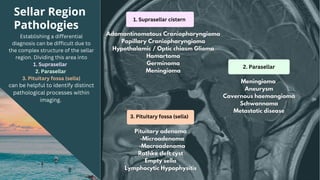
Sellar Region
Pathologies
Establishing a differential
diagnosis can be difficult due to
the complex structure of the sellar
region. Dividing this area into
1. Suprasellar
2. Parasellar
3. Pituitary fossa (sella)
can be helpful to identify distinct
pathological processes within
imaging.
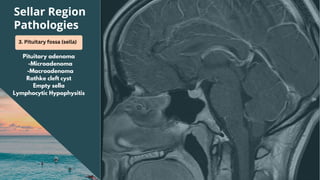
3. Pituitary fossa (sella)
1. Suprasellar cistern
2. Parasellar
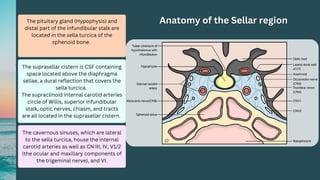
The pituitary gland (Hypophysis) and
distal part of the infundibular stalk are
located in the sella turcica of the
sphenoid bone.
The suprasellar cistern is CSF containing
space located above the diaphragma
sellae, a dural reflection that covers the
sella turcica.
The supraclinoid internal carotid arteries
circle of Willis, superior infundibular
stalk, optic nerves, chiasm, and tracts
are all located in the suprasellar cistern.
The cavernous sinuses, which are lateral
to the sella turcica, house the internal
carotid arteries as well as CN III, IV, V1/2
(the ocular and maxillary components of
the trigeminal nerve), and VI.
Anatomy of the Sellar region
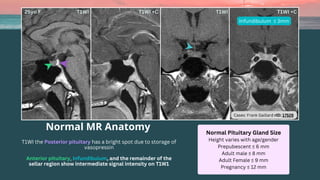
Normal MR Anatomy
T1WI the Posterior pituitary has a bright spot due to storage of
vasopressin
Anterior pituitary, Infundibulum, and the remainder of the
sellar region show intermediate signal intensity on T1W1
Normal Pituitary Gland Size
Height varies with age/gender
Prepubescent ≤ 6 mm
Adult male ≤ 8 mm
Adult Female ≤ 9 mm
Pregnancy ≤ 12 mm
Infundibulum ≤ 3mm
Cases: Frank Gaillard rID: 17529
Sellar Region
Pathologies
3. Pituitary fossa (sella)
Pituitary adenoma
-Microadenoma
-Macroadenoma
Rathke cleft cyst
Empty sella
Lymphocytic Hypophysitis
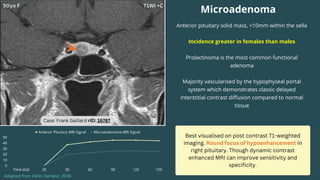
Best visualised on post contrast T1-weighted
imaging. Round focus of hypoenhancement in
right pituitary. Though dynamic contrast
enhanced MRI can improve sensitivity and
specificity.
Anterior pituitary solid mass, <10mm within the sella
Incidence greater in females than males
Prolactinoma is the most common functional
adenoma
Majority vascularised by the hypophyseal portal
system which demonstrates classic delayed
interstitial contrast diffusion compared to normal
tissue
Microadenoma
Anterior Pituitary MRI Signal Microandenoma MRI Signal
Time (Gd) 20 30 60 90 120 150
50
40
30
20
10
0
Adapted from Denis Gardeur, 2016
Case: Frank Gaillard rID: 16787
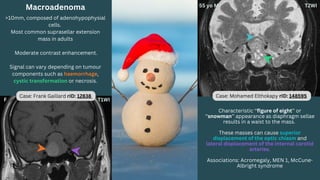
Case: Mohamed Elthokapy rID: 148595
Macroadenoma
>10mm, composed of adenohypophysial
cells.
Most common suprasellar extension
mass in adults
Moderate contrast enhancement.
Signal can vary depending on tumour
components such as haemorrhage,
cystic transformation or necrosis.
Characteristic ‘‘figure of eight’’ or
‘‘snowman’’ appearance as diaphragm sellae
results in a waist to the mass.
These masses can cause superior
displacement of the optic chiasm and
lateral displacement of the internal carotid
arteries.
Associations: Acromegaly, MEN 1, McCune-
Albright syndrome
Case: Frank Gaillard rID: 12838
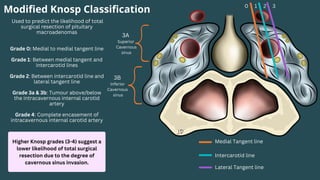
Medial Tangent line
Intercarotid line
Lateral Tangent line
Higher Knosp grades (3-4) suggest a
lower likelihood of total surgical
resection due to the degree of
cavernous sinus invasion.
Used to predict the likelihood of total
surgical resection of pituitary
macroadenomas
Grade 0: Medial to medial tangent line
Grade 1: Between medial tangent and
intercarotid lines
Grade 2: Between intercarotid line and
lateral tangent line
Grade 3a & 3b: Tumour above/below
the intracavernous internal carotid
artery
Grade 4: Complete encasement of
intracavernous internal carotid artery
Modified Knosp Classification 0 1 2 3
3A
Superior
Cavernous
sinus
3B
Inferior
Cavernous
sinus
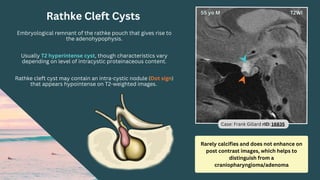
Rarely calcifies and does not enhance on
post contrast images, which helps to
distinguish from a
craniopharyngioma/adenoma
Rathke Cleft Cysts
Embryological remnant of the rathke pouch that gives rise to
the adenohypophysis.
Usually T2 hyperintense cyst, though characteristics vary
depending on level of intracystic proteinaceous content.
Rathke cleft cyst may contain an intra-cystic nodule (Dot sign)
that appears hypointense on T2-weighted images.
Case: Frank Gillard rID: 16835
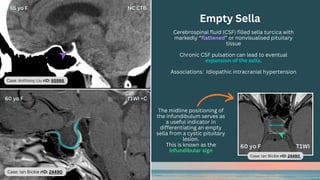
Empty Sella
Cerebrospinal fluid (CSF) filled sella turcica with
markedly “flattened” or nonvisualised pituitary
tissue
Chronic CSF pulsation can lead to eventual
expansion of the sella.
Associations: Idiopathic intracranial hypertension
Case: Anthony Liu rID: 65986
Case: Ian Bickle rID: 24490
The midline positioning of
the infundibulum serves as
a useful indicator in
differentiating an empty
sella from a cystic pituitary
lesion.
This is known as the
infundibular sign
Case: Ian Bickle rID: 24490
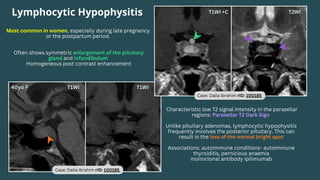
Lymphocytic Hypophysitis
Most common in women, especially during late pregnancy
or the postpartum period.
Often shows symmetric enlargement of the pituitary
gland and infundibulum
Homogeneous post contrast enhancement
Characteristic low T2 signal intensity in the parasellar
regions: Parasellar T2 Dark Sign
Unlike pituitary adenomas, lymphocytic hypophysitis
frequently involves the posterior pituitary. This can
result in the loss of the normal bright spot
Associations: autoimmune conditions- autoimmune
thyroiditis, pernicious anaemia
monoclonal antibody ipilimumab
Case: Dalia Ibrahim rID: 100185
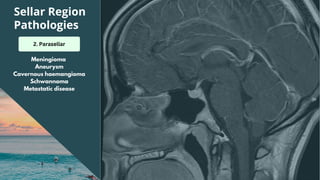
Sellar Region
Pathologies
2. Parasellar
Meningioma
Aneurysm
Cavernous haemangioma
Schwannoma
Metastatic disease
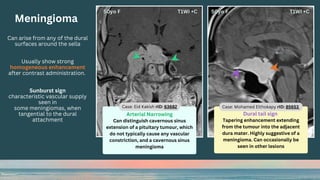
Dural tail sign
Tapering enhancement extending
from the tumour into the adjacent
dura mater. Highly suggestive of a
meningioma. Can occasionally be
seen in other lesions
Meningioma
Can arise from any of the dural
surfaces around the sella
Usually show strong
homogeneous enhancement
after contrast administration.
Sunburst sign
characteristic vascular supply
seen in
some meningiomas, when
tangential to the dural
attachment
Arterial Narrowing
Can distinguish cavernous sinus
extension of a pituitary tumour, which
do not typically cause any vascular
constriction, and a cavernous sinus
meningioma
Case: Eid Kakish rID: 63682 Case: Mohamed Elthokapy rID: 85653
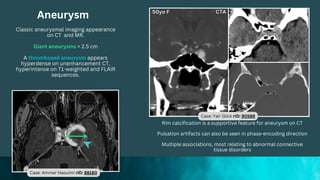
Aneurysm
Classic aneurysmal imaging appearance
on CT and MR.
Giant aneurysms > 2.5 cm
A thrombosed aneurysm appears
hyperdense on unenhancement CT,
hyperintense on T1-weighted and FLAIR
sequences.
Rim calcification is a supportive feature for aneurysm on CT
Pulsation artifacts can also be seen in phase-encoding direction
Multiple associations, most relating to abnormal connective
tissue disorders
Case: Yaïr Glick rID: 90589
Case: Ammar Haouimi rID: 88180
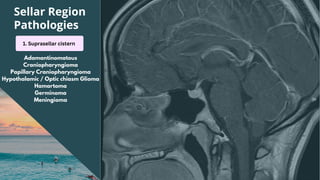
Sellar Region
Pathologies
1. Suprasellar cistern
Adamantinomatous
Craniopharyngioma
Papillary Craniopharyngioma
Hypothalamic / Optic chiasm Glioma
Hamartoma
Germinoma
Meningioma
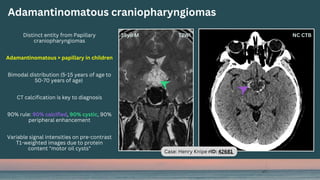
Distinct entity from Papillary
craniopharyngiomas
Adamantinomatous > papillary in children
Bimodal distribution (5-15 years of age to
50-70 years of age)
CT calcification is key to diagnosis
90% rule: 90% calcified, 90% cystic, 90%
peripheral enhancement
Variable signal intensities on pre-contrast
T1-weighted images due to protein
content "motor oil cysts"
Adamantinomatous craniopharyngiomas
Case: Henry Knipe rID: 42681
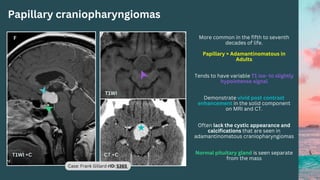
Papillary craniopharyngiomas
More common in the fifth to seventh
decades of life.
Papillary > Adamantino
matous in
Adults
Tends to have variable T1 iso- to slightly
hypointense signal
Demonstrate vivid post contrast
enhancement in the solid component
on MRI and CT.
Often lack the cystic appearance and
calcifications that are seen in
adamantinomatous craniopharyngiomas
Normal pituitary gland is seen separate
from the mass
Case: Frank Gillard rID: 5365
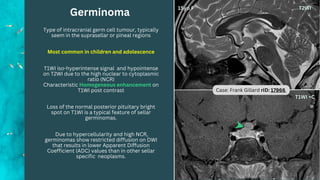
Germinoma
Case: Frank Gillard rID: 17966
Type of intracranial germ cell tumour, typically
seem in the suprasellar or pineal regions
Most common in children and adolescence
T1WI iso-hyperintense signal and hypointense
on T2WI due to the high nuclear to cytoplasmic
ratio (NCR)
Characteristic Homogeneous enhancement on
T1WI post contrast
Loss of the normal posterior pituitary bright
spot on T1WI is a typical feature of sellar
germinomas.
Due to hypercellularity and high NCR,
germinomas show restricted diffusion on DWI
that results in lower Apparent Diffusion
Coefficient (ADC) values than in other sellar
specific neoplasms.
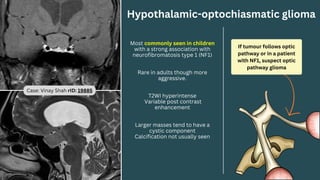
Hypothalamic-optochiasmatic glioma
If tumour follows optic
pathway or in a patient
with NF1, suspect optic
pathway glioma
Most commonly seen in children
with a strong association with
neurofibromatosis type 1 (NF1)
Rare in adults though more
aggressive.
T2WI hyperintense
Variable post contrast
enhancement
Larger masses tend to have a
cystic component
Calcification not usually seen
Case: Vinay Shah rID: 19885
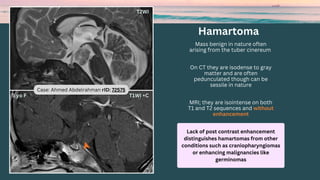
Hamartoma
Mass benign in nature often
arising from the tuber cinereum
On CT they are isodense to gray
matter and are often
pedunculated though can be
sessile in nature
MRI; they are isointense on both
T1 and T2 sequences and without
enhancement
Case: Ahmed Abdelrahman rID: 72575
Lack of post contrast enhancement
distinguishes hamartomas from other
conditions such as craniopharyngiomas
or enhancing malignancies like
germinomas
Take Home Points
Importance of Location
The anatomical location of a lesion within the sellar region and surrounding structures,
including the suprasellar cistern, cavernous sinus, and pituitary fossa, plays a key role in
differential diagnosis.
Role of Imaging
MRI is the main imaging modality used in the evaluation of sellar region lesions. CT is
useful in selected cases to detect calcifications, evaluate the relationship of lesions with
regional vessels, and assess regional bone.
Clinical Correlation
Radiographic findings should always be interpreted in the context of clinical
presentation, age, gender, and other relevant factors. Some pathologies have known
associations with certain demographics, clinical conditions or genetic factors.
Continued Learning
This presentation offers a baseline understanding, but sellar and parasellar pathologies
are a broad topic with many subtleties.
References
1. Shih R, Schroeder J, Koeller K. Primary Tumors of the Pituitary Gland: Radiologic-Pathologic Correlation. Radiographics.
2021;41(7):2029-46. doi:10.1148/rg.2021200203
2. Ugga L, Franca R, Scaravilli A et al. Neoplasms and Tumor-Like Lesions of the Sellar Region: Imaging Findings with Correlation
to Pathology and 2021 WHO Classification. Neuroradiology. 2023;65(4):675-99. doi:10.1007/s00234-023-03120-1
3. Jane Evanson. Radiology of the Pituitary. MDTextcom, Inc. 2020. https://www.ncbi.nlm.nih.gov/books/NBK279161
4. Making Sense of Sellar Region Pathology. Contemporary Diagnostic Radiology. 2015;38(22):8.
doi:10.1097/01.cdr.0000472827.42411.67
5. Gardeur D. New Protocol for the MR Imaging of Pituitary Adenomas. Multiphase, Dynamic and Volumetric Imaging on
MAGNETOM Skyra The Importance of StarVIBE and CAIPIRINHA Sequences.Siemens MRI

R23_282_Sellar_Region_Pathology_compressed.pdf

  • 1.
    Sellar region; ABRIEF LOOK INTO COMMON pathologies Jack Dalley Jack Dalley MD, BMedImagingSc RT(R) Logan Hospital Brisbane, Australia @Jack_Dalley
  • 2.
    Understand pathophysiologic and clinical features ofsellar and suprasellar lesions 1 2 3 Learning Objectives Identify common sellar region pathologies based on the MR and CT imaging features and their location Detail the sellar and suprasellar region and the importance of imaging
  • 3.
    Sellar Region Pathologies Establishing adifferential diagnosis can be difficult due to the complex structure of the sellar region. Dividing this area into 1. Suprasellar 2. Parasellar 3. Pituitary fossa (sella) can be helpful to identify distinct pathological processes within imaging. 3. Pituitary fossa (sella) 1. Suprasellar cistern 2. Parasellar
  • 4.
    The pituitary gland(Hypophysis) and distal part of the infundibular stalk are located in the sella turcica of the sphenoid bone. The suprasellar cistern is CSF containing space located above the diaphragma sellae, a dural reflection that covers the sella turcica. The supraclinoid internal carotid arteries circle of Willis, superior infundibular stalk, optic nerves, chiasm, and tracts are all located in the suprasellar cistern. The cavernous sinuses, which are lateral to the sella turcica, house the internal carotid arteries as well as CN III, IV, V1/2 (the ocular and maxillary components of the trigeminal nerve), and VI. Anatomy of the Sellar region Anatomy of the Sellar region
  • 5.
    Normal MR Anatomy T1WIthe Posterior pituitary has a bright spot due to storage of vasopressin Anterior pituitary, Infundibulum, and the remainder of the sellar region show intermediate signal intensity on T1W1 Normal Pituitary Gland Size Height varies with age/gender Prepubescent ≤ 6 mm Adult male ≤ 8 mm Adult Female ≤ 9 mm Pregnancy ≤ 12 mm Infundibulum ≤ 3mm Cases: Frank Gaillard rID: 17529
  • 6.
    Sellar Region Pathologies 3. Pituitaryfossa (sella) Pituitary adenoma -Microadenoma -Macroadenoma Rathke cleft cyst Empty sella Lymphocytic Hypophysitis
  • 7.
    Best visualised onpost contrast T1-weighted imaging. Round focus of hypoenhancement in right pituitary. Though dynamic contrast enhanced MRI can improve sensitivity and specificity. Anterior pituitary solid mass, <10mm within the sella Incidence greater in females than males Prolactinoma is the most common functional adenoma Majority vascularised by the hypophyseal portal system which demonstrates classic delayed interstitial contrast diffusion compared to normal tissue Microadenoma Anterior Pituitary MRI Signal Microandenoma MRI Signal Time (Gd) 20 30 60 90 120 150 50 40 30 20 10 0 Adapted from Denis Gardeur, 2016 Case: Frank Gaillard rID: 16787
  • 8.
    Case: Mohamed ElthokapyrID: 148595 Macroadenoma >10mm, composed of adenohypophysial cells. Most common suprasellar extension mass in adults Moderate contrast enhancement. Signal can vary depending on tumour components such as haemorrhage, cystic transformation or necrosis. Characteristic ‘‘figure of eight’’ or ‘‘snowman’’ appearance as diaphragm sellae results in a waist to the mass. These masses can cause superior displacement of the optic chiasm and lateral displacement of the internal carotid arteries. Associations: Acromegaly, MEN 1, McCune- Albright syndrome Case: Frank Gaillard rID: 12838
  • 9.
    Medial Tangent line Intercarotidline Lateral Tangent line Higher Knosp grades (3-4) suggest a lower likelihood of total surgical resection due to the degree of cavernous sinus invasion. Used to predict the likelihood of total surgical resection of pituitary macroadenomas Grade 0: Medial to medial tangent line Grade 1: Between medial tangent and intercarotid lines Grade 2: Between intercarotid line and lateral tangent line Grade 3a & 3b: Tumour above/below the intracavernous internal carotid artery Grade 4: Complete encasement of intracavernous internal carotid artery Modified Knosp Classification 0 1 2 3 3A Superior Cavernous sinus 3B Inferior Cavernous sinus
  • 10.
    Rarely calcifies anddoes not enhance on post contrast images, which helps to distinguish from a craniopharyngioma/adenoma Rathke Cleft Cysts Embryological remnant of the rathke pouch that gives rise to the adenohypophysis. Usually T2 hyperintense cyst, though characteristics vary depending on level of intracystic proteinaceous content. Rathke cleft cyst may contain an intra-cystic nodule (Dot sign) that appears hypointense on T2-weighted images. Case: Frank Gillard rID: 16835
  • 11.
    Empty Sella Cerebrospinal fluid(CSF) filled sella turcica with markedly “flattened” or nonvisualised pituitary tissue Chronic CSF pulsation can lead to eventual expansion of the sella. Associations: Idiopathic intracranial hypertension Case: Anthony Liu rID: 65986 Case: Ian Bickle rID: 24490 The midline positioning of the infundibulum serves as a useful indicator in differentiating an empty sella from a cystic pituitary lesion. This is known as the infundibular sign Case: Ian Bickle rID: 24490
  • 12.
    Lymphocytic Hypophysitis Most commonin women, especially during late pregnancy or the postpartum period. Often shows symmetric enlargement of the pituitary gland and infundibulum Homogeneous post contrast enhancement Characteristic low T2 signal intensity in the parasellar regions: Parasellar T2 Dark Sign Unlike pituitary adenomas, lymphocytic hypophysitis frequently involves the posterior pituitary. This can result in the loss of the normal bright spot Associations: autoimmune conditions- autoimmune thyroiditis, pernicious anaemia monoclonal antibody ipilimumab Case: Dalia Ibrahim rID: 100185 Case: Dalia Ibrahim rID: 100185
  • 13.
  • 14.
    Dural tail sign Taperingenhancement extending from the tumour into the adjacent dura mater. Highly suggestive of a meningioma. Can occasionally be seen in other lesions Meningioma Can arise from any of the dural surfaces around the sella Usually show strong homogeneous enhancement after contrast administration. Sunburst sign characteristic vascular supply seen in some meningiomas, when tangential to the dural attachment Arterial Narrowing Can distinguish cavernous sinus extension of a pituitary tumour, which do not typically cause any vascular constriction, and a cavernous sinus meningioma Case: Eid Kakish rID: 63682 Case: Mohamed Elthokapy rID: 85653
  • 15.
    Aneurysm Classic aneurysmal imagingappearance on CT and MR. Giant aneurysms > 2.5 cm A thrombosed aneurysm appears hyperdense on unenhancement CT, hyperintense on T1-weighted and FLAIR sequences. Rim calcification is a supportive feature for aneurysm on CT Pulsation artifacts can also be seen in phase-encoding direction Multiple associations, most relating to abnormal connective tissue disorders Case: Yaïr Glick rID: 90589 Case: Ammar Haouimi rID: 88180
  • 16.
    Sellar Region Pathologies 1. Suprasellarcistern Adamantinomatous Craniopharyngioma Papillary Craniopharyngioma Hypothalamic / Optic chiasm Glioma Hamartoma Germinoma Meningioma
  • 17.
    Distinct entity fromPapillary craniopharyngiomas Adamantinomatous > papillary in children Bimodal distribution (5-15 years of age to 50-70 years of age) CT calcification is key to diagnosis 90% rule: 90% calcified, 90% cystic, 90% peripheral enhancement Variable signal intensities on pre-contrast T1-weighted images due to protein content "motor oil cysts" Adamantinomatous craniopharyngiomas Case: Henry Knipe rID: 42681
  • 18.
    Papillary craniopharyngiomas More commonin the fifth to seventh decades of life. Papillary > Adamantino matous in Adults Tends to have variable T1 iso- to slightly hypointense signal Demonstrate vivid post contrast enhancement in the solid component on MRI and CT. Often lack the cystic appearance and calcifications that are seen in adamantinomatous craniopharyngiomas Normal pituitary gland is seen separate from the mass Case: Frank Gillard rID: 5365
  • 19.
    Germinoma Case: Frank GillardrID: 17966 Type of intracranial germ cell tumour, typically seem in the suprasellar or pineal regions Most common in children and adolescence T1WI iso-hyperintense signal and hypointense on T2WI due to the high nuclear to cytoplasmic ratio (NCR) Characteristic Homogeneous enhancement on T1WI post contrast Loss of the normal posterior pituitary bright spot on T1WI is a typical feature of sellar germinomas. Due to hypercellularity and high NCR, germinomas show restricted diffusion on DWI that results in lower Apparent Diffusion Coefficient (ADC) values than in other sellar specific neoplasms.
  • 20.
    Hypothalamic-optochiasmatic glioma If tumourfollows optic pathway or in a patient with NF1, suspect optic pathway glioma Most commonly seen in children with a strong association with neurofibromatosis type 1 (NF1) Rare in adults though more aggressive. T2WI hyperintense Variable post contrast enhancement Larger masses tend to have a cystic component Calcification not usually seen Case: Vinay Shah rID: 19885
  • 21.
    Hamartoma Mass benign innature often arising from the tuber cinereum On CT they are isodense to gray matter and are often pedunculated though can be sessile in nature MRI; they are isointense on both T1 and T2 sequences and without enhancement Case: Ahmed Abdelrahman rID: 72575 Lack of post contrast enhancement distinguishes hamartomas from other conditions such as craniopharyngiomas or enhancing malignancies like germinomas
  • 22.
    Take Home Points Importanceof Location The anatomical location of a lesion within the sellar region and surrounding structures, including the suprasellar cistern, cavernous sinus, and pituitary fossa, plays a key role in differential diagnosis. Role of Imaging MRI is the main imaging modality used in the evaluation of sellar region lesions. CT is useful in selected cases to detect calcifications, evaluate the relationship of lesions with regional vessels, and assess regional bone. Clinical Correlation Radiographic findings should always be interpreted in the context of clinical presentation, age, gender, and other relevant factors. Some pathologies have known associations with certain demographics, clinical conditions or genetic factors. Continued Learning This presentation offers a baseline understanding, but sellar and parasellar pathologies are a broad topic with many subtleties.
  • 23.
    References 1. Shih R,Schroeder J, Koeller K. Primary Tumors of the Pituitary Gland: Radiologic-Pathologic Correlation. Radiographics. 2021;41(7):2029-46. doi:10.1148/rg.2021200203 2. Ugga L, Franca R, Scaravilli A et al. Neoplasms and Tumor-Like Lesions of the Sellar Region: Imaging Findings with Correlation to Pathology and 2021 WHO Classification. Neuroradiology. 2023;65(4):675-99. doi:10.1007/s00234-023-03120-1 3. Jane Evanson. Radiology of the Pituitary. MDTextcom, Inc. 2020. https://www.ncbi.nlm.nih.gov/books/NBK279161 4. Making Sense of Sellar Region Pathology. Contemporary Diagnostic Radiology. 2015;38(22):8. doi:10.1097/01.cdr.0000472827.42411.67 5. Gardeur D. New Protocol for the MR Imaging of Pituitary Adenomas. Multiphase, Dynamic and Volumetric Imaging on MAGNETOM Skyra The Importance of StarVIBE and CAIPIRINHA Sequences.Siemens MRI