GLBT COMMUNITYBY: AMBER, Joshua & Shannon
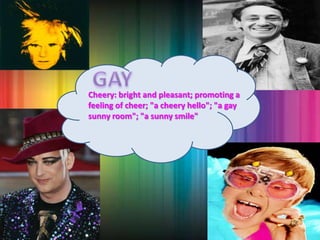
GAYCheery: bright and pleasant; promoting a feeling of cheer; "a cheery hello"; "a gay sunny room"; "a sunny smile"
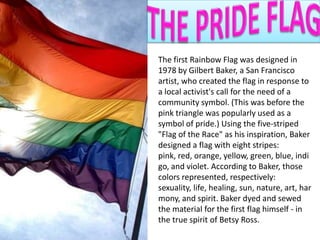
THE PRIDE FLAGThe first Rainbow Flag was designed in 1978 by Gilbert Baker, a San Francisco artist, who created the flag in response to a local activist's call for the need of a community symbol. (This was before the pink triangle was popularly used as a symbol of pride.) Using the five-striped "Flag of the Race" as his inspiration, Baker designed a flag with eight stripes: pink, red, orange, yellow, green, blue, indigo, and violet. According to Baker, those colors represented, respectively: sexuality, life, healing, sun, nature, art, harmony, and spirit. Baker dyed and sewed the material for the first flag himself - in the true spirit of Betsy Ross.
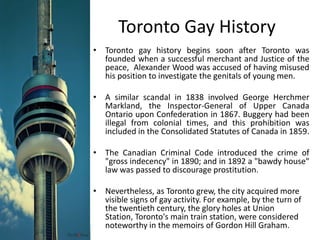
Toronto Gay HistoryToronto gay history begins soon after Toronto was founded when a successful merchant and Justice of the peace,  Alexander Wood was accused of having misused his position to investigate the genitals of young men. A similar scandal in 1838 involved George Herchmer Markland, the Inspector-General of Upper Canada Ontario upon Confederation in 1867. Buggery had been illegal from colonial times, and this prohibition was included in the Consolidated Statutes of Canada in 1859. The Canadian Criminal Code introduced the crime of "gross indecency" in 1890; and in 1892 a "bawdy house" law was passed to discourage prostitution.Nevertheless, as Toronto grew, the city acquired more visible signs of gay activity. For example, by the turn of the twentieth century, the glory holes at Union Station, Toronto's main train station, were considered noteworthy in the memoirs of Gordon Hill Graham.
The Struggle for Equal RightsHaving achieved recognition from the government, Toronto gays and lesbians went on to fight for equal rights. The Coalition for Lesbian and Gay Rights in Ontario (CLGRO), established in 1975, fought to include sexuality under the protective clauses of the Ontario Human Rights Code.However, the 1990s "We are Family" campaign implicitly contradicted the liberationist vision that earlier dominated Toronto's gay life.This direction culminated with the first gay marriages at Metropolitan Community Church in 2001 and their sanction by the Ontario Court of Appeals in 2003.In 1995, a key legal ruling by the Supreme Court of Canada found that while sexual orientation wasn't specifically mentioned in the Charter of Rights and Freedoms, they could be "read in." The next year, the federal government amended the Canadian Human Rights Act to include sexual orientation.Toronto's gay and lesbian community is now recognized as an integral part of the city's fabric. Toronto's GLBTQ community has gone from being a hidden subculture to a power base in politics, the economy, and the arts.
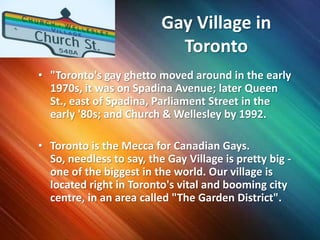
Gay Village in Toronto"Toronto's gay ghetto moved around in the early 1970s, it was on Spadina Avenue; later Queen St., east of Spadina, Parliament Street in the early '80s; and Church & Wellesley by 1992.Toronto is the Mecca for Canadian Gays. So, needless to say, the Gay Village is pretty big - one of the biggest in the world. Our village is located right in Toronto's vital and booming city centre, in an area called "The Garden District".
THE CLUB SCENE
Toronto's Gay Dance Club SceneIssues for HIV Prevention for Gay MenSummaryIn the late 1990s, outreach workers at AIDS service organizations (ASOs) in Toronto were hearing anecdotal reports linking high-risk sex among gay and bisexual men with the use of party drugs in Toronto’s gay dance club scene.Subsequently, five community-based ASOs came together to better understandgay and bisexual men’s experiences and modes of participation in the gay dance club scene, the circumstances associated with using party drugs in the scene, and the circumstances and reasoning processes associated with using party drugs in relation to sex. This knowledge is crucial to designing HIV prevention campaigns that are sensitive to the setting and culture of gay dance clubs, and the experiences of patrons.  Between June and November 2003 researchers from the five ASOs conducted in depth interviews with an ethno-racially diverse sample of 74 gay and bisexual men who use party drugs in Toronto’s gay dance clubs.Participants’ accounts of high-risk or unprotected anal sex associated with the clubscene or other types of social occasions suggest that unprotected sex is not merelydue to impaired judgement or a lapse in judgement under the influence of drugs.They indicated that drugs do or may impede their ability to practice or insist on safersex. However, they also articulated a very strong interest in sex within the realm oftheir clubbing experiences, and a generally weak or inconsistent commitment topracticing safer sex. They use drugs to enhance their dance club experiences andsexual fulfillment, but exempt themselves from safer sex in ways that are notnecessarily influenced by drugs.The research findings suggest a number of recommendations for HIV preventioneducation among gay and bisexual men who populate the dance club scene. Theserecommendations acknowledge the existing sense of community, but promote amore inclusive view of community as well as personal responsibility for the health ofcommunity members. The recommendations also build on patrons’ interest in harmreduction and their latent interest in safer sex, and promote the development of skillsand self-confidence related to safer sex and avoidance of the harms associated withDrugs.
Participants identified a number of key experiences and attributes of the dance club scene.These include getting into the music and dancing, a sense of community, the  sexualized atmosphere and, for some, the opportunity to meet men for sex. Drugs are intrinsic to these modes of experiencing the scene. However, Caribbean, South Asianand East and Southeast Asian men also remarked on how ‘whiteness’ is privileged inthe scene, and the sense of alienation that they experience. For those men, the scenepresents some challenges despite its obvious attraction.Participants use a variety of different drugs on their clubbing occasions, most notablyEcstasy alone or with at least one other drug. They vary the types, timing, sequenceand dosage to achieve certain desired effects. Though they articulated variouspractices to avoid or minimize harm, there is considerable variation in the degree towhich they carry through on those practices.
AIDS CrisisA challenge arose in 1982 with the appearance of the first cases of AIDS in Toronto. Building on the activist infrastructure already in place, a new set of institutions developed to address the needs of people with AIDS.These institutions were dominated and controlled by the gay community. The AIDS Committee of Toronto was established in June 1983, and it gave a liberationist bent to the struggle for AIDS prevention and research in Toronto.Again, Toronto's multicultural nature influenced the community's response. The city's Native community was served by Two-Spirited People of the First Nations while the Black Coalition for AIDS Prevention was established to meet the special needs of its community. Toronto took its own distinct road in combating AIDS: The baths were not closed, sex was accepted as a given, emphasis was placed on safer sex.

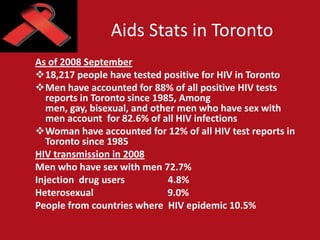
Aids Stats in TorontoAs of 2008 September18,217 people have tested positive for HIV in Toronto
Men have accounted for 88% of all positive HIV tests reports in Toronto since 1985, Among men, gay, bisexual, and other men who have sex with men account  for 82.6% of all HIV infections
Woman have accounted for 12% of all HIV test reports in Toronto since 1985HIV transmission in 2008Men who have sex with men 72.7% Injection  drug users                  4.8%Heterosexual                               9.0%People from countries where  HIV epidemic 10.5%
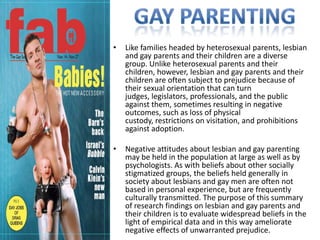
Gay ParentingLike families headed by heterosexual parents, lesbian and gay parents and their children are a diverse group. Unlike heterosexual parents and their children, however, lesbian and gay parents and their children are often subject to prejudice because of their sexual orientation that can turn judges, legislators, professionals, and the public against them, sometimes resulting in negative outcomes, such as loss of physical custody, restrictions on visitation, and prohibitions against adoption. Negative attitudes about lesbian and gay parenting may be held in the population at large as well as by psychologists. As with beliefs about other socially stigmatized groups, the beliefs held generally in society about lesbians and gay men are often not based in personal experience, but are frequently culturally transmitted. The purpose of this summary of research findings on lesbian and gay parents and their children is to evaluate widespread beliefs in the light of empirical data and in this way ameliorate negative effects of unwarranted prejudice.
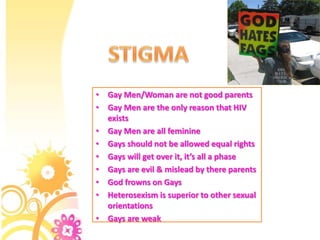
Gay StigmasSTIGMAGay Men/Woman are not good parentsGay Men are the only reason that HIV existsGay Men are all feminine Gays should not be allowed equal rights Gays will get over it, it’s all a phaseGays are evil& mislead by there parentsGod frowns on Gays Heterosexism is superior to other sexual orientationsGays are weak
HistoryResearch within the gay/lesbian history shows that there have always been men and women who have had same-sex relationships throughout history and across cultures.
The German and other European gay movements founded at the end of the 19th century were destroyed by the Nazi holocaust in the 1930s and 1940s. Homophobia reached its culmination in Nazi Germany when masses of people went to their deaths in concentration camps because they were or were thought to be gay men. Lesbians were not persecuted in the same way as gay men.
In Canada the age of consent for gay male or lesbian sex has until recently been 21, while it was 18 for heterosexual sex. This double standard meant, for example, that a heterosexual man could legally have sex with an 18 year old woman, but a gay man could not legally have sex with another gay or bisexual man who was 18 years old. Therefore, this group of young lesbians and gay men had lived with the knowledge that their sexual activity was not only stigmatized but also illegal.DYKELabelsLesbian (lɛzbiːən) is a term most widely used in the English language to describe sexual and romantic desire between females. The word may be used as a noun, to refer to women who identify themselves or who are characterized by others as having the primary attribute of female homosexuality, or as an adjective, to describe characteristics of an object or activity related to female same-sex desire.
Feminist historians assert that the primary motivation for sexologists to describe lesbians was based on their wariness of women's growing independence from menBUTCH
Two SpiritedPeople are Native Americans who fulfill one of many mixed gender roles found among many Native Americans and Canadian First Nations groups. Traditionally the roles included wearing the clothing and doing the work of both males and females . It usually implies a masculine spirit and a feminine spirit living in the same body.As of 1991, male and female bodied Two-Spirit people have been "documented in over 130 tribes, in every region of North America, among every type of native culture".
Religious IssuesScripture does NOT condemn being gayFor all of those who read the Bible, “The Book of Jesus Christ” Paul wrote (Romans 8:1): "There is therefore now no condemnation for those who are in Christ Jesus." There is NO CONDEMNATION. Paul means, There is no condemnation for those who are in Christ. If you are in Christ, then there is nothing, nothing at all, that can separate you from God's love. If you believe in Christ, the only Son of God; if you believe that for us he came down from heaven was crucified, died, buried, and rose again; if you believe, then the law of the Spirit of life in Christ Jesus has set you free from the law of sin and of death (Romans 8:2).Many other religious backgrounds refuse to see the Lesbian way of  sexuality. This web site discusses every type of religious issue concerning Lesbian acceptance or rejection.http://www.members.shaw.ca/samasutra/spiritual.html
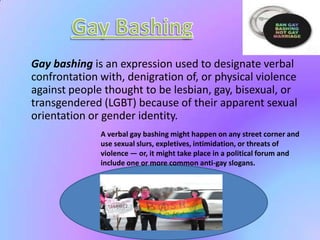
Gay Bashing	Gay bashing is an expression used to designate verbal confrontation with, denigration of, or physical violence against people thought to be lesbian, gay, bisexual, or transgendered (LGBT) because of their apparent sexual orientation or gender identity. A verbal gay bashing might happen on any street corner and use sexual slurs, expletives, intimidation, or threats of violence — or, it might take place in a political forum and include one or more common anti-gay slogans.
CriminalizationThe decriminalizing of same-sex sexual activity took place in 1969. In 1977.Quebec became the first Canadian province to include sexual orientation in its Human Rights Code as prohibited grounds for decriminalization in access to goods, Services and accommodation.
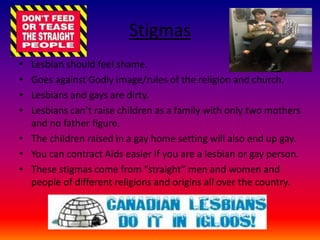
StigmasLesbian should feel shame.Goes against Godly image/rules of the religion and church.Lesbians and gays are dirty.Lesbians can’t raise children as a family with only two mothers and no father figure.The children raised in a gay home setting will also end up gay.You can contract Aids easier if you are a lesbian or gay person.These stigmas come from “straight” men and women and people of different religions and origins all over the country.
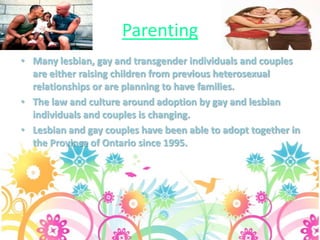
ParentingMany lesbian, gay and transgender individuals and couples are either raising children from previous heterosexual relationships or are planning to have families.The law and culture around adoption by gay and lesbian individuals and couples is changing.Lesbian and gay couples have been able to adopt together in the Province of Ontario since 1995.
Parenting IssuesDespite arguments to the contrary, there is no evidence that the development of children of lesbian or gay parents is compromised compared to children of heterosexual parents.There is also no evidence for the fears that homosexual parents will have homosexual children or that the children will develop "improper" sex role behavior or damaging conflicts with their peers
Programs Within the Lesbian CommunityLesbian and gay organizations continued to grow and expand.
By 1988, a Toronto directory of groups and services published by the Social Services Network listed 134 organizations, ranging from support groups for gays and lesbians of specific sociocultural or religious backgrounds (Black, Asian, Jewish, Roman Catholic) to social action groups concerned with public education and advocacy.Just A PoemI love you my brothers and sisters, wherever you are. Whether you kneel in your church worship in your Synagogue or pray in your mosque... I love you whoever you are, you and I are all children of one faith, for the diverse paths of religion are the fingers of the living hand of one Supreme Being, a hand extended to all.- Kahlil Gibran          Don’t make assumptions about me or anybody else.        Take your chalkboard and wipe it clean every time you enter into conversations with  patients.         Go in  with clear eyes and pure heart,         understanding that we are all persons  ,even         though the way we are in the world is different.        When we are cut, we all  bleed…. You might say you don’t have time. I say time is relative         There is always time to treat other people           like human beings.           (Stevens, 1998)Goddess
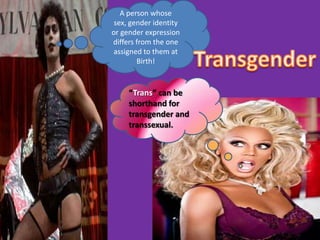
A person whose sex, gender identity or gender expression differs from the one assigned to them at Birth!Transgender“Trans” can be shorthand for transgender and transsexual.
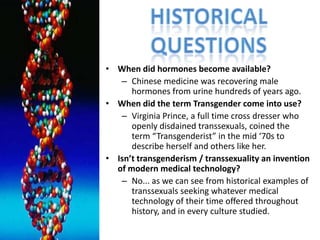
Historical QuestionsWhen did hormones become available?Chinese medicine was recovering male hormones from urine hundreds of years ago.When did the term Transgender come into use?Virginia Prince, a full time cross dresser who openly disdained transsexuals, coined the term “Transgenderist” in the mid ‘70s to describe herself and others like her.Isn’t transgenderism / transsexuality an invention of modern medical technology?No... as we can see from historical examples of transsexuals seeking whatever medical technology of their time offered throughout history, and in every culture studied.
PhalloplastyA complete construction or reconstruction of a penis is done on both cisgendered men who have lost their penis through either illness or accidents, and on trans men, that is, female-to-male transgendered or transsexual people.
Defining Relevant Terms:Stigma: the negative evaluation of a socially devalued attributeDiscrimination: To act on the basis of prejudice (Webster’s, 1986)Transphobia: Refers to discrimination against trans people, based on the expression of their gender identity (Wikipedia), often confused with homophobia but is specific to gender.
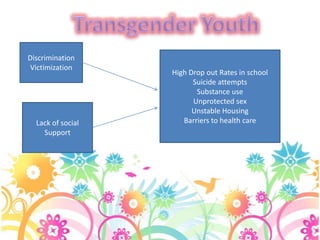
Transgender YouthDiscriminationVictimizationHigh Drop out Rates in schoolSuicide attemptsSubstance useUnprotected sexUnstable HousingBarriers to health careLack of social Support
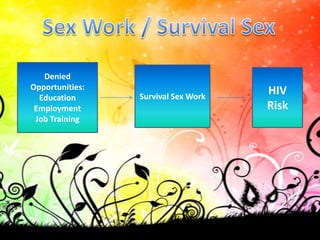
Sex Work / Survival SexDenied Opportunities:EducationEmploymentJob TrainingSurvival Sex WorkHIV Risk
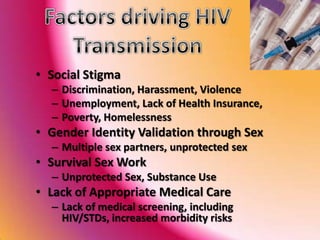
Factors driving HIV Transmission Social StigmaDiscrimination, Harassment, ViolenceUnemployment, Lack of Health Insurance,Poverty, HomelessnessGender Identity Validation through SexMultiple sex partners, unprotected sexSurvival Sex WorkUnprotected Sex, Substance UseLack of Appropriate Medical CareLack of medical screening, including HIV/STDs, increased morbidity risks
Hormone therapy for trans people living with HIVThere are no significant drug interactions with drugs used to treat HIV.Several HIV medications change the levels of estrogens.Hormone therapy is not contraindicated in HIV disease at any stage.Hormone therapy can increase adherence to HIV medications.
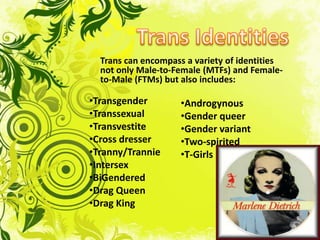
Trans IdentitiesTrans can encompass a variety of identities not only Male-to-Female (MTFs) and Female-to-Male (FTMs) but also includes: Transgender
Transsexual
Transvestite
Cross dresser
Tranny/Trannie
Intersex
BiGendered
Drag Queen
Drag King
Androgynous

Queer Community

  • 1.
    GLBT COMMUNITYBY: AMBER,Joshua & Shannon
  • 3.
    GAYCheery: bright andpleasant; promoting a feeling of cheer; "a cheery hello"; "a gay sunny room"; "a sunny smile"
  • 4.
    THE PRIDE FLAGThefirst Rainbow Flag was designed in 1978 by Gilbert Baker, a San Francisco artist, who created the flag in response to a local activist's call for the need of a community symbol. (This was before the pink triangle was popularly used as a symbol of pride.) Using the five-striped "Flag of the Race" as his inspiration, Baker designed a flag with eight stripes: pink, red, orange, yellow, green, blue, indigo, and violet. According to Baker, those colors represented, respectively: sexuality, life, healing, sun, nature, art, harmony, and spirit. Baker dyed and sewed the material for the first flag himself - in the true spirit of Betsy Ross.
  • 5.
    Toronto Gay HistoryTorontogay history begins soon after Toronto was founded when a successful merchant and Justice of the peace, Alexander Wood was accused of having misused his position to investigate the genitals of young men. A similar scandal in 1838 involved George Herchmer Markland, the Inspector-General of Upper Canada Ontario upon Confederation in 1867. Buggery had been illegal from colonial times, and this prohibition was included in the Consolidated Statutes of Canada in 1859. The Canadian Criminal Code introduced the crime of "gross indecency" in 1890; and in 1892 a "bawdy house" law was passed to discourage prostitution.Nevertheless, as Toronto grew, the city acquired more visible signs of gay activity. For example, by the turn of the twentieth century, the glory holes at Union Station, Toronto's main train station, were considered noteworthy in the memoirs of Gordon Hill Graham.
  • 6.
    The Struggle forEqual RightsHaving achieved recognition from the government, Toronto gays and lesbians went on to fight for equal rights. The Coalition for Lesbian and Gay Rights in Ontario (CLGRO), established in 1975, fought to include sexuality under the protective clauses of the Ontario Human Rights Code.However, the 1990s "We are Family" campaign implicitly contradicted the liberationist vision that earlier dominated Toronto's gay life.This direction culminated with the first gay marriages at Metropolitan Community Church in 2001 and their sanction by the Ontario Court of Appeals in 2003.In 1995, a key legal ruling by the Supreme Court of Canada found that while sexual orientation wasn't specifically mentioned in the Charter of Rights and Freedoms, they could be "read in." The next year, the federal government amended the Canadian Human Rights Act to include sexual orientation.Toronto's gay and lesbian community is now recognized as an integral part of the city's fabric. Toronto's GLBTQ community has gone from being a hidden subculture to a power base in politics, the economy, and the arts.
  • 7.
    Gay Village inToronto"Toronto's gay ghetto moved around in the early 1970s, it was on Spadina Avenue; later Queen St., east of Spadina, Parliament Street in the early '80s; and Church & Wellesley by 1992.Toronto is the Mecca for Canadian Gays. So, needless to say, the Gay Village is pretty big - one of the biggest in the world. Our village is located right in Toronto's vital and booming city centre, in an area called "The Garden District".
  • 9.
  • 10.
    Toronto's Gay DanceClub SceneIssues for HIV Prevention for Gay MenSummaryIn the late 1990s, outreach workers at AIDS service organizations (ASOs) in Toronto were hearing anecdotal reports linking high-risk sex among gay and bisexual men with the use of party drugs in Toronto’s gay dance club scene.Subsequently, five community-based ASOs came together to better understandgay and bisexual men’s experiences and modes of participation in the gay dance club scene, the circumstances associated with using party drugs in the scene, and the circumstances and reasoning processes associated with using party drugs in relation to sex. This knowledge is crucial to designing HIV prevention campaigns that are sensitive to the setting and culture of gay dance clubs, and the experiences of patrons. Between June and November 2003 researchers from the five ASOs conducted in depth interviews with an ethno-racially diverse sample of 74 gay and bisexual men who use party drugs in Toronto’s gay dance clubs.Participants’ accounts of high-risk or unprotected anal sex associated with the clubscene or other types of social occasions suggest that unprotected sex is not merelydue to impaired judgement or a lapse in judgement under the influence of drugs.They indicated that drugs do or may impede their ability to practice or insist on safersex. However, they also articulated a very strong interest in sex within the realm oftheir clubbing experiences, and a generally weak or inconsistent commitment topracticing safer sex. They use drugs to enhance their dance club experiences andsexual fulfillment, but exempt themselves from safer sex in ways that are notnecessarily influenced by drugs.The research findings suggest a number of recommendations for HIV preventioneducation among gay and bisexual men who populate the dance club scene. Theserecommendations acknowledge the existing sense of community, but promote amore inclusive view of community as well as personal responsibility for the health ofcommunity members. The recommendations also build on patrons’ interest in harmreduction and their latent interest in safer sex, and promote the development of skillsand self-confidence related to safer sex and avoidance of the harms associated withDrugs.
  • 11.
    Participants identified anumber of key experiences and attributes of the dance club scene.These include getting into the music and dancing, a sense of community, the sexualized atmosphere and, for some, the opportunity to meet men for sex. Drugs are intrinsic to these modes of experiencing the scene. However, Caribbean, South Asianand East and Southeast Asian men also remarked on how ‘whiteness’ is privileged inthe scene, and the sense of alienation that they experience. For those men, the scenepresents some challenges despite its obvious attraction.Participants use a variety of different drugs on their clubbing occasions, most notablyEcstasy alone or with at least one other drug. They vary the types, timing, sequenceand dosage to achieve certain desired effects. Though they articulated variouspractices to avoid or minimize harm, there is considerable variation in the degree towhich they carry through on those practices.
  • 12.
    AIDS CrisisA challengearose in 1982 with the appearance of the first cases of AIDS in Toronto. Building on the activist infrastructure already in place, a new set of institutions developed to address the needs of people with AIDS.These institutions were dominated and controlled by the gay community. The AIDS Committee of Toronto was established in June 1983, and it gave a liberationist bent to the struggle for AIDS prevention and research in Toronto.Again, Toronto's multicultural nature influenced the community's response. The city's Native community was served by Two-Spirited People of the First Nations while the Black Coalition for AIDS Prevention was established to meet the special needs of its community. Toronto took its own distinct road in combating AIDS: The baths were not closed, sex was accepted as a given, emphasis was placed on safer sex.

  • 13.
    Aids Stats inTorontoAs of 2008 September18,217 people have tested positive for HIV in Toronto
  • 14.
    Men have accountedfor 88% of all positive HIV tests reports in Toronto since 1985, Among men, gay, bisexual, and other men who have sex with men account for 82.6% of all HIV infections
  • 15.
    Woman have accountedfor 12% of all HIV test reports in Toronto since 1985HIV transmission in 2008Men who have sex with men 72.7% Injection drug users 4.8%Heterosexual 9.0%People from countries where HIV epidemic 10.5%
  • 16.
    Gay ParentingLike familiesheaded by heterosexual parents, lesbian and gay parents and their children are a diverse group. Unlike heterosexual parents and their children, however, lesbian and gay parents and their children are often subject to prejudice because of their sexual orientation that can turn judges, legislators, professionals, and the public against them, sometimes resulting in negative outcomes, such as loss of physical custody, restrictions on visitation, and prohibitions against adoption. Negative attitudes about lesbian and gay parenting may be held in the population at large as well as by psychologists. As with beliefs about other socially stigmatized groups, the beliefs held generally in society about lesbians and gay men are often not based in personal experience, but are frequently culturally transmitted. The purpose of this summary of research findings on lesbian and gay parents and their children is to evaluate widespread beliefs in the light of empirical data and in this way ameliorate negative effects of unwarranted prejudice.
  • 17.
    Gay StigmasSTIGMAGay Men/Womanare not good parentsGay Men are the only reason that HIV existsGay Men are all feminine Gays should not be allowed equal rights Gays will get over it, it’s all a phaseGays are evil& mislead by there parentsGod frowns on Gays Heterosexism is superior to other sexual orientationsGays are weak
  • 19.
    HistoryResearch within thegay/lesbian history shows that there have always been men and women who have had same-sex relationships throughout history and across cultures.
  • 20.
    The German andother European gay movements founded at the end of the 19th century were destroyed by the Nazi holocaust in the 1930s and 1940s. Homophobia reached its culmination in Nazi Germany when masses of people went to their deaths in concentration camps because they were or were thought to be gay men. Lesbians were not persecuted in the same way as gay men.
  • 21.
    In Canada theage of consent for gay male or lesbian sex has until recently been 21, while it was 18 for heterosexual sex. This double standard meant, for example, that a heterosexual man could legally have sex with an 18 year old woman, but a gay man could not legally have sex with another gay or bisexual man who was 18 years old. Therefore, this group of young lesbians and gay men had lived with the knowledge that their sexual activity was not only stigmatized but also illegal.DYKELabelsLesbian (lɛzbiːən) is a term most widely used in the English language to describe sexual and romantic desire between females. The word may be used as a noun, to refer to women who identify themselves or who are characterized by others as having the primary attribute of female homosexuality, or as an adjective, to describe characteristics of an object or activity related to female same-sex desire.
  • 22.
    Feminist historians assertthat the primary motivation for sexologists to describe lesbians was based on their wariness of women's growing independence from menBUTCH
  • 23.
    Two SpiritedPeople areNative Americans who fulfill one of many mixed gender roles found among many Native Americans and Canadian First Nations groups. Traditionally the roles included wearing the clothing and doing the work of both males and females . It usually implies a masculine spirit and a feminine spirit living in the same body.As of 1991, male and female bodied Two-Spirit people have been "documented in over 130 tribes, in every region of North America, among every type of native culture".
  • 24.
    Religious IssuesScripture doesNOT condemn being gayFor all of those who read the Bible, “The Book of Jesus Christ” Paul wrote (Romans 8:1): "There is therefore now no condemnation for those who are in Christ Jesus." There is NO CONDEMNATION. Paul means, There is no condemnation for those who are in Christ. If you are in Christ, then there is nothing, nothing at all, that can separate you from God's love. If you believe in Christ, the only Son of God; if you believe that for us he came down from heaven was crucified, died, buried, and rose again; if you believe, then the law of the Spirit of life in Christ Jesus has set you free from the law of sin and of death (Romans 8:2).Many other religious backgrounds refuse to see the Lesbian way of sexuality. This web site discusses every type of religious issue concerning Lesbian acceptance or rejection.http://www.members.shaw.ca/samasutra/spiritual.html
  • 26.
    Gay Bashing Gay bashingis an expression used to designate verbal confrontation with, denigration of, or physical violence against people thought to be lesbian, gay, bisexual, or transgendered (LGBT) because of their apparent sexual orientation or gender identity. A verbal gay bashing might happen on any street corner and use sexual slurs, expletives, intimidation, or threats of violence — or, it might take place in a political forum and include one or more common anti-gay slogans.
  • 27.
    CriminalizationThe decriminalizing ofsame-sex sexual activity took place in 1969. In 1977.Quebec became the first Canadian province to include sexual orientation in its Human Rights Code as prohibited grounds for decriminalization in access to goods, Services and accommodation.
  • 28.
    StigmasLesbian should feelshame.Goes against Godly image/rules of the religion and church.Lesbians and gays are dirty.Lesbians can’t raise children as a family with only two mothers and no father figure.The children raised in a gay home setting will also end up gay.You can contract Aids easier if you are a lesbian or gay person.These stigmas come from “straight” men and women and people of different religions and origins all over the country.
  • 29.
    ParentingMany lesbian, gayand transgender individuals and couples are either raising children from previous heterosexual relationships or are planning to have families.The law and culture around adoption by gay and lesbian individuals and couples is changing.Lesbian and gay couples have been able to adopt together in the Province of Ontario since 1995.
  • 30.
    Parenting IssuesDespite argumentsto the contrary, there is no evidence that the development of children of lesbian or gay parents is compromised compared to children of heterosexual parents.There is also no evidence for the fears that homosexual parents will have homosexual children or that the children will develop "improper" sex role behavior or damaging conflicts with their peers
  • 31.
    Programs Within theLesbian CommunityLesbian and gay organizations continued to grow and expand.
  • 32.
    By 1988, aToronto directory of groups and services published by the Social Services Network listed 134 organizations, ranging from support groups for gays and lesbians of specific sociocultural or religious backgrounds (Black, Asian, Jewish, Roman Catholic) to social action groups concerned with public education and advocacy.Just A PoemI love you my brothers and sisters, wherever you are. Whether you kneel in your church worship in your Synagogue or pray in your mosque... I love you whoever you are, you and I are all children of one faith, for the diverse paths of religion are the fingers of the living hand of one Supreme Being, a hand extended to all.- Kahlil Gibran Don’t make assumptions about me or anybody else. Take your chalkboard and wipe it clean every time you enter into conversations with patients. Go in with clear eyes and pure heart, understanding that we are all persons ,even though the way we are in the world is different. When we are cut, we all bleed…. You might say you don’t have time. I say time is relative There is always time to treat other people like human beings. (Stevens, 1998)Goddess
  • 34.
    A person whosesex, gender identity or gender expression differs from the one assigned to them at Birth!Transgender“Trans” can be shorthand for transgender and transsexual.
  • 35.
    Historical QuestionsWhen didhormones become available?Chinese medicine was recovering male hormones from urine hundreds of years ago.When did the term Transgender come into use?Virginia Prince, a full time cross dresser who openly disdained transsexuals, coined the term “Transgenderist” in the mid ‘70s to describe herself and others like her.Isn’t transgenderism / transsexuality an invention of modern medical technology?No... as we can see from historical examples of transsexuals seeking whatever medical technology of their time offered throughout history, and in every culture studied.
  • 36.
    PhalloplastyA complete constructionor reconstruction of a penis is done on both cisgendered men who have lost their penis through either illness or accidents, and on trans men, that is, female-to-male transgendered or transsexual people.
  • 37.
    Defining Relevant Terms:Stigma:the negative evaluation of a socially devalued attributeDiscrimination: To act on the basis of prejudice (Webster’s, 1986)Transphobia: Refers to discrimination against trans people, based on the expression of their gender identity (Wikipedia), often confused with homophobia but is specific to gender.
  • 38.
    Transgender YouthDiscriminationVictimizationHigh Dropout Rates in schoolSuicide attemptsSubstance useUnprotected sexUnstable HousingBarriers to health careLack of social Support
  • 39.
    Sex Work /Survival SexDenied Opportunities:EducationEmploymentJob TrainingSurvival Sex WorkHIV Risk
  • 40.
    Factors driving HIVTransmission Social StigmaDiscrimination, Harassment, ViolenceUnemployment, Lack of Health Insurance,Poverty, HomelessnessGender Identity Validation through SexMultiple sex partners, unprotected sexSurvival Sex WorkUnprotected Sex, Substance UseLack of Appropriate Medical CareLack of medical screening, including HIV/STDs, increased morbidity risks
  • 41.
    Hormone therapy fortrans people living with HIVThere are no significant drug interactions with drugs used to treat HIV.Several HIV medications change the levels of estrogens.Hormone therapy is not contraindicated in HIV disease at any stage.Hormone therapy can increase adherence to HIV medications.
  • 42.
    Trans IdentitiesTrans canencompass a variety of identities not only Male-to-Female (MTFs) and Female-to-Male (FTMs) but also includes: Transgender
  • 43.
  • 44.
  • 45.
  • 46.
  • 47.
  • 48.
  • 49.
  • 50.
  • 51.

Editor's Notes

  • #33 Today’s highly visible transgender movement is the continuation of a century of experience and activism. From the beginning it has been an international effort to gain self-determination and medical and legal recognition, with heroes, villains, triumphs and defeats in every decade. The experiences of transsexuals, transgenderists, cross-dressers and intersexuals have interwoven as definitions of sex, gender, perversion and disorder evolved from Victorian to Post-Modern. This class will explore the people and the issues they faced as the transgender community formed and helped create today’s celebration of diversity. Today’s highly visible transgender movement is the continuation of a century of experience and activism. From the beginning it has been an international effort to gain self-determination and medical and legal recognition, with heroes, villains, triumphs and defeats in every decade. The experiences of transsexuals, transgenderists, cross-dressers and intersexuals have interwoven as definitions of sex, gender, perversion and disorder evolved from Victorian to Post-Modern. This class will explore the people and the issues they faced as the transgender community formed and helped create today’s celebration of diversity.
  • #45 http://www.egale.ca/index.asp?lang=E&item=1086