Queen Victoria
Victoria was born at Kensington Palace, London, on 24 May 1819. She was the only daughter of Edward, Duke of Kent, fourth son of George III. Her father died shortly after her birth and she became heir to the throne because the three uncles had no legitimate children who survived.
Queen Victoria is associated with Britain's great age of industrial expansion, economic progress and, especially, empire. At her death, it was said, Britain had a worldwide empire on which the sun never set.
Her marriage to Prince Albert brought nine children between 1840 and 1857. Most of her children married into other Royal families of Europe.
 
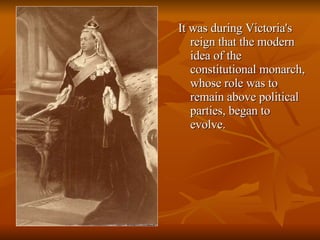
It was during Victoria's reign that the modern idea of the constitutional monarch, whose role was to remain above political parties, began to evolve.
In her later years, she almost became the symbol of the British Empire.
Despite her advanced age, Victoria continued her duties to the end - including an official visit to Dublin in 1900.
Victoria died at Osborne House on the Isle of Wight, on 22 January 1901 after a reign which lasted almost 64 years, the longest in British history.
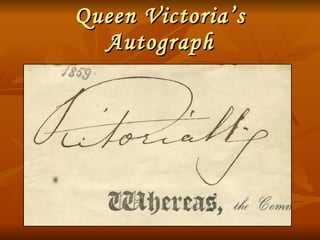
Queen Victoria’s Autograph

Queen%20 Victoria[1]

  • 1.
  • 2.
    Victoria was bornat Kensington Palace, London, on 24 May 1819. She was the only daughter of Edward, Duke of Kent, fourth son of George III. Her father died shortly after her birth and she became heir to the throne because the three uncles had no legitimate children who survived.
  • 3.
    Queen Victoria isassociated with Britain's great age of industrial expansion, economic progress and, especially, empire. At her death, it was said, Britain had a worldwide empire on which the sun never set.
  • 4.
    Her marriage toPrince Albert brought nine children between 1840 and 1857. Most of her children married into other Royal families of Europe.
  • 5.
  • 6.
    It was duringVictoria's reign that the modern idea of the constitutional monarch, whose role was to remain above political parties, began to evolve.
  • 7.
    In her lateryears, she almost became the symbol of the British Empire.
  • 8.
    Despite her advancedage, Victoria continued her duties to the end - including an official visit to Dublin in 1900.
  • 9.
    Victoria died atOsborne House on the Isle of Wight, on 22 January 1901 after a reign which lasted almost 64 years, the longest in British history.
  • 10.