Dr. Vishal Patil
Associate Professor
Department of Mechanical Engineering
1
Sharad Institute of Technology, College of
Engineering, Yadrav- Ichalkarnji
Department of Mechanical Engineering
Thermodynamics
 Quasi-static Process
 Macroscopic and Microscopic View
 Work Transfer
 Zeroth Law of Thermodynamics
2
Content
1. Macroscopic and Microscopic point view
2. Process
3. Quasi static process
4. Steady flow process
5. Work Transfer
6. Work done during quasi static process or quasi equilibrium process
7. Zeroth law of thermodynamics
8. Other types of work transfer
3
1. Macroscopic vs. Microscopic
The behavior of gas is described by summing of the behavior of each
molecules, such a study made in microscopic or statistical thermodynamics.
Macroscopic thermodynamics is only concerned with effect of action many
molecules and these effects can be sense by humans.
Ref: YouTube: Nidhi Agarwal
4
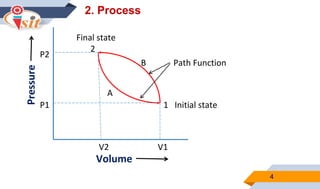
2. Process
Pressure
Volume
A
B
1
2
P2
P1
V2 V1
Initial state
Final state
Path Function
5
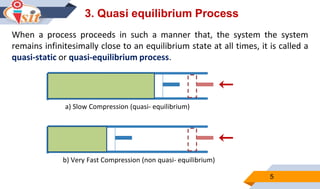
3. Quasi equilibrium Process
a) Slow Compression (quasi- equilibrium)
b) Very Fast Compression (non quasi- equilibrium)
When a process proceeds in such a manner that, the system the system
remains infinitesimally close to an equilibrium state at all times, it is called a
quasi-static or quasi-equilibrium process.
6
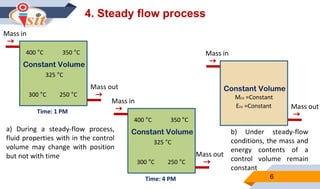
4. Steady flow process
Mcv =Constant
Constant Volume
Constant Volume
400 °C 350 °C
300 °C 250 °C
325 °C
Mass in
Mass out
Time: 1 PM
Constant Volume
400 °C 350 °C
300 °C 250 °C
325 °C
Mass in
Mass out
Time: 4 PM
Mass in
Mass out
a) During a steady-flow process,
fluid properties with in the control
volume may change with position
but not with time
b) Under steady-flow
conditions, the mass and
energy contents of a
control volume remain
constant
Ecv =Constant
7
5. Work transfer
Battery
Motor
Fan
W
Surroundings
System Boundary
Battery
Motor
Surroundings
System Boundary
Pulley
Weight
a) Driving-Motor System Diving a Fan b) Work Transfer from System
8
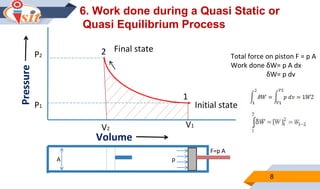
6. Work done during a Quasi Static or
Quasi Equilibrium Process
A p
F=p A
Pressure
Volume
1
2
P2
P1
V2
V1
Initial state
Final state
Total force on piston F = p A
Work done δW= p A dx
δW= p dv
9
7. Zeroth Law of Thermodynamics
System
A
System
B
System
C
Equilibrium
Equilibrium
Equilibrium
The Zeroth Law of Thermodynamics states that, if two bodies are in thermal
equilibrium with third body, they are also in thermal equilibrium with each
other.
10
8. Other Types of Work Transfer
1. Electrical work
2. Shaft work
3. Flow work
4. Work done in changing area of a surface film
5. Magnetization of a Paramagnetic Solid
6. Work done in stretching a wire
11
References:
1.Thermodynamics an Engineering Approach, Yunus Cengel and Michel A. Boles, Mc Graw Hill
Education, New Delhi
2.Refrigeration and Air Conditioning, P. L. Ballaney, Khanna Publications, New Delhi
3.Basic and Applied Thermodynamics, Prof. P. K. Nag, Mc Graw Hill Education, New Delhi
This video is prepared for academic use only.

Quasi static process details (Thermodynamics)

  • 1.
    Dr. Vishal Patil AssociateProfessor Department of Mechanical Engineering 1 Sharad Institute of Technology, College of Engineering, Yadrav- Ichalkarnji Department of Mechanical Engineering Thermodynamics  Quasi-static Process  Macroscopic and Microscopic View  Work Transfer  Zeroth Law of Thermodynamics
  • 2.
    2 Content 1. Macroscopic andMicroscopic point view 2. Process 3. Quasi static process 4. Steady flow process 5. Work Transfer 6. Work done during quasi static process or quasi equilibrium process 7. Zeroth law of thermodynamics 8. Other types of work transfer
  • 3.
    3 1. Macroscopic vs.Microscopic The behavior of gas is described by summing of the behavior of each molecules, such a study made in microscopic or statistical thermodynamics. Macroscopic thermodynamics is only concerned with effect of action many molecules and these effects can be sense by humans. Ref: YouTube: Nidhi Agarwal
  • 4.
  • 5.
    5 3. Quasi equilibriumProcess a) Slow Compression (quasi- equilibrium) b) Very Fast Compression (non quasi- equilibrium) When a process proceeds in such a manner that, the system the system remains infinitesimally close to an equilibrium state at all times, it is called a quasi-static or quasi-equilibrium process.
  • 6.
    6 4. Steady flowprocess Mcv =Constant Constant Volume Constant Volume 400 °C 350 °C 300 °C 250 °C 325 °C Mass in Mass out Time: 1 PM Constant Volume 400 °C 350 °C 300 °C 250 °C 325 °C Mass in Mass out Time: 4 PM Mass in Mass out a) During a steady-flow process, fluid properties with in the control volume may change with position but not with time b) Under steady-flow conditions, the mass and energy contents of a control volume remain constant Ecv =Constant
  • 7.
    7 5. Work transfer Battery Motor Fan W Surroundings SystemBoundary Battery Motor Surroundings System Boundary Pulley Weight a) Driving-Motor System Diving a Fan b) Work Transfer from System
  • 8.
    8 6. Work doneduring a Quasi Static or Quasi Equilibrium Process A p F=p A Pressure Volume 1 2 P2 P1 V2 V1 Initial state Final state Total force on piston F = p A Work done δW= p A dx δW= p dv
  • 9.
    9 7. Zeroth Lawof Thermodynamics System A System B System C Equilibrium Equilibrium Equilibrium The Zeroth Law of Thermodynamics states that, if two bodies are in thermal equilibrium with third body, they are also in thermal equilibrium with each other.
  • 10.
    10 8. Other Typesof Work Transfer 1. Electrical work 2. Shaft work 3. Flow work 4. Work done in changing area of a surface film 5. Magnetization of a Paramagnetic Solid 6. Work done in stretching a wire
  • 11.
    11 References: 1.Thermodynamics an EngineeringApproach, Yunus Cengel and Michel A. Boles, Mc Graw Hill Education, New Delhi 2.Refrigeration and Air Conditioning, P. L. Ballaney, Khanna Publications, New Delhi 3.Basic and Applied Thermodynamics, Prof. P. K. Nag, Mc Graw Hill Education, New Delhi This video is prepared for academic use only.