PRE-TEST
Conduct Pre-Test First
Can You Identify
the Picture?
Measuring Cup and
Spoon
Mixing Bowl
Scraper
Blender
Grater
Tools and
Equipment Used
in Preparing
Desserts
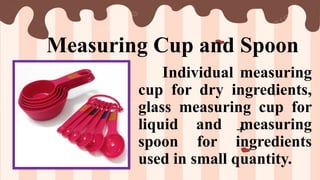
Measuring Cup and Spoon
Individual measuring
cup for dry ingredients,
glass measuring cup for
liquid and measuring
spoon for ingredients
used in small quantity.
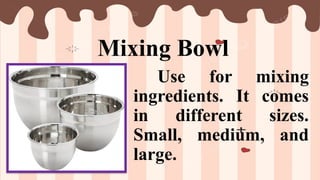
Mixing Bowl
Use for mixing
ingredients. It comes
in different sizes.
Small, medium, and
large.
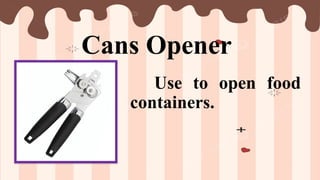
Cans Opener
Use to open food
containers.
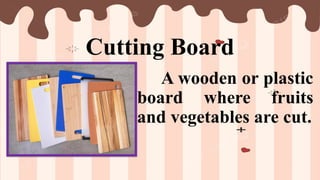
Cutting Board
A wooden or plastic
board where fruits
and vegetables are cut.
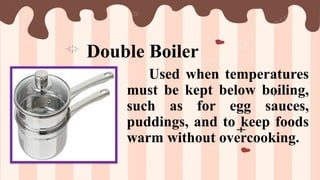
Double Boiler
Used when temperatures
must be kept below boiling,
such as for egg sauces,
puddings, and to keep foods
warm without overcooking.
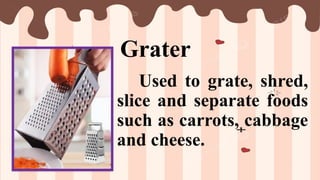
Grater
Used to grate, shred,
slice and separate foods
such as carrots, cabbage
and cheese.
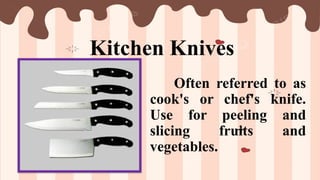
Kitchen Knives
Often referred to as
cook's or chef's knife.
Use for peeling and
slicing fruits and
vegetables.
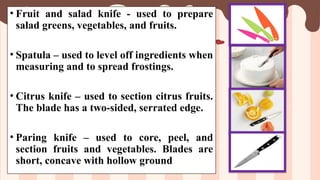
• Fruit and salad knife - used to prepare
salad greens, vegetables, and fruits.
• Spatula – used to level off ingredients when
measuring and to spread frostings.
• Citrus knife – used to section citrus fruits.
The blade has a two-sided, serrated edge.
• Paring knife – used to core, peel, and
section fruits and vegetables. Blades are
short, concave with hollow ground
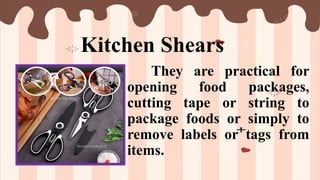
Kitchen Shears
They are practical for
opening food packages,
cutting tape or string to
package foods or simply to
remove labels or tags from
items.
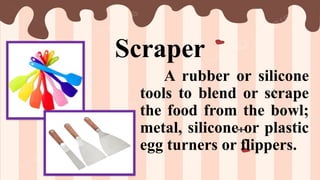
Scraper
A rubber or silicone
tools to blend or scrape
the food from the bowl;
metal, silicone or plastic
egg turners or flippers.
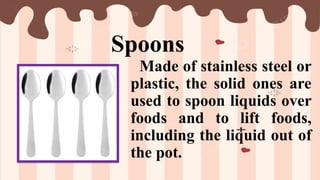
Spoons
Made of stainless steel or
plastic, the solid ones are
used to spoon liquids over
foods and to lift foods,
including the liquid out of
the pot.
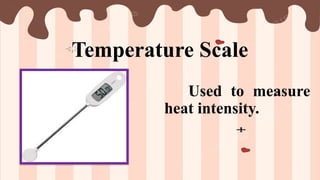
Temperature Scale
Used to measure
heat intensity.
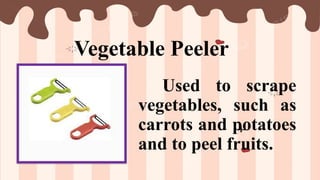
Vegetable Peeler
Used to scrape
vegetables, such as
carrots and potatoes
and to peel fruits.
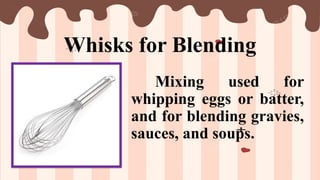
Whisks for Blending
Mixing used for
whipping eggs or batter,
and for blending gravies,
sauces, and soups.
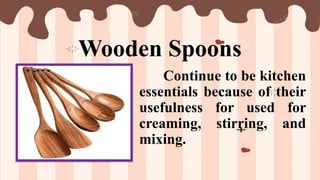
Wooden Spoons
Continue to be kitchen
essentials because of their
usefulness for used for
creaming, stirring, and
mixing.
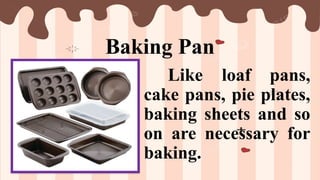
Baking Pan
Like loaf pans,
cake pans, pie plates,
baking sheets and so
on are necessary for
baking.
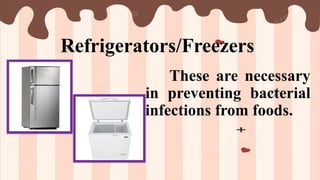
Refrigerators/Freezers
These are necessary
in preventing bacterial
infections from foods.
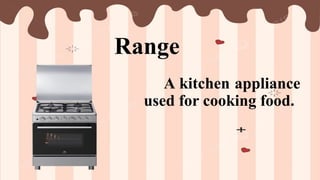
Range
A kitchen appliance
used for cooking food.
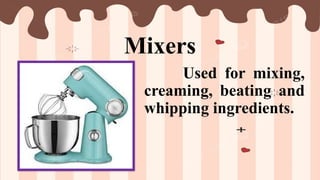
Mixers
Used for mixing,
creaming, beating and
whipping ingredients.
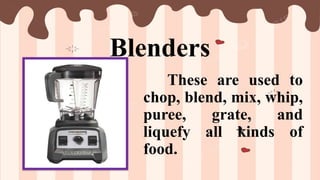
Blenders
These are used to
chop, blend, mix, whip,
puree, grate, and
liquefy all kinds of
food.
Give 5 kitchen tools used
in preparing desserts.
Give 5 equipment used in
preparing desserts.
Why tools and equipment
are important in
preparing desserts?
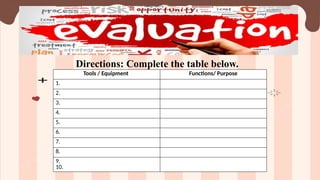
Directions: Complete the table below.
Tools / Equipment Functions/ Purpose
1.
2.
3.
4.
5.
6.
7.
8.
9.
10.
Directions: Go to your kitchen and list
down all tools and equipment that are
needed in preparing desserts. meat. Write
your assignment in your TLE Notebook.
What was our last topic?
Do you have any questions and
clarifications?
Why do we eat
desserts and
Sweets?
Reasons for Eating
Desserts and
Sweets
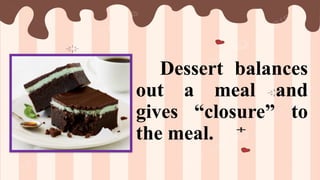
Dessert balances
out a meal and
gives “closure” to
the meal.
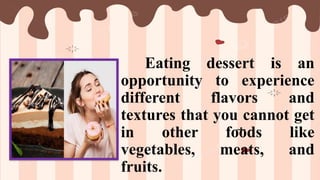
Eating dessert is an
opportunity to experience
different flavors and
textures that you cannot get
in other foods like
vegetables, meats, and
fruits.
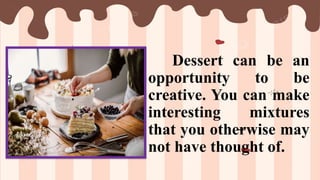
Dessert can be an
opportunity to be
creative. You can make
interesting mixtures
that you otherwise may
not have thought of.
Classification/types of desserts and their characteristics
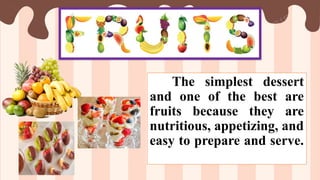
The simplest dessert
and one of the best are
fruits because they are
nutritious, appetizing, and
easy to prepare and serve.
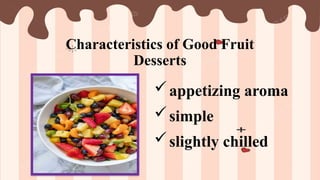
Characteristics of Good Fruit
Desserts
appetizing aroma
simple
slightly chilled
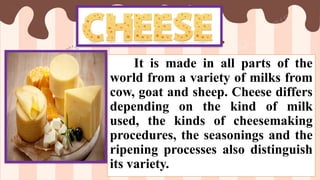
It is made in all parts of the
world from a variety of milks from
cow, goat and sheep. Cheese differs
depending on the kind of milk
used, the kinds of cheesemaking
procedures, the seasonings and the
ripening processes also distinguish
its variety.
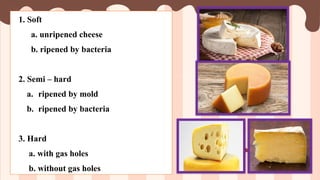
1. Soft
a. unripened cheese
b. ripened by bacteria
2. Semi – hard
a. ripened by mold
b. ripened by bacteria
3. Hard
a. with gas holes
b. without gas holes
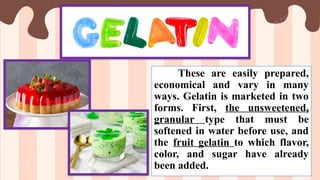
These are easily prepared,
economical and vary in many
ways. Gelatin is marketed in two
forms. First, the unsweetened,
granular type that must be
softened in water before use, and
the fruit gelatin to which flavor,
color, and sugar have already
been added.
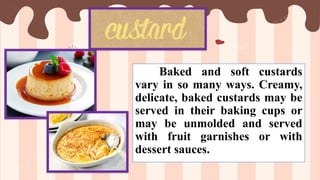
Baked and soft custards
vary in so many ways. Creamy,
delicate, baked custards may be
served in their baking cups or
may be unmolded and served
with fruit garnishes or with
dessert sauces.
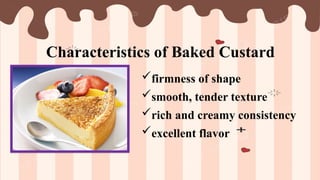
Characteristics of Baked Custard
firmness of shape
smooth, tender texture
rich and creamy consistency
excellent flavor
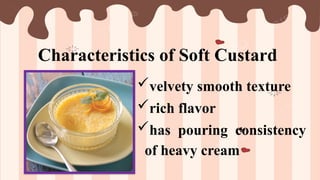
Characteristics of Soft Custard
velvety smooth texture
rich flavor
has pouring consistency
of heavy cream
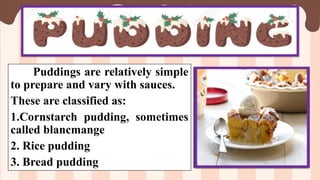
Puddings are relatively simple
to prepare and vary with sauces.
These are classified as:
1.Cornstarch pudding, sometimes
called blancmange
2. Rice pudding
3. Bread pudding
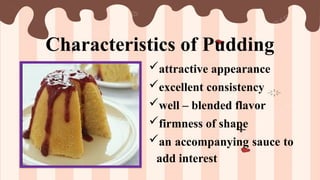
Characteristics of Pudding
attractive appearance
excellent consistency
well – blended flavor
firmness of shape
an accompanying sauce to
add interest
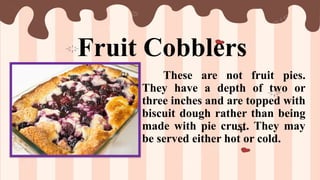
Fruit Cobblers
These are not fruit pies.
They have a depth of two or
three inches and are topped with
biscuit dough rather than being
made with pie crust. They may
be served either hot or cold.
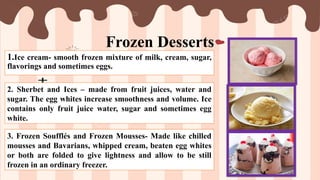
Frozen Desserts
1.Ice cream- smooth frozen mixture of milk, cream, sugar,
flavorings and sometimes eggs.
2. Sherbet and Ices – made from fruit juices, water and
sugar. The egg whites increase smoothness and volume. Ice
contains only fruit juice water, sugar and sometimes egg
white.
3. Frozen Soufflés and Frozen Mousses- Made like chilled
mousses and Bavarians, whipped cream, beaten egg whites
or both are folded to give lightness and allow to be still
frozen in an ordinary freezer.
Directions: Divide into 6 groups.
Each group will collaborate and
will give example for each type of
dessert and its characteristics.
Write your answer in one whole
pad.
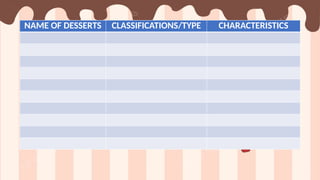
NAME OF DESSERTS CLASSIFICATIONS/TYPE CHARACTERISTICS
What is the
importance of dessert
in a meal?
Directions: Submit all the
papers. Each group will
represent their output.
Directions: Give the benefits of desserts in
terms of;
a.Health
b.Economy
Write in your TLE Notebook.
quarter 3 week 1- peformance task for the students

quarter 3 week 1- peformance task for the students

  • 1.
  • 2.
  • 3.
  • 4.
  • 5.
  • 6.
  • 7.
  • 9.
    Tools and Equipment Used inPreparing Desserts
  • 10.
    Measuring Cup andSpoon Individual measuring cup for dry ingredients, glass measuring cup for liquid and measuring spoon for ingredients used in small quantity.
  • 11.
    Mixing Bowl Use formixing ingredients. It comes in different sizes. Small, medium, and large.
  • 12.
    Cans Opener Use toopen food containers.
  • 13.
    Cutting Board A woodenor plastic board where fruits and vegetables are cut.
  • 14.
    Double Boiler Used whentemperatures must be kept below boiling, such as for egg sauces, puddings, and to keep foods warm without overcooking.
  • 15.
    Grater Used to grate,shred, slice and separate foods such as carrots, cabbage and cheese.
  • 16.
    Kitchen Knives Often referredto as cook's or chef's knife. Use for peeling and slicing fruits and vegetables.
  • 17.
    • Fruit andsalad knife - used to prepare salad greens, vegetables, and fruits. • Spatula – used to level off ingredients when measuring and to spread frostings. • Citrus knife – used to section citrus fruits. The blade has a two-sided, serrated edge. • Paring knife – used to core, peel, and section fruits and vegetables. Blades are short, concave with hollow ground
  • 18.
    Kitchen Shears They arepractical for opening food packages, cutting tape or string to package foods or simply to remove labels or tags from items.
  • 19.
    Scraper A rubber orsilicone tools to blend or scrape the food from the bowl; metal, silicone or plastic egg turners or flippers.
  • 20.
    Spoons Made of stainlesssteel or plastic, the solid ones are used to spoon liquids over foods and to lift foods, including the liquid out of the pot.
  • 21.
    Temperature Scale Used tomeasure heat intensity.
  • 22.
    Vegetable Peeler Used toscrape vegetables, such as carrots and potatoes and to peel fruits.
  • 23.
    Whisks for Blending Mixingused for whipping eggs or batter, and for blending gravies, sauces, and soups.
  • 24.
    Wooden Spoons Continue tobe kitchen essentials because of their usefulness for used for creaming, stirring, and mixing.
  • 25.
    Baking Pan Like loafpans, cake pans, pie plates, baking sheets and so on are necessary for baking.
  • 26.
    Refrigerators/Freezers These are necessary inpreventing bacterial infections from foods.
  • 27.
  • 28.
    Mixers Used for mixing, creaming,beating and whipping ingredients.
  • 29.
    Blenders These are usedto chop, blend, mix, whip, puree, grate, and liquefy all kinds of food.
  • 30.
    Give 5 kitchentools used in preparing desserts. Give 5 equipment used in preparing desserts.
  • 31.
    Why tools andequipment are important in preparing desserts?
  • 32.
    Directions: Complete thetable below. Tools / Equipment Functions/ Purpose 1. 2. 3. 4. 5. 6. 7. 8. 9. 10.
  • 33.
    Directions: Go toyour kitchen and list down all tools and equipment that are needed in preparing desserts. meat. Write your assignment in your TLE Notebook.
  • 35.
    What was ourlast topic? Do you have any questions and clarifications?
  • 38.
    Why do weeat desserts and Sweets?
  • 39.
  • 40.
    Dessert balances out ameal and gives “closure” to the meal.
  • 41.
    Eating dessert isan opportunity to experience different flavors and textures that you cannot get in other foods like vegetables, meats, and fruits.
  • 42.
    Dessert can bean opportunity to be creative. You can make interesting mixtures that you otherwise may not have thought of.
  • 43.
    Classification/types of dessertsand their characteristics
  • 44.
    The simplest dessert andone of the best are fruits because they are nutritious, appetizing, and easy to prepare and serve.
  • 45.
    Characteristics of GoodFruit Desserts appetizing aroma simple slightly chilled
  • 46.
    It is madein all parts of the world from a variety of milks from cow, goat and sheep. Cheese differs depending on the kind of milk used, the kinds of cheesemaking procedures, the seasonings and the ripening processes also distinguish its variety.
  • 47.
    1. Soft a. unripenedcheese b. ripened by bacteria 2. Semi – hard a. ripened by mold b. ripened by bacteria 3. Hard a. with gas holes b. without gas holes
  • 48.
    These are easilyprepared, economical and vary in many ways. Gelatin is marketed in two forms. First, the unsweetened, granular type that must be softened in water before use, and the fruit gelatin to which flavor, color, and sugar have already been added.
  • 49.
    Baked and softcustards vary in so many ways. Creamy, delicate, baked custards may be served in their baking cups or may be unmolded and served with fruit garnishes or with dessert sauces.
  • 50.
    Characteristics of BakedCustard firmness of shape smooth, tender texture rich and creamy consistency excellent flavor
  • 51.
    Characteristics of SoftCustard velvety smooth texture rich flavor has pouring consistency of heavy cream
  • 52.
    Puddings are relativelysimple to prepare and vary with sauces. These are classified as: 1.Cornstarch pudding, sometimes called blancmange 2. Rice pudding 3. Bread pudding
  • 53.
    Characteristics of Pudding attractiveappearance excellent consistency well – blended flavor firmness of shape an accompanying sauce to add interest
  • 54.
    Fruit Cobblers These arenot fruit pies. They have a depth of two or three inches and are topped with biscuit dough rather than being made with pie crust. They may be served either hot or cold.
  • 55.
    Frozen Desserts 1.Ice cream-smooth frozen mixture of milk, cream, sugar, flavorings and sometimes eggs. 2. Sherbet and Ices – made from fruit juices, water and sugar. The egg whites increase smoothness and volume. Ice contains only fruit juice water, sugar and sometimes egg white. 3. Frozen Soufflés and Frozen Mousses- Made like chilled mousses and Bavarians, whipped cream, beaten egg whites or both are folded to give lightness and allow to be still frozen in an ordinary freezer.
  • 57.
    Directions: Divide into6 groups. Each group will collaborate and will give example for each type of dessert and its characteristics. Write your answer in one whole pad.
  • 58.
    NAME OF DESSERTSCLASSIFICATIONS/TYPE CHARACTERISTICS
  • 59.
    What is the importanceof dessert in a meal?
  • 60.
    Directions: Submit allthe papers. Each group will represent their output.
  • 61.
    Directions: Give thebenefits of desserts in terms of; a.Health b.Economy Write in your TLE Notebook.