QUANTUM HUMANISM AS A FRAMEWORK FOR
                       HUMANISTIC MANAGEMENT

                 Carlos Largacha-Martínez, Ph.D.
                 Provost for Research
                 Universidad EAN
                 clargacha@ean.edu.co

                 May 14th 2010, IESE, Barcelona
www.ean.edu.co
CONTENTS
• Linear-rational thinking is privileged in
  mainstream corporations
• There is risk by disregarding systemic thinking at
  management.
• Holistic thinking is not enough (see Asian culture-
  firms), thus humanism ought to be included
• Quantum mechanics and alterity (otherness)
  are melt to generate quantum humanism
• Examples are shown that correlates quantum
  thinking (systemic-holistic) with management
• Research done in three Latin American
  companies that practice participatory-
  democratic management is briefly presented
MODERNITOUS THINKING
• The Newtonian idea of having an expert of
  knowledge in each part of the big watch of the
  universe is part of the linear, rational and
  scientific mainstream paradigm (see Kuhn, 1996)
• Aristotelian logic (Law of the Excluded Middle)
• Dualism + the independent nature of reality.
  Things are “out there” (objectivity, neutrality)

• Clinton Leaf contends that we are losing the War
  on Cancer because the research methods that
  have been used are
  deterministic, reductionistic, and with cause-
  effect analysis, disregarding holistic approaches
  (Fortune magazine, 2004: 77ff)
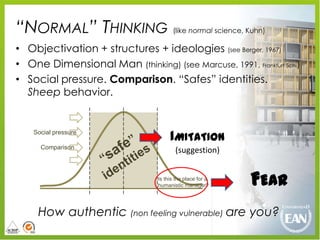
“NORMAL” THINKING                       (like normal science, Kuhn)

• Objectivation + structures + ideologies (see Berger, 1967)
• One Dimensional Man (thinking) (see Marcuse, 1991, Frankfurt Sch.)
• Social pressure. Comparison. “Safes” identities.
  Sheep behavior.


    Social pressure
                                       IMITATION
      Comparison
                                         (suggestion)


                                  Is this the place for a
                                  humanistic manager?         FEAR
     How authentic (non feeling vulnerable) are you?
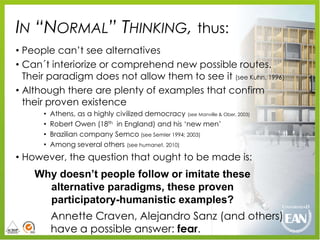
IN “NORMAL” THINKING, thus:
• People can‟t see alternatives
• Can´t interiorize or comprehend new possible routes.
  Their paradigm does not allow them to see it (see Kuhn, 1996)
• Although there are plenty of examples that confirm
  their proven existence
      •   Athens, as a highly civilized democracy (see Manville & Ober, 2003)
      •   Robert Owen (18th in England) and his „new men‟
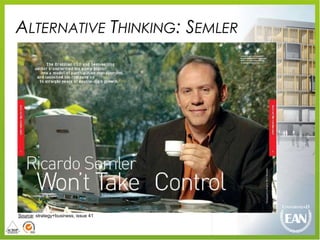
      •   Brazilian company Semco (see Semler 1994; 2003)
      •   Among several others (see humanet, 2010)
• However, the question that ought to be made is:
    Why doesn’t people follow or imitate these
      alternative paradigms, these proven
      participatory-humanistic examples?
          Annette Craven, Alejandro Sanz (and others)
          have a possible answer: fear.
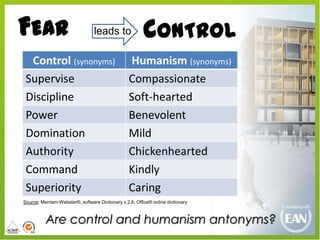
FEAR                             leads to                CONTROL
  Control (synonyms)                               Humanism (synonyms)
 Supervise                                        Compassionate
 Discipline                                       Soft-hearted
 Power                                            Benevolent
 Domination                                       Mild
 Authority                                        Chickenhearted
 Command                                          Kindly
 Superiority                                      Caring
Source: Merriam-Webster®, software Dictionary v.2.6; Office® online dictionary


          Are control and humanism antonyms?
ALTERNATIVE THINKING: SEMLER


Source: strategy+business, issue 41
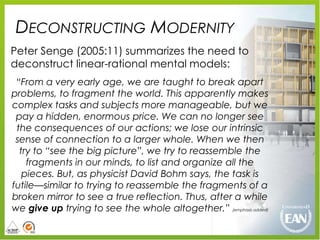
DECONSTRUCTING MODERNITY
Peter Senge (2005:11) summarizes the need to
deconstruct linear-rational mental models:
 “From a very early age, we are taught to break apart
problems, to fragment the world. This apparently makes
complex tasks and subjects more manageable, but we
 pay a hidden, enormous price. We can no longer see
 the consequences of our actions; we lose our intrinsic
 sense of connection to a larger whole. When we then
  try to “see the big picture”, we try to reassemble the
    fragments in our minds, to list and organize all the
   pieces. But, as physicist David Bohm says, the task is
futile—similar to trying to reassemble the fragments of a
broken mirror to see a true reflection. Thus, after a while
we give up trying to see the whole altogether.” (emphasis added)
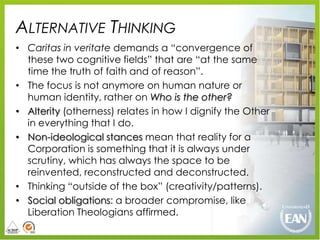
ALTERNATIVE THINKING
• Caritas in veritate demands a “convergence of
  these two cognitive fields” that are “at the same
  time the truth of faith and of reason”.
• The focus is not anymore on human nature or
  human identity, rather on Who is the other?
• Alterity (otherness) relates in how I dignify the Other
  in everything that I do.
• Non-ideological stances mean that reality for a
  Corporation is something that it is always under
  scrutiny, which has always the space to be
  reinvented, reconstructed and deconstructed.
• Thinking “outside of the box” (creativity/patterns).
• Social obligations: a broader compromise, like
  Liberation Theologians affirmed.
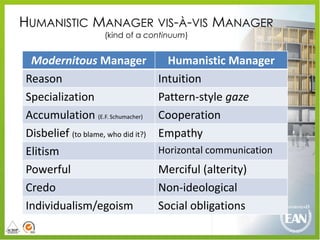
HUMANISTIC MANAGER VIS-À-VIS MANAGER
                     (kind of a continuum)


 Modernitous Manager                  Humanistic Manager
Reason                              Intuition
Specialization                      Pattern-style gaze
Accumulation (E.F. Schumacher)      Cooperation
Disbelief (to blame, who did it?)   Empathy
Elitism                             Horizontal communication
Powerful                            Merciful (alterity)
Credo                               Non-ideological
Individualism/egoism                Social obligations
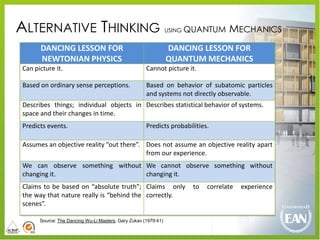
ALTERNATIVE THINKING                                            USING   QUANTUM      MECHANICS
      DANCING LESSON FOR                                        DANCING LESSON FOR
      NEWTONIAN PHYSICS                                         QUANTUM MECHANICS
Can picture it.                                      Cannot picture it.

Based on ordinary sense perceptions.                 Based on behavior of subatomic particles
                                                     and systems not directly observable.
Describes things; individual objects in Describes statistical behavior of systems.
space and their changes in time.
Predicts events.                                     Predicts probabilities.

Assumes an objective reality “out there”. Does not assume an objective reality apart
                                          from our experience.
We can observe something without We cannot observe something without
changing it.                     changing it.
Claims to be based on “absolute truth”; Claims only                      to   correlate   experience
the way that nature really is “behind the correctly.
scenes”.

      Source: The Dancing Wu-Li Masters, Gary Zukav (1979:41)
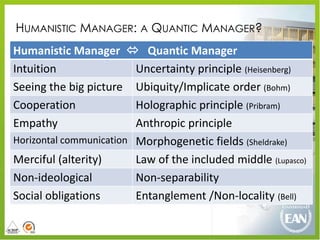
HUMANISTIC MANAGER: A QUANTIC MANAGER?
Humanistic Manager  Quantic Manager
Intuition                Uncertainty principle (Heisenberg)
Seeing the big picture Ubiquity/Implicate order (Bohm)
Cooperation              Holographic principle (Pribram)
Empathy                  Anthropic principle
Horizontal communication Morphogenetic fields (Sheldrake)
Merciful (alterity)      Law of the included middle (Lupasco)
Non-ideological          Non-separability
Social obligations       Entanglement /Non-locality (Bell)
LATIN AMERICAN CASE STUDIES
„Semco (Brazil) has no official structure. It has no
organizational chart. There‟s no business
plan, no goal or mission statement, no long-term
budget. The company often does not have a
fixed CEO. There are no vice presidents or chief
officers for information technology or operations.
There are no standards or practices. There‟s no
human resources department. There are no
career plans, no job descriptions or employee
contracts. No one approves reports or expense
accounts. Supervision or monitoring of workers is
rare indeed. Most important, [and this truly is the
most important] success is not measured only in
profit and growth‟. (Semler, 2003:8)
LATIN AMERICAN CASE STUDIES
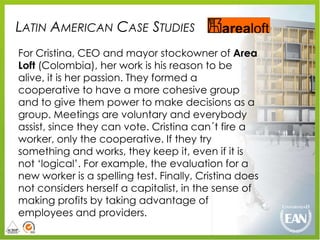
For Cristina, CEO and mayor stockowner of Area
Loft (Colombia), her work is his reason to be
alive, it is her passion. They formed a
cooperative to have a more cohesive group
and to give them power to make decisions as a
group. Meetings are voluntary and everybody
assist, since they can vote. Cristina can´t fire a
worker, only the cooperative. If they try
something and works, they keep it, even if it is
not „logical‟. For example, the evaluation for a
new worker is a spelling test. Finally, Cristina does
not considers herself a capitalist, in the sense of
making profits by taking advantage of
employees and providers.
LATIN AMERICAN CASE STUDIES
„In Acción Fiduciaria (Colombia), the first day on
the job is frustrating. That day nobody take
charge of him, nobody will show him the
company, nobody will tell him his functions, not
even will have lunch with him. The day goes on
and nobody talks to him. Everything is done with a
purpose: confront him with his own traditional
paradigms. If he resists the test and doesn‟t run
away, he will be part of a company where the
self-centered employee is gone and start really
working in and for a team. Now he is part not of a
company, but of a matrix organization. Ironically
as it sounds, this financial company does not
have a budget, there are not job positions, and in
the CEO‟s office the only sign is his name.
PATTERNS IN
• These companies show „non-logical‟
  approaches toward management
• All the CEOs of these humanistic companies put
  being human at the same level of profits
• Information is available to everyone. Everything
  can be discussed. Transparency is a must.
• Ethics is a sentiment not a fact, thus they have
  zero-tolerance for corruption
• Intrinsic motivators are always first
• They are open to all ideas (“Out of your mind committee?”)
• Participation is highly demanded by coworkers
• Divergent thinking (it is not „easy‟ to talk to them)
www.ean.edu.co
Thanks

                 The information and arguments here
                 presented are solely the opinion of the
                 author and not of Universidad EAN.

www.ean.edu.co

Quantum largacha iese v.2.1 video

  • 1.
    QUANTUM HUMANISM ASA FRAMEWORK FOR HUMANISTIC MANAGEMENT Carlos Largacha-Martínez, Ph.D. Provost for Research Universidad EAN clargacha@ean.edu.co May 14th 2010, IESE, Barcelona www.ean.edu.co
  • 2.
    CONTENTS • Linear-rational thinkingis privileged in mainstream corporations • There is risk by disregarding systemic thinking at management. • Holistic thinking is not enough (see Asian culture- firms), thus humanism ought to be included • Quantum mechanics and alterity (otherness) are melt to generate quantum humanism • Examples are shown that correlates quantum thinking (systemic-holistic) with management • Research done in three Latin American companies that practice participatory- democratic management is briefly presented
  • 3.
    MODERNITOUS THINKING • TheNewtonian idea of having an expert of knowledge in each part of the big watch of the universe is part of the linear, rational and scientific mainstream paradigm (see Kuhn, 1996) • Aristotelian logic (Law of the Excluded Middle) • Dualism + the independent nature of reality. Things are “out there” (objectivity, neutrality) • Clinton Leaf contends that we are losing the War on Cancer because the research methods that have been used are deterministic, reductionistic, and with cause- effect analysis, disregarding holistic approaches (Fortune magazine, 2004: 77ff)
  • 4.
    “NORMAL” THINKING (like normal science, Kuhn) • Objectivation + structures + ideologies (see Berger, 1967) • One Dimensional Man (thinking) (see Marcuse, 1991, Frankfurt Sch.) • Social pressure. Comparison. “Safes” identities. Sheep behavior. Social pressure IMITATION Comparison (suggestion) Is this the place for a humanistic manager? FEAR How authentic (non feeling vulnerable) are you?
  • 5.
    IN “NORMAL” THINKING,thus: • People can‟t see alternatives • Can´t interiorize or comprehend new possible routes. Their paradigm does not allow them to see it (see Kuhn, 1996) • Although there are plenty of examples that confirm their proven existence • Athens, as a highly civilized democracy (see Manville & Ober, 2003) • Robert Owen (18th in England) and his „new men‟ • Brazilian company Semco (see Semler 1994; 2003) • Among several others (see humanet, 2010) • However, the question that ought to be made is: Why doesn’t people follow or imitate these alternative paradigms, these proven participatory-humanistic examples? Annette Craven, Alejandro Sanz (and others) have a possible answer: fear.
  • 6.
    FEAR leads to CONTROL Control (synonyms) Humanism (synonyms) Supervise Compassionate Discipline Soft-hearted Power Benevolent Domination Mild Authority Chickenhearted Command Kindly Superiority Caring Source: Merriam-Webster®, software Dictionary v.2.6; Office® online dictionary Are control and humanism antonyms?
  • 7.
    ALTERNATIVE THINKING: SEMLER Source:strategy+business, issue 41
  • 8.
    DECONSTRUCTING MODERNITY Peter Senge(2005:11) summarizes the need to deconstruct linear-rational mental models: “From a very early age, we are taught to break apart problems, to fragment the world. This apparently makes complex tasks and subjects more manageable, but we pay a hidden, enormous price. We can no longer see the consequences of our actions; we lose our intrinsic sense of connection to a larger whole. When we then try to “see the big picture”, we try to reassemble the fragments in our minds, to list and organize all the pieces. But, as physicist David Bohm says, the task is futile—similar to trying to reassemble the fragments of a broken mirror to see a true reflection. Thus, after a while we give up trying to see the whole altogether.” (emphasis added)
  • 9.
    ALTERNATIVE THINKING • Caritasin veritate demands a “convergence of these two cognitive fields” that are “at the same time the truth of faith and of reason”. • The focus is not anymore on human nature or human identity, rather on Who is the other? • Alterity (otherness) relates in how I dignify the Other in everything that I do. • Non-ideological stances mean that reality for a Corporation is something that it is always under scrutiny, which has always the space to be reinvented, reconstructed and deconstructed. • Thinking “outside of the box” (creativity/patterns). • Social obligations: a broader compromise, like Liberation Theologians affirmed.
  • 10.
    HUMANISTIC MANAGER VIS-À-VISMANAGER (kind of a continuum) Modernitous Manager Humanistic Manager Reason Intuition Specialization Pattern-style gaze Accumulation (E.F. Schumacher) Cooperation Disbelief (to blame, who did it?) Empathy Elitism Horizontal communication Powerful Merciful (alterity) Credo Non-ideological Individualism/egoism Social obligations
  • 11.
    ALTERNATIVE THINKING USING QUANTUM MECHANICS DANCING LESSON FOR DANCING LESSON FOR NEWTONIAN PHYSICS QUANTUM MECHANICS Can picture it. Cannot picture it. Based on ordinary sense perceptions. Based on behavior of subatomic particles and systems not directly observable. Describes things; individual objects in Describes statistical behavior of systems. space and their changes in time. Predicts events. Predicts probabilities. Assumes an objective reality “out there”. Does not assume an objective reality apart from our experience. We can observe something without We cannot observe something without changing it. changing it. Claims to be based on “absolute truth”; Claims only to correlate experience the way that nature really is “behind the correctly. scenes”. Source: The Dancing Wu-Li Masters, Gary Zukav (1979:41)
  • 12.
    HUMANISTIC MANAGER: AQUANTIC MANAGER? Humanistic Manager  Quantic Manager Intuition Uncertainty principle (Heisenberg) Seeing the big picture Ubiquity/Implicate order (Bohm) Cooperation Holographic principle (Pribram) Empathy Anthropic principle Horizontal communication Morphogenetic fields (Sheldrake) Merciful (alterity) Law of the included middle (Lupasco) Non-ideological Non-separability Social obligations Entanglement /Non-locality (Bell)
  • 13.
  • 14.
    LATIN AMERICAN CASESTUDIES „Semco (Brazil) has no official structure. It has no organizational chart. There‟s no business plan, no goal or mission statement, no long-term budget. The company often does not have a fixed CEO. There are no vice presidents or chief officers for information technology or operations. There are no standards or practices. There‟s no human resources department. There are no career plans, no job descriptions or employee contracts. No one approves reports or expense accounts. Supervision or monitoring of workers is rare indeed. Most important, [and this truly is the most important] success is not measured only in profit and growth‟. (Semler, 2003:8)
  • 15.
    LATIN AMERICAN CASESTUDIES For Cristina, CEO and mayor stockowner of Area Loft (Colombia), her work is his reason to be alive, it is her passion. They formed a cooperative to have a more cohesive group and to give them power to make decisions as a group. Meetings are voluntary and everybody assist, since they can vote. Cristina can´t fire a worker, only the cooperative. If they try something and works, they keep it, even if it is not „logical‟. For example, the evaluation for a new worker is a spelling test. Finally, Cristina does not considers herself a capitalist, in the sense of making profits by taking advantage of employees and providers.
  • 16.
    LATIN AMERICAN CASESTUDIES „In Acción Fiduciaria (Colombia), the first day on the job is frustrating. That day nobody take charge of him, nobody will show him the company, nobody will tell him his functions, not even will have lunch with him. The day goes on and nobody talks to him. Everything is done with a purpose: confront him with his own traditional paradigms. If he resists the test and doesn‟t run away, he will be part of a company where the self-centered employee is gone and start really working in and for a team. Now he is part not of a company, but of a matrix organization. Ironically as it sounds, this financial company does not have a budget, there are not job positions, and in the CEO‟s office the only sign is his name.
  • 17.
    PATTERNS IN • Thesecompanies show „non-logical‟ approaches toward management • All the CEOs of these humanistic companies put being human at the same level of profits • Information is available to everyone. Everything can be discussed. Transparency is a must. • Ethics is a sentiment not a fact, thus they have zero-tolerance for corruption • Intrinsic motivators are always first • They are open to all ideas (“Out of your mind committee?”) • Participation is highly demanded by coworkers • Divergent thinking (it is not „easy‟ to talk to them)
  • 18.
  • 19.
    Thanks The information and arguments here presented are solely the opinion of the author and not of Universidad EAN. www.ean.edu.co