Quantitative Article Analysis Worksheet
Analyze and critique a quantitative nursing research article
from a nursing research journal published within the past 5
years. Include 3 scholarly references—the article, the text, and
one outside source. Use the Guidelines for Quantitative Nursing
Research Critique to complete the following steps:
1. State the purpose of the study and identify the problem.
2. Analyze the literature review.
3. Analyze the study framework or theoretical perspective.
4. Identify, describe, and critique for appropriateness any
research objectives, questions, or hypothesis.
5. Identify, describe, and critique—conceptually and
operationally—the major study variables.
6. Identify and critique the attributes and demographic
variables.
7. Describe and critique the research design.
8. Describe and critique the sample and setting.
9. Describe and critique the measurement instrument used in the
study.
10. Describe and critique the procedures for data collection
11. Describe and critique the statistical analysis.
12. Describe and critique the researcher’s interpretation.
Assignment (Part A - individual), total marks = 60
Due Date: 19th September
Question 1
(Marks: 28)
On 31 May 2012 Interactive Ltd had a cash balance as per
company records of $10
949 debit. The bank statement from Community Bank on that
date showed a credit
balance of $15 569.20. A comparison of the statement with the
cash account
revealed the following facts:
1. The statement included a debit entry of $120 for the printing
of additional
company cheques.
2. Cash sales of $1672.30 on 12 May were deposited in the
bank. The cash
receipts journal entry and the deposit slip were incorrectly made
for
$1692.30. The bank credited Interactive Ltd for the correct
amount.
3. Unpresented cheques at 31 May totalled $2552.50, and
outstanding deposits
were $1672.30.
4. On 18 May Interactive Ltd issued cheque no. 1181 for $1370
to M. Helms on
account. The cheque, which cleared the bank in May, was
incorrectly
journalised and posted by Interactive Ltd for $1730.
5. A $6000 note receivable was collected by the bank for
Interactive Ltd on 31
May plus $160 interest. The bank charged a collection fee of
$40. No interest
has been accrued on the note.
6. Included with the cheques paid was a cheque issued by
Teller Pty Ltd to P.
Jonet for $1200 that was incorrectly charged to Interactive Ltd
by the bank.
7. On 31 May the bank statement showed a dishonoured cheque
of $1400 that
had been issued by W. Hoad, a customer, to Interactive Ltd.
Required
(a) Prepare the bank reconciliation as at 31 May 2012.
(b) Prepare the necessary adjusting entries as at 31 May 2012.
Question 2 (Marks: 14)
At 30 June 2012, the trial balance of Gleason Ltd contained the
following amounts
before adjustment:
Debits Credits
Accounts Receivable $350 000
Allowance for Doubtful Debts $ 1 500
Sales 875 000
Required
(a) Based on the information given which method of accounting
for bad debts is
Gleason Ltd using — the direct write-off method or the
allowance method?
How can you tell?
(b) Prepare the adjusting entry at 30 June 2012 to record bad
debt expense
assuming that the ageing schedule indicates that $16 750 of
accounts receivable
will be uncollectable.
(c) Repeat part (b) assuming that instead of a credit balance
there is a $1500 debit
balance in the Allowance for Doubtful Debts.
(d) During the next month, July 2012, a $4500 account
receivable is written off as
uncollectable. Prepare the journal entry to record the write-off.
(e) Repeat part (d) assuming that Gleason Ltd uses the direct
write-off method
instead of the allowance method in accounting for uncollectable
accounts
receivable.
(f) Gleason Ltd is contemplating of using the direct write-off
method. As you are
the accountant in this company, give your advice on the
preference of using
either the direct write-off method or the allowance method.
Question3 (Marks: 18)
a. Stephanie Design purchased a piece of equipment for
$105,000 on 1
September 2013. At this time it was estimated that its useful
life was 8 years,
with a residual value of $15,000. On the 1 January 2014
Stephanie Design
decided to revalue the equipment to $92,000 with no residual
value, due to its
excessive use in the previous period and a revised useful life of
5 years.
Stephanie Design’s financial year ends on the 31 December and
business uses
straight-line deprecation for its equipment calculated to the
nearest whole dollar
and for whole months.
You are required to show all the necessary general journal
entries to record the
above information to ensure that the equipment is properly
reported in
Stephanie Design’s balance sheet as at 31 December 2014 (Hint:
make sure that
you include all necessary entries as required, not just at the 31
December 2014).
b. Discuss how to identify the difference between allocating
costs to expenses
or capital expenditure during an assets useful life.
Guidelines for Quantitative Nursing Research Critique
1. State the purpose of the study, and identify the problem.
2. Examine the literature review within your selected article. In
your analysis, critique these sections:
a. Are articles relevant? Are the previous studies and theories
described?
b. Are the references current? How many sources are from the
last 10 years?
c. How many sources are from the last 5 years?
d. Describe the current knowledge—what is known and
unknown—about the research problem.
3. Examine and critique the study framework or theoretical
perspective. In your analysis, discuss the following:
a. Is the framework explicitly expressed, or must the reviewer
extract the framework from implicit statements in the literature
review?
b. Is the framework based on scientific, substantive, or tentative
theory?
c. Does the framework identify, define, and describe
relationships among the concepts of interest?
d. How is the framework related to the body of knowledge in
nursing?
4. Identify, describe, and critique for appropriateness any
research objectives, questions, or hypotheses. If there are none,
suggest how those might be stated.
5. Identify, describe, and critique—conceptually and
operationally—the major study variables. Examine the purpose,
the objectives, questions, or hypotheses, as well as the results
section of the research article. Identify and define each variable
type as one of the following:
a. Independent variables
b. Dependent variables
c. Research variables
6. Identify and critique attributes and demographic variables.
7. Describe and critique the research design. Address the
following criteria in the analysis:
a. Identify the specific design of the study.
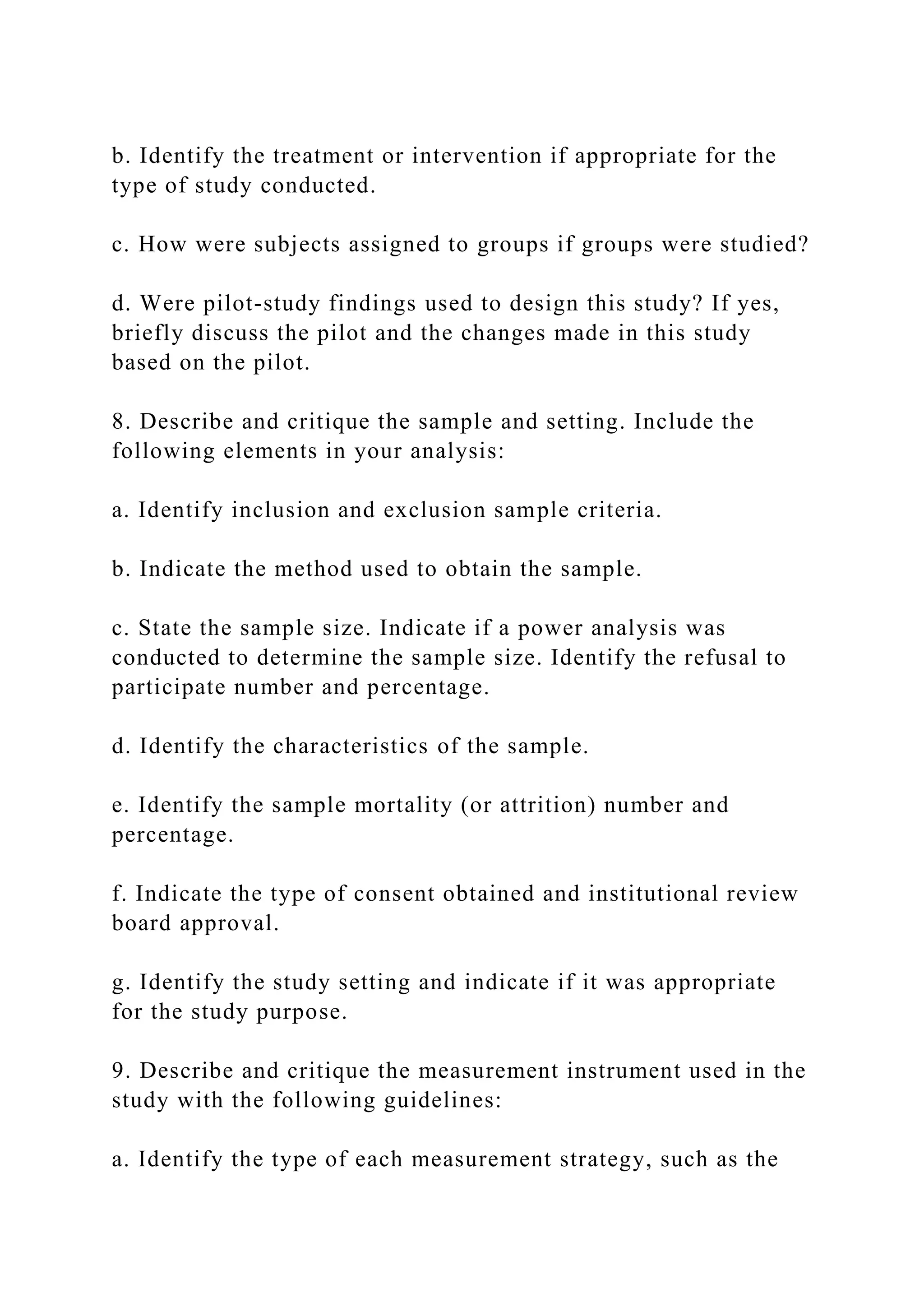
b. Identify the treatment or intervention if appropriate for the
type of study conducted.
c. How were subjects assigned to groups if groups were studied?
d. Were pilot-study findings used to design this study? If yes,
briefly discuss the pilot and the changes made in this study
based on the pilot.
8. Describe and critique the sample and setting. Include the
following elements in your analysis:
a. Identify inclusion and exclusion sample criteria.
b. Indicate the method used to obtain the sample.
c. State the sample size. Indicate if a power analysis was
conducted to determine the sample size. Identify the refusal to
participate number and percentage.
d. Identify the characteristics of the sample.
e. Identify the sample mortality (or attrition) number and
percentage.
f. Indicate the type of consent obtained and institutional review
board approval.
g. Identify the study setting and indicate if it was appropriate
for the study purpose.
9. Describe and critique the measurement instrument used in the
study with the following guidelines:
a. Identify the type of each measurement strategy, such as the
Likert scale, visual analog scale, physiological measure,
questionnaire, observation, or interview.
b. Identify the level of measurement (nominal, ordinal,
interval/ratio) achieved by each measurement strategy.
c. Discuss how the instrument was developed or the purpose of
use.
d. Report the reliability of each instrument from previous
studies and the current study.
e. Report the validity of each instrument from previous studies
and the current study.
10. Describe and critique the procedures for data collection.
a. Identify the intervention protocol, if appropriate.
b. Detail how the data were collected.
11. Describe and critique the statistical analyses used.
a. List the statistical procedures used to describe the sample.
b. Was the level of significance or alpha identified? If so,
indicate the level (.05, .01, or .001).
c. Complete the table below with the analysis techniques
conducted in the study:
1) Identify the focus (description, relationships, or differences)
of each analysis technique.
2) List the statistical procedures.
3) List the statistics.
4) Identify specific results.
5) Provide specific probability value (p =) in a table as shown
next.
Purpose of analysis
Statistical procedure
Statistic
Result
Probability (p)
Difference between males and females on blood pressure
t-test
t
3.75
p = .04
Difference between treatment and comparison groups on weight
loss
Analysis of variance
F
5.79
p = .009
Relationship of pain perception and anxiety for adolescents
Pearson’s correlation
r
0.56
p = .03
12. Describe and critique the researcher’s interpretation of
findings.
a. What study limitations were identified by the researcher?
b. How did the researcher generalize the findings?
c. What were the implications of the findings for nursing?
d. What suggestions for further study were identified?
e. Is the description of the study sufficiently clear for
replication?

Quantitative Article Analysis WorksheetAnalyze and critique a qu.docx

  • 1.
    Quantitative Article AnalysisWorksheet Analyze and critique a quantitative nursing research article from a nursing research journal published within the past 5 years. Include 3 scholarly references—the article, the text, and one outside source. Use the Guidelines for Quantitative Nursing Research Critique to complete the following steps: 1. State the purpose of the study and identify the problem. 2. Analyze the literature review. 3. Analyze the study framework or theoretical perspective. 4. Identify, describe, and critique for appropriateness any research objectives, questions, or hypothesis. 5. Identify, describe, and critique—conceptually and operationally—the major study variables. 6. Identify and critique the attributes and demographic variables. 7. Describe and critique the research design. 8. Describe and critique the sample and setting. 9. Describe and critique the measurement instrument used in the study. 10. Describe and critique the procedures for data collection 11. Describe and critique the statistical analysis. 12. Describe and critique the researcher’s interpretation.
  • 2.
    Assignment (Part A- individual), total marks = 60 Due Date: 19th September Question 1
  • 3.
    (Marks: 28) On 31May 2012 Interactive Ltd had a cash balance as per company records of $10 949 debit. The bank statement from Community Bank on that date showed a credit balance of $15 569.20. A comparison of the statement with the cash account revealed the following facts: 1. The statement included a debit entry of $120 for the printing of additional company cheques. 2. Cash sales of $1672.30 on 12 May were deposited in the bank. The cash receipts journal entry and the deposit slip were incorrectly made
  • 4.
    for $1692.30. The bankcredited Interactive Ltd for the correct amount. 3. Unpresented cheques at 31 May totalled $2552.50, and outstanding deposits were $1672.30. 4. On 18 May Interactive Ltd issued cheque no. 1181 for $1370 to M. Helms on account. The cheque, which cleared the bank in May, was incorrectly journalised and posted by Interactive Ltd for $1730. 5. A $6000 note receivable was collected by the bank for Interactive Ltd on 31 May plus $160 interest. The bank charged a collection fee of $40. No interest has been accrued on the note. 6. Included with the cheques paid was a cheque issued by Teller Pty Ltd to P. Jonet for $1200 that was incorrectly charged to Interactive Ltd by the bank. 7. On 31 May the bank statement showed a dishonoured cheque of $1400 that had been issued by W. Hoad, a customer, to Interactive Ltd.
  • 5.
    Required (a) Prepare thebank reconciliation as at 31 May 2012. (b) Prepare the necessary adjusting entries as at 31 May 2012. Question 2 (Marks: 14) At 30 June 2012, the trial balance of Gleason Ltd contained the following amounts before adjustment: Debits Credits Accounts Receivable $350 000
  • 6.
    Allowance for DoubtfulDebts $ 1 500 Sales 875 000 Required (a) Based on the information given which method of accounting for bad debts is Gleason Ltd using — the direct write-off method or the allowance method? How can you tell? (b) Prepare the adjusting entry at 30 June 2012 to record bad debt expense assuming that the ageing schedule indicates that $16 750 of accounts receivable will be uncollectable. (c) Repeat part (b) assuming that instead of a credit balance there is a $1500 debit balance in the Allowance for Doubtful Debts. (d) During the next month, July 2012, a $4500 account receivable is written off as uncollectable. Prepare the journal entry to record the write-off. (e) Repeat part (d) assuming that Gleason Ltd uses the direct write-off method
  • 7.
    instead of theallowance method in accounting for uncollectable accounts receivable. (f) Gleason Ltd is contemplating of using the direct write-off method. As you are the accountant in this company, give your advice on the preference of using either the direct write-off method or the allowance method. Question3 (Marks: 18) a. Stephanie Design purchased a piece of equipment for $105,000 on 1 September 2013. At this time it was estimated that its useful life was 8 years, with a residual value of $15,000. On the 1 January 2014 Stephanie Design decided to revalue the equipment to $92,000 with no residual value, due to its excessive use in the previous period and a revised useful life of 5 years. Stephanie Design’s financial year ends on the 31 December and business uses straight-line deprecation for its equipment calculated to the nearest whole dollar and for whole months.
  • 8.
    You are requiredto show all the necessary general journal entries to record the above information to ensure that the equipment is properly reported in Stephanie Design’s balance sheet as at 31 December 2014 (Hint: make sure that you include all necessary entries as required, not just at the 31 December 2014). b. Discuss how to identify the difference between allocating costs to expenses or capital expenditure during an assets useful life. Guidelines for Quantitative Nursing Research Critique 1. State the purpose of the study, and identify the problem. 2. Examine the literature review within your selected article. In your analysis, critique these sections: a. Are articles relevant? Are the previous studies and theories described? b. Are the references current? How many sources are from the last 10 years? c. How many sources are from the last 5 years? d. Describe the current knowledge—what is known and
  • 9.
    unknown—about the researchproblem. 3. Examine and critique the study framework or theoretical perspective. In your analysis, discuss the following: a. Is the framework explicitly expressed, or must the reviewer extract the framework from implicit statements in the literature review? b. Is the framework based on scientific, substantive, or tentative theory? c. Does the framework identify, define, and describe relationships among the concepts of interest? d. How is the framework related to the body of knowledge in nursing? 4. Identify, describe, and critique for appropriateness any research objectives, questions, or hypotheses. If there are none, suggest how those might be stated. 5. Identify, describe, and critique—conceptually and operationally—the major study variables. Examine the purpose, the objectives, questions, or hypotheses, as well as the results section of the research article. Identify and define each variable type as one of the following: a. Independent variables b. Dependent variables c. Research variables 6. Identify and critique attributes and demographic variables. 7. Describe and critique the research design. Address the following criteria in the analysis: a. Identify the specific design of the study.
  • 10.
    b. Identify thetreatment or intervention if appropriate for the type of study conducted. c. How were subjects assigned to groups if groups were studied? d. Were pilot-study findings used to design this study? If yes, briefly discuss the pilot and the changes made in this study based on the pilot. 8. Describe and critique the sample and setting. Include the following elements in your analysis: a. Identify inclusion and exclusion sample criteria. b. Indicate the method used to obtain the sample. c. State the sample size. Indicate if a power analysis was conducted to determine the sample size. Identify the refusal to participate number and percentage. d. Identify the characteristics of the sample. e. Identify the sample mortality (or attrition) number and percentage. f. Indicate the type of consent obtained and institutional review board approval. g. Identify the study setting and indicate if it was appropriate for the study purpose. 9. Describe and critique the measurement instrument used in the study with the following guidelines: a. Identify the type of each measurement strategy, such as the
  • 11.
    Likert scale, visualanalog scale, physiological measure, questionnaire, observation, or interview. b. Identify the level of measurement (nominal, ordinal, interval/ratio) achieved by each measurement strategy. c. Discuss how the instrument was developed or the purpose of use. d. Report the reliability of each instrument from previous studies and the current study. e. Report the validity of each instrument from previous studies and the current study. 10. Describe and critique the procedures for data collection. a. Identify the intervention protocol, if appropriate. b. Detail how the data were collected. 11. Describe and critique the statistical analyses used. a. List the statistical procedures used to describe the sample. b. Was the level of significance or alpha identified? If so, indicate the level (.05, .01, or .001). c. Complete the table below with the analysis techniques conducted in the study: 1) Identify the focus (description, relationships, or differences) of each analysis technique. 2) List the statistical procedures.
  • 12.
    3) List thestatistics. 4) Identify specific results. 5) Provide specific probability value (p =) in a table as shown next. Purpose of analysis Statistical procedure Statistic Result Probability (p) Difference between males and females on blood pressure t-test t 3.75 p = .04 Difference between treatment and comparison groups on weight loss Analysis of variance F 5.79 p = .009 Relationship of pain perception and anxiety for adolescents Pearson’s correlation r 0.56 p = .03 12. Describe and critique the researcher’s interpretation of findings. a. What study limitations were identified by the researcher? b. How did the researcher generalize the findings? c. What were the implications of the findings for nursing?
  • 13.
    d. What suggestionsfor further study were identified? e. Is the description of the study sufficiently clear for replication?