Week Nine:
Week 9: Regulatory & Environmental Issues relating to the
Quality Functions
QUALITY MANAGEMENT
DR EBENEZER ODURO ANTIRI
2
- What are quality management standards?
Quality management standards establish a framework for how a business
manages its key activities. They identify an agreed way of doing something,
either making a product, managing a process or delivering a service.
- What are quality standards?
Quality management standards are details of requirements, specifications,
guidelines and characteristics that products, services and processes should
consistently meet in order to ensure:
1. their quality matches expectations
2. they are fit for purpose
3. they meet the needs of their users
Regulatory Issues in Quality Management
R E G U L A T O R Y & E N V I R O N M E N T A L I S S U E S
3
Businesses use standards to satisfy their customers' quality
requirements and for a range of other reasons, such as:
1. ensuring the safety and reliability of their products and services
2. complying with regulations, often at a lower cost
3. defining and controlling internal processes
4. meeting environmental objectives
Purpose of quality management standards
R E G U L A T O R Y I S S U E S I N Q U A L I T Y M A N A G E M E N T
4
Businesses committed to following quality management standards are
often more able to:
1. increase their profits
2. reduce losses or costs across the business
3. improve their competitiveness
4. gain market access across the world
5. increase consumer loyalty
Purpose of quality management standards
R E G U L A T O R Y I S S U E S I N Q U A L I T Y M A N A G E M E N T
5
• ISO international standards are by far the most widely accepted set
of quality standards in the world.
• ISO 9001:2015 specifies the requirements for a quality management
system that businesses can use to develop their own quality agenda.
Examples of quality management standards
R E G U L A T O R Y I S S U E S I N Q U A L I T Y M A N A G E M E N T
6
• Other standards related to quality include:
• the remaining ISO 9000 family, including ISO 9000 and ISO 9004
• the ISO 14000 family for environmental management systems
• ISO 13485 for medical devices
• ISO 19011 for auditing management systems
• ISO/TS 16949 for automotive-related products
• Standards can be very specific, applying to a particular type of
product, or general such as wide-ranging management practices.
Examples of quality management standards
R E G U L A T O R Y I S S U E S I N Q U A L I T Y M A N A G E M E N T
7
• Standards can help you to achieve best practice in a wide range of
business activities, not just quality management.
• For example:
1. accessibility standards - can help make services or premises
accessible to disabled users
2. occupational health and safety standards - can help reduce
accidents in the workplace
3. information security standards - can help keep sensitive information
secure
Other types of best practice standards
R E G U L A T O R Y I S S U E S I N Q U A L I T Y M A N A G E M E N T
8
4. food safety standards - can help prevent food from being
contaminated
5. environmental management standards - can reduce environmental
impact and waste
increase their profits
reduce losses or costs across the business
improve their competitiveness
gain market access across the world
increase consumer loyalty
6. energy management standards - can help cut energy consumption
Other types of best practice standards
R E G U L A T O R Y I S S U E S I N Q U A L I T Y M A N A G E M E N T
9
4. food safety standards - can help prevent food from being
contaminated
5. environmental management standards - can reduce environmental
impact and waste
increase their profits
reduce losses or costs across the business
improve their competitiveness
gain market access across the world
increase consumer loyalty
6. energy management standards - can help cut energy consumption
Other types of best practice standards
R E G U L A T O R Y I S S U E S I N Q U A L I T Y M A N A G E M E N T
1 0
• For decades, mounting pressure to reduce carbon dioxide emissions
has elicited both minor and major adjustments in business practices.
• However, global warming and climate change are not the only
environmental concerns companies face.
• Business activities cause direct environmental impact when carried
out within host communities and indirect environmental impact
through supply chains.
• Resource consumption and waste production can bring about
excessive collateral damage on natural habitats.
Environmental Concerns for Business
E N V I R O N M E N T A L I S S U E S R E L A T I N G T O Q U A L I T Y
1 1
• Some of these effects of industrial growth have already proven to be
irreversible.
• The ability to identify these impacts even before the planning stage
is critical in crafting timely and effective mitigation measures.
• In this lecture, we will discuss the Top 4 Environmental Concerns
that require society’s urgent attention.
Environmental Concerns for Business
E N V I R O N M E N T A L I S S U E S R E L A T I N G T O Q U A L I T Y
1 2
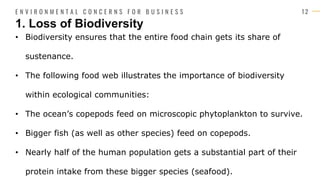
• Biodiversity ensures that the entire food chain gets its share of
sustenance.
• The following food web illustrates the importance of biodiversity
within ecological communities:
• The ocean’s copepods feed on microscopic phytoplankton to survive.
• Bigger fish (as well as other species) feed on copepods.
• Nearly half of the human population gets a substantial part of their
protein intake from these bigger species (seafood).
1. Loss of Biodiversity
E N V I R O N M E N T A L C O N C E R N S F O R B U S I N E S S
1 3
• Biodiversity loss is essentially removing links from the food chain.
When this happens, organisms that are dependent on extinct species
will feel that loss and strive to adapt or perish as well.
• This domino effect presents serious food security concerns.
• Anthropogenic activities such as overfishing or land conversion
(affecting terrestrial ecosystems) pose critical threats to
biodiversity. Shortages in the food chain put all of society at risk –
whether individuals, businesses, or host communities.
1. Loss of Biodiversity
E N V I R O N M E N T A L C O N C E R N S F O R B U S I N E S S
1 4
• Clamour for “net-zero” natural capital consumption has been the
global response to this problem.
• The International Union for Conservation of Nature (IUCN) has
spearheaded efforts to craft guidelines for businesses to manage
biodiversity risks in key areas.
1. Loss of Biodiversity
E N V I R O N M E N T A L C O N C E R N S F O R B U S I N E S S
1 5
• As the biodiversity discourse gains stronger international
participation, ESG standards will be an increasingly necessary
foothold for businesses.
• Seeking expert guidance and utilizing environmental management
tools that standardize and streamline their mitigation processes are
the first steps for any business attempting to correct its impact on
biodiversity.
1. Loss of Biodiversity
E N V I R O N M E N T A L C O N C E R N S F O R B U S I N E S S
1 6
• Increasing atmospheric carbon dioxide leads to global warming,
which in turn results in rising sea levels.
• To save the environment and avoid major financial losses,
businesses must curb carbon dioxide emissions that trigger the
following processes:
1. Glacial melting: Warmer temperatures trigger glacial melting at a
much faster rate than snow can replenish in the ice sheets. Every
year, huge volumes of water are released into the ocean.
2. Rising Sea Levels
E N V I R O N M E N T A L C O N C E R N S F O R B U S I N E S S
1 7
2. Thermal expansion of water: Cold water is denser than warm water.
As the global temperature continues to rise, the ocean is expanding.
According to the Intergovernmental Panel on Climate Change, thermal
expansion contributes half of the overall rate in sea-level rise.
Coastal regions have been slowly drowning from increasing global
temperatures.
2. Rising Sea Levels
E N V I R O N M E N T A L C O N C E R N S F O R B U S I N E S S
1 8
• Through the business lens, this goes beyond ruined reputation and
potential risk to their social license to operate.
• More frequent and intense tidal flooding because of sea-level rise
means complications in transportation infrastructure, higher
maintenance and equipment costs, and decreased distribution to
coastal regions.
2. Rising Sea Levels
E N V I R O N M E N T A L C O N C E R N S F O R B U S I N E S S
1 9
• Businesses produce huge volumes of waste–the subsequent
treatment and processing of which may be difficult, costly, and
harmful to the environment.
• The world is currently producing more waste (i.e., fertilizer residue,
textiles, food wastes, hazardous chemicals, plastics, etc.) than it can
manage.
• Mismanaged waste pollutes and reduces the quality of our air, soil,
and water.
3. Waste Production and Pollution
E N V I R O N M E N T A L C O N C E R N S F O R B U S I N E S S
2 0
• Pollution has already wreaked havoc on ecosystems and inflicted mild
and serious health concerns on micro and macro-organisms (including
humans).
• Businesses do not only rely solely on manmade infrastructure, but also
on the substantial contributions of ecosystem services.
• Mismanaged waste leads to the destruction of ecosystems, which in
turn disrupts supply chains.
• Attention to the amount and types of waste produced benefits both the
environment and businesses. Switching to both more sustainable raw
materials and processes significantly helps address the waste problem.
3. Waste Production and Pollution
E N V I R O N M E N T A L C O N C E R N S F O R B U S I N E S S
2 1
• More than a billion people live in areas with extreme water scarcity.
• Climate change is bringing prolonged droughts, increasing water-
scarce regions, and pushing water-stressed regions to the brink of
freshwater depletion.
• The United Nations, through SDG 6, highlights that “ clean water and
sanitation” are basic human rights and urges the private sector to
make proactive strides to ensure water security.
• Many water-scarce locations are hubs for water-intensive commercial
activities.
4. Water Scarcity
E N V I R O N M E N T A L C O N C E R N S F O R B U S I N E S S
2 2
• Acknowledging this, investors are integrating water stress mitigation
measures and initiating valuation discounts on shares of companies
that put minimal effort into confronting threats to water security.
• The rapid exhaustion of the world’s natural capital is partly attributable
to business activities.
• Declining biodiversity, rising sea levels, excessive waste production,
and depleting freshwater resources are all leading factors causing
collateral damage to corporate progress.
• Businesses depend on both manmade and natural systems to maintain
efficient production.
4. Water Scarcity
E N V I R O N M E N T A L C O N C E R N S F O R B U S I N E S S
2 3
• Environmental disruptions, therefore, are more than just logistical
difficulties through the business lens.
• Damaged corporate reputation from mismanaging resources and
negatively impacting the environment can also result in the loss of
social license to operate and valuation discounts from investors.
Businesses’ proactive management of their environmental footprint is
of utmost importance to profitability.
• Consulting with experts and equipping your business with
environmental management tools are the next step for any business
endeavoring to embrace the changes today’s industry requires.
4. Water Scarcity
E N V I R O N M E N T A L C O N C E R N S F O R B U S I N E S S
Any questions ?
Thanks!
24

Quality Management 09 Lecture Slides.pdf

  • 1.
    Week Nine: Week 9:Regulatory & Environmental Issues relating to the Quality Functions QUALITY MANAGEMENT DR EBENEZER ODURO ANTIRI
  • 2.
    2 - What arequality management standards? Quality management standards establish a framework for how a business manages its key activities. They identify an agreed way of doing something, either making a product, managing a process or delivering a service. - What are quality standards? Quality management standards are details of requirements, specifications, guidelines and characteristics that products, services and processes should consistently meet in order to ensure: 1. their quality matches expectations 2. they are fit for purpose 3. they meet the needs of their users Regulatory Issues in Quality Management R E G U L A T O R Y & E N V I R O N M E N T A L I S S U E S
  • 3.
    3 Businesses use standardsto satisfy their customers' quality requirements and for a range of other reasons, such as: 1. ensuring the safety and reliability of their products and services 2. complying with regulations, often at a lower cost 3. defining and controlling internal processes 4. meeting environmental objectives Purpose of quality management standards R E G U L A T O R Y I S S U E S I N Q U A L I T Y M A N A G E M E N T
  • 4.
    4 Businesses committed tofollowing quality management standards are often more able to: 1. increase their profits 2. reduce losses or costs across the business 3. improve their competitiveness 4. gain market access across the world 5. increase consumer loyalty Purpose of quality management standards R E G U L A T O R Y I S S U E S I N Q U A L I T Y M A N A G E M E N T
  • 5.
    5 • ISO internationalstandards are by far the most widely accepted set of quality standards in the world. • ISO 9001:2015 specifies the requirements for a quality management system that businesses can use to develop their own quality agenda. Examples of quality management standards R E G U L A T O R Y I S S U E S I N Q U A L I T Y M A N A G E M E N T
  • 6.
    6 • Other standardsrelated to quality include: • the remaining ISO 9000 family, including ISO 9000 and ISO 9004 • the ISO 14000 family for environmental management systems • ISO 13485 for medical devices • ISO 19011 for auditing management systems • ISO/TS 16949 for automotive-related products • Standards can be very specific, applying to a particular type of product, or general such as wide-ranging management practices. Examples of quality management standards R E G U L A T O R Y I S S U E S I N Q U A L I T Y M A N A G E M E N T
  • 7.
    7 • Standards canhelp you to achieve best practice in a wide range of business activities, not just quality management. • For example: 1. accessibility standards - can help make services or premises accessible to disabled users 2. occupational health and safety standards - can help reduce accidents in the workplace 3. information security standards - can help keep sensitive information secure Other types of best practice standards R E G U L A T O R Y I S S U E S I N Q U A L I T Y M A N A G E M E N T
  • 8.
    8 4. food safetystandards - can help prevent food from being contaminated 5. environmental management standards - can reduce environmental impact and waste increase their profits reduce losses or costs across the business improve their competitiveness gain market access across the world increase consumer loyalty 6. energy management standards - can help cut energy consumption Other types of best practice standards R E G U L A T O R Y I S S U E S I N Q U A L I T Y M A N A G E M E N T
  • 9.
    9 4. food safetystandards - can help prevent food from being contaminated 5. environmental management standards - can reduce environmental impact and waste increase their profits reduce losses or costs across the business improve their competitiveness gain market access across the world increase consumer loyalty 6. energy management standards - can help cut energy consumption Other types of best practice standards R E G U L A T O R Y I S S U E S I N Q U A L I T Y M A N A G E M E N T
  • 10.
    1 0 • Fordecades, mounting pressure to reduce carbon dioxide emissions has elicited both minor and major adjustments in business practices. • However, global warming and climate change are not the only environmental concerns companies face. • Business activities cause direct environmental impact when carried out within host communities and indirect environmental impact through supply chains. • Resource consumption and waste production can bring about excessive collateral damage on natural habitats. Environmental Concerns for Business E N V I R O N M E N T A L I S S U E S R E L A T I N G T O Q U A L I T Y
  • 11.
    1 1 • Someof these effects of industrial growth have already proven to be irreversible. • The ability to identify these impacts even before the planning stage is critical in crafting timely and effective mitigation measures. • In this lecture, we will discuss the Top 4 Environmental Concerns that require society’s urgent attention. Environmental Concerns for Business E N V I R O N M E N T A L I S S U E S R E L A T I N G T O Q U A L I T Y
  • 12.
    1 2 • Biodiversityensures that the entire food chain gets its share of sustenance. • The following food web illustrates the importance of biodiversity within ecological communities: • The ocean’s copepods feed on microscopic phytoplankton to survive. • Bigger fish (as well as other species) feed on copepods. • Nearly half of the human population gets a substantial part of their protein intake from these bigger species (seafood). 1. Loss of Biodiversity E N V I R O N M E N T A L C O N C E R N S F O R B U S I N E S S
  • 13.
    1 3 • Biodiversityloss is essentially removing links from the food chain. When this happens, organisms that are dependent on extinct species will feel that loss and strive to adapt or perish as well. • This domino effect presents serious food security concerns. • Anthropogenic activities such as overfishing or land conversion (affecting terrestrial ecosystems) pose critical threats to biodiversity. Shortages in the food chain put all of society at risk – whether individuals, businesses, or host communities. 1. Loss of Biodiversity E N V I R O N M E N T A L C O N C E R N S F O R B U S I N E S S
  • 14.
    1 4 • Clamourfor “net-zero” natural capital consumption has been the global response to this problem. • The International Union for Conservation of Nature (IUCN) has spearheaded efforts to craft guidelines for businesses to manage biodiversity risks in key areas. 1. Loss of Biodiversity E N V I R O N M E N T A L C O N C E R N S F O R B U S I N E S S
  • 15.
    1 5 • Asthe biodiversity discourse gains stronger international participation, ESG standards will be an increasingly necessary foothold for businesses. • Seeking expert guidance and utilizing environmental management tools that standardize and streamline their mitigation processes are the first steps for any business attempting to correct its impact on biodiversity. 1. Loss of Biodiversity E N V I R O N M E N T A L C O N C E R N S F O R B U S I N E S S
  • 16.
    1 6 • Increasingatmospheric carbon dioxide leads to global warming, which in turn results in rising sea levels. • To save the environment and avoid major financial losses, businesses must curb carbon dioxide emissions that trigger the following processes: 1. Glacial melting: Warmer temperatures trigger glacial melting at a much faster rate than snow can replenish in the ice sheets. Every year, huge volumes of water are released into the ocean. 2. Rising Sea Levels E N V I R O N M E N T A L C O N C E R N S F O R B U S I N E S S
  • 17.
    1 7 2. Thermalexpansion of water: Cold water is denser than warm water. As the global temperature continues to rise, the ocean is expanding. According to the Intergovernmental Panel on Climate Change, thermal expansion contributes half of the overall rate in sea-level rise. Coastal regions have been slowly drowning from increasing global temperatures. 2. Rising Sea Levels E N V I R O N M E N T A L C O N C E R N S F O R B U S I N E S S
  • 18.
    1 8 • Throughthe business lens, this goes beyond ruined reputation and potential risk to their social license to operate. • More frequent and intense tidal flooding because of sea-level rise means complications in transportation infrastructure, higher maintenance and equipment costs, and decreased distribution to coastal regions. 2. Rising Sea Levels E N V I R O N M E N T A L C O N C E R N S F O R B U S I N E S S
  • 19.
    1 9 • Businessesproduce huge volumes of waste–the subsequent treatment and processing of which may be difficult, costly, and harmful to the environment. • The world is currently producing more waste (i.e., fertilizer residue, textiles, food wastes, hazardous chemicals, plastics, etc.) than it can manage. • Mismanaged waste pollutes and reduces the quality of our air, soil, and water. 3. Waste Production and Pollution E N V I R O N M E N T A L C O N C E R N S F O R B U S I N E S S
  • 20.
    2 0 • Pollutionhas already wreaked havoc on ecosystems and inflicted mild and serious health concerns on micro and macro-organisms (including humans). • Businesses do not only rely solely on manmade infrastructure, but also on the substantial contributions of ecosystem services. • Mismanaged waste leads to the destruction of ecosystems, which in turn disrupts supply chains. • Attention to the amount and types of waste produced benefits both the environment and businesses. Switching to both more sustainable raw materials and processes significantly helps address the waste problem. 3. Waste Production and Pollution E N V I R O N M E N T A L C O N C E R N S F O R B U S I N E S S
  • 21.
    2 1 • Morethan a billion people live in areas with extreme water scarcity. • Climate change is bringing prolonged droughts, increasing water- scarce regions, and pushing water-stressed regions to the brink of freshwater depletion. • The United Nations, through SDG 6, highlights that “ clean water and sanitation” are basic human rights and urges the private sector to make proactive strides to ensure water security. • Many water-scarce locations are hubs for water-intensive commercial activities. 4. Water Scarcity E N V I R O N M E N T A L C O N C E R N S F O R B U S I N E S S
  • 22.
    2 2 • Acknowledgingthis, investors are integrating water stress mitigation measures and initiating valuation discounts on shares of companies that put minimal effort into confronting threats to water security. • The rapid exhaustion of the world’s natural capital is partly attributable to business activities. • Declining biodiversity, rising sea levels, excessive waste production, and depleting freshwater resources are all leading factors causing collateral damage to corporate progress. • Businesses depend on both manmade and natural systems to maintain efficient production. 4. Water Scarcity E N V I R O N M E N T A L C O N C E R N S F O R B U S I N E S S
  • 23.
    2 3 • Environmentaldisruptions, therefore, are more than just logistical difficulties through the business lens. • Damaged corporate reputation from mismanaging resources and negatively impacting the environment can also result in the loss of social license to operate and valuation discounts from investors. Businesses’ proactive management of their environmental footprint is of utmost importance to profitability. • Consulting with experts and equipping your business with environmental management tools are the next step for any business endeavoring to embrace the changes today’s industry requires. 4. Water Scarcity E N V I R O N M E N T A L C O N C E R N S F O R B U S I N E S S
  • 24.