Employment Relation Skills I
-The Key Employment Relation Skills
EMPLOYEE RELATIONS
DR EBENEZER ODURO ANTIRI
2
- Employment relations skills, also known as industrial relations skills
or labor relations skills, refer to the abilities and competencies that
individuals, typically within the context of an organization, use to
effectively manage and navigate relationships between employers,
employees, and labor unions.
- These skills are essential for creating and maintaining positive and
productive workplace environments.
Introduction
E M P L O Y M E N T R E L A T I O N S K I L L S
3
- These skills involve a deep understanding of labor laws, negotiation
techniques, conflict resolution strategies, and interpersonal
communication.
- Proficiency in employment relations skills empowers individuals to
address workplace challenges and promote cooperation and
collaboration among all stakeholders in the employment relationship.
Introduction
E M P L O Y M E N T R E L A T I O N S K I L L S
4
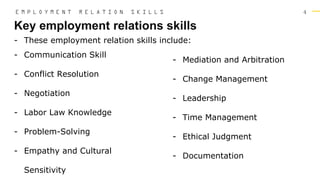
- These employment relation skills include:
Key employment relations skills
E M P L O Y M E N T R E L A T I O N S K I L L S
- Communication Skill
- Conflict Resolution
- Negotiation
- Labor Law Knowledge
- Problem-Solving
- Empathy and Cultural
Sensitivity
- Mediation and Arbitration
- Change Management
- Leadership
- Time Management
- Ethical Judgment
- Documentation
5
Communication Skill
K E Y E M P L O Y M E N T R E L A T I O N S S K I L L S
- This is the ability to listen actively, convey information clearly,
and facilitate open and honest dialogue between all parties
involved.
- In addition to verbal communication, written communication
skills are equally important, especially when drafting employment
contracts, policies, or grievance resolutions.
- Moreover, non-verbal communication cues such as body language
and facial expressions play a significant role in conveying
messages accurately in employment relations.
6
Conflict Resolution
K E Y E M P L O Y M E N T R E L A T I O N S S K I L L S
- The capacity to identify, address, and resolve conflicts in
the workplace is crucial.
- This involves mediating disputes, finding common ground,
and ensuring that conflicts do not escalate into more
significant issues.
- Conflict resolution skills also encompass the ability to
remain neutral and objective, facilitating compromise, and
implementing strategies to prevent future disputes.
7
Negotiation
K E Y E M P L O Y M E N T R E L A T I O N S S K I L L S
- Negotiation skills are essential when discussing
employment terms, conditions, and disputes.
- This includes bargaining for fair wages, benefits, and
working conditions.
- Negotiation skills are not only valuable in labor agreements
but also in everyday interactions within the workplace,
such as performance evaluations and project planning.
8
Labor Law Knowledge
K E Y E M P L O Y M E N T R E L A T I O N S S K I L L S
- Knowledge of the law helps ensure that all parties adhere
to legal requirements and rights.
- Awareness of labor laws allows for the fair treatment of
employees, preventing potential legal disputes and
promoting ethical conduct within organizations.
- Staying informed about evolving labor regulations is
essential in adapting to changing legal landscapes.
9
Problem-Solving
K E Y E M P L O Y M E N T R E L A T I O N S S K I L L S
- The ability to analyze complex issues and develop effective
solutions is vital in employment relations.
- Problem-solving skills empower individuals to address
various workplace challenges, from resolving grievances to
enhancing team dynamics.
- By fostering a problem-solving mindset, organizations can
promote a culture of continuous improvement and
adaptability.
1 0
Empathy and Cultural Sensitivity
K E Y E M P L O Y M E N T R E L A T I O N S S K I L L S
- Recognizing and respecting diverse perspectives,
backgrounds, and cultures is crucial for fostering inclusivity
and harmony in the workplace.
- Empathy and cultural sensitivity allow individuals to relate
to others on a deeper level, promoting understanding and
reducing potential conflicts related to cultural differences.
- This skill helps create an inclusive work environment where
employees from diverse backgrounds feel valued and
respected.
1 1
Mediation and Arbitration
K E Y E M P L O Y M E N T R E L A T I O N S S K I L L S
- In cases where disputes cannot be resolved through
negotiation, skills in mediation and arbitration are
essential.
- These techniques help find equitable solutions outside of
the traditional legal system and lengthy legal processes.
- Mediation and arbitration skills enable trained professionals
to facilitate discussions and make impartial decisions to
resolve disputes swiftly and fairly.
1 2
Change Management
K E Y E M P L O Y M E N T R E L A T I O N S S K I L L S
- As workplaces evolve, the ability to manage change and
adapt to new policies, procedures, and technologies is
valuable in maintaining positive relations.
- Change management skills involve guiding employees
through transitions, ensuring minimal disruption, and
promoting understanding and acceptance of changes.
- Effective communication and empathy play a significant
role in change management, as they help address
concerns and build trust.
1 3
Leadership
K E Y E M P L O Y M E N T R E L A T I O N S S K I L L S
- Leaders within organizations need strong employment
relations skills to set a positive example and guide their
teams effectively.
- Leadership skills in employment relations include being
role models for respectful communication, conflict
resolution, and adherence to labor laws.
- Effective leaders create an environment where employees
feel valued and heard, leading to improved morale and
productivity.
1 4
Time Management
K E Y E M P L O Y M E N T R E L A T I O N S S K I L L S
- Efficiently managing tasks and responsibilities related to
employment relations is essential.
- Time management skills enable professionals in
employment relations to prioritize tasks, meet deadlines
for negotiations or dispute resolutions, and ensure that
critical issues are addressed promptly.
- Efficiently managing time contributes to smoother labor
relations processes and prevents potential conflicts from
escalating.
1 5
Ethical Judgment
K E Y E M P L O Y M E N T R E L A T I O N S S K I L L S
- Making decisions and taking actions that are fair, ethical,
and aligned with the best interests of all stakeholders is a
critical skill in employment relations.
- Ethical judgment in employment relations involves
assessing situations impartially, considering the moral
implications of decisions, and acting in a principled
manner.
- This helps prevent unethical practices that can harm both
employees and employers.
1 6
Documentation
K E Y E M P L O Y M E N T R E L A T I O N S S K I L L S
- Keeping accurate records of employment-related
interactions and agreements is important for legal
compliance and accountability.
- Documentation skills in employment relations encompass
the ability to maintain meticulous records of all
communications, negotiations, disputes, and agreements.
- This practice ensures transparency, helps in resolving
conflicts by referring to established records, and aids in
legal compliance.
1 7
Conclusion
K E Y E M P L O Y M E N T R E L A T I O N S S K I L L S
- Key employment relations skills are pivotal for creating
thriving workplace environments.
- These competencies, ranging from effective communication
to ethical judgment, empower organizations to build
positive relationships, resolve conflicts, and navigate legal
complexities.
- By prioritizing the development of these skills, businesses
can foster productive, inclusive, and harmonious
workplaces that benefit both employees and employers.
Thanks!
18

Employee Relations Lecture Slides 09.pdf

  • 1.
    Employment Relation SkillsI -The Key Employment Relation Skills EMPLOYEE RELATIONS DR EBENEZER ODURO ANTIRI
  • 2.
    2 - Employment relationsskills, also known as industrial relations skills or labor relations skills, refer to the abilities and competencies that individuals, typically within the context of an organization, use to effectively manage and navigate relationships between employers, employees, and labor unions. - These skills are essential for creating and maintaining positive and productive workplace environments. Introduction E M P L O Y M E N T R E L A T I O N S K I L L S
  • 3.
    3 - These skillsinvolve a deep understanding of labor laws, negotiation techniques, conflict resolution strategies, and interpersonal communication. - Proficiency in employment relations skills empowers individuals to address workplace challenges and promote cooperation and collaboration among all stakeholders in the employment relationship. Introduction E M P L O Y M E N T R E L A T I O N S K I L L S
  • 4.
    4 - These employmentrelation skills include: Key employment relations skills E M P L O Y M E N T R E L A T I O N S K I L L S - Communication Skill - Conflict Resolution - Negotiation - Labor Law Knowledge - Problem-Solving - Empathy and Cultural Sensitivity - Mediation and Arbitration - Change Management - Leadership - Time Management - Ethical Judgment - Documentation
  • 5.
    5 Communication Skill K EY E M P L O Y M E N T R E L A T I O N S S K I L L S - This is the ability to listen actively, convey information clearly, and facilitate open and honest dialogue between all parties involved. - In addition to verbal communication, written communication skills are equally important, especially when drafting employment contracts, policies, or grievance resolutions. - Moreover, non-verbal communication cues such as body language and facial expressions play a significant role in conveying messages accurately in employment relations.
  • 6.
    6 Conflict Resolution K EY E M P L O Y M E N T R E L A T I O N S S K I L L S - The capacity to identify, address, and resolve conflicts in the workplace is crucial. - This involves mediating disputes, finding common ground, and ensuring that conflicts do not escalate into more significant issues. - Conflict resolution skills also encompass the ability to remain neutral and objective, facilitating compromise, and implementing strategies to prevent future disputes.
  • 7.
    7 Negotiation K E YE M P L O Y M E N T R E L A T I O N S S K I L L S - Negotiation skills are essential when discussing employment terms, conditions, and disputes. - This includes bargaining for fair wages, benefits, and working conditions. - Negotiation skills are not only valuable in labor agreements but also in everyday interactions within the workplace, such as performance evaluations and project planning.
  • 8.
    8 Labor Law Knowledge KE Y E M P L O Y M E N T R E L A T I O N S S K I L L S - Knowledge of the law helps ensure that all parties adhere to legal requirements and rights. - Awareness of labor laws allows for the fair treatment of employees, preventing potential legal disputes and promoting ethical conduct within organizations. - Staying informed about evolving labor regulations is essential in adapting to changing legal landscapes.
  • 9.
    9 Problem-Solving K E YE M P L O Y M E N T R E L A T I O N S S K I L L S - The ability to analyze complex issues and develop effective solutions is vital in employment relations. - Problem-solving skills empower individuals to address various workplace challenges, from resolving grievances to enhancing team dynamics. - By fostering a problem-solving mindset, organizations can promote a culture of continuous improvement and adaptability.
  • 10.
    1 0 Empathy andCultural Sensitivity K E Y E M P L O Y M E N T R E L A T I O N S S K I L L S - Recognizing and respecting diverse perspectives, backgrounds, and cultures is crucial for fostering inclusivity and harmony in the workplace. - Empathy and cultural sensitivity allow individuals to relate to others on a deeper level, promoting understanding and reducing potential conflicts related to cultural differences. - This skill helps create an inclusive work environment where employees from diverse backgrounds feel valued and respected.
  • 11.
    1 1 Mediation andArbitration K E Y E M P L O Y M E N T R E L A T I O N S S K I L L S - In cases where disputes cannot be resolved through negotiation, skills in mediation and arbitration are essential. - These techniques help find equitable solutions outside of the traditional legal system and lengthy legal processes. - Mediation and arbitration skills enable trained professionals to facilitate discussions and make impartial decisions to resolve disputes swiftly and fairly.
  • 12.
    1 2 Change Management KE Y E M P L O Y M E N T R E L A T I O N S S K I L L S - As workplaces evolve, the ability to manage change and adapt to new policies, procedures, and technologies is valuable in maintaining positive relations. - Change management skills involve guiding employees through transitions, ensuring minimal disruption, and promoting understanding and acceptance of changes. - Effective communication and empathy play a significant role in change management, as they help address concerns and build trust.
  • 13.
    1 3 Leadership K EY E M P L O Y M E N T R E L A T I O N S S K I L L S - Leaders within organizations need strong employment relations skills to set a positive example and guide their teams effectively. - Leadership skills in employment relations include being role models for respectful communication, conflict resolution, and adherence to labor laws. - Effective leaders create an environment where employees feel valued and heard, leading to improved morale and productivity.
  • 14.
    1 4 Time Management KE Y E M P L O Y M E N T R E L A T I O N S S K I L L S - Efficiently managing tasks and responsibilities related to employment relations is essential. - Time management skills enable professionals in employment relations to prioritize tasks, meet deadlines for negotiations or dispute resolutions, and ensure that critical issues are addressed promptly. - Efficiently managing time contributes to smoother labor relations processes and prevents potential conflicts from escalating.
  • 15.
    1 5 Ethical Judgment KE Y E M P L O Y M E N T R E L A T I O N S S K I L L S - Making decisions and taking actions that are fair, ethical, and aligned with the best interests of all stakeholders is a critical skill in employment relations. - Ethical judgment in employment relations involves assessing situations impartially, considering the moral implications of decisions, and acting in a principled manner. - This helps prevent unethical practices that can harm both employees and employers.
  • 16.
    1 6 Documentation K EY E M P L O Y M E N T R E L A T I O N S S K I L L S - Keeping accurate records of employment-related interactions and agreements is important for legal compliance and accountability. - Documentation skills in employment relations encompass the ability to maintain meticulous records of all communications, negotiations, disputes, and agreements. - This practice ensures transparency, helps in resolving conflicts by referring to established records, and aids in legal compliance.
  • 17.
    1 7 Conclusion K EY E M P L O Y M E N T R E L A T I O N S S K I L L S - Key employment relations skills are pivotal for creating thriving workplace environments. - These competencies, ranging from effective communication to ethical judgment, empower organizations to build positive relationships, resolve conflicts, and navigate legal complexities. - By prioritizing the development of these skills, businesses can foster productive, inclusive, and harmonious workplaces that benefit both employees and employers.
  • 18.