
Quality of Life Technologies Lab
University of Geneva & University of Copenhagen
qualityoflifetechnologies.org
Quality of Life Technologies:
From Cure to Care
Assoc. Prof. Katarzyna Wac
GSASA, 15/16 November 2018
3
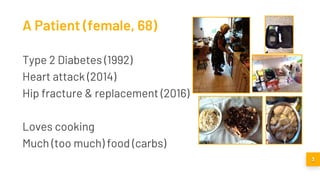
A Patient (female, 68)
Type 2 Diabetes (1992)
Heart attack (2014)
Hip fracture & replacement (2016)
Loves cooking
Much (too much) food (carbs)
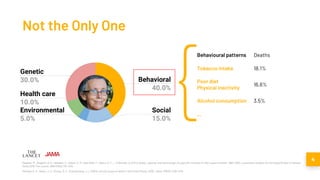
Not the Only One
4Naghavi, M., Abajobir, A. A., Abbafati, C., Abbas, K. M., Abd-Allah, F., Abera, S. F., ... & Ahmadi, A. (2017). Global, regional, and national age-sex specific mortality for 264 causes of death, 1980–2016: a systematic analysis for the Global Burden of Disease
Study 2016. The Lancet, 390(10100), 1151-1210.
Mokdad, A. H., Marks, J. S., Stroup, D. F., & Gerberding, J. L. (2004). Actual causes of death in the United States, 2000. Jama, 291(10), 1238-1245.
Behavioural patterns Deaths
Tobacco intake 18.1%
Poor diet
Physical inactivity
16.6%
Alcohol consumption 3.5%
...
{
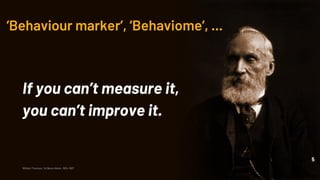
‘Behaviour marker’, ‘Behaviome’, ...
If you can’t measure it,
you can’t improve it.
5
William Thomson, 1st Baron Kelvin, 1824-1907
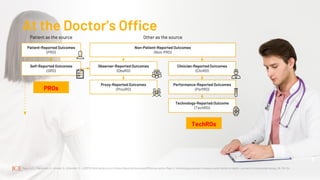
At the Doctor’s Office
6
Mayo, N. E., Figueiredo, S., Ahmed, S., & Bartlett, S. J. (2017). Montreal Accord on Patient-Reported Outcomes (PROs) use series–Paper 2: terminology proposed to measure what matters in health. Journal of clinical epidemiology, 89, 119-124.
TechROs
PROs
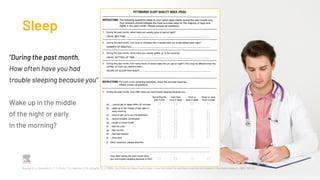
Sleep
7
“During the past month,
How often have you had
trouble sleeping because you”
Wake up in the middle
of the night or early
In the morning?
Buysse, D. J., Reynolds III, C. F., Monk, T. H., Berman, S. R., & Kupfer, D. J. (1989). The Pittsburgh Sleep Quality Index: a new instrument for psychiatric practice and research. Psychiatry research, 28(2), 193-213.
8
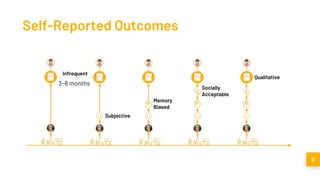
Self-Reported Outcomes
3~6 months
9
The Big
Picture
10
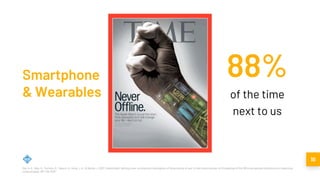
Dey, A. K., Wac, K., Ferreira, D., Tassini, K., Hong, J. H., & Ramos, J. (2011, September). Getting closer: an empirical investigation of the proximity of user to their smart phones. In Proceedings of the 13th international conference on Ubiquitous
computing (pp. 163-172). ACM.
Smartphone
& Wearables
88%
of the time
next to us
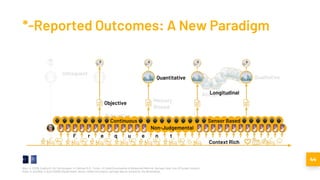
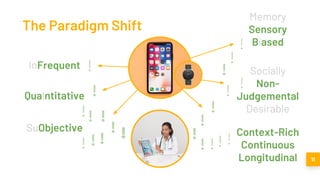
The Paradigm Shift
11
InFrequent
Qualntitative
SuObjective
Memory
Sensory
Biased
Socially
Non-
Judgemental
Desirable
!
!
!
!!
!
!
!
!
!
!!
!
!! Context-Rich
Continuous
Longitudinal
! !! !! !
!
12
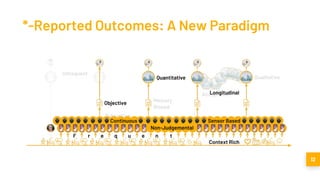
*-Reported Outcomes: A New Paradigm
“
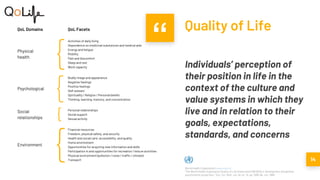
Individuals’ perception of
their position in life in the
context of the culture and
value systems in which they
live and in relation to their
goals, expectations,
standards, and concerns
Quality of Life
14
World Health Organization | www.who.int
“The World Health Organization Quality of Life Assessment (WHOQOL): development and general
psychometric properties.,” Soc. Sci. Med., vol. 46, no. 12, pp. 1569–85, Jun. 1998.
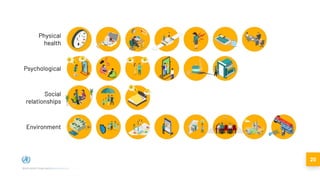
QoL Domains QoL Facets
Physical
health
Activities of daily living
Dependence on medicinal substances and medical aids
Energy and fatigue
Mobility
Pain and discomfort
Sleep and rest
Work capacity
Psychological
Bodily image and appearance
Negative feelings
Positive feelings
Self-esteem
Spirituality / Religion / Personal beliefs
Thinking, learning, memory, and concentration
Social
relationships
Personal relationships
Social support
Sexual activity
Environment
Financial resources
Freedom, physical safety, and security
Health and social care: accessibility, and quality
Home environment
Opportunities for acquiring new information and skills
Participation in and opportunities for recreation / leisure activities
Physical environment (pollution / noise / traffic / climate)
Transport
{
{
{
{
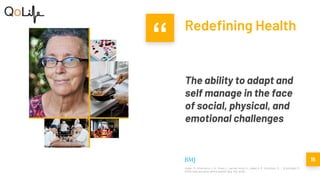
“ Redefining Health
The ability to adapt and
self manage in the face
of social, physical, and
emotional challenges
15
Huber, M., Knottnerus, J. A., Green, L., van der Horst, H., Jadad, A. R., Kromhout, D., ... & Schnabel, P.
(2011). How should we define health?. Bmj, 343, d4163.
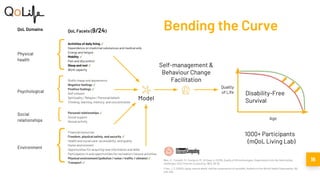
Bending the Curve
16Wac, K., Fiordelli, M., Gustarini, M., & Rivas, H. (2015). Quality of life technologies: Experiences from the field and key
challenges. IEEE Internet Computing, 19(4), 28-35.
Fries, J. F. (2002). Aging, natural death, and the compression of morbidity. Bulletin of the World Health Organization, 80,
245-250.
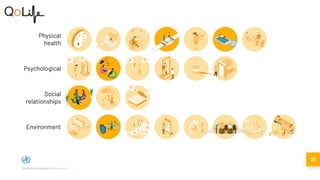
QoL Domains QoL Facets (9/24)
Physical
health
Activities of daily living ✓
Dependence on medicinal substances and medical aids
Energy and fatigue
Mobility ✓
Pain and discomfort
Sleep and rest ✓
Work capacity
Psychological
Bodily image and appearance
Negative feelings ✓
Positive feelings ✓
Self-esteem
Spirituality / Religion / Personal beliefs
Thinking, learning, memory, and concentration
Social
relationships
Personal relationships ✓
Social support
Sexual activity
Environment
Financial resources
Freedom, physical safety, and security ✓
Health and social care: accessibility, and quality
Home environment
Opportunities for acquiring new information and skills
Participation in and opportunities for recreation / leisure activities
Physical environment (pollution / noise / traffic / climate) ✓
Transport ✓
{
{
{
{
Model
Self-management &
Behaviour Change
Facilitation
1000+ Participants
(mQoL Living Lab)
17
De Masi, A., Berrocal, A., …, & Wac, K., (2018). Mixed-Methods Research Methodology Enabling Identification, Modelling and Predicting Human Aspects of Mobile Interaction "In the Wild". User Modelling and User-Adapted Interaction (under evaluation)
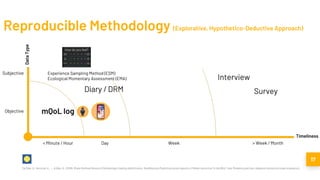
Reproducible Methodology (Explorative, Hypothetico-Deductive Approach)
Experience Sampling Method (ESM)
Ecological Momentary Assessment (EMA)
18
De Masi, A., & Wac, K. (2018). You're Using This App for What?: A mQoL Living Lab Study. Mobile Human Contributions: Workshop in conjunction with ACM UBICOMP, Singapore, October 2018.
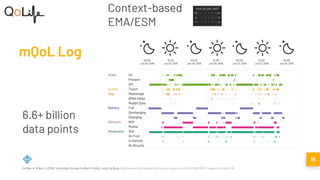
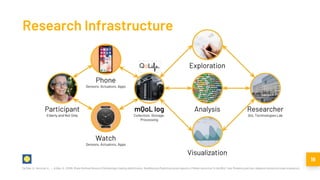
mQoL Log
6.6+ billion
data points
Context-based
EMA/ESM
19
De Masi, A., Berrocal, A., …, & Wac, K., (2018). Mixed-Methods Research Methodology Enabling Identification, Modelling and Predicting Human Aspects of Mobile Interaction "In the Wild". User Modelling and User-Adapted Interaction (under evaluation)
Research Infrastructure
20
World Health Organization | www.who.int
21
World Health Organization | www.who.int
22
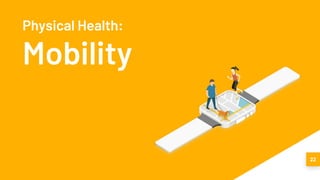
Physical Health:
Mobility
23
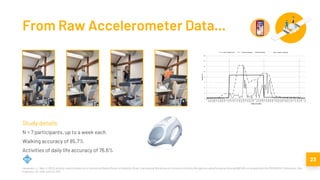
From Raw Accelerometer Data...
N = 7 participants, up to a week each
Walking accuracy of 85.7%
Activities of daily life accuracy of 76.6%
Hausmann, J., Wac, K. (2011). Activity Level Estimator on a Commercial Mobile Phone: A Feasibility Study. International Workshop on Frontiers in Activity Recognition using Pervasive Sensing (IWFAR), co-located with the PERVASIVE Conference, San
Francisco, CA, USA, June 12, 2011.
Study details
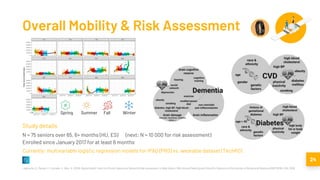
Spring Summer Fall Winter
24
Overall Mobility & Risk Assessment
Laghouila, S., Manea, V., Estrada, V., Wac, K. (2018). Digital Health Tools for Chronic Illness and Dementia Risk Assessment in Older Adults, 39th Annual Meeting and Scientific Sessions of the Society of Behavioral Medicine (SBM 2018), USA, 2018
N = 75 seniors over 65, 6+ months (HU, ES) (next: N = 10 000 for risk assessment)
Enrolled since January 2017 for at least 6 months
Study details
Currently: multivariable logistic regression models for IPAQ (PRO) vs. wearable dataset (TechRO)
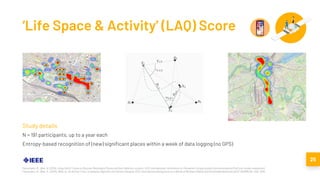
‘Life Space & Activity’ (LAQ) Score
N = 191 participants, up to a year each
Entropy-based recognition of (new) significant places within a week of data logging (no GPS)
25
Fanourakis, M., Wac, K. (2019). Using Cell ID Traces to Discover Meaningful Places and their Relative Location, IEEE International Conference on Pervasive Computing and Communications (PerCom) (under evaluation)
Fanourakis, M., Wac, K., (2015). ReNLoc: An Anchor-Free Localization Algorithm for Indirect Ranging, IEEE International Symposium on a World of Wireless Mobile and Multimedia Networks (IEEE WoWMoM), USA, 2015
Study details
26
Physical Health:
Sleep
27
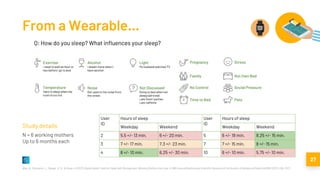
From a Wearable...
Wac, K., Montanini, L., Ryager, K. B., & Rivas, H. (2017). Digital Health Tools for Sleep Self-Management: Working Mothers Use Case. In 38th Annual Meeting and Scientific Sessions of the Society of Behavioral Medicine (SBM 2017), USA, 2017.
User
ID
Hours of sleep User
ID
Hours of sleep
Weekday Weekend Weekday Weekend
2 5.5 +/- 13 min. 6 +/- 20 min. 5 6 +/- 18 min. 8.25 +/- 15 min.
3 7 +/- 17 min. 7.3 +/- 23 min. 7 7 +/- 15 min. 8 +/- 15 min.
4 8 +/- 10 min. 6.25 +/- 30 min. 10 6 +/- 10 min. 5.75 +/- 10 min.
N = 6 working mothers
Up to 6 months each
Study details
Spring Summer Fall Winter
28
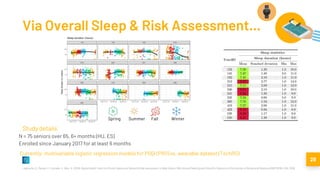
Via Overall Sleep & Risk Assessment...
Laghouila, S., Manea, V., Estrada, V., Wac, K. (2018). Digital Health Tools for Chronic Illness and Dementia Risk Assessment in Older Adults, 39th Annual Meeting and Scientific Sessions of the Society of Behavioral Medicine (SBM 2018), USA, 2018.
N = 75 seniors over 65, 6+ months (HU, ES)
Enrolled since January 2017 for at least 6 months
Study details
Currently: multivariable logistic regression models for PSQI (PRO) vs. wearable dataset (TechRO)
Back to Phone (ON-OFF ‘Sensor’)
N = 14: working mothers (S2-S5) and students (S11-S20), up to 6 months each 29
Ciman, M., Wac, K. (2018), iSenseSleep: Smartphone as a Sleep Duration Sensor, JMIR mhealth and uhealth (under minor revision)
User ID Sleep duration Phone ON-OFF Remark
BASIS watch
[avg±std]
Estimate [avg±std]
* significantly diff
2 (mothers) 393 +/- 10 min. 418 +/- 14 min.
3 402 +/- 15 min. 507 +/- 16 min.* Over
4 455 +/- 13 min. 377 +/- 34 min.* Under
5 446 +/- 15 min. 444 +/- 25 min.
11 (students) 429 +/- 15 min. 481 +/- 23 min.* Over
12 473 +/- 16 min. 478 +/- 25 min.
13 377 +/- 22 min. 377 +/- 24 min.
14 450 +/- 15 min. 454 +/- 35 min.
15 482 +/- 14 min. 459 +/- 24 min.
16 478 +/- 16 min. 446 +/- 36 min.
17 409 +/- 19 min. 378 +/- 45 min.* Under
18 417 +/- 24 min. 374 +/- 16 min.
19 462 +/- 16 min. 346 +/- 25 min.* Under
20 452 +/- 29 min. 426 +/- 39 min.* Under
Study details
mQoL Log
30
Psychological:
Negative
Feelings,
Stress
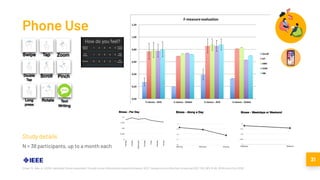
Phone Use
31
Ciman, M., Wac, K., (2018). Individuals’ Stress Assessment Through Human-Smartphone Interaction Analysis, IEEE Transactions on Affective Computing (IEEE TAC), 9(1): 51-65, 2018 (online first 2016)
N = 38 participants, up to a month each
Study details
35
Social Relationships:
Personal
Relationships
as ‘Sensors’
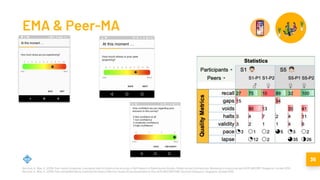
EMA & Peer-MA
36
Berrocal, A., Wac, K., (2018). Peer-vasive Computing: Leveraging Peers to Enhance the Accuracy of Self-Reports in Mobile Human Studies, Mobile Human Contributions: Workshop in conjunction with ACM UBICOMP, Singapore, October 2018.
Berrocal, A., Wac, K., (2018). Peer-ceived Well-Being: Exploring the Value of Peers for Human Stress Assessment in-Situ, ACM UBICOMP/ISWC Doctoral Colloquium, Singapore, October 2018.
37
Human Factors:
What about
the Patient?
38
Wac, K., Rivas, H., & Fiordelli, M. (2016). Use and misuse of mobile health information technologies for health self-management. Annals of Behavioral Medicine, 50 (Supplement 1).
Wac, K. et al., “I Try Harder”: The Design Implications for Mobile Apps and Wearables Contributing to Self-Efficacy of Patients with Chronic Conditions, Frontiers in Psychology, SI: Improving Wellbeing in Patients with Chronic Conditions (under revision)
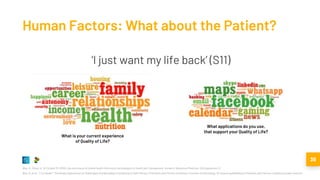
What applications do you use,
that support your Quality of Life?
What is your current experience
of Quality of Life?
Human Factors: What about the Patient?
‘I just want my life back’ (S11)
39
Wac, K., Rivas, H., & Fiordelli, M. (2016). Use and misuse of mobile health information technologies for health self-management. Annals of Behavioral Medicine, 50 (Supplement 1).
Wac, K. et al., “I Try Harder”: The Design Implications for Mobile Apps and Wearables Contributing to Self-Efficacy of Patients with Chronic Conditions, Frontiers in Psychology, SI: Improving Wellbeing in Patients with Chronic Conditions (under revision)
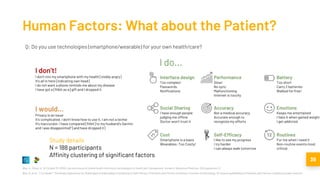
Human Factors: What about the Patient?
Study details
N = 188 participants
Affinity clustering of significant factors
Q: Do you use technologies (smartphone/wearable) for your own health/care?
40
Back to
The Big
Picture
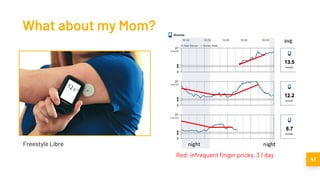
What about my Mom?
41
Red: infrequent finger pricks, 3 / day
Freestyle Libre
42
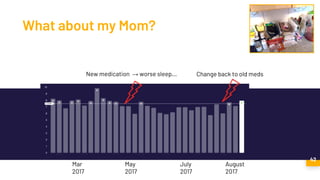
New medication → worse sleep... Change back to old meds
Mar
2017
May
2017
July
2017
What about my Mom?
August
2017
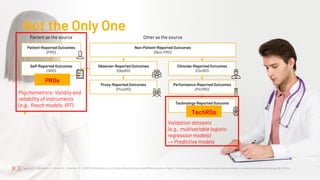
Not the Only One
43
Mayo, N. E., Figueiredo, S., Ahmed, S., & Bartlett, S. J. (2017). Montreal Accord on Patient-Reported Outcomes (PROs) use series–Paper 2: terminology proposed to measure what matters in health. Journal of clinical epidemiology, 89, 119-124.
Psychometrics: Validity and
reliability of instruments
(e.g., Rasch models, IRT)
Validation datasets
(e.g., multivariable logistic
regression models)
→ Predictive models
TechROs
PROs
44
*-Reported Outcomes: A New Paradigm
Wac., K. (2019). Quality of Life Technologies. In: Gellman M.D., Turner J.R. (eds) Encyclopedia of Behavioral Medicine. Springer, New York, NY (under revision)
Rivas, H. and Wac, K. (Eds.) (2018). Digital Health, Series: Health Informatics, Springer Nature, Dordrecht, the Netherlands.
45
Quality of Life Technologies Lab
qualityoflifetechnologies.org
Thank You
Assoc. Prof. Katarzyna Wac and the team
Human-Centered Computing, University of Copenhagen, Denmark
Quality of Life, Center for Informatics, University of Geneva, Switzerland
wac@di.ku.dk & katarzyna.wac@unige.ch
Images: unsplash.com and icons8.com

Quality of Life Technologies: From Cure to Care

  • 1.
    Quality of LifeTechnologies Lab University of Geneva & University of Copenhagen qualityoflifetechnologies.org Quality of Life Technologies: From Cure to Care Assoc. Prof. Katarzyna Wac GSASA, 15/16 November 2018
  • 2.
    3 A Patient (female,68) Type 2 Diabetes (1992) Heart attack (2014) Hip fracture & replacement (2016) Loves cooking Much (too much) food (carbs)
  • 3.
    Not the OnlyOne 4Naghavi, M., Abajobir, A. A., Abbafati, C., Abbas, K. M., Abd-Allah, F., Abera, S. F., ... & Ahmadi, A. (2017). Global, regional, and national age-sex specific mortality for 264 causes of death, 1980–2016: a systematic analysis for the Global Burden of Disease Study 2016. The Lancet, 390(10100), 1151-1210. Mokdad, A. H., Marks, J. S., Stroup, D. F., & Gerberding, J. L. (2004). Actual causes of death in the United States, 2000. Jama, 291(10), 1238-1245. Behavioural patterns Deaths Tobacco intake 18.1% Poor diet Physical inactivity 16.6% Alcohol consumption 3.5% ... {
  • 4.
    ‘Behaviour marker’, ‘Behaviome’,... If you can’t measure it, you can’t improve it. 5 William Thomson, 1st Baron Kelvin, 1824-1907
  • 5.
    At the Doctor’sOffice 6 Mayo, N. E., Figueiredo, S., Ahmed, S., & Bartlett, S. J. (2017). Montreal Accord on Patient-Reported Outcomes (PROs) use series–Paper 2: terminology proposed to measure what matters in health. Journal of clinical epidemiology, 89, 119-124. TechROs PROs
  • 6.
    Sleep 7 “During the pastmonth, How often have you had trouble sleeping because you” Wake up in the middle of the night or early In the morning? Buysse, D. J., Reynolds III, C. F., Monk, T. H., Berman, S. R., & Kupfer, D. J. (1989). The Pittsburgh Sleep Quality Index: a new instrument for psychiatric practice and research. Psychiatry research, 28(2), 193-213.
  • 7.
  • 8.
  • 9.
    10 Dey, A. K.,Wac, K., Ferreira, D., Tassini, K., Hong, J. H., & Ramos, J. (2011, September). Getting closer: an empirical investigation of the proximity of user to their smart phones. In Proceedings of the 13th international conference on Ubiquitous computing (pp. 163-172). ACM. Smartphone & Wearables 88% of the time next to us
  • 10.
  • 11.
  • 12.
    “ Individuals’ perception of theirposition in life in the context of the culture and value systems in which they live and in relation to their goals, expectations, standards, and concerns Quality of Life 14 World Health Organization | www.who.int “The World Health Organization Quality of Life Assessment (WHOQOL): development and general psychometric properties.,” Soc. Sci. Med., vol. 46, no. 12, pp. 1569–85, Jun. 1998. QoL Domains QoL Facets Physical health Activities of daily living Dependence on medicinal substances and medical aids Energy and fatigue Mobility Pain and discomfort Sleep and rest Work capacity Psychological Bodily image and appearance Negative feelings Positive feelings Self-esteem Spirituality / Religion / Personal beliefs Thinking, learning, memory, and concentration Social relationships Personal relationships Social support Sexual activity Environment Financial resources Freedom, physical safety, and security Health and social care: accessibility, and quality Home environment Opportunities for acquiring new information and skills Participation in and opportunities for recreation / leisure activities Physical environment (pollution / noise / traffic / climate) Transport { { { {
  • 13.
    “ Redefining Health Theability to adapt and self manage in the face of social, physical, and emotional challenges 15 Huber, M., Knottnerus, J. A., Green, L., van der Horst, H., Jadad, A. R., Kromhout, D., ... & Schnabel, P. (2011). How should we define health?. Bmj, 343, d4163.
  • 14.
    Bending the Curve 16Wac,K., Fiordelli, M., Gustarini, M., & Rivas, H. (2015). Quality of life technologies: Experiences from the field and key challenges. IEEE Internet Computing, 19(4), 28-35. Fries, J. F. (2002). Aging, natural death, and the compression of morbidity. Bulletin of the World Health Organization, 80, 245-250. QoL Domains QoL Facets (9/24) Physical health Activities of daily living ✓ Dependence on medicinal substances and medical aids Energy and fatigue Mobility ✓ Pain and discomfort Sleep and rest ✓ Work capacity Psychological Bodily image and appearance Negative feelings ✓ Positive feelings ✓ Self-esteem Spirituality / Religion / Personal beliefs Thinking, learning, memory, and concentration Social relationships Personal relationships ✓ Social support Sexual activity Environment Financial resources Freedom, physical safety, and security ✓ Health and social care: accessibility, and quality Home environment Opportunities for acquiring new information and skills Participation in and opportunities for recreation / leisure activities Physical environment (pollution / noise / traffic / climate) ✓ Transport ✓ { { { { Model Self-management & Behaviour Change Facilitation 1000+ Participants (mQoL Living Lab)
  • 15.
    17 De Masi, A.,Berrocal, A., …, & Wac, K., (2018). Mixed-Methods Research Methodology Enabling Identification, Modelling and Predicting Human Aspects of Mobile Interaction "In the Wild". User Modelling and User-Adapted Interaction (under evaluation) Reproducible Methodology (Explorative, Hypothetico-Deductive Approach) Experience Sampling Method (ESM) Ecological Momentary Assessment (EMA)
  • 16.
    18 De Masi, A.,& Wac, K. (2018). You're Using This App for What?: A mQoL Living Lab Study. Mobile Human Contributions: Workshop in conjunction with ACM UBICOMP, Singapore, October 2018. mQoL Log 6.6+ billion data points Context-based EMA/ESM
  • 17.
    19 De Masi, A.,Berrocal, A., …, & Wac, K., (2018). Mixed-Methods Research Methodology Enabling Identification, Modelling and Predicting Human Aspects of Mobile Interaction "In the Wild". User Modelling and User-Adapted Interaction (under evaluation) Research Infrastructure
  • 18.
  • 19.
  • 20.
  • 21.
    23 From Raw AccelerometerData... N = 7 participants, up to a week each Walking accuracy of 85.7% Activities of daily life accuracy of 76.6% Hausmann, J., Wac, K. (2011). Activity Level Estimator on a Commercial Mobile Phone: A Feasibility Study. International Workshop on Frontiers in Activity Recognition using Pervasive Sensing (IWFAR), co-located with the PERVASIVE Conference, San Francisco, CA, USA, June 12, 2011. Study details
  • 22.
    Spring Summer FallWinter 24 Overall Mobility & Risk Assessment Laghouila, S., Manea, V., Estrada, V., Wac, K. (2018). Digital Health Tools for Chronic Illness and Dementia Risk Assessment in Older Adults, 39th Annual Meeting and Scientific Sessions of the Society of Behavioral Medicine (SBM 2018), USA, 2018 N = 75 seniors over 65, 6+ months (HU, ES) (next: N = 10 000 for risk assessment) Enrolled since January 2017 for at least 6 months Study details Currently: multivariable logistic regression models for IPAQ (PRO) vs. wearable dataset (TechRO)
  • 23.
    ‘Life Space &Activity’ (LAQ) Score N = 191 participants, up to a year each Entropy-based recognition of (new) significant places within a week of data logging (no GPS) 25 Fanourakis, M., Wac, K. (2019). Using Cell ID Traces to Discover Meaningful Places and their Relative Location, IEEE International Conference on Pervasive Computing and Communications (PerCom) (under evaluation) Fanourakis, M., Wac, K., (2015). ReNLoc: An Anchor-Free Localization Algorithm for Indirect Ranging, IEEE International Symposium on a World of Wireless Mobile and Multimedia Networks (IEEE WoWMoM), USA, 2015 Study details
  • 24.
  • 25.
    27 From a Wearable... Wac,K., Montanini, L., Ryager, K. B., & Rivas, H. (2017). Digital Health Tools for Sleep Self-Management: Working Mothers Use Case. In 38th Annual Meeting and Scientific Sessions of the Society of Behavioral Medicine (SBM 2017), USA, 2017. User ID Hours of sleep User ID Hours of sleep Weekday Weekend Weekday Weekend 2 5.5 +/- 13 min. 6 +/- 20 min. 5 6 +/- 18 min. 8.25 +/- 15 min. 3 7 +/- 17 min. 7.3 +/- 23 min. 7 7 +/- 15 min. 8 +/- 15 min. 4 8 +/- 10 min. 6.25 +/- 30 min. 10 6 +/- 10 min. 5.75 +/- 10 min. N = 6 working mothers Up to 6 months each Study details
  • 26.
    Spring Summer FallWinter 28 Via Overall Sleep & Risk Assessment... Laghouila, S., Manea, V., Estrada, V., Wac, K. (2018). Digital Health Tools for Chronic Illness and Dementia Risk Assessment in Older Adults, 39th Annual Meeting and Scientific Sessions of the Society of Behavioral Medicine (SBM 2018), USA, 2018. N = 75 seniors over 65, 6+ months (HU, ES) Enrolled since January 2017 for at least 6 months Study details Currently: multivariable logistic regression models for PSQI (PRO) vs. wearable dataset (TechRO)
  • 27.
    Back to Phone(ON-OFF ‘Sensor’) N = 14: working mothers (S2-S5) and students (S11-S20), up to 6 months each 29 Ciman, M., Wac, K. (2018), iSenseSleep: Smartphone as a Sleep Duration Sensor, JMIR mhealth and uhealth (under minor revision) User ID Sleep duration Phone ON-OFF Remark BASIS watch [avg±std] Estimate [avg±std] * significantly diff 2 (mothers) 393 +/- 10 min. 418 +/- 14 min. 3 402 +/- 15 min. 507 +/- 16 min.* Over 4 455 +/- 13 min. 377 +/- 34 min.* Under 5 446 +/- 15 min. 444 +/- 25 min. 11 (students) 429 +/- 15 min. 481 +/- 23 min.* Over 12 473 +/- 16 min. 478 +/- 25 min. 13 377 +/- 22 min. 377 +/- 24 min. 14 450 +/- 15 min. 454 +/- 35 min. 15 482 +/- 14 min. 459 +/- 24 min. 16 478 +/- 16 min. 446 +/- 36 min. 17 409 +/- 19 min. 378 +/- 45 min.* Under 18 417 +/- 24 min. 374 +/- 16 min. 19 462 +/- 16 min. 346 +/- 25 min.* Under 20 452 +/- 29 min. 426 +/- 39 min.* Under Study details mQoL Log
  • 28.
  • 29.
    Phone Use 31 Ciman, M.,Wac, K., (2018). Individuals’ Stress Assessment Through Human-Smartphone Interaction Analysis, IEEE Transactions on Affective Computing (IEEE TAC), 9(1): 51-65, 2018 (online first 2016) N = 38 participants, up to a month each Study details
  • 30.
  • 31.
    EMA & Peer-MA 36 Berrocal,A., Wac, K., (2018). Peer-vasive Computing: Leveraging Peers to Enhance the Accuracy of Self-Reports in Mobile Human Studies, Mobile Human Contributions: Workshop in conjunction with ACM UBICOMP, Singapore, October 2018. Berrocal, A., Wac, K., (2018). Peer-ceived Well-Being: Exploring the Value of Peers for Human Stress Assessment in-Situ, ACM UBICOMP/ISWC Doctoral Colloquium, Singapore, October 2018.
  • 32.
  • 33.
    38 Wac, K., Rivas,H., & Fiordelli, M. (2016). Use and misuse of mobile health information technologies for health self-management. Annals of Behavioral Medicine, 50 (Supplement 1). Wac, K. et al., “I Try Harder”: The Design Implications for Mobile Apps and Wearables Contributing to Self-Efficacy of Patients with Chronic Conditions, Frontiers in Psychology, SI: Improving Wellbeing in Patients with Chronic Conditions (under revision) What applications do you use, that support your Quality of Life? What is your current experience of Quality of Life? Human Factors: What about the Patient? ‘I just want my life back’ (S11)
  • 34.
    39 Wac, K., Rivas,H., & Fiordelli, M. (2016). Use and misuse of mobile health information technologies for health self-management. Annals of Behavioral Medicine, 50 (Supplement 1). Wac, K. et al., “I Try Harder”: The Design Implications for Mobile Apps and Wearables Contributing to Self-Efficacy of Patients with Chronic Conditions, Frontiers in Psychology, SI: Improving Wellbeing in Patients with Chronic Conditions (under revision) Human Factors: What about the Patient? Study details N = 188 participants Affinity clustering of significant factors Q: Do you use technologies (smartphone/wearable) for your own health/care?
  • 35.
  • 36.
    What about myMom? 41 Red: infrequent finger pricks, 3 / day Freestyle Libre
  • 37.
    42 New medication →worse sleep... Change back to old meds Mar 2017 May 2017 July 2017 What about my Mom? August 2017
  • 38.
    Not the OnlyOne 43 Mayo, N. E., Figueiredo, S., Ahmed, S., & Bartlett, S. J. (2017). Montreal Accord on Patient-Reported Outcomes (PROs) use series–Paper 2: terminology proposed to measure what matters in health. Journal of clinical epidemiology, 89, 119-124. Psychometrics: Validity and reliability of instruments (e.g., Rasch models, IRT) Validation datasets (e.g., multivariable logistic regression models) → Predictive models TechROs PROs
  • 39.
    44 *-Reported Outcomes: ANew Paradigm Wac., K. (2019). Quality of Life Technologies. In: Gellman M.D., Turner J.R. (eds) Encyclopedia of Behavioral Medicine. Springer, New York, NY (under revision) Rivas, H. and Wac, K. (Eds.) (2018). Digital Health, Series: Health Informatics, Springer Nature, Dordrecht, the Netherlands.
  • 40.
  • 41.
    Quality of LifeTechnologies Lab qualityoflifetechnologies.org Thank You Assoc. Prof. Katarzyna Wac and the team Human-Centered Computing, University of Copenhagen, Denmark Quality of Life, Center for Informatics, University of Geneva, Switzerland wac@di.ku.dk & katarzyna.wac@unige.ch Images: unsplash.com and icons8.com