CUSTOMER ANALYSIS AND
BUYING BEHAVIOR
Dr. Kamal Kishor Pandey
Associate Professor
TMIMT-College of Management
Teerthanker Mahaveer University, Moradabad
UNDERSTANDING
CONSUMERS
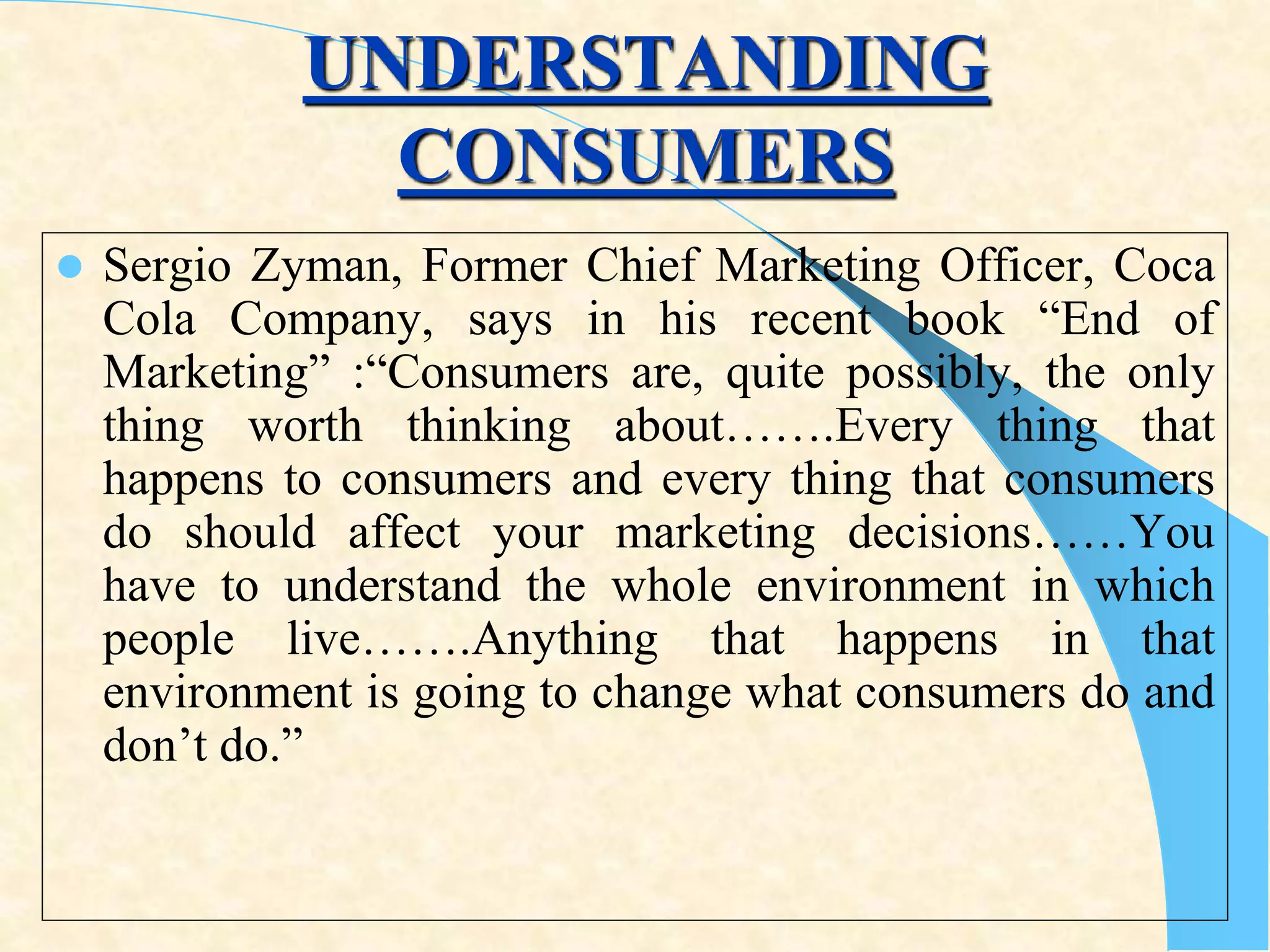
 Sergio Zyman, Former Chief Marketing Officer, Coca
Cola Company, says in his recent book “End of
Marketing” :“Consumers are, quite possibly, the only
thing worth thinking about…….Every thing that
happens to consumers and every thing that consumers
do should affect your marketing decisions……You
have to understand the whole environment in which
people live…….Anything that happens in that
environment is going to change what consumers do and
don’t do.”
STUDY OF CONSUMER BEHAVIOUR
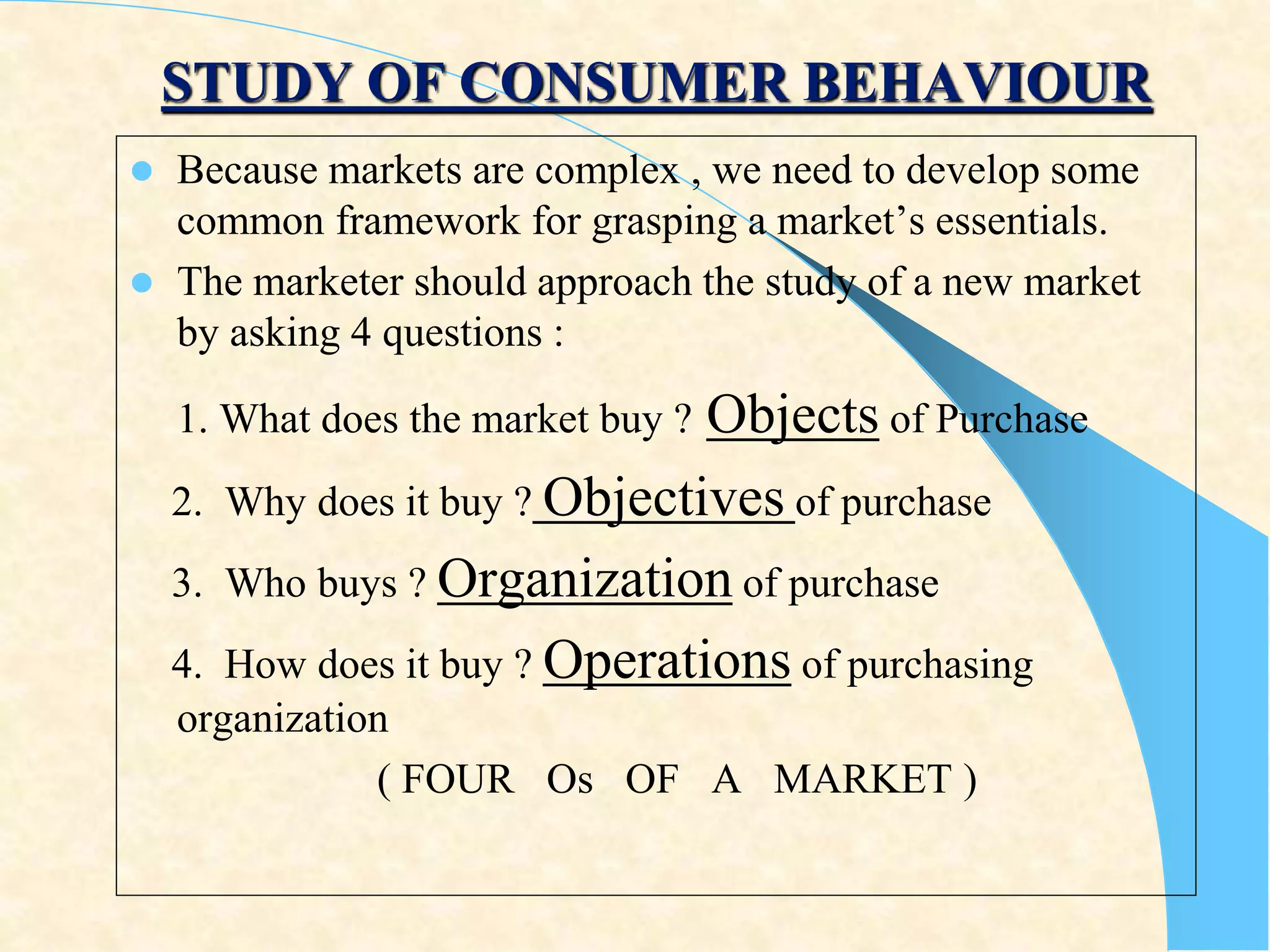
 Because markets are complex , we need to develop some
common framework for grasping a market’s essentials.
 The marketer should approach the study of a new market
by asking 4 questions :
1. What does the market buy ? Objects of Purchase
2. Why does it buy ? Objectives of purchase
3. Who buys ? Organization of purchase
4. How does it buy ? Operations of purchasing
organization
( FOUR Os OF A MARKET )
6 Os OF A MARKET
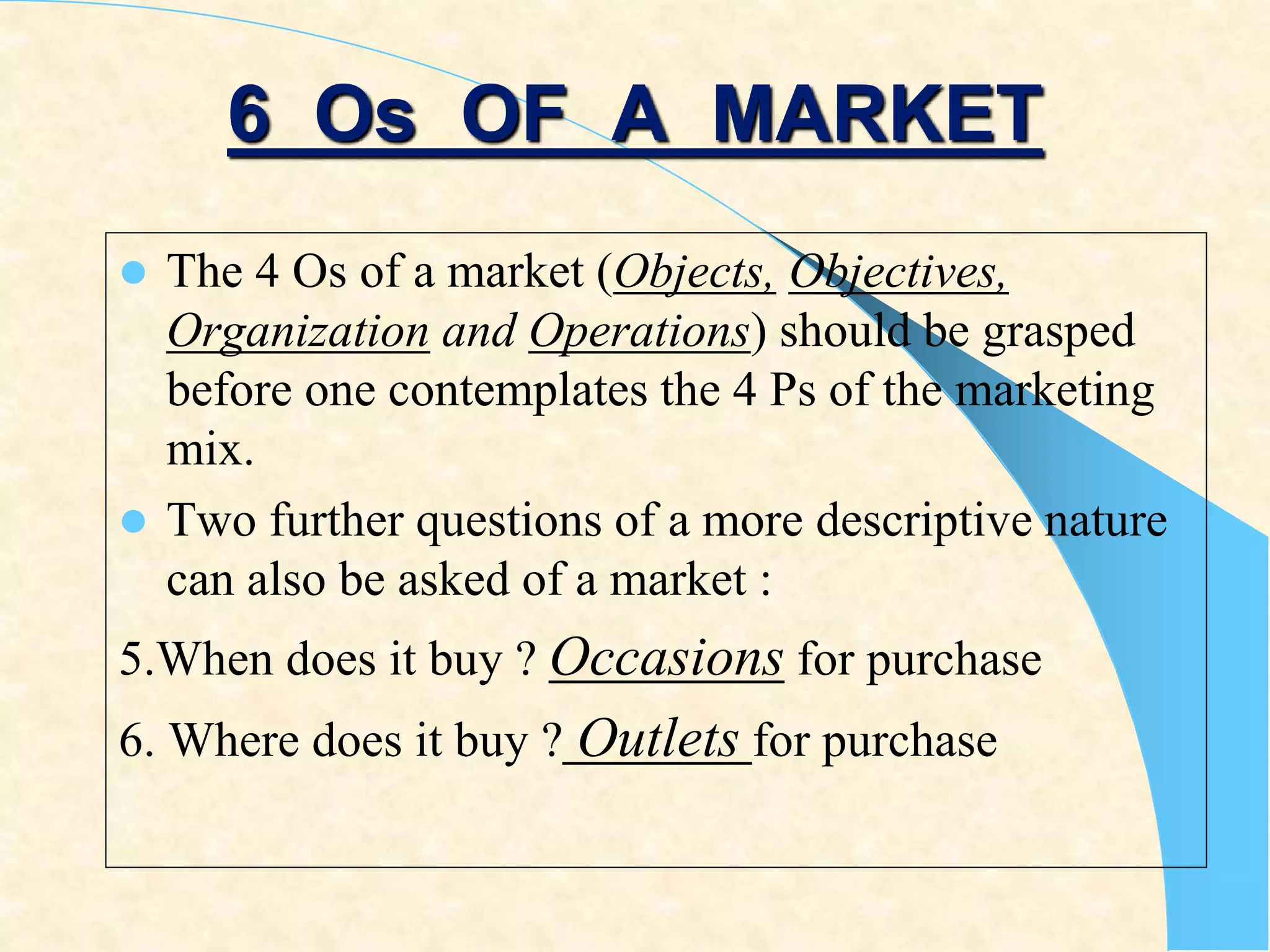
 The 4 Os of a market (Objects, Objectives,
Organization and Operations) should be grasped
before one contemplates the 4 Ps of the marketing
mix.
 Two further questions of a more descriptive nature
can also be asked of a market :
5.When does it buy ? Occasions for purchase
6. Where does it buy ? Outlets for purchase
CONSUMER MARKET
 Consumer Market is the market for
products and services that are
purchased or hired by individuals and
households for personal (non-business)
use.
 Consumer Products : Products
purchased for personal use.
BUYERS V/S CONSUMERS
 Mother buying toys for kid
(Buyer – Mother, Actual user – Kid)
 Marketers focus their promotion on both i.e.
buyers and the user (ultimate consumer)
 For example Maggi and Rasna , both try to
influence the buyer and the user. Taste and
fun aspects for children (main users) and
time saving and economy for mothers
(actual buyers).
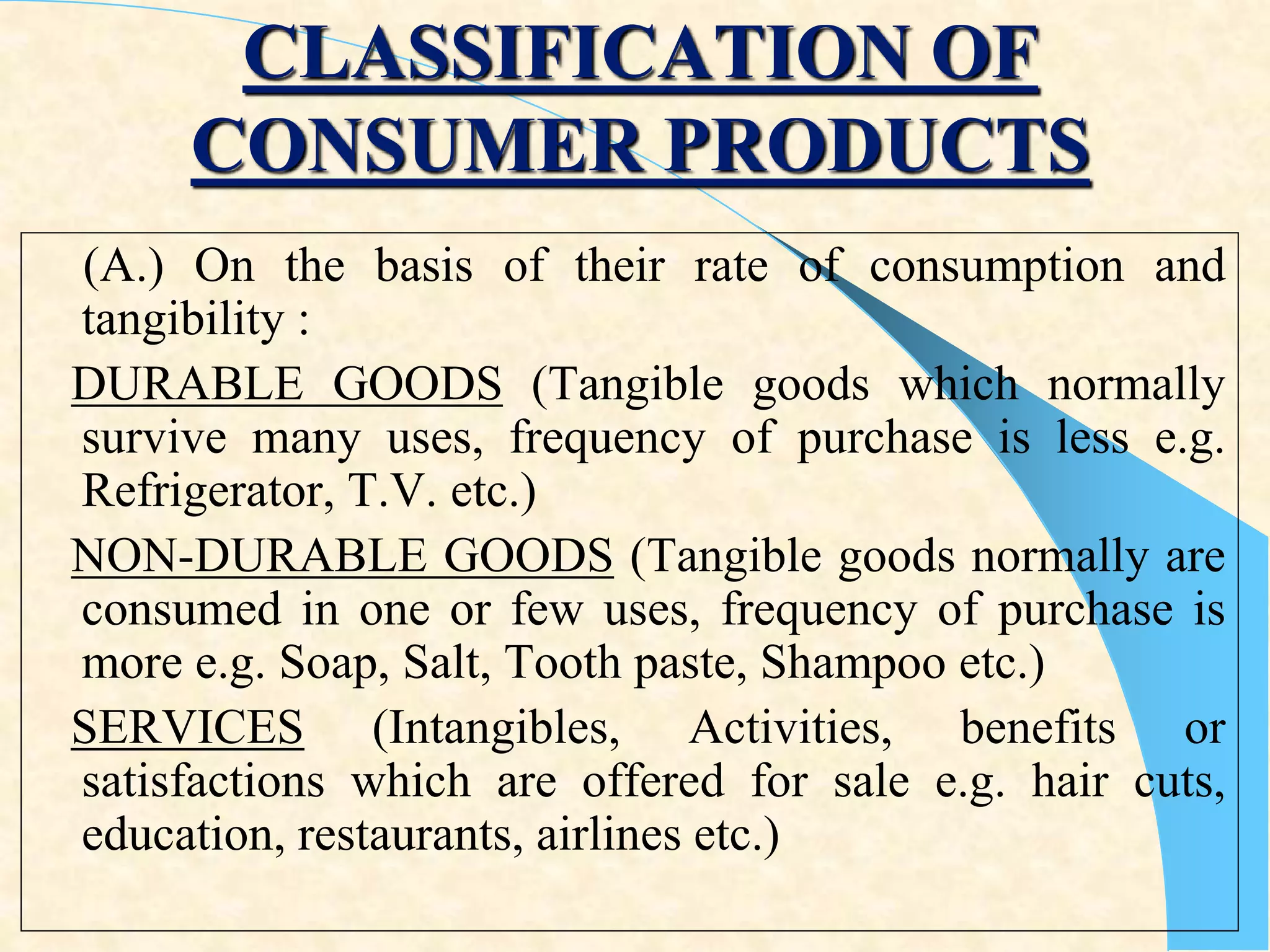
CLASSIFICATION OF
CONSUMER PRODUCTS
(A.) On the basis of their rate of consumption and
tangibility :
DURABLE GOODS (Tangible goods which normally
survive many uses, frequency of purchase is less e.g.
Refrigerator, T.V. etc.)
NON-DURABLE GOODS (Tangible goods normally are
consumed in one or few uses, frequency of purchase is
more e.g. Soap, Salt, Tooth paste, Shampoo etc.)
SERVICES (Intangibles, Activities, benefits or
satisfactions which are offered for sale e.g. hair cuts,
education, restaurants, airlines etc.)
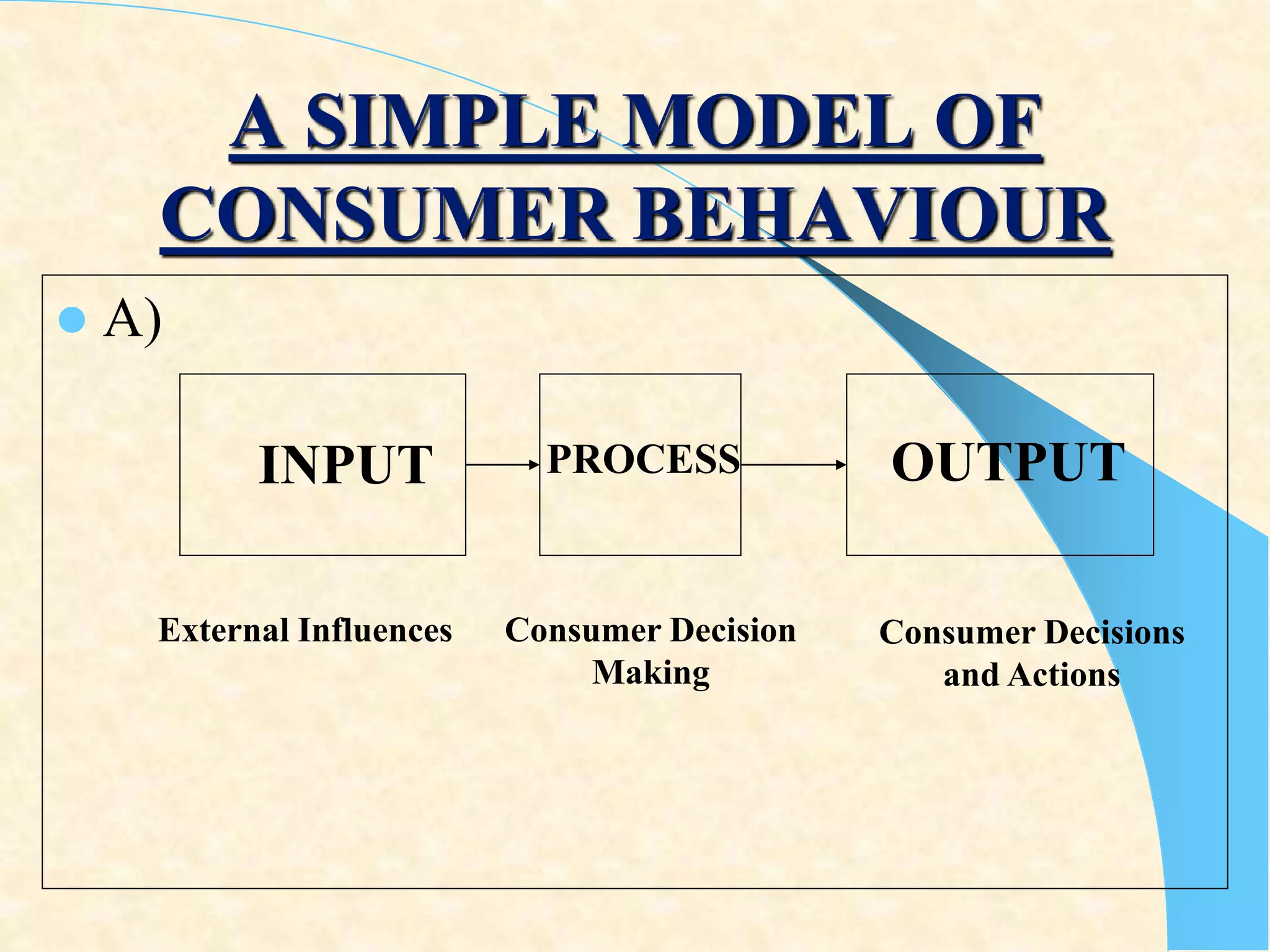
A SIMPLE MODEL OF
CONSUMER BEHAVIOUR
 A)
INPUT PROCESS OUTPUT
External Influences Consumer Decision
Making
Consumer Decisions
and Actions
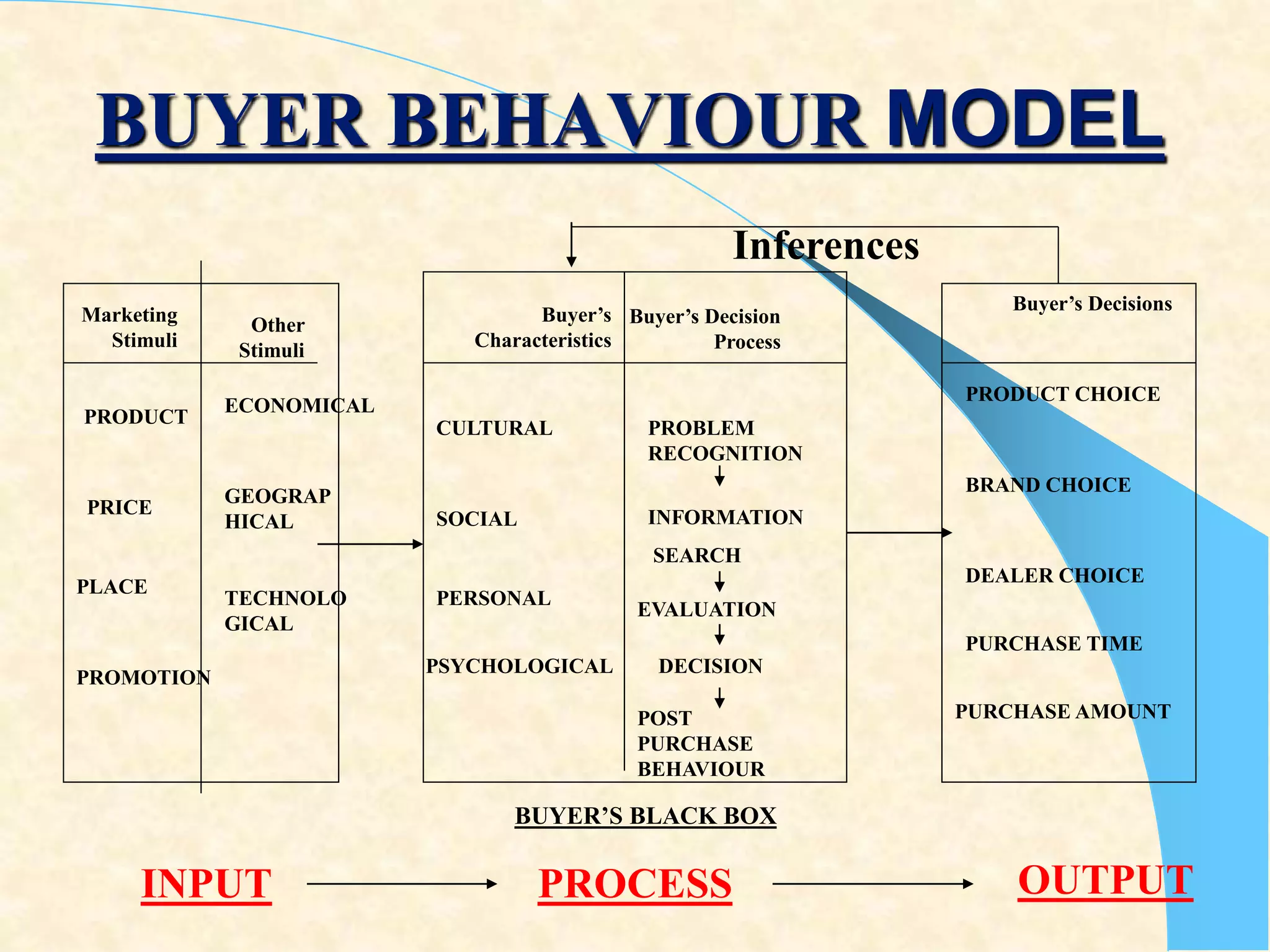
BUYER BEHAVIOUR MODEL
Marketing
Stimuli
Other
Stimuli
Buyer’s
Characteristics
Buyer’s Decision
Process
Buyer’s Decisions
PRODUCT
PRICE
PLACE
PROMOTION
ECONOMICAL
GEOGRAP
HICAL
TECHNOLO
GICAL
CULTURAL
SOCIAL
PERSONAL
PSYCHOLOGICAL
PROBLEM
RECOGNITION
INFORMATION
SEARCH
EVALUATION
DECISION
POST
PURCHASE
BEHAVIOUR
PRODUCT CHOICE
BRAND CHOICE
DEALER CHOICE
PURCHASE TIME
PURCHASE AMOUNT
BUYER’S BLACK BOX
INPUT PROCESS OUTPUT
Inferences
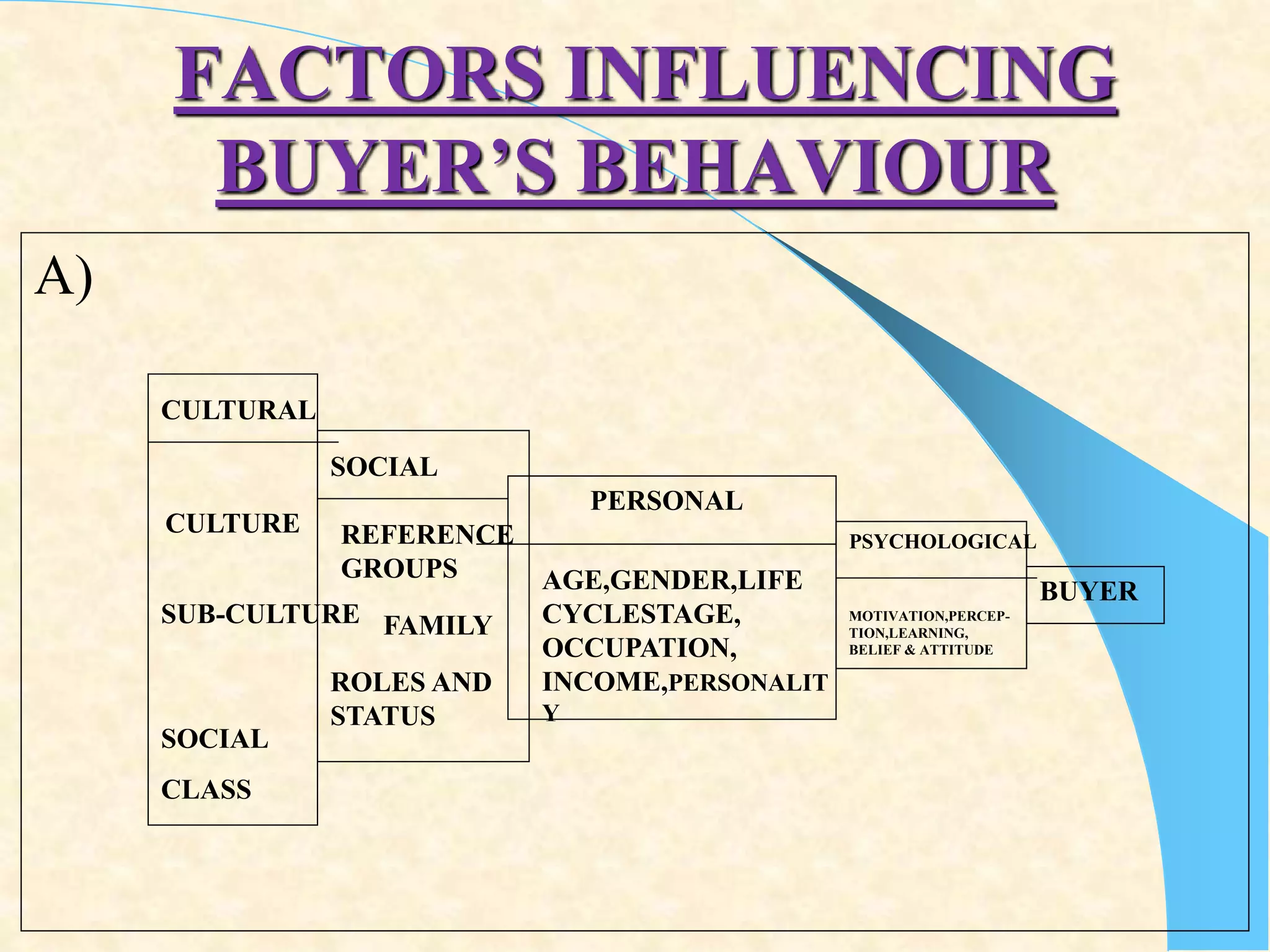
FACTORS INFLUENCING
BUYER’S BEHAVIOUR
A)
CULTURAL
SOCIAL
PERSONAL
PSYCHOLOGICAL
BUYER
CULTURE
SUB-CULTURE
SOCIAL
CLASS
REFERENCE
GROUPS
FAMILY
ROLES AND
STATUS
AGE,GENDER,LIFE
CYCLESTAGE,
OCCUPATION,
INCOME,PERSONALIT
Y
MOTIVATION,PERCEP-
TION,LEARNING,
BELIEF & ATTITUDE
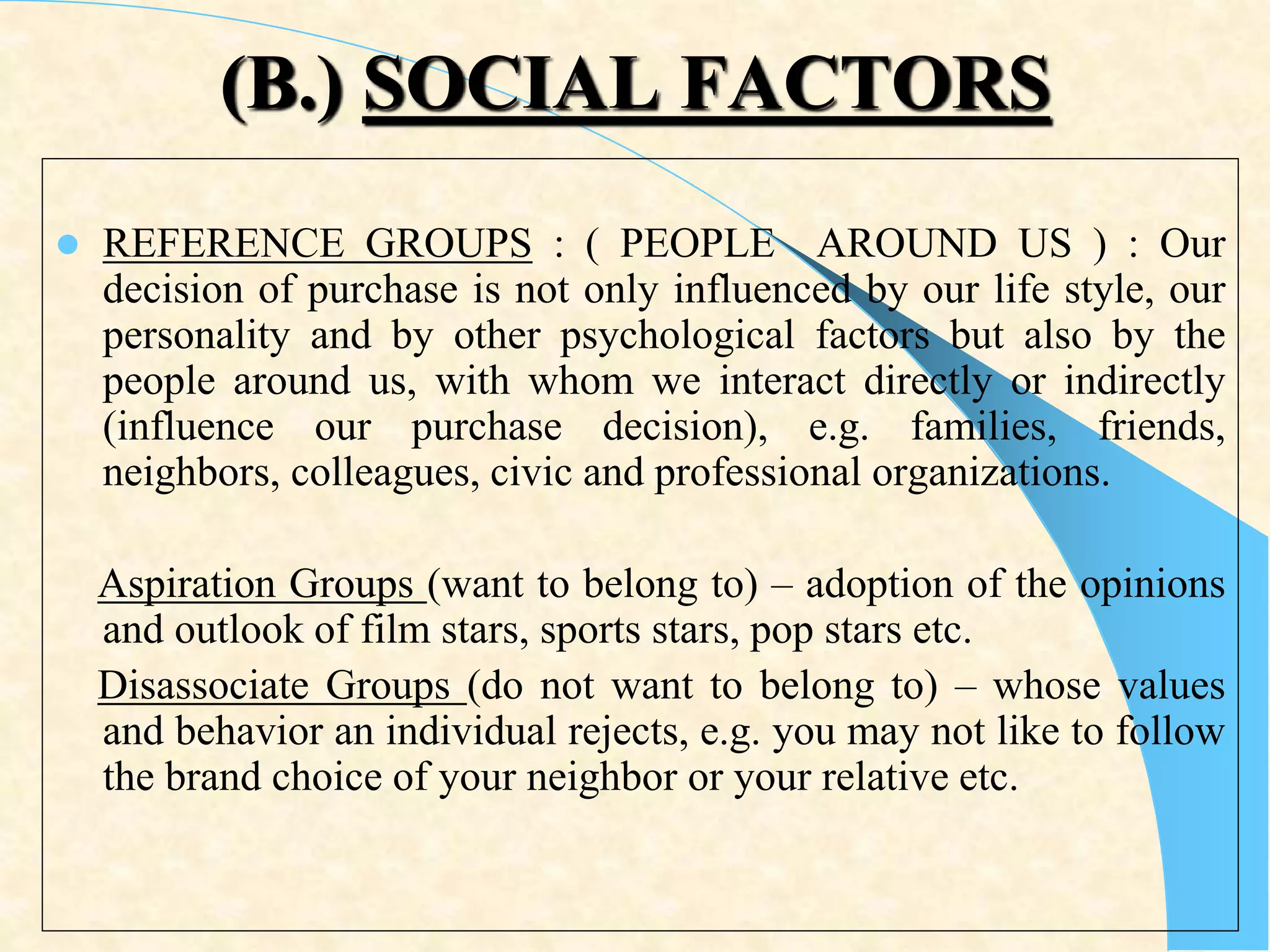
(B.) SOCIAL FACTORS
 REFERENCE GROUPS : ( PEOPLE AROUND US ) : Our
decision of purchase is not only influenced by our life style, our
personality and by other psychological factors but also by the
people around us, with whom we interact directly or indirectly
(influence our purchase decision), e.g. families, friends,
neighbors, colleagues, civic and professional organizations.
Aspiration Groups (want to belong to) – adoption of the opinions
and outlook of film stars, sports stars, pop stars etc.
Disassociate Groups (do not want to belong to) – whose values
and behavior an individual rejects, e.g. you may not like to follow
the brand choice of your neighbor or your relative etc.
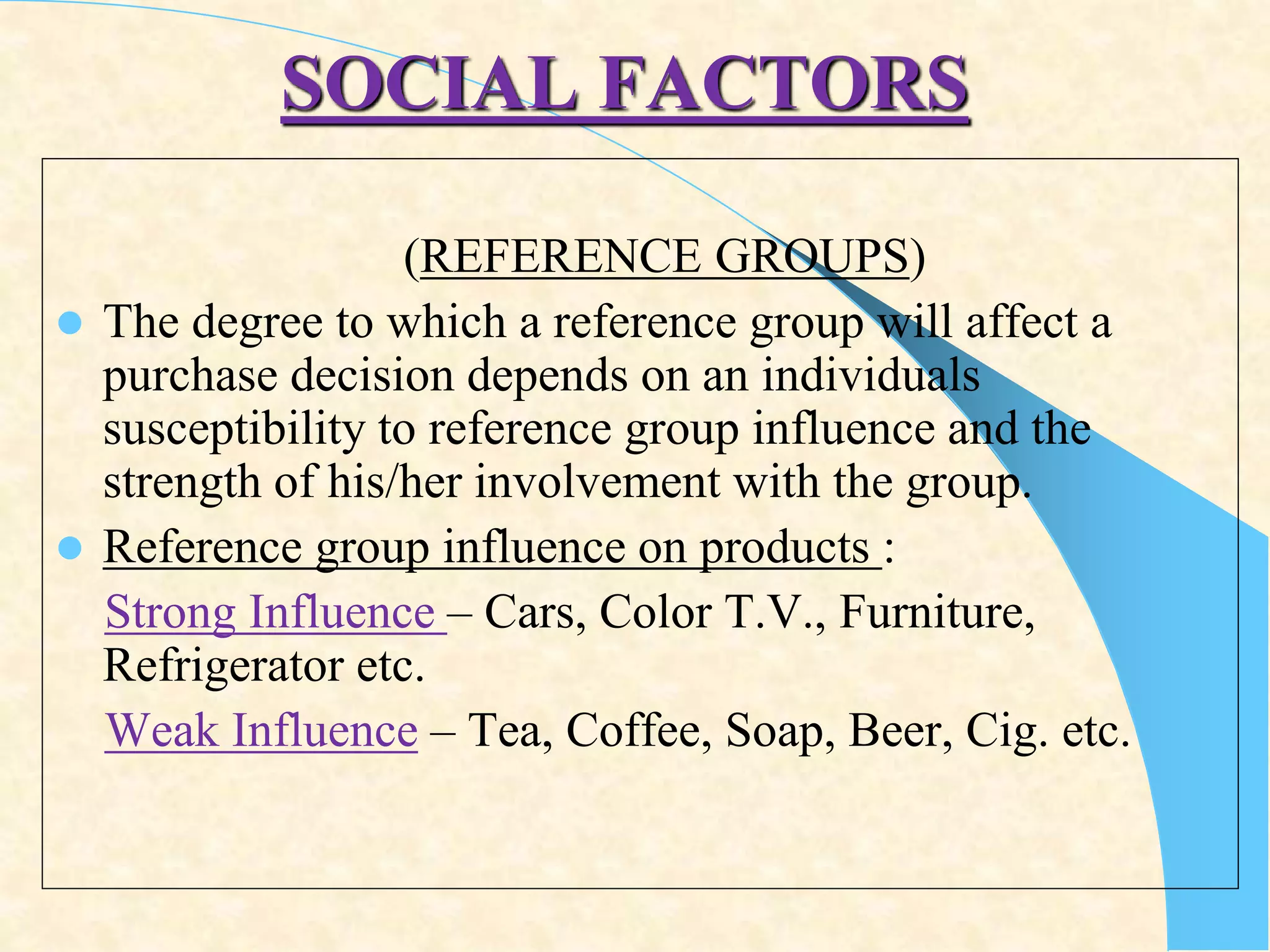
SOCIAL FACTORS
(REFERENCE GROUPS)
 The degree to which a reference group will affect a
purchase decision depends on an individuals
susceptibility to reference group influence and the
strength of his/her involvement with the group.
 Reference group influence on products :
Strong Influence – Cars, Color T.V., Furniture,
Refrigerator etc.
Weak Influence – Tea, Coffee, Soap, Beer, Cig. etc.
PERSONAL FACTORS
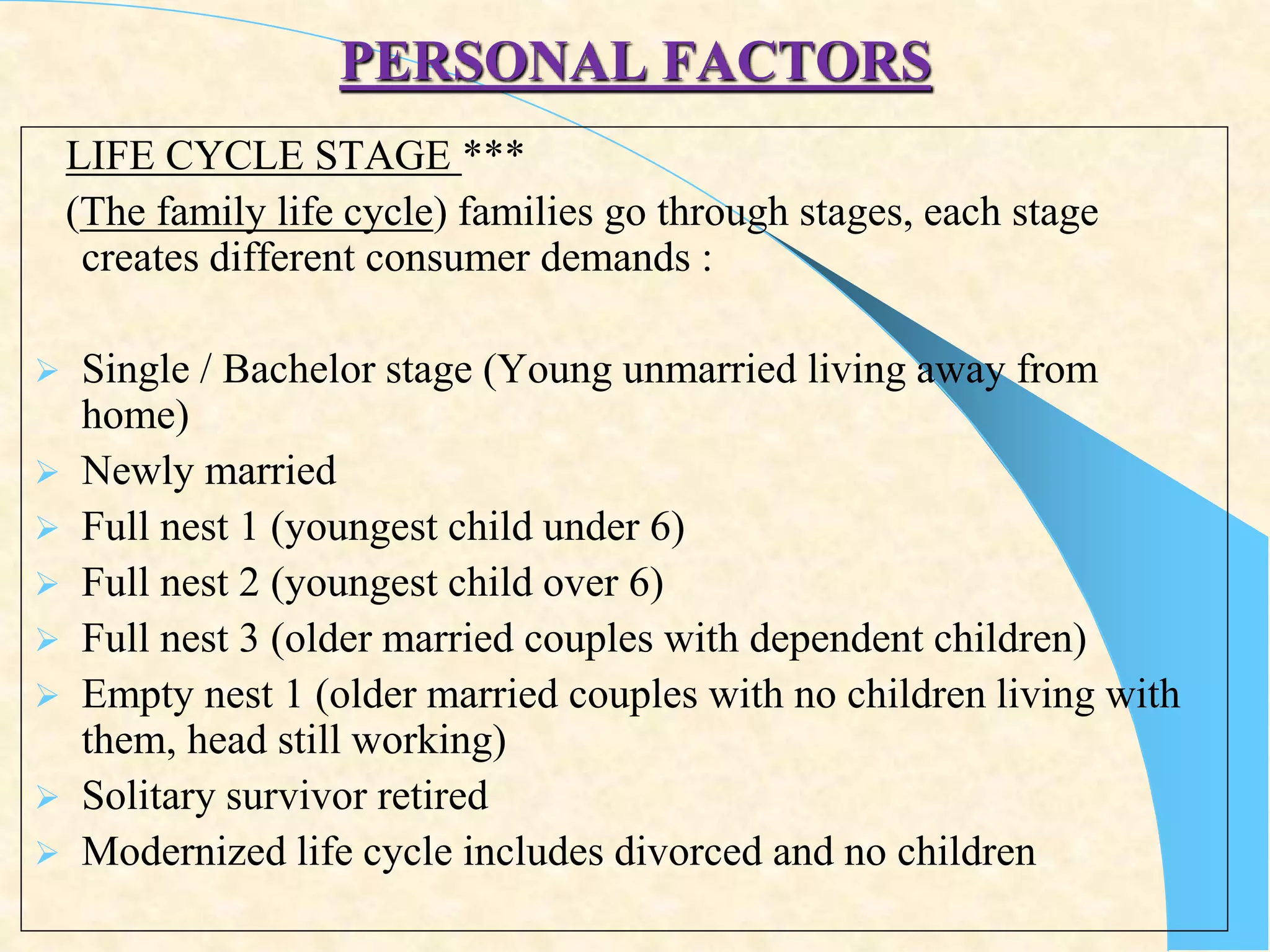
LIFE CYCLE STAGE ***
(The family life cycle) families go through stages, each stage
creates different consumer demands :
 Single / Bachelor stage (Young unmarried living away from
home)
 Newly married
 Full nest 1 (youngest child under 6)
 Full nest 2 (youngest child over 6)
 Full nest 3 (older married couples with dependent children)
 Empty nest 1 (older married couples with no children living with
them, head still working)
 Solitary survivor retired
 Modernized life cycle includes divorced and no children
MASLOW’S THEORY OF
MOTIVATION
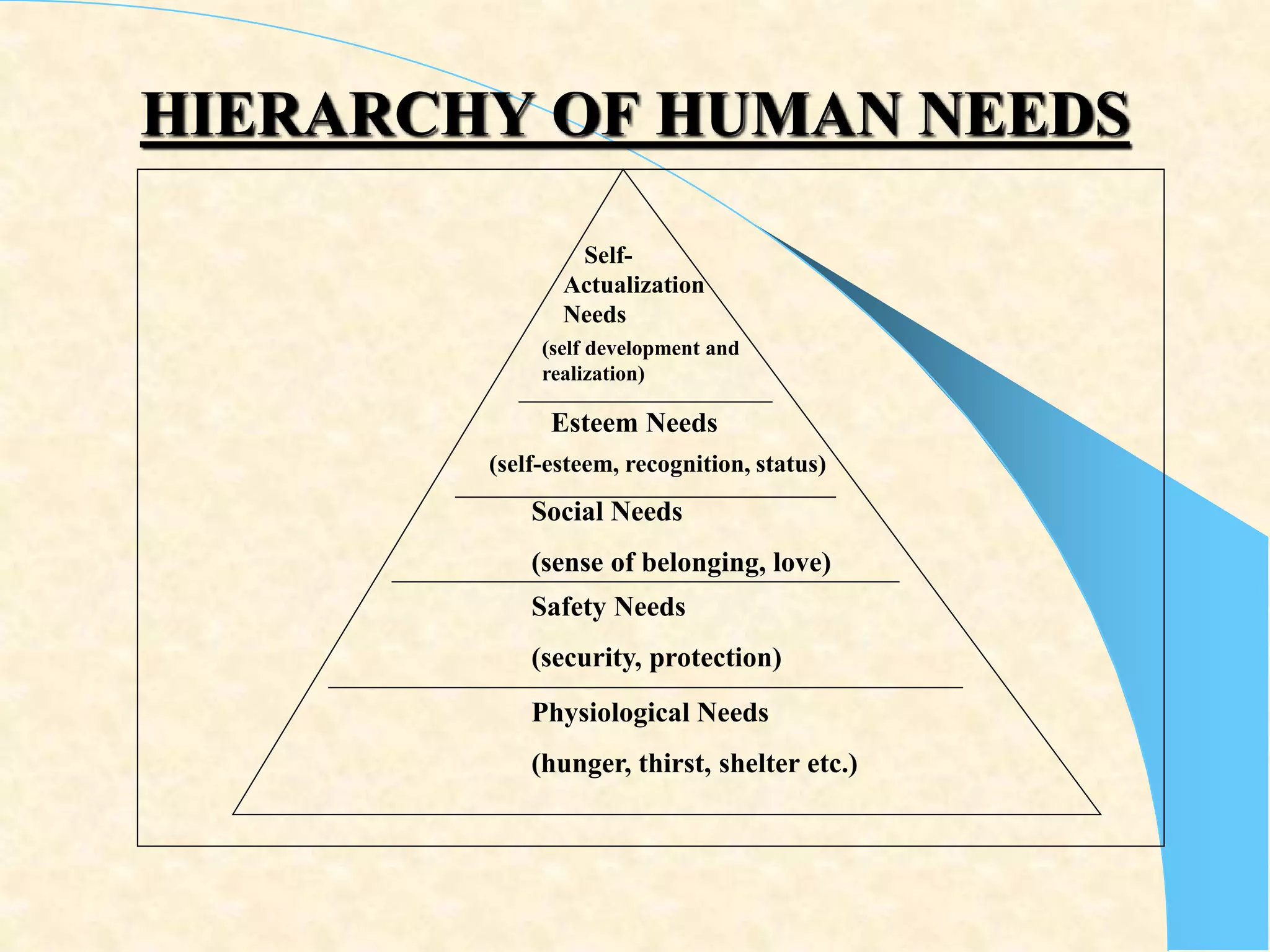
 According to Abraham Maslow human needs are
arranged in a hierarchy, from the most pressing to the
least pressing.
 People will try to satisfy their most important needs
first.
 When a person succeeds in satisfying an important
need, that need will cease being a current motivator,
and the person will try o satisfy the next most
important need.
HIERARCHY OF HUMAN NEEDS
Physiological Needs
(hunger, thirst, shelter etc.)
Safety Needs
(security, protection)
Social Needs
(sense of belonging, love)
Esteem Needs
(self-esteem, recognition, status)
Self-
Actualization
Needs
(self development and
realization)
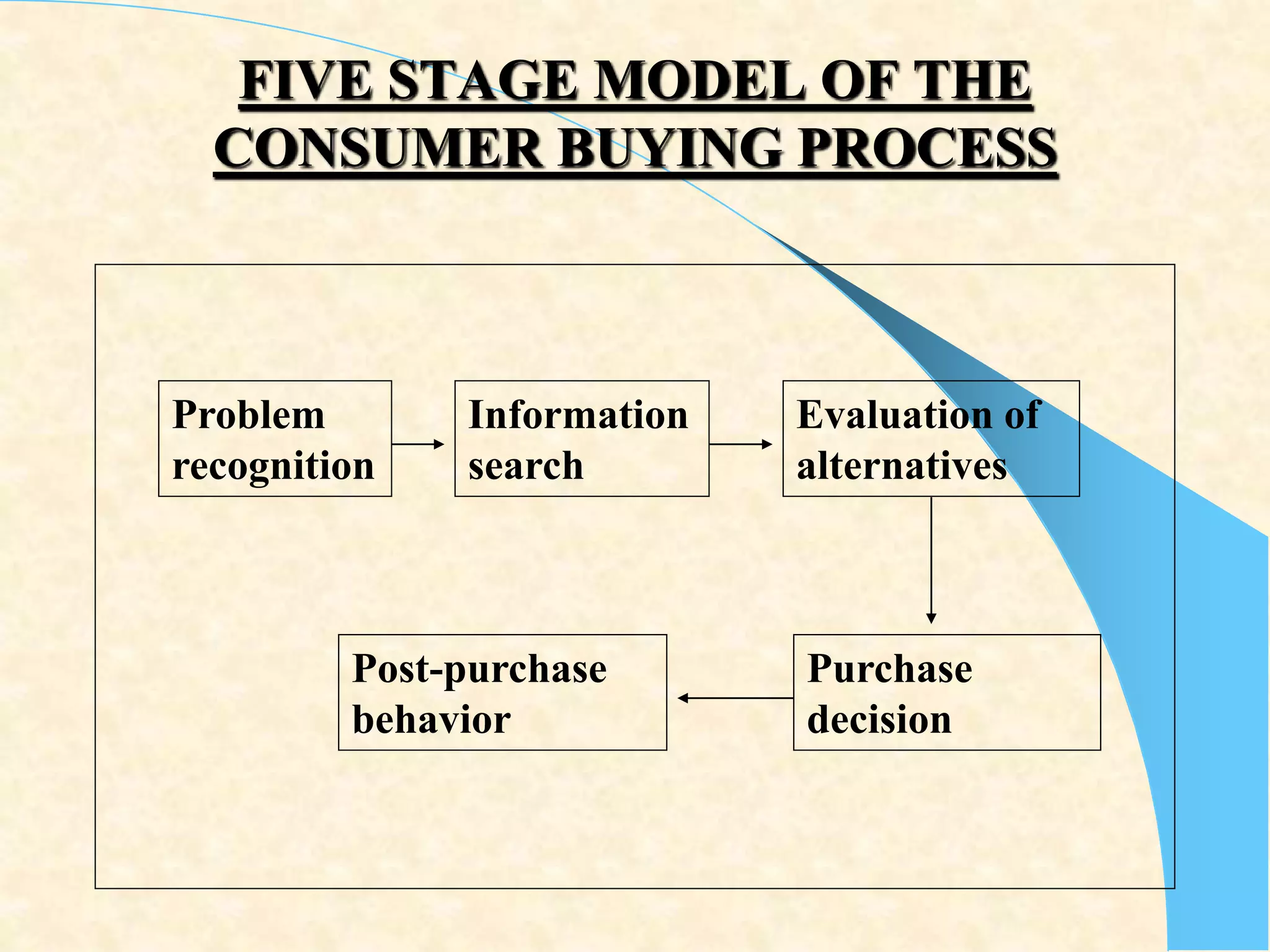
FIVE STAGE MODEL OF THE
CONSUMER BUYING PROCESS
Problem
recognition
Information
search
Evaluation of
alternatives
Purchase
decision
Post-purchase
behavior
References
 Leon G. Schiffman and Leslie Lazar Kanuk, Consumer Behavior, 7th ed. (Upper Saddle
River, NJ: Prentice-Hall, 2000).
 Rebecca Piirto Heath, “The Frontiers of Psychographics,” American Demographics,
July 1996, pp. 38–43.
 M. Joseph Sirgy, “Self-Concept in Consumer Behavior: A Critical Review,” Journal of
Consumer Research, December 1982, pp. 287–300.
 Bernard Berelson and Gary A. Steiner, Human Behavior: An Inventory of Scientific
Findings (New York: Harcourt Brace Jovanovich, 1964), p. 88.
 David Krech, Richard S. Crutchfield, and Egerton L. Ballachey, Individual in Society
(New York: McGraw-Hill, 1962), ch. 2.
 Henry Assael, Consumer Behavior and Marketing Action (Boston: Kent, 1987), ch. 4.
 Paul E. Green and Yoram Wind, Multiattribute Decisions in Marketing: A Measurement
Approach (Hinsdale, IL: Dryden, 1973), ch. 2.
 Leigh McAlister, “Choosing Multiple Items from a Product Class,” Journal of
Consumer Research, December 1979, pp. 213–24.
Thank You

Customer Analysis and Buying Behaviour

  • 1.
    CUSTOMER ANALYSIS AND BUYINGBEHAVIOR Dr. Kamal Kishor Pandey Associate Professor TMIMT-College of Management Teerthanker Mahaveer University, Moradabad
  • 2.
    UNDERSTANDING CONSUMERS  Sergio Zyman,Former Chief Marketing Officer, Coca Cola Company, says in his recent book “End of Marketing” :“Consumers are, quite possibly, the only thing worth thinking about…….Every thing that happens to consumers and every thing that consumers do should affect your marketing decisions……You have to understand the whole environment in which people live…….Anything that happens in that environment is going to change what consumers do and don’t do.”
  • 3.
    STUDY OF CONSUMERBEHAVIOUR  Because markets are complex , we need to develop some common framework for grasping a market’s essentials.  The marketer should approach the study of a new market by asking 4 questions : 1. What does the market buy ? Objects of Purchase 2. Why does it buy ? Objectives of purchase 3. Who buys ? Organization of purchase 4. How does it buy ? Operations of purchasing organization ( FOUR Os OF A MARKET )
  • 4.
    6 Os OFA MARKET  The 4 Os of a market (Objects, Objectives, Organization and Operations) should be grasped before one contemplates the 4 Ps of the marketing mix.  Two further questions of a more descriptive nature can also be asked of a market : 5.When does it buy ? Occasions for purchase 6. Where does it buy ? Outlets for purchase
  • 5.
    CONSUMER MARKET  ConsumerMarket is the market for products and services that are purchased or hired by individuals and households for personal (non-business) use.  Consumer Products : Products purchased for personal use.
  • 6.
    BUYERS V/S CONSUMERS Mother buying toys for kid (Buyer – Mother, Actual user – Kid)  Marketers focus their promotion on both i.e. buyers and the user (ultimate consumer)  For example Maggi and Rasna , both try to influence the buyer and the user. Taste and fun aspects for children (main users) and time saving and economy for mothers (actual buyers).
  • 7.
    CLASSIFICATION OF CONSUMER PRODUCTS (A.)On the basis of their rate of consumption and tangibility : DURABLE GOODS (Tangible goods which normally survive many uses, frequency of purchase is less e.g. Refrigerator, T.V. etc.) NON-DURABLE GOODS (Tangible goods normally are consumed in one or few uses, frequency of purchase is more e.g. Soap, Salt, Tooth paste, Shampoo etc.) SERVICES (Intangibles, Activities, benefits or satisfactions which are offered for sale e.g. hair cuts, education, restaurants, airlines etc.)
  • 8.
    A SIMPLE MODELOF CONSUMER BEHAVIOUR  A) INPUT PROCESS OUTPUT External Influences Consumer Decision Making Consumer Decisions and Actions
  • 9.
    BUYER BEHAVIOUR MODEL Marketing Stimuli Other Stimuli Buyer’s Characteristics Buyer’sDecision Process Buyer’s Decisions PRODUCT PRICE PLACE PROMOTION ECONOMICAL GEOGRAP HICAL TECHNOLO GICAL CULTURAL SOCIAL PERSONAL PSYCHOLOGICAL PROBLEM RECOGNITION INFORMATION SEARCH EVALUATION DECISION POST PURCHASE BEHAVIOUR PRODUCT CHOICE BRAND CHOICE DEALER CHOICE PURCHASE TIME PURCHASE AMOUNT BUYER’S BLACK BOX INPUT PROCESS OUTPUT Inferences
  • 10.
    FACTORS INFLUENCING BUYER’S BEHAVIOUR A) CULTURAL SOCIAL PERSONAL PSYCHOLOGICAL BUYER CULTURE SUB-CULTURE SOCIAL CLASS REFERENCE GROUPS FAMILY ROLESAND STATUS AGE,GENDER,LIFE CYCLESTAGE, OCCUPATION, INCOME,PERSONALIT Y MOTIVATION,PERCEP- TION,LEARNING, BELIEF & ATTITUDE
  • 11.
    (B.) SOCIAL FACTORS REFERENCE GROUPS : ( PEOPLE AROUND US ) : Our decision of purchase is not only influenced by our life style, our personality and by other psychological factors but also by the people around us, with whom we interact directly or indirectly (influence our purchase decision), e.g. families, friends, neighbors, colleagues, civic and professional organizations. Aspiration Groups (want to belong to) – adoption of the opinions and outlook of film stars, sports stars, pop stars etc. Disassociate Groups (do not want to belong to) – whose values and behavior an individual rejects, e.g. you may not like to follow the brand choice of your neighbor or your relative etc.
  • 12.
    SOCIAL FACTORS (REFERENCE GROUPS) The degree to which a reference group will affect a purchase decision depends on an individuals susceptibility to reference group influence and the strength of his/her involvement with the group.  Reference group influence on products : Strong Influence – Cars, Color T.V., Furniture, Refrigerator etc. Weak Influence – Tea, Coffee, Soap, Beer, Cig. etc.
  • 13.
    PERSONAL FACTORS LIFE CYCLESTAGE *** (The family life cycle) families go through stages, each stage creates different consumer demands :  Single / Bachelor stage (Young unmarried living away from home)  Newly married  Full nest 1 (youngest child under 6)  Full nest 2 (youngest child over 6)  Full nest 3 (older married couples with dependent children)  Empty nest 1 (older married couples with no children living with them, head still working)  Solitary survivor retired  Modernized life cycle includes divorced and no children
  • 14.
    MASLOW’S THEORY OF MOTIVATION According to Abraham Maslow human needs are arranged in a hierarchy, from the most pressing to the least pressing.  People will try to satisfy their most important needs first.  When a person succeeds in satisfying an important need, that need will cease being a current motivator, and the person will try o satisfy the next most important need.
  • 15.
    HIERARCHY OF HUMANNEEDS Physiological Needs (hunger, thirst, shelter etc.) Safety Needs (security, protection) Social Needs (sense of belonging, love) Esteem Needs (self-esteem, recognition, status) Self- Actualization Needs (self development and realization)
  • 16.
    FIVE STAGE MODELOF THE CONSUMER BUYING PROCESS Problem recognition Information search Evaluation of alternatives Purchase decision Post-purchase behavior
  • 17.
    References  Leon G.Schiffman and Leslie Lazar Kanuk, Consumer Behavior, 7th ed. (Upper Saddle River, NJ: Prentice-Hall, 2000).  Rebecca Piirto Heath, “The Frontiers of Psychographics,” American Demographics, July 1996, pp. 38–43.  M. Joseph Sirgy, “Self-Concept in Consumer Behavior: A Critical Review,” Journal of Consumer Research, December 1982, pp. 287–300.  Bernard Berelson and Gary A. Steiner, Human Behavior: An Inventory of Scientific Findings (New York: Harcourt Brace Jovanovich, 1964), p. 88.  David Krech, Richard S. Crutchfield, and Egerton L. Ballachey, Individual in Society (New York: McGraw-Hill, 1962), ch. 2.  Henry Assael, Consumer Behavior and Marketing Action (Boston: Kent, 1987), ch. 4.  Paul E. Green and Yoram Wind, Multiattribute Decisions in Marketing: A Measurement Approach (Hinsdale, IL: Dryden, 1973), ch. 2.  Leigh McAlister, “Choosing Multiple Items from a Product Class,” Journal of Consumer Research, December 1979, pp. 213–24.
  • 18.