
Guidelines for rainwater tanks
     on residential properties


                      Plumbing
                   requirements
 Information for rainwater tank suppliers
                           and plumbers


                                  April 2003
Contents
Plumbing for rainwater tanks                                                             1

1.          Introduction                                                                 1

2.          The guidelines                                                               2

            a)       Application                                                         2

            b)       Rainwater uses                                                      2

2.1         Approval to install a rainwater tank                                         2

2.2         Sydney Water requirements                                                    3

3.          Connecting properties to rainwater                                           4

3.1         Administrative requirements                                                  4

3.2          Rainwater tank plumbing regulatory requirements                             4

            a)       Approved materials                                                  4

            b)       Pipes and labelling                                                 4

            c)       Proximity to other services                                         4

            d)       Backflow prevention                                                 5

            e)       Water meters                                                        5

            f)       Top-up service                                                      6

4.          Definitions                                                                  7

5.          Related Sydney Water Policies                                                8

6.          Useful references                                                            8


Figure 1             Plumbing configuration for rainwater tanks                           9

Figure 2             Signage for rainwater tanks and outlets                             10

Appendix 1           Technical drawings                                                  11

Appendix 2            SEPP 4 Amendment                                                   15


Plumbing requirements Information for rainwater tank suppliers and plumbers APRIL 2003
Plumbing for rainwater tanks
A guide for rainwater tank suppliers and plumbers

1. Introduction
Rainwater tanks can make an important contribution towards reducing the demand for drinking
water. However, certain requirements are necessary to protect reticulated drinking water and
wastewater systems and to ensure public health is not compromised.
If the installation of a rainwater tank (regardless of size) involves work affecting the water supply
system, sewerage system, stormwater drainage system, or any part of Sydney Water’s systems, then
such work can only be undertaken with Sydney Water’s approval.
Sydney Water has developed the following guide on the technical and regulatory requirements for
plumbing from rainwater tanks. This is to ensure that the rainwater service cannot accidentally
backflow into the drinking water main or be cross-connected to the drinking water supply within the
property. Any cross connection would change the quality of the drinking water.
As part of our Operating Licence and Customer Contract, Sydney Water has a responsibility to ensure
that the quality of drinking water supplied to our customers is maintained. As the plumbing
regulator in our area of operations, Sydney Water also has responsibility to ensure that the drinking
water quality is maintained within the customer’s property.
In this guide, you will find detailed requirements that must be met when installing drinking water
top-up for rainwater tanks, technical drawings and fact sheets that your customers can obtain from
the Sydney Water website.
You can find out more about rainwater tanks from our website www.sydneywater.com.au or by
phoning our Plumbing Policy, Standards and Regulation group on 9952 0576.


Council Approval
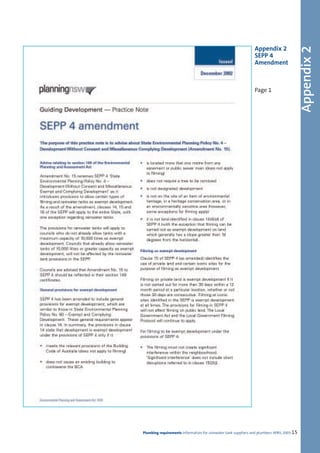
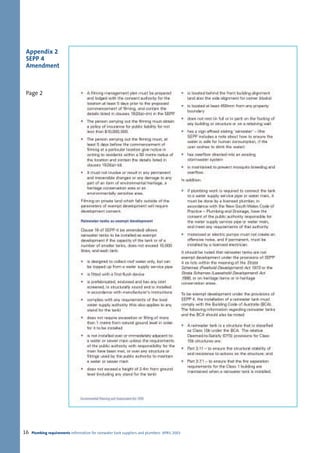
The NSW government has amended the State Environmental Planning Policy (SEPP 4) so that
rainwater tanks with a capacity of 10,000 litres or less do not require local council approval provided
they meet the conditions outlined in SEPP 4. Details are provided in Appendix 2.
Installation of rainwater tanks with capacity above 10,000 litres still require local council approval.


                                              Plumbing requirements Information for rainwater tank suppliers and plumbers APRIL 2003   1
2. The guidelines
a)        Application
These guidelines apply only to the plumbing for rainwater tanks that collect water from the roofs of
residential properties.
The guidelines do not apply to:
•         Rainwater tanks that are not connected to the internal plumbing and do not have top-up from the
          reticulated drinking water supply.
•         Tanks that collect ground water runoff.
•         Roof plumbing to the tank.
Rainwater tanks on commercial and industrial properties need to comply with Sydney Water’s Backflow
Prevention Policy and the New South Wales Code of Practice: Plumbing and Drainage.


b)        Rainwater uses
Rainwater can provide an alternative source for the following:
•         toilet flushing
•         garden irrigation
•         washing cars
•         filling ornamental ponds
•         washing machines
In line with NSW Health recommendations, Sydney Water does not recommend the use of rainwater tanks
for drinking purposes where a reticulated drinking water supply is available to the customer.


    In this case NSW Health does not advise using rainwater for:
    X     drinking
    X     cooking or other kitchen purposes
    X     personal washing, such as baths, showers, hand basins and bidets.


2.1 Approval to install a rainwater tank
Under no circumstances is a rainwater tank permitted to be built over a Sydney Water maintenance
structure or within any Sydney Water easement, regardless of tank size.


Tanks not connected to the plumbing
Sydney Water’s approval to proceed is not needed unless the tank capacity is greater than 10,000 litres. If
the tank capacity is greater than 10,000 litres Sydney Water needs to assess whether the tank is situated a
sufficient distance from Sydney Water’s sewer. This is the same requirement as for any proposed building
application.
A plan illustrating the location and size of the proposed rainwater tank must be supplied. Sydney Water’s
standard building over sewer procedures will apply. If it is a sufficient distance from the sewer, then Sydney
Water or a QuickCheck agent can give approval.


2       Plumbing requirements Information for rainwater tank suppliers and plumbers APRIL 2003
2.2 Sydney Water requirements
Below is a summary of Sydney Water’s main requirements regarding plumbing for rainwater tanks for
residential customers. Note: Words in italics are defined in Section 4.
a)   Sydney Water needs to be informed of all proposed rainwater tank installations so that the meter
     can be replaced with another containing a backflow prevention device.
b)   There must be no direct connection between the rainwater tank and Sydney Water’s reticulated
     drinking water supply.
c)   An application must be made to Sydney Water if the property owner wants a top-up from Sydney
     Water’s drinking water supply to the rainwater tank, as this is defined as an indirect connection.
d)   Top-up will be limited to a trickle top up to ensure that the water pressure to other customers is not
     compromised.
e)   Top-up to the rainwater tank is not permitted from the reticulated recycled water supply.
f)   In certain circumstances, Sydney Water can refuse to allow a connection from its system to the
     rainwater tank.
g)   Where a higher risk is assessed, Sydney Water may require the property owner to install a higher
     hazard Backflow Prevention Device at the property owner’s cost.
h)   The overflow from the tank should be directed to the stormwater system. It must not discharge to
     Sydney Water’s sewerage system.
i)   With all plumbing work, the plumber is required to make an application to Sydney Water at least two
     working days before the commencement of work.
j)   The plumber must arrange for the rainwater tank plumbing to be inspected by Sydney Water.
     The plumber must also submit a Certificate of Compliance to Sydney Water and the customer at
     the completion of the work.


                                                Plumbing requirements Information for rainwater tank suppliers and plumbers APRIL 2003   3
3. Connecting properties to rainwater
3.1 Administrative requirements
•      The plumber is required to apply to Sydney Water for a permit to do the work as they would when
       connecting any house service plumbing.
•      Sydney Water’s plumbing inspector must be contacted when work is completed to carry out a final
       inspection of the property before the Certificate of Compliance is submitted to Sydney Water and the
       customer.


3.2 Rainwater tank plumbing regulatory requirements
•      All plumbing work is to be done or supervised by a licensed plumber in compliance with these
       guidelines and the NSW Code of Practice: Plumbing and Drainage
•      Under no circumstances is there to be direct connection between the rainwater service and the
       drinking water service.
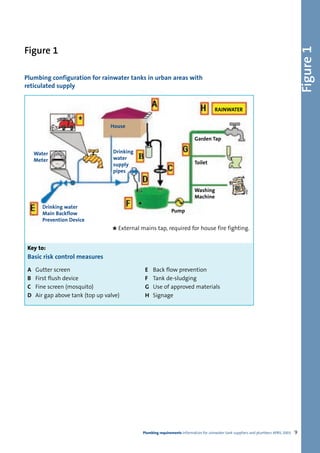
Figure 1 provides a drawing of plumbing for above ground rainwater tanks with an indirect connection to
the drinking water supply.


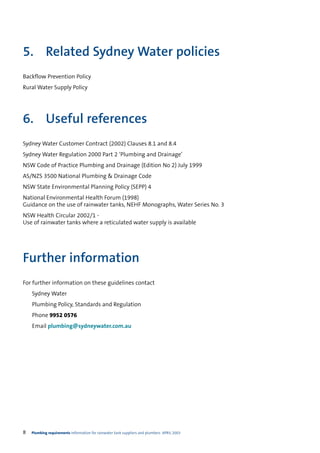
a)     Approved materials                                                                           The full
                                                                                                    Australian
Materials used in the rainwater tank plumbing must comply with AS/NZS 3500 Part 1                   Standards
                                                                                                    Mark
Water Supply Section 2 Materials and Products
Approved materials are those which have gone through the product approval process
                                                                                                    Water
and have had a licence granted to mark the product accordingly. The certifying body                 Mark
provides the manufacturer with the following licensed marks to indicate that the
products comply with the relevant standard. To the right are the current three types of
“Marks” that indicate that the product has been certified.                                          Type Tested


b)     Pipes and labelling
Pipe materials to be used for rainwater need to be approved products and be clearly and permanently
identified ‘RAINWATER’ continuously along the length. This can be done for below ground pipes by using
identification tape (made in accordance with AS2648) or for above ground pipes by using adhesive pipe
markers (made in accordance with AS1345).
Identification tape marked ‘RAINWATER’ must be at least 75mm wide. The identification tape is to be
installed on top of the rainwater pipeline, running longitudinally, and fastened to the pipe at not more
than 3 metre intervals.
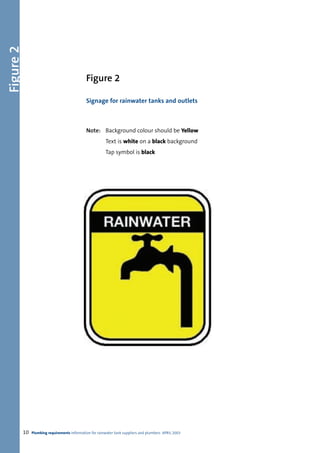
Every rainwater tank outlet must be labelled ‘RAINWATER’ on a permanent sign. An example is shown in
Figure 2. AS1319 provides direction as to appropriate layout, size and face materials for signs.


4    Plumbing requirements Information for rainwater tank suppliers and plumbers APRIL 2003
c)    Proximity to other services
Rainwater pipes must be separated from any parallel drinking water service.
Above ground pipes
Any rainwater pipe installed above ground must be a minimum of 100mm away from any drinking
water pipe.
Below ground pipes
Any rainwater pipe installed below ground must be a minimum of 300mm away from any drinking
water pipe.


d)    Backflow prevention
Check that all the following backflow protection is in place:


Above ground rainwater tanks
•    Sydney Water has replaced the old meter with one containing an integral dual check valve for 20 -
     25mm
     meters.
•    For meters 32mm or above, you need to install a dual check valve adjacent to the meter.


Below ground tanks
•    A testable backflow prevention device must be installed at the meter. It should be noted that for below
     ground tanks the cost of the device and its installation must be met by the customer.
•    The device must be tested annually. The cost of this annual check is to be met by the customer.


Testable backflow prevention devices
These must be tested by a plumber accredited by Sydney Water. Accredited plumbers are listed on our
website at http://www.sydneywater.com.au/html/yourBusiness/backflow/bckflw_plumber_search.cfm
A completed Backflow Prevention Device - Inspection and Maintenance Report must be forwarded within 2
working days of test completion to:
     Sydney Water Corporation
     Backflow Prevention Group
     Chatswood NSW 2067
For information on device testing requirements call 1800 680 636 or check out our website.


                                                Plumbing requirements Information for rainwater tank suppliers and plumbers APRIL 2003   5
e) Water meters
Where a rainwater tank is installed a meter with an integral dual check valve will be provided for each
property with a current 20-25mm water meter. Property owners will be requested to advise Sydney Water
when a rain water tank is installed at their properties for an Integral dual check valve water meter to be
fitted free of charge.


20mm water meters with integral dual check valves
The dual check valves are built into the meters and will provide backflow protection to the drinking water
supply system. There are no changes needed to the drinking water service installation requirements as the
integral dual check valve meters are of the same length as existing meters.
Plumbers will be able to identify the new integral dual check valve meters by the longer “spud” at the end
connection of the meter. The check valves will also be visible from the end of the meter and plumbers
should ensure that they are not damaged during installation.
As Sydney Water will be providing 20mm drinking water meters with integral dual check valves plumbers
may now use approved ball valves at the meter location as accepted in the Australian Standard AS/NZS
3500, Part 1, Clause 5.4. Using ball valves at the meter will lower the amount of water pressure loss within
the drinking water service and minimise future maintenance.
Contact Sydney Water on 13 20 92 to arrange for a replacement meter with an integral dual check valve


f)     Top-up service
The tank must meet Sydney Water’s storage tank requirements if top-up is required. The inlet drinking
water service must have a visible air gap between the reticulated supply and the tank external to the
rainwater tank.
The drinking water top-up service will only be permitted as a trickle top-up. This maintains the drinking
water pressure for internal purposes when the tank is filling. It also limits pressure fluctuations when flow
to the tank turns on/off.
Note: Top-up to the rainwater tank is not permitted from the reticulated recycled water supply.


Flow rate
For single residential properties, the flow rate of the trickle top-up into the tank from Sydney Water’s
reticulated supply must be restricted to a maximum of 2 litres/minute.
For townhouse or unit development, the flow rate of the trickle top-up into the tank from Sydney Water’s
reticulated supply must be restricted to a maximum of 2 litres/minute times the total number of
townhouses or units in the development.
Note: Sydney Water will generally allow an indirect connection between the tank and the reticulated
drinking water supply as long as the requirements outlined in 3a) to f) above are met. This is subject to the
disclaimer that, in accordance with the Customer Contract, Sydney Water is not responsible for any water
collected in a rainwater tank.


6    Plumbing requirements Information for rainwater tank suppliers and plumbers APRIL 2003
4. Definitions
Above ground              A tank collecting roofwater only which is either:
rainwater tank            •   fully above ground or
                          •   at least half the tank is above ground and the view of and access to the inlet
                              pipe, air gap and overflow pipe are unobstructed.
Backflow                  A backflow prevention device is a device, to prevent the reverse flow of water
prevention                from a potentially polluted source into the drinking water supply system. All
device                    backflow prevention devices need to comply with AS/NZS 2845.1
                          A tank collecting roof water only which is either:
Below ground
rainwater tank            •   fully or mostly underneath the ground
                          •   where the view of and access to any one of the air gap, inlet pipe or
                              overflow pipe is obscured by the ground or something similar e.g. rockery or
                              garden bed.
                          There should be no possibility that surface run-off eg: on a sloping site will
                          drain to a rainwater tank.
Connection                See direct connection or indirect connection.
Direct connection         Direct connection occurs:
                          •   where a pipe containing water from Sydney Water’s reticulated supply is
                              directly connected into a tank or pipe containing water from a rainwater
                              tank, or
                          •   where the outlet of a pipe containing Sydney Water’s reticulated supply is
                              submerged beneath the surface of water from a rainwater tank.
                          Note: Direct connection is expressly prohibited in Sydney Water’s Customer
                          Contract (clause 8.4) because of the risk of backflow of tank water into the
                          reticulated supply.
Dual check valve (DCV)    A device to prevent backflow caused by backpressure, which incorporates two
                          independently operating force loaded non-return valves.
Indirect connection       Indirect connection occurs between a rainwater tank and the Sydney Water
                          supply where the outlet of a pipe containing drinking water from the Sydney
                          Water reticulated supply is separated from the water in the rainwater tank by a
                          visible air gap. This ensures that there is no possibility of the rainwater
                          backflowing into the Sydney Water supply.
Reduced pressure zone (RPZ) A backflow prevention device for high risk connections.
Standard connections        Connections of 20 - 25mm pipes.
Testable double             A device to prevent backflow caused by backpressure, which has two
check valve (TDCV)
                            independently operating force loaded non-return valves and incorporates
                            specific test points for in-service testing.
Trickle top-up            Trickle top-up is the slow filling of the tank from the drinking water supply. It is
                          designed to minimise effects on the reticulated system and allow for a
                          reasonable re-supply into the tank over a period of several hours.
Visible air gap           The unobstructed vertical distance through the free atmosphere between the
                          lowest opening of a water service pipe or fixed outlet supplying water to a
                          fixture or receptacle and the highest possible water level of such fixture or
                          receptacle.


                                               Plumbing requirements Information for rainwater tank suppliers and plumbers APRIL 2003   7
5. Related Sydney Water policies
Backflow Prevention Policy
Rural Water Supply Policy


6. Useful references
Sydney Water Customer Contract (2002) Clauses 8.1 and 8.4
Sydney Water Regulation 2000 Part 2 ‘Plumbing and Drainage’
NSW Code of Practice Plumbing and Drainage (Edition No 2) July 1999
AS/NZS 3500 National Plumbing & Drainage Code
NSW State Environmental Planning Policy (SEPP) 4
National Environmental Health Forum (1998)
Guidance on the use of rainwater tanks, NEHF Monographs, Water Series No. 3
NSW Health Circular 2002/1 -
Use of rainwater tanks where a reticulated water supply is available


Further information
For further information on these guidelines contact
    Sydney Water
    Plumbing Policy, Standards and Regulation
    Phone 9952 0576
    Email plumbing@sydneywater.com.au


8   Plumbing requirements Information for rainwater tank suppliers and plumbers APRIL 2003
Figure 1
Figure 1

Plumbing configuration for rainwater tanks in urban areas with
reticulated supply


                                                                                        RAINWATER


                                  House

                                                                            Garden Tap

     Water                         Drinking
     Meter                         water
                                   supply                                   Toilet
                                   pipes


                                                                            Washing
                                                                            Machine
        Drinking water
        Main Backflow                                          Pump
        Prevention Device

                                   * External mains tap, required for house fire fighting.
 Key to:
 Basic risk control measures
 A   Gutter screen                              E   Back flow prevention
 B   First flush device                         F   Tank de-sludging
 C   Fine screen (mosquito)                     G   Use of approved materials
 D   Air gap above tank (top up valve)          H   Signage


                                               Plumbing requirements Information for rainwater tank suppliers and plumbers APRIL 2003   9
Figure 2


                                               Figure 2

                                               Signage for rainwater tanks and outlets


                                               Note: Background colour should be Yellow
                                                          Text is white on a black background
                                                          Tap symbol is black


           10   Plumbing requirements Information for rainwater tank suppliers and plumbers APRIL 2003
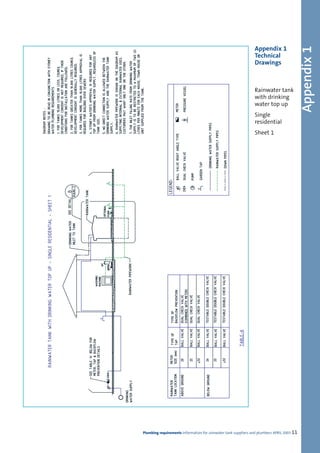
Appendix 1
                                                                Appendix 1
                                                                Technical
                                                                Drawings


                                                                Rainwater tank
                                                                with drinking
                                                                water top up
                                                                Single
                                                                residential
                                                                Sheet 1


Plumbing requirements Information for rainwater tank suppliers and plumbers APRIL 2003 11
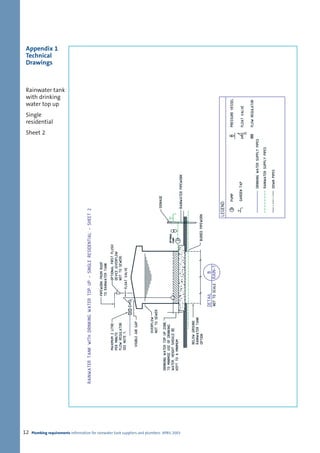
Appendix 1
 Technical
 Drawings


 Rainwater tank
 with drinking
 water top up
 Single
 residential
 Sheet 2


12   Plumbing requirements Information for rainwater tank suppliers and plumbers APRIL 2003
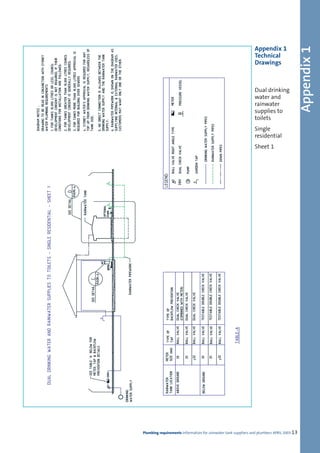
Appendix 1
                                                                Appendix 1
                                                                Technical
                                                                Drawings


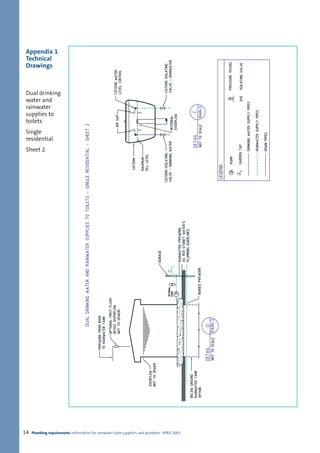
                                                                Dual drinking
                                                                water and
                                                                rainwater
                                                                supplies to
                                                                toilets
                                                                Single
                                                                residential
                                                                Sheet 1


Plumbing requirements Information for rainwater tank suppliers and plumbers APRIL 2003 13
Appendix 1
 Technical
 Drawings


 Dual drinking
 water and
 rainwater
 supplies to
 toilets
 Single
 residential
 Sheet 2


14   Plumbing requirements Information for rainwater tank suppliers and plumbers APRIL 2003
Appendix 2
                                                                Appendix 2
                                                                SEPP 4
                                                                Amendment


                                                                Page 1


Plumbing requirements Information for rainwater tank suppliers and plumbers APRIL 2003 15
Appendix 2
 SEPP 4
 Amendment


 Page 2


16   Plumbing requirements Information for rainwater tank suppliers and plumbers APRIL 2003
Appendix 2


                                                                                            Appendix 2
                                                                SEPP 4
                                                                Amendment


                                                                Page 3


Plumbing requirements Information for rainwater tank suppliers and plumbers APRIL 2003 17
For more information on Sydney Water visit our website at www.sydneywater.com.au

      Printed on recycled paper
      Plumbing Policy, Standards and Regulation Unit April 2003

Sydney Water Guidelines for Rainwater Tanks

  • 1.
    Guidelines for rainwatertanks on residential properties Plumbing requirements Information for rainwater tank suppliers and plumbers April 2003
  • 2.
    Contents Plumbing for rainwatertanks 1 1. Introduction 1 2. The guidelines 2 a) Application 2 b) Rainwater uses 2 2.1 Approval to install a rainwater tank 2 2.2 Sydney Water requirements 3 3. Connecting properties to rainwater 4 3.1 Administrative requirements 4 3.2 Rainwater tank plumbing regulatory requirements 4 a) Approved materials 4 b) Pipes and labelling 4 c) Proximity to other services 4 d) Backflow prevention 5 e) Water meters 5 f) Top-up service 6 4. Definitions 7 5. Related Sydney Water Policies 8 6. Useful references 8 Figure 1 Plumbing configuration for rainwater tanks 9 Figure 2 Signage for rainwater tanks and outlets 10 Appendix 1 Technical drawings 11 Appendix 2 SEPP 4 Amendment 15 Plumbing requirements Information for rainwater tank suppliers and plumbers APRIL 2003
  • 3.
    Plumbing for rainwatertanks A guide for rainwater tank suppliers and plumbers 1. Introduction Rainwater tanks can make an important contribution towards reducing the demand for drinking water. However, certain requirements are necessary to protect reticulated drinking water and wastewater systems and to ensure public health is not compromised. If the installation of a rainwater tank (regardless of size) involves work affecting the water supply system, sewerage system, stormwater drainage system, or any part of Sydney Water’s systems, then such work can only be undertaken with Sydney Water’s approval. Sydney Water has developed the following guide on the technical and regulatory requirements for plumbing from rainwater tanks. This is to ensure that the rainwater service cannot accidentally backflow into the drinking water main or be cross-connected to the drinking water supply within the property. Any cross connection would change the quality of the drinking water. As part of our Operating Licence and Customer Contract, Sydney Water has a responsibility to ensure that the quality of drinking water supplied to our customers is maintained. As the plumbing regulator in our area of operations, Sydney Water also has responsibility to ensure that the drinking water quality is maintained within the customer’s property. In this guide, you will find detailed requirements that must be met when installing drinking water top-up for rainwater tanks, technical drawings and fact sheets that your customers can obtain from the Sydney Water website. You can find out more about rainwater tanks from our website www.sydneywater.com.au or by phoning our Plumbing Policy, Standards and Regulation group on 9952 0576. Council Approval The NSW government has amended the State Environmental Planning Policy (SEPP 4) so that rainwater tanks with a capacity of 10,000 litres or less do not require local council approval provided they meet the conditions outlined in SEPP 4. Details are provided in Appendix 2. Installation of rainwater tanks with capacity above 10,000 litres still require local council approval. Plumbing requirements Information for rainwater tank suppliers and plumbers APRIL 2003 1
  • 4.
    2. The guidelines a) Application These guidelines apply only to the plumbing for rainwater tanks that collect water from the roofs of residential properties. The guidelines do not apply to: • Rainwater tanks that are not connected to the internal plumbing and do not have top-up from the reticulated drinking water supply. • Tanks that collect ground water runoff. • Roof plumbing to the tank. Rainwater tanks on commercial and industrial properties need to comply with Sydney Water’s Backflow Prevention Policy and the New South Wales Code of Practice: Plumbing and Drainage. b) Rainwater uses Rainwater can provide an alternative source for the following: • toilet flushing • garden irrigation • washing cars • filling ornamental ponds • washing machines In line with NSW Health recommendations, Sydney Water does not recommend the use of rainwater tanks for drinking purposes where a reticulated drinking water supply is available to the customer. In this case NSW Health does not advise using rainwater for: X drinking X cooking or other kitchen purposes X personal washing, such as baths, showers, hand basins and bidets. 2.1 Approval to install a rainwater tank Under no circumstances is a rainwater tank permitted to be built over a Sydney Water maintenance structure or within any Sydney Water easement, regardless of tank size. Tanks not connected to the plumbing Sydney Water’s approval to proceed is not needed unless the tank capacity is greater than 10,000 litres. If the tank capacity is greater than 10,000 litres Sydney Water needs to assess whether the tank is situated a sufficient distance from Sydney Water’s sewer. This is the same requirement as for any proposed building application. A plan illustrating the location and size of the proposed rainwater tank must be supplied. Sydney Water’s standard building over sewer procedures will apply. If it is a sufficient distance from the sewer, then Sydney Water or a QuickCheck agent can give approval. 2 Plumbing requirements Information for rainwater tank suppliers and plumbers APRIL 2003
  • 5.
    2.2 Sydney Waterrequirements Below is a summary of Sydney Water’s main requirements regarding plumbing for rainwater tanks for residential customers. Note: Words in italics are defined in Section 4. a) Sydney Water needs to be informed of all proposed rainwater tank installations so that the meter can be replaced with another containing a backflow prevention device. b) There must be no direct connection between the rainwater tank and Sydney Water’s reticulated drinking water supply. c) An application must be made to Sydney Water if the property owner wants a top-up from Sydney Water’s drinking water supply to the rainwater tank, as this is defined as an indirect connection. d) Top-up will be limited to a trickle top up to ensure that the water pressure to other customers is not compromised. e) Top-up to the rainwater tank is not permitted from the reticulated recycled water supply. f) In certain circumstances, Sydney Water can refuse to allow a connection from its system to the rainwater tank. g) Where a higher risk is assessed, Sydney Water may require the property owner to install a higher hazard Backflow Prevention Device at the property owner’s cost. h) The overflow from the tank should be directed to the stormwater system. It must not discharge to Sydney Water’s sewerage system. i) With all plumbing work, the plumber is required to make an application to Sydney Water at least two working days before the commencement of work. j) The plumber must arrange for the rainwater tank plumbing to be inspected by Sydney Water. The plumber must also submit a Certificate of Compliance to Sydney Water and the customer at the completion of the work. Plumbing requirements Information for rainwater tank suppliers and plumbers APRIL 2003 3
  • 6.
    3. Connecting propertiesto rainwater 3.1 Administrative requirements • The plumber is required to apply to Sydney Water for a permit to do the work as they would when connecting any house service plumbing. • Sydney Water’s plumbing inspector must be contacted when work is completed to carry out a final inspection of the property before the Certificate of Compliance is submitted to Sydney Water and the customer. 3.2 Rainwater tank plumbing regulatory requirements • All plumbing work is to be done or supervised by a licensed plumber in compliance with these guidelines and the NSW Code of Practice: Plumbing and Drainage • Under no circumstances is there to be direct connection between the rainwater service and the drinking water service. Figure 1 provides a drawing of plumbing for above ground rainwater tanks with an indirect connection to the drinking water supply. a) Approved materials The full Australian Materials used in the rainwater tank plumbing must comply with AS/NZS 3500 Part 1 Standards Mark Water Supply Section 2 Materials and Products Approved materials are those which have gone through the product approval process Water and have had a licence granted to mark the product accordingly. The certifying body Mark provides the manufacturer with the following licensed marks to indicate that the products comply with the relevant standard. To the right are the current three types of “Marks” that indicate that the product has been certified. Type Tested b) Pipes and labelling Pipe materials to be used for rainwater need to be approved products and be clearly and permanently identified ‘RAINWATER’ continuously along the length. This can be done for below ground pipes by using identification tape (made in accordance with AS2648) or for above ground pipes by using adhesive pipe markers (made in accordance with AS1345). Identification tape marked ‘RAINWATER’ must be at least 75mm wide. The identification tape is to be installed on top of the rainwater pipeline, running longitudinally, and fastened to the pipe at not more than 3 metre intervals. Every rainwater tank outlet must be labelled ‘RAINWATER’ on a permanent sign. An example is shown in Figure 2. AS1319 provides direction as to appropriate layout, size and face materials for signs. 4 Plumbing requirements Information for rainwater tank suppliers and plumbers APRIL 2003
  • 7.
    c) Proximity to other services Rainwater pipes must be separated from any parallel drinking water service. Above ground pipes Any rainwater pipe installed above ground must be a minimum of 100mm away from any drinking water pipe. Below ground pipes Any rainwater pipe installed below ground must be a minimum of 300mm away from any drinking water pipe. d) Backflow prevention Check that all the following backflow protection is in place: Above ground rainwater tanks • Sydney Water has replaced the old meter with one containing an integral dual check valve for 20 - 25mm meters. • For meters 32mm or above, you need to install a dual check valve adjacent to the meter. Below ground tanks • A testable backflow prevention device must be installed at the meter. It should be noted that for below ground tanks the cost of the device and its installation must be met by the customer. • The device must be tested annually. The cost of this annual check is to be met by the customer. Testable backflow prevention devices These must be tested by a plumber accredited by Sydney Water. Accredited plumbers are listed on our website at http://www.sydneywater.com.au/html/yourBusiness/backflow/bckflw_plumber_search.cfm A completed Backflow Prevention Device - Inspection and Maintenance Report must be forwarded within 2 working days of test completion to: Sydney Water Corporation Backflow Prevention Group Chatswood NSW 2067 For information on device testing requirements call 1800 680 636 or check out our website. Plumbing requirements Information for rainwater tank suppliers and plumbers APRIL 2003 5
  • 8.
    e) Water meters Wherea rainwater tank is installed a meter with an integral dual check valve will be provided for each property with a current 20-25mm water meter. Property owners will be requested to advise Sydney Water when a rain water tank is installed at their properties for an Integral dual check valve water meter to be fitted free of charge. 20mm water meters with integral dual check valves The dual check valves are built into the meters and will provide backflow protection to the drinking water supply system. There are no changes needed to the drinking water service installation requirements as the integral dual check valve meters are of the same length as existing meters. Plumbers will be able to identify the new integral dual check valve meters by the longer “spud” at the end connection of the meter. The check valves will also be visible from the end of the meter and plumbers should ensure that they are not damaged during installation. As Sydney Water will be providing 20mm drinking water meters with integral dual check valves plumbers may now use approved ball valves at the meter location as accepted in the Australian Standard AS/NZS 3500, Part 1, Clause 5.4. Using ball valves at the meter will lower the amount of water pressure loss within the drinking water service and minimise future maintenance. Contact Sydney Water on 13 20 92 to arrange for a replacement meter with an integral dual check valve f) Top-up service The tank must meet Sydney Water’s storage tank requirements if top-up is required. The inlet drinking water service must have a visible air gap between the reticulated supply and the tank external to the rainwater tank. The drinking water top-up service will only be permitted as a trickle top-up. This maintains the drinking water pressure for internal purposes when the tank is filling. It also limits pressure fluctuations when flow to the tank turns on/off. Note: Top-up to the rainwater tank is not permitted from the reticulated recycled water supply. Flow rate For single residential properties, the flow rate of the trickle top-up into the tank from Sydney Water’s reticulated supply must be restricted to a maximum of 2 litres/minute. For townhouse or unit development, the flow rate of the trickle top-up into the tank from Sydney Water’s reticulated supply must be restricted to a maximum of 2 litres/minute times the total number of townhouses or units in the development. Note: Sydney Water will generally allow an indirect connection between the tank and the reticulated drinking water supply as long as the requirements outlined in 3a) to f) above are met. This is subject to the disclaimer that, in accordance with the Customer Contract, Sydney Water is not responsible for any water collected in a rainwater tank. 6 Plumbing requirements Information for rainwater tank suppliers and plumbers APRIL 2003
  • 9.
    4. Definitions Above ground A tank collecting roofwater only which is either: rainwater tank • fully above ground or • at least half the tank is above ground and the view of and access to the inlet pipe, air gap and overflow pipe are unobstructed. Backflow A backflow prevention device is a device, to prevent the reverse flow of water prevention from a potentially polluted source into the drinking water supply system. All device backflow prevention devices need to comply with AS/NZS 2845.1 A tank collecting roof water only which is either: Below ground rainwater tank • fully or mostly underneath the ground • where the view of and access to any one of the air gap, inlet pipe or overflow pipe is obscured by the ground or something similar e.g. rockery or garden bed. There should be no possibility that surface run-off eg: on a sloping site will drain to a rainwater tank. Connection See direct connection or indirect connection. Direct connection Direct connection occurs: • where a pipe containing water from Sydney Water’s reticulated supply is directly connected into a tank or pipe containing water from a rainwater tank, or • where the outlet of a pipe containing Sydney Water’s reticulated supply is submerged beneath the surface of water from a rainwater tank. Note: Direct connection is expressly prohibited in Sydney Water’s Customer Contract (clause 8.4) because of the risk of backflow of tank water into the reticulated supply. Dual check valve (DCV) A device to prevent backflow caused by backpressure, which incorporates two independently operating force loaded non-return valves. Indirect connection Indirect connection occurs between a rainwater tank and the Sydney Water supply where the outlet of a pipe containing drinking water from the Sydney Water reticulated supply is separated from the water in the rainwater tank by a visible air gap. This ensures that there is no possibility of the rainwater backflowing into the Sydney Water supply. Reduced pressure zone (RPZ) A backflow prevention device for high risk connections. Standard connections Connections of 20 - 25mm pipes. Testable double A device to prevent backflow caused by backpressure, which has two check valve (TDCV) independently operating force loaded non-return valves and incorporates specific test points for in-service testing. Trickle top-up Trickle top-up is the slow filling of the tank from the drinking water supply. It is designed to minimise effects on the reticulated system and allow for a reasonable re-supply into the tank over a period of several hours. Visible air gap The unobstructed vertical distance through the free atmosphere between the lowest opening of a water service pipe or fixed outlet supplying water to a fixture or receptacle and the highest possible water level of such fixture or receptacle. Plumbing requirements Information for rainwater tank suppliers and plumbers APRIL 2003 7
  • 10.
    5. Related SydneyWater policies Backflow Prevention Policy Rural Water Supply Policy 6. Useful references Sydney Water Customer Contract (2002) Clauses 8.1 and 8.4 Sydney Water Regulation 2000 Part 2 ‘Plumbing and Drainage’ NSW Code of Practice Plumbing and Drainage (Edition No 2) July 1999 AS/NZS 3500 National Plumbing & Drainage Code NSW State Environmental Planning Policy (SEPP) 4 National Environmental Health Forum (1998) Guidance on the use of rainwater tanks, NEHF Monographs, Water Series No. 3 NSW Health Circular 2002/1 - Use of rainwater tanks where a reticulated water supply is available Further information For further information on these guidelines contact Sydney Water Plumbing Policy, Standards and Regulation Phone 9952 0576 Email plumbing@sydneywater.com.au 8 Plumbing requirements Information for rainwater tank suppliers and plumbers APRIL 2003
  • 11.
    Figure 1 Figure 1 Plumbingconfiguration for rainwater tanks in urban areas with reticulated supply RAINWATER House Garden Tap Water Drinking Meter water supply Toilet pipes Washing Machine Drinking water Main Backflow Pump Prevention Device * External mains tap, required for house fire fighting. Key to: Basic risk control measures A Gutter screen E Back flow prevention B First flush device F Tank de-sludging C Fine screen (mosquito) G Use of approved materials D Air gap above tank (top up valve) H Signage Plumbing requirements Information for rainwater tank suppliers and plumbers APRIL 2003 9
  • 12.
    Figure 2 Figure 2 Signage for rainwater tanks and outlets Note: Background colour should be Yellow Text is white on a black background Tap symbol is black 10 Plumbing requirements Information for rainwater tank suppliers and plumbers APRIL 2003
  • 13.
    Appendix 1 Appendix 1 Technical Drawings Rainwater tank with drinking water top up Single residential Sheet 1 Plumbing requirements Information for rainwater tank suppliers and plumbers APRIL 2003 11
  • 14.
    Appendix 1 Technical Drawings Rainwater tank with drinking water top up Single residential Sheet 2 12 Plumbing requirements Information for rainwater tank suppliers and plumbers APRIL 2003
  • 15.
    Appendix 1 Appendix 1 Technical Drawings Dual drinking water and rainwater supplies to toilets Single residential Sheet 1 Plumbing requirements Information for rainwater tank suppliers and plumbers APRIL 2003 13
  • 16.
    Appendix 1 Technical Drawings Dual drinking water and rainwater supplies to toilets Single residential Sheet 2 14 Plumbing requirements Information for rainwater tank suppliers and plumbers APRIL 2003
  • 17.
    Appendix 2 Appendix 2 SEPP 4 Amendment Page 1 Plumbing requirements Information for rainwater tank suppliers and plumbers APRIL 2003 15
  • 18.
    Appendix 2 SEPP4 Amendment Page 2 16 Plumbing requirements Information for rainwater tank suppliers and plumbers APRIL 2003
  • 19.
    Appendix 2 Appendix 2 SEPP 4 Amendment Page 3 Plumbing requirements Information for rainwater tank suppliers and plumbers APRIL 2003 17
  • 20.
    For more informationon Sydney Water visit our website at www.sydneywater.com.au Printed on recycled paper Plumbing Policy, Standards and Regulation Unit April 2003