


GUIDELINES ON


Rainwater
Catchment
 Systems
for Hawaii

 Patricia S. H. Macomber
Acknowledgments, publication data
Guidelines on Rainwater Catchment Systems for Hawai‘i


Acknowledgments                                                                       About this publication
The author wishes especially to thank Melvin Hamano,                                  The information contained herein is subject to change or
Hawai‘i Department of Health, Safe Drinking Water                                     correction. Procedures described should be considered
Branch, for providing valuable insights and perspectives                              as suggestions only. To the knowledge of the author, the
as well as continued support throughout the years.                                    information given is accurate as of January 2010. Neither
	 Mahalo to the many rainwater catchment system                                       the University of Hawai‘i at Mānoa, the UH College of
users who answered survey questions and allowed their                                 Tropical Agriculture and Human Resources, the United
systems to be photographed, as well as to the commercial                              States Department of Agriculture, the agencies providing
vendors who provided insight and photo releases, includ-                              funding for printing, nor the author shall be liable for any
ing Robert Jordan; Peter Epperson, Pacific Gunite; Verne                              damage or injury resulting from the use of or reliance
Wood, Water Works; Mike Greenslaw, Paradise Pools;                                    on the information contained in this publication or from
Lina Reed, Hawaii Catchment Company; the managers                                     any omissions to this publication. Mention of a com-
of Chem-Tainer, and many others. Thanks to Kirk John-                                 pany, trade, or product name or display of a proprietary
son for the illustrations on page 8. Thanks also go to the                            product does not imply approval or recommendation of
CTAHR publication staff, Dale Evans and Miles Hakoda;                                 the company or product to the exclusion of others that
to Carl Evensen from CTAHR’s Department of Natural                                    may also be suitable.
Resources and Environmental Management and to the                                     	 This information may be updated in more recent
great staff at the Hawai‘i Department of Health–Safe                                  publications posted on the CTAHR website, www. ctahr.
Drinking Water Branch including Chief Stuart Yamada.                                  hawaii.edu. For information on obtaining additional cop-
	 Funding for printing this document and to support                                   ies of this book, contact Trisha Macomber, Komohana
CTAHR’s efforts in maintaining a rainwater catch-                                     Agricultural Complex, 875 Komohana Street, Hilo, HI
ment system outreach program has been provided by                                     96720; phone (808) 981-5199; fax (808) 981-5211; e-
the Hawai‘i Department of Health* and the County of                                   mail macomber@hawaii.edu.
Hawai‘i. Thanks go to these offices for their financial
support and efforts to enhance the quality of life in                                 Important notice
Hawai‘i’s communities.                                                                Users of chemicals such as household bleach for water
                                                                                      treatment do so at their own risk. Most of these products
                                                                                      are not labeled for use in rainwater catchment systems.
                                                                                      Use of a commercial product as a biocide for sanita-
*Disclaimer: The views and recommendations con-                                       tion purposes is subject to the limitations, restrictions,
tained in this document are the views and recommen-                                   precautions, and directions given on the product label.
dations of the author, not of the Hawai‘i Department
of Health. Because many variables affect the quality
of water generated by a rainwater catchment system,
the Hawai‘i Department of Health does not endorse the                                 Guidelines on Rainwater Catchment Systems for Hawai‘i
concept that water of drinking-water quality may be                                   Patricia S. H. Macomber
achieved or maintained in all instances through com-
pliance with the recommendations contained in this                                    Revised edition, ©2010
document.                                                                             College of Tropical Agriculture and Human Resources,
                                                                                      University of Hawai‘i at Mānoa

                                                                                      CTAHR Resource Management publication no. RM-12
                                                                                      ISBN 1-929325-23-1

Published by the College of Tropical Agriculture and Human Resources (CTAHR) and issued in furtherance of Cooperative Extension work, Acts of May 8 and
June 30, 1914, in cooperation with the U.S. Department of Agriculture. Andrew G. Hashimoto, Director/Dean, Cooperative Extension Service/CTAHR, University
of Hawai‘i at Mānoa, Honolulu, HI 96822. An Equal Opportunity / Affirmative Action Institution providing programs and services to the people of Hawai‘i with-
out regard to race, sex, age, religion, color, national origin, ancestry, disability, marital status, arrest and court record, sexual orientation, or veteran status.
CTAHR publications can be found on the website www.ctahr.hawaii.edu or ordered by calling 808-956-7036 or sending e-mail to ocs@ctahr.hawaii.edu.

2
Guidelines on Rainwater Catchment Systems for Hawai‘i


                         Guidelines on
                  Rainwater Catchment Systems
                           for Hawai‘i
                                               Patricia S. H. Macomber
                          Department of Natural Resources and Environmental Management
                College of Tropical Agriculture and Human Resources, University of Hawai‘i at Mānoa


A
          n estimated 30,000 to 60,000 people in the state   water you use. The information is organized into six sec-
          of Hawai‘i are dependent on a rainwater catch-     tions, as follows:
          ment system for their water needs. The major-      1	 Water collection—how to catch the water, how much
ity of those people are located on the island of Hawai‘i        water you need
in the Puna, Ka‘ū, and Hāmākua districts. With proper        2	 Water storage—what to keep it in
design, maintenance, and water treatment, a rainwater        3	 Catchment system maintenance—identifying prob-
catchment system can provide water that is relatively           lems, keeping the tank clean
free of contamination, soft, clear, and odorless; this       4	 Water treatment—sources of water contamination,
water can be used for drinking, bathing, washing, flush-        principles of water treatment
ing, laundry, and gardening.(1) But if the system is not     5	 Water testing—keeping tabs on water quality
properly designed and maintained, it can be a source of      6	 Firefighting concerns
serious health risk and illness.
	 It is very important that those using water from a rain-   	 Many people using a rainwater catchment system
water catchment system understand all of the potential       have never noticed a problem with their water system.
dangers. In Hawai‘i, there are no government agencies        This could be because they do not have any problems, but
overseeing the safety of your catchment system. It is up     it may also be due to the fact that problems with water
to you as the owner or user of the system to know how        systems are not always obvious. Some problems may
to maintain the water source and use it in a manner ap-      take years to show up, and then it is too late. Some people
propriate for yourself and your family.                      can be immune to many water-tank pathogens, or they
	 This publication is for people who are building or         may be infected but not show symptoms, but a visitor
maintaining a rainwater catchment system. It is intended     could drink the same water and become ill. Likewise, a
to help them improve the quality of their water supply.      healthy adult may not become ill, but an elderly person
While there are too many variables to make any system        or an infant—people that are particularly susceptible to
100 percent safe, this publication should help you rec-      illnesses caused by contaminated water—could become
ognize problems, and it also suggests ways to minimize       deathly ill from drinking water from the same catchment
them. It starts with the premise that from the raindrop to   system.
your faucet, the whole system affects the quality of the


                                                                                                                              3
Guidelines on Rainwater Catchment Systems for Hawai‘i


4
Guidelines on Rainwater Catchment Systems for Hawai‘i


                                                          Table of Contents
Introduction.................................................................. 3   	   Bacterial and viral diseases................................... 26
Water pollution hazards for rainwater catchment                                    	   Protozoans............................................................. 26
   systems.................................................................... 6   	   Lead	 . ................................................................... 26
                                                                                   	   Acid rain............................................................... 27
                                                                                                   .
1.	 Water Collection . ................................................. 7         	   Some bacterial illnesses associated with water..... 28
	 Building materials................................................... 7          	   Some protozoan diseases associated with water... 30
	 Roofing. .................................................................. 7
           .                                                                       	   Other diseases associated with water.................... 30
	 Gutters..................................................................... 7
	 Screens.................................................................... 8    4.	 Water Treatment ................................................ 33
	 First-flush diverters................................................. 8         	 The solutions to water contamination .................. 33
	 Downspouts............................................................ 9
                  .                                                                	 Electrical wires and rats........................................ 33
	 Water use............................................................... 10      	 Disinfection........................................................... 34
	 Rainfall.................................................................. 11    	 Using chlorine in the water storage tank.............. 34    .
	                                                                                  		 Concerns about using chlorine......................... 35
2.	 Water Storage . ................................................... 15         What chlorine does for you........................................ 35
	 Type of tank.......................................................... 15        What chlorine doesn’t do for you.............................. 35
		 Swimming pool tanks...................................... 15
                                      .                                            	 Other disinfection techniques............................... 36
		 Corrugated steel tanks...................................... 16                 	 Filters.................................................................... 36
		 Enclosed metal tanks. ...................................... 17
                                     .                                             		 Coarse filters.................................................... 36
		 Concrete tanks (“cement” tanks)..................... 17
                                                       .                           		 Faucet, under-sink, and pitcher-type filters...... 36
		 Hollow tile tanks.............................................. 17              	 What is the best system for you?.......................... 36
		 Solid-pour concrete tanks................................ 18
                                            .                                      	
		 Ferroconcrete tanks.......................................... 18                5.	 Water Testing . .................................................... 39
		 Redwood tanks................................................. 19               	 Water testing—a snapshot in time........................ 39
		 Fiberglass tanks................................................ 19             	 How to get water tested........................................ 39
                                                                                                                        .
		 Polyethylene (plastic) tanks............................. 20                    	 Microbiological testing......................................... 40
		 Undesirable storage containers........................ 20                       		 Total coliform................................................... 40
	 Tank liners............................................................. 20      		 Fecal coliform.................................................. 40
	 Tank covers........................................................... 21        		 Heterotrophic bacteria...................................... 40
	 Tank overflow devices.......................................... 22               	 Inorganic contaminant testing............................... 40
	 Drain pipes............................................................ 23       	 Other water testing................................................ 42
	 House intake pipes................................................ 23            	 Other organic chemicals....................................... 42
                                                                                                                          .
	 Adding other water to tanks.................................. 23                 	 pH	 . ................................................................... 42
	 Tank location......................................................... 23        	 Turbidity .............................................................. 43
	 Tank foundations................................................... 24           	 Color, odor, taste................................................... 43
	 Pumps.................................................................... 24     	 Trucked-in water................................................... 43
	 Earthquakes........................................................... 24
                                                                                   6.	 Firefighting Concerns ........................................ 45
3.	 Rainwater Catchment System Maintenance ... 25
                                                                                   Notes and References .............................................. 47
	 Tank maintenance................................................. 25
	 Sludge removal..................................................... 25           Pump Systems for Rainwater Catchment . ........... 50
	 Dead animals in the tank....................................... 25
	 Leaf and organic decomposition........................... 25
	 Other problems with catchment water.................. 25

                                                                                                                                                                   5
Guidelines on Rainwater Catchment Systems for Hawai‘i


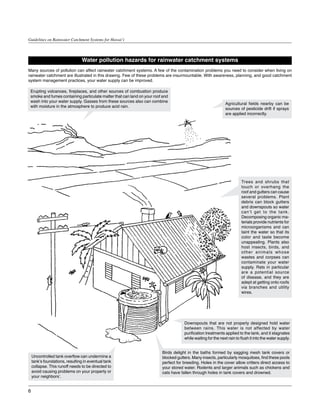
                                 Water pollution hazards for rainwater catchment systems
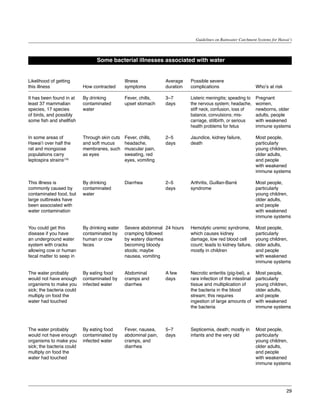
Many sources of pollution can affect rainwater catchment systems. A few of the contamination problems you need to consider when living on
rainwater catchment are illustrated in this drawing. Few of these problems are insurmountable. With awareness, planning, and good catchment
system management practices, your water supply can be improved.

 Erupting volcanoes, fireplaces, and other sources of combustion produce
 smoke and fumes containing particulate matter that can land on your roof and
 wash into your water supply. Gasses from these sources also can combine
                                                                                                              Agricultural fields nearby can be
 with moisture in the atmosphere to produce acid rain.
                                                                                                              sources of pesticide drift if sprays
                                                                                                              are applied incorrectly.


                                                                                                                        Trees and shrubs that
                                                                                                                        touch or overhang the
                                                                                                                        roof and gutters can cause
                                                                                                                        several problems. Plant
                                                                                                                        debris can block gutters
                                                                                                                        and downspouts so water
                                                                                                                        can’t get to the tank.
                                                                                                                        Decomposing organic ma-
                                                                                                                        terials provide nutrients for
                                                                                                                        microorganisms and can
                                                                                                                        taint the water so that its
                                                                                                                        color and taste become
                                                                                                                        unappealing. Plants also
                                                                                                                        host insects, birds, and
                                                                                                                        other animals whose
                                                                                                                        wastes and corpses can
                                                                                                                        contaminate your water
                                                                                                                        supply. Rats in particular
                                                                                                                        are a potential source
                                                                                                                        of disease, and they are
                                                                                                                        adept at getting onto roofs
                                                                                                                        via branches and utility
                                                                                                                        wires.


                                                                                     Downspouts that are not properly designed hold water
                                                                                     between rains. This water is not affected by water
                                                                                     purification treatments applied to the tank, and it stagnates
                                                                                     while waiting for the next rain to flush it into the water supply.


                                                                         Birds delight in the baths formed by sagging mesh tank covers or
    Uncontrolled tank overflow can undermine a                           blocked gutters. Many insects, particularly mosquitoes, find these pools
    tank’s foundations, resulting in eventual tank                       perfect for breeding. Holes in the cover allow critters direct access to
    collapse. This runoff needs to be directed to                        your stored water. Rodents and larger animals such as chickens and
    avoid causing problems on your property or                           cats have fallen through holes in tank covers and drowned.
    your neighbors’.


6
Guidelines on Rainwater Catchment Systems for Hawai‘i


                                                   Section 1


                                      Water Collection


Building materials                                            als containing lead should not be used anywhere in the
The key to choosing building materials for a rainwater        catchment system. Lead is a serious problem with older
catchment system is to select and use materials that will     homes because not only the paint but also nails, flash-
not leach toxins into the water under either normal or acid   ings, solders, and gutters could contain lead. Lead-based
rain conditions. The material should be both nontoxic         paint was not manufactured in the United States after
and inert (nonleaching). Acid rain, which is produced in      1978, but these paints were still in circulation after that
Hawai‘i as rain mixes with volcanic emissions, causes         time, so if your home is an older home it would be wise
certain metals and other materials to leach much more         to have the paint checked. Simple, inexpensive test kits
than normal rain would. The more acidic the rain at your      can be purchased at local hardware stores to test paint or
location, the more likely you are to have a problem with      surfaces for lead. In addition to lead, avoid using roofs
chemicals leaching from materials the water touches.          that contain uncovered galvanized metal, zinc, asbestos
                                                              (which can be mixed into concrete tiles), tar, asphalt, or
Roofing                                                       pesticide-treated wood.
Ideally, only materials approved by the Food and Drug         	 With a new roof, always divert rainfall away from the
Administration or the National Sanitation Foundation          catchment system for the first few rainfalls. Let the roof
would be used to catch drinking water. The National           rinse off and weather a bit before attaching the gutter sys-
Sanitation Foundation has approved the use of elasto-         tem to the tank. The first rains will help flush away dust
meric coatings for catchment surfaces. There are also         and debris such as metal shavings from the new building
epoxy coatings for drinking water use that can be painted     materials and keep these materials out of your tank. New
over a surface, but these coatings are very expensive,        paint, especially acrylic paint, could leach substances such
have an effective life span of only about seven years,        as detergent into the tank that could cause the water to
and were made for coating the interior of tanks rather        froth.(2) Before connecting your tank, catch some runoff
than roofs and gutters.                                       in a jar and check to see if the frothing has stopped.
	 The most common type of roofing material used               	 In designing a roof for catchment purposes, keep its
for water catchment is galvanized metal that has been         pitch relatively low to maximize the amount of water
painted or enameled with a nontoxic paint. Some paint         that gets into your gutter. A steep roof can cause water
companies have paints that have been approved for “in-        to splash out of the gutter.
cidental contact” of potable water. In other words, these
could be used on a roof or gutter but not inside a tank.      Gutters
Other materials that could be used are concrete, terracotta   Like roofs, gutters should be made of inert materials.
tiles, slate, polycarbonate, and fiberglass.(2) Paint used    Most commercially installed gutters in Hawai‘i are made
on the roofing material should not contain fungicides         of seamless aluminum. Also, a number of stores carry
or other poisons that could leach into the water. Materi-     PVC or plastic gutters. Like roofs, the gutter materials

                                                                                                                               7
Guidelines on Rainwater Catchment Systems for Hawai‘i


should be as inert as possible. Copper, for example, is
not a good choice for a gutter.
	 When installing gutters, make sure that there is a
slight continuous downward slope toward the catchment
tank. Low areas that cause a backflow or puddling must
not be allowed. Standing water can collect insects, attract
animals, and catch organic materials, such as leaves.
Decaying organic material can ruin the taste and color
of the water and cause health problems.

Screens
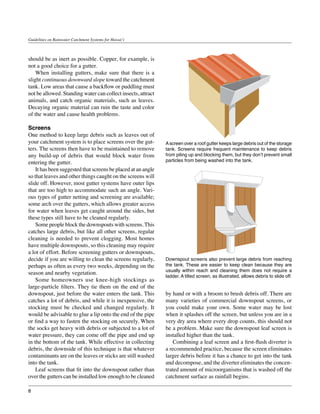
One method to keep large debris such as leaves out of
your catchment system is to place screens over the gut-       A screen over a roof gutter keeps large debris out of the storage
ters. The screens then have to be maintained to remove        tank. Screens require frequent maintenance to keep debris
any build-up of debris that would block water from            from piling up and blocking them, but they don’t prevent small
entering the gutter.                                          particles from being washed into the tank.
	 It has been suggested that screens be placed at an angle
so that leaves and other things caught on the screens will
slide off. However, most gutter systems have outer lips
that are too high to accommodate such an angle. Vari-
ous types of gutter netting and screening are available;
some arch over the gutters, which allows greater access
for water when leaves get caught around the sides, but
these types still have to be cleaned regularly.
	 Some people block the downspouts with screens. This
catches large debris, but like all other screens, regular
cleaning is needed to prevent clogging. Most homes
have multiple downspouts, so this cleaning may require
a lot of effort. Before screening gutters or downspouts,
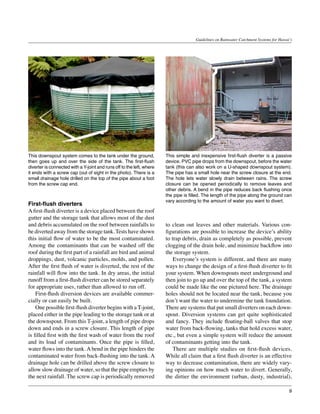
decide if you are willing to clean the screens regularly,     Downspout screens also prevent large debris from reaching
perhaps as often as every two weeks, depending on the         the tank. These are easier to keep clean because they are
                                                              usually within reach and cleaning them does not require a
season and nearby vegetation.
                                                              ladder. A tilted screen, as illustrated, allows debris to slide off.
	 Some homeowners use knee-high stockings as
large-particle filters. They tie them on the end of the
downspout, just before the water enters the tank. This        by hand or with a broom to brush debris off. There are
catches a lot of debris, and while it is inexpensive, the     many varieties of commercial downspout screens, or
stocking must be checked and changed regularly. It            you could make your own. Some water may be lost
would be advisable to glue a lip onto the end of the pipe     when it splashes off the screen, but unless you are in a
or find a way to fasten the stocking on securely. When        very dry area where every drop counts, this should not
the socks get heavy with debris or subjected to a lot of      be a problem. Make sure the downspout leaf screen is
water pressure, they can come off the pipe and end up         installed higher than the tank.
in the bottom of the tank. While effective in collecting      	 Combining a leaf screen and a first-flush diverter is
debris, the downside of this technique is that whatever       a recommended practice, because the screen eliminates
contaminants are on the leaves or sticks are still washed     larger debris before it has a chance to get into the tank
into the tank.                                                and decompose, and the diverter eliminates the concen-
	 Leaf screens that fit into the downspout rather than        trated amount of microorganisms that is washed off the
over the gutters can be installed low enough to be cleaned    catchment surface as rainfall begins.

8
Guidelines on Rainwater Catchment Systems for Hawai‘i


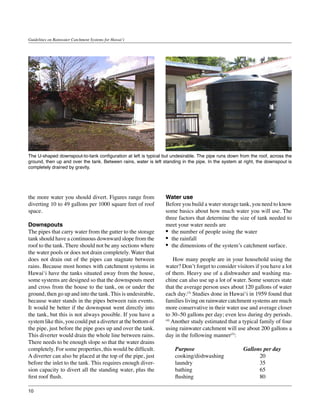
This downspout system comes to the tank under the ground,              This simple and inexpensive first-flush diverter is a passive
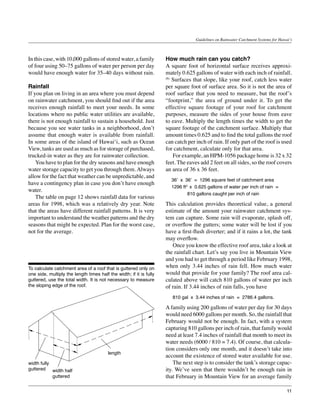
then goes up and over the side of the tank. The first-flush            device. PVC pipe drops from the downspout, before the water
diverter is connected with a Y-joint and runs off to the left, where   tank (this can also work on a U-shaped downspout system).
it ends with a screw cap (out of sight in the photo). There is a       The pipe has a small hole near the screw closure at the end.
small drainage hole drilled on the top of the pipe about a foot        The hole lets water slowly drain between rains. The screw
from the screw cap end.                                                closure can be opened periodically to remove leaves and
                                                                       other debris. A bend in the pipe reduces back flushing once
                                                                       the pipe is filled. The length of the pipe along the ground can
                                                                       vary according to the amount of water you want to divert.
First-flush diverters
A first-flush diverter is a device placed between the roof
gutter and the storage tank that allows most of the dust
and debris accumulated on the roof between rainfalls to                to clean out leaves and other materials. Various con-
be diverted away from the storage tank. Tests have shown               figurations are possible to increase the device’s ability
this initial flow of water to be the most contaminated.                to trap debris, drain as completely as possible, prevent
Among the contaminants that can be washed off the                      clogging of the drain hole, and minimize backflow into
roof during the first part of a rainfall are bird and animal           the storage system.
droppings, dust, volcanic particles, molds, and pollen.                	 Everyone’s system is different, and there are many
After the first flush of water is diverted, the rest of the            ways to change the design of a first-flush diverter to fit
rainfall will flow into the tank. In dry areas, the initial            your system. When downspouts meet underground and
runoff from a first-flush diverter can be stored separately            then join to go up and over the top of the tank, a system
for appropriate uses, rather than allowed to run off.                  could be made like the one pictured here. The drainage
	 First-flush diversion devices are available commer-                  holes should not be located near the tank, because you
cially or can easily be built.                                         don’t want the water to undermine the tank foundation.
	 One possible first-flush diverter begins with a T-joint,             There are systems that put small diverters on each down-
placed either in the pipe leading to the storage tank or at            spout. Diversion systems can get quite sophisticated
the downspout. From this T-joint, a length of pipe drops               and fancy. They include floating-ball valves that stop
down and ends in a screw closure. This length of pipe                  water from back-flowing, tanks that hold excess water,
is filled first with the first wash of water from the roof             etc., but even a simple system will reduce the amount
and its load of contaminants. Once the pipe is filled,                 of contaminants getting into the tank.
water flows into the tank. A bend in the pipe hinders the              	 There are multiple studies on first-flush devices.
contaminated water from back-flushing into the tank. A                 While all claim that a first flush diverter is an effective
drainage hole can be drilled above the screw closure to                way to decrease contamination, there are widely vary-
allow slow drainage of water, so that the pipe empties by              ing opinions on how much water to divert. Generally,
the next rainfall. The screw cap is periodically removed               the dirtier the environment (urban, dusty, industrial),

                                                                                                                                         9
Guidelines on Rainwater Catchment Systems for Hawai‘i


The U-shaped downspout-to-tank configuration at left is typical but undesirable. The pipe runs down from the roof, across the
ground, then up and over the tank. Between rains, water is left standing in the pipe. In the system at right, the downspout is
completely drained by gravity.


the more water you should divert. Figures range from             Water use
diverting 10 to 49 gallons per 1000 square feet of roof          Before you build a water storage tank, you need to know
space.                                                           some basics about how much water you will use. The
                                                                 three factors that determine the size of tank needed to
Downspouts                                                       meet your water needs are
The pipes that carry water from the gutter to the storage        •	 the number of people using the water
tank should have a continuous downward slope from the            •	 the rainfall
roof to the tank. There should not be any sections where         •	 the dimensions of the system’s catchment surface.
the water pools or does not drain completely. Water that
does not drain out of the pipes can stagnate between             	 How many people are in your household using the
rains. Because most homes with catchment systems in              water? Don’t forget to consider visitors if you have a lot
Hawai‘i have the tanks situated away from the house,             of them. Heavy use of a dishwasher and washing ma-
some systems are designed so that the downspouts meet            chine can also use up a lot of water. Some sources state
and cross from the house to the tank, on or under the            that the average person uses about 120 gallons of water
ground, then go up and into the tank. This is undesirable,       each day.(3) Studies done in Hawai‘i in 1959 found that
because water stands in the pipes between rain events.           families living on rainwater catchment systems are much
It would be better if the downspout went directly into           more conservative in their water use and average closer
the tank, but this is not always possible. If you have a         to 30–50 gallons per day; even less during dry periods.
system like this, you could put a diverter at the bottom of      (4)
                                                                     Another study estimated that a typical family of four
the pipe, just before the pipe goes up and over the tank.        using rainwater catchment will use about 200 gallons a
This diverter would drain the whole line between rains.          day in the following manner(5):
There needs to be enough slope so that the water drains
completely. For some properties, this would be difficult.        	    Purpose	                        Gallons per day
A diverter can also be placed at the top of the pipe, just       	    cooking/dishwashing	                  20
before the inlet to the tank. This requires enough diver-         	   laundry	                              35
sion capacity to divert all the standing water, plus the          	   bathing	                              65
first roof flush.                                                 	   flushing	                             80

10
Guidelines on Rainwater Catchment Systems for Hawai‘i


In this case, with 10,000 gallons of stored water, a family          How much rain can you catch?
of four using 50–75 gallons of water per person per day              A square foot of horizontal surface receives approxi-
would have enough water for 35–40 days without rain.                 mately 0.625 gallons of water with each inch of rainfall.
                                                                     (6)
                                                                         Surfaces that slope, like your roof, catch less water
Rainfall                                                             per square foot of surface area. So it is not the area of
If you plan on living in an area where you must depend               roof surface that you need to measure, but the roof’s
on rainwater catchment, you should find out if the area              “footprint,” the area of ground under it. To get the
receives enough rainfall to meet your needs. In some                 effective square footage of your roof for catchment
locations where no public water utilities are available,             purposes, measure the sides of your house from eave
there is not enough rainfall to sustain a household. Just            to eave. Multiply the length times the width to get the
because you see water tanks in a neighborhood, don’t                 square footage of the catchment surface. Multiply that
assume that enough water is available from rainfall.                 amount times 0.625 and to find the total gallons the roof
In some areas of the island of Hawai‘i, such as Ocean                can catch per inch of rain. If only part of the roof is used
View, tanks are used as much as for storage of purchased,            for catchment, calculate only for that area.
trucked-in water as they are for rainwater collection.               	 For example, an HPM-1056 package home is 32 x 32
	 You have to plan for the dry seasons and have enough               feet. The eaves add 2 feet on all sides, so the roof covers
water storage capacity to get you through them. Always               an area of 36 x 36 feet.
allow for the fact that weather can be unpredictable, and
                                                                       36’ x 36’ = 1296 square feet of catchment area
have a contingency plan in case you don’t have enough
                                                                       1296 ft2 x 0.625 gallons of water per inch of rain =
water.
                                                                               810 gallons caught per inch of rain
	 The table on page 12 shows rainfall data for various
areas for 1998, which was a relatively dry year. Note                This calculation provides theoretical value, a general
that the areas have different rainfall patterns. It is very          estimate of the amount your rainwater catchment sys-
important to understand the weather patterns and the dry             tem can capture. Some rain will evaporate, splash off,
seasons that might be expected. Plan for the worst case,             or overflow the gutters; some water will be lost if you
not for the average.                                                 have a first-flush diverter; and if it rains a lot, the tank
                                                                     may overflow.
                                                                     	 Once you know the effective roof area, take a look at
                                                                     the rainfall chart. Let’s say you live in Mountain View
                                                                     and you had to get through a period like February 1998,
To calculate catchment area of a roof that is guttered only on       when only 3.44 inches of rain fell. How much water
one side, multiply the length times half the width; if it is fully   would that provide for your family? The roof area cal-
guttered, use the total width. It is not necessary to measure        culated above will catch 810 gallons of water per inch
the sloping edge of the roof.                                        of rain. If 3.44 inches of rain falls, you have
                                                                     	 810 gal x 3.44 inches of rain = 2786.4 gallons.
                                                                     A family using 200 gallons of water per day for 30 days
                                                                     would need 6000 gallons per month. So, the rainfall that
                                                                     February would not be enough. In fact, with a system
                                                                     capturing 810 gallons per inch of rain, that family would
                                                                     need at least 7.4 inches of rainfall that month to meet its
                                                                     water needs (6000 / 810 = 7.4). Of course, that calcula-
                                                                     tion considers only one month, and it doesn’t take into
                                         length
                                                                     account the existence of stored water available for use.
width fully                                                          	 The next step is to consider the tank’s storage capac-
guttered width half                                                  ity. We’ve seen that there wouldn’t be enough rain in
            guttered                                                 that February in Mountain View for an average family

                                                                                                                                     11
Guidelines on Rainwater Catchment Systems for Hawai‘i


            Monthly rainfall (inches) during 1998 at selected locations on the island of Hawai‘i

STATION	           JAN	     FEB	     MAR	      APR	     MAY	     JUNE	    JULY 	 AUG	      SEPT	    OCT	    NOV	     DEC	     YEAR

Hwn. Bchs.	        1.43	    1.07	    5.26	     9.82	    13.36	   11.14	    6.28	   8.77	    8.69	 14.20	    11.42	 10.35	     101.79
HI Volcanoes
Natl. Pk.	         0.63	    1.31	    5.20	    13.90	    12.90	    7.08	    1.69	   4.91	    4.21	   7.59	   12.19	 12.41	      84.02
Hawi	              2.86	    3.30	    6.69	     8.42	     8.48	    9.86	    4.20	   3.78	    5.10	   4.14	    5.36	    5.51	    67.7
Hilo Airport	      0.13	    2.40	    3.67	     8.86	    15.65	   11.27	    6.09	   8.48	   10.76	 16.01	    15.57	    9.89	   108.78
Holualoa	          0.26	    1.78	    0.10	     0.50	     1.56	    1.46	    3.03	   2.23	    1.81	   3.53	    1.10	    0	       17.36
Honokaa
Town	              2.25	    3.39	    7.18	    15.29	    15.48	    7.47	    8.11	 14.11	    10.93	   6.94	   10.69	    5.19	   107.03
Kahuku
Mill Coop	         1.05	    0.12	    0.51	     0.97	     1.14	    3.18	    0.99	   1.67	    2.28	   2.20	    3.31	    1.48	    19.17
Kahuna
Falls	             1.82	    4.43	    7.71	    25.57	    28.37	 22.56	      9.57	 23.69	    16.69	 25.51	    27.95	 17.81	     211.68
Kainaliu	          1.63	    0.09	    0.94	     2.21	     1.49	    2.04	    2.67	   6.20	    5.57	   1.74	    4.76	    1.33	    30.67
Kapoho Bch.	       0.69	    1.00	    3.54	     5.04	     7.83	    5.65	    3.55	   6.20	    6.75	   5.93	   10.98	    5.32	    62.39
Kapoho Lndg.	 2.61	         1.18	    2.83	     6.86	    11.47	    7.73	    6.55	   6.19	    7.55	   9.98	   12.07	    9.40	    84.42
Keaau	             0.61	    1.55	    3.99	     9.81	    14.64	 12.96	      6.99	   7.27	   12.40	 18.40	    19.28	 13.43	     121.33
Kulani Camp	       0.10	    0.14	    0.79	     3.52	     1.67	    0.64	    0.40	   1.36	    0.67	   1.77	    2.84	 13.25	      27.15
Laupahoehoe	       1.95	    1.00	    2.00	     3.05	     2.05	    3.15	    2.45	   1.23	   11.44	 14.36	    17.43	    7.52	    67.63
Milolii	           0.61	    0.09	    1.55	     0.45	     0.43	    0.37	    0	      0	       0.50	   0	       1.15	    0	        5.12
Mountain
View	              0.95	    3.44	    8.41	    21.72	    25.85	 20.03	     14.01	 16.32	    15.73	 23.65	     *	       *	        *
Naalehu	           0.89	    0.12	    0.18	     1.14	     1.09	    1.75	    0.13	   0.52	    3.14	   3.33	    4.20	    1.13	    17.62
Opihihale	         1.27	    0.18	    1.24	     0.71	     1.37	    1.68	    3.77	   3.22	    3.31	   4.70	    2.80	    0.57	    24.82
Paauilo	           1.11	    2.64	    5.10	    12.74	    15.32	    5.53	    6.09	 11.71	    10.38	   5.08	   13.25	    7.73	    96.68
Pahala
Mauka	             0.70	    0.05	    0.43	     0.52	     0.97	    1.39	    0.11	   0.66	    1.41	   1.58	    2.31	    0.92	    10.75
Pahoa	             1.89	    1.68	    1.97	    12.61	    16.91	   11.17	    8.00	   5.11	   11.68	 18.26	    13.35	 15.41	     118.04
Sea
Mountain	          0.31	    0.01	    0.22	     0.31	     0.42	    0.71	    0.01	   0.33	    1.18	   2.86	    2.26	    1.04	    10.29
S. Glenwood	       1.47	    3.97	    *	         *	       *	       *	      10.64	 12.64	    13.00	   8.19	   25.2	    17.52	     *
S. Kona	           0.83	    0	       0.78	     3.36	     0.29	    0.74	    0.21	   1.71	    0.42	   1.00	    0.78	    0.22	    10.34
Waiakea SCD	 1.02	          2.82	    6.57	    21.12	    27.34	 19.8	      14.57	 19.93	    16.69	 26.31	    25.92	 18.24	     200.33
Waikaloa	          0.94	    0.07	    0.06	     0.50	     0.22	    0.32	    0	      0.31	    2.01	   0.20	    1.49	    0.08	     6.20
Waikaloa
Bch. Rsrt.	        0.51	    0.04	    0	        0.16	     0.12	    0.33	    0.03	   0.38	    0.08	   0.15	    0.23	    0.05	     2.08

* no data
Source: National Oceanic and Atmospheric Administration (NOAA)


12
Guidelines on Rainwater Catchment Systems for Hawai‘i


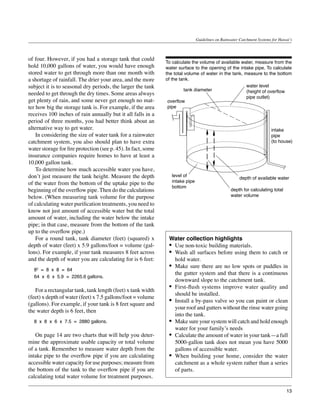
of four. However, if you had a storage tank that could
                                                               To calculate the volume of available water, measure from the
hold 10,000 gallons of water, you would have enough            water surface to the opening of the intake pipe. To calculate
stored water to get through more than one month with           the total volume of water in the tank, measure to the bottom
a shortage of rainfall. The drier your area, and the more      of the tank.
subject it is to seasonal dry periods, the larger the tank                                             water level
                                                                         tank diameter                 (height of overflow
needed to get through the dry times. Some areas always
                                                                                                       pipe outlet)
get plenty of rain, and some never get enough no mat-           overflow
ter how big the storage tank is. For example, if the area       pipe
receives 100 inches of rain annually but it all falls in a
period of three months, you had better think about an
alternative way to get water.                                                                                            intake
	 In considering the size of water tank for a rainwater                                                                  pipe
catchment system, you also should plan to have extra                                                                     (to house)
water storage for fire protection (see p. 45). In fact, some
insurance companies require homes to have at least a
10,000 gallon tank.
	 To determine how much accessible water you have,
don’t just measure the tank height. Measure the depth             level of
                                                                                                        depth of available water
of the water from the bottom of the uptake pipe to the            intake pipe
                                                                  bottom
beginning of the overflow pipe. Then do the calculations                                           depth for calculating total
below. (When measuring tank volume for the purpose                                                 water volume
of calculating water purification treatments, you need to
know not just amount of accessible water but the total
amount of water, including the water below the intake
pipe; in that case, measure from the bottom of the tank
up to the overflow pipe.)
	 For a round tank, tank diameter (feet) (squared) x            Water collection highlights
depth of water (feet) x 5.9 gallons/foot = volume (gal-         •	 Use non-toxic building materials.
lons). For example, if your tank measures 8 feet across         •	 Wash all surfaces before using them to catch or
and the depth of water you are calculating for is 6 feet:          hold water.
  82 = 8 x 8 = 64
                                                                •	 Make sure there are no low spots or puddles in
                                                                   the gutter system and that there is a continuous
  64 x 6 x 5.9 = 2265.6 gallons.
                                                                   downward slope to the catchment tank.
	 For a rectangular tank, tank length (feet) x tank width
                                                                •	 First-flush systems improve water quality and
                                                                   should be installed.
(feet) x depth of water (feet) x 7.5 gallons/foot = volume
(gallons). For example, if your tank is 8 feet square and
                                                                •	 Install a by-pass valve so you can paint or clean
                                                                   your roof and gutters without the rinse water going
the water depth is 6 feet, then
                                                                   into the tank.
  8 x 8 x 6 x 7.5 = 2880 gallons.                               •	 Make sure your system will catch and hold enough
                                                                   water for your family’s needs
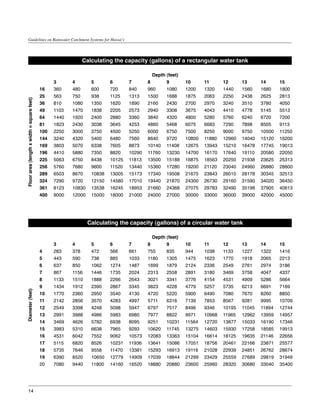
	 On page 14 are two charts that will help you deter-           •	 Calculate the amount of water in your tank—a full
mine the approximate usable capacity or total volume               5000-gallon tank does not mean you have 5000
of a tank. Remember to measure water depth from the                gallons of accessible water.
intake pipe to the overflow pipe if you are calculating         •	 When building your home, consider the water
accessible water capacity for use purposes; measure from           catchment as a whole system rather than a series
the bottom of the tank to the overflow pipe if you are             of parts.
calculating total water volume for treatment purposes.

                                                                                                                                  13
Guidelines on Rainwater Catchment Systems for Hawai‘i


                                                               Calculating the capacity (gallons) of a rectangular water tank

                                                                                                   Depth (feet)
                                            	      3	      4	        5	       6	       7	       8	       9	       10	      11	      12	      13	      14	      15
                                            16	    360	    480	      600	     720	     840	     960	     1080	    1200	    1320	    1440	    1560	    1680	    1800
                                            25	    563	    750	      938	     1125	    1313	    1500	 1688	       1875	    2063	    2250	    2438	    2625	    2813
Floor area (length x width = square feet)


                                            36	    810	    1080	     1350	    1620	    1890	    2160	 2430	       2700	    2970	    3240	    3510	    3780	    4050
                                            49	    1103	   1470	     1838	    2205	    2573	    2940	 3308	       3675	    4043	    4410	    4778	    5145	    5513
                                            64	    1440	   1920	     2400	    2880	    3360	    3840	 4320	       4800	    5280	    5760	    6240	    6720	    7200
                                            81	    1823	   2430	     3038	    3645	    4253	    4860	 5468	       6075	    6683	    7290	    7898	    8505	    9113
                                            100	   2250	   3000	     3750	    4500	    5250	    6000	 6750	       7500	    8250	    9000	    9750	    10500	   11250
                                            144	   3240	   4320	     5400	    6480	    7560	    8640	 9720	       10800	   11880	   12960	   14040	   15120	   16200
                                            169	   3803	   5070	     6338	    7605	    8873	    10140	 11408	     12675	   13943	   15210	   16478	   17745	   19013
                                            196	   4410	   5880	     7350	    8820	    10290	   11760	 13230	     14700	   16170	   17640	   19110	   20580	   22050
                                            225	   5063	   6750	     8438	    10125	   11813	   13500	 15188	     16875	   18563	   20250	   21938	   23625	   25313
                                            256	   5760	   7680	     9600	    11520	   13440	   15360	 17280	     19200	   21120	   23040	   24960	   26880	   28800
                                            289	   6503	   8670	     10838	   13005	   15173	   17340	 19508	     21675	   23843	   26010	   28178	   30345	   32513
                                            324	   7290	   9720	     12150	   14580	   17010	   19440	 21870	     24300	   26730	   29160	   31590	   34020	   36450
                                            361	   8123	   10830	    13538	   16245	   18953	   21660	 24368	     27075	   29783	   32490	   35198	   37905	   40613
                                            400	   9000	   12000	    15000	   18000	   21000	   24000	 27000	     30000	   33000	   36000	   39000	   42000	   45000


                                                                    Calculating the capacity (gallons) of a circular water tank

                                                                                                   Depth (feet)
                                            	      3	      4	        5	       6	       7	       8	       9	       10	      11	      12	      13	      14	      15
                                            4	     283	    378	      472	     566	     661	     755	     835	     944	     1038	    1133	    1227	    1322	    1416
                                            5	     443	    590	      738	     885	     1033	    1180	    1305	    1475	    1623	    1770	    1918	    2065	    2213
                                            6	     637	    850	      1062	    1274	    1487	    1699	 1879	       2124	    2336	    2549	    2761	    2974	    3186
                                            7	     867	    1156	     1446	    1735	    2024	    2313	 2558	       2891	    3180	    3469	    3758	    4047	    4337
                                            8	     1133	   1510	     1888	    2266	    2643	    3021	 3341	       3776	    4154	    4531	    4909	    5286	    5664
                                            9	     1434	   1912	     2390	    2867	    3345	    3823	 4228	       4779	    5257	    5735	    6213	    6691	    7169
Diameter (feet)


                                            10	    1770	   2360	     2950	    3540	    4130	    4720	 5220	       5900	    6490	    7080	    7670	    8260	    8850
                                            11	    2142	   2856	     3570	    4283	    4997	    5711	    6316	    7139	    7853	    8567	    9281	    9995	    10709
                                            12	    2549	   3398	     4248	    5098	    5947	    6797	 7517	       8496	    9346	    10195	   11045	   11894	   12744
                                            13	    2991	   3988	     4986	    5983	    6980	    7977	 8822	       9971	    10968	   11965	   12962	   13959	   14957
                                            14	    3469	   4626	     5782	    6938	    8095	    9251	 10231	      11564	   12720	   13877	   15033	   16190	   17346
                                            15	    3983	   5310	     6638	    7965	    9293	    10620	 11745	     13275	   14603	   15930	   17258	   18585	   19913
                                            16	    4531	   6042	     7552	    9062	    10573	   12083	 13363	     15104	   16614	   18125	   19635	   21146	   22656
                                            17	    5115	   6820	     8526	    10231	   11936	   13641	 15086	     17051	   18756	   20461	   22166	   23871	   25577
                                            18	    5735	   7646	     9558	    11470	   13381	   15293	 16913	     19116	   21028	   22939	   24851	   26762	   28674
                                            19	    6390	   8520	     10650	   12779	   14909	   17039	 18844	     21299	   23429	   25559	   27689	   29819	   31949
                                            20	    7080	   9440	     11800	   14160	   16520	   18880	 20880	     23600	   25960	   28320	   30680	   33040	   35400


         14
Guidelines on Rainwater Catchment Systems for Hawai‘i


                                                      Section 2


                                           Water Storage


Type of tank                                                     parts of the U.S. mainland.
Water tanks can be made of a variety of materials. Most          	 The table on page 16 gives a brief overview of the
are specially designed for the purpose, but sometimes            various types of tanks, which are discussed in more detail
containers meant for other purposes are used, such as            in the following paragraphs.
horse troughs and “kiddie pools.” Many people believe
that anything that holds water can be used as a catchment        Swimming pool tanks
tank(7), but they are mistaken. As with the other parts          Sometimes referred to as “portable above-ground swim-
of a catchment system, the tank should be chosen with            ming pools,” these tanks have metal sides and plastic
careful consideration of your water needs and awareness          (polyethylene) liners. Doughboy® is probably the most
of the materials that your water comes in contact with.          familiar trade name, but there are many companies mak-
Just like roofing materials, tank materials can leach into       ing this type of swimming pool. Some have a plastic
the water. Different tanks have different problems and           framework rather than metal, some have elaborate siding,
benefits. Whichever type of tank you use, you should             and some have no siding.
rinse it well before using it for the first time.                	 The greatest advantage of swimming pool tanks is low
	 Preferences for the type of tank have changed over             cost. Also, skilled homeowners can install them without
the years in Hawai‘i, due mostly to the materials cost           professional help, and they are available from various
and availability. Technology and market competition              sources including discount stores.
also influence what people are buying and using.                 	 Among their disadvantages, they are not as sturdy or
	 Fifty years ago, the popular tanks were redwood                as durable as some other types of tank. The liners that
tanks. They were easily obtainable and inexpensive. As           come with the pools are not food-grade quality. The lin-
availability of redwood diminished and prices increased,
swimming pool tanks were marketed by local suppliers
and became popular. This popularity gave way to the
sturdier corrugated steel tanks that lead the market in sales
today. Concrete tanks of one form or another have existed
for a long time, but their high price limits their popularity.
	 Ferroconcrete and polyethylene were the next types
of tanks to be introduced to the market, and they can be
seen in increasing numbers. Their higher price tag limits
their popularity. Fiberglass tanks were brought in at one
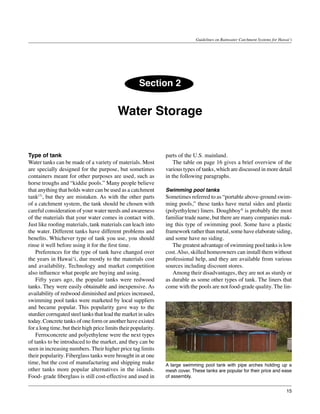
time, but the cost of manufacturing and shipping make            A large swimming pool tank with pipe arches holding up a
other tanks more popular alternatives in the islands.            mesh cover. These tanks are popular for their price and ease
Food- grade fiberglass is still cost-effective and used in       of assembly.


                                                                                                                                 15
Guidelines on Rainwater Catchment Systems for Hawai‘i


ers only come up to the top edge of the tank and often
pull out of their clips and droop into the pool, particularly
when the water level is low and the liners shrink with
drying. The biggest problem with swimming pool tanks
can be the liner material itself. Some liners contain bio-
cides designed to reduce fungal and bacterial growth in
the pool. This material can be very toxic. These types of
liner are NOT designed for storing water for consumption
and should not be used for holding household water(8).
It is very important to buy a liner approved by the Food
and Drug Administration if you use a swimming pool
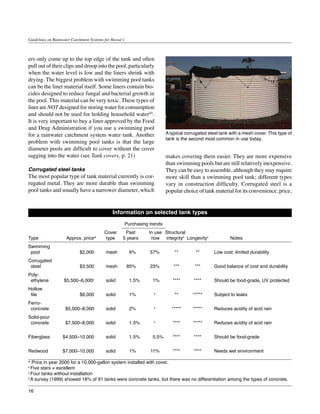
for a rainwater catchment system water tank. Another                         A typical corrugated steel tank with a mesh cover. This type of
                                                                             tank is the second most common in use today.
problem with swimming pool tanks is that the large
diameter pools are difficult to cover without the cover
sagging into the water (see Tank covers, p. 21)                              makes covering them easier. They are more expensive
                                                                             than swimming pools but are still relatively inexpensive.
Corrugated steel tanks                                                       They can be easy to assemble, although they may require
The most popular type of tank material currently is cor-                     more skill than a swimming pool tank; different types
rugated metal. They are more durable than swimming                           vary in construction difficulty. Corrugated steel is a
pool tanks and usually have a narrower diameter, which                       popular choice of tank material for its convenience, price,


                                              Information on selected tank types
	                                                       Purchasing trends
		                                        Cover	  Past	           In use	 Structural
Type	 Approx. pricew	                      type	 5 years	          now	 integrityx	 Longevityx	              Notes
Swimming
 pool	                      $2,000 	      mesh	           6%	      57%	          **	        **	      Low cost; limited durability
Corrugated
 steel	                     $3,500 	      mesh	         85%	       23%	          ***	      ***	      Good balance of cost and durability
Poly-
 ethylene	         $5,500–6,000y	         solid	          1.5%	     1%	         ****	      ****	     Should be food-grade, UV protected
Hollow
 tile	                      $6,000 	      solid	          1%	        z
                                                                         	       **	      *****	     Subject to leaks
Ferro-
 concrete	          $5,500–8,000	         solid	          2%	        z
                                                                         	      *****	    *****	     Reduces acidity of acid rain
Solid-pour
 concrete	          $7,500–8,000	         solid	          1.5%	      z
                                                                         	      ****	     *****	     Reduces acidity of acid rain


Fiberglass	        $4,500–10,000	         solid	          1.5%	     5.5%	       ****	      ****	     Should be food-grade


Redwood 	          $7,000–10,000	         solid	          1%	      11%	         ****	      ****	     Needs wet environment

w
  Price in year 2000 for a 10,000-gallon system installed with cover.
x
  Five stars = excellent
y
  Four tanks without installation
z
  A survey (1999) showed 16% of 91 tanks were concrete tanks, but there was no differentiation among the types of concrete.
	
16
Guidelines on Rainwater Catchment Systems for Hawai‘i


and reasonable durability. Liners for these tanks, as with
swimming pool tanks, should be FDA approved. Some
corrugated tanks have solid covers and were designed to
be used with a liner. They look a bit like miniature silos.

Enclosed metal tanks
These tanks are not common these days in Hawai‘i. An
advantage is that they usually have solid covers, which
make them less susceptible to the introduction of contam-
inating materials. But their disadvantages have resulted
in their seldom being used. Many of these tanks are too
small to meet the needs of most families, particularly in
locations not in a rain belt. Rust and deterioration inside
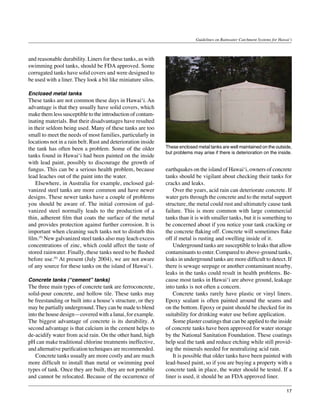
the tank has often been a problem. Some of the older          These enclosed metal tanks are well maintained on the outside,
                                                              but problems may arise if there is deterioration on the inside.
tanks found in Hawai‘i had been painted on the inside
with lead paint, possibly to discourage the growth of
fungus. This can be a serious health problem, because         earthquakes on the island of Hawai‘i, owners of concrete
lead leaches out of the paint into the water.                 tanks should be vigilant about checking their tanks for
	 Elsewhere, in Australia for example, enclosed gal-          cracks and leaks.
vanized steel tanks are more common and have newer            	 Over the years, acid rain can deteriorate concrete. If
designs. These newer tanks have a couple of problems          water gets through the concrete and to the metal support
you should be aware of. The initial corrosion of gal-         structure, the metal could rust and ultimately cause tank
vanized steel normally leads to the production of a           failure. This is more common with large commercial
thin, adherent film that coats the surface of the metal       tanks than it is with smaller tanks, but it is something to
and provides protection against further corrosion. It is      be concerned about if you notice your tank cracking or
important when cleaning such tanks not to disturb this        the concrete flaking off. Concrete will sometimes flake
film.(9) New galvanized steel tanks also may leach excess     off if metal is rusting and swelling inside of it.
concentrations of zinc, which could affect the taste of       	 Underground tanks are susceptible to leaks that allow
stored rainwater. Finally, these tanks need to be flushed     contaminants to enter. Compared to above-ground tanks,
before use.(9) At present (July 2004), we are not aware       leaks in underground tanks are more difficult to detect. If
of any source for these tanks on the island of Hawai‘i.       there is sewage seepage or another contaminant nearby,
                                                              leaks in the tanks could result in health problems. Be-
Concrete tanks (“cement” tanks)                               cause most tanks in Hawai‘i are above ground, leakage
The three main types of concrete tank are ferroconcrete,      into tanks is not often a concern.
solid-pour concrete, and hollow tile. These tanks may         	 Concrete tanks rarely have plastic or vinyl liners.
be freestanding or built into a house’s structure, or they    Epoxy sealant is often painted around the seams and
may be partially underground. They can be made to blend       on the bottom. Epoxy or paint should be checked for its
into the house design—covered with a lanai, for example.      suitability for drinking water use before application.
The biggest advantage of concrete is its durability. A        	 Some plaster coatings that can be applied to the inside
second advantage is that calcium in the cement helps to       of concrete tanks have been approved for water storage
de-acidify water from acid rain. On the other hand, high      by the National Sanitation Foundation. These coatings
pH can make traditional chlorine treatments ineffective,      help seal the tank and reduce etching while still provid-
and alternative purification techniques are recommended.      ing the minerals needed for neutralizing acid rain.
	 Concrete tanks usually are more costly and are much         	 It is possible that older tanks have been painted with
more difficult to install than metal or swimming pool         lead-based paint, so if you are buying a property with a
types of tank. Once they are built, they are not portable     concrete tank in place, the water should be tested. If a
and cannot be relocated. Because of the occurrence of         liner is used, it should be an FDA approved liner.

                                                                                                                               17
Guidelines on Rainwater Catchment Systems for Hawai‘i


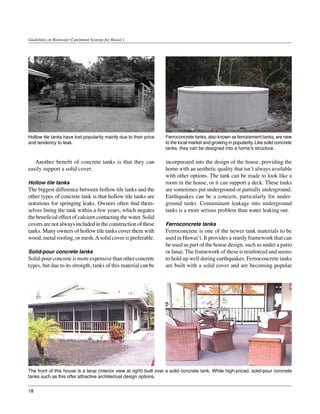
Hollow tile tanks have lost popularity mainly due to their price    Ferroconcrete tanks, also known as ferrocement tanks, are new
and tendency to leak.                                               to the local market and growing in popularity. Like solid concrete
                                                                    tanks, they can be designed into a home’s structure.

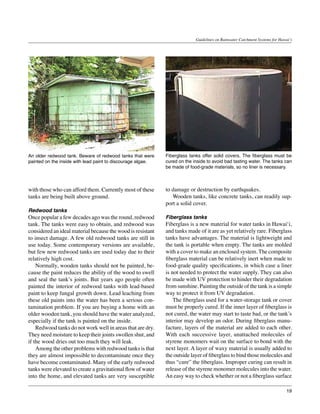
	 Another benefit of concrete tanks is that they can                incorporated into the design of the house, providing the
easily support a solid cover.                                       home with an aesthetic quality that isn’t always available
                                                                    with other options. The tank can be made to look like a
Hollow tile tanks                                                   room in the house, or it can support a deck. These tanks
The biggest difference between hollow tile tanks and the            are sometimes put underground or partially underground.
other types of concrete tank is that hollow tile tanks are          Earthquakes can be a concern, particularly for under-
notorious for springing leaks. Owners often find them-              ground tanks. Contaminant leakage into underground
selves lining the tank within a few years, which negates            tanks is a more serious problem than water leaking out.
the beneficial effect of calcium contacting the water. Solid
covers are not always included in the construction of these         Ferroconcrete tanks
tanks. Many owners of hollow tile tanks cover them with             Ferroconcrete is one of the newer tank materials to be
wood, metal roofing, or mesh. A solid cover is preferable.          used in Hawai‘i. It provides a sturdy framework that can
                                                                    be used as part of the house design, such as under a patio
Solid-pour concrete tanks                                           or lanai. The framework of these is reinforced and seems
Solid-pour concrete is more expensive than other concrete           to hold up well during earthquakes. Ferroconcrete tanks
types, but due to its strength, tanks of this material can be       are built with a solid cover and are becoming popular


The front of this house is a lanai (interior view at right) built over a solid concrete tank. While high-priced, solid-pour concrete
tanks such as this offer attractive architectual design options.


18
Guidelines on Rainwater Catchment Systems for Hawai‘i


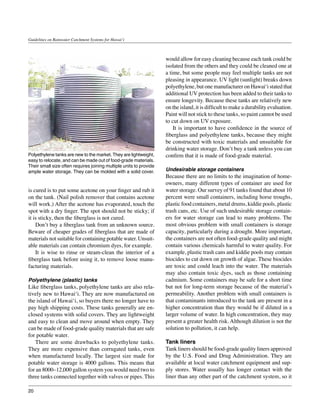
An older redwood tank. Beware of redwood tanks that were      Fiberglass tanks offer solid covers. The fiberglass must be
painted on the inside with lead paint to discourage algae.    cured on the inside to avoid bad tasting water. The tanks can
                                                              be made of food-grade materials, so no liner is necessary.


with those who can afford them. Currently most of these       to damage or destruction by earthquakes.
tanks are being built above ground.                           	 Wooden tanks, like concrete tanks, can readily sup-
                                                              port a solid cover.
Redwood tanks
Once popular a few decades ago was the round, redwood         Fiberglass tanks
tank. The tanks were easy to obtain, and redwood was          Fiberglass is a new material for water tanks in Hawai‘i,
considered an ideal material because the wood is resistant    and tanks made of it are as yet relatively rare. Fiberglass
to insect damage. A few old redwood tanks are still in        tanks have advantages. The material is lightweight and
use today. Some contemporary versions are available,          the tank is portable when empty. The tanks are molded
but few new redwood tanks are used today due to their         with a cover to make an enclosed system. The composite
relatively high cost.                                         fiberglass material can be relatively inert when made to
	 Normally, wooden tanks should not be painted, be-           food-grade quality specifications, in which case a liner
cause the paint reduces the ability of the wood to swell      is not needed to protect the water supply. They can also
and seal the tank’s joints. But years ago people often        be made with UV protection to hinder their degradation
painted the interior of redwood tanks with lead-based         from sunshine. Painting the outside of the tank is a simple
paint to keep fungal growth down. Lead leaching from          way to protect it from UV degradation.
these old paints into the water has been a serious con-       	 The fiberglass used for a water-storage tank or cover
tamination problem. If you are buying a home with an          must be properly cured. If the inner layer of fiberglass is
older wooden tank, you should have the water analyzed,        not cured, the water may start to taste bad, or the tank’s
especially if the tank is painted on the inside.              interior may develop an odor. During fiberglass manu-
	 Redwood tanks do not work well in areas that are dry.       facture, layers of the material are added to each other.
They need moisture to keep their joints swollen shut, and     With each successive layer, unattached molecules of
if the wood dries out too much they will leak.                styrene monomers wait on the surface to bond with the
	 Among the other problems with redwood tanks is that         next layer. A layer of waxy material is usually added to
they are almost impossible to decontaminate once they         the outside layer of fiberglass to bind those molecules and
have become contaminated. Many of the early redwood           thus “cure” the fiberglass. Improper curing can result in
tanks were elevated to create a gravitational flow of water   release of the styrene monomer molecules into the water.
into the home, and elevated tanks are very susceptible        An easy way to check whether or not a fiberglass surface

                                                                                                                              19
Guidelines on Rainwater Catchment Systems for Hawai‘i


                                                                    would allow for easy cleaning because each tank could be
                                                                    isolated from the others and they could be cleaned one at
                                                                    a time, but some people may feel multiple tanks are not
                                                                    pleasing in appearance. UV light (sunlight) breaks down
                                                                    polyethylene, but one manufacturer on Hawai‘i stated that
                                                                    additional UV protection has been added to their tanks to
                                                                    ensure longevity. Because these tanks are relatively new
                                                                    on the island, it is difficult to make a durability evaluation.
                                                                    Paint will not stick to these tanks, so paint cannot be used
                                                                    to cut down on UV exposure.
                                                                    	 It is important to have confidence in the source of
                                                                    fiberglass and polyethylene tanks, because they might
                                                                    be constructed with toxic materials and unsuitable for
                                                                    drinking water storage. Don’t buy a tank unless you can
Polyethylene tanks are new to the market. They are lightweight,     confirm that it is made of food-grade material.
easy to relocate, and can be made out of food-grade materials.
Their small size often requires joining multiple units to provide
ample water storage. They can be molded with a solid cover.         Undesirable storage containers
                                                                    Because there are no limits to the imagination of home-
                                                                    owners, many different types of container are used for
is cured is to put some acetone on your finger and rub it           water storage. Our survey of 91 tanks found that about 10
on the tank. (Nail polish remover that contains acetone             percent were small containers, including horse troughs,
will work.) After the acetone has evaporated, touch the             plastic food containers, metal drums, kiddie pools, plastic
spot with a dry finger. The spot should not be sticky; if           trash cans, etc. Use of such undesirable storage contain-
it is sticky, then the fiberglass is not cured.                     ers for water storage can lead to many problems. The
	 Don’t buy a fiberglass tank from an unknown source.               most obvious problem with small containers is storage
Beware of cheaper grades of fiberglass that are made of             capacity, particularly during a drought. More important,
materials not suitable for containing potable water. Unsuit-        the containers are not often food-grade quality and might
able materials can contain chromium dyes, for example.              contain various chemicals harmful to water quality. For
	 It is wise to rinse or steam-clean the interior of a              example, plastic trash cans and kiddie pools may contain
fiberglass tank before using it, to remove loose manu-              biocides to cut down on growth of algae. These biocides
facturing materials.                                                are toxic and could leach into the water. The materials
                                                                    may also contain toxic dyes, such as those containing
Polyethylene (plastic) tanks                                        cadmium. Some containers may be safe for a short time
Like fiberglass tanks, polyethylene tanks are also rela-            but not for long-term storage because of the material’s
tively new to Hawai‘i. They are now manufactured on                 permeability. Another problem with small containers is
the island of Hawai‘i, so buyers there no longer have to            that contaminants introduced to the tank are present in a
pay high shipping costs. These tanks generally are en-              higher concentration than they would be if diluted in a
closed systems with solid covers. They are lightweight              larger volume of water. In high concentration, they may
and easy to clean and move around when empty. They                  present a greater health risk. Although dilution is not the
can be made of food-grade quality materials that are safe           solution to pollution, it can help.
for potable water.
	 There are some drawbacks to polyethylene tanks.                   Tank liners
They are more expensive than corrugated tanks, even                 Tank liners should be food-grade quality liners approved
when manufactured locally. The largest size made for                by the U.S. Food and Drug Administration. They are
potable water storage is 4000 gallons. This means that              available at local water catchment equipment and sup-
for an 8000–12,000 gallon system you would need two to              ply stores. Water usually has longer contact with the
three tanks connected together with valves or pipes. This           liner than any other part of the catchment system, so it

20
Guidelines on Rainwater Catchment Systems for Hawai‘i


                                                               will be. Contaminants can get into a rainwater catchment
                                                               tank by washing off the roof, but as described earlier, a
                                                               first-flush system can eliminate the majority of the roof’s
                                                               contribution to debris entering the tank. Then, if the tank
                                                               is covered with a solid cover, airborne contamination
                                                               cannot get in.
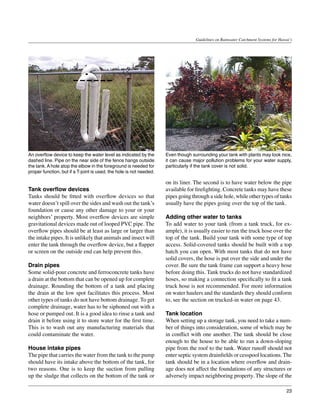
                                                               	 Mesh covers made from woven polypropylene
                                                               groundcover cloth or similar products are inexpensive,
                                                               but unfortunately they are not an acceptable choice of
                                                               cover as far as water quality is concerned. The mesh
                                                               allows dirt, small insects, bird and animal wastes, and
                                                               sunlight through. Keeping the mesh out of contact with
                                                               the water in the tank is a major problem. If the cover is
                                                               not properly supported, or as the material ages, stretches,
                                                               and sags into the water, the resulting “pond” allows
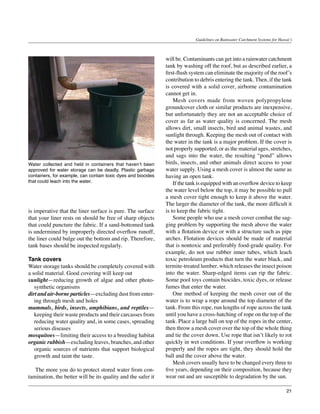
Water collected and held in containers that haven’t been       birds, insects, and other animals direct access to your
approved for water storage can be deadly. Plastic garbage      water supply. Using a mesh cover is almost the same as
containers, for example, can contain toxic dyes and biocides   having an open tank.
that could leach into the water.                               	 If the tank is equipped with an overflow device to keep
                                                               the water level below the top, it may be possible to pull
                                                               a mesh cover tight enough to keep it above the water.
                                                               The larger the diameter of the tank, the more difficult it
is imperative that the liner surface is pure. The surface      is to keep the fabric tight.
that your liner rests on should be free of sharp objects       	 Some people who use a mesh cover combat the sag-
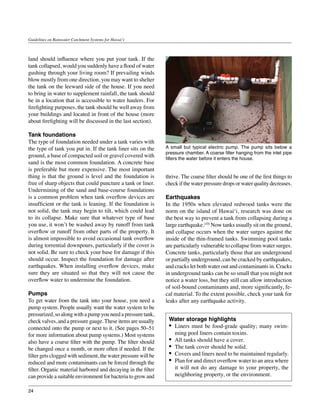
that could puncture the fabric. If a sand-bottomed tank        ging problem by supporting the mesh above the water
is undermined by improperly directed overflow runoff,          with a flotation device or with a structure such as pipe
the liner could bulge out the bottom and rip. Therefore,       arches. Flotation devices should be made of material
tank bases should be inspected regularly.                      that is nontoxic and preferably food-grade quality. For
                                                               example, do not use rubber inner tubes, which leach
Tank covers                                                    toxic petroleum products that turn the water black, and
Water storage tanks should be completely covered with          termite-treated lumber, which releases the insect poison
a solid material. Good covering will keep out                  into the water. Sharp-edged items can rip the fabric.
sunlight—reducing growth of algae and other photo-             Some pool toys contain biocides, toxic dyes, or release
   synthetic organisms                                         fumes that enter the water.
dirt and air-borne particles—excluding dust from enter-        	 One method of keeping the mesh cover out of the
   ing through mesh and holes                                  water is to wrap a rope around the top diameter of the
mammals, birds, insects, amphibians, and reptiles—             tank. From this rope, run lengths of rope across the tank
   keeping their waste products and their carcasses from       until you have a cross-hatching of rope on the top of the
   reducing water quality and, in some cases, spreading        tank. Place a large ball on top of the ropes in the center,
   serious diseases                                            then throw a mesh cover over the top of the whole thing
mosquitoes—limiting their access to a breeding habitat         and tie the cover down. Use rope that isn’t likely to rot
organic rubbish—excluding leaves, branches, and other          quickly in wet conditions. If your overflow is working
   organic sources of nutrients that support biological        properly and the ropes are tight, they should hold the
   growth and taint the taste.                                 ball and the cover above the water.
                                                               	 Mesh covers usually have to be changed every three to
	 The more you do to protect stored water from con-            five years, depending on their composition, because they
tamination, the better will be its quality and the safer it    wear out and are susceptible to degradation by the sun.

                                                                                                                               21
Guidelines on Rainwater Catchment Systems for Hawai‘i


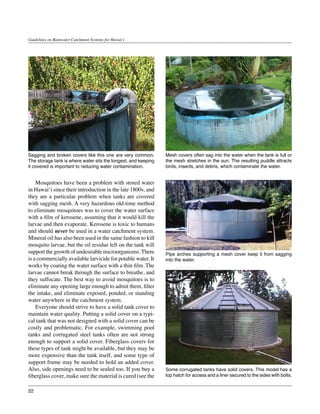
Sagging and broken covers like this one are very common.        Mesh covers often sag into the water when the tank is full or
The storage tank is where water sits the longest, and keeping   the mesh stretches in the sun. The resulting puddle attracts
it covered is important to reducing water contamination.        birds, insects, and debris, which contaminate the water.


	 Mosquitoes have been a problem with stored water
in Hawai‘i since their introduction in the late 1800s, and
they are a particular problem when tanks are covered
with sagging mesh. A very hazardous old-time method
to eliminate mosquitoes was to cover the water surface
with a film of kerosene, assuming that it would kill the
larvae and then evaporate. Kerosene is toxic to humans
and should never be used in a water catchment system.
Mineral oil has also been used in the same fashion to kill
mosquito larvae, but the oil residue left on the tank will
support the growth of undesirable microorganisms. There         Pipe arches supporting a mesh cover keep it from sagging
is a commercially available larvicide for potable water. It     into the water.
works by coating the water surface with a thin film. The
larvae cannot break through the surface to breathe, and
they suffocate. The best way to avoid mosquitoes is to
eliminate any opening large enough to admit them, filter
the intake, and eliminate exposed, ponded, or standing
water anywhere in the catchment system.
	 Everyone should strive to have a solid tank cover to          section on fiberglass tanks).
maintain water quality. Putting a solid cover on a typi-
cal tank that was not designed with a solid cover can be
costly and problematic. For example, swimming pool
tanks and corrugated steel tanks often are not strong
enough to support a solid cover. Fiberglass covers for
these types of tank might be available, but they may be
more expensive than the tank itself, and some type of
support frame may be needed to hold an added cover.
Also, side openings need to be sealed too. If you buy a         Some corrugated tanks have solid covers. This model has a
fiberglass cover, make sure the material is cured (see the      top hatch for access and a liner secured to the sides with bolts.


22
Guidelines on Rainwater Catchment Systems for Hawai‘i


An overflow device to keep the water level as indicated by the       Even though surrounding your tank with plants may look nice,
dashed line. Pipe on the near side of the fence hangs outside        it can cause major pollution problems for your water supply,
the tank. A hole atop the elbow in the foreground is needed for      particularly if the tank cover is not solid.
proper function, but if a T-joint is used, the hole is not needed.

                                                                     on its liner. The second is to have water below the pipe
Tank overflow devices                                                available for firefighting. Concrete tanks may have these
Tanks should be fitted with overflow devices so that                 pipes going through a side hole, while other types of tanks
water doesn’t spill over the sides and wash out the tank’s           usually have the pipes going over the top of the tank.
foundation or cause any other damage to your or your
neighbors’ property. Most overflow devices are simple                Adding other water to tanks
gravitational devices made out of looped PVC pipe. The               To add water to your tank (from a tank truck, for ex-
overflow pipes should be at least as large or larger than            ample), it is usually easier to run the truck hose over the
the intake pipes. It is unlikely that animals and insect will        top of the tank. Build your tank with some type of top
enter the tank through the overflow device, but a flapper            access. Solid-covered tanks should be built with a top
or screen on the outside end can help prevent this.                  hatch you can open. With most tanks that do not have
                                                                     solid covers, the hose is put over the side and under the
Drain pipes                                                          cover. Be sure the tank frame can support a heavy hose
Some solid-pour concrete and ferroconcrete tanks have                before doing this. Tank trucks do not have standardized
a drain at the bottom that can be opened up for complete             hoses, so making a connection specifically to fit a tank
drainage. Rounding the bottom of a tank and placing                  truck hose is not recommended. For more information
the drain at the low spot facilitates this process. Most             on water haulers and the standards they should conform
other types of tanks do not have bottom drainage. To get             to, see the section on trucked-in water on page 43.
complete drainage, water has to be siphoned out with a
hose or pumped out. It is a good idea to rinse a tank and            Tank location
drain it before using it to store water for the first time.          When setting up a storage tank, you need to take a num-
This is to wash out any manufacturing materials that                 ber of things into consideration, some of which may be
could contaminate the water.                                         in conflict with one another. The tank should be close
                                                                     enough to the house to be able to run a down-sloping
House intake pipes                                                   pipe from the roof to the tank. Water runoff should not
The pipe that carries the water from the tank to the pump            enter septic system drainfields or cesspool locations. The
should have its intake above the bottom of the tank, for             tank should be in a location where overflow and drain-
two reasons. One is to keep the suction from pulling                 age does not affect the foundations of any structures or
up the sludge that collects on the bottom of the tank or             adversely impact neighboring property. The slope of the

                                                                                                                                     23
Guidelines on Rainwater Catchment Systems for Hawai‘i


land should influence where you put your tank. If the
tank collapsed, would you suddenly have a flood of water
gushing through your living room? If prevailing winds
blow mostly from one direction, you may want to shelter
the tank on the leeward side of the house. If you need
to bring in water to supplement rainfall, the tank should
be in a location that is accessible to water haulers. For
firefighting purposes, the tank should be well away from
your buildings and located in front of the house (more
about firefighting will be discussed in the last section).

Tank foundations
The type of foundation needed under a tank varies with
the type of tank you put in. If the tank liner sits on the      A small but typical electric pump. The pump sits below a
                                                                pressure chamber. A coarse filter hanging from the inlet pipe
ground, a base of compacted soil or gravel covered with         filters the water before it enters the house.
sand is the most common foundation. A concrete base
is preferable but more expensive. The most important
thing is that the ground is level and the foundation is         thrive. The coarse filter should be one of the first things to
free of sharp objects that could puncture a tank or liner.      check if the water pressure drops or water quality decreases.
Undermining of the sand and base-course foundations
is a common problem when tank overflow devices are              Earthquakes
insufficient or the tank is leaning. If the foundation is       In the 1950s when elevated redwood tanks were the
not solid, the tank may begin to tilt, which could lead         norm on the island of Hawai‘i, research was done on
to its collapse. Make sure that whatever type of base           the best way to prevent a tank from collapsing during a
you use, it won’t be washed away by runoff from tank            large earthquake.(10) Now tanks usually sit on the ground,
overflow or runoff from other parts of the property. It         and collapse occurs when the water surges against the
is almost impossible to avoid occasional tank overflow          inside of the thin-framed tanks. Swimming pool tanks
during torrential downpours, particularly if the cover is       are particularly vulnerable to collapse from water surges.
not solid. Be sure to check your base for damage if this        Concrete tanks, particularly those that are underground
should occur. Inspect the foundation for damage after           or partially underground, can be cracked by earthquakes,
earthquakes. When installing overflow devices, make             and cracks let both water out and contaminants in. Cracks
sure they are situated so that they will not cause the          in underground tanks can be so small that you might not
overflow water to undermine the foundation.                     notice a water loss, but they still can allow introduction
                                                                of soil-bound contaminants and, more significantly, fe-
Pumps                                                           cal material. To the extent possible, check your tank for
To get water from the tank into your house, you need a          leaks after any earthquake activity.
pump system. People usually want the water system to be
pressurized, so along with a pump you need a pressure tank,
check valves, and a pressure gauge. These items are usually      Water storage highlights
connected onto the pump or next to it. (See pages 50–51          •	 Liners must be food-grade quality; many swim-
for more information about pump systems.) Most systems              ming pool liners contain toxins.
also have a coarse filter with the pump. The filter should       •	 All tanks should have a cover.
be changed once a month, or more often if needed. If the         •	 The tank cover should be solid.
filter gets clogged with sediment, the water pressure will be    •	 Covers and liners need to be maintained regularly.
reduced and more contaminants can be forced through the          •	 Plan for and direct overflow water to an area where
filter. Organic material harbored and decaying in the filter        it will not do any damage to your property, the
can provide a suitable environment for bacteria to grow and         neighboring property, or the environment.

24
Guidelines on Rainwater Catchment Systems for Hawai‘i


                                                    Section 3


 Rainwater Catchment System Maintenance


Tank maintenance                                               strong chlorine solution to decontaminate the water.
It is important to clean the water-storage tank periodically   Purge all the system’s pipes and faucets with this chlo-
to remove any sludge that has built up on the bottom. Fed-     rine-treated water. Then drain the entire system and flush
eral guidelines suggest that water storage tanks be cleaned    it with clean, chlorinated water. Replace or clean and
every three years.(11) You may want to do it more often if     decontaminate any filtering devices. Then, repair or seal
the tank gets dirty or less often if you have a closed sys-    places of entry so that other animals cannot get into the
tem with good screening devices and little dust. All tanks     tank. Professional tank cleaners are trained to deal with
build up sludge, but the amount depends on the system and      this kind of problem if you do not wish to do it yourself.
what gets washed into the tank. If you drain the system,
do not release the water in an area where it could harm        Leaf and organic decomposition
the environment or cause property damage.                      In addition to providing nutrients for microorganisms to
	 The reason it is important to clean the sludge and           grow in, the breakdown of plant and animal materials
organic material out of your tank is because it is an          may affect the color and taste of water. Although not
environment in which microorganisms grow. Also, lead           considered a major concern, trihalomethanes can be
and heavy metals can accumulate in sludge and create a         produced when chlorine is added to decaying organic
health hazard.                                                 materials. While trihalomethanes are carcinogenic, the
                                                               quantity produced in a home water system is probably
Sludge removal                                                 less than what would be considered a harmful amount
If you do not want to drain your tank to remove the            and should not deter you from using chlorine as a dis-
sludge from the bottom, you can clean the bottom of            infectant. If you suspect your tank has decaying organic
the tank using a pump and hose. Or, you can siphon the         matter inside, clean it.
sludge using a hose with an inverted funnel at the end.
Create a gravitational suction, then move the funnel           Other problems with catchment water
carefully and slowly across the bottom of the tank. Some       The sources of contamination that threaten water quality
swimming pool brushes connect to a hose that can be            are either biological, chemical, or metallic. Each type
used to push the debris and siphon it out. Professional        of contamination provides good reason why you should
cleaners provide sludge removal, and many do so with           treat stored rainwater to disinfect or purify it.
a minimal waste of water.                                      	 The biological threats include the various pathogens
                                                               that cause diseases. Leptospirosis, giardiasis, and crypto-
Dead animals in the tank                                       sporidiosis are three examples of diseases that come from
If you discover a dead animal in the tank, the tank            organisms carried in the gastrointestinal or urinary tracts
and water delivery system should be decontaminated,            of mammals; birds and reptiles may also carry some
cleaned, and drained. Remove the carcass and add a             pathogens, such as those causing campylo-bacteriosis

                                                                                                                               25
Guidelines on Rainwater Catchment Systems for Hawai‘i


and salmonellosis. Carcasses of insects, animals, and        often associated with water contamination in public utili-
reptiles, as well as other decaying organic materials, can   ties. They are not likely to be a problem in your water
cause water to become polluted or tainted. While not all     supply unless you allow people to swim in your tank or
microorganisms are pathogenic (disease causing), some        if there are leaks in the tank that allow contaminants to
may make the water undrinkable due to taste or turbidity.    seep in. However, any nearby occurrence of a sewage
	 The chemical threats come from many sources.               problem, such as an overflowing cesspool, should be a
Chemicals can be introduced from catchment system            clue to be concerned about possible contamination of
materials. The swimming pool liners sometimes used in        your rainwater catchment system.
catchment tanks contain biocides that can be extremely
toxic. Petroleum products can leach from some compos-        Protozoans
ite roofing and tank cover materials. Inner tubes that are   Protozoans are one-celled animals that normally inhabit
sometimes used as floats to keep tank covers out of the      water and soil, feeding on bacteria and small nutrient
water leach toxic petroleum products that can turn the       particles. Only a few of the 20,000 species of protozoans
water black. Pesticides in the form of aerosols or dust      cause disease. Some protozoans produce a protective
can be carried into the system from agricultural and         capsule, called a cyst or oocyst, which allows the or-
domestic applications. (If you live near an agricultural     ganism to survive for a long time in adverse conditions.
area, pesticide drift should be of particular concern to     	 Intestinal protozoans are a health threat when in-
you, and use of a first-flush diversion device is strongly   gested; they enter the body when swallowed in drinking
recommended.) Excessive intake of chlorine can cause         water or contaminated food. Protozoan cysts are usually
gastrointestinal illness. Nearby volcanic activity can       spread from the digestive system of one host to another
cause acid rain, and the lower pH can increase the reac-     in contaminated water. Once inside a digestive tract,
tivity of other chemicals in the system’s materials.         the protozoan changes to an active form (trophozoite),
	 Heavy metals are the third main source of potential        which can reproduce, usually in the intestines, to form
contamination. These primarily come from building            more cysts to be excreted by the new host.
materials leaching such elements as lead, zinc, or cop-      	 Protozoans are a problem for rainwater catchment
per into the water. Galvanized steel can leach cadmium.      systems because the cysts of some species survive
Heavy metals might also come from volcanic emissions         chlorination. The cysts also can be quite small, such as
and pesticide drift. Most of the problems with heavy         the 4–6 micron Cryptosporidium cysts, which can get
metal identified in Hawai‘i are associated with lead         through most filter systems. This is why chlorination
leaching from paint, nails, flashings, and other building    alone will not solve all your drinking water problems.
materials. Acid rain accelerates leaching of metals and      The National Safety Foundation lists products that can
various other chemicals from building materials. Acid        eliminate these cysts; these include “absolute 1-micron”
rain also affects copper piping, and the leaching reaction   filters, some types of ultraviolet radiation, and solar pas-
is greater when the pipes carry hot water. Copper leached    teurization. For more information, see page 48 for NSF
into water leaves a blue-green stain on your sink, iron      contact information and Section 4, Water treatment.
leaves a brown stain, but lead is not likely to leave any
discoloration.                                               Parasitic worms
                                                             The rat lungworm, (Angiostrongylus cantonensis) is a
Bacterial and viral diseases                                 parasitic worm of rats. It is transferred from rats to snails
Most biological pathogens can be eliminated by chlo-         and slugs. If humans eat part of the snail or slug, they
rination. The table on pages 28–31 lists some of the         can become infected by the larvae. Rats cannot transfer
more common types that might be encountered in your          this worm to humans, nor can humans transfer it to one
catchment system. It does not list some of the more          another. It is unknown if the larvae can exist outside of
commonly known diseases that affect water quality and        the snail or slug. If it can exist outside of the snail or
human health, such as amoebic dysentery, hepatitis A,        slug, the infectious larvae is large enough to be caught
Norwalk virus, and Asiatic cholera. These are diseases       by a 20 micron filter. Most reports of infections can be
caused by human feces contamination, and they are more       traced back to eating unclean, uncooked vegetables. As

26
Guidelines on Rainwater Catchment Systems for Hawai‘i


of this writing, human infections have not been linked          water in catchment tanks in Hawai‘i that are downwind
to drinking water.                                              of the volcanic plume have often had pH readings as low
                                                                as 4, particularly in areas such as Ka‘ū and South Kona.
Lead                                                            (12)

Lead contamination has been a problem for some people           	 To raise pH levels, commercial filters can be plumbed
using rainwater catchment systems, particularly for those       into your conveyance system. You can also lower the
in older plantation homes, where lead paint was often           pH in your tank by adding baking soda (sodium bicar-
used both on the roof and inside the water tank. Lead can       bonate), granulated calcium carbonate (also known as
come from lead solder, paint, flashings, gutters, nails, etc.   calcite, or sodium carbonate (soda ash).
Lead-containing products should be replaced. While older
homes often are singled out as having high lead readings
due to the larger use of building materials containing lead
                                                                       The pH scale
in the old days, new homes also can have lead problems.
For example, faucets can be a source of lead in newer                                     12     oven cleaner
homes, particularly if the water is acidic due to acid                                    11     hair remover
rain. The more acidic the water, the greater the problem                        basic
                                                                                          10     soap
with leaching of lead into the water. Hot water also can                    (alkaline)
increase leaching of lead and other contaminants, so hot                                    9    bleach
water from the tap should not be consumed. It is always                                     8    sea water
a good idea to flush the standing water from the faucet,
                                                                              neutral       7    pure water
particularly after the water has been sitting in the faucet
for a long period of time.                                                                  6    urine

                                                                                            5    acid rain
Acid rain
Rain is considered acidic when it has a pH less than 5.6.                      acidic       4    tomato juice
Acid rain is often associated with man-made pollution,                                      3    orange juice
usually where burning of fossil fuels releases excessive
                                                                                            2    lemon juice
amounts of nitrogen oxides into the atmosphere, but it
can occur anywhere in the world. In Hawai‘i, the great-                                     1    stomach acid
est cause of acid rain is fumes from volcanic activity.
Erupting volcanoes release gases, particularly sulfur
dioxide (SO2). In a series of reactions in the atmosphere,
the SO2 combines with water molecules, forming a dilute
sulfuric acid that returns to the earth as acid rain. Kilauea     System maintenance highlights
volcano releases 350 metric tons per day of SO2 during            •	 Keep your catchment system—and especially the
eruptive pauses, and 1850 metric tons per day during                 tank—clean.
active eruption.(13)                                              •	 Acid rain increases leaching of metals and other
	 In nature, rain with a pH a bit less than 5 can some-              system materials into the water.
times fall to the earth without causing much damage.              •	 Bacteria, viruses, protozoans, heavy metals, and
This is because the rocks, soil, and vegetation act as               chemical contaminants all threaten the quality of
buffers to neutralize the acidity. If the rain’s pH is too           your drinking water—and your health.
low for the earth to buffer, severe damage to the ecology
of an area can occur.(14) Farms exposed to the volcanic
emissions have lost crops because of the increased acid-
ity of rainfall and other related air-pollution factors. Acid
rain caught in catchment systems does not have the op-
portunity to benefit from the earth’s natural buffers. The

                                                                                                                                27
Guidelines on Rainwater Catchment Systems for Hawai‘i


                                     Some bacterial illnesses associated with water


                                                                                                                 Example methods of
Illness                     Bacteria name Where harbored                  Notes or nature of the disease	        water contamination	
                                          	
Listeriosis(15)	            Listeria      Fecal matter of                 Most people can be carriers of         Rodents leave
                            monocytogenes infected animals,               the disease without becoming           droppings on roof or in
                                          which can contami-              sick themselves; less than 2000        catchment system
                                          nate drinking water             people a year get ill from the
                                          supplies and soil               disease, but 25% of those people
                                                                          who get it die from it

Leptospirosis               Leptospira          Urine of infected         You can vaccinate domestic             Rodents urinate on
 (Weil’s disease)	          interrongans        mammals                   animals for leptospirosis, but         roof or in catchment
                                                                          there is no vaccine for humans;        system
                                                                          most people believe bathing in
                                                                          untreated water is safe, but this is
                                                                          an easy way to come into contact
                                                                          with the leptospira bacteria

Campylobacteriosis         Campylobacter        Fecal matter of           The most common cause of               Birds or rats leave
 (or gastroenteritis)(17)	 jejuni               animals, domestic         diarrheal illness in the USA;          droppings on roof or in
                                                and feral; particularly   a small quantity of the organism       catchment system
                                                carried by birds,         (<500) can cause illness in
                                                domestic and wild         humans (even one drop of juice
                                                                          from a raw chicken)


Diarrhea(18)                Escherichia         The fecal matter          This is an unlikely problem            Getting this disease
 (traveller’s diarrhea,     coli                of all animals, but       for catchment systems but              via your water system
  infantile diarrhea,                           types pathogenic to       is mentioned because of its            is unlikely
  gastroenteritis,                              humans are mostly         symptoms, which are often
  bacillary dysentery,                          found in human and        mistaken for other illnesses
  hemorrhagic colitis)	                         cattle feces              transferred in water tanks

                                                                          	
Enteritis necroticans       Clostridium         Fecal matter of           A very common form of food             Animals leave
 (perfringens food          perfingens          animals, domestic         poisoning; you need to ingest a        droppings on roof or in
  poisoning)(19)	                               and feral                 large amount of these bacteria         catchment system
                                                                          to get ill; the bacteria must
                                                                          contact a food source, then
                                                                          have time to multiply; e.g., salad
                                                                          dressing can be contaminated by
                                                                          washed lettuce if it sits at room
                                                                          temperature for a while

Salmonellosis               Salmonella          Fecal matter of           You need to ingest a large             Birds or geckos leave
 (or salmonella)(20)        gastroenteriti      animals, including        amount of these bacteria to get        droppings on roof or in
                                                birds and reptiles        ill; the bacteria must contact a       catchment system
                                                                          food source, then have time to
                                                                          multiply; e.g., salad dressing
                                                                          can be contaminated by
                                                                          washed lettuce if it sits at room
                                                                          temperature for a while


28
Guidelines on Rainwater Catchment Systems for Hawai‘i


                                 Some bacterial illnesses associated with water


Likelihood of getting                          Illness           Average    Possible severe
this illness               How contracted      symptoms          duration   complications                      Who’s at risk
                                                                 	
It has been found in at    By drinking         Fever, chills,    3–7        Listeric meningitis; speading to   Pregnant
least 37 mammalian         contaminated        upset stomach     days       the nervous system; headache,      women,
species, 17 species        water	                                           stiff neck, confusion, loss of     newborns, older
of birds, and possibly                                                      balance, convulsions; mis-         adults, people
some fish and shellfish	                                                    carriage, stillbirth, or serious   with weakened
                                                                            health problems for fetus	         immune systems

In some areas of           Through skin cuts   Fever, chills,    2–5        Jaundice, kidney failure,          Most people,
Hawai‘i over half the      and soft mucus      headache,         days       death                              particularly
rat and mongoose           membranes, such     muscular pain,                                                  young children,
populations carry          as eyes             sweating, red                                                   older adults,
leptospira strains(16)	                        eyes, vomiting                                                  and people
                                                                                                               with weakened
                                                                                                               immune systems

This illness is            By drinking         Diarrhea	         2–5        Arthritis, Guillan-Barré           Most people,
commonly caused by         contaminated                          days       syndrome                           particularly
contaminated food, but     water	                                                                              young children,
large outbreaks have                                                                                           older adults,
been associated with                                                                                           and people
water contamination                                                                                            with weakened
                                                                                                               immune systems

You could get this         By drinking water   Severe abdominal 24 hours	   Hemolytic uremic syndrome,         Most people,
disease if you have        contaminated by     cramping followed            which causes kidney                particularly
an underground water       human or cow        by watery diarrhea           damage, low red blood cell         young children,
system with cracks         feces               becoming bloody              count; leads to kidney failure,    older adults,
allowing cow or human                          stools; maybe                mostly in children                 and people
fecal matter to seep in                        nausea, vomiting                                                with weakened
                                                                                                               immune systems

The water probably         By eating food      Abdominal         A few      Necrotic enteritis (pig-bel), a    Most people,
would not have enough      contaminated by     cramps and        days       rare infection of the intestinal   particularly
organisms to make you      infected water      diarrhea                     tissue and multiplication of       young children,
sick; the bacteria could                                                    the bacteria in the blood          older adults,
multiply on food the                                                        stream; this requires              and people
water had touched                                                           ingestion of large amounts of      with weakened
                                                                            the bacteria                       immune systems


The water probably         By eating food      Fever, nausea,    5–7        Septicemia, death; mostly in       Most people,
would not have enough      contaminated by     abdominal pain,   days       infants and the very old           particularly
organisms to make you      infected water      cramps, and                                                     young children,
sick; the bacteria could                       diarrhea                                                        older adults,
multiply on food the                                                                                           and people
water had touched                                                                                              with weakened
                                                                                                               immune systems


                                                                                                                                29
Guidelines on Rainwater Catchment Systems for Hawai‘i


                                      Some protozoan diseases associated with water

                     Causal                                                          Notes or nature             Example methods of
Disease              organism            Where harbored           How contracted     of the disease              water contamination

Giardiasis           Giardia             In the fecal matter of   Drinking contam- Most common cause of Infected animals leave
                     lamblia (20)        infected animals         inated water     epidemic water-borne droppings on roof or in
                                                                                   diarrheal disease    catchment system


Toxoplasmosis        Toxoplasma          In cat, rodent, and      Ingesting the      A single-cell parasite;     Infected animals leave
                     gondii (17)         other animal feces;      parasite cysts     about 60 million            droppings on roof;
                                         also, contaminated                          people in the USA are       wind blows soil with
                                         soil                                        infected but few show       eggs into water
                                                                                     symptoms

Cryptosporidiosis                        In the fecal matter of Drinking contam-     The majority of people Infected animals leave
                                         animals, but mice and inated water          have had this disease; droppings on roof or in
                                         birds are not believed                      various species, but   catchment system
                                         to be carrying the                          parvum has been most
                                         human pathogen                              responsible for large
                                         species                                     human outbreaks;
                                                                                     cysts are tiny and go
                                                                                     through most filters
                                                                                     (4–6 microns)


                                            Other diseases associated with water

               Causal                                                                                          How disease can get
Disease        organism             Where harbored       How contracted      Notes                             into your water tank

Hantavirus     Sin nombre           Wild rodents and     Drinking water      Has not been found in dogs        From Mainland building
pulmonary      virus                maybe other small    containing feces,   and cats in the USA; cannot       materials that contain
syndrome                            mammals              urine, or saliva    be passed between people;         rodent feces, urine, or
(21, 22)
                                                         from infected       has been found in 19 states       saliva that wash into
                                                         species             so far                            your tank

Alveolar       Echinococcus In cat, rodent, and          Ingesting the       A microscopic tapeworm,           Infected animals leaving
hydatid(17)    multilocularis other animal feces         tapeworm eggs       found mostly in the northern      droppings on your roof,
               (a tapeworm)                                                  latitudes of the USA              or wind blowing soil with
                                                                                                               eggs into the water


30
Guidelines on Rainwater Catchment Systems for Hawai‘i


                                Some protozoan diseases associated with water

Likelihood of getting                                   Average duration   Possible severe
this illness                Illness symptoms            of disease         complications              Who’s at risk

There were 19 reported      Nausea, weakness,           Several weeks or   Chronic diarrhea           Most people, particularly
cases of giardiasis on      weight loss, abdominal      months; could be   with significant           young children, older adults,
Hawai‘i island in 1999      cramps, diarrhea, fatigue   asymptomatic       weight loss                and people with weakened
                                                                                                      immune systems

Most people are             “Flu-like” symptoms,        A few days to      Damage to eye or           Babies whose mothers were
asymptomatic                muscle aches                several weeks      brain; fetus can be        exposed during pregnancy;
                                                                           born retarded with         people with weakened
                                                                           serious mental and         immune systems
                                                                           physical problems

In Hawai‘i there were       Nausea, vomiting, watery    2 days to 4        Severe symptoms            Most people, particularly
3 reported cases on         diarrhea, stomach           weeks              lasting for months         young children, older adults,
O‘ahu in 1998, none in      cramps, headaches, and                                                    and people with weakened
1999                        low grade fever                                                           immune systems


                                        Other diseases associated with water

Likelihood of getting the                                      Average duration       Possible severe
illness                         Illness symptoms               of disease             complications	              Who’s at risk	

19 states have confirmed        Fever, muscle aches,           Unknown; onset         Severe respiratory      All age groups	
cases; not in Hawai‘i yet but   headache, cough that           is 2–3 weeks after     failure; mortality rate
infected droppings could        progresses rapidly to          exposure; 3–4 days     for the first 227 cases
easily be imported on goods     severe lung disease 	          until respiratory      was 42%; could be as
from infected areas                                            distress               high as 50%	

Not a common problem in         Tumor-like mass of             Surgical removal       Liver and other organ       Mostly people
Hawai‘i                         parasites in liver and other   required and           damage                      in the northern
                                organs; cyst with symptoms     continuous                                         latitudes; those
                                like liver cancer              medication                                         with weakened
                                                                                                                  immune systems


                                                                                                                                    31
Guidelines on Rainwater Catchment Systems for Hawai‘i


32
Guidelines on Rainwater Catchment Systems for Hawai‘i


                                                   Section 4


                                      Water Treatment


The solutions to water contamination                          Electrical wires and rats
Nothing you do to purify catchment water will be as           Rodents can get onto the roof not only by climbing
beneficial as your efforts to keep the catchment system       up vegetation but also by crawling along electric and
free from contamination in the first place. It is essential   telephone service wires. This problem is worse when
to eliminate any overhanging trees, bushes, or wires that     the wires are attached to the roof rather than the side
allow access to the system by rodents and mongoose.           of the house. During the plantation days, rat-control
Keep plants and trees far enough away from the system         workers would sometimes place disks or cones on the
so that leaves and branches do not fall onto the roof. As     wires that rodents couldn’t climb over. Currently it is
much as possible, block access of insects, reptiles, birds,   difficult to find suitable rodent guards for this purpose,
and amphibians to the roof and tank. You cannot make          and you would need a licensed electrician to install them.
a catchment system completely free of contamination,          The electric companies warn you not to try to install
but the more you can do to keep it clean, the better the      rat guards on the wires yourself due to the danger of
water quality will be. Make sure the tank is covered and      electrocution.(23) If you have a problem with rats getting
the cover does not hang into the water.                       onto your roof, the first thing you should do is call the


                                                              Rodents can access your roof by climbing utility poles and
                                                              running along electrical and phone cables. Putting the wires
Do not allow trees and bushes to overhang your roof. They     underground is an expensive but good solution to the problem.
provide roof access to rats and other vermin.                 Attaching the wires to the side of the house may be an option if
                                                              the house is tall enough to keep the wires out of reach. Contact
                                                              your utility companies for advice.

                                                                                                                               33
Guidelines on Rainwater Catchment Systems for Hawai‘i


Hawai‘i Department of Health’s Vector Control Branch.         ing dry periods, the recommendation is to add 5 ounces
They will help you find ways to reduce the rat popula-        per 1000 gallons of water.* The objective is to keep 1
tions near your home.                                         part per million (1 ppm) of chlorine in the tank. In the
                                                              absence of a method of precisely monitoring and main-
Disinfection                                                  taining this level of chlorine in the tank, some sources
Regarding drinking water disinfection (or purification),      recommend that chlorine be added once a month, but it
no single answer is available. You need to determine          is often needed much more frequently to keep the levels
which problems or potential problems your rainwater           high enough. Often, weekly applications are necessary.
catchment system has, and then choose ways to prevent         At the recommended level of 1 ppm, the presence of
them. The most endorsed method of disinfection for            chlorine is slightly discernible in the taste of the water.
home use in the United States currently is an ultraviolet     	 The active ingredient of most household bleach prod-
light system, but this isn’t the only way to disinfect        ucts is sodium hypochlorite. Read the label to find out
catchment water. Following are some things you can            the sodium hypochlorite content. If the percentage is not
use and what they do for you.                                 listed, call the company’s customer service department
                                                              and ask. Do not use scented bleach or products with other
Using chlorine in the water storage tank                      types of additives.
Laundry bleach is an inexpensive, readily available           	 “Ultra” household bleach products may contain 6
material that can be used to kill many of the pathogenic      percent sodium hypochlorite. In this case, you would use
microorganisms and algae that may be present in a water       2 ounces (1⁄4 cup) per 1000 gallons during rainy periods
storage tank. While chlorination is commonly practiced        and 4 ounces per 1000 gallons during dry periods.
by municipalities, regulatory policies in the USA tend        	 Use the formula or charts on pages 13–14 to deter-
to discourage private citizens from chlorinating water        mine the amount of water in the tank. In your calcula-
with chlorine sources not approved for water treatment.       tions, measure the total volume of water in the tank, not
Household bleach products are not labeled for use for         just the “accessible” water.
water treatment because they are not approved for this        	 If you drink catchment water and are concerned about
use by the FDA. Despite this fact, various agencies in        using laundry bleach, you can buy other, purer forms of
the USA and elsewhere do recommend use of household           chlorine, which usually come in solid rather than liquid
bleach products as part of a water treatment program. In      form. Solid chlorine is calcium hypochlorite and usually
some cases, chlorination with household bleach is recom-      has 65 percent available chlorine. At that strength, 205
mended only in emergency situations, while in other cases     ounces by weight in 1000 gallons of water would result
it is recommended as part of a sensible public health ap-     in a level of 1 ppm chlorine. If you are against ingesting
proach to disease prevention. People using and drinking       any kind of chlorine, you could filter it out with a faucet
catchment water need to evaluate their situation and decide   filter or some other point-of-use type filter.
for themselves what action to take to ensure safe water.      	 One instance where chlorine is not recommended as
	 A typical recommendation for chlorine treatment from        an effective treatment is when the water pH is above 8.5.
the literature available on the subject(11) is to add 21⁄2    Such high levels of pH often occur in concrete tanks be-
ounces (just under 1⁄3 cup) of unscented laundry bleach       cause calcium in the concrete raises the water’s pH. The
(containing 5.25 percent available sodium hypochlorite)       higher the pH, the more chlorine is required to disinfect
for every 1000 gallons of water during rainy periods; dur-    the water, and it is difficult to maintain adequate chlorine


*You may wonder why more chlorine is recommended per 1000 gallons during dry periods, when there is less water to
treat. During wet periods there is more throughput and turnover in the system—stored water may be actively consumed
due to ample supply, and some water may even be lost in overflow from a full tank. During dry periods, less water is
moving through the system, and the volume of water stored becomes smaller. If there are biological pollutants in the
system, they tend to become more concentrated in dry periods, and more chlorine is needed to disinfect the water. As
a general rule, the more rain, the cleaner the water in your catchment system.

34
Guidelines on Rainwater Catchment Systems for Hawai‘i


levels. If the pH of your water is high, other treatment        Concerns about using chlorine
methods are recommended, such as ultraviolet light treat-       People have been drinking and surviving on municipal
ment systems.                                                   chlorinated water for generations and have not experienced
	 Chlorine may not be a good treatment in combination           an obvious health threat. The technology has been proven
with reverse-osmosis treatment systems, because some of         safe and effective. However, when the technology is trans-
the membranes used in these systems break down in the           ferred to the home catchment system, some people have
presence of chlorine.                                           concerns about it. Even in municipal systems, chlorine can
	 For either liquid or solid chlorine sources, it is best       give an odor and taste to treated water that might be found
to dilute or dissolve the material in a bucket of water         objectionable. Some people are concerned that chlorine
before adding it to the tank. This results in more even         will cause gastrointestinal illness, but they likely are at
distribution. Fill the bucket first, then add the chlorine to   greater risk of gastrointestinal problems when drinking
the water. Do not add the water to the chlorine source—         nonchlorinated water from a catchment system. Some
this can cause a chemical reaction that could splash and        people are concerned about carcinogenic trihalometh-
burn you. When pouring the solution into the tank, try          anes being produced when chlorine reacts with decaying
to spread it out across the tank if possible. If you have       organic material. Production of trihalomethanes can be
a method if stirring the water, that would be helpful.          minimized by keeping your water tank free of debris. Also,
Some people mix the water using their garden hose to            it would be difficult to produce enough trihalomethanes
circulate the water, but this is a bad idea because garden      in this manner to cause a health threat.
hoses often contain lead and other toxins. Do not pour the
solution into the tank next to the pipe that takes the water    What chlorine does for you
into the house, because the chlorine could be pulled into       Chlorine kills bacteria and viruses. This includes bacteria
the pipe before it’s mixed. Chlorine added to water will        like leptospira, which is common in Hawai‘i. Leptospira
dissipate, reducing its effectiveness. Chlorine dissipates      bacteria are a problem because they can infect the body
more rapidly in sunlight or if the tank contains organic        by entering through skin cuts and soft mucus membranes,
debris. If the tank is not covered, added chlorine dissi-       when you shower with contaminated water, for example.
pates so rapidly that it is almost impossible to maintain       If you are using a disinfection technique only on your
a 1 ppm chlorine level. This is one reason we suggest           kitchen sink, consider a treatment like chlorine for any
that water storage tanks should be covered. The amount          water used for bathing and other contact.
of rainfall will also influence the dilution of chlorine in
your tank. You need more chlorine if your tank is dirty,        What chlorine doesn’t do for you
but the best advice is to clean the tank.                       It is important to remember that while chlorine is very
	 One problem with using chlorine is keeping an ad-             effective on most microorganisms, it doesn’t protect
equate level of it in the tank. It is because most people       you from all of them. While chlorine is a very effective
cannot or do not want to monitor the chlorine level             agent for killing many pathogenic organisms, such as
that various public health sources recommend regular            leptospira, it will not kill protozoan spores (cysts) of
monthly application of chlorine; while this method is           pathogens such as Giardia or Cryptosporidium. In fact,
imprecise, it is considered better than no treatment at all.    even full-strength household bleach cannot harm some
If you do monitor the chlorine level, you can add just          protozoan cysts. These single-celled animals can be
enough to keep a 1 ppm level in the tank. If you drink          harmful to humans, especially the young, the elderly,
the water, you should monitor the chlorine level. Test          and those with compromised immune systems.
kits are available to check chlorine levels, but the ones
designed for swimming pool water are not likely to be           Other disinfection techniques
sensitive enough. For more information on chlorine test         There is no generally accepted substitute for the use of
kits, contact the Hawai‘i Department of Health, Safe            chlorine as a disinfectant in water purification,(24) but
Drinking Water Branch, or the Cooperative Extension             there are other methods you could use. Boiling water kills
Service office in Hilo.                                         pathogenic viruses, fungi, and bacteria, but this method is
                                                                impractical on a large scale, and expensive. Solar distil-

                                                                                                                                35
Guidelines on Rainwater Catchment Systems for Hawai‘i


lation units are practical for treating small amounts of         Faucet, under-sink, and pitcher-type filters
drinking water, and they are likely less expensive than          Many people use small filters to purify their drinking
boiling over the long term.                                      water. These filters are problem-specific and have various
	 Chemicals other than chlorine have been tested for effec-      limitations. For example, if your concern is to get rid
tiveness in disinfecting drinking water, including chlorine      of the chlorine taste in the water, you should choose a
dioxide, ozone, bromine, hydrogen peroxide, iodine, and          specific type that removes chlorine. Other filters remove
colloidal silver, and some of them have been developed into      lead, and others remove protozoan cysts. None of these
commercial water-treatment products. Claims of companies         filters remove bacteria and viruses.
selling such products should be carefully researched.            	 It is difficult to know whom to believe when research-
                                                                 ing the claims of commercial brands of filters. There are
Filters                                                          many conflicting opinions. You should not rely solely
Filters come in various types that do different things.          on the manufacturer’s claims about its product. And an
No single filter will take care of all your water treatment      important consideration is that most of the near-faucet
needs. A filter is basically a screen that catches particles     systems are designed to be used with public water sup-
in water and still lets the water run through. Filters           plies, which are already in compliance with drinking
with smaller screen or pore sizes trap more debris, but          water quality standards, not with catchment water (which
the small size restricts water flow, and the filter clogs        is considered “raw water”).
sooner and has to be cleaned or changed more often. The          	 One of the better, unbiased sources of information
amount of particulate matter caught in your system also          on filters can be found on the Internet at the National
determines how often you need to clean or change a filter.       Sanitation Foundation’s Web site, <http://www.nsf.org>.
	 Filters can harbor bacterial growth, so it is important        The NSF certifies drinking water treatment units for their
to maintain and change them regularly. Once a month is           ability to reduce the levels of specific contaminants. It is
the standard for coarse filters, but that varies depending       always wise to verify a manufacturer’s claim or specifi-
on the size of the filter and your system’s conditions. Most     cations against their NSF certifications.
filter holes are too large to keep microorganisms from           	 Different types of water filters and purification devices
passing through with the water, so you are not safe from         are listed on page 37. As the list shows, no single method
pathogens just because you have a filter. Some filters,          of treatment can remove all potential contaminants.
however, are specifically made to trap protozoan cysts.          Generally, a good system will utilize a combination of
You should understand exactly what you want your filter          treatment methods to provide a “multiple barrier.”
to do, then purchase one that does it.
	 Water pressure can force larger particles through pore         What is the best system for you?
(hole) sizes that would normally be too small. As pres-          If you are confused about filtering systems, don’t feel
sure builds behind a dirty filter, more particles will get       alone—even the experts can’t agree. Every household
pushed through the filter. Therefore, pore size and filter       needs to determine its own needs and budget restric-
function are not absolute; as the filter ages, the material in   tions. Remember, the best line of defense is keeping the
it can stretch, wear down, or tear. This is another reason       entire rainwater catchment system clean and free from
to change filters on a regular basis.                            contamination in the first place.
                                                                 	 If your budget is limited, the least expensive and
Coarse filters                                                   most effective thing you could do would be to treat your
Most water pumps come with a coarse filter, sometimes            water with chlorine regularly and get all your drinking
called a sediment filter. These act by catching the larger       and cooking water from public spigots. You have to
particles of debris. You can buy filters of various pore         remember not to drink water while in the shower, not to
sizes. Common ones range from 20 to 30 microns in pore           drink water from outside taps, and to brush your teeth
diameter, although they come in smaller pore sizes too.          in clean water. Your pets can be susceptible to water
The smaller the holes, the less water pressure is available      contamination, so be sure to give them clean water too.
at the faucet. Coarse filters are not designed to filter out     Keep your roof and tank clean, and install an inexpensive
chemicals or pathogens.                                          first-flush diversion device. The hardest part about using

36
Guidelines on Rainwater Catchment Systems for Hawai‘i


                                             Water treatment systems

Type                 Eliminates	             Advantages                       Limitations, special requirements
 Basic filters
Sediment filter      Larger particles        Often needed for pre-            Doesn’t remove pathogens or small particles,
 (“coarse filter”)                           filtering before other filters   metals, or chemicals; clogs quickly if tank is dirty;
                                             or disinfection systems          filter should be changed approximately once a
                                             will work; reduces               month
                                             turbidity; inexpensive
Ceramic candle       Particulates and        Simple, inexpensive              Probably not effective against viruses; only makes
 (filters through    some bacteria                                            small quantities; needs frequent cleaning
 ceramic)
Fine filter          Smaller particles	      Takes out more sediment          Specific for a task; may not work on rainwater; clogs
                                             than a coarse filter             quickly; most made to work only on pretreated water,
                                                                              not rainwater; more effective after coarse filter

 Disinfection treatments
Chlorination         Most biological         Proven, widely used              Ineffective on some protozoan cysts; regular
                     pathogens               technology; inexpensive          application and residual monitoring needed

Distillation         Pathogens, most         Very effective in killing        Done in batches; slow; expensive; may not remove
                     metals and inorganic    pathogens including cysts;       all organic volatile materials; needs holding tank and
                     contaminants            solar units available;           lots of electricity or energy source
                                             no filters to replace

Pasteurization       Pathogens               Very effective in killing        Done in batches; slow; expensive; may not remove
 (boiling)                                   pathogens including              all organic volatile materials; doesn’t remove metals
                                             cysts                            and inorganic materials; may need holding tank;
                                                                              uses lots of electricity or energy source
Ozonation            Pathogens               Short exposure time              Expensive; only effective at point of contact; could
                                             required; produces no            produce toxic by-products such as formaldehyde and
                                             taste or odor                    ketones; needs electricity (can be solar powered)
Ultraviolet light	   Pathogens               Doesn’t use chemicals;           Doesn’t work well on turbid water; works best
                                             whole-house (point of            following filtration; may not kill cysts; water flow
                                             entry) systems are readily       rate limited by size of system; light needs to be kept
                                             available                        clean; needs electricity

 Other treatments
Activated carbon     Most organic            Usually improves taste           Doesn’t remove minerals, nitrates, viruses, or
                     chemicals, chlorine,    of water                         radioactive particles; if filter has silver nitrate to
                     bacteria, lead, iron,                                    prevent bacterial growth, then silver could leak and
                     copper, radon                                            is toxic; large variety of prices, sizes, and types
                                                                              of units; replacement of carbon filter every 6–12
                                                                              months

Reverse osmosis      Toxic metals,           Some models and                  Susceptible to clogging; flow rate dependent on
                     radiation (except       membrane types                   size of system; interferes with normal water flow
                     radon), inorganic       remove Cryptospor-               (by 25–50%); for every gallon of clean water, 6–8
                     salts, most bacterial   idium cysts; many sizes          gallons of water may be wasted; adequate water
                     pathogens (depending    and types of models to           pressure required; flushing may be required; can
                     on membrane and         choose from                      be very expensive; membranes vary in quality and
                     unit)                                                    durability and may need to be changed frequently;
                                                                              some membranes do not work with chlorinated water
                                                                              or hard water; membranes can harbor bacteria


                                                                                                                                    37
Guidelines on Rainwater Catchment Systems for Hawai‘i


chlorine to treat catchment water is keeping the chlorine      it down. A soft cloth and a product that removes lime is
level consistently between 0.2 and 1 part per million.         usually very effective for bulb cleaning.
	 If you wish to drink your catchment system water and         	 Everyone will have different disinfection needs and
you have a limited budget, in addition to chlorinating,        concerns. Each home rainwater catchment system will
you need to run your water through an “absolute 1-mi-          have its own characteristics, and each will have its indi-
cron filter” that is certified to remove Cryptospor-idium,     vidual problems. The important thing is to identify the
the smallest of the protozoan cysts.                           potential dangers and do your best to prevent them from
	 Absolute 1-micron filters are relatively inexpensive,        becoming health hazards to you and your family.
but they do restrict the water flow rate, which makes
them impractical for showers or any faucet where normal
pressure and flow volume is required.
	 If pesticides are applied in the vicinity of your catch-
ment system, you may want to look into specialized
filters for removing chemicals and/or a reverse-osmosis
system to remove pesticides. Be sure to read the manu-          Water treatment highlights
facturer’s specifications, then check out the product’s         •	 Keep bushes and trees away from your roof and
certification for the target contaminant with the National         tank.
Sanitation Foundation.                                          •	 Block off or remove any possible access to your
	 A system with growing popularity across the US for               roof or tank by animals.
rainwater and wells is the ultraviolet light system. A          •	 Unless water pH is over 8.5 (as in some cement
preferred system combines an ultraviolet light (Class              tanks), chlorine is highly recommended as a treat-
A, which guarantees an intensity of 40,000 microwatt               ment to kill bacteria, fungi, and viruses, particularly
seconds per square centimeter, also expressed as 40 mil-           the bacterium causing leptospirosis.
lijoules per square centimeter) with pre-filters. Prefilters    •	 To treat your water supply with chlorine, add 2
are usually used in a series; starting with a coarse one           ounces unscented household bleach (6% strength)
(maybe 20 microns) and ending with one that filters to             per 1000 gallons of water in the tank.
1–5 microns would be best. The ultraviolet light will kill      •	 Leptospirosis disease is spread through contact
most pathogens, and prices for these systems are more af-          with the urine of infected animals. The leptospira
fordable than they used to be, as they have become more            bacteria, which is found in most of our rodent
commonly used. They inactivate most of the common                  population, enters the human body through tiny
pathogens found in raw water. One notable exception is             skin cuts and soft mucus membranes. This puts you
Toxoplasma gondii, which is transmitted via cat feces.             at risk anytime you come into contact with water
	 Ultraviolet light systems usually require that you               contaminated with leptospira.
change the bulb once a year and that you keep the bulb          •	 Chlorine test kits are recommended for monitoring
clean by wiping it down periodically. Some systems wipe            drinking water.
down the bulb automatically. If you buy a UV system,            •	 In addition to chlorine, a treatment system such
be sure you can obtain replacement parts easily. Each              as an absolute 1-micron filter is recommended to
system has a specific water pressure requirement. Since            remove protozoan cysts from drinking water.
proper function of the UV depends on the organisms              •	 Filters are not designed to remove bacteria and
being in contact with a specific intensity of light for a          viruses.
specific amount of time, the water cannot be allowed            •	 Most water treatment and purification options are
to flow faster than the system was designed to handle.             designed for use with municipal water, not for the
Because rainwater contains few minerals, UV light bulbs            raw water of rainwater catchment systems. If you
do not need much cleaning compared to systems used                 are confused about treatment options, ask for help.
with well water. However if you have a concrete tank               Phone numbers are listed in the Notes and Refer-
or use a mineral like calcium to raise your water’s pH,            ences section of this document.
then it will adhere to the bulb, and you will need to wipe

38
Guidelines on Rainwater Catchment Systems for Hawai‘i


                                                         Section 5


                                              Water Testing


Water testing—a snapshot in time                                    	 There are simple home test kits on the market, and if
When you take a sample of your stored water to be tested,           you just want a quick check of your water quality, they
the results only reflect a “snapshot in time.” The analysis         are easy to use. They are not very precise, so don’t rely
tells you only what is in that portion of your water system         on them if there is a critical concern. However, they are
during the moment when you collected the sample. How-               a good way to check your system to make sure all is in
ever, it still is useful to do tests in order to know the general   order. These types of kits can be found in local catch-
condition of the water and evaluate the effectiveness of            ment supply stores and at the UH Cooperative Extension
your system maintenance and treatment. For example,                 Service’s office in Hilo .
high total coliform counts suggest a fecal contamination            	 Only a few laboratories test water in the state of
problem and the probability that lizards, birds, and other          Hawai‘i. Check the telephone directory under Labora-
animals have access to your catchment system. The hardest           tories-Analytical for local listings. You can also call the
part about using chlorine to treat your system is keeping           Hawai‘i Department of Health’s Safe Drinking Water
the levels consistently at 1 part per million.                      Branch in Honolulu toll-free at 974-4000, ext. 64258,
	 How often you have your water analyzed depends on                 or the University of Hawai‘i Cooperative Extension Ser-
your tank and situation. When you move into a house                 vice’s Hilo office at (808) 981-5199 for more information.
with an existing tank, it is a good idea to test the water.         	 The Department of Health has offered subsidized lead
If you suspect contamination, you should test the water.            and copper testing when funds are available. This test
You should particularly do a test if there is a change for          currently costs the consumer $27 plus shipping. Call the
the worse in the water’s turbidity (cloudiness), color, or          Honolulu branch number given above for details.
taste. If you don’t regularly treat or purify your water,           	 In addition to commercial laboratories in Hawai‘i and
or if your tank is subject to contamination, you should             on the Mainland, the CTAHR Agricultural Diagnostic
test it periodically. If you have an older tank and older           Service Center (ADSC), located at UH-Mānoa, offers
home, be sure to test for heavy metals.                             water testing in several categories: (1) pH and salinity;
                                                                    (2) heavy metals including lead, arsenic, selenium, cad-
How to get water tested                                             mium, chromium, copper, zinc, silver, and nickel; (3)
The first step is to determine what you want your water             minerals including aluminum, boron, calcium, copper,
tested for. Checking for bacterial contamination is al-             iron, magnesium, manganese, molybdenum, phosphorus,
ways important, but perhaps you have other concerns.                potassium, sodium, and zinc; and (4) nitrates, nitrites,
Think about what materials the system components are                ammonium nitrogen, and total nitrogen. The sample
made of. Could the pipes contain lead? What about your              needed is approximately two cups (16 oz) of water in a
paint? Do the neighbors spray pesticides nearby? What               clean plastic container. Samples can be brought to ADSC
types? Make a list of your concerns, then start searching           on the Mānoa campus or to CTAHR Cooperative Exten-
for a laboratory that can do the analysis.                          sion Service offices throughout the state. These tests were

                                                                                                                                    39
Guidelines on Rainwater Catchment Systems for Hawai‘i


designed for agricultural use, not drinking water testing,      water tested for total coliform and it comes out positive,
so the results should be used only as a general guide.          then a fecal coliform test would confirm that there were
	 The type of testing you want done will determine how          animal waste products in your water. Positive results of
to take and preserve the sample. It is important to contact     either test indicate that you should clean the tank, but if
the analytical laboratory to find out exactly how to take       there is any fecal contamination, you definitely should
and transport a water sample for the analyses you want.         decontaminate the tank and the system. There is no water
	 Here are some questions to consider, as suggested             analysis for leptospira bacteria, which are spread through
by the HDOH Safe Drinking Water Branch, before you              animal urine, but if the test is positive for fecal coliform,
choose a laboratory for water analysis:                         you should assume there also is urine contamination.
•	 Do they use U.S. Environmental Protection Agency             	 Simple test kits are available that can be used by a
   (EPA) approved drinking water analysis methods to            homeowner to test for fecal contamination. Some kits
   analyze the contaminants you have chosen?                    indicate the presence of E. coli bacteria populations,
•	 If they do not use EPA drinking water methods, what          while others test for bacteria that produce hydrogen
   methods do they use, and why do they consider that           sulfide (H2S). Because Hawai‘i has indigenous E. coli
   satisfactory?                                                populations in the soil, those test kits are probably not
•	 Can they analyze all the chemicals and microbiologi-         as accurate as the kits measuring H2S.(25) These simple
   cal agents you have selected?                                tests will not tell you how much fecal bacteria are pres-
•	 What is the cost of the requested analyses?                  ent, but they will tell you if there is some or none. Such
•	 Do they provide sampling containers and instructions         “presence-absence tests” are useful tools for home-
   for sampling?                                                owners who wish to monitor their water systems.
•	 Are there requirements for shipping and handling,
   including time constraints between sampling and              Heterotrophic bacteria
   analysis?                                                    Heterotrophic plate counts are tests that check the general
                                                                quality of your water by looking for various types of
Microbiological testing                                         bacteria, not just those associated with fecal contamina-
If someone using a water catchment system is ill and the        tion. For drinking water, you should not have more than
water is suspected to be the cause, a doctor should be seen     500 bacteria colonies per milliliter of water.
for diagnosis. Water analysis only tells you what is in your    	 Because the purpose of the water testing is to see if
tank at the moment of testing; whatever caused the illness      the water is dirty or not, once you get a positive reading
could have already been flushed out of the system.              for total coliform or fecal coliform you should decon-
                                                                taminate the system. You really don’t need to pay for an
Total coliform                                                  additional heterotrophic plate count.
When you test for total coliform, you are looking for
indications of fecal waste. Coliform bacteria are called        Inorganic contaminant testing
“indicator bacteria” for waste products including bird and      Inorganic substances from the materials making up
rat droppings. However, the test could also be positive for     rainwater catchment systems often can be leached to
coliform if you have leaves and other organic materials         contaminate the water supply. Acid rain increases the
in your tank. A positive total coliform test tells you—at       leaching properties of water; for example, copper pipes
least—that the system is dirty and could use cleaning and       will leach copper if your water is acidic, and this will
disinfection. It does not necessarily tell you that you have    make green stains on porcelain fixtures. Lead is one of
fecal coliform bacteria in the system, but it is likely—if a    the most serious problems caused by metals in Hawai‘i’s
lot of plant material can enter the tank, it is probable that   rainwater catchment systems, especially in older homes
animals and their wastes can enter it as well.                  that used lead paint and other lead materials. Some newer
                                                                homes also have lead contamination, most often from
Fecal coliform                                                  brass faucets.
A positive fecal coliform test tells you that there are ani-    	 The terms you should be familiar with regarding
mal waste products in your water sample. If you have the        inorganic contamination are the following:

40
Guidelines on Rainwater Catchment Systems for Hawai‘i


Action level—EPA regulations require that public water         intake can be related to hypertension and cardiovascular
  systems be treated when the amount of contaminant            disorders. There is a link between low calcium intake
  reaches this level. This amount of contaminant is not        and osteoporosis. With a low level of calcium in the diet,
  an immediate health threat but should be used as an          drinking water may provide a significant portion of the
  alert that decontamination is advisable.                     daily calcium requirement.
MCL—maximum contaminant level allowed by federal               	 Chromium (Cr). MCL = 0.1 mg/L. Freshwater
  or state law (standards mentioned below are federal          and saltwater aquatic life can be adversely affected by
  standards).                                                  the presence of chromium. The effect of chromium in
SMCL—secondary maximum contaminant level; this                 drinking water has not been thoroughly investigated.
  level is for unregulated compounds, which may not be         However, chromium is known to produce lung tumors
  desirable for aesthetic reasons but are not considered       when inhaled. It also causes kidney, liver, nerve, and
  to pose a health risk.                                       circulatory system damage, respiratory disorders, der-
mg/L—milligrams per liter (= parts per million, ppm)           matitis, and digestive problems.
µg/L—micrograms per liter (= parts per billion, ppb)           	 Copper (Cu). Action level = 1.3 mg/L. Studies show
                                                               that diets in the USA are often deficient in copper. Its
	 The following contaminant levels and definitions of          deficiency causes anemia, loss of hair pigment, growth
problems are taken from publications of the University         inhibition, and loss of arterial elasticity. High levels of
of Florida Cooperative Extension Service,(26) the South        vitamin C inhibit good copper absorption. However,
Central Connecticut Regional Water Authority,(27) and          water containing amounts higher than 1 mg/L is likely
the U.S. EPA.                                                  to supply too much of this metal and that level is also the
	 Aluminum (Al). No MCL established; SMCL =                    taste threshold for most people. Copper is highly toxic
0.05–0.2 mg/L. High aluminum levels are associated             and very dangerous to infants and people with certain
with premature senile dementia (Alzheimer’s disease)           metabolic disorders. Uptake of copper is also influenced
and other types of dementia.                                   by zinc, silver, cadmium, and sulfate in the diet. Few
	 Arsenic (As). MCL = 0.01 mg/L. Minor symptoms                people have been diagnosed with copper toxicity, but it
of chronic arsenic poisoning are similar to those of many      is possible that acidic water could corrode copper pipes
common ailments, making actual arsenic poisoning               more quickly and they could fail or spring leaks.
difficult to diagnose. This type of poisoning can make         	 Iron (Fe). SMCL = 0.3 mg/L. The presence of iron
people tired, lethargic, and depressed. Other symptoms         in drinking water may increase the hazard of pathogenic
are white lines across the toenails and fingernails, weight    organisms, because most of those organisms need iron to
loss, nausea and diarrhea alternating with constipation,       grow, but this availability of iron in drinking water has
and loss of hair. Arsenic is highly toxic and widespread       not been well researched. It is known that iron influences
in the environment due to its natural occurrence and           the uptake of copper and lead. Iron can stain laundry and
former extensive use in pesticides.                            porcelain and produce an “off” taste.
	 Barium (Ba). MCL = 2.0 mg/L. Due to the scarcity of          	 Lead (Pb). Action level = 0.015 mg/L. Lead can oc-
data on the chronic effects of barium, the MCL includes a      cur naturally, or result from industrial contamination, or
large safety factor. High levels of barium can have severe     be leached from lead pipes in some water systems. If the
toxic effects on the heart, blood vessels, and nerves. It is   plumbing contains lead, higher levels will be detectable
capable of causing nerve blocks at high doses; 550–600         in the morning after water has been standing in pipes
mg is a fatal dose for humans.                                 throughout the night. Lead is a cumulative poison. Lead
	 Cadmium (Cd). MCL = 0.005 mg/L. Acute cadmium                poisoning is difficult to distinguish in its early stages
poisoning symptoms are similar to those of food poison-        from minor illness. Early reversible symptoms include
ing. Cadmium causes damage to kidneys, digestive tract         abdominal pain, decreased appetite, constipation, fatigue,
upsets, brittle bones, and is linked to hypertension. There    sleep disturbance, and decreased physical fitness. Long-
is also some evidence that cadmium can cause genetic           term exposure to lead may cause kidney damage, anemia,
mutation. 	                                                    nerve damage including brain damage, and death. Lead
	 Calcium (Ca). MCL not established. Low calcium               poisoning affects almost every organ and system in the

                                                                                                                               41
Guidelines on Rainwater Catchment Systems for Hawai‘i


body. The most sensitive is the central nervous system.      water supply to cause harm. Zinc does not accumulate
	 Magnesium (Mg). MCL not established. An average            in the body with continued exposure.(24)
adult ingests as much as 480 mg of magnesium daily.
Any excess amounts are quickly expelled by the body.         Other water testing
No upper limit has been set for this metal in drinking
water. It can, however, create a problem for people with     	 Dissolved silica can cause scale formation on pipes,
kidney disease. They may develop toxic reactions to high     particularly in hot water systems.
levels of magnesium, with symptoms including muscle          	 Ammonia is a decomposition product of plant and
weakness, coma, hypertension, and confusion.                 animal protein. It can be very toxic to fish.
	 Manganese (Mn). SMCL = 0.05 mg/L. Excess man-              	 Nitrate (MCL = 10 mg/L) is more of a concern in
ganese in a diet prevents the use of iron in the regenera-   well water, and excessive amounts can cause illness and
tion of blood hemoglobin. Large doses of manganese           infant death. The presence of nitrate contamination could
cause apathy, irritability, headaches, insomnia, and         indicate bacterial contamination.
weakness of the legs. Psychological symptoms may also        	 Nitrites (MCL = 1 mg/L) are formed during the de-
develop including impulsive acts, absent‑mindedness,         composition of organic materials that contain nitrogen.
hallucinations, aggressiveness, and unaccountable laugh-     Even low levels can be harmful to humans.
ter. Finally, a condition similar to Parkinson’s disease     	 Sulfate in the form of magnesium sulfate or sodium
may develop. Manganese causes a bitter taste in water,       sulfate can act as a purgative.
and at high concentrations (above 0.1 mg/L) it causes        	 Tannin (found in redwood tanks) is an astringent
laundry stains and can stain fixtures.                       material found in many plants. Tannin is also present in
	 Mercury (Hg). MCL = 0.002 mg/L. Mercury poi-               tea, coffee, and walnuts.(28) It is water soluble and can
soning symptoms include weakness, loss of appetite,          stain laundry, although it is usually diluted enough in
insomnia, indigestion, diarrhea, inflammation of the         water tanks to not be considered a problem.
gums, black lines on the gums, loosening of teeth, irri-     	 Trihalomethanes (MCL = 0.08 mg/L) are volatile
tability, loss of memory, and tremors of fingers, eyelids,   organic compounds that contain chlorine and/or bromine,
lips, and tongue. At higher levels, mercury produces         such as chloroform and bromodichloromethane. They can
hallucinations, manic‑depressive psychosis, gingivitis,      be formed when chlorine is added to water containing
diarrhea, increased irritability, muscular tremors, and      decaying organic material, such as algae, leaves, and dead
irreversible brain damage.                                   bugs. The more organics you have in your tank, the more
	 Selenium (Se). MCL = 0.05 mg/L. One recognized             trihalomethanes will be formed if chlorine is added to the
effect of selenium poisoning is growth inhibition. There     water. In very large amounts, trihalomethanes have been
is some evidence that selenium is related to skin discol-    linked to cancer and reproductive problems. The threat of
oration, bad teeth, hair and fingernail loss, and some       cancer and other health risks from trihalomethanes is much
psychological and gastrointestinal problems. On the          less than the threat of water borne diseases that occur when
other hand, a small amount of selenium has been found        water is not chlorinated. Scientists have asserted that the
to be protective against other heavy metals including        risk of getting cancer from eating one peanut-butter sand-
mercury, cadmium, silver, and thallium.                      wich (containing 2 ppb aflatoxin) is higher than the risk of
	 Silver (Ag). SMCL = 0.01 mg/L. The first evidence          drinking water with one part per billion of chloroform (a
of excess silver intake is a permanent blue‑gray discol-     component of trihalomethane).(29) It is estimated that the
oration of the skin, mucous membranes, and eyes. Large       risk of getting cancer from the consumption of 1 part per
doses of silver can be fatal.                                million of chloroform in water is 1 in 10 million.(30) Even
	 Zinc (Zn). SMCL = 5 mg/L. Zinc, which can leach            though the risk of health problems from trihalo-methanes
from unpainted galvanized metal roofs, is essential in       is small, keeping water storage tanks clean of organic
our diet. However, very high concentrations can irritate     materials is recommended as the best way to minimize the
the digestive system. More than 5 mg/L of zinc can           chance that trihalomethanes will be produced by chlorine
cause a bitter taste and opalescence in the water, but it    treatment.
is unlikely that you would ingest enough zinc from your

42
Guidelines on Rainwater Catchment Systems for Hawai‘i


Other organic chemicals                                         Discoloration by itself is not considered a health threat,
MCLs have been established for a variety of organic             but it can be a nuisance, and its source should be inves-
chemicals. For more information, call the Hawai‘i               tigated. Water’s color is measured in color units (CU);
Department of Health’s Safe Drinking Water Branch               the SMCL is 15 CU.
toll-free at 974-4000, extension 64258.                         	 Odor is a subjective observation. Water quality spe-
                                                                cialists have established a numeric code to denote the
pH                                                              type of odor and its intensity. For example, using an odor
pH is a unit used to describe the acidity or alkalinity         code of 31, the “3” denotes that the odor is chlorine and
of water. Most drinking water is in the range of pH 6.5         the “1” describes the intensity.(27)
to 8.5. pH 7 is neutral. Water above pH 7 is considered         	 A green or greenish-blue stain on sinks, bathtubs,
alkaline (basic), and below pH 7 it is considered acidic.       and showers is a common complaint on Hawai‘i. This
Rainwater is more acidic than groundwater. Due to acid          is because acidic water from acid rain causes leaching
rain in parts of Hawai‘i (see p. 27), many water catch-         of copper from the pipes, which is deposited onto the
ment systems, particularly those in the Volcano area,           porcelain or fiberglass. To stop the leaching problem,
have pH readings that are lower than 5.5 The more acidic        dissolve baking soda in water and put it into the tank
the water, the more prone to corrosion the system is. You       to raise the pH. If the problem doesn’t stop, add more
can lessen the acidity of your catchment tank water by          baking soda. If the water begins to feel too “slimy” or
using a concrete water tank or by adding bicarbonate of         “soft,” add less. It is hard to determine the exact amount
soda to the tank.                                               of baking soda to use, because the pH of water in catch-
                                                                ment tanks varies so broadly. Start with a small box, and
Turbidity                                                       experiment.
Turbidity (cloudiness) is usually caused by undissolved
inorganic or organic materials washed into the system           Trucked-in water
from the catchment area. Turbidity tests measure the            If you are buying water in bulk, delivered by a tank truck,
suspended particulate matter in water using nephelo-            be sure to know its source. Water tankers that look clean
metric turbidity units (NTU). The MCL is 1.0 NTU for            and shiny on the outside could be harboring rust, decay,
surface water. Even if the undissolved materials aren’t         pathogens, or contaminants on the inside. To legally be
carrying pathogens, the appearance of cloudy water is           a commercial water hauler, truck owners must have a
often displeasing to someone who has to consume it. If          Public Utilities Certificate (PUC). A PUC still does not
your catchment system water is turbid, it is time to clean      guarantee that the water comes from a clean source or is
your tank and eliminate the source of the problem. If           carried in a clean container. Haulers may, at their own ex-
you use filtering or purification devices, be aware that        pense, certify their tanks for safe water hauling. 		
many of them will not work if your water is too turbid.         According to the HDOH Safe Drinking Water Branch,(31)
                                                                state regulations require HDOH to ensure that truckers
Color, odor, taste                                              hauling water to a public water system meet procedures
Whenever water has a distinctive color, odor, or taste,         or standards specified by the department. Water haulers
you should be concerned with contamination. If you are          transporting water to private homes are not subject to
chlorinating the water, it should have a slight chlorine        such health procedures or standards. When shopping
taste or odor (some people may be quite sensitive to            for a water hauler, ask whether the hauler is currently
this, while others may not notice it). Other than chlorine,     approved by the HDOH, because some truckers hauling
water should not have any taste or odor.                        water to private businesses such as restaurants are also
	 Discoloration can come from certain metals and                approved by the department.
organic materials, described previously, some of which          	 HDOH approval provides the following: (1) assur-
cause stains. These contaminants can also change the            ance that the tank is used only to transport water or food
taste of the water. While the presence of minerals often        products and not petroleum products or chemicals, (2)
gives water a certain subtle flavor that is desirable, metal-   assurance that the tank has been tested for coliform and
lic and “off” flavors should be regarded with suspicion.        bacteria contamination, and (3) that a visual inspection

                                                                                                                                43
Guidelines on Rainwater Catchment Systems for Hawai‘i


has been conducted to provide assurance that the water
tank is sealed and that the water will not be contaminated    Water testing highlights
during transportation. This approval is valid for one year.   •	 Testing water from storage systems only tells you
	 Some water haulers are in business to carry water for          what is in the sample at that moment. If someone
toilet and other non-potable uses. They have no reason           is ill and you need to identify the cause, test the
to get HDOH approval. Their prices could be much                 person, not the water.
cheaper than other haulers who do comply with HDOH            •	 If you have had your water tested and do not know
standards, so be wary of “cheap” rates. Be sure you are          how to interpret the results, call one of the sources
not getting water from a container that normally carries         of assistance listed under Notes and References.
non-potable water.                                            •	 A positive result of a total coliform presence/ab-
	 Don’t be afraid to ask questions of your water hauler.         sence test should be enough to induce you to clean
Avoid giving up quality for a discounted price. Does the         and decontaminate your system.
hauler have a Public Utilities Certificate? Where does        •	 Everyone should be concerned about microbiologi-
the water come from? What is the tank made of? Does              cal and lead contamination.
the cover have a gasket seal to prevent contamination         •	 If your water changes in taste, odor, or color, have
from entering? Do the output hoses have covers on both           it tested.
ends and are they sealed between use? Has the tank ever       •	 Use a reliable water carrier if you need to buy
carried anything other than water? How often is the tank         water.
cleaned, and how is the cleaning done?
	 Often during droughts, there are not enough haulers
to meet the demand. Just about anyone who can carry
water can find desperate people to sell water to. Plan
ahead before a drought hits and find a hauler you trust.
Call before your water gets too low, so if you need to
wait for the delivery, you can do so. Every time the rains
let up, keep an eye on the levels in your tank.


44
Guidelines on Rainwater Catchment Systems for Hawai‘i


                                                    Section 6


                               Firefighting Concerns


It is less common for firefighters to depend on catchment      •	 Provide an access to the tank for big trucks.
water for putting out house fires than it was a few years      •	 If you have a fence, make the gate large enough for a
ago. Tank trucks that have been added to the fire fight-          big rig to go through, and account for their turn radius.
ing fleets are replacing the need in many communities          •	 Keep the end of the outlet pipe inside the tank at least
for the dependence on home tanks. However, it still is a          2 feet from the bottom so the fire engine pumps do
concern in some areas.                                            not get clogged with sediment.
	 If your house were on fire, how much water would the
fire department need to put the fire out? According to the     	 Fire hoses cannot be put over weak-framed tanks,
National Fire Protection Association, the average fire in a    such as plastic swimming pool tanks, because the weight
1200 sq ft dwelling requires about 2570 gallons of water to    of the hose could collapse the framework of the tank.
extinguish. A 2000 sq ft home takes 3429 gallons.(33) The      If you have such a tank, you could install a support that
water capacity on hand depends on the community. If the        will allow hose access, or install a supported outlet pipe
supply runs out, how long would it take a back-up tanker       with the standard 21⁄2-inch National Standard fitting.
from a nearby department to get to your location? 	            	 If you run pipes from the tank to an area accessible
	 Being able to use water from a catchment system              to the fire department, use thick PVC pipe, because thin
storage tank is not just a matter of throwing a hose over      pipe tends to crack and become brittle with age, particu-
the top. If local fire departments got to dictate how they     larly if it runs on top of the ground.
would set up a private water tank for ease of access for       	 While it is not realistic to expect homeowners to
firefighting, this is what they would like:(34)                meet all the fire department’s ideal conditions, if your
•	 Situate the tank(s) in front of the home for easy access.   community fire department still depends on individual
•	 Have the tank and outlet at least 50 feet away from         tanks for their water supply it would be wise to give
    the home or structure that needs protection.               consideration to their needs, particularly considering that
•	 Provide an outlet pipe with a National Standard             the house or life they save may be your own. For further
    21⁄2-inch fitting to match the fire department’s hoses.    information about assisting your local fire department,
    National Standard fittings can be purchased at local       you may call the Fire Prevention Bureau of the Hilo
    hardware stores. Call the fire department numbers          Fire Department at 961-8350, the Training Division at
    listed below to get more information on piping speci-      961-8520, or the Kona inspection office at 327-3546. On
    fications.                                                 O‘ahu and Kaua‘i, private water tanks are not often used
•	 Keep the tank no more than 5–6 feet tall for easy           for firefighting supply, but information is available for
    drafting of the water if piping is not provided.           those islands by calling 831-7778 (O‘ahu) or 241-6517
•	 Cut back trees and bushes from the driveway and             (Kaua‘i). At the time of publication, Maui County did
    access way to the tank so the large fire department        not have policies regarding use of catchment water for
    vehicles can get to the tank.                              firefighting.

                                                                                                                               45
Guidelines on Rainwater Catchment Systems for Hawai‘i


Standardized piping preferred by fire deparatments; these fittings                       Firefighting highlights
are needed to connect firefighters’ hoses to your tank.
                                                                                         •	 Take firefighting into consideration when planning
                                             Siamese 21⁄2-inch
                                                                                            your catchment system.
                                             National Standard thread                    •	 Some fire insurance companies require a specific
                                                                                            size of catchment tank, usually 10,000 gallons.
                                                       21⁄2-inch gate valve
                         48 inches maximum
     18 inches minimum


                                                                 21⁄2-inch steel pipe


                                                                     Finish grade


                                                                        Concrete block


46
Guidelines on Rainwater Catchment Systems for Hawai‘i


                                    Notes and References*


Notes to the text                                               Monographs, Water Series no. 3, South Australian
1.	 Cunliffe, David A. 1998. Guidance on the use of rain-       Health Commission. p. 7.
    water tanks. National Environmental Health Forum        10.	Wentworth, Chester K. 1953. Construction of water
    Monographs, Water Series No. 3, South Australian            tanks for resistance to earthquake damage. Univ. of
    Health Commission. p. 1.                                    Hawai‘i, Agricultural Extension Service, Extension
2.	 Guidelines on the collection, care and control of           Bulletin 60. 10 p.
    rainwater in tanks. South Australian Health Com-        11.	Protecting your resources through a farm and home
    mission.                                                    assessment: a partnership program for voluntary
3.	 U.S. Geological Survey. Estimated use of water in           pollution prevention. National Farm*A*Syst/Home*
    the United States in 1990. Domestic water use. Table        A*Syst staff with USDA Natural Resources Conser-
    12, Domestic freshwater use by state, 1990. http://         vation Service, USDA Cooperative State Research,
    water.usgs.gov/watuse/tables/dotab.st.html.                 Education and Extension Service, U.S. Environmen-
4.	 Wentworth, Chester K. 1959. Rainfall, tanks, catch-         tal Protection Agency. p. 23–28.
    ment and family use of water. Hawai‘i Water Author-     12.	O’Connell, R., et. al. Investigation of the effects
    ity. p. 10                                                  of acid rain on water catchment pH levels on the
5.	 Fok, Yu-Si, H.L. Ronald, Jack Hung, Edwin T.                island of Hawaii, Hawaii. Water Resources Group,
    Mura-bayashi, and Andrew Lo. 1980. Bayes-Markov             Geography 791, Spring 1989, p. 2–3.
    analysis for rain-catchment cisterns. WRRC Techni-      13.	Sutton, J.T.E. Volcanic emissions from Kilauea and
    cal Report 133, Water Resources Research Center,            their effects on air quality. U.S. Geological Survey,
    Univ. of Hawai‘i at Mānoa, Honolulu. p. 27. http://         Hawaiian Volcano Observatory, Hawai‘i Volcanoes
    scholarspace.manoa.hawaii.edu/handle/10125/2317.            National Park.
6.	 Wentworth, Chester K. 1959. Rainfall, tanks, catch-     14.	Acid rain: USGS water science for schools. http://
    ment and family use of water, Hawai‘i Water Author-         ga.water.usgs.gov/edu/acidrain.html.
    ity. p. 6–8                                             15.	Food Safety Education Office, Food Safety and
7.	 Macomber, Patricia S.H. Unpublished survey of               Inspection Service, U.S. Dept. of Agriculture, Wash-
    74 Puna residents, July 1999. Dept. of Natural Re-          ington, D.C.
    sources and Environmental Management, College of        16.	Hawai‘i Dept. of Health, Vector Control Branch and
    Tropical Agriculture and Human Resources, Univ. of          Epidemiology Branch, Hilo Office.
    Hawai‘i at Mānoa, Honolulu.
8.	 Conversation with Dr. Ewen Campbell, O’Sullivan         * All Web URLs given were current as of January, 2010.
    Corporation, June, 1999.                                  URLs are hyperlinked in the pdf version of this guide,
9.	 Cunliffe, David A. 1998. Guidance on the use of rain-     available at http://www.ctahr.hawaii.edu/oc/freepubs/
    water tanks. National Environmental Health Forum          pdf/WC-12.pdf.

                                                                                                                           47
Guidelines on Rainwater Catchment Systems for Hawai‘i


17.	Centers for Disease Control and Prevention, National     29.	Capece, John. 1998. Trihalomethanes in our water
    Center for Infectious Diseases, Division of Bacterial        supply. Univ. of Florida Institute of Food and Agri-
    and Mycotic Diseases, 1600 Clifton Rd., NE, MS               cultural Sciences. www.agen.ufl.edu/~wq/thm.
    C-09, Atlanta, Georgia 30333, Sept 1, 1999.              30.	Water quality facts sheet, Public Utilities, City and
18.	American Academy of Family Physicians, 11400                 County of San Francisco.
    Tomahawk Creek Parkway, Leawood, Kansas 66211-           31.	Personal communication, Donald Yasutake, Hawaii
    2672, 1999.                                                  Department of Health, Safe Drinking Water Branch.
19.	U.S. Food and Drug Administration, Center for Food       32.	Bjornsen, R.L., et. al. (Technical Committee on
    Safety and Applied Nutrition. Food-borne pathogenic          Forest and Rural Fire Protection) Standard on Water
    microorganisms and natural toxins handbook, Bad              Supplies for Suburban and Rural Fire Fighting, NFPA
    Bug Book, www.fda.gov/Food/FoodSafety/Food-                  1231, 1989 edition.
    borneIllness/FoodborneIllnessFoodbornePathogen-          33.	Conversation with Lloyd Narimatsu and Richard
    sNaturalToxins/BadBugBook/default.htm.                       Kihara, Hawai‘i County Fire Dept., March 3, 2000.
20.	Tortora, G.J., B.R. Funke, and C.L. Case. 1986.
    Microbiology: an introduction. Second edition. Ben-      Other information sources
    jamin/Cummings Publishing Company, Inc. Menlo            Texas guide to rainwater harvesting. Texas Water Devel-
    Park, California. p. 649–650.                               opment Board. www.twdb.state.tx.us/publications/
21.	Three Rivers District Health Department, 33 West 4th        reports/RainwaterHarvestingManual_3rdedition.pdf.
    Street, Fremont, Nebraska 68025. www.threeriver-         The Developing Technology Unit, School of Engineer-
    spublichealth.org/heatlth_topics/a-z_hantavirus.htm.        ing, University of Warwick, Roofwater Harvesting
22.	Centers for Disease Control and Prevention, National        Programme. www.eng.warwick.ac.uk/DTU/rwh/
    Center for Infectious Diseases. www.cdc.gov/ncidod/         index.html; an international site for rainwater har-
    diseases/hanta/hps/index.htm.                               vesting, with links to other rainwater harvesting sites.
23.	Conversations with Dave Murakani and Stanly Na-          Montana State University, Rainwater Harvesting Sys-
    gata, engineering departments of Hawai‘i Electric           tems for Montana. http://msuextension.org/publica-
    Light Company and Hawaiian Electric Company,                tions/AgandNaturalResources/MT199707AG.pdf.
    March 17, 2000.                                          Sustainable Sources. www.greenbuilder.com; sustain-
24.	Amdur, M.O, J. Doull, and C.D. Klaassen. 1986.              able building sourcebook.
    Carsarett & Doull’s toxicology: the basic science of     Sustainable Building Sourcebook, Rainwater Harvest-
    poisons. Fourth edition. McGraw-Hill, Inc., Health          ing Guidelines; www.greenbuilder.com/sourcebook/
    Professions Division.                                       Rainwater.html; guidelines and rainwater harvesting
25.	Rijal, G., and R. Fujioka. A homeowners test for            information.
    bacteria in cistern waters. Water Resources Research     EPA Office of Water, Ground Water and Drinking Water.
    Center, Univ. of Hawai‘i at Mānoa, Honolulu. p.             www.epa.gov/safewater; drinking water standards
    9-58–9-64                                                   and maximum contaminant levels.
26.	The section on metals in a water supply and their        National Primary Drinking Water Regulations. http://
    toxic effect is taken from Univ. of Florida Coopera-        www.epa.gov/safewater/mcl.html; national primary
    tive Extension Service Circular 703, Institute of Food      drinking water standards fact sheets of inorganic
    and Agricultural Sciences, Univ. of Florida, May            contaminants.
    1986, by D.Z. Haman and D.B. Bottcher, p. 6–8.           National Sanitation Foundation. www.nsf.org/
    www.edis.ifas.ufl.edu/ss440.                                consumer/drinking_water/dw_treatment.asp?
27.	South Central Connecticut Regional Water Authority,         program=WaterTre; testing and certifying chemicals
    90 Sargent Dr., New Haven, Connecticut 06511-               and products used to treat and distribute water.
    5966, www.rwater.com.                                    Hawai‘i Department of Health, Safe Drinking Water
28.	The Columbia Encyclopedia. Fifth edition. 1993.             Branch. www.hawaii.gov/health/environmental/
    Columbia University Press, licensed from Inso Cor-          water/sdwb/index.html.
    poration.                                                Hawai‘i Department of Health Safe Drinking Water

48
Guidelines on Rainwater Catchment Systems for Hawai‘i


  Branch. Toll-free number: 974-4000 extension
  64258; regulated water contaminants list; updated
  rules relating to potable water systems; subsidized
  water testing for lead and copper.
UH Cooperative Extension Service, Hilo office. Pa-
  tricia “Trisha” Macomber, educational specialist,
  Dept. of Natural Resources and Environmental
  Management, College of Tropical Agriculture and
  Human Resources, University of Hawai‘i at Mānoa;
  rainwater catchment system information available;
  call (808) 981-5199, or e-mail macomber@hawaii.
  edu; visit www.hawaiirain.org; see also, www.ctahr.
  hawaii.edu/ctahr2001/CTAHRInAction/Feb_02/
  TMacomber.html.


                                                                                                          49
Guidelines on Rainwater Catchment Systems for Hawai‘i


        Appendix. Pump Systems for Rainwater Catchment


[This information on pump systems was contributed by            of 1 inch diameter—larger if possible—to reduce strain
Verne Wood, owner of Water Works.]                              on the pump.
	 Understanding how water gets from the catchment               	 Changing filters on a regular basis will give you better
tank to the faucet can help people on rainwater catchment       water flow and reduce work for the pump. It is possible
systems feel more comfortable with their system and be          for a dirty filter to impede water flow completely.
more self-reliant.                                              	 Your pump will also give you better service if you
	 A normal pump system is composed of a pump, a                 have a large pressure tank in the system. The larger
pressure tank, a pressure switch, and a check valve.            the pressure tank, the less the pump will turn on and
These main components all work together automatically           off, which in turn will extend the life of the pump and
to supply pressurized water to your point of use.               consume less electricity. It is possible to add a multiple
	 Catchment pump systems draw water from the tank,              number of pressure tanks in your system.
pressurize it, and store it in a pressure tank until you need   	 You can improve the pump’s performance and reduce
it. There is a one-way valve called a check valve (also         electrical consumption by using a 220-volt pump. Higher
called a foot valve) between the water tank and the pump;       quality water pumps are configured to run on 220 volts,
this valve prevents the pressurized water from returning        and these pumps will lower electrical con-sumtion and
to the water tank, and it simultaneously creates a closed       improve the performance of your system. Some pumps
system between it and your faucets.                             have a “dual-voltage” feature whereby you can select
	 When you open a faucet, water is delivered under              either 110 volts or 220 volts as your power source. From
pressure. The subsequent pressure drop activates the            the point of view of pump operation performance, the
pump switch and the pump turns on, drawing more water           220-volt option is preferrable.*
from the tank and delivering it, under pressure, to the         	 The correct pressure setting between the switch and
pressure tank and thence to the faucet. When you close          the pressure tank will ensure that the pump does not run
the faucet, the same switch senses the pressure build-up        any longer than it needs to. It should shut off promptly
and, at a prescribed pressure, shuts the pump off.              once it has delivered water to your point of use and
	 Shallow-well pumps, which are commonly used for               refilled the pressure tank.
catchment systems, are designed to push water rather
than to pull it. For that reason, the most appropriate place
for the pump is at the same level (elevation) as the water      *Editor’s note: All electrical installations and electrical
storage tank. The pump can be placed elsewhere, but the         trouble-shooting should be done by a qualified electri-
efficency and the life of the pump will be compromised          cian. A 220-volt system can be much more hazardous
as the demand to “pull” increases. The diameter of the          than a 110-volt system. Pump housings should be locked
supply line from the tank to the pump also affects the          to prevent unauthorized access.
pump’s performance. This pipe should be a minimum

50
Guidelines on Rainwater Catchment Systems for Hawai‘i


	 The pressure switch on the side of the pump should           pressure can be drained down. The tire gauge should
cycle freely without sticking. A switch that is dirty can      read 2 pounds less than what the “turn-on” setting is on
stick and cause the pump to run longer than it needs to.       your pump’s switch. If it is incorrect, it can be adjusted
Ants may nest in the switch and cause it to stick. Also, the   by pumping air into the tank or adjusting the switch.
check valve must work properly and prevent water from          	 Most problems with pump systems are actually a
returning to the tank. If debris gets stuck in the check       failure of one of the components and not the pump
valve, the valve will not close tightly, and pressurized       itself, although a sustained malfunction of one of the
water will leak back into the tank. You may notice this        components can damage the pump.
problem if your pump turns on when you are not using           	 If the pressure setting is not matched between the air
water.                                                         tank and the switch, the pump can cycle repetitively and
	 Many times when people think a water pump is                 damage the pump motor. The motor also can be damaged
broken and needs repair, the problem is actually in the        if the check valve leaks or if there is an air lock in the
switch, the check valve, or the pressure tank. Under-          system.
standing how the system works could save you from              	 The pump can also be damaged from overheating.
the inconvenience of no water or an unnecessary service        This is the single biggest cause of water pump damage.
call.                                                          Water moving through the pump housing cools the pump.
	 Some simple checks that can be done prior to having          If the water supply is severed or the water does not get
a service call are (1) make sure that the pump is getting      pumped out of the housing, the pump will overheat.
water from your tank, and (2) make sure that the pump          This circumstance will lead to a burnt motor, a damaged
is getting electricity.                                        impeller, or a warped shaft and seal.
	 After this, a more technical investigation begins, and       	 If you ever run out of water or lose water flow for
you may want to call a service person. If you feel capable     any reason, the pump should be shut off immediately. To
of continuing the process, the next step is to check to see    further protect your pump, there are two types of sensors
if the air pressure in the pressure tank is correct. Open      that can be installed at the switch that will automatically
the valve stem and let some air out. If no air comes out       shut off the pump before any damage occurs. One unit
of the pressure tank, test the tank with a tire gauge. The     senses heat in the electrical wire, and the other one reacts
pump needs to be turned off (or isolated) so that the water    to a drop in water pressure.


                                                                                                                               51
A         n estimated 30,000 to 60,000
          people in Hawaii are depen-
          dent on rainwater catchment
systems for their water needs. Despite
the fact that so many people own and
use these systems, very little informa-
tion has been available about their
design and maintenance until now. This
publication addresses water quality
issues from the raindrop to the faucet.
It includes chapters on water collection,
water storage, water treatment, water
testing, and fire-fighting concerns, and
it gives an overview of the typical kinds
of catchment equipment used in Hawaii.
These guidelines are intended as a
practical reference on the major con-
cerns and best management practices
for proper maintenance of rainwater
catchment and storage systems.


                                            ISBN 1-929325-23-1

Hawaii Rainwater Harvesting Manual

  • 1.
    GUIDELINES ON Rainwater Catchment Systems forHawaii Patricia S. H. Macomber
  • 2.
    Acknowledgments, publication data Guidelineson Rainwater Catchment Systems for Hawai‘i Acknowledgments About this publication The author wishes especially to thank Melvin Hamano, The information contained herein is subject to change or Hawai‘i Department of Health, Safe Drinking Water correction. Procedures described should be considered Branch, for providing valuable insights and perspectives as suggestions only. To the knowledge of the author, the as well as continued support throughout the years. information given is accurate as of January 2010. Neither Mahalo to the many rainwater catchment system the University of Hawai‘i at Mānoa, the UH College of users who answered survey questions and allowed their Tropical Agriculture and Human Resources, the United systems to be photographed, as well as to the commercial States Department of Agriculture, the agencies providing vendors who provided insight and photo releases, includ- funding for printing, nor the author shall be liable for any ing Robert Jordan; Peter Epperson, Pacific Gunite; Verne damage or injury resulting from the use of or reliance Wood, Water Works; Mike Greenslaw, Paradise Pools; on the information contained in this publication or from Lina Reed, Hawaii Catchment Company; the managers any omissions to this publication. Mention of a com- of Chem-Tainer, and many others. Thanks to Kirk John- pany, trade, or product name or display of a proprietary son for the illustrations on page 8. Thanks also go to the product does not imply approval or recommendation of CTAHR publication staff, Dale Evans and Miles Hakoda; the company or product to the exclusion of others that to Carl Evensen from CTAHR’s Department of Natural may also be suitable. Resources and Environmental Management and to the This information may be updated in more recent great staff at the Hawai‘i Department of Health–Safe publications posted on the CTAHR website, www. ctahr. Drinking Water Branch including Chief Stuart Yamada. hawaii.edu. For information on obtaining additional cop- Funding for printing this document and to support ies of this book, contact Trisha Macomber, Komohana CTAHR’s efforts in maintaining a rainwater catch- Agricultural Complex, 875 Komohana Street, Hilo, HI ment system outreach program has been provided by 96720; phone (808) 981-5199; fax (808) 981-5211; e- the Hawai‘i Department of Health* and the County of mail macomber@hawaii.edu. Hawai‘i. Thanks go to these offices for their financial support and efforts to enhance the quality of life in Important notice Hawai‘i’s communities. Users of chemicals such as household bleach for water treatment do so at their own risk. Most of these products are not labeled for use in rainwater catchment systems. Use of a commercial product as a biocide for sanita- *Disclaimer: The views and recommendations con- tion purposes is subject to the limitations, restrictions, tained in this document are the views and recommen- precautions, and directions given on the product label. dations of the author, not of the Hawai‘i Department of Health. Because many variables affect the quality of water generated by a rainwater catchment system, the Hawai‘i Department of Health does not endorse the Guidelines on Rainwater Catchment Systems for Hawai‘i concept that water of drinking-water quality may be Patricia S. H. Macomber achieved or maintained in all instances through com- pliance with the recommendations contained in this Revised edition, ©2010 document. College of Tropical Agriculture and Human Resources, University of Hawai‘i at Mānoa CTAHR Resource Management publication no. RM-12 ISBN 1-929325-23-1 Published by the College of Tropical Agriculture and Human Resources (CTAHR) and issued in furtherance of Cooperative Extension work, Acts of May 8 and June 30, 1914, in cooperation with the U.S. Department of Agriculture. Andrew G. Hashimoto, Director/Dean, Cooperative Extension Service/CTAHR, University of Hawai‘i at Mānoa, Honolulu, HI 96822. An Equal Opportunity / Affirmative Action Institution providing programs and services to the people of Hawai‘i with- out regard to race, sex, age, religion, color, national origin, ancestry, disability, marital status, arrest and court record, sexual orientation, or veteran status. CTAHR publications can be found on the website www.ctahr.hawaii.edu or ordered by calling 808-956-7036 or sending e-mail to ocs@ctahr.hawaii.edu. 2
  • 3.
    Guidelines on RainwaterCatchment Systems for Hawai‘i Guidelines on Rainwater Catchment Systems for Hawai‘i Patricia S. H. Macomber Department of Natural Resources and Environmental Management College of Tropical Agriculture and Human Resources, University of Hawai‘i at Mānoa A n estimated 30,000 to 60,000 people in the state water you use. The information is organized into six sec- of Hawai‘i are dependent on a rainwater catch- tions, as follows: ment system for their water needs. The major- 1 Water collection—how to catch the water, how much ity of those people are located on the island of Hawai‘i water you need in the Puna, Ka‘ū, and Hāmākua districts. With proper 2 Water storage—what to keep it in design, maintenance, and water treatment, a rainwater 3 Catchment system maintenance—identifying prob- catchment system can provide water that is relatively lems, keeping the tank clean free of contamination, soft, clear, and odorless; this 4 Water treatment—sources of water contamination, water can be used for drinking, bathing, washing, flush- principles of water treatment ing, laundry, and gardening.(1) But if the system is not 5 Water testing—keeping tabs on water quality properly designed and maintained, it can be a source of 6 Firefighting concerns serious health risk and illness. It is very important that those using water from a rain- Many people using a rainwater catchment system water catchment system understand all of the potential have never noticed a problem with their water system. dangers. In Hawai‘i, there are no government agencies This could be because they do not have any problems, but overseeing the safety of your catchment system. It is up it may also be due to the fact that problems with water to you as the owner or user of the system to know how systems are not always obvious. Some problems may to maintain the water source and use it in a manner ap- take years to show up, and then it is too late. Some people propriate for yourself and your family. can be immune to many water-tank pathogens, or they This publication is for people who are building or may be infected but not show symptoms, but a visitor maintaining a rainwater catchment system. It is intended could drink the same water and become ill. Likewise, a to help them improve the quality of their water supply. healthy adult may not become ill, but an elderly person While there are too many variables to make any system or an infant—people that are particularly susceptible to 100 percent safe, this publication should help you rec- illnesses caused by contaminated water—could become ognize problems, and it also suggests ways to minimize deathly ill from drinking water from the same catchment them. It starts with the premise that from the raindrop to system. your faucet, the whole system affects the quality of the 3
  • 4.
    Guidelines on RainwaterCatchment Systems for Hawai‘i 4
  • 5.
    Guidelines on RainwaterCatchment Systems for Hawai‘i Table of Contents Introduction.................................................................. 3 Bacterial and viral diseases................................... 26 Water pollution hazards for rainwater catchment Protozoans............................................................. 26 systems.................................................................... 6 Lead . ................................................................... 26 Acid rain............................................................... 27 . 1. Water Collection . ................................................. 7 Some bacterial illnesses associated with water..... 28 Building materials................................................... 7 Some protozoan diseases associated with water... 30 Roofing. .................................................................. 7 . Other diseases associated with water.................... 30 Gutters..................................................................... 7 Screens.................................................................... 8 4. Water Treatment ................................................ 33 First-flush diverters................................................. 8 The solutions to water contamination .................. 33 Downspouts............................................................ 9 . Electrical wires and rats........................................ 33 Water use............................................................... 10 Disinfection........................................................... 34 Rainfall.................................................................. 11 Using chlorine in the water storage tank.............. 34 . Concerns about using chlorine......................... 35 2. Water Storage . ................................................... 15 What chlorine does for you........................................ 35 Type of tank.......................................................... 15 What chlorine doesn’t do for you.............................. 35 Swimming pool tanks...................................... 15 . Other disinfection techniques............................... 36 Corrugated steel tanks...................................... 16 Filters.................................................................... 36 Enclosed metal tanks. ...................................... 17 . Coarse filters.................................................... 36 Concrete tanks (“cement” tanks)..................... 17 . Faucet, under-sink, and pitcher-type filters...... 36 Hollow tile tanks.............................................. 17 What is the best system for you?.......................... 36 Solid-pour concrete tanks................................ 18 . Ferroconcrete tanks.......................................... 18 5. Water Testing . .................................................... 39 Redwood tanks................................................. 19 Water testing—a snapshot in time........................ 39 Fiberglass tanks................................................ 19 How to get water tested........................................ 39 . Polyethylene (plastic) tanks............................. 20 Microbiological testing......................................... 40 Undesirable storage containers........................ 20 Total coliform................................................... 40 Tank liners............................................................. 20 Fecal coliform.................................................. 40 Tank covers........................................................... 21 Heterotrophic bacteria...................................... 40 Tank overflow devices.......................................... 22 Inorganic contaminant testing............................... 40 Drain pipes............................................................ 23 Other water testing................................................ 42 House intake pipes................................................ 23 Other organic chemicals....................................... 42 . Adding other water to tanks.................................. 23 pH . ................................................................... 42 Tank location......................................................... 23 Turbidity .............................................................. 43 Tank foundations................................................... 24 Color, odor, taste................................................... 43 Pumps.................................................................... 24 Trucked-in water................................................... 43 Earthquakes........................................................... 24 6. Firefighting Concerns ........................................ 45 3. Rainwater Catchment System Maintenance ... 25 Notes and References .............................................. 47 Tank maintenance................................................. 25 Sludge removal..................................................... 25 Pump Systems for Rainwater Catchment . ........... 50 Dead animals in the tank....................................... 25 Leaf and organic decomposition........................... 25 Other problems with catchment water.................. 25 5
  • 6.
    Guidelines on RainwaterCatchment Systems for Hawai‘i Water pollution hazards for rainwater catchment systems Many sources of pollution can affect rainwater catchment systems. A few of the contamination problems you need to consider when living on rainwater catchment are illustrated in this drawing. Few of these problems are insurmountable. With awareness, planning, and good catchment system management practices, your water supply can be improved. Erupting volcanoes, fireplaces, and other sources of combustion produce smoke and fumes containing particulate matter that can land on your roof and wash into your water supply. Gasses from these sources also can combine Agricultural fields nearby can be with moisture in the atmosphere to produce acid rain. sources of pesticide drift if sprays are applied incorrectly. Trees and shrubs that touch or overhang the roof and gutters can cause several problems. Plant debris can block gutters and downspouts so water can’t get to the tank. Decomposing organic ma- terials provide nutrients for microorganisms and can taint the water so that its color and taste become unappealing. Plants also host insects, birds, and other animals whose wastes and corpses can contaminate your water supply. Rats in particular are a potential source of disease, and they are adept at getting onto roofs via branches and utility wires. Downspouts that are not properly designed hold water between rains. This water is not affected by water purification treatments applied to the tank, and it stagnates while waiting for the next rain to flush it into the water supply. Birds delight in the baths formed by sagging mesh tank covers or Uncontrolled tank overflow can undermine a blocked gutters. Many insects, particularly mosquitoes, find these pools tank’s foundations, resulting in eventual tank perfect for breeding. Holes in the cover allow critters direct access to collapse. This runoff needs to be directed to your stored water. Rodents and larger animals such as chickens and avoid causing problems on your property or cats have fallen through holes in tank covers and drowned. your neighbors’. 6
  • 7.
    Guidelines on RainwaterCatchment Systems for Hawai‘i Section 1 Water Collection Building materials als containing lead should not be used anywhere in the The key to choosing building materials for a rainwater catchment system. Lead is a serious problem with older catchment system is to select and use materials that will homes because not only the paint but also nails, flash- not leach toxins into the water under either normal or acid ings, solders, and gutters could contain lead. Lead-based rain conditions. The material should be both nontoxic paint was not manufactured in the United States after and inert (nonleaching). Acid rain, which is produced in 1978, but these paints were still in circulation after that Hawai‘i as rain mixes with volcanic emissions, causes time, so if your home is an older home it would be wise certain metals and other materials to leach much more to have the paint checked. Simple, inexpensive test kits than normal rain would. The more acidic the rain at your can be purchased at local hardware stores to test paint or location, the more likely you are to have a problem with surfaces for lead. In addition to lead, avoid using roofs chemicals leaching from materials the water touches. that contain uncovered galvanized metal, zinc, asbestos (which can be mixed into concrete tiles), tar, asphalt, or Roofing pesticide-treated wood. Ideally, only materials approved by the Food and Drug With a new roof, always divert rainfall away from the Administration or the National Sanitation Foundation catchment system for the first few rainfalls. Let the roof would be used to catch drinking water. The National rinse off and weather a bit before attaching the gutter sys- Sanitation Foundation has approved the use of elasto- tem to the tank. The first rains will help flush away dust meric coatings for catchment surfaces. There are also and debris such as metal shavings from the new building epoxy coatings for drinking water use that can be painted materials and keep these materials out of your tank. New over a surface, but these coatings are very expensive, paint, especially acrylic paint, could leach substances such have an effective life span of only about seven years, as detergent into the tank that could cause the water to and were made for coating the interior of tanks rather froth.(2) Before connecting your tank, catch some runoff than roofs and gutters. in a jar and check to see if the frothing has stopped. The most common type of roofing material used In designing a roof for catchment purposes, keep its for water catchment is galvanized metal that has been pitch relatively low to maximize the amount of water painted or enameled with a nontoxic paint. Some paint that gets into your gutter. A steep roof can cause water companies have paints that have been approved for “in- to splash out of the gutter. cidental contact” of potable water. In other words, these could be used on a roof or gutter but not inside a tank. Gutters Other materials that could be used are concrete, terracotta Like roofs, gutters should be made of inert materials. tiles, slate, polycarbonate, and fiberglass.(2) Paint used Most commercially installed gutters in Hawai‘i are made on the roofing material should not contain fungicides of seamless aluminum. Also, a number of stores carry or other poisons that could leach into the water. Materi- PVC or plastic gutters. Like roofs, the gutter materials 7
  • 8.
    Guidelines on RainwaterCatchment Systems for Hawai‘i should be as inert as possible. Copper, for example, is not a good choice for a gutter. When installing gutters, make sure that there is a slight continuous downward slope toward the catchment tank. Low areas that cause a backflow or puddling must not be allowed. Standing water can collect insects, attract animals, and catch organic materials, such as leaves. Decaying organic material can ruin the taste and color of the water and cause health problems. Screens One method to keep large debris such as leaves out of your catchment system is to place screens over the gut- A screen over a roof gutter keeps large debris out of the storage ters. The screens then have to be maintained to remove tank. Screens require frequent maintenance to keep debris any build-up of debris that would block water from from piling up and blocking them, but they don’t prevent small entering the gutter. particles from being washed into the tank. It has been suggested that screens be placed at an angle so that leaves and other things caught on the screens will slide off. However, most gutter systems have outer lips that are too high to accommodate such an angle. Vari- ous types of gutter netting and screening are available; some arch over the gutters, which allows greater access for water when leaves get caught around the sides, but these types still have to be cleaned regularly. Some people block the downspouts with screens. This catches large debris, but like all other screens, regular cleaning is needed to prevent clogging. Most homes have multiple downspouts, so this cleaning may require a lot of effort. Before screening gutters or downspouts, decide if you are willing to clean the screens regularly, Downspout screens also prevent large debris from reaching perhaps as often as every two weeks, depending on the the tank. These are easier to keep clean because they are usually within reach and cleaning them does not require a season and nearby vegetation. ladder. A tilted screen, as illustrated, allows debris to slide off. Some homeowners use knee-high stockings as large-particle filters. They tie them on the end of the downspout, just before the water enters the tank. This by hand or with a broom to brush debris off. There are catches a lot of debris, and while it is inexpensive, the many varieties of commercial downspout screens, or stocking must be checked and changed regularly. It you could make your own. Some water may be lost would be advisable to glue a lip onto the end of the pipe when it splashes off the screen, but unless you are in a or find a way to fasten the stocking on securely. When very dry area where every drop counts, this should not the socks get heavy with debris or subjected to a lot of be a problem. Make sure the downspout leaf screen is water pressure, they can come off the pipe and end up installed higher than the tank. in the bottom of the tank. While effective in collecting Combining a leaf screen and a first-flush diverter is debris, the downside of this technique is that whatever a recommended practice, because the screen eliminates contaminants are on the leaves or sticks are still washed larger debris before it has a chance to get into the tank into the tank. and decompose, and the diverter eliminates the concen- Leaf screens that fit into the downspout rather than trated amount of microorganisms that is washed off the over the gutters can be installed low enough to be cleaned catchment surface as rainfall begins. 8
  • 9.
    Guidelines on RainwaterCatchment Systems for Hawai‘i This downspout system comes to the tank under the ground, This simple and inexpensive first-flush diverter is a passive then goes up and over the side of the tank. The first-flush device. PVC pipe drops from the downspout, before the water diverter is connected with a Y-joint and runs off to the left, where tank (this can also work on a U-shaped downspout system). it ends with a screw cap (out of sight in the photo). There is a The pipe has a small hole near the screw closure at the end. small drainage hole drilled on the top of the pipe about a foot The hole lets water slowly drain between rains. The screw from the screw cap end. closure can be opened periodically to remove leaves and other debris. A bend in the pipe reduces back flushing once the pipe is filled. The length of the pipe along the ground can vary according to the amount of water you want to divert. First-flush diverters A first-flush diverter is a device placed between the roof gutter and the storage tank that allows most of the dust and debris accumulated on the roof between rainfalls to to clean out leaves and other materials. Various con- be diverted away from the storage tank. Tests have shown figurations are possible to increase the device’s ability this initial flow of water to be the most contaminated. to trap debris, drain as completely as possible, prevent Among the contaminants that can be washed off the clogging of the drain hole, and minimize backflow into roof during the first part of a rainfall are bird and animal the storage system. droppings, dust, volcanic particles, molds, and pollen. Everyone’s system is different, and there are many After the first flush of water is diverted, the rest of the ways to change the design of a first-flush diverter to fit rainfall will flow into the tank. In dry areas, the initial your system. When downspouts meet underground and runoff from a first-flush diverter can be stored separately then join to go up and over the top of the tank, a system for appropriate uses, rather than allowed to run off. could be made like the one pictured here. The drainage First-flush diversion devices are available commer- holes should not be located near the tank, because you cially or can easily be built. don’t want the water to undermine the tank foundation. One possible first-flush diverter begins with a T-joint, There are systems that put small diverters on each down- placed either in the pipe leading to the storage tank or at spout. Diversion systems can get quite sophisticated the downspout. From this T-joint, a length of pipe drops and fancy. They include floating-ball valves that stop down and ends in a screw closure. This length of pipe water from back-flowing, tanks that hold excess water, is filled first with the first wash of water from the roof etc., but even a simple system will reduce the amount and its load of contaminants. Once the pipe is filled, of contaminants getting into the tank. water flows into the tank. A bend in the pipe hinders the There are multiple studies on first-flush devices. contaminated water from back-flushing into the tank. A While all claim that a first flush diverter is an effective drainage hole can be drilled above the screw closure to way to decrease contamination, there are widely vary- allow slow drainage of water, so that the pipe empties by ing opinions on how much water to divert. Generally, the next rainfall. The screw cap is periodically removed the dirtier the environment (urban, dusty, industrial), 9
  • 10.
    Guidelines on RainwaterCatchment Systems for Hawai‘i The U-shaped downspout-to-tank configuration at left is typical but undesirable. The pipe runs down from the roof, across the ground, then up and over the tank. Between rains, water is left standing in the pipe. In the system at right, the downspout is completely drained by gravity. the more water you should divert. Figures range from Water use diverting 10 to 49 gallons per 1000 square feet of roof Before you build a water storage tank, you need to know space. some basics about how much water you will use. The three factors that determine the size of tank needed to Downspouts meet your water needs are The pipes that carry water from the gutter to the storage • the number of people using the water tank should have a continuous downward slope from the • the rainfall roof to the tank. There should not be any sections where • the dimensions of the system’s catchment surface. the water pools or does not drain completely. Water that does not drain out of the pipes can stagnate between How many people are in your household using the rains. Because most homes with catchment systems in water? Don’t forget to consider visitors if you have a lot Hawai‘i have the tanks situated away from the house, of them. Heavy use of a dishwasher and washing ma- some systems are designed so that the downspouts meet chine can also use up a lot of water. Some sources state and cross from the house to the tank, on or under the that the average person uses about 120 gallons of water ground, then go up and into the tank. This is undesirable, each day.(3) Studies done in Hawai‘i in 1959 found that because water stands in the pipes between rain events. families living on rainwater catchment systems are much It would be better if the downspout went directly into more conservative in their water use and average closer the tank, but this is not always possible. If you have a to 30–50 gallons per day; even less during dry periods. system like this, you could put a diverter at the bottom of (4) Another study estimated that a typical family of four the pipe, just before the pipe goes up and over the tank. using rainwater catchment will use about 200 gallons a This diverter would drain the whole line between rains. day in the following manner(5): There needs to be enough slope so that the water drains completely. For some properties, this would be difficult. Purpose Gallons per day A diverter can also be placed at the top of the pipe, just cooking/dishwashing 20 before the inlet to the tank. This requires enough diver- laundry 35 sion capacity to divert all the standing water, plus the bathing 65 first roof flush. flushing 80 10
  • 11.
    Guidelines on RainwaterCatchment Systems for Hawai‘i In this case, with 10,000 gallons of stored water, a family How much rain can you catch? of four using 50–75 gallons of water per person per day A square foot of horizontal surface receives approxi- would have enough water for 35–40 days without rain. mately 0.625 gallons of water with each inch of rainfall. (6) Surfaces that slope, like your roof, catch less water Rainfall per square foot of surface area. So it is not the area of If you plan on living in an area where you must depend roof surface that you need to measure, but the roof’s on rainwater catchment, you should find out if the area “footprint,” the area of ground under it. To get the receives enough rainfall to meet your needs. In some effective square footage of your roof for catchment locations where no public water utilities are available, purposes, measure the sides of your house from eave there is not enough rainfall to sustain a household. Just to eave. Multiply the length times the width to get the because you see water tanks in a neighborhood, don’t square footage of the catchment surface. Multiply that assume that enough water is available from rainfall. amount times 0.625 and to find the total gallons the roof In some areas of the island of Hawai‘i, such as Ocean can catch per inch of rain. If only part of the roof is used View, tanks are used as much as for storage of purchased, for catchment, calculate only for that area. trucked-in water as they are for rainwater collection. For example, an HPM-1056 package home is 32 x 32 You have to plan for the dry seasons and have enough feet. The eaves add 2 feet on all sides, so the roof covers water storage capacity to get you through them. Always an area of 36 x 36 feet. allow for the fact that weather can be unpredictable, and 36’ x 36’ = 1296 square feet of catchment area have a contingency plan in case you don’t have enough 1296 ft2 x 0.625 gallons of water per inch of rain = water. 810 gallons caught per inch of rain The table on page 12 shows rainfall data for various areas for 1998, which was a relatively dry year. Note This calculation provides theoretical value, a general that the areas have different rainfall patterns. It is very estimate of the amount your rainwater catchment sys- important to understand the weather patterns and the dry tem can capture. Some rain will evaporate, splash off, seasons that might be expected. Plan for the worst case, or overflow the gutters; some water will be lost if you not for the average. have a first-flush diverter; and if it rains a lot, the tank may overflow. Once you know the effective roof area, take a look at the rainfall chart. Let’s say you live in Mountain View and you had to get through a period like February 1998, To calculate catchment area of a roof that is guttered only on when only 3.44 inches of rain fell. How much water one side, multiply the length times half the width; if it is fully would that provide for your family? The roof area cal- guttered, use the total width. It is not necessary to measure culated above will catch 810 gallons of water per inch the sloping edge of the roof. of rain. If 3.44 inches of rain falls, you have 810 gal x 3.44 inches of rain = 2786.4 gallons. A family using 200 gallons of water per day for 30 days would need 6000 gallons per month. So, the rainfall that February would not be enough. In fact, with a system capturing 810 gallons per inch of rain, that family would need at least 7.4 inches of rainfall that month to meet its water needs (6000 / 810 = 7.4). Of course, that calcula- tion considers only one month, and it doesn’t take into length account the existence of stored water available for use. width fully The next step is to consider the tank’s storage capac- guttered width half ity. We’ve seen that there wouldn’t be enough rain in guttered that February in Mountain View for an average family 11
  • 12.
    Guidelines on RainwaterCatchment Systems for Hawai‘i Monthly rainfall (inches) during 1998 at selected locations on the island of Hawai‘i STATION JAN FEB MAR APR MAY JUNE JULY AUG SEPT OCT NOV DEC YEAR Hwn. Bchs. 1.43 1.07 5.26 9.82 13.36 11.14 6.28 8.77 8.69 14.20 11.42 10.35 101.79 HI Volcanoes Natl. Pk. 0.63 1.31 5.20 13.90 12.90 7.08 1.69 4.91 4.21 7.59 12.19 12.41 84.02 Hawi 2.86 3.30 6.69 8.42 8.48 9.86 4.20 3.78 5.10 4.14 5.36 5.51 67.7 Hilo Airport 0.13 2.40 3.67 8.86 15.65 11.27 6.09 8.48 10.76 16.01 15.57 9.89 108.78 Holualoa 0.26 1.78 0.10 0.50 1.56 1.46 3.03 2.23 1.81 3.53 1.10 0 17.36 Honokaa Town 2.25 3.39 7.18 15.29 15.48 7.47 8.11 14.11 10.93 6.94 10.69 5.19 107.03 Kahuku Mill Coop 1.05 0.12 0.51 0.97 1.14 3.18 0.99 1.67 2.28 2.20 3.31 1.48 19.17 Kahuna Falls 1.82 4.43 7.71 25.57 28.37 22.56 9.57 23.69 16.69 25.51 27.95 17.81 211.68 Kainaliu 1.63 0.09 0.94 2.21 1.49 2.04 2.67 6.20 5.57 1.74 4.76 1.33 30.67 Kapoho Bch. 0.69 1.00 3.54 5.04 7.83 5.65 3.55 6.20 6.75 5.93 10.98 5.32 62.39 Kapoho Lndg. 2.61 1.18 2.83 6.86 11.47 7.73 6.55 6.19 7.55 9.98 12.07 9.40 84.42 Keaau 0.61 1.55 3.99 9.81 14.64 12.96 6.99 7.27 12.40 18.40 19.28 13.43 121.33 Kulani Camp 0.10 0.14 0.79 3.52 1.67 0.64 0.40 1.36 0.67 1.77 2.84 13.25 27.15 Laupahoehoe 1.95 1.00 2.00 3.05 2.05 3.15 2.45 1.23 11.44 14.36 17.43 7.52 67.63 Milolii 0.61 0.09 1.55 0.45 0.43 0.37 0 0 0.50 0 1.15 0 5.12 Mountain View 0.95 3.44 8.41 21.72 25.85 20.03 14.01 16.32 15.73 23.65 * * * Naalehu 0.89 0.12 0.18 1.14 1.09 1.75 0.13 0.52 3.14 3.33 4.20 1.13 17.62 Opihihale 1.27 0.18 1.24 0.71 1.37 1.68 3.77 3.22 3.31 4.70 2.80 0.57 24.82 Paauilo 1.11 2.64 5.10 12.74 15.32 5.53 6.09 11.71 10.38 5.08 13.25 7.73 96.68 Pahala Mauka 0.70 0.05 0.43 0.52 0.97 1.39 0.11 0.66 1.41 1.58 2.31 0.92 10.75 Pahoa 1.89 1.68 1.97 12.61 16.91 11.17 8.00 5.11 11.68 18.26 13.35 15.41 118.04 Sea Mountain 0.31 0.01 0.22 0.31 0.42 0.71 0.01 0.33 1.18 2.86 2.26 1.04 10.29 S. Glenwood 1.47 3.97 * * * * 10.64 12.64 13.00 8.19 25.2 17.52 * S. Kona 0.83 0 0.78 3.36 0.29 0.74 0.21 1.71 0.42 1.00 0.78 0.22 10.34 Waiakea SCD 1.02 2.82 6.57 21.12 27.34 19.8 14.57 19.93 16.69 26.31 25.92 18.24 200.33 Waikaloa 0.94 0.07 0.06 0.50 0.22 0.32 0 0.31 2.01 0.20 1.49 0.08 6.20 Waikaloa Bch. Rsrt. 0.51 0.04 0 0.16 0.12 0.33 0.03 0.38 0.08 0.15 0.23 0.05 2.08 * no data Source: National Oceanic and Atmospheric Administration (NOAA) 12
  • 13.
    Guidelines on RainwaterCatchment Systems for Hawai‘i of four. However, if you had a storage tank that could To calculate the volume of available water, measure from the hold 10,000 gallons of water, you would have enough water surface to the opening of the intake pipe. To calculate stored water to get through more than one month with the total volume of water in the tank, measure to the bottom a shortage of rainfall. The drier your area, and the more of the tank. subject it is to seasonal dry periods, the larger the tank water level tank diameter (height of overflow needed to get through the dry times. Some areas always pipe outlet) get plenty of rain, and some never get enough no mat- overflow ter how big the storage tank is. For example, if the area pipe receives 100 inches of rain annually but it all falls in a period of three months, you had better think about an alternative way to get water. intake In considering the size of water tank for a rainwater pipe catchment system, you also should plan to have extra (to house) water storage for fire protection (see p. 45). In fact, some insurance companies require homes to have at least a 10,000 gallon tank. To determine how much accessible water you have, don’t just measure the tank height. Measure the depth level of depth of available water of the water from the bottom of the uptake pipe to the intake pipe bottom beginning of the overflow pipe. Then do the calculations depth for calculating total below. (When measuring tank volume for the purpose water volume of calculating water purification treatments, you need to know not just amount of accessible water but the total amount of water, including the water below the intake pipe; in that case, measure from the bottom of the tank up to the overflow pipe.) For a round tank, tank diameter (feet) (squared) x Water collection highlights depth of water (feet) x 5.9 gallons/foot = volume (gal- • Use non-toxic building materials. lons). For example, if your tank measures 8 feet across • Wash all surfaces before using them to catch or and the depth of water you are calculating for is 6 feet: hold water. 82 = 8 x 8 = 64 • Make sure there are no low spots or puddles in the gutter system and that there is a continuous 64 x 6 x 5.9 = 2265.6 gallons. downward slope to the catchment tank. For a rectangular tank, tank length (feet) x tank width • First-flush systems improve water quality and should be installed. (feet) x depth of water (feet) x 7.5 gallons/foot = volume (gallons). For example, if your tank is 8 feet square and • Install a by-pass valve so you can paint or clean your roof and gutters without the rinse water going the water depth is 6 feet, then into the tank. 8 x 8 x 6 x 7.5 = 2880 gallons. • Make sure your system will catch and hold enough water for your family’s needs On page 14 are two charts that will help you deter- • Calculate the amount of water in your tank—a full mine the approximate usable capacity or total volume 5000-gallon tank does not mean you have 5000 of a tank. Remember to measure water depth from the gallons of accessible water. intake pipe to the overflow pipe if you are calculating • When building your home, consider the water accessible water capacity for use purposes; measure from catchment as a whole system rather than a series the bottom of the tank to the overflow pipe if you are of parts. calculating total water volume for treatment purposes. 13
  • 14.
    Guidelines on RainwaterCatchment Systems for Hawai‘i Calculating the capacity (gallons) of a rectangular water tank Depth (feet) 3 4 5 6 7 8 9 10 11 12 13 14 15 16 360 480 600 720 840 960 1080 1200 1320 1440 1560 1680 1800 25 563 750 938 1125 1313 1500 1688 1875 2063 2250 2438 2625 2813 Floor area (length x width = square feet) 36 810 1080 1350 1620 1890 2160 2430 2700 2970 3240 3510 3780 4050 49 1103 1470 1838 2205 2573 2940 3308 3675 4043 4410 4778 5145 5513 64 1440 1920 2400 2880 3360 3840 4320 4800 5280 5760 6240 6720 7200 81 1823 2430 3038 3645 4253 4860 5468 6075 6683 7290 7898 8505 9113 100 2250 3000 3750 4500 5250 6000 6750 7500 8250 9000 9750 10500 11250 144 3240 4320 5400 6480 7560 8640 9720 10800 11880 12960 14040 15120 16200 169 3803 5070 6338 7605 8873 10140 11408 12675 13943 15210 16478 17745 19013 196 4410 5880 7350 8820 10290 11760 13230 14700 16170 17640 19110 20580 22050 225 5063 6750 8438 10125 11813 13500 15188 16875 18563 20250 21938 23625 25313 256 5760 7680 9600 11520 13440 15360 17280 19200 21120 23040 24960 26880 28800 289 6503 8670 10838 13005 15173 17340 19508 21675 23843 26010 28178 30345 32513 324 7290 9720 12150 14580 17010 19440 21870 24300 26730 29160 31590 34020 36450 361 8123 10830 13538 16245 18953 21660 24368 27075 29783 32490 35198 37905 40613 400 9000 12000 15000 18000 21000 24000 27000 30000 33000 36000 39000 42000 45000 Calculating the capacity (gallons) of a circular water tank Depth (feet) 3 4 5 6 7 8 9 10 11 12 13 14 15 4 283 378 472 566 661 755 835 944 1038 1133 1227 1322 1416 5 443 590 738 885 1033 1180 1305 1475 1623 1770 1918 2065 2213 6 637 850 1062 1274 1487 1699 1879 2124 2336 2549 2761 2974 3186 7 867 1156 1446 1735 2024 2313 2558 2891 3180 3469 3758 4047 4337 8 1133 1510 1888 2266 2643 3021 3341 3776 4154 4531 4909 5286 5664 9 1434 1912 2390 2867 3345 3823 4228 4779 5257 5735 6213 6691 7169 Diameter (feet) 10 1770 2360 2950 3540 4130 4720 5220 5900 6490 7080 7670 8260 8850 11 2142 2856 3570 4283 4997 5711 6316 7139 7853 8567 9281 9995 10709 12 2549 3398 4248 5098 5947 6797 7517 8496 9346 10195 11045 11894 12744 13 2991 3988 4986 5983 6980 7977 8822 9971 10968 11965 12962 13959 14957 14 3469 4626 5782 6938 8095 9251 10231 11564 12720 13877 15033 16190 17346 15 3983 5310 6638 7965 9293 10620 11745 13275 14603 15930 17258 18585 19913 16 4531 6042 7552 9062 10573 12083 13363 15104 16614 18125 19635 21146 22656 17 5115 6820 8526 10231 11936 13641 15086 17051 18756 20461 22166 23871 25577 18 5735 7646 9558 11470 13381 15293 16913 19116 21028 22939 24851 26762 28674 19 6390 8520 10650 12779 14909 17039 18844 21299 23429 25559 27689 29819 31949 20 7080 9440 11800 14160 16520 18880 20880 23600 25960 28320 30680 33040 35400 14
  • 15.
    Guidelines on RainwaterCatchment Systems for Hawai‘i Section 2 Water Storage Type of tank parts of the U.S. mainland. Water tanks can be made of a variety of materials. Most The table on page 16 gives a brief overview of the are specially designed for the purpose, but sometimes various types of tanks, which are discussed in more detail containers meant for other purposes are used, such as in the following paragraphs. horse troughs and “kiddie pools.” Many people believe that anything that holds water can be used as a catchment Swimming pool tanks tank(7), but they are mistaken. As with the other parts Sometimes referred to as “portable above-ground swim- of a catchment system, the tank should be chosen with ming pools,” these tanks have metal sides and plastic careful consideration of your water needs and awareness (polyethylene) liners. Doughboy® is probably the most of the materials that your water comes in contact with. familiar trade name, but there are many companies mak- Just like roofing materials, tank materials can leach into ing this type of swimming pool. Some have a plastic the water. Different tanks have different problems and framework rather than metal, some have elaborate siding, benefits. Whichever type of tank you use, you should and some have no siding. rinse it well before using it for the first time. The greatest advantage of swimming pool tanks is low Preferences for the type of tank have changed over cost. Also, skilled homeowners can install them without the years in Hawai‘i, due mostly to the materials cost professional help, and they are available from various and availability. Technology and market competition sources including discount stores. also influence what people are buying and using. Among their disadvantages, they are not as sturdy or Fifty years ago, the popular tanks were redwood as durable as some other types of tank. The liners that tanks. They were easily obtainable and inexpensive. As come with the pools are not food-grade quality. The lin- availability of redwood diminished and prices increased, swimming pool tanks were marketed by local suppliers and became popular. This popularity gave way to the sturdier corrugated steel tanks that lead the market in sales today. Concrete tanks of one form or another have existed for a long time, but their high price limits their popularity. Ferroconcrete and polyethylene were the next types of tanks to be introduced to the market, and they can be seen in increasing numbers. Their higher price tag limits their popularity. Fiberglass tanks were brought in at one time, but the cost of manufacturing and shipping make A large swimming pool tank with pipe arches holding up a other tanks more popular alternatives in the islands. mesh cover. These tanks are popular for their price and ease Food- grade fiberglass is still cost-effective and used in of assembly. 15
  • 16.
    Guidelines on RainwaterCatchment Systems for Hawai‘i ers only come up to the top edge of the tank and often pull out of their clips and droop into the pool, particularly when the water level is low and the liners shrink with drying. The biggest problem with swimming pool tanks can be the liner material itself. Some liners contain bio- cides designed to reduce fungal and bacterial growth in the pool. This material can be very toxic. These types of liner are NOT designed for storing water for consumption and should not be used for holding household water(8). It is very important to buy a liner approved by the Food and Drug Administration if you use a swimming pool for a rainwater catchment system water tank. Another A typical corrugated steel tank with a mesh cover. This type of tank is the second most common in use today. problem with swimming pool tanks is that the large diameter pools are difficult to cover without the cover sagging into the water (see Tank covers, p. 21) makes covering them easier. They are more expensive than swimming pools but are still relatively inexpensive. Corrugated steel tanks They can be easy to assemble, although they may require The most popular type of tank material currently is cor- more skill than a swimming pool tank; different types rugated metal. They are more durable than swimming vary in construction difficulty. Corrugated steel is a pool tanks and usually have a narrower diameter, which popular choice of tank material for its convenience, price, Information on selected tank types Purchasing trends Cover Past In use Structural Type Approx. pricew type 5 years now integrityx Longevityx Notes Swimming pool $2,000 mesh 6% 57% ** ** Low cost; limited durability Corrugated steel $3,500 mesh 85% 23% *** *** Good balance of cost and durability Poly- ethylene $5,500–6,000y solid 1.5% 1% **** **** Should be food-grade, UV protected Hollow tile $6,000 solid 1% z ** ***** Subject to leaks Ferro- concrete $5,500–8,000 solid 2% z ***** ***** Reduces acidity of acid rain Solid-pour concrete $7,500–8,000 solid 1.5% z **** ***** Reduces acidity of acid rain Fiberglass $4,500–10,000 solid 1.5% 5.5% **** **** Should be food-grade Redwood $7,000–10,000 solid 1% 11% **** **** Needs wet environment w Price in year 2000 for a 10,000-gallon system installed with cover. x Five stars = excellent y Four tanks without installation z A survey (1999) showed 16% of 91 tanks were concrete tanks, but there was no differentiation among the types of concrete. 16
  • 17.
    Guidelines on RainwaterCatchment Systems for Hawai‘i and reasonable durability. Liners for these tanks, as with swimming pool tanks, should be FDA approved. Some corrugated tanks have solid covers and were designed to be used with a liner. They look a bit like miniature silos. Enclosed metal tanks These tanks are not common these days in Hawai‘i. An advantage is that they usually have solid covers, which make them less susceptible to the introduction of contam- inating materials. But their disadvantages have resulted in their seldom being used. Many of these tanks are too small to meet the needs of most families, particularly in locations not in a rain belt. Rust and deterioration inside the tank has often been a problem. Some of the older These enclosed metal tanks are well maintained on the outside, but problems may arise if there is deterioration on the inside. tanks found in Hawai‘i had been painted on the inside with lead paint, possibly to discourage the growth of fungus. This can be a serious health problem, because earthquakes on the island of Hawai‘i, owners of concrete lead leaches out of the paint into the water. tanks should be vigilant about checking their tanks for Elsewhere, in Australia for example, enclosed gal- cracks and leaks. vanized steel tanks are more common and have newer Over the years, acid rain can deteriorate concrete. If designs. These newer tanks have a couple of problems water gets through the concrete and to the metal support you should be aware of. The initial corrosion of gal- structure, the metal could rust and ultimately cause tank vanized steel normally leads to the production of a failure. This is more common with large commercial thin, adherent film that coats the surface of the metal tanks than it is with smaller tanks, but it is something to and provides protection against further corrosion. It is be concerned about if you notice your tank cracking or important when cleaning such tanks not to disturb this the concrete flaking off. Concrete will sometimes flake film.(9) New galvanized steel tanks also may leach excess off if metal is rusting and swelling inside of it. concentrations of zinc, which could affect the taste of Underground tanks are susceptible to leaks that allow stored rainwater. Finally, these tanks need to be flushed contaminants to enter. Compared to above-ground tanks, before use.(9) At present (July 2004), we are not aware leaks in underground tanks are more difficult to detect. If of any source for these tanks on the island of Hawai‘i. there is sewage seepage or another contaminant nearby, leaks in the tanks could result in health problems. Be- Concrete tanks (“cement” tanks) cause most tanks in Hawai‘i are above ground, leakage The three main types of concrete tank are ferroconcrete, into tanks is not often a concern. solid-pour concrete, and hollow tile. These tanks may Concrete tanks rarely have plastic or vinyl liners. be freestanding or built into a house’s structure, or they Epoxy sealant is often painted around the seams and may be partially underground. They can be made to blend on the bottom. Epoxy or paint should be checked for its into the house design—covered with a lanai, for example. suitability for drinking water use before application. The biggest advantage of concrete is its durability. A Some plaster coatings that can be applied to the inside second advantage is that calcium in the cement helps to of concrete tanks have been approved for water storage de-acidify water from acid rain. On the other hand, high by the National Sanitation Foundation. These coatings pH can make traditional chlorine treatments ineffective, help seal the tank and reduce etching while still provid- and alternative purification techniques are recommended. ing the minerals needed for neutralizing acid rain. Concrete tanks usually are more costly and are much It is possible that older tanks have been painted with more difficult to install than metal or swimming pool lead-based paint, so if you are buying a property with a types of tank. Once they are built, they are not portable concrete tank in place, the water should be tested. If a and cannot be relocated. Because of the occurrence of liner is used, it should be an FDA approved liner. 17
  • 18.
    Guidelines on RainwaterCatchment Systems for Hawai‘i Hollow tile tanks have lost popularity mainly due to their price Ferroconcrete tanks, also known as ferrocement tanks, are new and tendency to leak. to the local market and growing in popularity. Like solid concrete tanks, they can be designed into a home’s structure. Another benefit of concrete tanks is that they can incorporated into the design of the house, providing the easily support a solid cover. home with an aesthetic quality that isn’t always available with other options. The tank can be made to look like a Hollow tile tanks room in the house, or it can support a deck. These tanks The biggest difference between hollow tile tanks and the are sometimes put underground or partially underground. other types of concrete tank is that hollow tile tanks are Earthquakes can be a concern, particularly for under- notorious for springing leaks. Owners often find them- ground tanks. Contaminant leakage into underground selves lining the tank within a few years, which negates tanks is a more serious problem than water leaking out. the beneficial effect of calcium contacting the water. Solid covers are not always included in the construction of these Ferroconcrete tanks tanks. Many owners of hollow tile tanks cover them with Ferroconcrete is one of the newer tank materials to be wood, metal roofing, or mesh. A solid cover is preferable. used in Hawai‘i. It provides a sturdy framework that can be used as part of the house design, such as under a patio Solid-pour concrete tanks or lanai. The framework of these is reinforced and seems Solid-pour concrete is more expensive than other concrete to hold up well during earthquakes. Ferroconcrete tanks types, but due to its strength, tanks of this material can be are built with a solid cover and are becoming popular The front of this house is a lanai (interior view at right) built over a solid concrete tank. While high-priced, solid-pour concrete tanks such as this offer attractive architectual design options. 18
  • 19.
    Guidelines on RainwaterCatchment Systems for Hawai‘i An older redwood tank. Beware of redwood tanks that were Fiberglass tanks offer solid covers. The fiberglass must be painted on the inside with lead paint to discourage algae. cured on the inside to avoid bad tasting water. The tanks can be made of food-grade materials, so no liner is necessary. with those who can afford them. Currently most of these to damage or destruction by earthquakes. tanks are being built above ground. Wooden tanks, like concrete tanks, can readily sup- port a solid cover. Redwood tanks Once popular a few decades ago was the round, redwood Fiberglass tanks tank. The tanks were easy to obtain, and redwood was Fiberglass is a new material for water tanks in Hawai‘i, considered an ideal material because the wood is resistant and tanks made of it are as yet relatively rare. Fiberglass to insect damage. A few old redwood tanks are still in tanks have advantages. The material is lightweight and use today. Some contemporary versions are available, the tank is portable when empty. The tanks are molded but few new redwood tanks are used today due to their with a cover to make an enclosed system. The composite relatively high cost. fiberglass material can be relatively inert when made to Normally, wooden tanks should not be painted, be- food-grade quality specifications, in which case a liner cause the paint reduces the ability of the wood to swell is not needed to protect the water supply. They can also and seal the tank’s joints. But years ago people often be made with UV protection to hinder their degradation painted the interior of redwood tanks with lead-based from sunshine. Painting the outside of the tank is a simple paint to keep fungal growth down. Lead leaching from way to protect it from UV degradation. these old paints into the water has been a serious con- The fiberglass used for a water-storage tank or cover tamination problem. If you are buying a home with an must be properly cured. If the inner layer of fiberglass is older wooden tank, you should have the water analyzed, not cured, the water may start to taste bad, or the tank’s especially if the tank is painted on the inside. interior may develop an odor. During fiberglass manu- Redwood tanks do not work well in areas that are dry. facture, layers of the material are added to each other. They need moisture to keep their joints swollen shut, and With each successive layer, unattached molecules of if the wood dries out too much they will leak. styrene monomers wait on the surface to bond with the Among the other problems with redwood tanks is that next layer. A layer of waxy material is usually added to they are almost impossible to decontaminate once they the outside layer of fiberglass to bind those molecules and have become contaminated. Many of the early redwood thus “cure” the fiberglass. Improper curing can result in tanks were elevated to create a gravitational flow of water release of the styrene monomer molecules into the water. into the home, and elevated tanks are very susceptible An easy way to check whether or not a fiberglass surface 19
  • 20.
    Guidelines on RainwaterCatchment Systems for Hawai‘i would allow for easy cleaning because each tank could be isolated from the others and they could be cleaned one at a time, but some people may feel multiple tanks are not pleasing in appearance. UV light (sunlight) breaks down polyethylene, but one manufacturer on Hawai‘i stated that additional UV protection has been added to their tanks to ensure longevity. Because these tanks are relatively new on the island, it is difficult to make a durability evaluation. Paint will not stick to these tanks, so paint cannot be used to cut down on UV exposure. It is important to have confidence in the source of fiberglass and polyethylene tanks, because they might be constructed with toxic materials and unsuitable for drinking water storage. Don’t buy a tank unless you can Polyethylene tanks are new to the market. They are lightweight, confirm that it is made of food-grade material. easy to relocate, and can be made out of food-grade materials. Their small size often requires joining multiple units to provide ample water storage. They can be molded with a solid cover. Undesirable storage containers Because there are no limits to the imagination of home- owners, many different types of container are used for is cured is to put some acetone on your finger and rub it water storage. Our survey of 91 tanks found that about 10 on the tank. (Nail polish remover that contains acetone percent were small containers, including horse troughs, will work.) After the acetone has evaporated, touch the plastic food containers, metal drums, kiddie pools, plastic spot with a dry finger. The spot should not be sticky; if trash cans, etc. Use of such undesirable storage contain- it is sticky, then the fiberglass is not cured. ers for water storage can lead to many problems. The Don’t buy a fiberglass tank from an unknown source. most obvious problem with small containers is storage Beware of cheaper grades of fiberglass that are made of capacity, particularly during a drought. More important, materials not suitable for containing potable water. Unsuit- the containers are not often food-grade quality and might able materials can contain chromium dyes, for example. contain various chemicals harmful to water quality. For It is wise to rinse or steam-clean the interior of a example, plastic trash cans and kiddie pools may contain fiberglass tank before using it, to remove loose manu- biocides to cut down on growth of algae. These biocides facturing materials. are toxic and could leach into the water. The materials may also contain toxic dyes, such as those containing Polyethylene (plastic) tanks cadmium. Some containers may be safe for a short time Like fiberglass tanks, polyethylene tanks are also rela- but not for long-term storage because of the material’s tively new to Hawai‘i. They are now manufactured on permeability. Another problem with small containers is the island of Hawai‘i, so buyers there no longer have to that contaminants introduced to the tank are present in a pay high shipping costs. These tanks generally are en- higher concentration than they would be if diluted in a closed systems with solid covers. They are lightweight larger volume of water. In high concentration, they may and easy to clean and move around when empty. They present a greater health risk. Although dilution is not the can be made of food-grade quality materials that are safe solution to pollution, it can help. for potable water. There are some drawbacks to polyethylene tanks. Tank liners They are more expensive than corrugated tanks, even Tank liners should be food-grade quality liners approved when manufactured locally. The largest size made for by the U.S. Food and Drug Administration. They are potable water storage is 4000 gallons. This means that available at local water catchment equipment and sup- for an 8000–12,000 gallon system you would need two to ply stores. Water usually has longer contact with the three tanks connected together with valves or pipes. This liner than any other part of the catchment system, so it 20
  • 21.
    Guidelines on RainwaterCatchment Systems for Hawai‘i will be. Contaminants can get into a rainwater catchment tank by washing off the roof, but as described earlier, a first-flush system can eliminate the majority of the roof’s contribution to debris entering the tank. Then, if the tank is covered with a solid cover, airborne contamination cannot get in. Mesh covers made from woven polypropylene groundcover cloth or similar products are inexpensive, but unfortunately they are not an acceptable choice of cover as far as water quality is concerned. The mesh allows dirt, small insects, bird and animal wastes, and sunlight through. Keeping the mesh out of contact with the water in the tank is a major problem. If the cover is not properly supported, or as the material ages, stretches, and sags into the water, the resulting “pond” allows Water collected and held in containers that haven’t been birds, insects, and other animals direct access to your approved for water storage can be deadly. Plastic garbage water supply. Using a mesh cover is almost the same as containers, for example, can contain toxic dyes and biocides having an open tank. that could leach into the water. If the tank is equipped with an overflow device to keep the water level below the top, it may be possible to pull a mesh cover tight enough to keep it above the water. The larger the diameter of the tank, the more difficult it is imperative that the liner surface is pure. The surface is to keep the fabric tight. that your liner rests on should be free of sharp objects Some people who use a mesh cover combat the sag- that could puncture the fabric. If a sand-bottomed tank ging problem by supporting the mesh above the water is undermined by improperly directed overflow runoff, with a flotation device or with a structure such as pipe the liner could bulge out the bottom and rip. Therefore, arches. Flotation devices should be made of material tank bases should be inspected regularly. that is nontoxic and preferably food-grade quality. For example, do not use rubber inner tubes, which leach Tank covers toxic petroleum products that turn the water black, and Water storage tanks should be completely covered with termite-treated lumber, which releases the insect poison a solid material. Good covering will keep out into the water. Sharp-edged items can rip the fabric. sunlight—reducing growth of algae and other photo- Some pool toys contain biocides, toxic dyes, or release synthetic organisms fumes that enter the water. dirt and air-borne particles—excluding dust from enter- One method of keeping the mesh cover out of the ing through mesh and holes water is to wrap a rope around the top diameter of the mammals, birds, insects, amphibians, and reptiles— tank. From this rope, run lengths of rope across the tank keeping their waste products and their carcasses from until you have a cross-hatching of rope on the top of the reducing water quality and, in some cases, spreading tank. Place a large ball on top of the ropes in the center, serious diseases then throw a mesh cover over the top of the whole thing mosquitoes—limiting their access to a breeding habitat and tie the cover down. Use rope that isn’t likely to rot organic rubbish—excluding leaves, branches, and other quickly in wet conditions. If your overflow is working organic sources of nutrients that support biological properly and the ropes are tight, they should hold the growth and taint the taste. ball and the cover above the water. Mesh covers usually have to be changed every three to The more you do to protect stored water from con- five years, depending on their composition, because they tamination, the better will be its quality and the safer it wear out and are susceptible to degradation by the sun. 21
  • 22.
    Guidelines on RainwaterCatchment Systems for Hawai‘i Sagging and broken covers like this one are very common. Mesh covers often sag into the water when the tank is full or The storage tank is where water sits the longest, and keeping the mesh stretches in the sun. The resulting puddle attracts it covered is important to reducing water contamination. birds, insects, and debris, which contaminate the water. Mosquitoes have been a problem with stored water in Hawai‘i since their introduction in the late 1800s, and they are a particular problem when tanks are covered with sagging mesh. A very hazardous old-time method to eliminate mosquitoes was to cover the water surface with a film of kerosene, assuming that it would kill the larvae and then evaporate. Kerosene is toxic to humans and should never be used in a water catchment system. Mineral oil has also been used in the same fashion to kill mosquito larvae, but the oil residue left on the tank will support the growth of undesirable microorganisms. There Pipe arches supporting a mesh cover keep it from sagging is a commercially available larvicide for potable water. It into the water. works by coating the water surface with a thin film. The larvae cannot break through the surface to breathe, and they suffocate. The best way to avoid mosquitoes is to eliminate any opening large enough to admit them, filter the intake, and eliminate exposed, ponded, or standing water anywhere in the catchment system. Everyone should strive to have a solid tank cover to section on fiberglass tanks). maintain water quality. Putting a solid cover on a typi- cal tank that was not designed with a solid cover can be costly and problematic. For example, swimming pool tanks and corrugated steel tanks often are not strong enough to support a solid cover. Fiberglass covers for these types of tank might be available, but they may be more expensive than the tank itself, and some type of support frame may be needed to hold an added cover. Also, side openings need to be sealed too. If you buy a Some corrugated tanks have solid covers. This model has a fiberglass cover, make sure the material is cured (see the top hatch for access and a liner secured to the sides with bolts. 22
  • 23.
    Guidelines on RainwaterCatchment Systems for Hawai‘i An overflow device to keep the water level as indicated by the Even though surrounding your tank with plants may look nice, dashed line. Pipe on the near side of the fence hangs outside it can cause major pollution problems for your water supply, the tank. A hole atop the elbow in the foreground is needed for particularly if the tank cover is not solid. proper function, but if a T-joint is used, the hole is not needed. on its liner. The second is to have water below the pipe Tank overflow devices available for firefighting. Concrete tanks may have these Tanks should be fitted with overflow devices so that pipes going through a side hole, while other types of tanks water doesn’t spill over the sides and wash out the tank’s usually have the pipes going over the top of the tank. foundation or cause any other damage to your or your neighbors’ property. Most overflow devices are simple Adding other water to tanks gravitational devices made out of looped PVC pipe. The To add water to your tank (from a tank truck, for ex- overflow pipes should be at least as large or larger than ample), it is usually easier to run the truck hose over the the intake pipes. It is unlikely that animals and insect will top of the tank. Build your tank with some type of top enter the tank through the overflow device, but a flapper access. Solid-covered tanks should be built with a top or screen on the outside end can help prevent this. hatch you can open. With most tanks that do not have solid covers, the hose is put over the side and under the Drain pipes cover. Be sure the tank frame can support a heavy hose Some solid-pour concrete and ferroconcrete tanks have before doing this. Tank trucks do not have standardized a drain at the bottom that can be opened up for complete hoses, so making a connection specifically to fit a tank drainage. Rounding the bottom of a tank and placing truck hose is not recommended. For more information the drain at the low spot facilitates this process. Most on water haulers and the standards they should conform other types of tanks do not have bottom drainage. To get to, see the section on trucked-in water on page 43. complete drainage, water has to be siphoned out with a hose or pumped out. It is a good idea to rinse a tank and Tank location drain it before using it to store water for the first time. When setting up a storage tank, you need to take a num- This is to wash out any manufacturing materials that ber of things into consideration, some of which may be could contaminate the water. in conflict with one another. The tank should be close enough to the house to be able to run a down-sloping House intake pipes pipe from the roof to the tank. Water runoff should not The pipe that carries the water from the tank to the pump enter septic system drainfields or cesspool locations. The should have its intake above the bottom of the tank, for tank should be in a location where overflow and drain- two reasons. One is to keep the suction from pulling age does not affect the foundations of any structures or up the sludge that collects on the bottom of the tank or adversely impact neighboring property. The slope of the 23
  • 24.
    Guidelines on RainwaterCatchment Systems for Hawai‘i land should influence where you put your tank. If the tank collapsed, would you suddenly have a flood of water gushing through your living room? If prevailing winds blow mostly from one direction, you may want to shelter the tank on the leeward side of the house. If you need to bring in water to supplement rainfall, the tank should be in a location that is accessible to water haulers. For firefighting purposes, the tank should be well away from your buildings and located in front of the house (more about firefighting will be discussed in the last section). Tank foundations The type of foundation needed under a tank varies with the type of tank you put in. If the tank liner sits on the A small but typical electric pump. The pump sits below a pressure chamber. A coarse filter hanging from the inlet pipe ground, a base of compacted soil or gravel covered with filters the water before it enters the house. sand is the most common foundation. A concrete base is preferable but more expensive. The most important thing is that the ground is level and the foundation is thrive. The coarse filter should be one of the first things to free of sharp objects that could puncture a tank or liner. check if the water pressure drops or water quality decreases. Undermining of the sand and base-course foundations is a common problem when tank overflow devices are Earthquakes insufficient or the tank is leaning. If the foundation is In the 1950s when elevated redwood tanks were the not solid, the tank may begin to tilt, which could lead norm on the island of Hawai‘i, research was done on to its collapse. Make sure that whatever type of base the best way to prevent a tank from collapsing during a you use, it won’t be washed away by runoff from tank large earthquake.(10) Now tanks usually sit on the ground, overflow or runoff from other parts of the property. It and collapse occurs when the water surges against the is almost impossible to avoid occasional tank overflow inside of the thin-framed tanks. Swimming pool tanks during torrential downpours, particularly if the cover is are particularly vulnerable to collapse from water surges. not solid. Be sure to check your base for damage if this Concrete tanks, particularly those that are underground should occur. Inspect the foundation for damage after or partially underground, can be cracked by earthquakes, earthquakes. When installing overflow devices, make and cracks let both water out and contaminants in. Cracks sure they are situated so that they will not cause the in underground tanks can be so small that you might not overflow water to undermine the foundation. notice a water loss, but they still can allow introduction of soil-bound contaminants and, more significantly, fe- Pumps cal material. To the extent possible, check your tank for To get water from the tank into your house, you need a leaks after any earthquake activity. pump system. People usually want the water system to be pressurized, so along with a pump you need a pressure tank, check valves, and a pressure gauge. These items are usually Water storage highlights connected onto the pump or next to it. (See pages 50–51 • Liners must be food-grade quality; many swim- for more information about pump systems.) Most systems ming pool liners contain toxins. also have a coarse filter with the pump. The filter should • All tanks should have a cover. be changed once a month, or more often if needed. If the • The tank cover should be solid. filter gets clogged with sediment, the water pressure will be • Covers and liners need to be maintained regularly. reduced and more contaminants can be forced through the • Plan for and direct overflow water to an area where filter. Organic material harbored and decaying in the filter it will not do any damage to your property, the can provide a suitable environment for bacteria to grow and neighboring property, or the environment. 24
  • 25.
    Guidelines on RainwaterCatchment Systems for Hawai‘i Section 3 Rainwater Catchment System Maintenance Tank maintenance strong chlorine solution to decontaminate the water. It is important to clean the water-storage tank periodically Purge all the system’s pipes and faucets with this chlo- to remove any sludge that has built up on the bottom. Fed- rine-treated water. Then drain the entire system and flush eral guidelines suggest that water storage tanks be cleaned it with clean, chlorinated water. Replace or clean and every three years.(11) You may want to do it more often if decontaminate any filtering devices. Then, repair or seal the tank gets dirty or less often if you have a closed sys- places of entry so that other animals cannot get into the tem with good screening devices and little dust. All tanks tank. Professional tank cleaners are trained to deal with build up sludge, but the amount depends on the system and this kind of problem if you do not wish to do it yourself. what gets washed into the tank. If you drain the system, do not release the water in an area where it could harm Leaf and organic decomposition the environment or cause property damage. In addition to providing nutrients for microorganisms to The reason it is important to clean the sludge and grow in, the breakdown of plant and animal materials organic material out of your tank is because it is an may affect the color and taste of water. Although not environment in which microorganisms grow. Also, lead considered a major concern, trihalomethanes can be and heavy metals can accumulate in sludge and create a produced when chlorine is added to decaying organic health hazard. materials. While trihalomethanes are carcinogenic, the quantity produced in a home water system is probably Sludge removal less than what would be considered a harmful amount If you do not want to drain your tank to remove the and should not deter you from using chlorine as a dis- sludge from the bottom, you can clean the bottom of infectant. If you suspect your tank has decaying organic the tank using a pump and hose. Or, you can siphon the matter inside, clean it. sludge using a hose with an inverted funnel at the end. Create a gravitational suction, then move the funnel Other problems with catchment water carefully and slowly across the bottom of the tank. Some The sources of contamination that threaten water quality swimming pool brushes connect to a hose that can be are either biological, chemical, or metallic. Each type used to push the debris and siphon it out. Professional of contamination provides good reason why you should cleaners provide sludge removal, and many do so with treat stored rainwater to disinfect or purify it. a minimal waste of water. The biological threats include the various pathogens that cause diseases. Leptospirosis, giardiasis, and crypto- Dead animals in the tank sporidiosis are three examples of diseases that come from If you discover a dead animal in the tank, the tank organisms carried in the gastrointestinal or urinary tracts and water delivery system should be decontaminated, of mammals; birds and reptiles may also carry some cleaned, and drained. Remove the carcass and add a pathogens, such as those causing campylo-bacteriosis 25
  • 26.
    Guidelines on RainwaterCatchment Systems for Hawai‘i and salmonellosis. Carcasses of insects, animals, and often associated with water contamination in public utili- reptiles, as well as other decaying organic materials, can ties. They are not likely to be a problem in your water cause water to become polluted or tainted. While not all supply unless you allow people to swim in your tank or microorganisms are pathogenic (disease causing), some if there are leaks in the tank that allow contaminants to may make the water undrinkable due to taste or turbidity. seep in. However, any nearby occurrence of a sewage The chemical threats come from many sources. problem, such as an overflowing cesspool, should be a Chemicals can be introduced from catchment system clue to be concerned about possible contamination of materials. The swimming pool liners sometimes used in your rainwater catchment system. catchment tanks contain biocides that can be extremely toxic. Petroleum products can leach from some compos- Protozoans ite roofing and tank cover materials. Inner tubes that are Protozoans are one-celled animals that normally inhabit sometimes used as floats to keep tank covers out of the water and soil, feeding on bacteria and small nutrient water leach toxic petroleum products that can turn the particles. Only a few of the 20,000 species of protozoans water black. Pesticides in the form of aerosols or dust cause disease. Some protozoans produce a protective can be carried into the system from agricultural and capsule, called a cyst or oocyst, which allows the or- domestic applications. (If you live near an agricultural ganism to survive for a long time in adverse conditions. area, pesticide drift should be of particular concern to Intestinal protozoans are a health threat when in- you, and use of a first-flush diversion device is strongly gested; they enter the body when swallowed in drinking recommended.) Excessive intake of chlorine can cause water or contaminated food. Protozoan cysts are usually gastrointestinal illness. Nearby volcanic activity can spread from the digestive system of one host to another cause acid rain, and the lower pH can increase the reac- in contaminated water. Once inside a digestive tract, tivity of other chemicals in the system’s materials. the protozoan changes to an active form (trophozoite), Heavy metals are the third main source of potential which can reproduce, usually in the intestines, to form contamination. These primarily come from building more cysts to be excreted by the new host. materials leaching such elements as lead, zinc, or cop- Protozoans are a problem for rainwater catchment per into the water. Galvanized steel can leach cadmium. systems because the cysts of some species survive Heavy metals might also come from volcanic emissions chlorination. The cysts also can be quite small, such as and pesticide drift. Most of the problems with heavy the 4–6 micron Cryptosporidium cysts, which can get metal identified in Hawai‘i are associated with lead through most filter systems. This is why chlorination leaching from paint, nails, flashings, and other building alone will not solve all your drinking water problems. materials. Acid rain accelerates leaching of metals and The National Safety Foundation lists products that can various other chemicals from building materials. Acid eliminate these cysts; these include “absolute 1-micron” rain also affects copper piping, and the leaching reaction filters, some types of ultraviolet radiation, and solar pas- is greater when the pipes carry hot water. Copper leached teurization. For more information, see page 48 for NSF into water leaves a blue-green stain on your sink, iron contact information and Section 4, Water treatment. leaves a brown stain, but lead is not likely to leave any discoloration. Parasitic worms The rat lungworm, (Angiostrongylus cantonensis) is a Bacterial and viral diseases parasitic worm of rats. It is transferred from rats to snails Most biological pathogens can be eliminated by chlo- and slugs. If humans eat part of the snail or slug, they rination. The table on pages 28–31 lists some of the can become infected by the larvae. Rats cannot transfer more common types that might be encountered in your this worm to humans, nor can humans transfer it to one catchment system. It does not list some of the more another. It is unknown if the larvae can exist outside of commonly known diseases that affect water quality and the snail or slug. If it can exist outside of the snail or human health, such as amoebic dysentery, hepatitis A, slug, the infectious larvae is large enough to be caught Norwalk virus, and Asiatic cholera. These are diseases by a 20 micron filter. Most reports of infections can be caused by human feces contamination, and they are more traced back to eating unclean, uncooked vegetables. As 26
  • 27.
    Guidelines on RainwaterCatchment Systems for Hawai‘i of this writing, human infections have not been linked water in catchment tanks in Hawai‘i that are downwind to drinking water. of the volcanic plume have often had pH readings as low as 4, particularly in areas such as Ka‘ū and South Kona. Lead (12) Lead contamination has been a problem for some people To raise pH levels, commercial filters can be plumbed using rainwater catchment systems, particularly for those into your conveyance system. You can also lower the in older plantation homes, where lead paint was often pH in your tank by adding baking soda (sodium bicar- used both on the roof and inside the water tank. Lead can bonate), granulated calcium carbonate (also known as come from lead solder, paint, flashings, gutters, nails, etc. calcite, or sodium carbonate (soda ash). Lead-containing products should be replaced. While older homes often are singled out as having high lead readings due to the larger use of building materials containing lead The pH scale in the old days, new homes also can have lead problems. For example, faucets can be a source of lead in newer 12 oven cleaner homes, particularly if the water is acidic due to acid 11 hair remover rain. The more acidic the water, the greater the problem basic 10 soap with leaching of lead into the water. Hot water also can (alkaline) increase leaching of lead and other contaminants, so hot 9 bleach water from the tap should not be consumed. It is always 8 sea water a good idea to flush the standing water from the faucet, neutral 7 pure water particularly after the water has been sitting in the faucet for a long period of time. 6 urine 5 acid rain Acid rain Rain is considered acidic when it has a pH less than 5.6. acidic 4 tomato juice Acid rain is often associated with man-made pollution, 3 orange juice usually where burning of fossil fuels releases excessive 2 lemon juice amounts of nitrogen oxides into the atmosphere, but it can occur anywhere in the world. In Hawai‘i, the great- 1 stomach acid est cause of acid rain is fumes from volcanic activity. Erupting volcanoes release gases, particularly sulfur dioxide (SO2). In a series of reactions in the atmosphere, the SO2 combines with water molecules, forming a dilute sulfuric acid that returns to the earth as acid rain. Kilauea System maintenance highlights volcano releases 350 metric tons per day of SO2 during • Keep your catchment system—and especially the eruptive pauses, and 1850 metric tons per day during tank—clean. active eruption.(13) • Acid rain increases leaching of metals and other In nature, rain with a pH a bit less than 5 can some- system materials into the water. times fall to the earth without causing much damage. • Bacteria, viruses, protozoans, heavy metals, and This is because the rocks, soil, and vegetation act as chemical contaminants all threaten the quality of buffers to neutralize the acidity. If the rain’s pH is too your drinking water—and your health. low for the earth to buffer, severe damage to the ecology of an area can occur.(14) Farms exposed to the volcanic emissions have lost crops because of the increased acid- ity of rainfall and other related air-pollution factors. Acid rain caught in catchment systems does not have the op- portunity to benefit from the earth’s natural buffers. The 27
  • 28.
    Guidelines on RainwaterCatchment Systems for Hawai‘i Some bacterial illnesses associated with water Example methods of Illness Bacteria name Where harbored Notes or nature of the disease water contamination Listeriosis(15) Listeria Fecal matter of Most people can be carriers of Rodents leave monocytogenes infected animals, the disease without becoming droppings on roof or in which can contami- sick themselves; less than 2000 catchment system nate drinking water people a year get ill from the supplies and soil disease, but 25% of those people who get it die from it Leptospirosis Leptospira Urine of infected You can vaccinate domestic Rodents urinate on (Weil’s disease) interrongans mammals animals for leptospirosis, but roof or in catchment there is no vaccine for humans; system most people believe bathing in untreated water is safe, but this is an easy way to come into contact with the leptospira bacteria Campylobacteriosis Campylobacter Fecal matter of The most common cause of Birds or rats leave (or gastroenteritis)(17) jejuni animals, domestic diarrheal illness in the USA; droppings on roof or in and feral; particularly a small quantity of the organism catchment system carried by birds, (<500) can cause illness in domestic and wild humans (even one drop of juice from a raw chicken) Diarrhea(18) Escherichia The fecal matter This is an unlikely problem Getting this disease (traveller’s diarrhea, coli of all animals, but for catchment systems but via your water system infantile diarrhea, types pathogenic to is mentioned because of its is unlikely gastroenteritis, humans are mostly symptoms, which are often bacillary dysentery, found in human and mistaken for other illnesses hemorrhagic colitis) cattle feces transferred in water tanks Enteritis necroticans Clostridium Fecal matter of A very common form of food Animals leave (perfringens food perfingens animals, domestic poisoning; you need to ingest a droppings on roof or in poisoning)(19) and feral large amount of these bacteria catchment system to get ill; the bacteria must contact a food source, then have time to multiply; e.g., salad dressing can be contaminated by washed lettuce if it sits at room temperature for a while Salmonellosis Salmonella Fecal matter of You need to ingest a large Birds or geckos leave (or salmonella)(20) gastroenteriti animals, including amount of these bacteria to get droppings on roof or in birds and reptiles ill; the bacteria must contact a catchment system food source, then have time to multiply; e.g., salad dressing can be contaminated by washed lettuce if it sits at room temperature for a while 28
  • 29.
    Guidelines on RainwaterCatchment Systems for Hawai‘i Some bacterial illnesses associated with water Likelihood of getting Illness Average Possible severe this illness How contracted symptoms duration complications Who’s at risk It has been found in at By drinking Fever, chills, 3–7 Listeric meningitis; speading to Pregnant least 37 mammalian contaminated upset stomach days the nervous system; headache, women, species, 17 species water stiff neck, confusion, loss of newborns, older of birds, and possibly balance, convulsions; mis- adults, people some fish and shellfish carriage, stillbirth, or serious with weakened health problems for fetus immune systems In some areas of Through skin cuts Fever, chills, 2–5 Jaundice, kidney failure, Most people, Hawai‘i over half the and soft mucus headache, days death particularly rat and mongoose membranes, such muscular pain, young children, populations carry as eyes sweating, red older adults, leptospira strains(16) eyes, vomiting and people with weakened immune systems This illness is By drinking Diarrhea 2–5 Arthritis, Guillan-Barré Most people, commonly caused by contaminated days syndrome particularly contaminated food, but water young children, large outbreaks have older adults, been associated with and people water contamination with weakened immune systems You could get this By drinking water Severe abdominal 24 hours Hemolytic uremic syndrome, Most people, disease if you have contaminated by cramping followed which causes kidney particularly an underground water human or cow by watery diarrhea damage, low red blood cell young children, system with cracks feces becoming bloody count; leads to kidney failure, older adults, allowing cow or human stools; maybe mostly in children and people fecal matter to seep in nausea, vomiting with weakened immune systems The water probably By eating food Abdominal A few Necrotic enteritis (pig-bel), a Most people, would not have enough contaminated by cramps and days rare infection of the intestinal particularly organisms to make you infected water diarrhea tissue and multiplication of young children, sick; the bacteria could the bacteria in the blood older adults, multiply on food the stream; this requires and people water had touched ingestion of large amounts of with weakened the bacteria immune systems The water probably By eating food Fever, nausea, 5–7 Septicemia, death; mostly in Most people, would not have enough contaminated by abdominal pain, days infants and the very old particularly organisms to make you infected water cramps, and young children, sick; the bacteria could diarrhea older adults, multiply on food the and people water had touched with weakened immune systems 29
  • 30.
    Guidelines on RainwaterCatchment Systems for Hawai‘i Some protozoan diseases associated with water Causal Notes or nature Example methods of Disease organism Where harbored How contracted of the disease water contamination Giardiasis Giardia In the fecal matter of Drinking contam- Most common cause of Infected animals leave lamblia (20) infected animals inated water epidemic water-borne droppings on roof or in diarrheal disease catchment system Toxoplasmosis Toxoplasma In cat, rodent, and Ingesting the A single-cell parasite; Infected animals leave gondii (17) other animal feces; parasite cysts about 60 million droppings on roof; also, contaminated people in the USA are wind blows soil with soil infected but few show eggs into water symptoms Cryptosporidiosis In the fecal matter of Drinking contam- The majority of people Infected animals leave animals, but mice and inated water have had this disease; droppings on roof or in birds are not believed various species, but catchment system to be carrying the parvum has been most human pathogen responsible for large species human outbreaks; cysts are tiny and go through most filters (4–6 microns) Other diseases associated with water Causal How disease can get Disease organism Where harbored How contracted Notes into your water tank Hantavirus Sin nombre Wild rodents and Drinking water Has not been found in dogs From Mainland building pulmonary virus maybe other small containing feces, and cats in the USA; cannot materials that contain syndrome mammals urine, or saliva be passed between people; rodent feces, urine, or (21, 22) from infected has been found in 19 states saliva that wash into species so far your tank Alveolar Echinococcus In cat, rodent, and Ingesting the A microscopic tapeworm, Infected animals leaving hydatid(17) multilocularis other animal feces tapeworm eggs found mostly in the northern droppings on your roof, (a tapeworm) latitudes of the USA or wind blowing soil with eggs into the water 30
  • 31.
    Guidelines on RainwaterCatchment Systems for Hawai‘i Some protozoan diseases associated with water Likelihood of getting Average duration Possible severe this illness Illness symptoms of disease complications Who’s at risk There were 19 reported Nausea, weakness, Several weeks or Chronic diarrhea Most people, particularly cases of giardiasis on weight loss, abdominal months; could be with significant young children, older adults, Hawai‘i island in 1999 cramps, diarrhea, fatigue asymptomatic weight loss and people with weakened immune systems Most people are “Flu-like” symptoms, A few days to Damage to eye or Babies whose mothers were asymptomatic muscle aches several weeks brain; fetus can be exposed during pregnancy; born retarded with people with weakened serious mental and immune systems physical problems In Hawai‘i there were Nausea, vomiting, watery 2 days to 4 Severe symptoms Most people, particularly 3 reported cases on diarrhea, stomach weeks lasting for months young children, older adults, O‘ahu in 1998, none in cramps, headaches, and and people with weakened 1999 low grade fever immune systems Other diseases associated with water Likelihood of getting the Average duration Possible severe illness Illness symptoms of disease complications Who’s at risk 19 states have confirmed Fever, muscle aches, Unknown; onset Severe respiratory All age groups cases; not in Hawai‘i yet but headache, cough that is 2–3 weeks after failure; mortality rate infected droppings could progresses rapidly to exposure; 3–4 days for the first 227 cases easily be imported on goods severe lung disease until respiratory was 42%; could be as from infected areas distress high as 50% Not a common problem in Tumor-like mass of Surgical removal Liver and other organ Mostly people Hawai‘i parasites in liver and other required and damage in the northern organs; cyst with symptoms continuous latitudes; those like liver cancer medication with weakened immune systems 31
  • 32.
    Guidelines on RainwaterCatchment Systems for Hawai‘i 32
  • 33.
    Guidelines on RainwaterCatchment Systems for Hawai‘i Section 4 Water Treatment The solutions to water contamination Electrical wires and rats Nothing you do to purify catchment water will be as Rodents can get onto the roof not only by climbing beneficial as your efforts to keep the catchment system up vegetation but also by crawling along electric and free from contamination in the first place. It is essential telephone service wires. This problem is worse when to eliminate any overhanging trees, bushes, or wires that the wires are attached to the roof rather than the side allow access to the system by rodents and mongoose. of the house. During the plantation days, rat-control Keep plants and trees far enough away from the system workers would sometimes place disks or cones on the so that leaves and branches do not fall onto the roof. As wires that rodents couldn’t climb over. Currently it is much as possible, block access of insects, reptiles, birds, difficult to find suitable rodent guards for this purpose, and amphibians to the roof and tank. You cannot make and you would need a licensed electrician to install them. a catchment system completely free of contamination, The electric companies warn you not to try to install but the more you can do to keep it clean, the better the rat guards on the wires yourself due to the danger of water quality will be. Make sure the tank is covered and electrocution.(23) If you have a problem with rats getting the cover does not hang into the water. onto your roof, the first thing you should do is call the Rodents can access your roof by climbing utility poles and running along electrical and phone cables. Putting the wires Do not allow trees and bushes to overhang your roof. They underground is an expensive but good solution to the problem. provide roof access to rats and other vermin. Attaching the wires to the side of the house may be an option if the house is tall enough to keep the wires out of reach. Contact your utility companies for advice. 33
  • 34.
    Guidelines on RainwaterCatchment Systems for Hawai‘i Hawai‘i Department of Health’s Vector Control Branch. ing dry periods, the recommendation is to add 5 ounces They will help you find ways to reduce the rat popula- per 1000 gallons of water.* The objective is to keep 1 tions near your home. part per million (1 ppm) of chlorine in the tank. In the absence of a method of precisely monitoring and main- Disinfection taining this level of chlorine in the tank, some sources Regarding drinking water disinfection (or purification), recommend that chlorine be added once a month, but it no single answer is available. You need to determine is often needed much more frequently to keep the levels which problems or potential problems your rainwater high enough. Often, weekly applications are necessary. catchment system has, and then choose ways to prevent At the recommended level of 1 ppm, the presence of them. The most endorsed method of disinfection for chlorine is slightly discernible in the taste of the water. home use in the United States currently is an ultraviolet The active ingredient of most household bleach prod- light system, but this isn’t the only way to disinfect ucts is sodium hypochlorite. Read the label to find out catchment water. Following are some things you can the sodium hypochlorite content. If the percentage is not use and what they do for you. listed, call the company’s customer service department and ask. Do not use scented bleach or products with other Using chlorine in the water storage tank types of additives. Laundry bleach is an inexpensive, readily available “Ultra” household bleach products may contain 6 material that can be used to kill many of the pathogenic percent sodium hypochlorite. In this case, you would use microorganisms and algae that may be present in a water 2 ounces (1⁄4 cup) per 1000 gallons during rainy periods storage tank. While chlorination is commonly practiced and 4 ounces per 1000 gallons during dry periods. by municipalities, regulatory policies in the USA tend Use the formula or charts on pages 13–14 to deter- to discourage private citizens from chlorinating water mine the amount of water in the tank. In your calcula- with chlorine sources not approved for water treatment. tions, measure the total volume of water in the tank, not Household bleach products are not labeled for use for just the “accessible” water. water treatment because they are not approved for this If you drink catchment water and are concerned about use by the FDA. Despite this fact, various agencies in using laundry bleach, you can buy other, purer forms of the USA and elsewhere do recommend use of household chlorine, which usually come in solid rather than liquid bleach products as part of a water treatment program. In form. Solid chlorine is calcium hypochlorite and usually some cases, chlorination with household bleach is recom- has 65 percent available chlorine. At that strength, 205 mended only in emergency situations, while in other cases ounces by weight in 1000 gallons of water would result it is recommended as part of a sensible public health ap- in a level of 1 ppm chlorine. If you are against ingesting proach to disease prevention. People using and drinking any kind of chlorine, you could filter it out with a faucet catchment water need to evaluate their situation and decide filter or some other point-of-use type filter. for themselves what action to take to ensure safe water. One instance where chlorine is not recommended as A typical recommendation for chlorine treatment from an effective treatment is when the water pH is above 8.5. the literature available on the subject(11) is to add 21⁄2 Such high levels of pH often occur in concrete tanks be- ounces (just under 1⁄3 cup) of unscented laundry bleach cause calcium in the concrete raises the water’s pH. The (containing 5.25 percent available sodium hypochlorite) higher the pH, the more chlorine is required to disinfect for every 1000 gallons of water during rainy periods; dur- the water, and it is difficult to maintain adequate chlorine *You may wonder why more chlorine is recommended per 1000 gallons during dry periods, when there is less water to treat. During wet periods there is more throughput and turnover in the system—stored water may be actively consumed due to ample supply, and some water may even be lost in overflow from a full tank. During dry periods, less water is moving through the system, and the volume of water stored becomes smaller. If there are biological pollutants in the system, they tend to become more concentrated in dry periods, and more chlorine is needed to disinfect the water. As a general rule, the more rain, the cleaner the water in your catchment system. 34
  • 35.
    Guidelines on RainwaterCatchment Systems for Hawai‘i levels. If the pH of your water is high, other treatment Concerns about using chlorine methods are recommended, such as ultraviolet light treat- People have been drinking and surviving on municipal ment systems. chlorinated water for generations and have not experienced Chlorine may not be a good treatment in combination an obvious health threat. The technology has been proven with reverse-osmosis treatment systems, because some of safe and effective. However, when the technology is trans- the membranes used in these systems break down in the ferred to the home catchment system, some people have presence of chlorine. concerns about it. Even in municipal systems, chlorine can For either liquid or solid chlorine sources, it is best give an odor and taste to treated water that might be found to dilute or dissolve the material in a bucket of water objectionable. Some people are concerned that chlorine before adding it to the tank. This results in more even will cause gastrointestinal illness, but they likely are at distribution. Fill the bucket first, then add the chlorine to greater risk of gastrointestinal problems when drinking the water. Do not add the water to the chlorine source— nonchlorinated water from a catchment system. Some this can cause a chemical reaction that could splash and people are concerned about carcinogenic trihalometh- burn you. When pouring the solution into the tank, try anes being produced when chlorine reacts with decaying to spread it out across the tank if possible. If you have organic material. Production of trihalomethanes can be a method if stirring the water, that would be helpful. minimized by keeping your water tank free of debris. Also, Some people mix the water using their garden hose to it would be difficult to produce enough trihalomethanes circulate the water, but this is a bad idea because garden in this manner to cause a health threat. hoses often contain lead and other toxins. Do not pour the solution into the tank next to the pipe that takes the water What chlorine does for you into the house, because the chlorine could be pulled into Chlorine kills bacteria and viruses. This includes bacteria the pipe before it’s mixed. Chlorine added to water will like leptospira, which is common in Hawai‘i. Leptospira dissipate, reducing its effectiveness. Chlorine dissipates bacteria are a problem because they can infect the body more rapidly in sunlight or if the tank contains organic by entering through skin cuts and soft mucus membranes, debris. If the tank is not covered, added chlorine dissi- when you shower with contaminated water, for example. pates so rapidly that it is almost impossible to maintain If you are using a disinfection technique only on your a 1 ppm chlorine level. This is one reason we suggest kitchen sink, consider a treatment like chlorine for any that water storage tanks should be covered. The amount water used for bathing and other contact. of rainfall will also influence the dilution of chlorine in your tank. You need more chlorine if your tank is dirty, What chlorine doesn’t do for you but the best advice is to clean the tank. It is important to remember that while chlorine is very One problem with using chlorine is keeping an ad- effective on most microorganisms, it doesn’t protect equate level of it in the tank. It is because most people you from all of them. While chlorine is a very effective cannot or do not want to monitor the chlorine level agent for killing many pathogenic organisms, such as that various public health sources recommend regular leptospira, it will not kill protozoan spores (cysts) of monthly application of chlorine; while this method is pathogens such as Giardia or Cryptosporidium. In fact, imprecise, it is considered better than no treatment at all. even full-strength household bleach cannot harm some If you do monitor the chlorine level, you can add just protozoan cysts. These single-celled animals can be enough to keep a 1 ppm level in the tank. If you drink harmful to humans, especially the young, the elderly, the water, you should monitor the chlorine level. Test and those with compromised immune systems. kits are available to check chlorine levels, but the ones designed for swimming pool water are not likely to be Other disinfection techniques sensitive enough. For more information on chlorine test There is no generally accepted substitute for the use of kits, contact the Hawai‘i Department of Health, Safe chlorine as a disinfectant in water purification,(24) but Drinking Water Branch, or the Cooperative Extension there are other methods you could use. Boiling water kills Service office in Hilo. pathogenic viruses, fungi, and bacteria, but this method is impractical on a large scale, and expensive. Solar distil- 35
  • 36.
    Guidelines on RainwaterCatchment Systems for Hawai‘i lation units are practical for treating small amounts of Faucet, under-sink, and pitcher-type filters drinking water, and they are likely less expensive than Many people use small filters to purify their drinking boiling over the long term. water. These filters are problem-specific and have various Chemicals other than chlorine have been tested for effec- limitations. For example, if your concern is to get rid tiveness in disinfecting drinking water, including chlorine of the chlorine taste in the water, you should choose a dioxide, ozone, bromine, hydrogen peroxide, iodine, and specific type that removes chlorine. Other filters remove colloidal silver, and some of them have been developed into lead, and others remove protozoan cysts. None of these commercial water-treatment products. Claims of companies filters remove bacteria and viruses. selling such products should be carefully researched. It is difficult to know whom to believe when research- ing the claims of commercial brands of filters. There are Filters many conflicting opinions. You should not rely solely Filters come in various types that do different things. on the manufacturer’s claims about its product. And an No single filter will take care of all your water treatment important consideration is that most of the near-faucet needs. A filter is basically a screen that catches particles systems are designed to be used with public water sup- in water and still lets the water run through. Filters plies, which are already in compliance with drinking with smaller screen or pore sizes trap more debris, but water quality standards, not with catchment water (which the small size restricts water flow, and the filter clogs is considered “raw water”). sooner and has to be cleaned or changed more often. The One of the better, unbiased sources of information amount of particulate matter caught in your system also on filters can be found on the Internet at the National determines how often you need to clean or change a filter. Sanitation Foundation’s Web site, <http://www.nsf.org>. Filters can harbor bacterial growth, so it is important The NSF certifies drinking water treatment units for their to maintain and change them regularly. Once a month is ability to reduce the levels of specific contaminants. It is the standard for coarse filters, but that varies depending always wise to verify a manufacturer’s claim or specifi- on the size of the filter and your system’s conditions. Most cations against their NSF certifications. filter holes are too large to keep microorganisms from Different types of water filters and purification devices passing through with the water, so you are not safe from are listed on page 37. As the list shows, no single method pathogens just because you have a filter. Some filters, of treatment can remove all potential contaminants. however, are specifically made to trap protozoan cysts. Generally, a good system will utilize a combination of You should understand exactly what you want your filter treatment methods to provide a “multiple barrier.” to do, then purchase one that does it. Water pressure can force larger particles through pore What is the best system for you? (hole) sizes that would normally be too small. As pres- If you are confused about filtering systems, don’t feel sure builds behind a dirty filter, more particles will get alone—even the experts can’t agree. Every household pushed through the filter. Therefore, pore size and filter needs to determine its own needs and budget restric- function are not absolute; as the filter ages, the material in tions. Remember, the best line of defense is keeping the it can stretch, wear down, or tear. This is another reason entire rainwater catchment system clean and free from to change filters on a regular basis. contamination in the first place. If your budget is limited, the least expensive and Coarse filters most effective thing you could do would be to treat your Most water pumps come with a coarse filter, sometimes water with chlorine regularly and get all your drinking called a sediment filter. These act by catching the larger and cooking water from public spigots. You have to particles of debris. You can buy filters of various pore remember not to drink water while in the shower, not to sizes. Common ones range from 20 to 30 microns in pore drink water from outside taps, and to brush your teeth diameter, although they come in smaller pore sizes too. in clean water. Your pets can be susceptible to water The smaller the holes, the less water pressure is available contamination, so be sure to give them clean water too. at the faucet. Coarse filters are not designed to filter out Keep your roof and tank clean, and install an inexpensive chemicals or pathogens. first-flush diversion device. The hardest part about using 36
  • 37.
    Guidelines on RainwaterCatchment Systems for Hawai‘i Water treatment systems Type Eliminates Advantages Limitations, special requirements Basic filters Sediment filter Larger particles Often needed for pre- Doesn’t remove pathogens or small particles, (“coarse filter”) filtering before other filters metals, or chemicals; clogs quickly if tank is dirty; or disinfection systems filter should be changed approximately once a will work; reduces month turbidity; inexpensive Ceramic candle Particulates and Simple, inexpensive Probably not effective against viruses; only makes (filters through some bacteria small quantities; needs frequent cleaning ceramic) Fine filter Smaller particles Takes out more sediment Specific for a task; may not work on rainwater; clogs than a coarse filter quickly; most made to work only on pretreated water, not rainwater; more effective after coarse filter Disinfection treatments Chlorination Most biological Proven, widely used Ineffective on some protozoan cysts; regular pathogens technology; inexpensive application and residual monitoring needed Distillation Pathogens, most Very effective in killing Done in batches; slow; expensive; may not remove metals and inorganic pathogens including cysts; all organic volatile materials; needs holding tank and contaminants solar units available; lots of electricity or energy source no filters to replace Pasteurization Pathogens Very effective in killing Done in batches; slow; expensive; may not remove (boiling) pathogens including all organic volatile materials; doesn’t remove metals cysts and inorganic materials; may need holding tank; uses lots of electricity or energy source Ozonation Pathogens Short exposure time Expensive; only effective at point of contact; could required; produces no produce toxic by-products such as formaldehyde and taste or odor ketones; needs electricity (can be solar powered) Ultraviolet light Pathogens Doesn’t use chemicals; Doesn’t work well on turbid water; works best whole-house (point of following filtration; may not kill cysts; water flow entry) systems are readily rate limited by size of system; light needs to be kept available clean; needs electricity Other treatments Activated carbon Most organic Usually improves taste Doesn’t remove minerals, nitrates, viruses, or chemicals, chlorine, of water radioactive particles; if filter has silver nitrate to bacteria, lead, iron, prevent bacterial growth, then silver could leak and copper, radon is toxic; large variety of prices, sizes, and types of units; replacement of carbon filter every 6–12 months Reverse osmosis Toxic metals, Some models and Susceptible to clogging; flow rate dependent on radiation (except membrane types size of system; interferes with normal water flow radon), inorganic remove Cryptospor- (by 25–50%); for every gallon of clean water, 6–8 salts, most bacterial idium cysts; many sizes gallons of water may be wasted; adequate water pathogens (depending and types of models to pressure required; flushing may be required; can on membrane and choose from be very expensive; membranes vary in quality and unit) durability and may need to be changed frequently; some membranes do not work with chlorinated water or hard water; membranes can harbor bacteria 37
  • 38.
    Guidelines on RainwaterCatchment Systems for Hawai‘i chlorine to treat catchment water is keeping the chlorine it down. A soft cloth and a product that removes lime is level consistently between 0.2 and 1 part per million. usually very effective for bulb cleaning. If you wish to drink your catchment system water and Everyone will have different disinfection needs and you have a limited budget, in addition to chlorinating, concerns. Each home rainwater catchment system will you need to run your water through an “absolute 1-mi- have its own characteristics, and each will have its indi- cron filter” that is certified to remove Cryptospor-idium, vidual problems. The important thing is to identify the the smallest of the protozoan cysts. potential dangers and do your best to prevent them from Absolute 1-micron filters are relatively inexpensive, becoming health hazards to you and your family. but they do restrict the water flow rate, which makes them impractical for showers or any faucet where normal pressure and flow volume is required. If pesticides are applied in the vicinity of your catch- ment system, you may want to look into specialized filters for removing chemicals and/or a reverse-osmosis system to remove pesticides. Be sure to read the manu- Water treatment highlights facturer’s specifications, then check out the product’s • Keep bushes and trees away from your roof and certification for the target contaminant with the National tank. Sanitation Foundation. • Block off or remove any possible access to your A system with growing popularity across the US for roof or tank by animals. rainwater and wells is the ultraviolet light system. A • Unless water pH is over 8.5 (as in some cement preferred system combines an ultraviolet light (Class tanks), chlorine is highly recommended as a treat- A, which guarantees an intensity of 40,000 microwatt ment to kill bacteria, fungi, and viruses, particularly seconds per square centimeter, also expressed as 40 mil- the bacterium causing leptospirosis. lijoules per square centimeter) with pre-filters. Prefilters • To treat your water supply with chlorine, add 2 are usually used in a series; starting with a coarse one ounces unscented household bleach (6% strength) (maybe 20 microns) and ending with one that filters to per 1000 gallons of water in the tank. 1–5 microns would be best. The ultraviolet light will kill • Leptospirosis disease is spread through contact most pathogens, and prices for these systems are more af- with the urine of infected animals. The leptospira fordable than they used to be, as they have become more bacteria, which is found in most of our rodent commonly used. They inactivate most of the common population, enters the human body through tiny pathogens found in raw water. One notable exception is skin cuts and soft mucus membranes. This puts you Toxoplasma gondii, which is transmitted via cat feces. at risk anytime you come into contact with water Ultraviolet light systems usually require that you contaminated with leptospira. change the bulb once a year and that you keep the bulb • Chlorine test kits are recommended for monitoring clean by wiping it down periodically. Some systems wipe drinking water. down the bulb automatically. If you buy a UV system, • In addition to chlorine, a treatment system such be sure you can obtain replacement parts easily. Each as an absolute 1-micron filter is recommended to system has a specific water pressure requirement. Since remove protozoan cysts from drinking water. proper function of the UV depends on the organisms • Filters are not designed to remove bacteria and being in contact with a specific intensity of light for a viruses. specific amount of time, the water cannot be allowed • Most water treatment and purification options are to flow faster than the system was designed to handle. designed for use with municipal water, not for the Because rainwater contains few minerals, UV light bulbs raw water of rainwater catchment systems. If you do not need much cleaning compared to systems used are confused about treatment options, ask for help. with well water. However if you have a concrete tank Phone numbers are listed in the Notes and Refer- or use a mineral like calcium to raise your water’s pH, ences section of this document. then it will adhere to the bulb, and you will need to wipe 38
  • 39.
    Guidelines on RainwaterCatchment Systems for Hawai‘i Section 5 Water Testing Water testing—a snapshot in time There are simple home test kits on the market, and if When you take a sample of your stored water to be tested, you just want a quick check of your water quality, they the results only reflect a “snapshot in time.” The analysis are easy to use. They are not very precise, so don’t rely tells you only what is in that portion of your water system on them if there is a critical concern. However, they are during the moment when you collected the sample. How- a good way to check your system to make sure all is in ever, it still is useful to do tests in order to know the general order. These types of kits can be found in local catch- condition of the water and evaluate the effectiveness of ment supply stores and at the UH Cooperative Extension your system maintenance and treatment. For example, Service’s office in Hilo . high total coliform counts suggest a fecal contamination Only a few laboratories test water in the state of problem and the probability that lizards, birds, and other Hawai‘i. Check the telephone directory under Labora- animals have access to your catchment system. The hardest tories-Analytical for local listings. You can also call the part about using chlorine to treat your system is keeping Hawai‘i Department of Health’s Safe Drinking Water the levels consistently at 1 part per million. Branch in Honolulu toll-free at 974-4000, ext. 64258, How often you have your water analyzed depends on or the University of Hawai‘i Cooperative Extension Ser- your tank and situation. When you move into a house vice’s Hilo office at (808) 981-5199 for more information. with an existing tank, it is a good idea to test the water. The Department of Health has offered subsidized lead If you suspect contamination, you should test the water. and copper testing when funds are available. This test You should particularly do a test if there is a change for currently costs the consumer $27 plus shipping. Call the the worse in the water’s turbidity (cloudiness), color, or Honolulu branch number given above for details. taste. If you don’t regularly treat or purify your water, In addition to commercial laboratories in Hawai‘i and or if your tank is subject to contamination, you should on the Mainland, the CTAHR Agricultural Diagnostic test it periodically. If you have an older tank and older Service Center (ADSC), located at UH-Mānoa, offers home, be sure to test for heavy metals. water testing in several categories: (1) pH and salinity; (2) heavy metals including lead, arsenic, selenium, cad- How to get water tested mium, chromium, copper, zinc, silver, and nickel; (3) The first step is to determine what you want your water minerals including aluminum, boron, calcium, copper, tested for. Checking for bacterial contamination is al- iron, magnesium, manganese, molybdenum, phosphorus, ways important, but perhaps you have other concerns. potassium, sodium, and zinc; and (4) nitrates, nitrites, Think about what materials the system components are ammonium nitrogen, and total nitrogen. The sample made of. Could the pipes contain lead? What about your needed is approximately two cups (16 oz) of water in a paint? Do the neighbors spray pesticides nearby? What clean plastic container. Samples can be brought to ADSC types? Make a list of your concerns, then start searching on the Mānoa campus or to CTAHR Cooperative Exten- for a laboratory that can do the analysis. sion Service offices throughout the state. These tests were 39
  • 40.
    Guidelines on RainwaterCatchment Systems for Hawai‘i designed for agricultural use, not drinking water testing, water tested for total coliform and it comes out positive, so the results should be used only as a general guide. then a fecal coliform test would confirm that there were The type of testing you want done will determine how animal waste products in your water. Positive results of to take and preserve the sample. It is important to contact either test indicate that you should clean the tank, but if the analytical laboratory to find out exactly how to take there is any fecal contamination, you definitely should and transport a water sample for the analyses you want. decontaminate the tank and the system. There is no water Here are some questions to consider, as suggested analysis for leptospira bacteria, which are spread through by the HDOH Safe Drinking Water Branch, before you animal urine, but if the test is positive for fecal coliform, choose a laboratory for water analysis: you should assume there also is urine contamination. • Do they use U.S. Environmental Protection Agency Simple test kits are available that can be used by a (EPA) approved drinking water analysis methods to homeowner to test for fecal contamination. Some kits analyze the contaminants you have chosen? indicate the presence of E. coli bacteria populations, • If they do not use EPA drinking water methods, what while others test for bacteria that produce hydrogen methods do they use, and why do they consider that sulfide (H2S). Because Hawai‘i has indigenous E. coli satisfactory? populations in the soil, those test kits are probably not • Can they analyze all the chemicals and microbiologi- as accurate as the kits measuring H2S.(25) These simple cal agents you have selected? tests will not tell you how much fecal bacteria are pres- • What is the cost of the requested analyses? ent, but they will tell you if there is some or none. Such • Do they provide sampling containers and instructions “presence-absence tests” are useful tools for home- for sampling? owners who wish to monitor their water systems. • Are there requirements for shipping and handling, including time constraints between sampling and Heterotrophic bacteria analysis? Heterotrophic plate counts are tests that check the general quality of your water by looking for various types of Microbiological testing bacteria, not just those associated with fecal contamina- If someone using a water catchment system is ill and the tion. For drinking water, you should not have more than water is suspected to be the cause, a doctor should be seen 500 bacteria colonies per milliliter of water. for diagnosis. Water analysis only tells you what is in your Because the purpose of the water testing is to see if tank at the moment of testing; whatever caused the illness the water is dirty or not, once you get a positive reading could have already been flushed out of the system. for total coliform or fecal coliform you should decon- taminate the system. You really don’t need to pay for an Total coliform additional heterotrophic plate count. When you test for total coliform, you are looking for indications of fecal waste. Coliform bacteria are called Inorganic contaminant testing “indicator bacteria” for waste products including bird and Inorganic substances from the materials making up rat droppings. However, the test could also be positive for rainwater catchment systems often can be leached to coliform if you have leaves and other organic materials contaminate the water supply. Acid rain increases the in your tank. A positive total coliform test tells you—at leaching properties of water; for example, copper pipes least—that the system is dirty and could use cleaning and will leach copper if your water is acidic, and this will disinfection. It does not necessarily tell you that you have make green stains on porcelain fixtures. Lead is one of fecal coliform bacteria in the system, but it is likely—if a the most serious problems caused by metals in Hawai‘i’s lot of plant material can enter the tank, it is probable that rainwater catchment systems, especially in older homes animals and their wastes can enter it as well. that used lead paint and other lead materials. Some newer homes also have lead contamination, most often from Fecal coliform brass faucets. A positive fecal coliform test tells you that there are ani- The terms you should be familiar with regarding mal waste products in your water sample. If you have the inorganic contamination are the following: 40
  • 41.
    Guidelines on RainwaterCatchment Systems for Hawai‘i Action level—EPA regulations require that public water intake can be related to hypertension and cardiovascular systems be treated when the amount of contaminant disorders. There is a link between low calcium intake reaches this level. This amount of contaminant is not and osteoporosis. With a low level of calcium in the diet, an immediate health threat but should be used as an drinking water may provide a significant portion of the alert that decontamination is advisable. daily calcium requirement. MCL—maximum contaminant level allowed by federal Chromium (Cr). MCL = 0.1 mg/L. Freshwater or state law (standards mentioned below are federal and saltwater aquatic life can be adversely affected by standards). the presence of chromium. The effect of chromium in SMCL—secondary maximum contaminant level; this drinking water has not been thoroughly investigated. level is for unregulated compounds, which may not be However, chromium is known to produce lung tumors desirable for aesthetic reasons but are not considered when inhaled. It also causes kidney, liver, nerve, and to pose a health risk. circulatory system damage, respiratory disorders, der- mg/L—milligrams per liter (= parts per million, ppm) matitis, and digestive problems. µg/L—micrograms per liter (= parts per billion, ppb) Copper (Cu). Action level = 1.3 mg/L. Studies show that diets in the USA are often deficient in copper. Its The following contaminant levels and definitions of deficiency causes anemia, loss of hair pigment, growth problems are taken from publications of the University inhibition, and loss of arterial elasticity. High levels of of Florida Cooperative Extension Service,(26) the South vitamin C inhibit good copper absorption. However, Central Connecticut Regional Water Authority,(27) and water containing amounts higher than 1 mg/L is likely the U.S. EPA. to supply too much of this metal and that level is also the Aluminum (Al). No MCL established; SMCL = taste threshold for most people. Copper is highly toxic 0.05–0.2 mg/L. High aluminum levels are associated and very dangerous to infants and people with certain with premature senile dementia (Alzheimer’s disease) metabolic disorders. Uptake of copper is also influenced and other types of dementia. by zinc, silver, cadmium, and sulfate in the diet. Few Arsenic (As). MCL = 0.01 mg/L. Minor symptoms people have been diagnosed with copper toxicity, but it of chronic arsenic poisoning are similar to those of many is possible that acidic water could corrode copper pipes common ailments, making actual arsenic poisoning more quickly and they could fail or spring leaks. difficult to diagnose. This type of poisoning can make Iron (Fe). SMCL = 0.3 mg/L. The presence of iron people tired, lethargic, and depressed. Other symptoms in drinking water may increase the hazard of pathogenic are white lines across the toenails and fingernails, weight organisms, because most of those organisms need iron to loss, nausea and diarrhea alternating with constipation, grow, but this availability of iron in drinking water has and loss of hair. Arsenic is highly toxic and widespread not been well researched. It is known that iron influences in the environment due to its natural occurrence and the uptake of copper and lead. Iron can stain laundry and former extensive use in pesticides. porcelain and produce an “off” taste. Barium (Ba). MCL = 2.0 mg/L. Due to the scarcity of Lead (Pb). Action level = 0.015 mg/L. Lead can oc- data on the chronic effects of barium, the MCL includes a cur naturally, or result from industrial contamination, or large safety factor. High levels of barium can have severe be leached from lead pipes in some water systems. If the toxic effects on the heart, blood vessels, and nerves. It is plumbing contains lead, higher levels will be detectable capable of causing nerve blocks at high doses; 550–600 in the morning after water has been standing in pipes mg is a fatal dose for humans. throughout the night. Lead is a cumulative poison. Lead Cadmium (Cd). MCL = 0.005 mg/L. Acute cadmium poisoning is difficult to distinguish in its early stages poisoning symptoms are similar to those of food poison- from minor illness. Early reversible symptoms include ing. Cadmium causes damage to kidneys, digestive tract abdominal pain, decreased appetite, constipation, fatigue, upsets, brittle bones, and is linked to hypertension. There sleep disturbance, and decreased physical fitness. Long- is also some evidence that cadmium can cause genetic term exposure to lead may cause kidney damage, anemia, mutation. nerve damage including brain damage, and death. Lead Calcium (Ca). MCL not established. Low calcium poisoning affects almost every organ and system in the 41
  • 42.
    Guidelines on RainwaterCatchment Systems for Hawai‘i body. The most sensitive is the central nervous system. water supply to cause harm. Zinc does not accumulate Magnesium (Mg). MCL not established. An average in the body with continued exposure.(24) adult ingests as much as 480 mg of magnesium daily. Any excess amounts are quickly expelled by the body. Other water testing No upper limit has been set for this metal in drinking water. It can, however, create a problem for people with Dissolved silica can cause scale formation on pipes, kidney disease. They may develop toxic reactions to high particularly in hot water systems. levels of magnesium, with symptoms including muscle Ammonia is a decomposition product of plant and weakness, coma, hypertension, and confusion. animal protein. It can be very toxic to fish. Manganese (Mn). SMCL = 0.05 mg/L. Excess man- Nitrate (MCL = 10 mg/L) is more of a concern in ganese in a diet prevents the use of iron in the regenera- well water, and excessive amounts can cause illness and tion of blood hemoglobin. Large doses of manganese infant death. The presence of nitrate contamination could cause apathy, irritability, headaches, insomnia, and indicate bacterial contamination. weakness of the legs. Psychological symptoms may also Nitrites (MCL = 1 mg/L) are formed during the de- develop including impulsive acts, absent‑mindedness, composition of organic materials that contain nitrogen. hallucinations, aggressiveness, and unaccountable laugh- Even low levels can be harmful to humans. ter. Finally, a condition similar to Parkinson’s disease Sulfate in the form of magnesium sulfate or sodium may develop. Manganese causes a bitter taste in water, sulfate can act as a purgative. and at high concentrations (above 0.1 mg/L) it causes Tannin (found in redwood tanks) is an astringent laundry stains and can stain fixtures. material found in many plants. Tannin is also present in Mercury (Hg). MCL = 0.002 mg/L. Mercury poi- tea, coffee, and walnuts.(28) It is water soluble and can soning symptoms include weakness, loss of appetite, stain laundry, although it is usually diluted enough in insomnia, indigestion, diarrhea, inflammation of the water tanks to not be considered a problem. gums, black lines on the gums, loosening of teeth, irri- Trihalomethanes (MCL = 0.08 mg/L) are volatile tability, loss of memory, and tremors of fingers, eyelids, organic compounds that contain chlorine and/or bromine, lips, and tongue. At higher levels, mercury produces such as chloroform and bromodichloromethane. They can hallucinations, manic‑depressive psychosis, gingivitis, be formed when chlorine is added to water containing diarrhea, increased irritability, muscular tremors, and decaying organic material, such as algae, leaves, and dead irreversible brain damage. bugs. The more organics you have in your tank, the more Selenium (Se). MCL = 0.05 mg/L. One recognized trihalomethanes will be formed if chlorine is added to the effect of selenium poisoning is growth inhibition. There water. In very large amounts, trihalomethanes have been is some evidence that selenium is related to skin discol- linked to cancer and reproductive problems. The threat of oration, bad teeth, hair and fingernail loss, and some cancer and other health risks from trihalomethanes is much psychological and gastrointestinal problems. On the less than the threat of water borne diseases that occur when other hand, a small amount of selenium has been found water is not chlorinated. Scientists have asserted that the to be protective against other heavy metals including risk of getting cancer from eating one peanut-butter sand- mercury, cadmium, silver, and thallium. wich (containing 2 ppb aflatoxin) is higher than the risk of Silver (Ag). SMCL = 0.01 mg/L. The first evidence drinking water with one part per billion of chloroform (a of excess silver intake is a permanent blue‑gray discol- component of trihalomethane).(29) It is estimated that the oration of the skin, mucous membranes, and eyes. Large risk of getting cancer from the consumption of 1 part per doses of silver can be fatal. million of chloroform in water is 1 in 10 million.(30) Even Zinc (Zn). SMCL = 5 mg/L. Zinc, which can leach though the risk of health problems from trihalo-methanes from unpainted galvanized metal roofs, is essential in is small, keeping water storage tanks clean of organic our diet. However, very high concentrations can irritate materials is recommended as the best way to minimize the the digestive system. More than 5 mg/L of zinc can chance that trihalomethanes will be produced by chlorine cause a bitter taste and opalescence in the water, but it treatment. is unlikely that you would ingest enough zinc from your 42
  • 43.
    Guidelines on RainwaterCatchment Systems for Hawai‘i Other organic chemicals Discoloration by itself is not considered a health threat, MCLs have been established for a variety of organic but it can be a nuisance, and its source should be inves- chemicals. For more information, call the Hawai‘i tigated. Water’s color is measured in color units (CU); Department of Health’s Safe Drinking Water Branch the SMCL is 15 CU. toll-free at 974-4000, extension 64258. Odor is a subjective observation. Water quality spe- cialists have established a numeric code to denote the pH type of odor and its intensity. For example, using an odor pH is a unit used to describe the acidity or alkalinity code of 31, the “3” denotes that the odor is chlorine and of water. Most drinking water is in the range of pH 6.5 the “1” describes the intensity.(27) to 8.5. pH 7 is neutral. Water above pH 7 is considered A green or greenish-blue stain on sinks, bathtubs, alkaline (basic), and below pH 7 it is considered acidic. and showers is a common complaint on Hawai‘i. This Rainwater is more acidic than groundwater. Due to acid is because acidic water from acid rain causes leaching rain in parts of Hawai‘i (see p. 27), many water catch- of copper from the pipes, which is deposited onto the ment systems, particularly those in the Volcano area, porcelain or fiberglass. To stop the leaching problem, have pH readings that are lower than 5.5 The more acidic dissolve baking soda in water and put it into the tank the water, the more prone to corrosion the system is. You to raise the pH. If the problem doesn’t stop, add more can lessen the acidity of your catchment tank water by baking soda. If the water begins to feel too “slimy” or using a concrete water tank or by adding bicarbonate of “soft,” add less. It is hard to determine the exact amount soda to the tank. of baking soda to use, because the pH of water in catch- ment tanks varies so broadly. Start with a small box, and Turbidity experiment. Turbidity (cloudiness) is usually caused by undissolved inorganic or organic materials washed into the system Trucked-in water from the catchment area. Turbidity tests measure the If you are buying water in bulk, delivered by a tank truck, suspended particulate matter in water using nephelo- be sure to know its source. Water tankers that look clean metric turbidity units (NTU). The MCL is 1.0 NTU for and shiny on the outside could be harboring rust, decay, surface water. Even if the undissolved materials aren’t pathogens, or contaminants on the inside. To legally be carrying pathogens, the appearance of cloudy water is a commercial water hauler, truck owners must have a often displeasing to someone who has to consume it. If Public Utilities Certificate (PUC). A PUC still does not your catchment system water is turbid, it is time to clean guarantee that the water comes from a clean source or is your tank and eliminate the source of the problem. If carried in a clean container. Haulers may, at their own ex- you use filtering or purification devices, be aware that pense, certify their tanks for safe water hauling. many of them will not work if your water is too turbid. According to the HDOH Safe Drinking Water Branch,(31) state regulations require HDOH to ensure that truckers Color, odor, taste hauling water to a public water system meet procedures Whenever water has a distinctive color, odor, or taste, or standards specified by the department. Water haulers you should be concerned with contamination. If you are transporting water to private homes are not subject to chlorinating the water, it should have a slight chlorine such health procedures or standards. When shopping taste or odor (some people may be quite sensitive to for a water hauler, ask whether the hauler is currently this, while others may not notice it). Other than chlorine, approved by the HDOH, because some truckers hauling water should not have any taste or odor. water to private businesses such as restaurants are also Discoloration can come from certain metals and approved by the department. organic materials, described previously, some of which HDOH approval provides the following: (1) assur- cause stains. These contaminants can also change the ance that the tank is used only to transport water or food taste of the water. While the presence of minerals often products and not petroleum products or chemicals, (2) gives water a certain subtle flavor that is desirable, metal- assurance that the tank has been tested for coliform and lic and “off” flavors should be regarded with suspicion. bacteria contamination, and (3) that a visual inspection 43
  • 44.
    Guidelines on RainwaterCatchment Systems for Hawai‘i has been conducted to provide assurance that the water tank is sealed and that the water will not be contaminated Water testing highlights during transportation. This approval is valid for one year. • Testing water from storage systems only tells you Some water haulers are in business to carry water for what is in the sample at that moment. If someone toilet and other non-potable uses. They have no reason is ill and you need to identify the cause, test the to get HDOH approval. Their prices could be much person, not the water. cheaper than other haulers who do comply with HDOH • If you have had your water tested and do not know standards, so be wary of “cheap” rates. Be sure you are how to interpret the results, call one of the sources not getting water from a container that normally carries of assistance listed under Notes and References. non-potable water. • A positive result of a total coliform presence/ab- Don’t be afraid to ask questions of your water hauler. sence test should be enough to induce you to clean Avoid giving up quality for a discounted price. Does the and decontaminate your system. hauler have a Public Utilities Certificate? Where does • Everyone should be concerned about microbiologi- the water come from? What is the tank made of? Does cal and lead contamination. the cover have a gasket seal to prevent contamination • If your water changes in taste, odor, or color, have from entering? Do the output hoses have covers on both it tested. ends and are they sealed between use? Has the tank ever • Use a reliable water carrier if you need to buy carried anything other than water? How often is the tank water. cleaned, and how is the cleaning done? Often during droughts, there are not enough haulers to meet the demand. Just about anyone who can carry water can find desperate people to sell water to. Plan ahead before a drought hits and find a hauler you trust. Call before your water gets too low, so if you need to wait for the delivery, you can do so. Every time the rains let up, keep an eye on the levels in your tank. 44
  • 45.
    Guidelines on RainwaterCatchment Systems for Hawai‘i Section 6 Firefighting Concerns It is less common for firefighters to depend on catchment • Provide an access to the tank for big trucks. water for putting out house fires than it was a few years • If you have a fence, make the gate large enough for a ago. Tank trucks that have been added to the fire fight- big rig to go through, and account for their turn radius. ing fleets are replacing the need in many communities • Keep the end of the outlet pipe inside the tank at least for the dependence on home tanks. However, it still is a 2 feet from the bottom so the fire engine pumps do concern in some areas. not get clogged with sediment. If your house were on fire, how much water would the fire department need to put the fire out? According to the Fire hoses cannot be put over weak-framed tanks, National Fire Protection Association, the average fire in a such as plastic swimming pool tanks, because the weight 1200 sq ft dwelling requires about 2570 gallons of water to of the hose could collapse the framework of the tank. extinguish. A 2000 sq ft home takes 3429 gallons.(33) The If you have such a tank, you could install a support that water capacity on hand depends on the community. If the will allow hose access, or install a supported outlet pipe supply runs out, how long would it take a back-up tanker with the standard 21⁄2-inch National Standard fitting. from a nearby department to get to your location? If you run pipes from the tank to an area accessible Being able to use water from a catchment system to the fire department, use thick PVC pipe, because thin storage tank is not just a matter of throwing a hose over pipe tends to crack and become brittle with age, particu- the top. If local fire departments got to dictate how they larly if it runs on top of the ground. would set up a private water tank for ease of access for While it is not realistic to expect homeowners to firefighting, this is what they would like:(34) meet all the fire department’s ideal conditions, if your • Situate the tank(s) in front of the home for easy access. community fire department still depends on individual • Have the tank and outlet at least 50 feet away from tanks for their water supply it would be wise to give the home or structure that needs protection. consideration to their needs, particularly considering that • Provide an outlet pipe with a National Standard the house or life they save may be your own. For further 21⁄2-inch fitting to match the fire department’s hoses. information about assisting your local fire department, National Standard fittings can be purchased at local you may call the Fire Prevention Bureau of the Hilo hardware stores. Call the fire department numbers Fire Department at 961-8350, the Training Division at listed below to get more information on piping speci- 961-8520, or the Kona inspection office at 327-3546. On fications. O‘ahu and Kaua‘i, private water tanks are not often used • Keep the tank no more than 5–6 feet tall for easy for firefighting supply, but information is available for drafting of the water if piping is not provided. those islands by calling 831-7778 (O‘ahu) or 241-6517 • Cut back trees and bushes from the driveway and (Kaua‘i). At the time of publication, Maui County did access way to the tank so the large fire department not have policies regarding use of catchment water for vehicles can get to the tank. firefighting. 45
  • 46.
    Guidelines on RainwaterCatchment Systems for Hawai‘i Standardized piping preferred by fire deparatments; these fittings Firefighting highlights are needed to connect firefighters’ hoses to your tank. • Take firefighting into consideration when planning Siamese 21⁄2-inch your catchment system. National Standard thread • Some fire insurance companies require a specific size of catchment tank, usually 10,000 gallons. 21⁄2-inch gate valve 48 inches maximum 18 inches minimum 21⁄2-inch steel pipe Finish grade Concrete block 46
  • 47.
    Guidelines on RainwaterCatchment Systems for Hawai‘i Notes and References* Notes to the text Monographs, Water Series no. 3, South Australian 1. Cunliffe, David A. 1998. Guidance on the use of rain- Health Commission. p. 7. water tanks. National Environmental Health Forum 10. Wentworth, Chester K. 1953. Construction of water Monographs, Water Series No. 3, South Australian tanks for resistance to earthquake damage. Univ. of Health Commission. p. 1. Hawai‘i, Agricultural Extension Service, Extension 2. Guidelines on the collection, care and control of Bulletin 60. 10 p. rainwater in tanks. South Australian Health Com- 11. Protecting your resources through a farm and home mission. assessment: a partnership program for voluntary 3. U.S. Geological Survey. Estimated use of water in pollution prevention. National Farm*A*Syst/Home* the United States in 1990. Domestic water use. Table A*Syst staff with USDA Natural Resources Conser- 12, Domestic freshwater use by state, 1990. http:// vation Service, USDA Cooperative State Research, water.usgs.gov/watuse/tables/dotab.st.html. Education and Extension Service, U.S. Environmen- 4. Wentworth, Chester K. 1959. Rainfall, tanks, catch- tal Protection Agency. p. 23–28. ment and family use of water. Hawai‘i Water Author- 12. O’Connell, R., et. al. Investigation of the effects ity. p. 10 of acid rain on water catchment pH levels on the 5. Fok, Yu-Si, H.L. Ronald, Jack Hung, Edwin T. island of Hawaii, Hawaii. Water Resources Group, Mura-bayashi, and Andrew Lo. 1980. Bayes-Markov Geography 791, Spring 1989, p. 2–3. analysis for rain-catchment cisterns. WRRC Techni- 13. Sutton, J.T.E. Volcanic emissions from Kilauea and cal Report 133, Water Resources Research Center, their effects on air quality. U.S. Geological Survey, Univ. of Hawai‘i at Mānoa, Honolulu. p. 27. http:// Hawaiian Volcano Observatory, Hawai‘i Volcanoes scholarspace.manoa.hawaii.edu/handle/10125/2317. National Park. 6. Wentworth, Chester K. 1959. Rainfall, tanks, catch- 14. Acid rain: USGS water science for schools. http:// ment and family use of water, Hawai‘i Water Author- ga.water.usgs.gov/edu/acidrain.html. ity. p. 6–8 15. Food Safety Education Office, Food Safety and 7. Macomber, Patricia S.H. Unpublished survey of Inspection Service, U.S. Dept. of Agriculture, Wash- 74 Puna residents, July 1999. Dept. of Natural Re- ington, D.C. sources and Environmental Management, College of 16. Hawai‘i Dept. of Health, Vector Control Branch and Tropical Agriculture and Human Resources, Univ. of Epidemiology Branch, Hilo Office. Hawai‘i at Mānoa, Honolulu. 8. Conversation with Dr. Ewen Campbell, O’Sullivan * All Web URLs given were current as of January, 2010. Corporation, June, 1999. URLs are hyperlinked in the pdf version of this guide, 9. Cunliffe, David A. 1998. Guidance on the use of rain- available at http://www.ctahr.hawaii.edu/oc/freepubs/ water tanks. National Environmental Health Forum pdf/WC-12.pdf. 47
  • 48.
    Guidelines on RainwaterCatchment Systems for Hawai‘i 17. Centers for Disease Control and Prevention, National 29. Capece, John. 1998. Trihalomethanes in our water Center for Infectious Diseases, Division of Bacterial supply. Univ. of Florida Institute of Food and Agri- and Mycotic Diseases, 1600 Clifton Rd., NE, MS cultural Sciences. www.agen.ufl.edu/~wq/thm. C-09, Atlanta, Georgia 30333, Sept 1, 1999. 30. Water quality facts sheet, Public Utilities, City and 18. American Academy of Family Physicians, 11400 County of San Francisco. Tomahawk Creek Parkway, Leawood, Kansas 66211- 31. Personal communication, Donald Yasutake, Hawaii 2672, 1999. Department of Health, Safe Drinking Water Branch. 19. U.S. Food and Drug Administration, Center for Food 32. Bjornsen, R.L., et. al. (Technical Committee on Safety and Applied Nutrition. Food-borne pathogenic Forest and Rural Fire Protection) Standard on Water microorganisms and natural toxins handbook, Bad Supplies for Suburban and Rural Fire Fighting, NFPA Bug Book, www.fda.gov/Food/FoodSafety/Food- 1231, 1989 edition. borneIllness/FoodborneIllnessFoodbornePathogen- 33. Conversation with Lloyd Narimatsu and Richard sNaturalToxins/BadBugBook/default.htm. Kihara, Hawai‘i County Fire Dept., March 3, 2000. 20. Tortora, G.J., B.R. Funke, and C.L. Case. 1986. Microbiology: an introduction. Second edition. Ben- Other information sources jamin/Cummings Publishing Company, Inc. Menlo Texas guide to rainwater harvesting. Texas Water Devel- Park, California. p. 649–650. opment Board. www.twdb.state.tx.us/publications/ 21. Three Rivers District Health Department, 33 West 4th reports/RainwaterHarvestingManual_3rdedition.pdf. Street, Fremont, Nebraska 68025. www.threeriver- The Developing Technology Unit, School of Engineer- spublichealth.org/heatlth_topics/a-z_hantavirus.htm. ing, University of Warwick, Roofwater Harvesting 22. Centers for Disease Control and Prevention, National Programme. www.eng.warwick.ac.uk/DTU/rwh/ Center for Infectious Diseases. www.cdc.gov/ncidod/ index.html; an international site for rainwater har- diseases/hanta/hps/index.htm. vesting, with links to other rainwater harvesting sites. 23. Conversations with Dave Murakani and Stanly Na- Montana State University, Rainwater Harvesting Sys- gata, engineering departments of Hawai‘i Electric tems for Montana. http://msuextension.org/publica- Light Company and Hawaiian Electric Company, tions/AgandNaturalResources/MT199707AG.pdf. March 17, 2000. Sustainable Sources. www.greenbuilder.com; sustain- 24. Amdur, M.O, J. Doull, and C.D. Klaassen. 1986. able building sourcebook. Carsarett & Doull’s toxicology: the basic science of Sustainable Building Sourcebook, Rainwater Harvest- poisons. Fourth edition. McGraw-Hill, Inc., Health ing Guidelines; www.greenbuilder.com/sourcebook/ Professions Division. Rainwater.html; guidelines and rainwater harvesting 25. Rijal, G., and R. Fujioka. A homeowners test for information. bacteria in cistern waters. Water Resources Research EPA Office of Water, Ground Water and Drinking Water. Center, Univ. of Hawai‘i at Mānoa, Honolulu. p. www.epa.gov/safewater; drinking water standards 9-58–9-64 and maximum contaminant levels. 26. The section on metals in a water supply and their National Primary Drinking Water Regulations. http:// toxic effect is taken from Univ. of Florida Coopera- www.epa.gov/safewater/mcl.html; national primary tive Extension Service Circular 703, Institute of Food drinking water standards fact sheets of inorganic and Agricultural Sciences, Univ. of Florida, May contaminants. 1986, by D.Z. Haman and D.B. Bottcher, p. 6–8. National Sanitation Foundation. www.nsf.org/ www.edis.ifas.ufl.edu/ss440. consumer/drinking_water/dw_treatment.asp? 27. South Central Connecticut Regional Water Authority, program=WaterTre; testing and certifying chemicals 90 Sargent Dr., New Haven, Connecticut 06511- and products used to treat and distribute water. 5966, www.rwater.com. Hawai‘i Department of Health, Safe Drinking Water 28. The Columbia Encyclopedia. Fifth edition. 1993. Branch. www.hawaii.gov/health/environmental/ Columbia University Press, licensed from Inso Cor- water/sdwb/index.html. poration. Hawai‘i Department of Health Safe Drinking Water 48
  • 49.
    Guidelines on RainwaterCatchment Systems for Hawai‘i Branch. Toll-free number: 974-4000 extension 64258; regulated water contaminants list; updated rules relating to potable water systems; subsidized water testing for lead and copper. UH Cooperative Extension Service, Hilo office. Pa- tricia “Trisha” Macomber, educational specialist, Dept. of Natural Resources and Environmental Management, College of Tropical Agriculture and Human Resources, University of Hawai‘i at Mānoa; rainwater catchment system information available; call (808) 981-5199, or e-mail macomber@hawaii. edu; visit www.hawaiirain.org; see also, www.ctahr. hawaii.edu/ctahr2001/CTAHRInAction/Feb_02/ TMacomber.html. 49
  • 50.
    Guidelines on RainwaterCatchment Systems for Hawai‘i Appendix. Pump Systems for Rainwater Catchment [This information on pump systems was contributed by of 1 inch diameter—larger if possible—to reduce strain Verne Wood, owner of Water Works.] on the pump. Understanding how water gets from the catchment Changing filters on a regular basis will give you better tank to the faucet can help people on rainwater catchment water flow and reduce work for the pump. It is possible systems feel more comfortable with their system and be for a dirty filter to impede water flow completely. more self-reliant. Your pump will also give you better service if you A normal pump system is composed of a pump, a have a large pressure tank in the system. The larger pressure tank, a pressure switch, and a check valve. the pressure tank, the less the pump will turn on and These main components all work together automatically off, which in turn will extend the life of the pump and to supply pressurized water to your point of use. consume less electricity. It is possible to add a multiple Catchment pump systems draw water from the tank, number of pressure tanks in your system. pressurize it, and store it in a pressure tank until you need You can improve the pump’s performance and reduce it. There is a one-way valve called a check valve (also electrical consumption by using a 220-volt pump. Higher called a foot valve) between the water tank and the pump; quality water pumps are configured to run on 220 volts, this valve prevents the pressurized water from returning and these pumps will lower electrical con-sumtion and to the water tank, and it simultaneously creates a closed improve the performance of your system. Some pumps system between it and your faucets. have a “dual-voltage” feature whereby you can select When you open a faucet, water is delivered under either 110 volts or 220 volts as your power source. From pressure. The subsequent pressure drop activates the the point of view of pump operation performance, the pump switch and the pump turns on, drawing more water 220-volt option is preferrable.* from the tank and delivering it, under pressure, to the The correct pressure setting between the switch and pressure tank and thence to the faucet. When you close the pressure tank will ensure that the pump does not run the faucet, the same switch senses the pressure build-up any longer than it needs to. It should shut off promptly and, at a prescribed pressure, shuts the pump off. once it has delivered water to your point of use and Shallow-well pumps, which are commonly used for refilled the pressure tank. catchment systems, are designed to push water rather than to pull it. For that reason, the most appropriate place for the pump is at the same level (elevation) as the water *Editor’s note: All electrical installations and electrical storage tank. The pump can be placed elsewhere, but the trouble-shooting should be done by a qualified electri- efficency and the life of the pump will be compromised cian. A 220-volt system can be much more hazardous as the demand to “pull” increases. The diameter of the than a 110-volt system. Pump housings should be locked supply line from the tank to the pump also affects the to prevent unauthorized access. pump’s performance. This pipe should be a minimum 50
  • 51.
    Guidelines on RainwaterCatchment Systems for Hawai‘i The pressure switch on the side of the pump should pressure can be drained down. The tire gauge should cycle freely without sticking. A switch that is dirty can read 2 pounds less than what the “turn-on” setting is on stick and cause the pump to run longer than it needs to. your pump’s switch. If it is incorrect, it can be adjusted Ants may nest in the switch and cause it to stick. Also, the by pumping air into the tank or adjusting the switch. check valve must work properly and prevent water from Most problems with pump systems are actually a returning to the tank. If debris gets stuck in the check failure of one of the components and not the pump valve, the valve will not close tightly, and pressurized itself, although a sustained malfunction of one of the water will leak back into the tank. You may notice this components can damage the pump. problem if your pump turns on when you are not using If the pressure setting is not matched between the air water. tank and the switch, the pump can cycle repetitively and Many times when people think a water pump is damage the pump motor. The motor also can be damaged broken and needs repair, the problem is actually in the if the check valve leaks or if there is an air lock in the switch, the check valve, or the pressure tank. Under- system. standing how the system works could save you from The pump can also be damaged from overheating. the inconvenience of no water or an unnecessary service This is the single biggest cause of water pump damage. call. Water moving through the pump housing cools the pump. Some simple checks that can be done prior to having If the water supply is severed or the water does not get a service call are (1) make sure that the pump is getting pumped out of the housing, the pump will overheat. water from your tank, and (2) make sure that the pump This circumstance will lead to a burnt motor, a damaged is getting electricity. impeller, or a warped shaft and seal. After this, a more technical investigation begins, and If you ever run out of water or lose water flow for you may want to call a service person. If you feel capable any reason, the pump should be shut off immediately. To of continuing the process, the next step is to check to see further protect your pump, there are two types of sensors if the air pressure in the pressure tank is correct. Open that can be installed at the switch that will automatically the valve stem and let some air out. If no air comes out shut off the pump before any damage occurs. One unit of the pressure tank, test the tank with a tire gauge. The senses heat in the electrical wire, and the other one reacts pump needs to be turned off (or isolated) so that the water to a drop in water pressure. 51
  • 52.
    A n estimated 30,000 to 60,000 people in Hawaii are depen- dent on rainwater catchment systems for their water needs. Despite the fact that so many people own and use these systems, very little informa- tion has been available about their design and maintenance until now. This publication addresses water quality issues from the raindrop to the faucet. It includes chapters on water collection, water storage, water treatment, water testing, and fire-fighting concerns, and it gives an overview of the typical kinds of catchment equipment used in Hawaii. These guidelines are intended as a practical reference on the major con- cerns and best management practices for proper maintenance of rainwater catchment and storage systems. ISBN 1-929325-23-1