Acknowledgements
EDITOR: David Belson	

CONTRIBUTOR: Jon Thompson	

CONTRIBUTOR: Svante Bergqvist (Ericsson)

ART DIRECTOR: Brendan O’Hara	

CONTRIBUTOR: Martin Mckeay	

CONTRIBUTOR: Mathias Sintorn (Ericsson)

GRAPHIC DESIGNER: Carolynn DeCillo	

CONTRIBUTOR: Michael Smith	

CONTRIBUTOR: Geoff Huston (APNIC)

Please send comments, questions, and corrections to stateoftheinternet@akamai.com
Follow @akamai and @akamai_soti on

VOLUME 6, NUMBER 3

The State of
the Internet
3RD QUARTER, 2013 REPORT

Akamai® is the leading cloud platform for helping enterprises provide secure, high-performing online experiences on any device, anywhere. At the core of the company’s solutions
is the Akamai Intelligent Platform™ providing extensive reach, coupled with unmatched reliability, security, visibility and expertise. Akamai removes the complexities of connecting
the increasingly mobile world, supporting 24/7 consumer demand, and enabling enterprises to securely leverage the cloud. To learn more about how Akamai is accelerating the
pace of innovation in a hyperconnected world, please visit www.akamai.com and follow @Akamai on Twitter.
Akamai is headquartered in Cambridge, Massachusetts in the United States with operations in more than 40 offices around the world. Our services and renowned customer care are
designed to enable businesses to provide an unparalleled Internet experience for their customers worldwide. Addresses, phone numbers and contact information for all locations are
listed on www.akamai.com/locations.

©2014 Akamai Technologies, Inc. All Rights Reserved. Reproduction in whole or in part in any form or medium without express written permission is prohibited. Akamai and the Akamai wave logo are registered
trademarks. Other trademarks contained herein are the property of their respective owners. Akamai believes that the information in this publication is accurate as of its publication date; such information is subject
to change without notice. Published 01/14.

INCLUDES INSIGHT ON MOBILE TRAFFIC AND CONNECTED DEVICES FROM ERICSSON
Introducing the Complete Solution.
Hyperconnected. Cloud and Mobile Ready.

Control Center
Optimize and mobilize
to grow revenues

AQUA
Web

Engage your audience
globally and at scale

SOLA
Media

SERVICE  SUPPORT FROM INTERNET EXPERTS

Gain business agility
by leveraging cloud

TERRA
Enterprise

Web security so you can
innovate fearlessly

KONA
Security

BUILT ON THE AKAMAI INTELLIGENT PLATFORMTM

Monetize your network
and control costs

AURA
Network

WE’RE SOCIAL, FOLLOW US!
@Akamai
facebook.com/AkamaiTechnologies

The hyperconnected world presents tremendous opportunities for businesses to lead.
F
 our key trends shape today’s marketplace: mobile, media, cloud, and security. Each one
r
 epresents its own set of challenges and opportunities for businesses. To help customers
a
 ccelerate growth in this landscape, Akamai continues to develop innovative solutions
t
 hat leverage the power of the Intelligent Platform.™
www.akamai.com/solutions

linkedin.com/company/Akamai-Technologies
youtube.com/AkamaiTechnologies
blogs.akamai.com
pinterest.com/AkamaiTech
slideshare.net/AkamaiTechnologies
Letter From the Editor
Over the last five-plus years, the State of the Internet Report has grown into a key reference for those involved in
broadband initiatives around the world, whether at an industry or government level. I am extremely excited to see
that it has become such a valuable resource for those tracking the progress of high-speed Internet connectivity in
their state or country. Going forward, I am confident that average and average peak connection speeds, as well as
high broadband and broadband adoption levels, will continue to improve over the long term, and that the State of
the Internet Report and associated data visualization tools will continue to provide valuable and actionable data for
this constituency.
While those tracking broadband progress often focus primarily on wired connectivity, we also need to make sure
that we don’t lose sight of the progress being made on mobile Internet connectivity as well. While the State of the
Internet Report currently provides somewhat limited insight into connection speeds across mobile network providers,
we plan to improve this insight throughout 2014, expanding the scope of coverage. In addition, the often vast
differences in experience across users on various types of devices and platforms on mobile and fixed connections
means that content providers are now faced with the challenge of optimizing for each unique user experience –
something known as “situational performance”. In this issue, we begin looking at situational performance, analyzing
actual end-user performance measurement data from Akamai customers that have implemented Akamai’s Real User
Monitoring (RUM). Going forward, we plan to expand this insight as well, looking at things like differences between
device types and trends over time.
In addition, the ongoing improvements in Internet connectivity and the growth in connected devices continue
to contribute to the exhaustion of available IPv4 address space. This exhaustion has, in part, driven growth in
the adoption of IPv6, though arguably not quite as fast as necessary. Starting with this issue of the report, we
are also looking at IPv6 adoption rates at a country and network level, as observed from content requests to the
Akamai Intelligent Platform, highlighting those that have taken a leadership position in making this important new
technology available. We will track changes and trends in this data going forward.
Finally, Akamai is launching a State of the Internet companion application for Apple iOS devices. The app provides
easy access to interactive State of the Internet data, including the ability to drill down on trends over time at a
country level. Each new issue of the report will be available through the app as it is published, and a library of past
issues of the report is available as well. The app also includes a feed of State of the Internet-related news items. To
download it onto your iPhone or iPad (iOS 6 or 7 required), search the Apple iOS App Store for “Akamai’s State of
the Internet”.
As always, if you have questions, comments, or suggestions regarding the State of the Internet Report, connect with
us via e-mail at stateoftheinternet@akamai.com or on Twitter at @akamai_soti.

– David Belson
Table of Contents
EXECUTIVE SUMMARY	

3

SECTION 6: GEOGRAPHY – ASIA PACIFIC REGION	

22

SECTION 1: SECURITY	

4

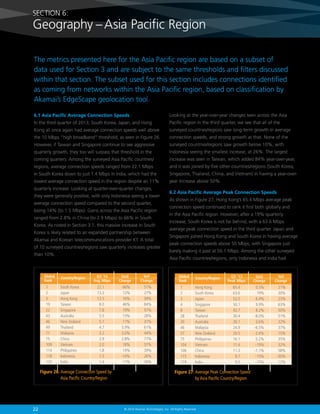
6.1 Asia Pacific Average Connection Speeds	

22

1.1 Attack Traffic, Top Originating Countries	

4

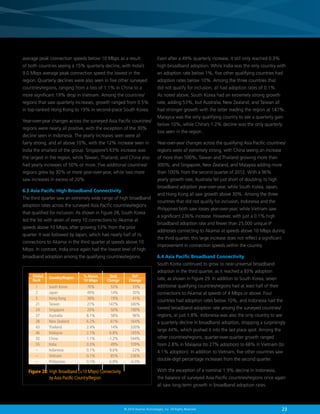
6.2 Asia Pacific Average Peak Connection Speeds	

22

1.2 Attack Traffic, Top Ports	

5

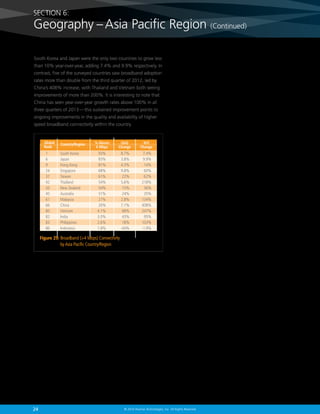
6.3 Asia Pacific High Broadband Connectivity	

23

1.3 Observations on DDoS Attacks	

5

6.4 Asia Pacific Broadband Connectivity	

23

1.4 Ongoing Syrian Electronic Army Attacks	

7

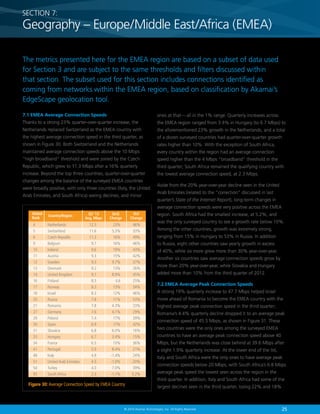
SECTION 7: GEOGRAPHY – EUROPE/MIDDLE EAST/AFRICA

SECTION 2: INTERNET PENETRATION	

9

2.1 Unique IPv4 Addresses	

9

2.2 IPv4 Exhaustion	

9

2.3 IPv6 Adoption	

11

SECTION 3: GEOGRAPHY – GLOBAL	

13

3.1 Global Average Connection Speeds	

13

3.2 Global Average Peak Connection Speeds	

14

3.3 Global High Broadband Connectivity	

15

3.4 Global Broadband Connectivity	

15

SECTION 4: GEOGRAPHY – UNITED STATES	

16

4.1 United States Average Connection Speeds	

16

4.2 United States Average Peak Connection Speeds	

16

4.3 United States High Broadband Connectivity	

17

4.4 United States Broadband Connectivity	

18

SECTION 5: GEOGRAPHY – AMERICAS	

19

5.1 Americas Average Connection Speeds	

19

5.2 Americas Average Peak Connection Speeds	

25

7.2 EMEA Average Peak Connection Speeds	

25

7.3 EMEA High Broadband Connectivity	

26

7.4 EMEA Broadband Connectivity	

27

SECTION 8: MOBILE CONNECTIVITY	

28

8.1 Connection Speeds on Mobile Networks	

28

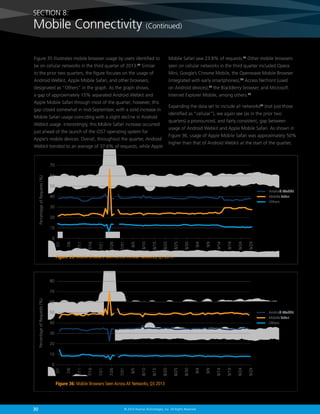
8.2 Mobile Browser Usage Data	

28

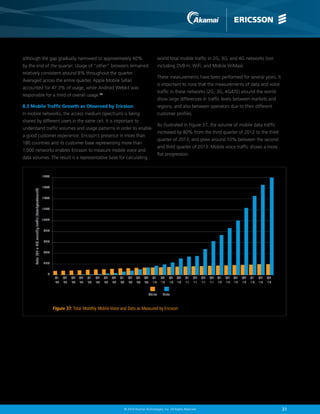
8.3 Mobile Traffic Growth as Observed by Ericsson	

31

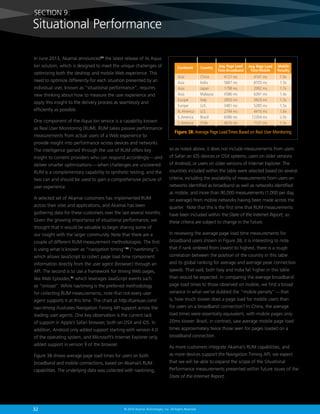
SECTION 9: SITUATIONAL PERFORMANCE	

32

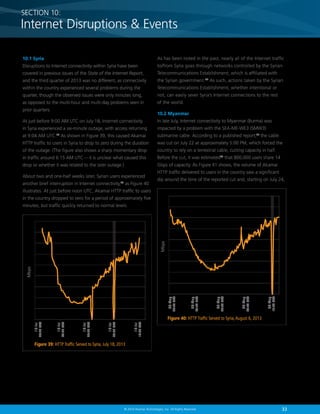
SECTION 10: INTERNET DISRUPTIONS  EVENTS	

33

10.1 Syria	

33

10.2 Myanmar	

33

10.3 Sudan	

34

SECTION 11: APPENDIX	
35

SECTION 12: ENDNOTES	

36

20

5.4 Americas Broadband Connectivity	

7.1 EMEA Average Connection Speeds	

19

5.3 Americas High Broadband Connectivity	

(EMEA)	25

21

© 2014 Akamai Technologies, Inc. All Rights Reserved
Executive Summary
Executive Summary
Akamai’s globally-distributed Intelligent Platform allows us to gather massive amounts
of information on many metrics, including connection speeds, attack traffic, network
connectivity/availability issues, and IPv6 growth/transition progress, as well as traffic
patterns across leading Web properties and digital media providers. Each quarter,
Akamai publishes the State of the Internet Report.
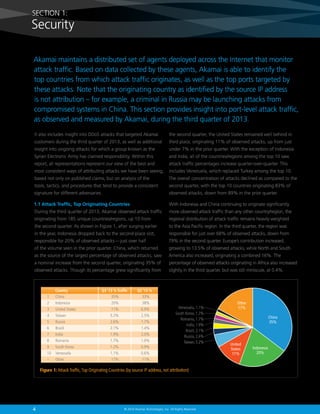
This quarter’s report includes data gathered from across

Internet and Broadband Adoption

the Akamai Intelligent Platform in the third quarter of 2013,

In the third quarter, Akamai observed a 1.1% increase in the

covering attack traffic, Internet connection speeds and

number of unique IPv4 addresses connecting to the Akamai

broadband adoption, and mobile connectivity, as well as

Intelligent Platform, growing to just under 761 million, or about

trends seen in this data over time. In addition, this edition

8 million more than were seen in the second quarter of 2013.

of the report includes insight into ongoing Syrian Electronic

Looking at connection speeds, the global average connection

Army attacks, the states of IPv4 exhaustion and IPv6 adoption,

speed grew 10% to 3.6 Mbps, but the global average peak

Internet disruptions that occurred during the quarter, and

connection speed declined 5.2% to 17.9 Mbps. At a country

observations from Akamai partner Ericsson regarding data and

level, South Korea had the highest average connection speed

voice traffic growth on mobile networks.

at 22.1 Mbps, while Hong Kong continued to have the highest
average peak connection speed at 65.4 Mbps. Globally, high

Security
During the third quarter of 2013, Akamai observed attack
traffic originating from source IP addresses in 185 unique
countries/regions. Note that our methodology captures the
source IP address of an observed attack and cannot determine
attribution of an attacker. China regained the top slot, growing
to 35% of observed attack traffic. After spiking over the last

broadband (10 Mbps) adoption jumped 31% to 19%, and
South Korea remained the country with the highest level of
high broadband adoption, growing to 70%. Global broadband
(4 Mbps) adoption grew 5.8% quarter-over-quarter to 53%,
with South Korea taking the top slot for this metric as well,
with an adoption rate of 93%.

several quarters, Indonesia’s share fell by nearly half, as it

Mobile Connectivity

originated 20% of observed attack traffic during the quarter.

In the third quarter of 2013, average connection speeds on

In addition to China’s increase, the United States also saw

surveyed mobile network providers ranged from a high of 9.5

significant growth in observed attack traffic, responsible for

Mbps down to a low of 0.6 Mbps. Average peak connection

11%. Overall attack traffic concentration across the top 10

speeds ranged from 49.8 Mbps down to 2.4 Mbps. Based on

countries/regions was on par with the second quarter, up

traffic data collected by Ericsson, the volume of mobile data

slightly to 83% of observed attacks. Along with the decline

traffic increased by 80% from the third quarter of 2012 to

in observed attacks originating in Indonesia, the percentage

the third quarter of 2013, and grew around 10% between

of attacks targeting Ports 80 and 443 declined in the second

the second and third quarters of 2013.

quarter as well, accounting for just over 27% combined. Port
445 returned to its position in as the most-targeted port,
growing to 23% of attacks. During the third quarter, Akamai
customers reported being targeted by 281 DDoS attacks,
an 11% reduction from the prior quarter. Enterprise and
Commerce customers together accounted for just over 70%
of the reported attacks. In addition, a group known as the
Syrian Electronic Army continued its attacks, compromising
domain name registrations to redirect traffic away from
legitimate sites.

Analysis of Akamai IO data collected across the third quarter
from a sample of requests to the Akamai Intelligent Platform
indicates that, for users of devices on cellular networks,
just over 50% more requests came from Android Webkitbased browsers than from Apple Mobile Safari, with Webkit
accounting for almost 38% of requests, and less than 24% for
Safari. However, for users of mobile devices across all networks
(not just cellular), Apple Mobile Safari accounted for just over
47% of requests, with Android Webkit approximately twothirds of that, at just over 33% of requests.

© 2014 Akamai Technologies, Inc. All Rights Reserved

3
3
SECTION 1:

Security
Akamai maintains a distributed set of agents deployed across the Internet that monitor
attack traffic. Based on data collected by these agents, Akamai is able to identify the
top countries from which attack traffic originates, as well as the top ports targeted by
these attacks. Note that the originating country as identified by the source IP address
is not attribution – for example, a criminal in Russia may be launching attacks from
compromised systems in China. This section provides insight into port-level attack traffic,
as observed and measured by Akamai, during the third quarter of 2013.
It also includes insight into DDoS attacks that targeted Akamai

the second quarter, the United States remained well behind in

customers during the third quarter of 2013, as well as additional

third place, originating 11% of observed attacks, up from just

insight into ongoing attacks for which a group known as the

under 7% in the prior quarter. With the exception of Indonesia

Syrian Electronic Army has claimed responsibility. Within this

and India, all of the countries/regions among the top 10 saw

report, all representations represent our view of the best and

attack traffic percentages increase quarter-over-quarter. This

most consistent ways of attributing attacks we have been seeing,

includes Venezuela, which replaced Turkey among the top 10.

based not only on published claims, but on analysis of the

The overall concentration of attacks declined as compared to the

tools, tactics, and procedures that tend to provide a consistent

second quarter, with the top 10 countries originating 83% of

signature for different adversaries.

observed attacks, down from 89% in the prior quarter.

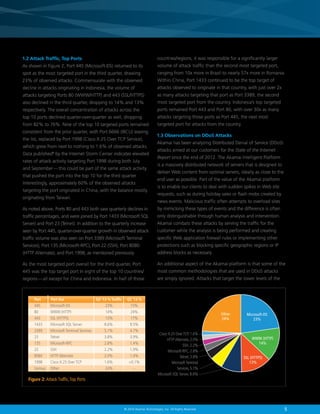
1.1 Attack Traffic, Top Originating Countries

With Indonesia and China continuing to originate significantly

During the third quarter of 2013, Akamai observed attack traffic

more observed attack traffic than any other country/region, the

originating from 185 unique countries/regions, up 10 from

regional distribution of attack traffic remains heavily weighted

the second quarter. As shown in Figure 1, after surging earlier

to the Asia Pacific region. In the third quarter, the region was

in the year, Indonesia dropped back to the second-place slot,

responsible for just over 68% of observed attacks, down from

responsible for 20% of observed attacks — just over half

79% in the second quarter. Europe’s contribution increased,

of the volume seen in the prior quarter. China, which returned

growing to 13.5% of observed attacks, while North and South

as the source of the largest percentage of observed attacks, saw

America also increased, originating a combined 16%. The

a nominal increase from the second quarter, originating 35% of

percentage of observed attacks originating in Africa also increased

observed attacks. Though its percentage grew significantly from

slightly in the third quarter, but was still miniscule, at 0.4%.

Country

1	China	
2	Indonesia	
3	 United States	
4	Taiwan	
5	Russia	
6	Brazil	
7	India	
8	Romania	
9	 South Korea	
10	Venezuela	
–	Other	

Q3 ‘13 % Traffic

35%	
20%	
11%	
5.2%	
2.6%	
2.1%	
1.9%	
1.7%	
1.2%	
1.1%	
17%	

Q2 ‘13 %

33%
38%
6.9%
2.5%
1.7%
1.4%
2.0%
1.0%
0.9%
0.6%
11%

Venezuela, 1.1%
South Korea, 1.2%
Romania, 1.7%
India, 1.9%
Brazil, 2.1%
Russia, 2.6%
Taiwan, 5.2%

Figure 1: Attack Traffic, Top Originating Countries (by source IP address, not attribution)

4

© 2014 Akamai Technologies, Inc. All Rights Reserved

Other
17%
China
35%

United
States
11%

Indonesia
20%
countries/regions, it was responsible for a significantly larger

1.2 Attack Traffic, Top Ports
As shown in Figure 2, Port 445 (Microsoft-DS) returned to its

volume of attack traffic than the second most targeted port,

spot as the most targeted port in the third quarter, drawing

ranging from 10x more in Brazil to nearly 57x more in Romania.

23% of observed attacks. Commensurate with the observed

Within China, Port 1433 continued to be the top target of

decline in attacks originating in Indonesia, the volume of

attacks observed to originate in that country, with just over 2x

attacks targeting Ports 80 (WWW/HTTP) and 443 (SSL/HTTPS)

as many attacks targeting that port as Port 3389, the second

also declined in the third quarter, dropping to 14% and 13%

most targeted port from the country. Indonesia’s top targeted

respectively. The overall concentration of attacks across the

ports remained Port 443 and Port 80, with over 30x as many

top 10 ports declined quarter-over-quarter as well, dropping

attacks targeting those ports as Port 445, the next most

from 82% to 76%. Nine of the top 10 targeted ports remained

targeted port for attacks from the country.

consistent from the prior quarter, with Port 6666 (IRCU) leaving
the list, replaced by Port 1998 (Cisco X.25 Over TCP Service),
which grew from next to nothing to 1.6% of observed attacks.
Data published1 by the Internet Storm Center indicates elevated
rates of attack activity targeting Port 1998 during both July
and September — this could be part of the same attack activity
that pushed the port into the top 10 for the third quarter.
Interestingly, approximately 60% of the observed attacks
targeting the port originated in China, with the balance mostly
originating from Taiwan.

1.3 Observations on DDoS Attacks
Akamai has been analyzing Distributed Denial of Service (DDoS)
attacks aimed at our customers for the State of the Internet
Report since the end of 2012. The Akamai Intelligent Platform
is a massively distributed network of servers that is designed to
deliver Web content from optimal servers, ideally as close to the
end user as possible. Part of the value of the Akamai platform
is to enable our clients to deal with sudden spikes in Web site
requests, such as during holiday sales or flash mobs created by
news events. Malicious traffic often attempts to overload sites

As noted above, Ports 80 and 443 both saw quarterly declines in

by mimicking these types of events and the difference is often

traffic percentages, and were joined by Port 1433 (Microsoft SQL

only distinguishable through human analysis and intervention.

Server) and Port 23 (Telnet). In addition to the quarterly increase

Akamai combats these attacks by serving the traffic for the

seen by Port 445, quarter-over-quarter growth in observed attack

customer while the analysis is being performed and creating

traffic volume was also seen on Port 3389 (Microsoft Terminal

specific Web application firewall rules or implementing other

Services), Port 135 (Microsoft-RPC), Port 22 (SSH), Port 8080

protections such as blocking specific geographic regions or IP

(HTTP Alternate), and Port 1998, as mentioned previously.

address blocks as necessary.

As the most targeted port overall for the third quarter, Port

An additional aspect of the Akamai platform is that some of the

445 was the top target port in eight of the top 10 countries/

most common methodologies that are used in DDoS attacks

regions — all except for China and Indonesia. In half of those

are simply ignored. Attacks that target the lower levels of the

Port

Port Use

445	Microsoft-DS	
80	
WWW (HTTP)	
443	
SSL (HTTPS)	
1433	
Microsoft SQL Server	
3389	
Microsoft Terminal Services	
23	Telnet	
135	Microsoft-RPC	
22	SSH	
8080	
HTTP Alternate	
1998	
Cisco X.25 Over TCP	
Various	Other	

Figure 2: Attack Traffic, Top Ports

Q3 ‘13 % Traffic

Q2 ‘13 %

23%	
15%
14%	
24%
13%	
17%
8.6%	
9.5%
5.1%	
4.7%
3.8%	 3.9%
2.8%	
1.4%
2.2%	 1.9%
2.0%	
1.4%
1.6%	
0.1%
24%	
–

Other
24%
Cisco X.25 Over TCP, 1.6%
HTTP Alternate, 2.0%
SSH, 2.2%
Microsoft-RPC, 2.8%
Telnet, 3.8%
Microsoft Terminal
Services, 5.1%
Microsoft SQL Server, 8.6%

© 2014 Akamai Technologies, Inc. All Rights Reserved

Microsoft-DS
23%

WWW (HTTP)
14%
SSL (HTTPS)
13%

5
SECTION 1:

Security (continued)

350
318
300

281

Americas
165

# of Attacks

250
200

200

208

150

EMEA
45

100
50

Asia Pacific
71

0
Q4 2012

Q1 2013

Q2 2013

Q3 2013

Figure 3: DDoS Attacks Reported by Akamai Customers by Quarter

Figure 4: Q3 2013 DDoS Attacks by Region

TCP/IP stack, such as UDP floods and SYN floods, hit the Akamai

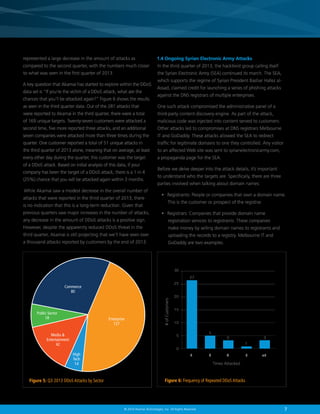
Figure 4 illustrates the distribution of DDoS attack targets by

platform and are dropped. Specifically, Layer 1-4 traffic does

geography. Customers in North America saw only 165 attacks

not contain the information needed by Akamai to route it to

in the third quarter of 2013, an 18% decrease from the previous

a specific customer, and is automatically assumed to be either

quarter. These customers continued to see the majority of the

malicious or malformed traffic.

attack traffic, although it was only 57% of the total attacks

The vast majority of the attacks that Akamai is reporting on
here is related to traffic in layers 5–7 of the TCP stack, such
as volumetric attacks like HTTP GET floods and repeated file
downloads, or application and logical layer attacks, which
require much less traffic to be effective. These statistics are
based on the higher level attacks reported by our customers.

in the third quarter, as opposed to 65% in the second quarter.
Customers in the Asia Pacific region saw 71 attacks this quarter,
representing a modest decrease of 10% from the previous quarter,
but still well above the number of attacks seen in late 2012 and
the first quarter of 2013. In contrast, Europe saw a 22% increase
in attacks over the previous quarter. Overall, the attacks seen in
the third quarter appeared to be targeting customers in European

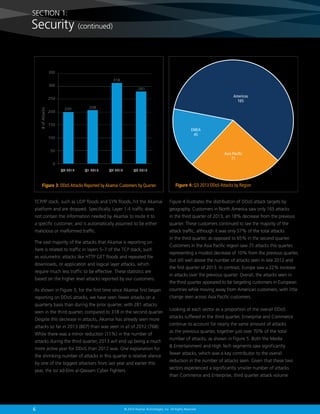
As shown in Figure 3, for the first time since Akamai first began

countries while moving away from American customers, with little

reporting on DDoS attacks, we have seen fewer attacks on a

change seen across Asia Pacific customers.

quarterly basis than during the prior quarter, with 281 attacks
seen in the third quarter, compared to 318 in the second quarter.
Despite this decrease in attacks, Akamai has already seen more
attacks so far in 2013 (807) than was seen in all of 2012 (768).
While there was a minor reduction (11%) in the number of
attacks during the third quarter, 2013 will end up being a much
more active year for DDoS than 2012 was. One explanation for
the shrinking number of attacks in this quarter is relative silence
by one of the biggest attackers from last year and earlier this
year, the Izz ad-Dim al-Qassam Cyber Fighters.

6

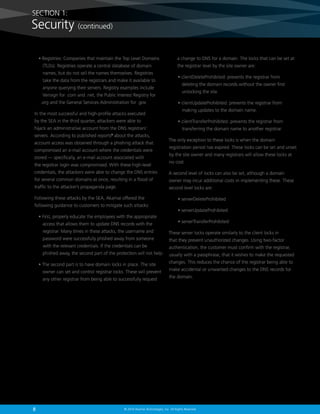
Looking at each sector as a proportion of the overall DDoS
attacks suffered in the third quarter, Enterprise and Commerce
continue to account for nearly the same amount of attacks
as the previous quarter, together just over 70% of the total
number of attacks, as shown in Figure 5. Both the Media
 Entertainment and High Tech segments saw significantly
fewer attacks, which was a key contributor to the overall
reduction in the number of attacks seen. Given that these two
sectors experienced a significantly smaller number of attacks
than Commerce and Enterprise, third quarter attack volume

© 2014 Akamai Technologies, Inc. All Rights Reserved
represented a large decrease in the amount of attacks as

1.4 Ongoing Syrian Electronic Army Attacks

compared to the second quarter, with the numbers much closer

In the third quarter of 2013, the hacktivist group calling itself

to what was seen in the first quarter of 2013.

the Syrian Electronic Army (SEA) continued its march. The SEA,

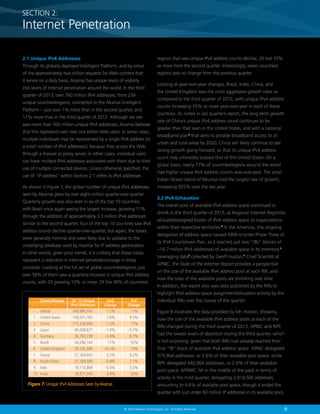
A key question that Akamai has started to explore within the DDoS
data set is ”If you’re the victim of a DDoS attack, what are the
chances that you’ll be attacked again?” Figure 6 shows the results
as seen in the third quarter data. Out of the 281 attacks that

which supports the regime of Syrian President Bashar Hafez alAssad, claimed credit for launching a series of phishing attacks
against the DNS registrars of multiple enterprises.
One such attack compromised the administrative panel of a

were reported to Akamai in the third quarter, there were a total

third-party content discovery engine. As part of the attack,

of 169 unique targets. Twenty-seven customers were attacked a

malicious code was injected into content served to customers.

second time, five more reported three attacks, and an additional

Other attacks led to compromises at DNS registrars Melbourne

seven companies were attacked more than three times during the

IT and GoDaddy. These attacks allowed the SEA to redirect

quarter. One customer reported a total of 51 unique attacks in

traffic for legitimate domains to one they controlled. Any visitor

the third quarter of 2013 alone, meaning that on average, at least

to an affected Web site was sent to syrianelectronicarmy.com,

every other day during the quarter, this customer was the target

a propaganda page for the SEA.

of a DDoS attack. Based on initial analysis of this data, if your
company has been the target of a DDoS attack, there is a 1 in 4
(25%) chance that you will be attacked again within 3 months.
While Akamai saw a modest decrease in the overall number of
attacks that were reported in the third quarter of 2013, there
is no indication that this is a long-term reduction. Given that
previous quarters saw major increases in the number of attacks,

Before we delve deeper into the attack details, it’s important
to understand who the targets are. Specifically, there are three
parties involved when talking about domain names:
•	
Registrants: People or companies that own a domain name.
This is the customer or prospect of the registrar.
•	  egistrars: Companies that provide domain name
R

any decrease in the amount of DDoS attacks is a positive sign.

registration services to registrants. These companies

However, despite the apparently reduced DDoS threat in the

make money by selling domain names to registrants and

third quarter, Akamai is still projecting that we’ll have seen over

uploading the records to a registry. Melbourne IT and

a thousand attacks reported by customers by the end of 2013.

GoDaddy are two examples.

30
27
25

Business
Services
Enterprise
66
127

Public Sector
18 Financial
Services
41
Media 
Entertainment
42

# of Customers

Commerce
80

20
15
10
5

5

3

3
1

0

High
Tech
14

Figure 5: Q3 2013 DDoS Attacks by Sector

2

3

4

5

5

Times Attacked

Figure 6: Frequency of Repeated DDoS Attacks

© 2014 Akamai Technologies, Inc. All Rights Reserved

7
SECTION 1:

Security (continued)
•  egistries: Companies that maintain the Top Level Domains
R
(TLDs). Registries operate a central database of domain
names, but do not sell the names themselves. Registries
take the data from the registrars and make it available to
anyone querying their servers. Registry examples include
Verisign for .com and .net, the Public Interest Registry for
.org and the General Services Administration for .gov.
In the most successful and high-profile attacks executed
by the SEA in the third quarter, attackers were able to
hijack an administrative account from the DNS registrars’
servers. According to published reports2 about the attacks,
account access was obtained through a phishing attack that
compromised an e-mail account where the credentials were
stored — specifically, an e-mail account associated with
the registrar login was compromised. With these high-level
credentials, the attackers were able to change the DNS entries

a change to DNS for a domain. The locks that can be set at
the registrar level by the site owner are:
•  lientDeleteProhibited: prevents the registrar from
c
deleting the domain records without the owner first
unlocking the site.
•  lientUpdateProhibited: prevents the registrar from
c
making updates to the domain name.
•  lientTransferProhibited: prevents the registrar from
c
transferring the domain name to another registrar.
The only exception to these locks is when the domain
registration period has expired. These locks can be set and unset
by the site owner and many registrars will allow these locks at
no cost.
A second level of locks can also be set, although a domain

for several common domains at once, resulting in a flood of

owner may incur additional costs in implementing these. These

traffic to the attacker’s propaganda page.

second level locks are:

Following these attacks by the SEA, Akamai offered the
following guidance to customers to mitigate such attacks:
•  irst, properly educate the employees with the appropriate
F
access that allows them to update DNS records with the

• serverDeleteProhibited
• serverUpdateProhibited
• serverTransferProhibited

registrar. Many times in these attacks, the username and

These server locks operate similarly to the client locks in

password were successfully phished away from someone

that they prevent unauthorized changes. Using two-factor

with the relevant credentials. If the credentials can be

authentication, the customer must confirm with the registrar,

phished away, the second part of the protection will not help.

usually with a passphrase, that it wishes to make the requested

•  he second part is to have domain locks in place. The site
T
owner can set and control registrar locks. These will prevent
any other registrar from being able to successfully request

8

changes. This reduces the chance of the registrar being able to
make accidental or unwanted changes to the DNS records for
the domain.

© 2014 Akamai Technologies, Inc. All Rights Reserved
SECTION 2:

Internet Penetration

2.1 Unique IPv4 Addresses

regions that saw unique IPv4 address counts decline, 26 lost 10%

Through its globally-deployed Intelligent Platform, and by virtue

or more from the second quarter. Interestingly, seven countries/

of the approximately two trillion requests for Web content that

regions saw no change from the previous quarter.

it serves on a daily basis, Akamai has unique levels of visibility
into levels of Internet penetration around the world. In the third
quarter of 2013, over 760 million IPv4 addresses, from 239
unique countries/regions, connected to the Akamai Intelligent
Platform — just over 1% more than in the second quarter, and
11% more than in the third quarter of 2012. Although we see
saw more than 760 million unique IPv4 addresses, Akamai believes
that this represents well over one billion Web users. In some cases,
multiple individuals may be represented by a single IPv4 address (or
a small number of IPv4 addresses), because they access the Web
through a firewall or proxy server; in other cases, individual users
can have multiple IPv4 addresses associated with them due to their
use of multiple connected devices. Unless otherwise specified, the
use of “IP address” within Section 2.1 refers to IPv4 addresses.
As shown in Figure 7, the global number of unique IPv4 addresses
seen by Akamai grew by over eight million quarter-over-quarter.
Quarterly growth was also seen in six of the top 10 countries,
with Brazil once again seeing the largest increase, growing 11%
through the addition of approximately 3.3 million IPv4 addresses.
Similar to the second quarter, four of the top 10 countries saw IPv4
address counts decline quarter-over-quarter, but again, the losses
were generally minimal and were likely due to updates to the
underlying database used by Akamai for IP address geolocation.
In other words, given prior trends, it is unlikely that these losses
represent a reduction in Internet penetration/usage in these
countries. Looking at the full set of global countries/regions, just
over 58% of them saw a quarterly increase in unique IPv4 address
counts, with 33 growing 10% or more. Of the 38% of countries/

Looking at year-over-year changes, Brazil, India, China, and
the United Kingdom saw the most aggressive growth rates as
compared to the third quarter of 2012, with unique IPv4 address
counts increasing 10% or more year-over-year in each of these
countries. As noted in last quarter’s report, the long-term growth
rate of China’s unique IPv4 address count continues to be
greater than that seen in the United States, and with a national
broadband plan3 that aims to provide broadband access to all
urban and rural areas by 2020, China will likely continue to see
strong growth going forward, so that its unique IPv4 address
count may ultimately surpass that of the United States. On a
global basis, nearly 77% of countries/regions around the world
had higher unique IPv4 address counts year-over-year. The small
Indian Ocean island of Réunion had the largest rate of growth,
increasing 925% over the last year.
2.2 IPv4 Exhaustion
The overall pool of available IPv4 address space continued to
shrink in the third quarter of 2013, as Regional Internet Registries
allocated/assigned blocks of IPv4 address space to organizations
within their respective territories.4 In the Americas, this ongoing
delegation of address space caused ARIN to enter Phase Three of
its IPv4 Countdown Plan, as it reached just two “/8s” (blocks of
~16.7 million IPv4 addresses) of available space in its inventory.5
Leveraging data6 collected by Geoff Huston,7 Chief Scientist at
APNIC, the State of the Internet Report provides a perspective
on the size of the available IPv4 address pool at each RIR, and
how the sizes of the available pools are shrinking over time.
In addition, the report also uses data published by the RIRs to
highlight IPv4 address space assignment/allocation activity by the

Country/Region

–	Global	
1	 United States	
2	China	
3	Japan	
4	Germany	
5	Brazil	
6	 United Kingdom	
7	France	
8	 South Korea	
9	Italy	
10	India	

Q3 ’13 Unique
IPv4 Addresses

760,980,743	
158,501,183	
115,336,684	
40,008,677	
36,792,239	
34,298,144	
29,142,389	
27,164,647	
21,169,590	
19,173,868	
18,371,345	

QoQ
Change

YoY
Change

individual RIRs over the course of the quarter.

1.1%	
2.6%	
1.3%	
-1.9%	
-3.4%	
11%	
0.1%	
0.2%	
-0.8%	
-5.0%	
4.9%	

11%
9.3%
17%
-0.7%
0.7%
52%
10%
6.2%
7.1%
5.5%
32%

Figure 8 illustrates the data provided by Mr. Huston, showing

Figure 7: Unique IPv4 Addresses Seen by Akamai

how the size of the available IPv4 address pools at each of the
RIRs changed during the third quarter of 2013. APNIC and RIPE
had the lowest levels of depletion during the third quarter, which
is not surprising, given that both RIRs had already reached their
final “/8” block of available IPv4 address space. APNIC delegated
379,904 addresses, or 2.6% of their available pool space, while
RIPE delegated 440,064 addresses, or 2.9% of their available
pool space. AFRINIC fell in the middle of the pack in terms of
activity in the third quarter, delegating 2,914,560 addresses,
amounting to 4.6% of available pool space, though it ended the
quarter with just under 60 million IP addresses in its available pool,

© 2014 Akamai Technologies, Inc. All Rights Reserved

9
SECTION 2:

Internet Penetration (continued)
70

IPv4 Addresses (Millions)

60
50
AFRINIC
APNIC
ARIN
LACNIC
RIPE

40
30
20
10

30-Sep

23-Sep

16-Sep

2-Sep

26-Aug

19-Aug

12-Aug

5-Aug

29-Jul

22-Jul

15-Jul

8-Jul

1-Jul

0

Figure 8: Available IPv4 Address Pool Size by RIR, Q3 2013
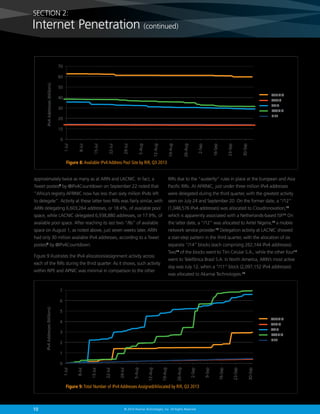
approximately twice as many as at ARIN and LACNIC. In fact, a

RIRs due to the “austerity” rules in place at the European and Asia

Tweet posted8 by @IPv4Countdown on September 22 noted that

Pacific RIRs. At AFRINIC, just under three million IPv4 addresses

“Africa’s registry AFRINIC now has less than sixty million IPv4s left

were delegated during the third quarter, with the greatest activity

to delegate”. Activity at these latter two RIRs was fairly similar, with

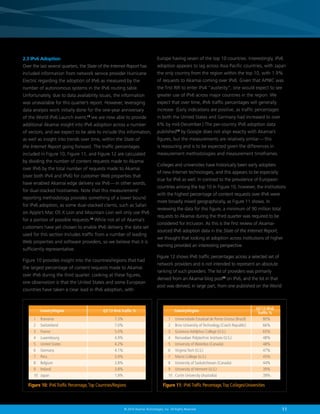
seen on July 24 and September 20. On the former date, a “/12”

ARIN delegating 6,603,264 addresses, or 18.4%, of available pool

(1,048,576 IPv4 addresses) was allocated to CloudInnovation,10

space, while LACNIC delegated 6,938,880 addresses, or 17.9%, of

which is apparently associated with a Netherlands-based ISP.11 On

available pool space. After reaching its last two “/8s” of available

the latter date, a “/12” was allocated to Airtel Nigeria,12 a mobile

space on August 1, as noted above, just seven weeks later, ARIN

network service provider.13 Delegation activity at LACNIC showed

had only 30 million available IPv4 addresses, according to a Tweet

a stair-step pattern in the third quarter, with the allocation of six

posted9 by @IPv4Countdown.

separate “/14” blocks (each comprising 262,144 IPv4 addresses).
Two14 of the blocks went to Tim Celular S.A., while the other four15

Figure 9 illustrates the IPv4 allocation/assignment activity across

went to Telefônica Brasil S.A. In North America, ARIN’s most active

each of the RIRs during the third quarter. As it shows, such activity

day was July 12, when a “/11” block (2,097,152 IPv4 addresses)

within RIPE and APNIC was minimal in comparison to the other

was allocated to Akamai Technologies.16

7

IPv4 Addresses (Millions)

6
5
AFRINIC
APNIC
ARIN
LACNIC
RIPE

4
3
2
1

Figure 9: Total Number of IPv4 Addresses Assigned/Allocated by RIR, Q3 2013

10

© 2014 Akamai Technologies, Inc. All Rights Reserved

30-Sep

23-Sep

16-Sep

9-Sep

2-Sep

26-Aug

19-Aug

12-Aug

5-Aug

29-Jul

22-Jul

15-Jul

8-Jul

1-Jul

0
2.3 IPv6 Adoption

Europe having seven of the top 10 countries. Interestingly, IPv6

Over the last several quarters, the State of the Internet Report has

adoption appears to lag across Asia Pacific countries, with Japan

included information from network service provider Hurricane

the only country from the region within the top 10, with 1.9%

Electric regarding the adoption of IPv6 as measured by the

of requests to Akamai coming over IPv6. Given that APNIC was

number of autonomous systems in the IPv6 routing table.

the first RIR to enter IPv4 “austerity”, one would expect to see

Unfortunately, due to data availability issues, the information

greater use of IPv6 across major countries in the region. We

was unavailable for this quarter’s report. However, leveraging

expect that over time, IPv6 traffic percentages will generally

data analysis work initially done for the one-year anniversary

increase. (Early indications are positive, as traffic percentages

of the World IPv6 Launch event,17 we are now able to provide

in both the United States and Germany had increased to over

additional Akamai insight into IPv6 adoption across a number

6% by mid-December.) The per-country IPv6 adoption data

of vectors, and we expect to be able to include this information,

published19 by Google does not align exactly with Akamai’s

as well as insight into trends over time, within the State of

figures, but the measurements are relatively similar — this

the Internet Report going forward. The traffic percentages

is reassuring and is to be expected given the differences in

included in Figure 10, Figure 11, and Figure 12 are calculated

measurement methodologies and measurement timeframes.

by dividing the number of content requests made to Akamai
over IPv6 by the total number of requests made to Akamai
(over both IPv4 and IPv6) for customer Web properties that
have enabled Akamai edge delivery via IPv6 — in other words,
for dual-stacked hostnames. Note that this measurement/
reporting methodology provides something of a lower bound
for IPv6 adoption, as some dual-stacked clients, such as Safari
on Apple’s Mac OS X Lion and Mountain Lion will only use IPv6
for a portion of possible requests.18 While not all of Akamai’s
customers have yet chosen to enable IPv6 delivery, the data set
used for this section includes traffic from a number of leading
Web properties and software providers, so we believe that it is
sufficiently representative.
Figure 10 provides insight into the countries/regions that had
the largest percentage of content requests made to Akamai
over IPv6 during the third quarter. Looking at these figures,
one observation is that the United States and some European
countries have taken a clear lead in IPv6 adoption, with

Country/Region

1	Romania	
2	Switzerland	
3	France	
4	Luxembourg	
5	 United States	
6	Germany	
7	Peru	
8	Belgium	
9	Ireland	
10	Japan	

Colleges and universities have historically been early adopters
of new Internet technologies, and this appears to be especially
true for IPv6 as well. In contrast to the prevalence of European
countries among the top 10 in Figure 10, however, the institutions
with the highest percentage of content requests over IPv6 were
more broadly mixed geographically, as Figure 11 shows. In
reviewing the data for this figure, a minimum of 90 million total
requests to Akamai during the third quarter was required to be
considered for inclusion. As this is the first review of Akamaisourced IPv6 adoption data in the State of the Internet Report,
we thought that looking at adoption across institutions of higher
learning provided an interesting perspective.
Figure 12 shows IPv6 traffic percentages across a selected set of
network providers and is not intended to represent an absolute
ranking of such providers. The list of providers was primarily
derived from an Akamai blog post20 on IPv6, and the list in that
post was derived, in large part, from one published on the World

Country/Region

Q3’13 IPv6 Traffic %

7.3%
7.0%
5.0%
4.9%
4.2%
4.1%
3.9%
3.8%
3.8%
1.9%

1	
2	
3	
4	
5	
6	
7	
8	
9	
10	

Figure 10: IPv6 Traffic Percentage, Top Countries/Regions

Universidade Estadual de Ponta Grossa (Brazil)	
Brno University of Technology (Czech Republic)	
Gustavus Adolphus College (U.S.)	
Rensselaer Polytechnic Institute (U.S.)	
University of Waterloo (Canada)	
Virginia Tech (U.S.)	
Marist College (U.S.)	
University of Saskatchewan (Canada)	
University of Vermont (U.S.)	
Curtin University (Australia)	

Q3’13 IPv6
Traffic %

80%
66%
65%
48%
48%
47%
45%
44%
39%
39%

Figure 11: IPv6 Traffic Percentage, Top Colleges/Universities

© 2014 Akamai Technologies, Inc. All Rights Reserved

11
SECTION 2:

Internet Penetration (continued)
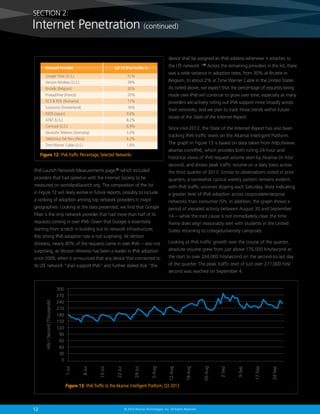
device shall be assigned an IPv6 address whenever it attaches to
Network Provider

the LTE network.”22 Across the remaining providers in the list, there

Q3’13 IPv6 Traffic %

Google Fiber (U.S.)	
Verizon Wireless (U.S.)	
Brutele (Belgium)	
Proxad/Free (France)	
RCS  RDS (Romania)	
Swisscom (Switzerland)	
KDDI (Japan)	
ATT (U.S.)	
Comcast (U.S.)	
Deutsche Telekom (Germany)	
Telefonica Del Peru (Peru)	
Time Warner Cable (U.S.)	

was a wide variance in adoption rates, from 30% at Brutele in

51%
39%
30%
20%
17%
16%
9.6%
8.2%
6.9%
5.0%
4.2%
1.8%

Belgium, to about 2% at Time Warner Cable in the United States.
As noted above, we expect that the percentage of requests being
made over IPv6 will continue to grow over time, especially as many
providers are actively rolling out IPv6 support more broadly across
their networks, and we plan to track those trends within future
issues of the State of the Internet Report.
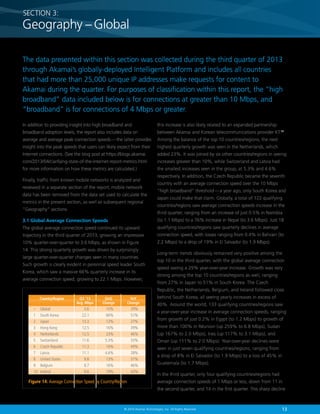
Since mid-2012, the State of the Internet Report has also been
tracking IPv6 traffic levels on the Akamai Intelligent Platform.
The graph in Figure 13 is based on data taken from http://www.
akamai.com/IPv6, which provides both rolling 24-hour and

Figure 12: IPv6 Traffic Percentage, Selected Networks

historical views of IPv6 request volume seen by Akamai (in hits/
second), and shows peak traffic volume on a daily basis across

IPv6 Launch Network Measurements page,21 which included

the third quarter of 2013. Similar to observations noted in prior

providers that had opted-in with the Internet Society to be

quarters, a somewhat cyclical weekly pattern remains evident,

measured on worldipv6launch.org. The composition of the list

with IPv6 traffic volumes dipping each Saturday, likely indicating

in Figure 12 will likely evolve in future reports, possibly to include

a greater level of IPv6 adoption across corporate/enterprise

a ranking of adoption among top network providers in major

networks than consumer ISPs. In addition, the graph shows a

geographies. Looking at the data presented, we find that Google

period of elevated activity between August 30 and September

Fiber is the only network provider that had more than half of its

14 — while the root cause is not immediately clear, the time

requests coming in over IPv6. Given that Google is essentially

frame does align reasonably well with students in the United

starting from scratch in building out its network infrastructure,

States returning to college/university campuses.

this strong IPv6 adoption rate is not surprising. At Verizon
Wireless, nearly 40% of the requests came in over IPv6 — also not

Looking at IPv6 traffic growth over the course of the quarter,

surprising, as Verizon Wireless has been a leader in IPv6 adoption

absolute volume grew from just above 176,000 hits/second at

since 2009, when it announced that any device that connected to

the start to over 244,000 hits/second on the second-to-last day

its LTE network “shall support IPv6” and further stated that “the

of the quarter. The peak traffic level of just over 277,000 hits/

Figure 13: IPv6 Traffic to the Akamai Intelligent Platform, Q3 2013

12

© 2014 Akamai Technologies, Inc. All Rights Reserved

24-Sep

17-Sep

9-Sep

2-Sep

26-Aug

19-Aug

12-Aug

5-Aug

29-Jul

22-Jul

15-Jul

8-Jul

300
270
240
210
180
150
120
90
60
60
30
0
1-Jul

Hits / Second (Thousands)

second was reached on September 4.
SECTION 3:

Geography – Global
The data presented within this section was collected during the third quarter of 2013
through Akamai’s globally-deployed Intelligent Platform and includes all countries
that had more than 25,000 unique IP addresses make requests for content to
Akamai during the quarter. For purposes of classification within this report, the “high
broadband” data included below is for connections at greater than 10 Mbps, and
“broadband” is for connections of 4 Mbps or greater.
In addition to providing insight into high broadband and

this increase is also likely related to an expanded partnership

broadband adoption levels, the report also includes data on

between Akamai and Korean telecommunications provider KT.23

average and average peak connection speeds — the latter provides

Among the balance of the top 10 countries/regions, the next

insight into the peak speeds that users can likely expect from their

highest quarterly growth was seen in the Netherlands, which

Internet connections. (See the blog post at https://blogs.akamai.

added 23%. It was joined by six other countries/regions in seeing

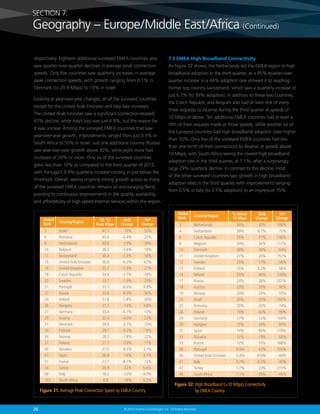
com/2013/04/clarifying-state-of-the-internet-report-metrics.html

increases greater than 10%, while Switzerland and Latvia had

for more information on how these metrics are calculated.)

the smallest increases seen in the group, at 5.3% and 4.6%

Finally, traffic from known mobile networks is analyzed and
reviewed in a separate section of the report; mobile network
data has been removed from the data set used to calculate the
metrics in the present section, as well as subsequent regional
“Geography” sections.

respectively. In addition, the Czech Republic became the seventh
country with an average connection speed over the 10 Mbps
“high broadband” threshold — a year ago, only South Korea and
Japan could make that claim. Globally, a total of 122 qualifying
countries/regions saw average connection speeds increase in the
third quarter, ranging from an increase of just 0.5% in Namibia

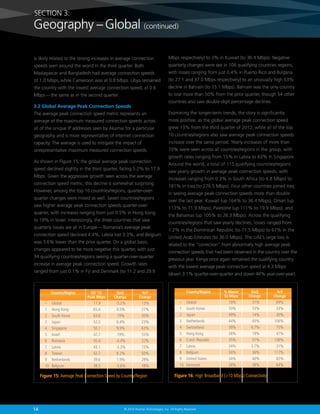
3.1 Global Average Connection Speeds

(to 1.1 Mbps) to a 76% increase in Nepal (to 3.6 Mbps). Just 18

The global average connection speed continued its upward

qualifying countries/regions saw quarterly declines in average

trajectory in the third quarter of 2013, growing an impressive

connection speed, with losses ranging from 0.4% in Bahrain (to

10% quarter-over-quarter to 3.6 Mbps, as shown in Figure

2.2 Mbps) to a drop of 19% in El Salvador (to 1.9 Mbps).

14. This strong quarterly growth was driven by surprisingly
large quarter-over-quarter changes seen in many countries.
Such growth is clearly evident in perennial speed leader South
Korea, which saw a massive 66% quarterly increase in its
average connection speed, growing to 22.1 Mbps. However,

Long-term trends obviously remained very positive among the
top 10 in the third quarter, with the global average connection
speed seeing a 29% year-over-year increase. Growth was very
strong among the top 10 countries/regions as well, ranging
from 27% in Japan to 51% in South Korea. The Czech
Republic, the Netherlands, Belgium, and Ireland followed close

Country/Region

Q3 ’13
Avg. Mbps

–	Global	
1	 South Korea	
2	Japan	
3	 Hong Kong	
4	Netherlands	
5	Switzerland	
6	 Czech Republic	
7	Latvia	
8	 United States	
9	Belgium	
10	Ireland	

3.6	
22.1	
13.3	
12.5	
12.5	
11.6	
11.3	
11.1	
9.8	
9.7	
9.6	

QoQ
Change

YoY
Change

10%	
66%	
12%	
16%	
23%	
5.3%	
16%	
4.6%	
13%	
16%	
19%	

29%
51%
27%
39%
46%
33%
49%
28%
31%
46%
43%

Figure 14: Average Connection Speed by Country/Region

behind South Korea, all seeing yearly increases in excess of
40%. Around the world, 133 qualifying countries/regions saw
a year-over-year increase in average connection speeds, ranging
from growth of just 0.2% in Egypt (to 1.2 Mbps) to growth of
more than 100% in Réunion (up 259% to 6.8 Mbps), Sudan
(up 167% to 2.0 Mbps), Iraq (up 117% to 3.1 Mbps), and
Oman (up 111% to 2.0 Mbps). Year-over-year declines were
seen in just seven qualifying countries/regions, ranging from
a drop of 8% in El Salvador (to 1.9 Mbps) to a loss of 45% in
Guatemala (to 1.7 Mbps).
In the third quarter, only four qualifying countries/regions had
average connection speeds of 1 Mbps or less, down from 11 in
the second quarter, and 14 in the first quarter. This sharp decline

© 2014 Akamai Technologies, Inc. All Rights Reserved

13
SECTION 3:

Geography – Global (continued)
is likely related to the strong increases in average connection

Mbps respectively) to 3% in Kuwait (to 36.4 Mbps). Negative

speeds seen around the world in the third quarter. Both

quarterly changes were see in 106 qualifying countries regions,

Madagascar and Bangladesh had average connection speeds

with losses ranging from just 0.4% in Puerto Rico and Bulgaria

of 1.0 Mbps, while Cameroon was at 0.8 Mbps. Libya remained

(to 27.1 and 37.0 Mbps respectively) to an unusually high 63%

the country with the lowest average connection speed, at 0.6

decline in Bahrain (to 15.1 Mbps). Bahrain was the only country

Mbps — the same as in the second quarter.

to lose more than 50% from the prior quarter, though 54 other
countries also saw double-digit percentage declines.

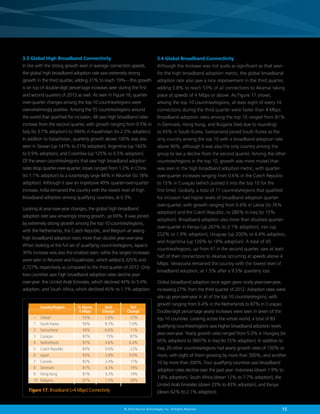
3.2 Global Average Peak Connection Speeds
The average peak connection speed metric represents an

Examining the longer-term trends, the story is significantly

average of the maximum measured connection speeds across

more positive, as the global average peak connection speed

all of the unique IP addresses seen by Akamai for a particular

grew 13% from the third quarter of 2012, while all of the top

geography and is more representative of Internet connection

10 countries/regions also saw average peak connection speeds

capacity. The average is used to mitigate the impact of

increase over the same period. Yearly increases of more than

unrepresentative maximum measured connection speeds.

10% were seen across all countries/regions in the group, with

As shown in Figure 15, the global average peak connection
speed declined slightly in the third quarter, falling 5.2% to 17.9
Mbps. Given the aggressive growth seen across the average
connection speed metric, this decline is somewhat surprising.
However, among the top 10 countries/regions, quarter-overquarter changes were mixed as well. Seven countries/regions
saw higher average peak connection speeds quarter-overquarter, with increases ranging from just 0.5% in Hong Kong
to 19% in Israel. Interestingly, the three countries that saw
quarterly losses are all in Europe — Romania’s average peak
connection speed declined 4.4%, Latvia lost 3.3%, and Belgium
was 3.6% lower than the prior quarter. On a global basis,
changes appeared to be more negative this quarter, with just
34 qualifying countries/regions seeing a quarter-over-quarter
increase in average peak connection speed. Growth rates
ranged from just 0.1% in Fiji and Denmark (to 11.2 and 29.9

Country/Region

Q3 ’13
Peak Mbps

–	Global	
1	 Hong Kong	
2	 South Korea	
3	Japan	
4	Singapore	
5	Israel	
6	Romania	
7	Latvia	
8	Taiwan	
9	Netherlands	
10	Belgium	

17.9	
65.4	
63.6	
52.0	
50.1	
47.7	
45.4	
43.1	
42.7	
39.6	
38.5	

QoQ
Change

-5.2%	
0.5%	
19%	
6.4%	
9.9%	
19%	
-4.4%	
-3.3%	
8.2%	
1.9%	
-3.6%	

YoY
Change

13%
21%
30%
23%
63%
55%
22%
15%
50%
29%
18%

Figure 15: Average Peak Connection Speed by Country/Region

14

growth rates ranging from 15% in Latvia to 63% in Singapore.
Around the world, a total of 115 qualifying countries/regions
saw yearly growth in average peak connection speeds, with
increases ranging from 0.3% in South Africa (to 6.8 Mbps) to
181% in Iraq (to 276.5 Mbps). Four other countries joined Iraq
in seeing average peak connection speeds more than double
over the last year: Kuwait (up 164% to 36.4 Mbps), Oman (up
113% to 11.9 Mbps), Palestine (up 111% to 19.9 Mbps), and
the Bahamas (up 105% to 26.3 Mbps). Across the qualifying
countries/regions that saw yearly declines, losses ranged from
1.2% in the Dominican Republic (to 11.5 Mbps) to 67% in the
United Arab Emirates (to 36.0 Mbps). The UAE’s large loss is
related to the “correction” from abnormally high average peak
connection speeds that had been observed in the country over the
previous year. Kenya once again remained the qualifying country
with the lowest average peak connection speed at 4.3 Mbps
(down 3.1% quarter-over-quarter and down 44% year-over-year).

Country/Region

–	Global	
1	 South Korea	
2	Japan	
3	Netherlands	
4	Switzerland	
5	 Hong Kong	
6	 Czech Republic	
7	Latvia	
8	Belgium	
9	 United States	
10	Denmark	

% Above
10 Mbps

19%	
70%	
49%	
44%	
39%	
38%	
35%	
34%	
34%	
34%	
28%	

QoQ
Change

31%	
53%	
14%	
45%	
6.7%	
19%	
31%	
3.7%	
36%	
40%	
38%	

Figure 16: High Broadband (10 Mbps) Connectivity

© 2014 Akamai Technologies, Inc. All Rights Reserved

YoY
Change

69%
33%
30%
106%
75%
41%
136%
31%
117%
82%
64%
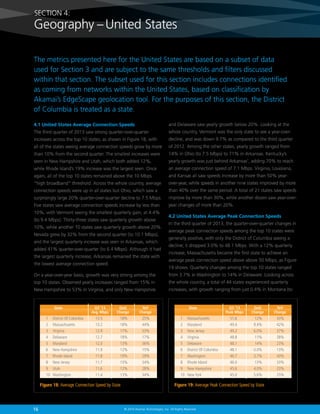
3.3 Global High Broadband Connectivity

3.4 Global Broadband Connectivity

In line with the strong growth seen in average connection speeds,

Although the increase was not quite as significant as that seen

the global high broadband adoption rate saw extremely strong

for the high broadband adoption metric, the global broadband

growth in the third quarter, adding 31% to reach 19%—this growth

adoption rate also saw a nice improvement in the third quarter,

is on top of double-digit percentage increases seen during the first

adding 5.8% to reach 53% of all connections to Akamai taking

and second quarters of 2013 as well. As seen in Figure 16, quarter-

place at speeds of 4 Mbps or above. As Figure 17 shows,

over-quarter changes among the top 10 countries/regions were

among the top 10 countries/regions, at least eight of every 10

overwhelmingly positive. Among the 55 countries/regions around

connections during the third quarter were faster than 4 Mbps.

the world that qualified for inclusion, 48 saw high broadband rates

Broadband adoption rates among the top 10 ranged from 81%

increase from the second quarter, with growth ranging from 0.5% in

in Denmark, Hong Kong, and Bulgaria (tied due to rounding)

Italy (to 3.7% adoption) to 394% in Kazakhstan (to 2.3% adoption).

to 93% in South Korea. Switzerland joined South Korea as the

In addition to Kazakhstan, quarterly growth above 100% was also

only country among the top 10 with a broadband adoption rate

seen in Taiwan (up 147% to 21% adoption), Argentina (up 142%

above 90%, although it was also the only country among the

to 0.9% adoption), and Colombia (up 125% to 0.5% adoption).

group to see a decline from the second quarter. Among the other

Of the seven countries/regions that saw high broadband adoption

countries/regions in the top 10, growth was more muted than

rates drop quarter-over-quarter, losses ranged from 1.2% in China

was seen in the high broadband adoption metric, with quarter-

(to 1.1% adoption) to a surprisingly large 44% in Réunion (to 18%

over-quarter increases ranging from 0.6% in the Czech Republic

adoption). Although it saw an impressive 49% quarter-over-quarter

to 15% in Curaçao (which pushed it into the top 10 for the

increase, India remained the country with the lowest level of high

first time). Globally, a total of 71 countries/regions that qualified

broadband adoption among qualifying countries, at 0.3%.

for inclusion had higher levels of broadband adoption quarter-

Looking at year-over-year changes, the global high broadband
adoption rate saw amazingly strong growth, up 69%. It was joined
by extremely strong growth among the top 10 countries/regions,
with the Netherlands, the Czech Republic, and Belgium all seeing
high broadband adoption rates more than double year-over-year.
When looking at the full set of qualifying countries/regions, Japan’s
30% increase was also the smallest seen, while the largest increases
were seen in Réunion and Kazakhstan, which added 6,325% and
2,727% respectively as compared to the third quarter of 2012. Only
two countries saw high broadband adoption rates decline year-

over-quarter, with growth ranging from 0.6% in Latvia (to 76%
adoption) and the Czech Republic, to 280% in Iraq (to 15%
adoption). Broadband adoption also more than doubled quarterover-quarter in Kenya (up 267% to 2.1% adoption), Iran (up
252% to 1.9% adoption), Uruguay (up 200% to 4.4% adoption,
and Argentina (up 120% to 18% adoption). A total of 45
countries/regions, up from 41 in the second quarter, saw at least
half of their connections to Akamai occurring at speeds above 4
Mbps. Venezuela remained the country with the lowest level of
broadband adoption, at 1.5% after a 9.5% quarterly loss.

over-year: the United Arab Emirates, which declined 44% to 5.4%

Global broadband adoption once again grew nicely year-over-year,

adoption, and South Africa, which declined 45% to 1.1% adoption.

increasing 27% from the third quarter of 2012. Adoption rates were
also up year-over-year in all of the top 10 countries/regions, with

Country/Region

–	Global	
1	 South Korea	
2	Switzerland	
3	Curaçao	
4	Netherlands	
5	 Czech Republic	
6	Japan	
7	Canada	
8	Denmark	
9	 Hong Kong	
10	Bulgaria	

% Above
4 Mbps

53%	
93%	
90%	
87%	
87%	
83%	
83%	
82%	
81%	
81%	
81%	

QoQ
Change

5.8%	
8.7%	
-0.6%	
15%	
4.6%	
0.6%	
3.8%	
2.4%	
6.3%	
4.3%	
7.3%	

Figure 17: Broadband (4 Mbps) Connectivity

YoY
Change

27%
7.4%
11%
87%
6.4%
22%
9.9%
17%
19%
14%
38%

growth ranging from 6.4% in the Netherlands to 87% in Curaçao.
Double-digit percentage yearly increases were seen in seven of the
top 10 countries. Looking across the whole world, a total of 83
qualifying countries/regions saw higher broadband adoption levels
year-over-year. Yearly growth rates ranged from 5.3% in Hungary (to
65% adoption) to 3607% in Iraq (to 15% adoption). In addition to
Iraq, 26 other countries/regions had yearly growth rates of 100% or
more, with eight of them growing by more than 500%, and another
10 by more than 200%. Four qualifying countries saw broadband
adoption rates decline over the past year: Indonesia (down 1.9% to
1.8% adoption), South Africa (down 12% to 7.7% adoption), the
United Arab Emirates (down 23% to 43% adoption), and Kenya
(down 62% to 2.1% adoption).

© 2014 Akamai Technologies, Inc. All Rights Reserved

15
SECTION 4:

Geography – United States
The metrics presented here for the United States are based on a subset of data
used for Section 3 and are subject to the same thresholds and filters discussed
within that section. The subset used for this section includes connections identified
as coming from networks within the United States, based on classification by
Akamai’s EdgeScape geolocation tool. For the purposes of this section, the District
of Columbia is treated as a state.
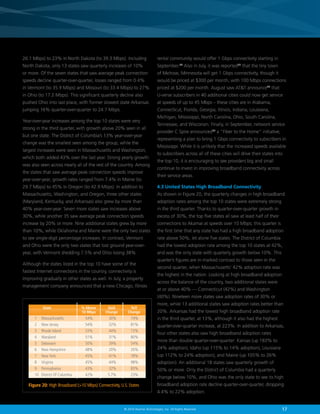
4.1 United States Average Connection Speeds

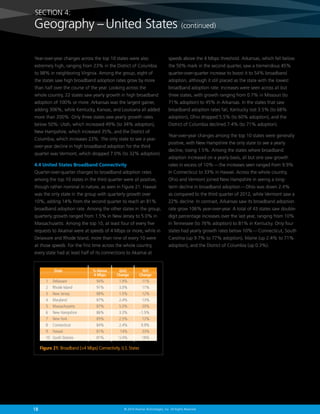
and Delaware saw yearly growth below 20%. Looking at the

The third quarter of 2013 saw strong quarter-over-quarter

whole country, Vermont was the only state to see a year-over-

increases across the top 10 states, as shown in Figure 18, with

decline, and was down 9.7% as compared to the third quarter

all of the states seeing average connection speeds grow by more

of 2012. Among the other states, yearly growth ranged from

than 10% from the second quarter. The smallest increases were

14% in Ohio (to 7.5 Mbps) to 71% in Arkansas. Kentucky’s

seen in New Hampshire and Utah, which both added 12%,

yearly growth was just behind Arkansas’, adding 70% to reach

while Rhode Island’s 19% increase was the largest seen. Once

an average connection speed of 7.1 Mbps. Virginia, Louisiana,

again, all of the top 10 states remained above the 10 Mbps

and Kansas all saw speeds increase by more than 50% year-

“high broadband” threshold. Across the whole country, average

over-year, while speeds in another nine states improved by more

connection speeds were up in all states but Ohio, which saw a

than 40% over the same period. A total of 21 states saw speeds

surprisingly large 20% quarter-over-quarter decline to 7.5 Mbps.

improve by more than 30%, while another dozen saw year-over-

Five states saw average connection speeds increase by less than

year changes of more than 20%.

10%, with Vermont seeing the smallest quarterly gain, at 4.4%
(to 9.4 Mbps). Thirty-three states saw quarterly growth above
10%, while another 10 states saw quarterly growth above 20%.
Nevada grew by 32% from the second quarter (to 10.1 Mbps),
and the largest quarterly increase was seen in Arkansas, which
added 41% quarter-over-quarter (to 6.4 Mbps). Although it had
the largest quarterly increase, Arkansas remained the state with
the lowest average connection speed.

4.2 United States Average Peak Connection Speeds
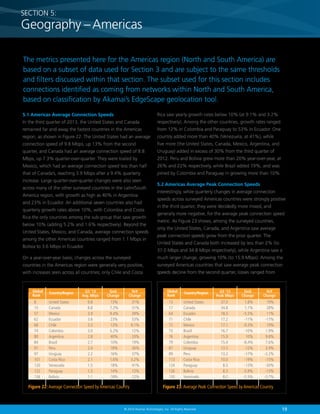
In the third quarter of 2013, the quarter-over-quarter changes in
average peak connection speeds among the top 10 states were
generally positive, with only the District of Columbia seeing a
decline; it dropped 3.0% to 48.1 Mbps. With a 12% quarterly
increase, Massachusetts became the first state to achieve an
average peak connection speed above above 50 Mbps, as Figure
19 shows. Quarterly changes among the top 10 states ranged

On a year-over-year basis, growth was very strong among the

from 3.7% in Washington to 14% in Delaware. Looking across

top 10 states. Observed yearly increases ranged from 15% in

the whole country, a total of 44 states experienced quarterly

New Hampshire to 53% in Virginia, and only New Hampshire

increases, with growth ranging from just 0.4% in Montana (to

State

1	 District Of Columbia	
2	Massachusetts	
3	Virginia	
4	Delaware	
5	Maryland	
6	 New Hampshire	
7	 Rhode Island	
8	 New Jersey	
9	Utah	
10	Washington	

Q3 ’13
Avg. Mbps

13.5	
13.2	
12.9	
12.7	
12.0	
11.9	
11.8	
11.7	
11.6	
11.4	

QoQ
Change

18%	
18%	
17%	
18%	
13%	
12%	
19%	
15%	
12%	
13%	

Figure 18: Average Connection Speed by State

16

YoY
Change

25%
44%
53%
17%
36%
15%
29%
34%
28%
34%

State

1	Massachusetts	
2	Maryland	
3	 New Jersey	
4	Virginia	
5	Delaware	
6	 District Of Columbia	
7	Washington	
8	 Rhode Island	
9	 New Hampshire	
10	 New York	

Q3 ’13
Peak Mbps

51.6	
49.4	
49.2	
48.8	
48.1	
48.1	
46.7	
46.0	
45.6	
45.0	

QoQ
Change

12%	
9.4%	
6.0%	
11%	
14%	
-3.0%	
3.7%	
13%	
4.0%	
5.6%	

Figure 19: Average Peak Connection Speed by State

© 2014 Akamai Technologies, Inc. All Rights Reserved

YoY
Change

43%
42%
37%
38%
23%
13%
43%
33%
23%
25%
26.1 Mbps) to 23% in North Dakota (to 39.3 Mbps). Including

rental community would offer 1 Gbps connectivity starting in

North Dakota, only 13 states saw quarterly increases of 10%

September.24 Also in July, it was reported25 that the tiny town

or more. Of the seven states that saw average peak connection

of Melrose, Minnesota will get 1 Gbps connectivity, though it

speeds decline quarter-over-quarter, losses ranged from 0.4%

would be priced at $300 per month, with 100 Mbps connections

in Vermont (to 35.9 Mbps) and Missouri (to 33.4 Mbps) to 27%

priced at $200 per month. August saw ATT announce26 that

in Ohio (to 17.2 Mbps). This significant quarterly decline also

U-verse subscribers in 40 additional cities could now get service

pushed Ohio into last place, with former slowest state Arkansas

at speeds of up to 45 Mbps – these cities are in Alabama,

jumping 16% quarter-over-quarter to 24.7 Mbps.

Connecticut, Florida, Georgia, Illinois, Indiana, Louisiana,

Year-over-year increases among the top 10 states were very
strong in the third quarter, with growth above 20% seen in all
but one state. The District of Columbia’s 13% year-over-year
change was the smallest seen among the group, while the
largest increases were seen in Massachusetts and Washington,
which both added 43% over the last year. Strong yearly growth
was also seen across nearly all of the rest of the country. Among
the states that saw average peak connection speeds improve
year-over-year, growth rates ranged from 7.4% in Maine (to

Michigan, Mississippi, North Carolina, Ohio, South Carolina,
Tennessee, and Wisconsin. Finally, in September, network service
provider C Spire announced27 a “Fiber to the Home” initiative,
representing a plan to bring 1 Gbps connectivity to subscribers in
Mississippi. While it is unlikely that the increased speeds available
to subscribers across all of these cities will drive their states into
the top 10, it is encouraging to see providers big and small
continue to invest in improving broadband connectivity across
their service areas.

29.7 Mbps) to 45% in Oregon (to 42.9 Mbps). In addition to

4.3 United States High Broadband Connectivity

Massachusetts, Washington, and Oregon, three other states

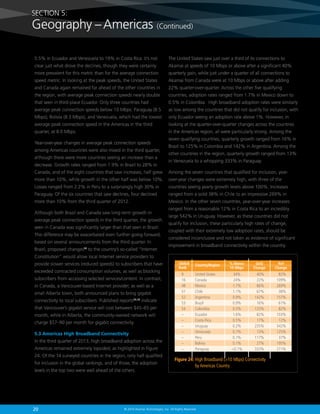
As shown in Figure 20, the quarterly changes in high broadband

(Maryland, Kentucky, and Arkansas) also grew by more than

adoption rates among the top 10 states were extremely strong

40% year-over-year. Seven more states saw increases above

in the third quarter. Thanks to quarter-over-quarter growth in

30%, while another 35 saw average peak connection speeds

excess of 30%, the top five states all saw at least half of their

increase by 20% or more. Nine additional states grew by more

connections to Akamai at speeds over 10 Mbps; this quarter is

than 10%, while Oklahoma and Maine were the only two states

the first time that any state has had a high broadband adoption

to see single-digit percentage increases. In contrast, Vermont

rate above 50%, let alone five states. The District of Columbia

and Ohio were the only two states that lost ground year-over-

had the lowest adoption rate among the top 10 states at 42%,

year, with Vermont shedding 7.5% and Ohio losing 38%.

and was the only state with quarterly growth below 10%. This

Although the states listed in the top 10 have some of the
fastest Internet connections in the country, connectivity is
improving gradually in other states as well. In July, a property
management company announced that a new Chicago, Illinois

quarter’s figures are in marked contrast to those seen in the
second quarter, when Massachusetts’ 42% adoption rate was
the highest in the nation. Looking at high broadband adoption
across the balance of the country, two additional states were
at or above 40% — Connecticut (42%) and Washington
(40%). Nineteen more states saw adoption rates of 30% or

State

1	Massachusetts	
2	 New Jersey	
3	 Rhode Island	
4	Maryland	
5	Delaware	
6	 New Hampshire	
7	 New York	
8	Virginia	
9	Pennsylvania	
10	 District Of Columbia	

% Above
10 Mbps

54%	
54%	
53%	
51%	
50%	
48%	
45%	
45%	
43%	
42%	

QoQ
Change

30%	
32%	
44%	
31%	
39%	
20%	
41%	
44%	
32%	
5.7%	

YoY
Change

74%
81%
72%
80%
54%
35%
78%
98%
83%
23%

Figure 20: High Broadband (10 Mbps) Connectivity, U.S. States

more, while 13 additional states saw adoption rates better than
20%. Arkansas had the lowest high broadband adoption rate
in the third quarter, at 13%, although it also had the highest
quarter-over-quarter increase, at 223%. In addition to Arkansas,
four other states also saw high broadband adoption rates
more than double quarter-over-quarter: Kansas (up 183% to
24% adoption), Idaho (up 115% to 14% adoption), Louisiana
(up 112% to 24% adoption), and Maine (up 105% to 26%
adoption). An additional 18 states saw quarterly growth of
50% or more. Only the District of Columbia had a quarterly
change below 10%, and Ohio was the only state to see its high
broadband adoption rate decline quarter-over-quarter, dropping
4.4% to 22% adoption.

© 2014 Akamai Technologies, Inc. All Rights Reserved

17
SECTION 4:

Geography – United States (continued)
Year-over-year changes across the top 10 states were also

speeds above the 4 Mbps threshold. Arkansas, which fell below

extremely high, ranging from 23% in the District of Columbia

the 50% mark in the second quarter, saw a tremendous 45%

to 98% in neighboring Virginia. Among the group, eight of

quarter-over-quarter increase to boost it to 54% broadband

the states saw high broadband adoption rates grow by more

adoption, although it still placed as the state with the lowest

than half over the course of the year. Looking across the

broadband adoption rate. Increases were seen across all but

whole country, 22 states saw yearly growth in high broadband

three states, with growth ranging from 0.7% in Missouri (to

adoption of 100% or more. Arkansas was the largest gainer,

71% adoption) to 45% in Arkansas. In the states that saw

adding 306%, while Kentucky, Kansas, and Louisiana all added

broadband adoption rates fall, Kentucky lost 3.5% (to 68%

more than 200%. Only three states saw yearly growth rates

adoption), Ohio dropped 5.5% (to 60% adoption), and the

below 50%: Utah, which increased 49% (to 34% adoption),

District of Columbia declined 7.4% (to 71% adoption).

New Hampshire, which increased 35%, and the District of
Columbia, which increases 23%. The only state to see a yearover-year decline in high broadband adoption for the third
quarter was Vermont, which dropped 7.0% (to 32% adoption).

Year-over-year changes among the top 10 states were generally
positive, with New Hampshire the only state to see a yearly
decline, losing 1.5%. Among the states where broadband
adoption increased on a yearly basis, all but one saw growth

4.4 United States Broadband Connectivity

rates in excess of 10% — the increases seen ranged from 9.9%

Quarter-over-quarter changes to broadband adoption rates

in Connecticut to 33% in Hawaii. Across the whole country,

among the top 10 states in the third quarter were all positive,

Ohio and Vermont joined New Hampshire in seeing a long-

though rather nominal in nature, as seen in Figure 21. Hawaii

term decline in broadband adoption — Ohio was down 2.4%

was the only state in the group with quarterly growth over

as compared to the third quarter of 2012, while Vermont saw a

10%, adding 14% from the second quarter to reach an 81%

22% decline. In contrast, Arkansas saw its broadband adoption

broadband adoption rate. Among the other states in the group,

rate grow 106% year-over-year. A total of 43 states saw double-

quarterly growth ranged from 1.5% in New Jersey to 5.0% in

digit percentage increases over the last year, ranging from 10%

Massachusetts. Among the top 10, at least four of every five

in Tennessee (to 76% adoption) to 81% in Kentucky. Only four

requests to Akamai were at speeds of 4 Mbps or more, while in

states had yearly growth rates below 10% — Connecticut, South

Delaware and Rhode Island, more than nine of every 10 were

Carolina (up 9.7% to 77% adoption), Maine (up 2.4% to 71%

at those speeds. For the first time across the whole country,

adoption), and the District of Columbia (up 0.3%).

every state had at least half of its connections to Akamai at

State

1	Delaware	
2	 Rhode Island	
3	 New Jersey	
4	Maryland	
5	Massachusetts	
6	 New Hampshire	
7	 New York	
8	Connecticut	
9	Hawaii	
10	 South Dakota	

% Above
4 Mbps

94%	
91%	
88%	
87%	
87%	
86%	
85%	
84%	
81%	
81%	

QoQ
Change

1.9%	
3.0%	
1.5%	
2.4%	
5.0%	
3.3%	
2.5%	
2.4%	
14%	
5.0%	

YoY
Change

11%
11%
12%
13%
20%
-1.5%
12%
9.9%
33%
18%

Figure 21: Broadband (4 Mbps) Connectivity, U.S. States

18

© 2014 Akamai Technologies, Inc. All Rights Reserved
SECTION 5:

Geography – Americas
The metrics presented here for the Americas region (North and South America) are
based on a subset of data used for Section 3 and are subject to the same thresholds
and filters discussed within that section. The subset used for this section includes
connections identified as coming from networks within North and South America,
based on classification by Akamai’s EdgeScape geolocation tool.
5.1 Americas Average Connection Speeds

Rica saw yearly growth rates below 10% (at 9.1% and 3.2%

In the third quarter of 2013, the United States and Canada

respectively). Among the other countries, growth rates ranged

remained far and away the fastest countries in the Americas

from 12% in Colombia and Paraguay to 53% in Ecuador. One

region, as shown in Figure 22. The United States had an average

country added more than 40% (Venezuela, at 41%), while

connection speed of 9.8 Mbps, up 13% from the second

five more (the United States, Canada, Mexico, Argentina, and

quarter, and Canada had an average connection speed of 8.8

Uruguay) added in excess of 30% from the third quarter of

Mbps, up 7.3% quarter-over-quarter. They were trailed by

2012. Peru and Bolivia grew more than 20% year-over-year, at

Mexico, which had an average connection speed less than half

26% and 22% respectively, while Brazil added 19%, and was

that of Canada’s, reaching 3.9 Mbps after a 9.4% quarterly

joined by Colombia and Paraguay in growing more than 10%.

increase. Large quarter-over-quarter changes were also seen
across many of the other surveyed countries in the Latin/South
America region, with growth as high as 40% in Argentina
and 23% in Ecuador. An additional seven countries also had
quarterly growth rates above 10%, with Colombia and Costa
Rica the only countries among the sub-group that saw growth
below 10% (adding 5.2% and 1.6% respectively). Beyond the
United States, Mexico, and Canada, average connection speeds
among the other Americas countries ranged from 1.1 Mbps in
Bolivia to 3.6 Mbps in Ecuador.

5.2 Americas Average Peak Connection Speeds
Interestingly, while quarterly changes in average connection
speeds across surveyed Americas countries were strongly positive
in the third quarter, they were decidedly more mixed, and
generally more negative, for the average peak connection speed
metric. As Figure 23 shows, among the surveyed countries,
only the United States, Canada, and Argentina saw average
peak connection speeds grow from the prior quarter. The
United States and Canada both increased by less than 2% (to
37.0 Mbps and 34.8 Mbps respectively), while Argentina saw a

On a year-over-year basis, changes across the surveyed

much larger change, growing 10% (to 15.9 Mbps). Among the

countries in the Americas region were generally very positive,

surveyed Americas countries that saw average peak connection

with increases seen across all countries; only Chile and Costa

speeds decline from the second quarter, losses ranged from

Global
Rank

Country/Region

8	
United States	
15	Canada	
57	Mexico	
62	Ecuador	
68	Chile	
74	Colombia	
80	Argentina	
84	Brazil	
91	Peru	
97	Uruguay	
101	
Costa Rica	
120	Venezuela	
122	Paraguay	
136	Bolivia	

Q3 ’13
Avg. Mbps

9.8	
8.8	
3.9	
3.6	
3.3	
3.0	
2.8	
2.7	
2.4	
2.2	
2.1	
1.5	
1.5	
1.1	

QoQ
Change

YoY
Change

13%	
7.3%	
9.4%	
23%	
13%	
5.2%	
40%	
10%	
18%	
16%	
1.6%	
18%	
14%	
18%	

Figure 22: Average Connection Speed by Americas Country

31%
31%
39%
53%
9.1%
12%
33%
19%
26%
37%
3.2%
41%
12%
22%

Global
Rank

Country/Region

13	
United States	
17	Canada	
64	Ecuador	
71	Chile	
72	Mexico	
73	Brazil	
76	Argentina	
79	Colombia	
87	Uruguay	
89	Peru	
113	
Costa Rica	
124	Paraguay	
126	Bolivia	
130	Venezuela	

Q3 ’13
Peak Mbps

37.0	
34.8	
18.5	
17.2	
17.1	
16.7	
15.9	
15.4	
13.5	
13.2	
10.0	
8.5	
8.3	
8.0	

QoQ
Change

YoY
Change

1.8%	
19%
1.1%	 28%
-5.5%	 11%
-11%	 -17%
-9.3%	 19%
-10%	 1.9%
10%	 9.8%
-8.4%	 7.6%
-12%	 3.9%
-17%	 -2.2%
-19%	
-15%
-13%	 -30%
-5.9%	 -13%
-5.5%	 -3.7%

Figure 23: Average Peak Connection Speed by Americas Country

© 2014 Akamai Technologies, Inc. All Rights Reserved

19
SECTION 5:

Geography – Americas (Continued)
5.5% in Ecuador and Venezuela to 19% in Costa Rica. It’s not

The United States saw just over a third of its connections to

clear just what drove the declines, though they were certainly

Akamai at speeds of 10 Mbps or above after a significant 40%

more prevalent for this metric than for the average connection

quarterly gain, while just under a quarter of all connections to

speed metric. In looking at the peak speeds, the United States

Akamai from Canada were at 10 Mbps or above after adding

and Canada again remained far ahead of the other countries in

22% quarter-over-quarter. Across the other five qualifying

the region, with average peak connection speeds nearly double

countries, adoption rates ranged from 1.7% in Mexico down to

that seen in third-place Ecuador. Only three countries had

0.5% in Colombia. High broadband adoption rates were similarly

average peak connection speeds below 10 Mbps: Paraguay (8.5

as low among the countries that did not qualify for inclusion, with

Mbps), Bolivia (8.3 Mbps), and Venezuela, which had the lowest

only Ecuador seeing an adoption rate above 1%. However, in

average peak connection speed in the Americas in the third

looking at the quarter-over-quarter changes across the countries

quarter, at 8.0 Mbps.

in the Americas region, all were particularly strong. Among the

Year-over-year changes in average peak connection speeds
among Americas countries were also mixed in the third quarter,
although there were more countries seeing an increase than a
decrease. Growth rates ranged from 1.9% in Brazil to 28% in

seven qualifying countries, quarterly growth ranged from 16% in
Brazil to 125% in Colombia and 142% in Argentina. Among the
other countries in the region, quarterly growth ranged from 13%
in Venezuela to a whopping 333% in Paraguay.

Canada, and of the eight countries that saw increases, half grew

Among the seven countries that qualified for inclusion, year-

more than 10%, while growth in the other half was below 10%.

over-year changes were extremely high, with three of the

Losses ranged from 2.2% in Peru to a surprisingly high 30% in

countries seeing yearly growth levels above 100%. Increases

Paraguay. Of the six countries that saw declines, four declined

ranged from a solid 38% in Chile to an impressive 269% in

more than 10% from the third quarter of 2012.

Mexico. In the other seven countries, year-over-year increases

Although both Brazil and Canada saw long-term growth in
average peak connection speeds in the third quarter, the growth
seen in Canada was significantly larger than that seen in Brazil.
This difference may be exacerbated even further going forward,
based on several announcements from the third quarter. In
Brazil, proposed changes28 to the country’s so-called “Internet

ranged from a reasonable 12% in Costa Rica to an incredibly
large 542% in Uruguay. However, as these countries did not
qualify for inclusion, these particularly high rates of change,
coupled with their extremely low adoption rates, should be
considered inconclusive and not taken as evidence of significant
improvement in broadband connectivity within the country.

Constitution” would allow local Internet service providers to
provide slower services (reduced speeds) to subscribers that have
exceeded contracted consumption volumes, as well as blocking
subscribers from accessing selected services/content. In contrast,
in Canada, a Vancouver-based Internet provider, as well as a
small Alberta town, both announced plans to bring gigabit
connectivity to local subscribers. Published reports29,30 indicate
that Vancouver’s gigabit service will cost between $45–65 per
month, while in Alberta, the community-owned network will
charge $57–90 per month for gigabit connectivity.
5.3 Americas High Broadband Connectivity
In the third quarter of 2013, high broadband adoption across the
Americas remained extremely lopsided, as highlighted in Figure
24. Of the 14 surveyed countries in the region, only half qualified
for inclusion in the global rankings, and of those, the adoption
levels in the top two were well ahead of the others.

20

Global
Rank

Country/Region

9	
United States	
16	Canada	
48	Mexico	
51	Chile	
52	Argentina	
53	Brazil	
54	Colombia	
–	Ecuador	
–	
Costa Rica	
–	Uruguay	
–	Venezuela	
–	Peru	
–	Bolivia	
–	Paraguay	

% Above
10 Mbps

QoQ
Change

34%	
40%	
82%
24%	
22%	 109%
1.7%	 66%	 269%
1.1%	 67%	 38%
0.9%	 142%	 157%
0.9%	 16%	 61%
0.5%	 125%	 82%
1.6%	 82%	 103%
0.5%	
17%	
12%
0.2%	 235%	 542%
0.1%	 13%	 125%
0.1%	 117%	 37%
0.1%	 27%	 195%
0.1%	 333%	 271%

Figure 24:  igh Broadband (10 Mbps) Connectivity
H
by Americas Country

© 2014 Akamai Technologies, Inc. All Rights Reserved

YoY
Change
5.4 Americas Broadband Connectivity

in Canada to Argentina and Uruguay more than doubling, adding

As shown in Figure 25, 11 of the 14 surveyed countries in

120% and 200% respectively. Among the other countries,

the Americas region qualified for inclusion in the broadband

quarterly growth was also fairly strong, with Paraguay growing by

adoption rankings, up from nine countries in the second quarter.

174% (but remaining under 1% adoption), and Costa Rica and

Among the countries that qualified for inclusion, Canada once

Bolivia seeing double-digit percentage growth.

again had the highest level of broadband adoption, at 82%,
followed by the United States, which had three quarters of all
connections to Akamai at speeds above 4 Mbps. Among the
remaining qualifying countries, broadband adoption ranged
from 1.5% in Venezuela to 33% in Mexico. In the three
countries that did not qualify to be included in the global
rankings, Costa Rica had a broadband adoption rate of 4.2%,
while Bolivia and Paraguay were both below 1%. Quarterly
changes had a very broad range in the third quarter. Venezuela
was the only qualifying country to see a quarter-over-quarter
decline, losing 9.5%, while increases ranged from 2.4% growth

Global
Rank

Country/Region

7	Canada	
18	
United States	
57	Mexico	
62	Ecuador	
63	Chile	
65	Brazil	
67	Argentina	
69	Colombia	
79	Uruguay	
81	Peru	
87	Venezuela	
–	
Costa Rica	
–	Bolivia	
–	Paraguay	

% Above
4 Mbps

82%	
75%	
33%	
25%	
24%	
20%	
18%	
18%	
4.4%	
3.6%	
1.5%	
4.2%	
0.8%	
0.6%	

QoQ
Change

Year-over-year changes among qualifying countries also covered
an extremely broad range in the third quarter. The United States
and Canada came in on the low end, increasing 15% and
17% respectively from the third quarter of 2012. Uruguay had
the largest increase, growing 573% over the last year, while
Argentina, Peru, and Mexico also saw broadband adoption rates
more than double over the past year, with Ecuador just missing
it with a 99% growth rate. Among the three non-qualifying
countries, Costa Rica and Bolivia had strong year-over-year
growth, while Paraguay saw growth of almost 10%.

YoY
Change

2.4%	 17%
4.0%	
15%
31%	 204%
43%	 99%
60%	 82%
36%	 65%
120%	 100%
28%	 83%
200%	 573%
94%	 132%
-9.5%	 62%
44%	
46%
12%	 74%
174%	 9.8%

Figure 25: Broadband (4 Mbps) Connectivity by Americas Country

© 2014 Akamai Technologies, Inc. All Rights Reserved

21
SECTION 6:

Geography – Asia Pacific Region
The metrics presented here for the Asia Pacific region are based on a subset of
data used for Section 3 and are subject to the same thresholds and filters discussed
within that section. The subset used for this section includes connections identified
as coming from networks within the Asia Pacific region, based on classification by
Akamai’s EdgeScape geolocation tool.
6.1 Asia Pacific Average Connection Speeds

Looking at the year-over-year changes seen across the Asia

In the third quarter of 2013, South Korea, Japan, and Hong

Pacific region in the third quarter, we see that all of the

Kong all once again had average connection speeds well above

surveyed countries/regions saw long-term growth in average

the 10 Mbps “high broadband” threshold, as seen in Figure 26.

connection speeds, and strong growth at that. None of the

However, if Taiwan and Singapore continue to see aggressive

surveyed countries/regions saw growth below 10%, with

quarterly growth, they too will surpass that threshold in the

Indonesia seeing the smallest increase, at 26%. The largest

coming quarters. Among the surveyed Asia Pacific countries/

increase was seen in Taiwan, which added 84% year-over-year,

regions, average connection speeds ranged from 22.1 Mbps

and it was joined by five other countries/regions (South Korea,

in South Korea down to just 1.4 Mbps in India, which had the

Singapore, Thailand, China, and Vietnam) in having a year-over-

lowest average connection speed in the region despite an 11%

year increase above 50%.

quarterly increase. Looking at quarter-over-quarter changes,
they were generally positive, with only Indonesia seeing a lower
average connection speed compared to the second quarter,
losing 14% (to 1.5 Mbps). Gains across the Asia Pacific region
ranged from 2.8% in China (to 2.9 Mbps) to 66% in South
Korea. As noted in Section 3.1, this massive increase in South
Korea is likely related to an expanded partnership between
Akamai and Korean telecommunications provider KT. A total
of 10 surveyed countries/regions saw quarterly increases greater
than 10%.

Global
Rank

As shown in Figure 27, Hong Kong’s 65.4 Mbps average peak
connection speed continued to rank it first both globally and
in the Asia Pacific region. However, after a 19% quarterly
increase, South Korea is not far behind, with a 63.6 Mbps
average peak connection speed in the third quarter. Japan and
Singapore joined Hong Kong and South Korea in having average
peak connection speeds above 50 Mbps, with Singapore just
barely making it past at 50.1 Mbps. Among the other surveyed
Asia Pacific countries/regions, only Indonesia and India had

Country/Region

1	
South Korea	
2	Japan	
3	
Hong Kong	
19	Taiwan	
22	Singapore	
43	Australia	
46	
New Zealand	
49	Thailand	
71	Malaysia	
75	China	
109	Vietnam	
114	Philippines	
118	Indonesia	
123	India	

Q3 ’13
Avg. Mbps

22.1	
13.3	
12.5	
8.0	
7.8	
5.5	
5.1	
4.7	
3.2	
2.9	
2.0	
1.8	
1.5	
1.4	

Figure 26:  verage Connection Speed by
A
Asia Pacific Country/Region

22

6.2 Asia Pacific Average Peak Connection Speeds

QoQ
Change

YoY
Change

66%	
12%	
16%	
46%	
19%	
13%	
11%	
5.9%	
3.0%	
2.8%	
18%	
14%	
-14%	
11%	

51%
27%
39%
84%
57%
28%
31%
61%
44%
77%
57%
39%
26%
34%

Global
Rank

Country/Region

1	
Hong Kong	
2	
South Korea	
3	Japan	
4	Singapore	
8	Taiwan	
28	Thailand	
30	Australia	
46	Malaysia	
57	
New Zealand	
75	Philippines	
104	Vietnam	
106	China	
115	Indonesia	
119	India	

Q3 ’13
Peak Mbps

65.4	
63.6	
52.0	
50.1	
42.7	
30.4	
30.1	
24.9	
20.5	
16.1	
11.4	
11.3	
9.7	
9.0	

Figure 27:  verage Peak Connection Speed
A
by Asia Pacific Country/Region

© 2014 Akamai Technologies, Inc. All Rights Reserved

QoQ
Change

YoY
Change

0.5%	
21%
19%	
30%
6.4%	 23%
9.9%	 63%
8.2%	 50%
-8.0%	 51%
3.6%	 32%
-6.5%	 37%
-2.4%	
15%
0.2%	 35%
-19%	 32%
-1.1%	 58%
-15%	 -30%
-15%	 12%
average peak connection speeds below 10 Mbps as a result

Even after a 49% quarterly increase, it still only reached 0.3%

of both countries seeing a 15% quarterly decline, with India’s

high broadband adoption. While India was the only country with

9.0 Mbps average peak connection speed the lowest in the

an adoption rate below 1%, five other qualifying countries had

region. Quarterly declines were also seen in five other surveyed

adoption rates below 10%. Among the three countries that

countries/regions, ranging from a loss of 1.1% in China to a

did not qualify for inclusion, all had adoption rates of 0.1%.

more significant 19% drop in Vietnam. Among the countries/

As noted above, South Korea had an extremely strong growth

regions that saw quarterly increases, growth ranged from 0.5%

rate, adding 53%, but Australia, New Zealand, and Taiwan all

in top-ranked Hong Kong to 19% in second-place South Korea.

had stronger growth with the latter leading the region at 147%.

Year-over-year changes across the surveyed Asia Pacific countries/
regions were nearly all positive, with the exception of the 30%
decline seen in Indonesia. The yearly increases seen were all

Malaysia was the only qualifying country to see a quarterly gain
below 10%, while China’s 1.2% decline was the only quarterly
loss seen in the region.

fairly strong, and all above 10%, with the 12% increase seen in

Year-over-year changes across the qualifying Asia Pacific countries/

India the smallest of the group. Singapore’s 63% increase was

regions were all extremely strong, with China seeing an increase

the largest in the region, while Taiwan, Thailand, and China also

of more than 500%, Taiwan and Thailand growing more than

had yearly increases of 50% or more. Five additional countries/

300%, and Singapore, New Zealand, and Malaysia adding more

regions grew by 30% or more year-over-year, while two more

than 100% from the second quarter of 2012. With a 96%

saw increases in excess of 20%.

yearly growth rate, Australia fell just short of doubling its high
broadband adoption year-over-year, while South Korea, Japan,

6.3 Asia Pacific High Broadband Connectivity
The third quarter saw an extremely wide range of high broadband
adoption rates across the surveyed Asia Pacific countries/regions
that qualified for inclusion. As shown in Figure 28, South Korea
led the list with seven of every 10 connections to Akamai at
speeds above 10 Mbps, after growing 53% from the prior
quarter. It was followed by Japan, which had nearly half of its
connections to Akamai in the third quarter at speeds above 10
Mbps. In contrast, India once again had the lowest level of high
broadband adoption among the qualifying countries/regions.

and Hong Kong all saw growth above 30%. Among the three
countries that did not qualify for inclusion, Indonesia and the
Philippines both saw losses year-over-year, while Vietnam saw
a significant 236% increase. However, with just a 0.1% high
broadband adoption rate and fewer than 25,000 unique IP
addresses connecting to Akamai at speeds above 10 Mbps during
the third quarter, this large increase does not reflect a significant
improvement in connection speeds within the country.
6.4 Asia Pacific Broadband Connectivity
South Korea continued to grow to near-universal broadband

Global
Rank

Country/Region

1	
South Korea	
2	Japan	
5	
Hong Kong	
21	Taiwan	
24	Singapore	
37	Australia	
38	
New Zealand	
43	Thailand	
46	Malaysia	
50	China	
55	India	
–	Indonesia	
–	Vietnam	
–	Philippines	

% Above
10 Mbps

70%	
49%	
38%	
21%	
20%	
8.1%	
6.2%	
2.4%	
2.1%	
1.1%	
0.3%	
0.1%	
0.1%	
0.1%	

QoQ
Change

YoY
Change

53%	
33%
14%	 30%
19%	
41%
147%	 340%
50%	 190%
58%	 96%
61%	
164%
14%	 330%
6.8%	 145%
-1.2%	 544%
49%	 109%
9.6%	 -22%
85%	 236%
6.8%	 -6.0%

Figure 28:  igh Broadband (10 Mbps) Connectivity
H
by Asia Pacific Country/Region

adoption in the third quarter, as it reached a 93% adoption
rate, as shown in Figure 29. In addition to South Korea, seven
additional qualifying countries/regions had at least half of their
connections to Akamai at speeds of 4 Mbps or above. Four
countries had adoption rates below 10%, and Indonesia had the
lowest broadband adoption rate among the surveyed countries/
regions, at just 1.8%. Indonesia was also the only country to see
a quarterly decline in broadband adoption, dropping a surprisingly
large 44%, which pushed it into the last place spot. Among the
other countries/regions, quarter-over-quarter growth ranged
from 2.8% in Malaysia (to 27% adoption) to 68% in Vietnam (to
4.1% adoption). In addition to Vietnam, five other countries saw
double-digit percentage increases from the second quarter.
With the exception of a nominal 1.9% decline in Indonesia,
the balance of surveyed Asia Pacific countries/regions once again
all saw long-term growth in broadband adoption rates.

© 2014 Akamai Technologies, Inc. All Rights Reserved

23
SECTION 6:

Geography – Asia Pacific Region (Continued)
South Korea and Japan were the only two countries to grow less
than 10% year-over-year, adding 7.4% and 9.9% respectively. In
contrast, five of the surveyed countries saw broadband adoption
rates more than double from the third quarter of 2012, led by
China’s 408% increase, with Thailand and Vietnam both seeing
improvements of more than 200%. It is interesting to note that
China has seen year-over-year growth rates above 100% in all
three quarters of 2013 — this sustained improvement points to
ongoing improvements in the quality and availability of higher
speed broadband connectivity within the country.

Global
Rank

Country/Region

1	
South Korea	
6	Japan	
9	
Hong Kong	
24	Singapore	
37	Taiwan	
42	Thailand	
43	
New Zealand	
45	Australia	
61	Malaysia	
66	China	
80	Vietnam	
82	India	
83	Philippines	
86	Indonesia	

% Above
4 Mbps

QoQ
Change

93%	
83%	
81%	
68%	
61%	
54%	
54%	
51%	
27%	
20%	
4.1%	
3.0%	
2.6%	
1.8%	

YoY
Change

8.7%	
7.4%
3.8%	 9.9%
4.3%	
14%
9.8%	 60%
22%	 62%
5.6%	 218%
15%	
56%
24%	 35%
2.8%	 134%
7.1%	 408%
68%	 247%
43%	 95%
18%	 103%
-44%	 -1.9%

Figure 29:  roadband (4 Mbps) Connectivity
B
by Asia Pacific Country/Region

24

© 2014 Akamai Technologies, Inc. All Rights Reserved
SECTION 7:

Geography – Europe/Middle East/Africa (EMEA)
The metrics presented here for the EMEA region are based on a subset of data used
for Section 3 and are subject to the same thresholds and filters discussed within
that section. The subset used for this section includes connections identified as
coming from networks within the EMEA region, based on classification by Akamai’s
EdgeScape geolocation tool.
7.1 EMEA Average Connection Speeds

ones at that — all in the 1% range. Quarterly increases across

Thanks to a strong 23% quarter-over-quarter increase, the

the EMEA region ranged from 3.4% in Hungary (to 6.7 Mbps) to

Netherlands replaced Switzerland as the EMEA country with

the aforementioned 23% growth in the Netherlands, and a total

the highest average connection speed in the third quarter, as

of a dozen surveyed countries had quarter-over-quarter growth

shown in Figure 30. Both Switzerland and the Netherlands

rates higher than 10%. With the exception of South Africa,

maintained average connection speeds above the 10 Mbps

every country within the region had an average connection

“high broadband” threshold and were joined by the Czech

speed higher than the 4 Mbps “broadband” threshold in the

Republic, which grew to 11.3 Mbps after a 16% quarterly

third quarter; South Africa remained the qualifying country with

increase. Beyond the top three countries, quarter-over-quarter

the lowest average connection speed, at 2.3 Mbps.

changes among the balance of the surveyed EMEA countries
were broadly positive, with only three countries (Italy, the United
Arab Emirates, and South Africa) seeing declines, and minor

Aside from the 20% year-over-year decline seen in the United
Arab Emirates (related to the “correction” discussed in last
quarter’s State of the Internet Report), long-term changes in
average connection speeds were very positive across the EMEA

Global
Rank

Country/Region

4	Netherlands	
5	Switzerland	
6	
Czech Republic	
9	Belgium	
10	Ireland	
11	Austria	
12	Sweden	
13	Denmark	
14	
United Kingdom	
16	Finland	
17	Norway	
18	Israel	
20	Russia	
21	Romania	
27	Germany	
29	Poland	
30	Spain	
31	Slovakia	
33	Hungary	
34	France	
41	Portugal	
48	Italy	
51	
United Arab Emirates	
54	Turkey	
95	
South Africa	

Q3 ‘13
Avg. Mbps

12.5	
11.6	
11.3	
9.7	
9.6	
9.3	
9.3	
9.2	
9.1	
8.5	
8.3	
8.3	
7.8	
7.8	
7.6	
7.4	
6.9	
6.8	
6.7	
6.5	
5.9	
4.9	
4.5	
4.0	
2.3	

QoQ
Change

YoY
Change

23%	46%
5.3%	33%
16%	
49%
16%	46%
19%	 43%
15%	 42%
9.7%	 37%
13%	 26%
8.9%	
45%
4.6	 25%
13%	 34%
12%	 46%
11%	 53%
4.3%	 23%
4.1%	 29%
17%	 39%
17%	 42%
6.0%	 16%
3.4%	 15%
15%	 36%
8.4%	 21%
-1.4%	 24%
-1.0%	
-20%
7.0%	 39%
-1.1%	
5.2%

Figure 30:  verage Connection Speed by EMEA Country
A

region. South Africa had the smallest increase, at 5.2%, and
was the only surveyed country to see a growth rate below 10%.
Among the other countries, growth was extremely strong,
ranging from 15% in Hungary to 53% in Russia. In addition
to Russia, eight other countries saw yearly growth in excess
of 40%, while six more grew more than 30% year-over-year.
Another six countries saw average connection speeds grow by
more than 20% year-over-year, while Slovakia and Hungary
added more than 10% from the third quarter of 2012.
7.2 EMEA Average Peak Connection Speeds
A strong 19% quarterly increase to 47.7 Mbps helped Israel
move ahead of Romania to become the EMEA country with the
highest average peak connection speed in the third quarter;
Romania’s 4.4% quarterly decline dropped it to an average peak
connection speed of 45.5 Mbps, as shown in Figure 31. These
two countries were the only ones among the surveyed EMEA
countries to have an average peak connection speed above 40
Mbps, but the Netherlands was close behind at 39.6 Mbps after
a slight 1.9% quarterly increase. At the lower end of the list,
Italy and South Africa were the only ones to have average peak
connection speeds below 20 Mbps, with South Africa’s 6.8 Mbps
average peak speed the lowest seen across the region in the
third quarter. In addition, Italy and South Africa had some of the
largest declines seen in the third quarter, losing 22% and 18%

© 2014 Akamai Technologies, Inc. All Rights Reserved

25
SECTION 7:

Geography – Europe/Middle East/Africa (Continued)
respectively. Eighteen additional surveyed EMEA countries also

7.3 EMEA High Broadband Connectivity

saw quarter-over-quarter declines in average peak connection

As Figure 32 shows, the Netherlands led the EMEA region in high

speeds. Only five countries saw quarterly increases in average

broadband adoption in the third quarter, as a 45% quarter-over-

peak connection speeds, with growth ranging from 0.1% in

quarter increase to a 44% adoption rate allowed it to leapfrog

Denmark (to 29.9 Mbps) to 19% in Israel.

former top country Switzerland, which saw a quarterly increase of

Looking at year-over-year changes, all of the surveyed countries
except for the United Arab Emirates and Italy saw increases.
The United Arab Emirates saw a significant (correction-related)
67% decline, while Italy’s loss was just 4.9%, but the reason for
it was unclear. Among the surveyed EMEA countries that saw
year-over-year growth, improvements ranged from just 0.3% in
South Africa to 55% in Israel. Just one additional country (Russia)
saw year-over-year growth above 30%, while eight more had
increases of 20% or more. Only six of the surveyed countries
grew less than 10% as compared to the third quarter of 2012,
with Portugal’s 9.9% quarterly increase coming in just below the
threshold. Overall, seeing ongoing strong growth across so many
of the surveyed EMEA countries remains an encouraging trend,
pointing to continuous improvements in the quality, availability,

just 6.7% (to 39% adoption). In addition to these two countries,
the Czech Republic and Belgium also had at least one of every
three requests to Akamai during the third quarter at speeds of
10 Mbps or above. Ten additional EMEA countries had at least a
fifth of their requests made at those speeds, while another six of
the surveyed countries had high broadband adoption rates higher
than 10%. Only five of the surveyed EMEA countries had less
than one-tenth of their connections to Akamai at speeds above
10 Mbps, with South Africa seeing the lowest high broadband
adoption rate in the third quarter, at 1.1%, after a surprisingly
large 29% quarterly decline. In contrast to this decline, most
of the other surveyed countries saw growth in high broadband
adoption rates in the third quarter, with improvements ranging
from 0.5% in Italy (to 3.7% adoption) to an impressive 75%

and affordability of high speed Internet services within the region.

Global
Rank

Country/Region

5	Israel	
6	Romania	
9	Netherlands	
10	Belgium	
11	Switzerland	
15	
United Arab Emirates	
16	
United Kingdom	
18	
Czech Republic	
20	Sweden	
21	Portugal	
22	Russia	
24	Ireland	
26	Hungary	
27	Germany	
29	Austria	
31	Denmark	
33	Finland	
34	Norway	
37	Poland	
40	Slovakia	
41	Spain	
51	France	
54	Turkey	
69	Italy	
133	
South Africa	

Q3 ‘13
Peak Mbps

QoQ
Change

YoY
Change

47.7	 19%	55%
45.4	 -4.4%	22%
39.6	 1.9%	29%
38.5	 -3.6%	 18%
38.4	 -7.3%	 18%
36.0	
-6.2%	
-67%
35.7	
-3.9%	
27%
34.8	
-1.7%	
28%
33.1	 -1.9%	 23%
32.7	 -6.6%	 9.9%
32.6	 6.0%	 36%
31.8	 2.8%	 20%
31.1	 -14%	 3.8%
30.4	 -6.7%	 17%
30.4	 -4.0%	 23%
29.9	 0.1%	 13%
29.7	 -4.2%	 19%
28.2	 -1.8%	 22%
27.7	 -10%	 11%
27.0	 -9.3%	 3.1%
26.8	 -16%	 3.1%
22.1	 -8.7%	 12%
20.9	 -22%	 6.6%
18.2	 -22%	-4.9%
6.8	
-18%	
0.3%

Figure 31:  verage Peak Connection Speed by EMEA Country
A

26

Global
Rank

Country/Region

3	 Netherlands	
4	Switzerland	
6	
Czech Republic	
8	 Belgium	
10	Denmark	
11	
United Kingdom	
12	Sweden	
13	Finland	
14	Ireland	
17	Russia	
18	Austria	
19	Norway	
23	Israel	
25	Romania	
26	Poland	
29	Germany	
30	Hungary	
31	Spain	
32	Slovakia	
33	France	
36	Portugal	
40	
United Arab Emirates	
41	Italy	
47	Turkey	
49	
South Africa	

% Above
10 Mbps

QoQ
Change

44%	 45%	106%
39%	 6.7%	75%
35%	
31%	
136%
34%	 36%	117%
28%	 38%	 64%
27%	
20%	
151%
25%	 17%	 58%
25%	 8.2%	 56%
25%	 56%	 126%
24%	 28%	 207%
23%	 35%	 90%
23%	 25%	 55%
20%	 23%	 193%
20%	 20%	 74%
19%	 40%	 99%
17%	 13%	 104%
15%	 34%	 83%
14%	 66%	 174%
12%	 19%	 60%
12%	 75%	 188%
9.9%	 43%	 104%
5.4%	
-8.0%	
-44%
3.7%	 0.5%	 40%
1.7%	 23%	 215%
1.1%	
-29%	
-45%

Figure 32:  igh Broadband (10 Mbps) Connectivity
H
by EMEA Country

© 2014 Akamai Technologies, Inc. All Rights Reserved

YoY
Change
in France (to 12% adoption). Aside from Italy and Switzerland,

In addition to once again posting the largest quarter-over-

Finland was the only other country to see a quarterly increase

quarter change, Turkey also had, far and away, the largest

below 10% — it added 8.2% (to 25% adoption).

year-over-year change in broadband adoption, growing 332%

Once again, extremely strong year-over-year increases were seen
across surveyed EMEA countries. Long-term growth rates greater
than 100% were seen in 12 countries, led by a 215% increase in
Turkey and a 207% jump in Russia. Ten additional countries grew
by more than 50% over the last year, with Italy seeing the smallest
year-over-year change, a still impressive 40%. Only the United
Arab Emirates and South Africa saw high broadband adoption
rates decline in the third quarter, with the United Arab Emirates

from the third quarter of 2012. None of the other surveyed
countries saw an increase above 100%, as growth across the
other countries ranged from 5.3% in Hungary to 93% in Italy.
Similar to the high broadband adoption metric, the United Arab
Emirates and South Africa were the only two surveyed EMEA
countries to see a yearly decline, with South Africa’s broadband
adoption rate dropping 12% year-over-year, while adoption in
the United Arab Emirates lost 23%.

losing 44%, and South Africa dropping 45%.
Although its high broadband adoption fell just behind the
Netherlands in the third quarter, Switzerland may reclaim its top
spot among surveyed EMEA countries in the coming quarters. In
September, it was reported31 that Swisscom was trialing 1 Gbps
connectivity with 100 of its fiber-to-the-home (FTTH) customers,
with a goal of having all of its FTTH customers upgraded by the
end of 2013. In addition, Swisscom plans to extend coverage
of its 100 Mbps+ broadband service to 2.3 million premises
by 2015 through fiber-to-the-building and fiber-to-the-street
deployments, as well as new “vectoring” technology.
7.4 EMEA Broadband Connectivity
Switzerland’s broadband adoption rate held steady at 90% in
the third quarter despite a slight decline, as seen in Figure 33.
The Netherlands remained behind Switzerland for this metric,
with 87% broadband adoption, and was joined by four other
countries in having at least four of every five connections
to Akamai at speeds of 4 Mbps or above. An additional 15
surveyed EMEA countries had a broadband adoption rate of at
least 50%, while South Africa lagged for this metric as well, as
the only country with a broadband adoption rate below 10%,
at 7.7% adoption. Quarterly changes among the surveyed
countries were somewhat mixed, with increases seen in 17
countries, ranging from 0.6% in the Czech Republic (to 83%

Global
Rank

Country/Region

2	 Switzerland	
4	 Netherlands	
5	
Czech Republic	
8	Denmark	
11	Austria	
12	Israel	
13	Belgium	
14	Romania	
15	
United Kingdom	
17	Germany	
21	Russia	
22	Spain	
23	France	
25	Poland	
27	Finland	
30	Ireland	
32	Hungary	
33	Portugal	
34	Sweden	
38	Slovakia	
44	Norway	
46	Italy	
50	
United Arab Emirates	
55	Turkey	
78	
South Africa	

% Above
4 Mbps

QoQ
Change

YoY
Change

90%	-0.6%	 11%
87%	 4.6%	6.4%
83%	
0.6%	
22%
81%	 6.3%	19%
81%	 2.3%	 39%
80%	 7.5%	 43%
78%	 1.0%	 14%
78%	 -1.9%	 22%
77%	
3.3%	
25%
75%	 -0.6%	 24%
73%	 4.7%	 40%
71%	 10%	 55%
69%	 9.7%	 45%
67%	 11%	 45%
67%	 -0.3%	 13%
66%	 5.8%	 31%
65%	 -9.7%	 5.3%
64%	 5.1%	 22%
64%	 5.4%	 28%
57%	 -2.8%	 19%
52%	 5.5%	 17%
49%	 -6.4%	 93%
43%	
4.5%	
-23%
35%	 25%	332%
7.7%	
-0.5%	
-12%

Figure 33:  roadband (4 Mbps) Connectivity by EMEA Country
B

adoption) to 25% in Turkey (to 35% adoption). Eight countries
saw lower broadband adoption rates quarter-over-quarter, with
losses ranging from just 0.3% in Finland (to 67% adoption) to
Hungary’s 9.7% decline (to 65% adoption).

© 2014 Akamai Technologies, Inc. All Rights Reserved

27
SECTION 8:

Mobile Connectivity
The source data in this section encompasses usage not only from smartphones
and tablets, but also laptops and other connected devices that connect to the
Internet through mobile (cellular, non Wi-Fi) networks. In addition, this edition of the
State of the Internet Report once again includes insight into mobile traffic growth
contributed by Ericsson, a leading provider of telecommunications equipment and
related services to mobile and fixed operators globally.
As has been noted in prior quarters, the source data set for this

a tenth of a percent at NZ-2 to an impressive 69% increase at

section is subject to the following constraints:

mobile provider US-2. Quarterly declines ranged from 0.2%

•  minimum of 1,000 unique IP addresses connecting to
A
Akamai from the network provider in the third quarter of 2013
was required for inclusion in the list.

at Singaporean provider SG-3 to a 39% decline at US-4 in the
United States.
Examining the average peak connection speed data for the third

• n countries where Akamai had data for multiple network
I
providers, only the top three are listed, based on unique IP
address count.

quarter of 2013, we find that Russian provider RU-1 had the
highest average peak connection speed at 49.8 Mbps, which
was 10 Mbps ahead of Malaysian provider MY-2, which had the
second highest speed. Italian provider IT-1 was the only other

•  he names of specific mobile network providers have been
T
made anonymous, and providers are identified by a unique ID.
•  ata is included only for networks where Akamai believes that
D
the entire autonomous system (AS) is mobile — that is, if a
network provider mixes traffic from fixed/wireline connections
with traffic from mobile connections on a single autonomous
system, that AS was excluded from the source data set.
•  kamai’s EdgeScape database was used for the geographic
A

surveyed mobile provider with an average peak connection speed
above 30 Mbps, while an additional 21 providers had an average
peak speed higher than 20 Mbps. Average peak connection
speeds above 10 Mbps were seen at an additional 31 mobile
providers. South African mobile provider ZA-1 had the lowest
average peak connection speed, at just 2.4 Mbps. Observed
quarter-over-quarter increases ranged from just under a tenth of
a percent at Spanish provider ES-1 to a jump of 50% at mobile
provider HK-1 in Hong Kong. Observed quarterly declines ranged
from just 0.2% at Malaysian provider MY-2 to a surprisingly large

assignments.
8.1 Connection Speeds on Mobile Networks
In the third quarter of 2013, Russian mobile provider RU-1

64% decline at Greek provider GR-1, in which it gave back the
significant gains seen in the prior quarter.

retained its spot as the mobile provider with the highest average

8.2 Mobile Browser Usage Data

connection speed, at 9.5 Mbps. Ukrainian provider UA-1

In June 2012, Akamai launched the “Akamai IO” destination

continued to have the second fastest average connection speed

site (http://www.akamai.com/io), with an initial data set that

among surveyed providers, at 8.7 Mbps. In reviewing the full

highlighted browser usage across PC and mobile devices,

list of mobile providers in Figure 34, we find that there are a

connecting via fixed and mobile networks. The original Akamai

total of 18 providers that had average connection speeds in the

IO data set came from sampling traffic across several hundred

“broadband” (4 Mbps) range, up from 11 providers in the

top-tier sites delivering content through Akamai, most of which

second quarter. A total of 74 surveyed mobile providers had

were focused on a U.S. audience, biasing the data presented in

average connection speeds above 1 Mbps, up from 62 in the

favor of U.S. users. However, the initial release of an updated

second quarter. Only providers NC-1 in New Caledonia, AR-2

data source in mid-February 2013 expanded the sample set,

in Argentina, and ZA-1 in South Africa had average connection

providing us with a more global view of the data. Future updates

speeds below 1 Mbps, with mobile provider ZA-1 once again

will allow us to provide more detailed insight into browser

having the lowest average connection speed, at 0.6 Mbps.

version trends as well as geography-specific trends. The data and

Observed quarter-over-quarter increases ranged from just under

graphs included below are derived from Akamai IO.

28

© 2014 Akamai Technologies, Inc. All Rights Reserved
Country

AFRICA	
Egypt	
Morocco	
South Africa	
ASIA	
ASIA
China	
Hong Kong	
Hong Kong	
Indonesia	
Kuwait	
Malaysia	
Malaysia	
Pakistan	
Saudi Arabia	
Singapore	
Sri Lanka	
Taiwan	
Taiwan	
Thailand	
United Arab Emirates	
EUROPE	
EUROPE
Austria	
Austria	
Belgium	
Belgium	
Bulgaria	
Czech Republic	
Czech Republic	
Czech Republic	
Estonia	
France	
Germany	
Greece	
Hungary	
Ireland	
Ireland	
Ireland	
Italy		
Italy		
Italy		
Lithuania	

ID

Q3 ‘13
Avg.
Mbps

Q3 ‘13
Peak
Mbps

		
EG-1	1.4	 8.4
MA-1	1.8	12.6
ZA-1	
0.6	
2.4
		
CN-1	3.5	 8.8
HK-2	
4.2	
21.4
HK-1	
3.0	
28.8
ID-1	 1.0	13.7
KW-1	2.6	26.9
MY-3	1.7	11.7
MY-2	3.7	39.8
PK-1	 1.5	12.6
SA-1	
3.0	
28.5
SG-3	2.4	12.1
LK-1	
1.9	
15.1
TW-1	3.0	20.0
TW-2	2.0	16.9
TH-1	 1.3	27.6
AE-1	
2.7	
16.9
		
AT-1	 7.1	26.9
AT-2	 6.9	21.6
BE-3	 2.7	15.5
BE-2	 3.1	11.0
BG-1	2.2	11.6
CZ-3	
6.7	
20.4
CZ-1	
1.8	
7.6
CZ-2	
1.4	
6.3
EE-1	1.6	 6.9
FR-2	 3.2	10.5
DE-1	2.2	 9.9
GR-1	4.4	19.5
HU-1	2.0	 9.7
IE-1	 5.1	22.2
IE-2	 2.4	12.9
IE-4	 3.3	19.0
IT-2	
3.6	
25.6
IT-3	
4.5	
19.8
IT-4	
2.9	
19.0
LT-2	 3.0	18.9

Country

Moldova	
Netherlands	
Norway	
Poland	
Poland	
Poland	
Russia	
Russia	
Russia	
Slovakia	
Slovenia	
Spain	
Turkey	
Ukraine	
United Kingdom	
United Kingdom	
United Kingdom	
NORTH AMERICA
NORTHAMERICA	
Canada	
United States	
United States	
United States	
United States	
OCEANIA	
OCEANIA
Australia	
New Caledonia	
New Zealand	
SOUTH AMERICA
SOUTHAMERICA	
Argentina	
Argentina	
Bolivia	
Brazil	
Brazil	
Chile	
Chile	
Colombia	
El Salvador	
El Salvador	
Paraguay	
Uruguay	
Venezuela	

ID

Q3‘13
Avg.
Mbps

Q3‘13
Peak
Mbps

MD-1	3.4	13.9
NL-2	2.2	 6.4
NO-1	4.8	23.7
PL-2	 4.9	25.4
PL-4	 3.8	26.2
PL-3	 2.3	13.3
RU-1	9.5	49.8
RU-4	6.0	27.4
RU-3	1.1	 5.8
SK-2	 3.2	28.0
SI-1	 2.8	10.7
ES-1	 6.0	26.8
TR-1	 2.4	13.4
UA-1	8.7	27.4
UK-2	
5.0	
26.3
UK-3	
2.9	
14.0
UK-1	
2.7	
21.0
		
CA-2	5.8	16.7
US-2	
6.4	
24.5
US-1	
4.4	
14.0
US-4	
8.4	
15.5
US-3	
2.1	
6.3
		
AU-3	3.0	16.1
NC-1	
0.9	
6.0
NZ-2	
2.5	
11.2
		
AR-1	
1.0	
3.9
AR-2	0.9	 8.0
BO-1	1.3	 6.7
BR-1	1.1	 7.8
BR-2	1.7	10.8
CL-3	1.1	 6.1
CL-4	 1.7	12.9
CO-1	1.5	 7.0
SV-1	
2.1	
11.0
SV-3	
1.8	
7.3
PY-2	1.4	 6.4
UY-1	1.7	 9.7
VE-1	1.3	 7.3

Figure 34: Average and Average Peak Connection Speeds by Mobile Provider

© 2014 Akamai Technologies, Inc. All Rights Reserved

29
SECTION 8:

Mobile Connectivity (Continued)
Figure 35 illustrates mobile browser usage by users identified to

Mobile Safari saw 23.8% of requests.33 Other mobile browsers

be on cellular networks in the third quarter of 2013.32 Similar

seen on cellular networks in the third quarter included Opera

to the prior two quarters, the figure focuses on the usage of

Mini, Google’s Chrome Mobile, the Openwave Mobile Browser

Android Webkit, Apple Mobile Safari, and other browsers,

(integrated with early smartphones),34 Access Netfront (used

designated as “Others” in the graph. As the graph shows,

on Android devices),35 the BlackBerry browser, and Microsoft

a gap of approximately 15% separated Android Webkit and

Internet Explorer Mobile, among others.36

Apple Mobile Safari through most of the quarter; however, this

Expanding the data set to include all networks37 (not just those

gap closed somewhat in mid-September, with a solid increase in

identified as “cellular”), we again see (as in the prior two

Mobile Safari usage coinciding with a slight decline in Android

quarters) a pronounced, and fairly consistent, gap between

Webkit usage. Interestingly, this Mobile Safari increase occurred

usage of Android Webkit and Apple Mobile Safari. As shown in

just ahead of the launch of the iOS7 operating system for

Figure 36, usage of Apple Mobile Safari was approximately 50%

Apple’s mobile devices. Overall, throughout the quarter, Android

higher than that of Android Webkit at the start of the quarter,

Webkit trended to an average of 37.6% of requests, while Apple

Percentage of Requests (%)

70
60
50
Android Webkit
Mobile Safari
Others

40
30
20
10

9/29

9/24

9/19

9/14

9/9

9/4

8/30

8/25

8/20

8/15

8/10

8/5

7/31

7/26

7/21

7/16

7/11

7/6

7/1

0

Figure 35: Mobile Browsers Seen Across Cellular Networks, Q3 2013

80

Percentage of Requests (%)

70
60
50

Android Webkit
Mobile Safari
Others

40
30
20
10

Figure 36: Mobile Browsers Seen Across All Networks, Q3 2013

30

© 2014 Akamai Technologies, Inc. All Rights Reserved

9/29

9/24

9/19

9/14

9/9

9/4

8/30

8/25

8/20

8/15

8/10

8/5

7/31

7/26

7/21

7/16

7/11

7/6

7/1

0
although the gap gradually narrowed to approximately 40%

world total mobile traffic in 2G, 3G, and 4G networks (not

by the end of the quarter. Usage of “other” browsers remained

including DVB-H, WiFi, and Mobile WiMax).

relatively consistent around 8% throughout the quarter.

These measurements have been performed for several years. It

Averaged across the entire quarter, Apple Mobile Safari

is important to note that the measurements of data and voice

accounted for 47.3% of usage, while Android Webkit was

traffic in these networks (2G, 3G, 4G/LTE) around the world

responsible for a third of overall usage.38

show large differences in traffic levels between markets and

8.3 Mobile Traffic Growth as Observed by Ericsson

regions, and also between operators due to their different

In mobile networks, the access medium (spectrum) is being

customer profiles.

shared by different users in the same cell. It is important to

As illustrated in Figure 37, the volume of mobile data traffic

understand traffic volumes and usage patterns in order to enable

increased by 80% from the third quarter of 2012 to the third

a good customer experience. Ericsson’s presence in more than

quarter of 2013, and grew around 10% between the second

180 countries and its customer base representing more than

and third quarter of 2013. Mobile voice traffic shows a more

1,000 networks enables Ericsson to measure mobile voice and

flat progression.

data volumes. The result is a representative base for calculating

Total (UL + DL) monthly traffic (PetaBytes/month)

1800
1600
1400
1200
1000
800
600
400
200
0

Q1
‘07

Q2
‘07

Q3
‘07

Q4
‘07

Q1
‘08

Q2
‘08

Q3
‘08

Q4
‘08

Q1
‘09

Q2
‘09

Q3
‘09

Q4
‘09

Q1
‘10

Voice

Q2
‘10

Q3
‘10

Q4
‘10

Q1
‘11

Q2
‘11

Q3
‘11

Q4
‘11

Q1
‘12

Q2
‘12

Q3
‘12

Q4
‘12

Q1
‘13

Q2
‘13

Q3
‘13

Data

Figure 37: Total Monthly Mobile Voice and Data as Measured by Ericsson

© 2014 Akamai Technologies, Inc. All Rights Reserved

31
SECTION 9:

Situational Performance
In June 2013, Akamai announced39 the latest release of its Aqua
Ion solution, which is designed to meet the unique challenges of
optimizing both the desktop and mobile Web experience. This
need to optimize differently for each situation presented by an
individual user, known as “situational performance”, requires
new thinking about how to measure the user experience and
apply this insight to the delivery process as seamlessly and
efficiently as possible.
One component of the Aqua Ion service is a capability known
as Real User Monitoring (RUM). RUM takes passive performance
measurements from actual users of a Web experience to

Continent

Country

Avg. Page Load
Time-Broadband

Avg. Page Load
Time-Mobile

Mobile
Penalty

Asia	
Asia	
Asia	
Asia	
Europe	
Europe	
N. America	
S. America	
S. America	

China	
India	
Japan	
Malaysia	
Italy	
U.K.	
U.S.	
Brazil	
Chile	

4121 ms	
5887 ms	
1798 ms	
4586 ms	
2850 ms	
3481 ms	
2794 ms	
6086 ms	
4616 ms	

4141 ms	
8705 ms	
2992 ms	
6391 ms	
3820 ms	
5285 ms	
4410 ms	
12304 ms	
7121 ms	

1.0x
1.5x
1.7x
1.4x
1.3x
1.5x
1.6x
2.0x
1.5x

Figure 38:  verage Page Load Times Based on Real User Monitoring
A

provide insight into performance across devices and networks.
The intelligence gained through the use of RUM offers key

so as noted above, it does not include measurements from users

insight to content providers who can respond accordingly — and

of Safari on iOS devices or OSX systems, users on older versions

deliver smarter optimizations — when challenges are uncovered.

of Android, or users on older versions of Internet Explorer. The

RUM is a complementary capability to synthetic testing, and the

countries included within the table were selected based on several

two can and should be used to gain a comprehensive picture of

criteria, including the availability of measurements from users on

user experience.

networks identified as broadband as well as networks identified

A selected set of Akamai customers has implemented RUM
across their sites and applications, and Akamai has been
gathering data for these customers over the last several months.
Given the growing importance of situational performance, we
thought that it would be valuable to begin sharing some of

as mobile, and more than 90,000 measurements (1,000 per day,
on average) from mobile networks having been made across the
quarter. Note that this is the first time that RUM measurements
have been included within the State of the Internet Report, so
these criteria are subject to change in the future.

our insight with the larger community. Note that there are a

In reviewing the average page load time measurements for

couple of different RUM measurement methodologies. The first

broadband users shown in Figure 38, it is interesting to note

is using what is known as “navigation timing”40 (“navtiming”),

that if rank ordered from lowest to highest, there is a rough

which allows JavaScript to collect page load time component

correlation between the position of the country in this table

information directly from the user agent (browser) through an

and its global ranking for average and average peak connection

API. The second is to use a framework for timing Web pages,

speeds. That said, both Italy and India fall higher in this table

like Web Episodes,41 which leverages JavaScript events such

than would be expected. In comparing the average broadband

as “onload”. While navtiming is the preferred methodology

page load times to those observed on mobile, we find a broad

for collecting RUM measurements, note that not every user

variance in what we’ve dubbed the “mobile penalty” — that

agent supports it at this time. The chart at http://caniuse.com/

is, how much slower does a page load for mobile users than

nav-timing illustrates Navigation Timing API support across the

for users on a broadband connection? In China, the average

leading user agents. One key observation is the current lack

load times were essentially equivalent, with mobile pages only

of support in Apple’s Safari browser, both on OSX and iOS. In

20ms slower. Brazil, in contrast, saw average mobile page load

addition, Android only added support starting with version 4.0

times approximately twice those seen for pages loaded on a

of the operating system, and Microsoft’s Internet Explorer only

broadband connection.

added support in version 9 of the browser.

As more customers integrate Akamai’s RUM capabilities, and

Figure 38 shows average page load times for users on both

as more devices support the Navigation Timing API, we expect

broadband and mobile connections, based on Akamai’s RUM

that we will be able to expand the scope of the Situational

capabilities. The underlying data was collected with navtiming,

Performance measurements presented within future issues of the
State of the Internet Report.

32

© 2014 Akamai Technologies, Inc. All Rights Reserved
SECTION 10:

Internet Disruptions  Events
10.1 Syria

As has been noted in the past, nearly all of the Internet traffic

Disruptions to Internet connectivity within Syria have been

to/from Syria goes through networks controlled by the Syrian

covered in previous issues of the State of the Internet Report,

Telecommunications Establishment, which is affiliated with

and the third quarter of 2013 was no different, as connectivity

the Syrian government.44 As such, actions taken by the Syrian

within the country experienced several problems during the

Telecommunications Establishment, whether intentional or

quarter, though the observed issues were only minutes long,

not, can easily sever Syria’s Internet connections to the rest

as opposed to the multi-hour and multi-day problems seen in

of the world.

prior quarters.

10.2 Myanmar

At just before 9:00 AM UTC on July 18, Internet connectivity

In late July, Internet connectivity to Myanmar (Burma) was

in Syria experienced a six-minute outage, with access returning

impacted by a problem with the SEA-ME-WE3 (SMW3)

at 9:04 AM UTC.42 As shown in Figure 39, this caused Akamai

submarine cable. According to a published report,45 the cable

HTTP traffic to users in Syria to drop to zero during the duration

was cut on July 22 at approximately 5:00 PM, which forced the

of the outage. (The figure also shows a sharp momentary drop

country to rely on a terrestrial cable, cutting capacity in half.

in traffic around 6:15 AM UTC — it is unclear what caused this

Before the cut, it was estimated46 that 800,000 users share 14

drop or whether it was related to the later outage.)

Gbps of capacity. As Figure 41 shows, the volume of Akamai

About two and one-half weeks later, Syrian users experienced
another brief interruption in Internet connectivity,43 as Figure 40

HTTP traffic delivered to users in the country saw a significant
dip around the time of the reported cut and, starting on July 24,

illustrates. At just before noon UTC, Akamai HTTP traffic to users
in the country dropped to zero for a period of approximately five

06-Aug

12:00 UTC

06-Aug

09:00 UTC

06-Aug

06:00 UTC

06-Aug

03:00 UTC

00:00 UTC

06-Aug

Mbps

Mbps

minutes, but traffic quickly returned to normal levels.

18-Jul

12:00 UTC

18-Jul

09:00 UTC

18-Jul

06:00 UTC

18-Jul

03:00 UTC

18-Jul

00:00 UTC

Figure 40: HTTP Traffic Served to Syria, August 6, 2013

Figure 39: HTTP Traffic Served to Syria, July 18, 2013

© 2014 Akamai Technologies, Inc. All Rights Reserved

33
SECTION 10:

Internet Disruptions  Events (Continued)
a clear reduction in daily traffic levels for approximately a week.
It was reported47 on July 31 that repairs to the cable had been
completed the previous day, which coincides with traffic levels
beginning to return to normal, as shown in Figure 41.
However, less than a week later, Internet connectivity to the
country suffered an hour-long disruption on August 5. As Figure
dropped to zero at approximately 2:00 AM UTC, recovering
just after 3:00 AM UTC. According to a published report,48 the

Mbps

42 shows, Akamai HTTP traffic delivered to users in the country

chief engineer of the Information and Technology Department
at the state-run Myanmar Posts and Telecommunications (MPT)
said that the disruption was due to the compromise of an
underground fiber-optic cable near the Irrawaddy Delta city of

On September 25, at approximately 10:00 AM UTC, Akamai

levels remained near zero until approximately 10:00 AM UTC
on September 26, as seen in Figure 43. According to Internet
monitoring firm Renesys, the differences in the timing of outages
seen across the primary network service providers in Sudan

00:00 UTC

29-Jul

00:00 UTC

31-Jul

27-Jul

00:00 UTC

remove Sudan from the Internet.”49 It is worth noting that the
disruption to Internet service within the country occurred in the
midst of several days of violent anti-government protests and
riots in the capital city of Khartoum.

26-Sep

12:00 UTC

26-Sep

06:00 UTC

00:00 UTC

25-Sep

18:00 UTC

25-Sep

12:00 UTC

25-Sep

06:00 UTC

25-Sep

25-Sep

00:00 UTC

05-Aug

18:00 UTC

05-Aug

15:00 UTC

05-Aug

12:00 UTC

05-Aug

09:00 UTC

05-Aug

06:00 UTC

05-Aug

03:00 UTC

05-Aug

00:00 UTC

Figure 42: HTTP Traffic Served to Myanmar, August 5, 2013

34

technical failure, but strongly suggests a coordinated action to

Mbps

Mbps

“implies that this event was not caused by a single catastrophic

25-Jul

Figure 41: HTTP Traffic Served to Myanmar, July 20 - August 1, 2013

HTTP traffic delivered to users in Sudan declined sharply. After
a slight two-hour recovery that occurred just after noon, traffic

00:00 UTC

10.3 Sudan

00:00 UTC

00:00 UTC

21-Jul

power supply in another.

23-Jul

Pyapon, with damage to the cable in one location, and a failed

Figure 43: HTTP Traffic Served to Sudan, September 25-26, 2013

© 2014 Akamai Technologies, Inc. All Rights Reserved
SECTION 11:

Appendix
Region

% Attack
Traffic

Unique IP
Addresses

Avg. Connection
Speed (Mbps)

Peak Connection
Speed (Mbps)

% Above
10 Mbps*

% Above
4 Mbps*

Europe						
Austria	
0.1%	2,617,990	
9.3	
30.4	
23%	
81%
Belgium	
0.1%	4,668,675	
9.7	
38.5	
34%	
78%
Czech Republic	
0.1%	
1,854,322	
11.3	
34.8	
35%	
83%
Denmark	
0.1%	2,907,011	
9.2	
29.9	
28%	
81%
Finland	
0.1%	2,775,879	
8.5	
29.7	
25%	
67%
France	
0.5%	27,164,647	
6.5	
22.1	
12%	
69%
Germany	
0.9%	36,792,239	
7.6	
30.4	
17%	
75%
Greece	
0.1%	3,181,604	
4.6	
21.3	
2.9%	
45%
Hungary	
0.8%	3,103,967	
6.7	
31.1	
15%	
65%
Iceland	
0.1%	168,829	
7.5	
31.9	 14%	 67%
Ireland	
0.1%	1,786,084	
9.6	
31.8	
25%	
66%
Italy	
0.7%	19,173,868	
4.9	
18.2	
3.7%	
49%
Luxembourg	
0.1%	165,112	
6.4	
23.6	 8.3%	 74%
Netherlands	
0.5%	9,036,140	
12.5	
39.6	
44%	
87%
Norway	
0.1%	3,789,628	
8.3	
28.2	
23%	
52%
Poland	
0.5%	8,570,969	
7.4	
27.7	
19%	
67%
Portugal	
0.1%	3,458,370	
5.9	
32.7	
9.9%	
64%
Romania	
1.7%	2,862,979	
7.8	
45.4	
20%	
78%
Russia	
2.6%	17,597,927	
7.8	
32.6	
24%	
73%
Slovakia	
0.1%	1,054,468	
6.8	
27.0	
12%	
57%
Spain	
0.4%	13,668,278	
6.9	
26.8	
14%	
71%
Sweden	
0.3%	6,893,485	
9.3	
33.1	
25%	
64%
Switzerland	
0.1%	3,491,000	
11.6	
38.4	
39%	
90%
Turkey	
1.0%	9,811,602	
4.0	
20.9	
1.7%	
35%
United Kingdom	
0.7%	
29,142,389	
9.1	
35.7	
27%	
77%
Asia/Pacific						
Australia	
0.2%	9,096,235	
5.5	
30.1	
8.1%	
51%
China	
35%	115,336,684	
2.9	
11.3	
1.1%	
20%
Hong Kong	
0.8%	
3,024,811	
12.5	
65.4	
38%	
81%
India	
1.9%	18,371,345	
1.4	
9.0	
0.3%	
3.0%
Indonesia	
20%	5,804,419	
1.5	
9.7	
0.1%	
1.8%
Japan	
0.8%	40,008,677	
13.3	
52.0	
49%	
83%
Malaysia	
0.2%	2,137,032	
3.2	
24.9	
2.1%	
27%
New Zealand	
0.1%	
2,134,518	
5.1	
20.5	
6.2%	
54%
Singapore	
0.1%	1,566,346	
7.8	
50.1	
20%	
68%
South Korea	
1.2%	
21,169,590	
22.1	
63.6	
70%	
93%
Taiwan	
5.2%	12,024,858	
8.0	
42.7	
21%	
61%
Vietnam	
0.8%	5,296,163	
2.0	
11.4	
0.1%	
4.1%
Middle East  Africa						
Egypt	
0.3%	3,936,098	
1.2	
9.0	
0.1%	
0.7%
Israel	
0.3%	2,245,183	
8.3	
47.7	
20%	
80%
Kuwait	
0.1%	850,818	
2.8	
36.4	 0.8%	 8.0%
Saudi Arabia	
0.1%	
4,094,599	
2.8	
14.5	
0.1%	
9.1%
South Africa	
0.1%	
6,496,136	
2.3	
6.8	
1.1%	
7.7%
Sudan	
0.1%	382,524	
2.0	
7.3	 0.1%	 2.7%
Syria	
0.1%	667,681	
1.5	
8.0	 0.1%	 1.6%
United Arab Emirates (UAE)	
0.1%	
1,498,314	
4.5	
36.0	
5.4%	
43%
Latin  South America						
Argentina	
0.5%	7,397,954	
2.8	
15.9	
0.9%	
18%
Brazil	
2.1%	34,298,144	
0.5	
16.7	
0.9%	
20%
Chile	
0.2%	4,264,760	
3.3	
17.2	
1.1%	
24%
Colombia	
0.3%	7,666,915	
3.0	
15.4	
0.5%	
18%
Mexico	
0.5%	11,635,802	
3.9	
17.1	
1.7%	
33%
Peru	
0.1%	1,276,731	
2.4	
13.2	
0.1%	
3.6%
Venezuela	
1.1%	3,333,533	
1.5	
8.0	
0.1%	
1.5%
North America						
Canada	
0.4%	13,994,116	
8.8	
34.8	
24%	
82%
Costa Rica	
0.1%	
437,121	
2.1	
10.0	
0.5%	
4.2%
United States	
11%	
158,501,183	
9.8	
37.0	
34%	
75%

© 2014 Akamai Technologies, Inc. All Rights Reserved

35
SECTION 12:

Endnotes
https://isc.sans.edu/port.html?port=1998, Start Date: 2013-07-01, End Date: 2013-09-30
 http://www.infosecurity-magazine.com/view/34149/syrian-electronic-army-hacks-sharethis-godaddy-domain/, http://www.eweek.com/security/syrianelectronic-army-goes-after-sharethis.html, http://www.huffingtonpost.com/2013/08/28/melbourne-it-hacker_n_3829593.html
3
http://www.globaltimes.cn/content/804680.shtml#.Up4mfBCPWjd
4
https://www.arin.net/knowledge/rirs.html
5
https://www.arin.net/announcements/2013/20130801.html
6
http://www.potaroo.net/tools/ipv4
7
http://www.apnic.net/publications/research-and-insights/geoff-huston
8
https://twitter.com/ipv4countdown/status/381953597610934272
9
https://twitter.com/ipv4countdown/status/381583660144943104
10
http://whois.domaintools.com/154.80.0.0
11
http://www.outsideheaven.com/uk
12
http://whois.domaintools.com/105.112.0.0
13
http://www.africa.airtel.com/wps/wcm/connect/africarevamp/nigeria/home/about
14
http://whois.domaintools.com/179.72.0.0, http://whois.domaintools.com/179.76.0.0
15
h
 ttp://whois.domaintools.com/179.80.0.0, http://whois.domaintools.com/179.84.0.0, http://whois.domaintools.com/179.88.0.0, http://whois.
domaintools.com/179.92.0.0
16
http://whois.domaintools.com/23.192.0.0
17
https://blogs.akamai.com/2013/06/world-ipv6-launch-anniversary-measuring-adoption-one-year-later.html
18
https://labs.ripe.net/Members/emileaben/hampered-eyeballs
19
http://www.google.com/ipv6/statistics.html#tab=per-country-ipv6-adoption
20
https://blogs.akamai.com/2013/06/world-ipv6-launch-anniversary-measuring-adoption-one-year-later.html
21
http://www.worldipv6launch.org/measurements/
22
http://www.networkworld.com/news/2009/061009-verizon-lte-ipv6.html
23
http://www.akamai.com/html/about/press/releases/2013/press_032713.html
24
http://bbpmag.com/wordpress2/2013/07/mac-offers-first-chicago-apartments-with-gigabit-speeds/
25
http://news.yahoo.com/tiny-minnesota-town-becomes-latest-gigabit-fiber-024554796.html
26
http://www.att.com/gen/press-room?pid=24734cdvn=newsnewsarticleid=36934
27
http://circle.cspire.com/blogs/speedoflight/2013/09/24/c-spire-announces-breakthrough-fiber-to-the-home-initiative
28
http://www.zdnet.com/slow-internet-could-become-legal-in-brazil-7000018690/
29
http://www.cbc.ca/news/technology/ultrafast-internet-service-launched-by-vancouver-startup-1.1382430
30
http://www.cbc.ca/news/technology/small-alberta-town-gets-massive-1-000-mbps-broadband-boost-1.1382428
31
http://www.zdnet.com/swisscom-planning-1gbps-fibre-rollout-this-year-7000020652/
32
http://www.akamai.com/html/io/io_dataset.html#stat=mobile_browsertop=5type=linestart=20130701end=20130930net=mhide=ope
ra%20mini+docomo+chrome%20mobile
33
http://www.akamai.com/html/io/io_dataset.html#stat=mobile_browsertop=5type=piestart=20130701end=20130930net=m
34
http://www.prnewswire.com/news-releases/openwave-announces-mobile-browser-integration-for-qualcomms-brew-solution-56049422.html
35
http://en.wikipedia.org/wiki/NetFront
36
http://www.akamai.com/html/io/io_dataset.html#stat=mobile_browsertop=15type=piestart=20130701end=20130930net=m
37
http://www.akamai.com/html/io/io_dataset.html#stat=mobile_browsertop=5type=linestart=20130701end=20130930net=both
38
http://www.akamai.com/html/io/io_dataset.html#stat=mobile_browsertop=5type=piestart=20130701end=20130930net=both
39
http://www.akamai.com/html/about/press/releases/2013/press_061113.html
40
http://www.w3.org/TR/navigation-timing/
41
http://stevesouders.com/episodes/
42
https://twitter.com/renesys/status/357862591424516096
43
https://twitter.com/bgpmon/status/364731789866041344
44
http://en.wikipedia.org/wiki/Syrian_Telecom
45
http://www.mizzima.com/mizzima-news/myanmar/item/9735-broken-underwater-cable-plays-havoc-with-myanmar-internet
46
http://lirneasia.net/2013/07/bandwidth-famine-threatens-myanmars-mobile-future/
47
http://www.irrawaddy.org/investment/fiber-fix-brings-burmas-internet-back-up-to-speed.html
48
http://www.irrawaddy.org/investment/burmas-internet-delays-continue-ahead-of-88-uprising-anniversary.html
49
http://www.renesys.com/2013/09/internet-blackout-sudan/
1
2

36

© 2014 Akamai Technologies, Inc. All Rights Reserved
Introducing the Complete Solution.
Hyperconnected. Cloud and Mobile Ready.

Control Center
Optimize and mobilize
to grow revenues

AQUA
Web

Engage your audience
globally and at scale

SOLA
Media

SERVICE  SUPPORT FROM INTERNET EXPERTS

Gain business agility
by leveraging cloud

TERRA
Enterprise

Web security so you can
innovate fearlessly

KONA
Security

BUILT ON THE AKAMAI INTELLIGENT PLATFORMTM

Monetize your network
and control costs

AURA
Network

WE’RE SOCIAL, FOLLOW US!
@Akamai
facebook.com/AkamaiTechnologies

The hyperconnected world presents tremendous opportunities for businesses to lead.
F
 our key trends shape today’s marketplace: mobile, media, cloud, and security. Each one
r
 epresents its own set of challenges and opportunities for businesses. To help customers
a
 ccelerate growth in this landscape, Akamai continues to develop innovative solutions
t
 hat leverage the power of the Intelligent Platform.™
www.akamai.com/solutions

linkedin.com/company/Akamai-Technologies
youtube.com/AkamaiTechnologies
blogs.akamai.com
pinterest.com/AkamaiTech
slideshare.net/AkamaiTechnologies
Acknowledgements
EDITOR: David Belson	

CONTRIBUTOR: Jon Thompson	

CONTRIBUTOR: Svante Bergqvist (Ericsson)

ART DIRECTOR: Brendan O’Hara	

CONTRIBUTOR: Martin Mckeay	

CONTRIBUTOR: Mathias Sintorn (Ericsson)

GRAPHIC DESIGNER: Carolynn DeCillo	

CONTRIBUTOR: Michael Smith	

CONTRIBUTOR: Geoff Huston (APNIC)

Please send comments, questions, and corrections to stateoftheinternet@akamai.com
Follow @akamai and @akamai_soti on

VOLUME 6, NUMBER 3

The State of
the Internet
3RD QUARTER, 2013 REPORT

Akamai® is the leading cloud platform for helping enterprises provide secure, high-performing online experiences on any device, anywhere. At the core of the company’s solutions
is the Akamai Intelligent Platform™ providing extensive reach, coupled with unmatched reliability, security, visibility and expertise. Akamai removes the complexities of connecting
the increasingly mobile world, supporting 24/7 consumer demand, and enabling enterprises to securely leverage the cloud. To learn more about how Akamai is accelerating the
pace of innovation in a hyperconnected world, please visit www.akamai.com and follow @Akamai on Twitter.
Akamai is headquartered in Cambridge, Massachusetts in the United States with operations in more than 40 offices around the world. Our services and renowned customer care are
designed to enable businesses to provide an unparalleled Internet experience for their customers worldwide. Addresses, phone numbers and contact information for all locations are
listed on www.akamai.com/locations.

©2014 Akamai Technologies, Inc. All Rights Reserved. Reproduction in whole or in part in any form or medium without express written permission is prohibited. Akamai and the Akamai wave logo are registered
trademarks. Other trademarks contained herein are the property of their respective owners. Akamai believes that the information in this publication is accurate as of its publication date; such information is subject
to change without notice. Published 01/14.

INCLUDES INSIGHT ON MOBILE TRAFFIC AND CONNECTED DEVICES FROM ERICSSON

VOLUME 6, NUMBER 3 3RD QUARTER, 2013 REPORT The State of the Internet

  • 1.
    Acknowledgements EDITOR: David Belson CONTRIBUTOR:Jon Thompson CONTRIBUTOR: Svante Bergqvist (Ericsson) ART DIRECTOR: Brendan O’Hara CONTRIBUTOR: Martin Mckeay CONTRIBUTOR: Mathias Sintorn (Ericsson) GRAPHIC DESIGNER: Carolynn DeCillo CONTRIBUTOR: Michael Smith CONTRIBUTOR: Geoff Huston (APNIC) Please send comments, questions, and corrections to stateoftheinternet@akamai.com Follow @akamai and @akamai_soti on VOLUME 6, NUMBER 3 The State of the Internet 3RD QUARTER, 2013 REPORT Akamai® is the leading cloud platform for helping enterprises provide secure, high-performing online experiences on any device, anywhere. At the core of the company’s solutions is the Akamai Intelligent Platform™ providing extensive reach, coupled with unmatched reliability, security, visibility and expertise. Akamai removes the complexities of connecting the increasingly mobile world, supporting 24/7 consumer demand, and enabling enterprises to securely leverage the cloud. To learn more about how Akamai is accelerating the pace of innovation in a hyperconnected world, please visit www.akamai.com and follow @Akamai on Twitter. Akamai is headquartered in Cambridge, Massachusetts in the United States with operations in more than 40 offices around the world. Our services and renowned customer care are designed to enable businesses to provide an unparalleled Internet experience for their customers worldwide. Addresses, phone numbers and contact information for all locations are listed on www.akamai.com/locations. ©2014 Akamai Technologies, Inc. All Rights Reserved. Reproduction in whole or in part in any form or medium without express written permission is prohibited. Akamai and the Akamai wave logo are registered trademarks. Other trademarks contained herein are the property of their respective owners. Akamai believes that the information in this publication is accurate as of its publication date; such information is subject to change without notice. Published 01/14. INCLUDES INSIGHT ON MOBILE TRAFFIC AND CONNECTED DEVICES FROM ERICSSON
  • 2.
    Introducing the CompleteSolution. Hyperconnected. Cloud and Mobile Ready. Control Center Optimize and mobilize to grow revenues AQUA Web Engage your audience globally and at scale SOLA Media SERVICE SUPPORT FROM INTERNET EXPERTS Gain business agility by leveraging cloud TERRA Enterprise Web security so you can innovate fearlessly KONA Security BUILT ON THE AKAMAI INTELLIGENT PLATFORMTM Monetize your network and control costs AURA Network WE’RE SOCIAL, FOLLOW US! @Akamai facebook.com/AkamaiTechnologies The hyperconnected world presents tremendous opportunities for businesses to lead. F our key trends shape today’s marketplace: mobile, media, cloud, and security. Each one r epresents its own set of challenges and opportunities for businesses. To help customers a ccelerate growth in this landscape, Akamai continues to develop innovative solutions t hat leverage the power of the Intelligent Platform.™ www.akamai.com/solutions linkedin.com/company/Akamai-Technologies youtube.com/AkamaiTechnologies blogs.akamai.com pinterest.com/AkamaiTech slideshare.net/AkamaiTechnologies
  • 3.
    Letter From theEditor Over the last five-plus years, the State of the Internet Report has grown into a key reference for those involved in broadband initiatives around the world, whether at an industry or government level. I am extremely excited to see that it has become such a valuable resource for those tracking the progress of high-speed Internet connectivity in their state or country. Going forward, I am confident that average and average peak connection speeds, as well as high broadband and broadband adoption levels, will continue to improve over the long term, and that the State of the Internet Report and associated data visualization tools will continue to provide valuable and actionable data for this constituency. While those tracking broadband progress often focus primarily on wired connectivity, we also need to make sure that we don’t lose sight of the progress being made on mobile Internet connectivity as well. While the State of the Internet Report currently provides somewhat limited insight into connection speeds across mobile network providers, we plan to improve this insight throughout 2014, expanding the scope of coverage. In addition, the often vast differences in experience across users on various types of devices and platforms on mobile and fixed connections means that content providers are now faced with the challenge of optimizing for each unique user experience – something known as “situational performance”. In this issue, we begin looking at situational performance, analyzing actual end-user performance measurement data from Akamai customers that have implemented Akamai’s Real User Monitoring (RUM). Going forward, we plan to expand this insight as well, looking at things like differences between device types and trends over time. In addition, the ongoing improvements in Internet connectivity and the growth in connected devices continue to contribute to the exhaustion of available IPv4 address space. This exhaustion has, in part, driven growth in the adoption of IPv6, though arguably not quite as fast as necessary. Starting with this issue of the report, we are also looking at IPv6 adoption rates at a country and network level, as observed from content requests to the Akamai Intelligent Platform, highlighting those that have taken a leadership position in making this important new technology available. We will track changes and trends in this data going forward. Finally, Akamai is launching a State of the Internet companion application for Apple iOS devices. The app provides easy access to interactive State of the Internet data, including the ability to drill down on trends over time at a country level. Each new issue of the report will be available through the app as it is published, and a library of past issues of the report is available as well. The app also includes a feed of State of the Internet-related news items. To download it onto your iPhone or iPad (iOS 6 or 7 required), search the Apple iOS App Store for “Akamai’s State of the Internet”. As always, if you have questions, comments, or suggestions regarding the State of the Internet Report, connect with us via e-mail at stateoftheinternet@akamai.com or on Twitter at @akamai_soti. – David Belson
  • 4.
    Table of Contents EXECUTIVESUMMARY 3 SECTION 6: GEOGRAPHY – ASIA PACIFIC REGION 22 SECTION 1: SECURITY 4 6.1 Asia Pacific Average Connection Speeds 22 1.1 Attack Traffic, Top Originating Countries 4 6.2 Asia Pacific Average Peak Connection Speeds 22 1.2 Attack Traffic, Top Ports 5 6.3 Asia Pacific High Broadband Connectivity 23 1.3 Observations on DDoS Attacks 5 6.4 Asia Pacific Broadband Connectivity 23 1.4 Ongoing Syrian Electronic Army Attacks 7 SECTION 7: GEOGRAPHY – EUROPE/MIDDLE EAST/AFRICA SECTION 2: INTERNET PENETRATION 9 2.1 Unique IPv4 Addresses 9 2.2 IPv4 Exhaustion 9 2.3 IPv6 Adoption 11 SECTION 3: GEOGRAPHY – GLOBAL 13 3.1 Global Average Connection Speeds 13 3.2 Global Average Peak Connection Speeds 14 3.3 Global High Broadband Connectivity 15 3.4 Global Broadband Connectivity 15 SECTION 4: GEOGRAPHY – UNITED STATES 16 4.1 United States Average Connection Speeds 16 4.2 United States Average Peak Connection Speeds 16 4.3 United States High Broadband Connectivity 17 4.4 United States Broadband Connectivity 18 SECTION 5: GEOGRAPHY – AMERICAS 19 5.1 Americas Average Connection Speeds 19 5.2 Americas Average Peak Connection Speeds 25 7.2 EMEA Average Peak Connection Speeds 25 7.3 EMEA High Broadband Connectivity 26 7.4 EMEA Broadband Connectivity 27 SECTION 8: MOBILE CONNECTIVITY 28 8.1 Connection Speeds on Mobile Networks 28 8.2 Mobile Browser Usage Data 28 8.3 Mobile Traffic Growth as Observed by Ericsson 31 SECTION 9: SITUATIONAL PERFORMANCE 32 SECTION 10: INTERNET DISRUPTIONS EVENTS 33 10.1 Syria 33 10.2 Myanmar 33 10.3 Sudan 34 SECTION 11: APPENDIX 35 SECTION 12: ENDNOTES 36 20 5.4 Americas Broadband Connectivity 7.1 EMEA Average Connection Speeds 19 5.3 Americas High Broadband Connectivity (EMEA) 25 21 © 2014 Akamai Technologies, Inc. All Rights Reserved
  • 5.
    Executive Summary Executive Summary Akamai’sglobally-distributed Intelligent Platform allows us to gather massive amounts of information on many metrics, including connection speeds, attack traffic, network connectivity/availability issues, and IPv6 growth/transition progress, as well as traffic patterns across leading Web properties and digital media providers. Each quarter, Akamai publishes the State of the Internet Report. This quarter’s report includes data gathered from across Internet and Broadband Adoption the Akamai Intelligent Platform in the third quarter of 2013, In the third quarter, Akamai observed a 1.1% increase in the covering attack traffic, Internet connection speeds and number of unique IPv4 addresses connecting to the Akamai broadband adoption, and mobile connectivity, as well as Intelligent Platform, growing to just under 761 million, or about trends seen in this data over time. In addition, this edition 8 million more than were seen in the second quarter of 2013. of the report includes insight into ongoing Syrian Electronic Looking at connection speeds, the global average connection Army attacks, the states of IPv4 exhaustion and IPv6 adoption, speed grew 10% to 3.6 Mbps, but the global average peak Internet disruptions that occurred during the quarter, and connection speed declined 5.2% to 17.9 Mbps. At a country observations from Akamai partner Ericsson regarding data and level, South Korea had the highest average connection speed voice traffic growth on mobile networks. at 22.1 Mbps, while Hong Kong continued to have the highest average peak connection speed at 65.4 Mbps. Globally, high Security During the third quarter of 2013, Akamai observed attack traffic originating from source IP addresses in 185 unique countries/regions. Note that our methodology captures the source IP address of an observed attack and cannot determine attribution of an attacker. China regained the top slot, growing to 35% of observed attack traffic. After spiking over the last broadband (10 Mbps) adoption jumped 31% to 19%, and South Korea remained the country with the highest level of high broadband adoption, growing to 70%. Global broadband (4 Mbps) adoption grew 5.8% quarter-over-quarter to 53%, with South Korea taking the top slot for this metric as well, with an adoption rate of 93%. several quarters, Indonesia’s share fell by nearly half, as it Mobile Connectivity originated 20% of observed attack traffic during the quarter. In the third quarter of 2013, average connection speeds on In addition to China’s increase, the United States also saw surveyed mobile network providers ranged from a high of 9.5 significant growth in observed attack traffic, responsible for Mbps down to a low of 0.6 Mbps. Average peak connection 11%. Overall attack traffic concentration across the top 10 speeds ranged from 49.8 Mbps down to 2.4 Mbps. Based on countries/regions was on par with the second quarter, up traffic data collected by Ericsson, the volume of mobile data slightly to 83% of observed attacks. Along with the decline traffic increased by 80% from the third quarter of 2012 to in observed attacks originating in Indonesia, the percentage the third quarter of 2013, and grew around 10% between of attacks targeting Ports 80 and 443 declined in the second the second and third quarters of 2013. quarter as well, accounting for just over 27% combined. Port 445 returned to its position in as the most-targeted port, growing to 23% of attacks. During the third quarter, Akamai customers reported being targeted by 281 DDoS attacks, an 11% reduction from the prior quarter. Enterprise and Commerce customers together accounted for just over 70% of the reported attacks. In addition, a group known as the Syrian Electronic Army continued its attacks, compromising domain name registrations to redirect traffic away from legitimate sites. Analysis of Akamai IO data collected across the third quarter from a sample of requests to the Akamai Intelligent Platform indicates that, for users of devices on cellular networks, just over 50% more requests came from Android Webkitbased browsers than from Apple Mobile Safari, with Webkit accounting for almost 38% of requests, and less than 24% for Safari. However, for users of mobile devices across all networks (not just cellular), Apple Mobile Safari accounted for just over 47% of requests, with Android Webkit approximately twothirds of that, at just over 33% of requests. © 2014 Akamai Technologies, Inc. All Rights Reserved 3 3
  • 6.
    SECTION 1: Security Akamai maintainsa distributed set of agents deployed across the Internet that monitor attack traffic. Based on data collected by these agents, Akamai is able to identify the top countries from which attack traffic originates, as well as the top ports targeted by these attacks. Note that the originating country as identified by the source IP address is not attribution – for example, a criminal in Russia may be launching attacks from compromised systems in China. This section provides insight into port-level attack traffic, as observed and measured by Akamai, during the third quarter of 2013. It also includes insight into DDoS attacks that targeted Akamai the second quarter, the United States remained well behind in customers during the third quarter of 2013, as well as additional third place, originating 11% of observed attacks, up from just insight into ongoing attacks for which a group known as the under 7% in the prior quarter. With the exception of Indonesia Syrian Electronic Army has claimed responsibility. Within this and India, all of the countries/regions among the top 10 saw report, all representations represent our view of the best and attack traffic percentages increase quarter-over-quarter. This most consistent ways of attributing attacks we have been seeing, includes Venezuela, which replaced Turkey among the top 10. based not only on published claims, but on analysis of the The overall concentration of attacks declined as compared to the tools, tactics, and procedures that tend to provide a consistent second quarter, with the top 10 countries originating 83% of signature for different adversaries. observed attacks, down from 89% in the prior quarter. 1.1 Attack Traffic, Top Originating Countries With Indonesia and China continuing to originate significantly During the third quarter of 2013, Akamai observed attack traffic more observed attack traffic than any other country/region, the originating from 185 unique countries/regions, up 10 from regional distribution of attack traffic remains heavily weighted the second quarter. As shown in Figure 1, after surging earlier to the Asia Pacific region. In the third quarter, the region was in the year, Indonesia dropped back to the second-place slot, responsible for just over 68% of observed attacks, down from responsible for 20% of observed attacks — just over half 79% in the second quarter. Europe’s contribution increased, of the volume seen in the prior quarter. China, which returned growing to 13.5% of observed attacks, while North and South as the source of the largest percentage of observed attacks, saw America also increased, originating a combined 16%. The a nominal increase from the second quarter, originating 35% of percentage of observed attacks originating in Africa also increased observed attacks. Though its percentage grew significantly from slightly in the third quarter, but was still miniscule, at 0.4%. Country 1 China 2 Indonesia 3 United States 4 Taiwan 5 Russia 6 Brazil 7 India 8 Romania 9 South Korea 10 Venezuela – Other Q3 ‘13 % Traffic 35% 20% 11% 5.2% 2.6% 2.1% 1.9% 1.7% 1.2% 1.1% 17% Q2 ‘13 % 33% 38% 6.9% 2.5% 1.7% 1.4% 2.0% 1.0% 0.9% 0.6% 11% Venezuela, 1.1% South Korea, 1.2% Romania, 1.7% India, 1.9% Brazil, 2.1% Russia, 2.6% Taiwan, 5.2% Figure 1: Attack Traffic, Top Originating Countries (by source IP address, not attribution) 4 © 2014 Akamai Technologies, Inc. All Rights Reserved Other 17% China 35% United States 11% Indonesia 20%
  • 7.
    countries/regions, it wasresponsible for a significantly larger 1.2 Attack Traffic, Top Ports As shown in Figure 2, Port 445 (Microsoft-DS) returned to its volume of attack traffic than the second most targeted port, spot as the most targeted port in the third quarter, drawing ranging from 10x more in Brazil to nearly 57x more in Romania. 23% of observed attacks. Commensurate with the observed Within China, Port 1433 continued to be the top target of decline in attacks originating in Indonesia, the volume of attacks observed to originate in that country, with just over 2x attacks targeting Ports 80 (WWW/HTTP) and 443 (SSL/HTTPS) as many attacks targeting that port as Port 3389, the second also declined in the third quarter, dropping to 14% and 13% most targeted port from the country. Indonesia’s top targeted respectively. The overall concentration of attacks across the ports remained Port 443 and Port 80, with over 30x as many top 10 ports declined quarter-over-quarter as well, dropping attacks targeting those ports as Port 445, the next most from 82% to 76%. Nine of the top 10 targeted ports remained targeted port for attacks from the country. consistent from the prior quarter, with Port 6666 (IRCU) leaving the list, replaced by Port 1998 (Cisco X.25 Over TCP Service), which grew from next to nothing to 1.6% of observed attacks. Data published1 by the Internet Storm Center indicates elevated rates of attack activity targeting Port 1998 during both July and September — this could be part of the same attack activity that pushed the port into the top 10 for the third quarter. Interestingly, approximately 60% of the observed attacks targeting the port originated in China, with the balance mostly originating from Taiwan. 1.3 Observations on DDoS Attacks Akamai has been analyzing Distributed Denial of Service (DDoS) attacks aimed at our customers for the State of the Internet Report since the end of 2012. The Akamai Intelligent Platform is a massively distributed network of servers that is designed to deliver Web content from optimal servers, ideally as close to the end user as possible. Part of the value of the Akamai platform is to enable our clients to deal with sudden spikes in Web site requests, such as during holiday sales or flash mobs created by news events. Malicious traffic often attempts to overload sites As noted above, Ports 80 and 443 both saw quarterly declines in by mimicking these types of events and the difference is often traffic percentages, and were joined by Port 1433 (Microsoft SQL only distinguishable through human analysis and intervention. Server) and Port 23 (Telnet). In addition to the quarterly increase Akamai combats these attacks by serving the traffic for the seen by Port 445, quarter-over-quarter growth in observed attack customer while the analysis is being performed and creating traffic volume was also seen on Port 3389 (Microsoft Terminal specific Web application firewall rules or implementing other Services), Port 135 (Microsoft-RPC), Port 22 (SSH), Port 8080 protections such as blocking specific geographic regions or IP (HTTP Alternate), and Port 1998, as mentioned previously. address blocks as necessary. As the most targeted port overall for the third quarter, Port An additional aspect of the Akamai platform is that some of the 445 was the top target port in eight of the top 10 countries/ most common methodologies that are used in DDoS attacks regions — all except for China and Indonesia. In half of those are simply ignored. Attacks that target the lower levels of the Port Port Use 445 Microsoft-DS 80 WWW (HTTP) 443 SSL (HTTPS) 1433 Microsoft SQL Server 3389 Microsoft Terminal Services 23 Telnet 135 Microsoft-RPC 22 SSH 8080 HTTP Alternate 1998 Cisco X.25 Over TCP Various Other Figure 2: Attack Traffic, Top Ports Q3 ‘13 % Traffic Q2 ‘13 % 23% 15% 14% 24% 13% 17% 8.6% 9.5% 5.1% 4.7% 3.8% 3.9% 2.8% 1.4% 2.2% 1.9% 2.0% 1.4% 1.6% 0.1% 24% – Other 24% Cisco X.25 Over TCP, 1.6% HTTP Alternate, 2.0% SSH, 2.2% Microsoft-RPC, 2.8% Telnet, 3.8% Microsoft Terminal Services, 5.1% Microsoft SQL Server, 8.6% © 2014 Akamai Technologies, Inc. All Rights Reserved Microsoft-DS 23% WWW (HTTP) 14% SSL (HTTPS) 13% 5
  • 8.
    SECTION 1: Security (continued) 350 318 300 281 Americas 165 #of Attacks 250 200 200 208 150 EMEA 45 100 50 Asia Pacific 71 0 Q4 2012 Q1 2013 Q2 2013 Q3 2013 Figure 3: DDoS Attacks Reported by Akamai Customers by Quarter Figure 4: Q3 2013 DDoS Attacks by Region TCP/IP stack, such as UDP floods and SYN floods, hit the Akamai Figure 4 illustrates the distribution of DDoS attack targets by platform and are dropped. Specifically, Layer 1-4 traffic does geography. Customers in North America saw only 165 attacks not contain the information needed by Akamai to route it to in the third quarter of 2013, an 18% decrease from the previous a specific customer, and is automatically assumed to be either quarter. These customers continued to see the majority of the malicious or malformed traffic. attack traffic, although it was only 57% of the total attacks The vast majority of the attacks that Akamai is reporting on here is related to traffic in layers 5–7 of the TCP stack, such as volumetric attacks like HTTP GET floods and repeated file downloads, or application and logical layer attacks, which require much less traffic to be effective. These statistics are based on the higher level attacks reported by our customers. in the third quarter, as opposed to 65% in the second quarter. Customers in the Asia Pacific region saw 71 attacks this quarter, representing a modest decrease of 10% from the previous quarter, but still well above the number of attacks seen in late 2012 and the first quarter of 2013. In contrast, Europe saw a 22% increase in attacks over the previous quarter. Overall, the attacks seen in the third quarter appeared to be targeting customers in European As shown in Figure 3, for the first time since Akamai first began countries while moving away from American customers, with little reporting on DDoS attacks, we have seen fewer attacks on a change seen across Asia Pacific customers. quarterly basis than during the prior quarter, with 281 attacks seen in the third quarter, compared to 318 in the second quarter. Despite this decrease in attacks, Akamai has already seen more attacks so far in 2013 (807) than was seen in all of 2012 (768). While there was a minor reduction (11%) in the number of attacks during the third quarter, 2013 will end up being a much more active year for DDoS than 2012 was. One explanation for the shrinking number of attacks in this quarter is relative silence by one of the biggest attackers from last year and earlier this year, the Izz ad-Dim al-Qassam Cyber Fighters. 6 Looking at each sector as a proportion of the overall DDoS attacks suffered in the third quarter, Enterprise and Commerce continue to account for nearly the same amount of attacks as the previous quarter, together just over 70% of the total number of attacks, as shown in Figure 5. Both the Media Entertainment and High Tech segments saw significantly fewer attacks, which was a key contributor to the overall reduction in the number of attacks seen. Given that these two sectors experienced a significantly smaller number of attacks than Commerce and Enterprise, third quarter attack volume © 2014 Akamai Technologies, Inc. All Rights Reserved
  • 9.
    represented a largedecrease in the amount of attacks as 1.4 Ongoing Syrian Electronic Army Attacks compared to the second quarter, with the numbers much closer In the third quarter of 2013, the hacktivist group calling itself to what was seen in the first quarter of 2013. the Syrian Electronic Army (SEA) continued its march. The SEA, A key question that Akamai has started to explore within the DDoS data set is ”If you’re the victim of a DDoS attack, what are the chances that you’ll be attacked again?” Figure 6 shows the results as seen in the third quarter data. Out of the 281 attacks that which supports the regime of Syrian President Bashar Hafez alAssad, claimed credit for launching a series of phishing attacks against the DNS registrars of multiple enterprises. One such attack compromised the administrative panel of a were reported to Akamai in the third quarter, there were a total third-party content discovery engine. As part of the attack, of 169 unique targets. Twenty-seven customers were attacked a malicious code was injected into content served to customers. second time, five more reported three attacks, and an additional Other attacks led to compromises at DNS registrars Melbourne seven companies were attacked more than three times during the IT and GoDaddy. These attacks allowed the SEA to redirect quarter. One customer reported a total of 51 unique attacks in traffic for legitimate domains to one they controlled. Any visitor the third quarter of 2013 alone, meaning that on average, at least to an affected Web site was sent to syrianelectronicarmy.com, every other day during the quarter, this customer was the target a propaganda page for the SEA. of a DDoS attack. Based on initial analysis of this data, if your company has been the target of a DDoS attack, there is a 1 in 4 (25%) chance that you will be attacked again within 3 months. While Akamai saw a modest decrease in the overall number of attacks that were reported in the third quarter of 2013, there is no indication that this is a long-term reduction. Given that previous quarters saw major increases in the number of attacks, Before we delve deeper into the attack details, it’s important to understand who the targets are. Specifically, there are three parties involved when talking about domain names: • Registrants: People or companies that own a domain name. This is the customer or prospect of the registrar. • egistrars: Companies that provide domain name R any decrease in the amount of DDoS attacks is a positive sign. registration services to registrants. These companies However, despite the apparently reduced DDoS threat in the make money by selling domain names to registrants and third quarter, Akamai is still projecting that we’ll have seen over uploading the records to a registry. Melbourne IT and a thousand attacks reported by customers by the end of 2013. GoDaddy are two examples. 30 27 25 Business Services Enterprise 66 127 Public Sector 18 Financial Services 41 Media Entertainment 42 # of Customers Commerce 80 20 15 10 5 5 3 3 1 0 High Tech 14 Figure 5: Q3 2013 DDoS Attacks by Sector 2 3 4 5 5 Times Attacked Figure 6: Frequency of Repeated DDoS Attacks © 2014 Akamai Technologies, Inc. All Rights Reserved 7
  • 10.
    SECTION 1: Security (continued) • egistries: Companies that maintain the Top Level Domains R (TLDs). Registries operate a central database of domain names, but do not sell the names themselves. Registries take the data from the registrars and make it available to anyone querying their servers. Registry examples include Verisign for .com and .net, the Public Interest Registry for .org and the General Services Administration for .gov. In the most successful and high-profile attacks executed by the SEA in the third quarter, attackers were able to hijack an administrative account from the DNS registrars’ servers. According to published reports2 about the attacks, account access was obtained through a phishing attack that compromised an e-mail account where the credentials were stored — specifically, an e-mail account associated with the registrar login was compromised. With these high-level credentials, the attackers were able to change the DNS entries a change to DNS for a domain. The locks that can be set at the registrar level by the site owner are: • lientDeleteProhibited: prevents the registrar from c deleting the domain records without the owner first unlocking the site. • lientUpdateProhibited: prevents the registrar from c making updates to the domain name. • lientTransferProhibited: prevents the registrar from c transferring the domain name to another registrar. The only exception to these locks is when the domain registration period has expired. These locks can be set and unset by the site owner and many registrars will allow these locks at no cost. A second level of locks can also be set, although a domain for several common domains at once, resulting in a flood of owner may incur additional costs in implementing these. These traffic to the attacker’s propaganda page. second level locks are: Following these attacks by the SEA, Akamai offered the following guidance to customers to mitigate such attacks: • irst, properly educate the employees with the appropriate F access that allows them to update DNS records with the • serverDeleteProhibited • serverUpdateProhibited • serverTransferProhibited registrar. Many times in these attacks, the username and These server locks operate similarly to the client locks in password were successfully phished away from someone that they prevent unauthorized changes. Using two-factor with the relevant credentials. If the credentials can be authentication, the customer must confirm with the registrar, phished away, the second part of the protection will not help. usually with a passphrase, that it wishes to make the requested • he second part is to have domain locks in place. The site T owner can set and control registrar locks. These will prevent any other registrar from being able to successfully request 8 changes. This reduces the chance of the registrar being able to make accidental or unwanted changes to the DNS records for the domain. © 2014 Akamai Technologies, Inc. All Rights Reserved
  • 11.
    SECTION 2: Internet Penetration 2.1Unique IPv4 Addresses regions that saw unique IPv4 address counts decline, 26 lost 10% Through its globally-deployed Intelligent Platform, and by virtue or more from the second quarter. Interestingly, seven countries/ of the approximately two trillion requests for Web content that regions saw no change from the previous quarter. it serves on a daily basis, Akamai has unique levels of visibility into levels of Internet penetration around the world. In the third quarter of 2013, over 760 million IPv4 addresses, from 239 unique countries/regions, connected to the Akamai Intelligent Platform — just over 1% more than in the second quarter, and 11% more than in the third quarter of 2012. Although we see saw more than 760 million unique IPv4 addresses, Akamai believes that this represents well over one billion Web users. In some cases, multiple individuals may be represented by a single IPv4 address (or a small number of IPv4 addresses), because they access the Web through a firewall or proxy server; in other cases, individual users can have multiple IPv4 addresses associated with them due to their use of multiple connected devices. Unless otherwise specified, the use of “IP address” within Section 2.1 refers to IPv4 addresses. As shown in Figure 7, the global number of unique IPv4 addresses seen by Akamai grew by over eight million quarter-over-quarter. Quarterly growth was also seen in six of the top 10 countries, with Brazil once again seeing the largest increase, growing 11% through the addition of approximately 3.3 million IPv4 addresses. Similar to the second quarter, four of the top 10 countries saw IPv4 address counts decline quarter-over-quarter, but again, the losses were generally minimal and were likely due to updates to the underlying database used by Akamai for IP address geolocation. In other words, given prior trends, it is unlikely that these losses represent a reduction in Internet penetration/usage in these countries. Looking at the full set of global countries/regions, just over 58% of them saw a quarterly increase in unique IPv4 address counts, with 33 growing 10% or more. Of the 38% of countries/ Looking at year-over-year changes, Brazil, India, China, and the United Kingdom saw the most aggressive growth rates as compared to the third quarter of 2012, with unique IPv4 address counts increasing 10% or more year-over-year in each of these countries. As noted in last quarter’s report, the long-term growth rate of China’s unique IPv4 address count continues to be greater than that seen in the United States, and with a national broadband plan3 that aims to provide broadband access to all urban and rural areas by 2020, China will likely continue to see strong growth going forward, so that its unique IPv4 address count may ultimately surpass that of the United States. On a global basis, nearly 77% of countries/regions around the world had higher unique IPv4 address counts year-over-year. The small Indian Ocean island of Réunion had the largest rate of growth, increasing 925% over the last year. 2.2 IPv4 Exhaustion The overall pool of available IPv4 address space continued to shrink in the third quarter of 2013, as Regional Internet Registries allocated/assigned blocks of IPv4 address space to organizations within their respective territories.4 In the Americas, this ongoing delegation of address space caused ARIN to enter Phase Three of its IPv4 Countdown Plan, as it reached just two “/8s” (blocks of ~16.7 million IPv4 addresses) of available space in its inventory.5 Leveraging data6 collected by Geoff Huston,7 Chief Scientist at APNIC, the State of the Internet Report provides a perspective on the size of the available IPv4 address pool at each RIR, and how the sizes of the available pools are shrinking over time. In addition, the report also uses data published by the RIRs to highlight IPv4 address space assignment/allocation activity by the Country/Region – Global 1 United States 2 China 3 Japan 4 Germany 5 Brazil 6 United Kingdom 7 France 8 South Korea 9 Italy 10 India Q3 ’13 Unique IPv4 Addresses 760,980,743 158,501,183 115,336,684 40,008,677 36,792,239 34,298,144 29,142,389 27,164,647 21,169,590 19,173,868 18,371,345 QoQ Change YoY Change individual RIRs over the course of the quarter. 1.1% 2.6% 1.3% -1.9% -3.4% 11% 0.1% 0.2% -0.8% -5.0% 4.9% 11% 9.3% 17% -0.7% 0.7% 52% 10% 6.2% 7.1% 5.5% 32% Figure 8 illustrates the data provided by Mr. Huston, showing Figure 7: Unique IPv4 Addresses Seen by Akamai how the size of the available IPv4 address pools at each of the RIRs changed during the third quarter of 2013. APNIC and RIPE had the lowest levels of depletion during the third quarter, which is not surprising, given that both RIRs had already reached their final “/8” block of available IPv4 address space. APNIC delegated 379,904 addresses, or 2.6% of their available pool space, while RIPE delegated 440,064 addresses, or 2.9% of their available pool space. AFRINIC fell in the middle of the pack in terms of activity in the third quarter, delegating 2,914,560 addresses, amounting to 4.6% of available pool space, though it ended the quarter with just under 60 million IP addresses in its available pool, © 2014 Akamai Technologies, Inc. All Rights Reserved 9
  • 12.
    SECTION 2: Internet Penetration(continued) 70 IPv4 Addresses (Millions) 60 50 AFRINIC APNIC ARIN LACNIC RIPE 40 30 20 10 30-Sep 23-Sep 16-Sep 2-Sep 26-Aug 19-Aug 12-Aug 5-Aug 29-Jul 22-Jul 15-Jul 8-Jul 1-Jul 0 Figure 8: Available IPv4 Address Pool Size by RIR, Q3 2013 approximately twice as many as at ARIN and LACNIC. In fact, a RIRs due to the “austerity” rules in place at the European and Asia Tweet posted8 by @IPv4Countdown on September 22 noted that Pacific RIRs. At AFRINIC, just under three million IPv4 addresses “Africa’s registry AFRINIC now has less than sixty million IPv4s left were delegated during the third quarter, with the greatest activity to delegate”. Activity at these latter two RIRs was fairly similar, with seen on July 24 and September 20. On the former date, a “/12” ARIN delegating 6,603,264 addresses, or 18.4%, of available pool (1,048,576 IPv4 addresses) was allocated to CloudInnovation,10 space, while LACNIC delegated 6,938,880 addresses, or 17.9%, of which is apparently associated with a Netherlands-based ISP.11 On available pool space. After reaching its last two “/8s” of available the latter date, a “/12” was allocated to Airtel Nigeria,12 a mobile space on August 1, as noted above, just seven weeks later, ARIN network service provider.13 Delegation activity at LACNIC showed had only 30 million available IPv4 addresses, according to a Tweet a stair-step pattern in the third quarter, with the allocation of six posted9 by @IPv4Countdown. separate “/14” blocks (each comprising 262,144 IPv4 addresses). Two14 of the blocks went to Tim Celular S.A., while the other four15 Figure 9 illustrates the IPv4 allocation/assignment activity across went to Telefônica Brasil S.A. In North America, ARIN’s most active each of the RIRs during the third quarter. As it shows, such activity day was July 12, when a “/11” block (2,097,152 IPv4 addresses) within RIPE and APNIC was minimal in comparison to the other was allocated to Akamai Technologies.16 7 IPv4 Addresses (Millions) 6 5 AFRINIC APNIC ARIN LACNIC RIPE 4 3 2 1 Figure 9: Total Number of IPv4 Addresses Assigned/Allocated by RIR, Q3 2013 10 © 2014 Akamai Technologies, Inc. All Rights Reserved 30-Sep 23-Sep 16-Sep 9-Sep 2-Sep 26-Aug 19-Aug 12-Aug 5-Aug 29-Jul 22-Jul 15-Jul 8-Jul 1-Jul 0
  • 13.
    2.3 IPv6 Adoption Europehaving seven of the top 10 countries. Interestingly, IPv6 Over the last several quarters, the State of the Internet Report has adoption appears to lag across Asia Pacific countries, with Japan included information from network service provider Hurricane the only country from the region within the top 10, with 1.9% Electric regarding the adoption of IPv6 as measured by the of requests to Akamai coming over IPv6. Given that APNIC was number of autonomous systems in the IPv6 routing table. the first RIR to enter IPv4 “austerity”, one would expect to see Unfortunately, due to data availability issues, the information greater use of IPv6 across major countries in the region. We was unavailable for this quarter’s report. However, leveraging expect that over time, IPv6 traffic percentages will generally data analysis work initially done for the one-year anniversary increase. (Early indications are positive, as traffic percentages of the World IPv6 Launch event,17 we are now able to provide in both the United States and Germany had increased to over additional Akamai insight into IPv6 adoption across a number 6% by mid-December.) The per-country IPv6 adoption data of vectors, and we expect to be able to include this information, published19 by Google does not align exactly with Akamai’s as well as insight into trends over time, within the State of figures, but the measurements are relatively similar — this the Internet Report going forward. The traffic percentages is reassuring and is to be expected given the differences in included in Figure 10, Figure 11, and Figure 12 are calculated measurement methodologies and measurement timeframes. by dividing the number of content requests made to Akamai over IPv6 by the total number of requests made to Akamai (over both IPv4 and IPv6) for customer Web properties that have enabled Akamai edge delivery via IPv6 — in other words, for dual-stacked hostnames. Note that this measurement/ reporting methodology provides something of a lower bound for IPv6 adoption, as some dual-stacked clients, such as Safari on Apple’s Mac OS X Lion and Mountain Lion will only use IPv6 for a portion of possible requests.18 While not all of Akamai’s customers have yet chosen to enable IPv6 delivery, the data set used for this section includes traffic from a number of leading Web properties and software providers, so we believe that it is sufficiently representative. Figure 10 provides insight into the countries/regions that had the largest percentage of content requests made to Akamai over IPv6 during the third quarter. Looking at these figures, one observation is that the United States and some European countries have taken a clear lead in IPv6 adoption, with Country/Region 1 Romania 2 Switzerland 3 France 4 Luxembourg 5 United States 6 Germany 7 Peru 8 Belgium 9 Ireland 10 Japan Colleges and universities have historically been early adopters of new Internet technologies, and this appears to be especially true for IPv6 as well. In contrast to the prevalence of European countries among the top 10 in Figure 10, however, the institutions with the highest percentage of content requests over IPv6 were more broadly mixed geographically, as Figure 11 shows. In reviewing the data for this figure, a minimum of 90 million total requests to Akamai during the third quarter was required to be considered for inclusion. As this is the first review of Akamaisourced IPv6 adoption data in the State of the Internet Report, we thought that looking at adoption across institutions of higher learning provided an interesting perspective. Figure 12 shows IPv6 traffic percentages across a selected set of network providers and is not intended to represent an absolute ranking of such providers. The list of providers was primarily derived from an Akamai blog post20 on IPv6, and the list in that post was derived, in large part, from one published on the World Country/Region Q3’13 IPv6 Traffic % 7.3% 7.0% 5.0% 4.9% 4.2% 4.1% 3.9% 3.8% 3.8% 1.9% 1 2 3 4 5 6 7 8 9 10 Figure 10: IPv6 Traffic Percentage, Top Countries/Regions Universidade Estadual de Ponta Grossa (Brazil) Brno University of Technology (Czech Republic) Gustavus Adolphus College (U.S.) Rensselaer Polytechnic Institute (U.S.) University of Waterloo (Canada) Virginia Tech (U.S.) Marist College (U.S.) University of Saskatchewan (Canada) University of Vermont (U.S.) Curtin University (Australia) Q3’13 IPv6 Traffic % 80% 66% 65% 48% 48% 47% 45% 44% 39% 39% Figure 11: IPv6 Traffic Percentage, Top Colleges/Universities © 2014 Akamai Technologies, Inc. All Rights Reserved 11
  • 14.
    SECTION 2: Internet Penetration(continued) device shall be assigned an IPv6 address whenever it attaches to Network Provider the LTE network.”22 Across the remaining providers in the list, there Q3’13 IPv6 Traffic % Google Fiber (U.S.) Verizon Wireless (U.S.) Brutele (Belgium) Proxad/Free (France) RCS RDS (Romania) Swisscom (Switzerland) KDDI (Japan) ATT (U.S.) Comcast (U.S.) Deutsche Telekom (Germany) Telefonica Del Peru (Peru) Time Warner Cable (U.S.) was a wide variance in adoption rates, from 30% at Brutele in 51% 39% 30% 20% 17% 16% 9.6% 8.2% 6.9% 5.0% 4.2% 1.8% Belgium, to about 2% at Time Warner Cable in the United States. As noted above, we expect that the percentage of requests being made over IPv6 will continue to grow over time, especially as many providers are actively rolling out IPv6 support more broadly across their networks, and we plan to track those trends within future issues of the State of the Internet Report. Since mid-2012, the State of the Internet Report has also been tracking IPv6 traffic levels on the Akamai Intelligent Platform. The graph in Figure 13 is based on data taken from http://www. akamai.com/IPv6, which provides both rolling 24-hour and Figure 12: IPv6 Traffic Percentage, Selected Networks historical views of IPv6 request volume seen by Akamai (in hits/ second), and shows peak traffic volume on a daily basis across IPv6 Launch Network Measurements page,21 which included the third quarter of 2013. Similar to observations noted in prior providers that had opted-in with the Internet Society to be quarters, a somewhat cyclical weekly pattern remains evident, measured on worldipv6launch.org. The composition of the list with IPv6 traffic volumes dipping each Saturday, likely indicating in Figure 12 will likely evolve in future reports, possibly to include a greater level of IPv6 adoption across corporate/enterprise a ranking of adoption among top network providers in major networks than consumer ISPs. In addition, the graph shows a geographies. Looking at the data presented, we find that Google period of elevated activity between August 30 and September Fiber is the only network provider that had more than half of its 14 — while the root cause is not immediately clear, the time requests coming in over IPv6. Given that Google is essentially frame does align reasonably well with students in the United starting from scratch in building out its network infrastructure, States returning to college/university campuses. this strong IPv6 adoption rate is not surprising. At Verizon Wireless, nearly 40% of the requests came in over IPv6 — also not Looking at IPv6 traffic growth over the course of the quarter, surprising, as Verizon Wireless has been a leader in IPv6 adoption absolute volume grew from just above 176,000 hits/second at since 2009, when it announced that any device that connected to the start to over 244,000 hits/second on the second-to-last day its LTE network “shall support IPv6” and further stated that “the of the quarter. The peak traffic level of just over 277,000 hits/ Figure 13: IPv6 Traffic to the Akamai Intelligent Platform, Q3 2013 12 © 2014 Akamai Technologies, Inc. All Rights Reserved 24-Sep 17-Sep 9-Sep 2-Sep 26-Aug 19-Aug 12-Aug 5-Aug 29-Jul 22-Jul 15-Jul 8-Jul 300 270 240 210 180 150 120 90 60 60 30 0 1-Jul Hits / Second (Thousands) second was reached on September 4.
  • 15.
    SECTION 3: Geography – Global Thedata presented within this section was collected during the third quarter of 2013 through Akamai’s globally-deployed Intelligent Platform and includes all countries that had more than 25,000 unique IP addresses make requests for content to Akamai during the quarter. For purposes of classification within this report, the “high broadband” data included below is for connections at greater than 10 Mbps, and “broadband” is for connections of 4 Mbps or greater. In addition to providing insight into high broadband and this increase is also likely related to an expanded partnership broadband adoption levels, the report also includes data on between Akamai and Korean telecommunications provider KT.23 average and average peak connection speeds — the latter provides Among the balance of the top 10 countries/regions, the next insight into the peak speeds that users can likely expect from their highest quarterly growth was seen in the Netherlands, which Internet connections. (See the blog post at https://blogs.akamai. added 23%. It was joined by six other countries/regions in seeing com/2013/04/clarifying-state-of-the-internet-report-metrics.html increases greater than 10%, while Switzerland and Latvia had for more information on how these metrics are calculated.) the smallest increases seen in the group, at 5.3% and 4.6% Finally, traffic from known mobile networks is analyzed and reviewed in a separate section of the report; mobile network data has been removed from the data set used to calculate the metrics in the present section, as well as subsequent regional “Geography” sections. respectively. In addition, the Czech Republic became the seventh country with an average connection speed over the 10 Mbps “high broadband” threshold — a year ago, only South Korea and Japan could make that claim. Globally, a total of 122 qualifying countries/regions saw average connection speeds increase in the third quarter, ranging from an increase of just 0.5% in Namibia 3.1 Global Average Connection Speeds (to 1.1 Mbps) to a 76% increase in Nepal (to 3.6 Mbps). Just 18 The global average connection speed continued its upward qualifying countries/regions saw quarterly declines in average trajectory in the third quarter of 2013, growing an impressive connection speed, with losses ranging from 0.4% in Bahrain (to 10% quarter-over-quarter to 3.6 Mbps, as shown in Figure 2.2 Mbps) to a drop of 19% in El Salvador (to 1.9 Mbps). 14. This strong quarterly growth was driven by surprisingly large quarter-over-quarter changes seen in many countries. Such growth is clearly evident in perennial speed leader South Korea, which saw a massive 66% quarterly increase in its average connection speed, growing to 22.1 Mbps. However, Long-term trends obviously remained very positive among the top 10 in the third quarter, with the global average connection speed seeing a 29% year-over-year increase. Growth was very strong among the top 10 countries/regions as well, ranging from 27% in Japan to 51% in South Korea. The Czech Republic, the Netherlands, Belgium, and Ireland followed close Country/Region Q3 ’13 Avg. Mbps – Global 1 South Korea 2 Japan 3 Hong Kong 4 Netherlands 5 Switzerland 6 Czech Republic 7 Latvia 8 United States 9 Belgium 10 Ireland 3.6 22.1 13.3 12.5 12.5 11.6 11.3 11.1 9.8 9.7 9.6 QoQ Change YoY Change 10% 66% 12% 16% 23% 5.3% 16% 4.6% 13% 16% 19% 29% 51% 27% 39% 46% 33% 49% 28% 31% 46% 43% Figure 14: Average Connection Speed by Country/Region behind South Korea, all seeing yearly increases in excess of 40%. Around the world, 133 qualifying countries/regions saw a year-over-year increase in average connection speeds, ranging from growth of just 0.2% in Egypt (to 1.2 Mbps) to growth of more than 100% in Réunion (up 259% to 6.8 Mbps), Sudan (up 167% to 2.0 Mbps), Iraq (up 117% to 3.1 Mbps), and Oman (up 111% to 2.0 Mbps). Year-over-year declines were seen in just seven qualifying countries/regions, ranging from a drop of 8% in El Salvador (to 1.9 Mbps) to a loss of 45% in Guatemala (to 1.7 Mbps). In the third quarter, only four qualifying countries/regions had average connection speeds of 1 Mbps or less, down from 11 in the second quarter, and 14 in the first quarter. This sharp decline © 2014 Akamai Technologies, Inc. All Rights Reserved 13
  • 16.
    SECTION 3: Geography – Global(continued) is likely related to the strong increases in average connection Mbps respectively) to 3% in Kuwait (to 36.4 Mbps). Negative speeds seen around the world in the third quarter. Both quarterly changes were see in 106 qualifying countries regions, Madagascar and Bangladesh had average connection speeds with losses ranging from just 0.4% in Puerto Rico and Bulgaria of 1.0 Mbps, while Cameroon was at 0.8 Mbps. Libya remained (to 27.1 and 37.0 Mbps respectively) to an unusually high 63% the country with the lowest average connection speed, at 0.6 decline in Bahrain (to 15.1 Mbps). Bahrain was the only country Mbps — the same as in the second quarter. to lose more than 50% from the prior quarter, though 54 other countries also saw double-digit percentage declines. 3.2 Global Average Peak Connection Speeds The average peak connection speed metric represents an Examining the longer-term trends, the story is significantly average of the maximum measured connection speeds across more positive, as the global average peak connection speed all of the unique IP addresses seen by Akamai for a particular grew 13% from the third quarter of 2012, while all of the top geography and is more representative of Internet connection 10 countries/regions also saw average peak connection speeds capacity. The average is used to mitigate the impact of increase over the same period. Yearly increases of more than unrepresentative maximum measured connection speeds. 10% were seen across all countries/regions in the group, with As shown in Figure 15, the global average peak connection speed declined slightly in the third quarter, falling 5.2% to 17.9 Mbps. Given the aggressive growth seen across the average connection speed metric, this decline is somewhat surprising. However, among the top 10 countries/regions, quarter-overquarter changes were mixed as well. Seven countries/regions saw higher average peak connection speeds quarter-overquarter, with increases ranging from just 0.5% in Hong Kong to 19% in Israel. Interestingly, the three countries that saw quarterly losses are all in Europe — Romania’s average peak connection speed declined 4.4%, Latvia lost 3.3%, and Belgium was 3.6% lower than the prior quarter. On a global basis, changes appeared to be more negative this quarter, with just 34 qualifying countries/regions seeing a quarter-over-quarter increase in average peak connection speed. Growth rates ranged from just 0.1% in Fiji and Denmark (to 11.2 and 29.9 Country/Region Q3 ’13 Peak Mbps – Global 1 Hong Kong 2 South Korea 3 Japan 4 Singapore 5 Israel 6 Romania 7 Latvia 8 Taiwan 9 Netherlands 10 Belgium 17.9 65.4 63.6 52.0 50.1 47.7 45.4 43.1 42.7 39.6 38.5 QoQ Change -5.2% 0.5% 19% 6.4% 9.9% 19% -4.4% -3.3% 8.2% 1.9% -3.6% YoY Change 13% 21% 30% 23% 63% 55% 22% 15% 50% 29% 18% Figure 15: Average Peak Connection Speed by Country/Region 14 growth rates ranging from 15% in Latvia to 63% in Singapore. Around the world, a total of 115 qualifying countries/regions saw yearly growth in average peak connection speeds, with increases ranging from 0.3% in South Africa (to 6.8 Mbps) to 181% in Iraq (to 276.5 Mbps). Four other countries joined Iraq in seeing average peak connection speeds more than double over the last year: Kuwait (up 164% to 36.4 Mbps), Oman (up 113% to 11.9 Mbps), Palestine (up 111% to 19.9 Mbps), and the Bahamas (up 105% to 26.3 Mbps). Across the qualifying countries/regions that saw yearly declines, losses ranged from 1.2% in the Dominican Republic (to 11.5 Mbps) to 67% in the United Arab Emirates (to 36.0 Mbps). The UAE’s large loss is related to the “correction” from abnormally high average peak connection speeds that had been observed in the country over the previous year. Kenya once again remained the qualifying country with the lowest average peak connection speed at 4.3 Mbps (down 3.1% quarter-over-quarter and down 44% year-over-year). Country/Region – Global 1 South Korea 2 Japan 3 Netherlands 4 Switzerland 5 Hong Kong 6 Czech Republic 7 Latvia 8 Belgium 9 United States 10 Denmark % Above 10 Mbps 19% 70% 49% 44% 39% 38% 35% 34% 34% 34% 28% QoQ Change 31% 53% 14% 45% 6.7% 19% 31% 3.7% 36% 40% 38% Figure 16: High Broadband (10 Mbps) Connectivity © 2014 Akamai Technologies, Inc. All Rights Reserved YoY Change 69% 33% 30% 106% 75% 41% 136% 31% 117% 82% 64%
  • 17.
    3.3 Global HighBroadband Connectivity 3.4 Global Broadband Connectivity In line with the strong growth seen in average connection speeds, Although the increase was not quite as significant as that seen the global high broadband adoption rate saw extremely strong for the high broadband adoption metric, the global broadband growth in the third quarter, adding 31% to reach 19%—this growth adoption rate also saw a nice improvement in the third quarter, is on top of double-digit percentage increases seen during the first adding 5.8% to reach 53% of all connections to Akamai taking and second quarters of 2013 as well. As seen in Figure 16, quarter- place at speeds of 4 Mbps or above. As Figure 17 shows, over-quarter changes among the top 10 countries/regions were among the top 10 countries/regions, at least eight of every 10 overwhelmingly positive. Among the 55 countries/regions around connections during the third quarter were faster than 4 Mbps. the world that qualified for inclusion, 48 saw high broadband rates Broadband adoption rates among the top 10 ranged from 81% increase from the second quarter, with growth ranging from 0.5% in in Denmark, Hong Kong, and Bulgaria (tied due to rounding) Italy (to 3.7% adoption) to 394% in Kazakhstan (to 2.3% adoption). to 93% in South Korea. Switzerland joined South Korea as the In addition to Kazakhstan, quarterly growth above 100% was also only country among the top 10 with a broadband adoption rate seen in Taiwan (up 147% to 21% adoption), Argentina (up 142% above 90%, although it was also the only country among the to 0.9% adoption), and Colombia (up 125% to 0.5% adoption). group to see a decline from the second quarter. Among the other Of the seven countries/regions that saw high broadband adoption countries/regions in the top 10, growth was more muted than rates drop quarter-over-quarter, losses ranged from 1.2% in China was seen in the high broadband adoption metric, with quarter- (to 1.1% adoption) to a surprisingly large 44% in Réunion (to 18% over-quarter increases ranging from 0.6% in the Czech Republic adoption). Although it saw an impressive 49% quarter-over-quarter to 15% in Curaçao (which pushed it into the top 10 for the increase, India remained the country with the lowest level of high first time). Globally, a total of 71 countries/regions that qualified broadband adoption among qualifying countries, at 0.3%. for inclusion had higher levels of broadband adoption quarter- Looking at year-over-year changes, the global high broadband adoption rate saw amazingly strong growth, up 69%. It was joined by extremely strong growth among the top 10 countries/regions, with the Netherlands, the Czech Republic, and Belgium all seeing high broadband adoption rates more than double year-over-year. When looking at the full set of qualifying countries/regions, Japan’s 30% increase was also the smallest seen, while the largest increases were seen in Réunion and Kazakhstan, which added 6,325% and 2,727% respectively as compared to the third quarter of 2012. Only two countries saw high broadband adoption rates decline year- over-quarter, with growth ranging from 0.6% in Latvia (to 76% adoption) and the Czech Republic, to 280% in Iraq (to 15% adoption). Broadband adoption also more than doubled quarterover-quarter in Kenya (up 267% to 2.1% adoption), Iran (up 252% to 1.9% adoption), Uruguay (up 200% to 4.4% adoption, and Argentina (up 120% to 18% adoption). A total of 45 countries/regions, up from 41 in the second quarter, saw at least half of their connections to Akamai occurring at speeds above 4 Mbps. Venezuela remained the country with the lowest level of broadband adoption, at 1.5% after a 9.5% quarterly loss. over-year: the United Arab Emirates, which declined 44% to 5.4% Global broadband adoption once again grew nicely year-over-year, adoption, and South Africa, which declined 45% to 1.1% adoption. increasing 27% from the third quarter of 2012. Adoption rates were also up year-over-year in all of the top 10 countries/regions, with Country/Region – Global 1 South Korea 2 Switzerland 3 Curaçao 4 Netherlands 5 Czech Republic 6 Japan 7 Canada 8 Denmark 9 Hong Kong 10 Bulgaria % Above 4 Mbps 53% 93% 90% 87% 87% 83% 83% 82% 81% 81% 81% QoQ Change 5.8% 8.7% -0.6% 15% 4.6% 0.6% 3.8% 2.4% 6.3% 4.3% 7.3% Figure 17: Broadband (4 Mbps) Connectivity YoY Change 27% 7.4% 11% 87% 6.4% 22% 9.9% 17% 19% 14% 38% growth ranging from 6.4% in the Netherlands to 87% in Curaçao. Double-digit percentage yearly increases were seen in seven of the top 10 countries. Looking across the whole world, a total of 83 qualifying countries/regions saw higher broadband adoption levels year-over-year. Yearly growth rates ranged from 5.3% in Hungary (to 65% adoption) to 3607% in Iraq (to 15% adoption). In addition to Iraq, 26 other countries/regions had yearly growth rates of 100% or more, with eight of them growing by more than 500%, and another 10 by more than 200%. Four qualifying countries saw broadband adoption rates decline over the past year: Indonesia (down 1.9% to 1.8% adoption), South Africa (down 12% to 7.7% adoption), the United Arab Emirates (down 23% to 43% adoption), and Kenya (down 62% to 2.1% adoption). © 2014 Akamai Technologies, Inc. All Rights Reserved 15
  • 18.
    SECTION 4: Geography – UnitedStates The metrics presented here for the United States are based on a subset of data used for Section 3 and are subject to the same thresholds and filters discussed within that section. The subset used for this section includes connections identified as coming from networks within the United States, based on classification by Akamai’s EdgeScape geolocation tool. For the purposes of this section, the District of Columbia is treated as a state. 4.1 United States Average Connection Speeds and Delaware saw yearly growth below 20%. Looking at the The third quarter of 2013 saw strong quarter-over-quarter whole country, Vermont was the only state to see a year-over- increases across the top 10 states, as shown in Figure 18, with decline, and was down 9.7% as compared to the third quarter all of the states seeing average connection speeds grow by more of 2012. Among the other states, yearly growth ranged from than 10% from the second quarter. The smallest increases were 14% in Ohio (to 7.5 Mbps) to 71% in Arkansas. Kentucky’s seen in New Hampshire and Utah, which both added 12%, yearly growth was just behind Arkansas’, adding 70% to reach while Rhode Island’s 19% increase was the largest seen. Once an average connection speed of 7.1 Mbps. Virginia, Louisiana, again, all of the top 10 states remained above the 10 Mbps and Kansas all saw speeds increase by more than 50% year- “high broadband” threshold. Across the whole country, average over-year, while speeds in another nine states improved by more connection speeds were up in all states but Ohio, which saw a than 40% over the same period. A total of 21 states saw speeds surprisingly large 20% quarter-over-quarter decline to 7.5 Mbps. improve by more than 30%, while another dozen saw year-over- Five states saw average connection speeds increase by less than year changes of more than 20%. 10%, with Vermont seeing the smallest quarterly gain, at 4.4% (to 9.4 Mbps). Thirty-three states saw quarterly growth above 10%, while another 10 states saw quarterly growth above 20%. Nevada grew by 32% from the second quarter (to 10.1 Mbps), and the largest quarterly increase was seen in Arkansas, which added 41% quarter-over-quarter (to 6.4 Mbps). Although it had the largest quarterly increase, Arkansas remained the state with the lowest average connection speed. 4.2 United States Average Peak Connection Speeds In the third quarter of 2013, the quarter-over-quarter changes in average peak connection speeds among the top 10 states were generally positive, with only the District of Columbia seeing a decline; it dropped 3.0% to 48.1 Mbps. With a 12% quarterly increase, Massachusetts became the first state to achieve an average peak connection speed above above 50 Mbps, as Figure 19 shows. Quarterly changes among the top 10 states ranged On a year-over-year basis, growth was very strong among the from 3.7% in Washington to 14% in Delaware. Looking across top 10 states. Observed yearly increases ranged from 15% in the whole country, a total of 44 states experienced quarterly New Hampshire to 53% in Virginia, and only New Hampshire increases, with growth ranging from just 0.4% in Montana (to State 1 District Of Columbia 2 Massachusetts 3 Virginia 4 Delaware 5 Maryland 6 New Hampshire 7 Rhode Island 8 New Jersey 9 Utah 10 Washington Q3 ’13 Avg. Mbps 13.5 13.2 12.9 12.7 12.0 11.9 11.8 11.7 11.6 11.4 QoQ Change 18% 18% 17% 18% 13% 12% 19% 15% 12% 13% Figure 18: Average Connection Speed by State 16 YoY Change 25% 44% 53% 17% 36% 15% 29% 34% 28% 34% State 1 Massachusetts 2 Maryland 3 New Jersey 4 Virginia 5 Delaware 6 District Of Columbia 7 Washington 8 Rhode Island 9 New Hampshire 10 New York Q3 ’13 Peak Mbps 51.6 49.4 49.2 48.8 48.1 48.1 46.7 46.0 45.6 45.0 QoQ Change 12% 9.4% 6.0% 11% 14% -3.0% 3.7% 13% 4.0% 5.6% Figure 19: Average Peak Connection Speed by State © 2014 Akamai Technologies, Inc. All Rights Reserved YoY Change 43% 42% 37% 38% 23% 13% 43% 33% 23% 25%
  • 19.
    26.1 Mbps) to23% in North Dakota (to 39.3 Mbps). Including rental community would offer 1 Gbps connectivity starting in North Dakota, only 13 states saw quarterly increases of 10% September.24 Also in July, it was reported25 that the tiny town or more. Of the seven states that saw average peak connection of Melrose, Minnesota will get 1 Gbps connectivity, though it speeds decline quarter-over-quarter, losses ranged from 0.4% would be priced at $300 per month, with 100 Mbps connections in Vermont (to 35.9 Mbps) and Missouri (to 33.4 Mbps) to 27% priced at $200 per month. August saw ATT announce26 that in Ohio (to 17.2 Mbps). This significant quarterly decline also U-verse subscribers in 40 additional cities could now get service pushed Ohio into last place, with former slowest state Arkansas at speeds of up to 45 Mbps – these cities are in Alabama, jumping 16% quarter-over-quarter to 24.7 Mbps. Connecticut, Florida, Georgia, Illinois, Indiana, Louisiana, Year-over-year increases among the top 10 states were very strong in the third quarter, with growth above 20% seen in all but one state. The District of Columbia’s 13% year-over-year change was the smallest seen among the group, while the largest increases were seen in Massachusetts and Washington, which both added 43% over the last year. Strong yearly growth was also seen across nearly all of the rest of the country. Among the states that saw average peak connection speeds improve year-over-year, growth rates ranged from 7.4% in Maine (to Michigan, Mississippi, North Carolina, Ohio, South Carolina, Tennessee, and Wisconsin. Finally, in September, network service provider C Spire announced27 a “Fiber to the Home” initiative, representing a plan to bring 1 Gbps connectivity to subscribers in Mississippi. While it is unlikely that the increased speeds available to subscribers across all of these cities will drive their states into the top 10, it is encouraging to see providers big and small continue to invest in improving broadband connectivity across their service areas. 29.7 Mbps) to 45% in Oregon (to 42.9 Mbps). In addition to 4.3 United States High Broadband Connectivity Massachusetts, Washington, and Oregon, three other states As shown in Figure 20, the quarterly changes in high broadband (Maryland, Kentucky, and Arkansas) also grew by more than adoption rates among the top 10 states were extremely strong 40% year-over-year. Seven more states saw increases above in the third quarter. Thanks to quarter-over-quarter growth in 30%, while another 35 saw average peak connection speeds excess of 30%, the top five states all saw at least half of their increase by 20% or more. Nine additional states grew by more connections to Akamai at speeds over 10 Mbps; this quarter is than 10%, while Oklahoma and Maine were the only two states the first time that any state has had a high broadband adoption to see single-digit percentage increases. In contrast, Vermont rate above 50%, let alone five states. The District of Columbia and Ohio were the only two states that lost ground year-over- had the lowest adoption rate among the top 10 states at 42%, year, with Vermont shedding 7.5% and Ohio losing 38%. and was the only state with quarterly growth below 10%. This Although the states listed in the top 10 have some of the fastest Internet connections in the country, connectivity is improving gradually in other states as well. In July, a property management company announced that a new Chicago, Illinois quarter’s figures are in marked contrast to those seen in the second quarter, when Massachusetts’ 42% adoption rate was the highest in the nation. Looking at high broadband adoption across the balance of the country, two additional states were at or above 40% — Connecticut (42%) and Washington (40%). Nineteen more states saw adoption rates of 30% or State 1 Massachusetts 2 New Jersey 3 Rhode Island 4 Maryland 5 Delaware 6 New Hampshire 7 New York 8 Virginia 9 Pennsylvania 10 District Of Columbia % Above 10 Mbps 54% 54% 53% 51% 50% 48% 45% 45% 43% 42% QoQ Change 30% 32% 44% 31% 39% 20% 41% 44% 32% 5.7% YoY Change 74% 81% 72% 80% 54% 35% 78% 98% 83% 23% Figure 20: High Broadband (10 Mbps) Connectivity, U.S. States more, while 13 additional states saw adoption rates better than 20%. Arkansas had the lowest high broadband adoption rate in the third quarter, at 13%, although it also had the highest quarter-over-quarter increase, at 223%. In addition to Arkansas, four other states also saw high broadband adoption rates more than double quarter-over-quarter: Kansas (up 183% to 24% adoption), Idaho (up 115% to 14% adoption), Louisiana (up 112% to 24% adoption), and Maine (up 105% to 26% adoption). An additional 18 states saw quarterly growth of 50% or more. Only the District of Columbia had a quarterly change below 10%, and Ohio was the only state to see its high broadband adoption rate decline quarter-over-quarter, dropping 4.4% to 22% adoption. © 2014 Akamai Technologies, Inc. All Rights Reserved 17
  • 20.
    SECTION 4: Geography – UnitedStates (continued) Year-over-year changes across the top 10 states were also speeds above the 4 Mbps threshold. Arkansas, which fell below extremely high, ranging from 23% in the District of Columbia the 50% mark in the second quarter, saw a tremendous 45% to 98% in neighboring Virginia. Among the group, eight of quarter-over-quarter increase to boost it to 54% broadband the states saw high broadband adoption rates grow by more adoption, although it still placed as the state with the lowest than half over the course of the year. Looking across the broadband adoption rate. Increases were seen across all but whole country, 22 states saw yearly growth in high broadband three states, with growth ranging from 0.7% in Missouri (to adoption of 100% or more. Arkansas was the largest gainer, 71% adoption) to 45% in Arkansas. In the states that saw adding 306%, while Kentucky, Kansas, and Louisiana all added broadband adoption rates fall, Kentucky lost 3.5% (to 68% more than 200%. Only three states saw yearly growth rates adoption), Ohio dropped 5.5% (to 60% adoption), and the below 50%: Utah, which increased 49% (to 34% adoption), District of Columbia declined 7.4% (to 71% adoption). New Hampshire, which increased 35%, and the District of Columbia, which increases 23%. The only state to see a yearover-year decline in high broadband adoption for the third quarter was Vermont, which dropped 7.0% (to 32% adoption). Year-over-year changes among the top 10 states were generally positive, with New Hampshire the only state to see a yearly decline, losing 1.5%. Among the states where broadband adoption increased on a yearly basis, all but one saw growth 4.4 United States Broadband Connectivity rates in excess of 10% — the increases seen ranged from 9.9% Quarter-over-quarter changes to broadband adoption rates in Connecticut to 33% in Hawaii. Across the whole country, among the top 10 states in the third quarter were all positive, Ohio and Vermont joined New Hampshire in seeing a long- though rather nominal in nature, as seen in Figure 21. Hawaii term decline in broadband adoption — Ohio was down 2.4% was the only state in the group with quarterly growth over as compared to the third quarter of 2012, while Vermont saw a 10%, adding 14% from the second quarter to reach an 81% 22% decline. In contrast, Arkansas saw its broadband adoption broadband adoption rate. Among the other states in the group, rate grow 106% year-over-year. A total of 43 states saw double- quarterly growth ranged from 1.5% in New Jersey to 5.0% in digit percentage increases over the last year, ranging from 10% Massachusetts. Among the top 10, at least four of every five in Tennessee (to 76% adoption) to 81% in Kentucky. Only four requests to Akamai were at speeds of 4 Mbps or more, while in states had yearly growth rates below 10% — Connecticut, South Delaware and Rhode Island, more than nine of every 10 were Carolina (up 9.7% to 77% adoption), Maine (up 2.4% to 71% at those speeds. For the first time across the whole country, adoption), and the District of Columbia (up 0.3%). every state had at least half of its connections to Akamai at State 1 Delaware 2 Rhode Island 3 New Jersey 4 Maryland 5 Massachusetts 6 New Hampshire 7 New York 8 Connecticut 9 Hawaii 10 South Dakota % Above 4 Mbps 94% 91% 88% 87% 87% 86% 85% 84% 81% 81% QoQ Change 1.9% 3.0% 1.5% 2.4% 5.0% 3.3% 2.5% 2.4% 14% 5.0% YoY Change 11% 11% 12% 13% 20% -1.5% 12% 9.9% 33% 18% Figure 21: Broadband (4 Mbps) Connectivity, U.S. States 18 © 2014 Akamai Technologies, Inc. All Rights Reserved
  • 21.
    SECTION 5: Geography – Americas Themetrics presented here for the Americas region (North and South America) are based on a subset of data used for Section 3 and are subject to the same thresholds and filters discussed within that section. The subset used for this section includes connections identified as coming from networks within North and South America, based on classification by Akamai’s EdgeScape geolocation tool. 5.1 Americas Average Connection Speeds Rica saw yearly growth rates below 10% (at 9.1% and 3.2% In the third quarter of 2013, the United States and Canada respectively). Among the other countries, growth rates ranged remained far and away the fastest countries in the Americas from 12% in Colombia and Paraguay to 53% in Ecuador. One region, as shown in Figure 22. The United States had an average country added more than 40% (Venezuela, at 41%), while connection speed of 9.8 Mbps, up 13% from the second five more (the United States, Canada, Mexico, Argentina, and quarter, and Canada had an average connection speed of 8.8 Uruguay) added in excess of 30% from the third quarter of Mbps, up 7.3% quarter-over-quarter. They were trailed by 2012. Peru and Bolivia grew more than 20% year-over-year, at Mexico, which had an average connection speed less than half 26% and 22% respectively, while Brazil added 19%, and was that of Canada’s, reaching 3.9 Mbps after a 9.4% quarterly joined by Colombia and Paraguay in growing more than 10%. increase. Large quarter-over-quarter changes were also seen across many of the other surveyed countries in the Latin/South America region, with growth as high as 40% in Argentina and 23% in Ecuador. An additional seven countries also had quarterly growth rates above 10%, with Colombia and Costa Rica the only countries among the sub-group that saw growth below 10% (adding 5.2% and 1.6% respectively). Beyond the United States, Mexico, and Canada, average connection speeds among the other Americas countries ranged from 1.1 Mbps in Bolivia to 3.6 Mbps in Ecuador. 5.2 Americas Average Peak Connection Speeds Interestingly, while quarterly changes in average connection speeds across surveyed Americas countries were strongly positive in the third quarter, they were decidedly more mixed, and generally more negative, for the average peak connection speed metric. As Figure 23 shows, among the surveyed countries, only the United States, Canada, and Argentina saw average peak connection speeds grow from the prior quarter. The United States and Canada both increased by less than 2% (to 37.0 Mbps and 34.8 Mbps respectively), while Argentina saw a On a year-over-year basis, changes across the surveyed much larger change, growing 10% (to 15.9 Mbps). Among the countries in the Americas region were generally very positive, surveyed Americas countries that saw average peak connection with increases seen across all countries; only Chile and Costa speeds decline from the second quarter, losses ranged from Global Rank Country/Region 8 United States 15 Canada 57 Mexico 62 Ecuador 68 Chile 74 Colombia 80 Argentina 84 Brazil 91 Peru 97 Uruguay 101 Costa Rica 120 Venezuela 122 Paraguay 136 Bolivia Q3 ’13 Avg. Mbps 9.8 8.8 3.9 3.6 3.3 3.0 2.8 2.7 2.4 2.2 2.1 1.5 1.5 1.1 QoQ Change YoY Change 13% 7.3% 9.4% 23% 13% 5.2% 40% 10% 18% 16% 1.6% 18% 14% 18% Figure 22: Average Connection Speed by Americas Country 31% 31% 39% 53% 9.1% 12% 33% 19% 26% 37% 3.2% 41% 12% 22% Global Rank Country/Region 13 United States 17 Canada 64 Ecuador 71 Chile 72 Mexico 73 Brazil 76 Argentina 79 Colombia 87 Uruguay 89 Peru 113 Costa Rica 124 Paraguay 126 Bolivia 130 Venezuela Q3 ’13 Peak Mbps 37.0 34.8 18.5 17.2 17.1 16.7 15.9 15.4 13.5 13.2 10.0 8.5 8.3 8.0 QoQ Change YoY Change 1.8% 19% 1.1% 28% -5.5% 11% -11% -17% -9.3% 19% -10% 1.9% 10% 9.8% -8.4% 7.6% -12% 3.9% -17% -2.2% -19% -15% -13% -30% -5.9% -13% -5.5% -3.7% Figure 23: Average Peak Connection Speed by Americas Country © 2014 Akamai Technologies, Inc. All Rights Reserved 19
  • 22.
    SECTION 5: Geography – Americas(Continued) 5.5% in Ecuador and Venezuela to 19% in Costa Rica. It’s not The United States saw just over a third of its connections to clear just what drove the declines, though they were certainly Akamai at speeds of 10 Mbps or above after a significant 40% more prevalent for this metric than for the average connection quarterly gain, while just under a quarter of all connections to speed metric. In looking at the peak speeds, the United States Akamai from Canada were at 10 Mbps or above after adding and Canada again remained far ahead of the other countries in 22% quarter-over-quarter. Across the other five qualifying the region, with average peak connection speeds nearly double countries, adoption rates ranged from 1.7% in Mexico down to that seen in third-place Ecuador. Only three countries had 0.5% in Colombia. High broadband adoption rates were similarly average peak connection speeds below 10 Mbps: Paraguay (8.5 as low among the countries that did not qualify for inclusion, with Mbps), Bolivia (8.3 Mbps), and Venezuela, which had the lowest only Ecuador seeing an adoption rate above 1%. However, in average peak connection speed in the Americas in the third looking at the quarter-over-quarter changes across the countries quarter, at 8.0 Mbps. in the Americas region, all were particularly strong. Among the Year-over-year changes in average peak connection speeds among Americas countries were also mixed in the third quarter, although there were more countries seeing an increase than a decrease. Growth rates ranged from 1.9% in Brazil to 28% in seven qualifying countries, quarterly growth ranged from 16% in Brazil to 125% in Colombia and 142% in Argentina. Among the other countries in the region, quarterly growth ranged from 13% in Venezuela to a whopping 333% in Paraguay. Canada, and of the eight countries that saw increases, half grew Among the seven countries that qualified for inclusion, year- more than 10%, while growth in the other half was below 10%. over-year changes were extremely high, with three of the Losses ranged from 2.2% in Peru to a surprisingly high 30% in countries seeing yearly growth levels above 100%. Increases Paraguay. Of the six countries that saw declines, four declined ranged from a solid 38% in Chile to an impressive 269% in more than 10% from the third quarter of 2012. Mexico. In the other seven countries, year-over-year increases Although both Brazil and Canada saw long-term growth in average peak connection speeds in the third quarter, the growth seen in Canada was significantly larger than that seen in Brazil. This difference may be exacerbated even further going forward, based on several announcements from the third quarter. In Brazil, proposed changes28 to the country’s so-called “Internet ranged from a reasonable 12% in Costa Rica to an incredibly large 542% in Uruguay. However, as these countries did not qualify for inclusion, these particularly high rates of change, coupled with their extremely low adoption rates, should be considered inconclusive and not taken as evidence of significant improvement in broadband connectivity within the country. Constitution” would allow local Internet service providers to provide slower services (reduced speeds) to subscribers that have exceeded contracted consumption volumes, as well as blocking subscribers from accessing selected services/content. In contrast, in Canada, a Vancouver-based Internet provider, as well as a small Alberta town, both announced plans to bring gigabit connectivity to local subscribers. Published reports29,30 indicate that Vancouver’s gigabit service will cost between $45–65 per month, while in Alberta, the community-owned network will charge $57–90 per month for gigabit connectivity. 5.3 Americas High Broadband Connectivity In the third quarter of 2013, high broadband adoption across the Americas remained extremely lopsided, as highlighted in Figure 24. Of the 14 surveyed countries in the region, only half qualified for inclusion in the global rankings, and of those, the adoption levels in the top two were well ahead of the others. 20 Global Rank Country/Region 9 United States 16 Canada 48 Mexico 51 Chile 52 Argentina 53 Brazil 54 Colombia – Ecuador – Costa Rica – Uruguay – Venezuela – Peru – Bolivia – Paraguay % Above 10 Mbps QoQ Change 34% 40% 82% 24% 22% 109% 1.7% 66% 269% 1.1% 67% 38% 0.9% 142% 157% 0.9% 16% 61% 0.5% 125% 82% 1.6% 82% 103% 0.5% 17% 12% 0.2% 235% 542% 0.1% 13% 125% 0.1% 117% 37% 0.1% 27% 195% 0.1% 333% 271% Figure 24: igh Broadband (10 Mbps) Connectivity H by Americas Country © 2014 Akamai Technologies, Inc. All Rights Reserved YoY Change
  • 23.
    5.4 Americas BroadbandConnectivity in Canada to Argentina and Uruguay more than doubling, adding As shown in Figure 25, 11 of the 14 surveyed countries in 120% and 200% respectively. Among the other countries, the Americas region qualified for inclusion in the broadband quarterly growth was also fairly strong, with Paraguay growing by adoption rankings, up from nine countries in the second quarter. 174% (but remaining under 1% adoption), and Costa Rica and Among the countries that qualified for inclusion, Canada once Bolivia seeing double-digit percentage growth. again had the highest level of broadband adoption, at 82%, followed by the United States, which had three quarters of all connections to Akamai at speeds above 4 Mbps. Among the remaining qualifying countries, broadband adoption ranged from 1.5% in Venezuela to 33% in Mexico. In the three countries that did not qualify to be included in the global rankings, Costa Rica had a broadband adoption rate of 4.2%, while Bolivia and Paraguay were both below 1%. Quarterly changes had a very broad range in the third quarter. Venezuela was the only qualifying country to see a quarter-over-quarter decline, losing 9.5%, while increases ranged from 2.4% growth Global Rank Country/Region 7 Canada 18 United States 57 Mexico 62 Ecuador 63 Chile 65 Brazil 67 Argentina 69 Colombia 79 Uruguay 81 Peru 87 Venezuela – Costa Rica – Bolivia – Paraguay % Above 4 Mbps 82% 75% 33% 25% 24% 20% 18% 18% 4.4% 3.6% 1.5% 4.2% 0.8% 0.6% QoQ Change Year-over-year changes among qualifying countries also covered an extremely broad range in the third quarter. The United States and Canada came in on the low end, increasing 15% and 17% respectively from the third quarter of 2012. Uruguay had the largest increase, growing 573% over the last year, while Argentina, Peru, and Mexico also saw broadband adoption rates more than double over the past year, with Ecuador just missing it with a 99% growth rate. Among the three non-qualifying countries, Costa Rica and Bolivia had strong year-over-year growth, while Paraguay saw growth of almost 10%. YoY Change 2.4% 17% 4.0% 15% 31% 204% 43% 99% 60% 82% 36% 65% 120% 100% 28% 83% 200% 573% 94% 132% -9.5% 62% 44% 46% 12% 74% 174% 9.8% Figure 25: Broadband (4 Mbps) Connectivity by Americas Country © 2014 Akamai Technologies, Inc. All Rights Reserved 21
  • 24.
    SECTION 6: Geography – AsiaPacific Region The metrics presented here for the Asia Pacific region are based on a subset of data used for Section 3 and are subject to the same thresholds and filters discussed within that section. The subset used for this section includes connections identified as coming from networks within the Asia Pacific region, based on classification by Akamai’s EdgeScape geolocation tool. 6.1 Asia Pacific Average Connection Speeds Looking at the year-over-year changes seen across the Asia In the third quarter of 2013, South Korea, Japan, and Hong Pacific region in the third quarter, we see that all of the Kong all once again had average connection speeds well above surveyed countries/regions saw long-term growth in average the 10 Mbps “high broadband” threshold, as seen in Figure 26. connection speeds, and strong growth at that. None of the However, if Taiwan and Singapore continue to see aggressive surveyed countries/regions saw growth below 10%, with quarterly growth, they too will surpass that threshold in the Indonesia seeing the smallest increase, at 26%. The largest coming quarters. Among the surveyed Asia Pacific countries/ increase was seen in Taiwan, which added 84% year-over-year, regions, average connection speeds ranged from 22.1 Mbps and it was joined by five other countries/regions (South Korea, in South Korea down to just 1.4 Mbps in India, which had the Singapore, Thailand, China, and Vietnam) in having a year-over- lowest average connection speed in the region despite an 11% year increase above 50%. quarterly increase. Looking at quarter-over-quarter changes, they were generally positive, with only Indonesia seeing a lower average connection speed compared to the second quarter, losing 14% (to 1.5 Mbps). Gains across the Asia Pacific region ranged from 2.8% in China (to 2.9 Mbps) to 66% in South Korea. As noted in Section 3.1, this massive increase in South Korea is likely related to an expanded partnership between Akamai and Korean telecommunications provider KT. A total of 10 surveyed countries/regions saw quarterly increases greater than 10%. Global Rank As shown in Figure 27, Hong Kong’s 65.4 Mbps average peak connection speed continued to rank it first both globally and in the Asia Pacific region. However, after a 19% quarterly increase, South Korea is not far behind, with a 63.6 Mbps average peak connection speed in the third quarter. Japan and Singapore joined Hong Kong and South Korea in having average peak connection speeds above 50 Mbps, with Singapore just barely making it past at 50.1 Mbps. Among the other surveyed Asia Pacific countries/regions, only Indonesia and India had Country/Region 1 South Korea 2 Japan 3 Hong Kong 19 Taiwan 22 Singapore 43 Australia 46 New Zealand 49 Thailand 71 Malaysia 75 China 109 Vietnam 114 Philippines 118 Indonesia 123 India Q3 ’13 Avg. Mbps 22.1 13.3 12.5 8.0 7.8 5.5 5.1 4.7 3.2 2.9 2.0 1.8 1.5 1.4 Figure 26: verage Connection Speed by A Asia Pacific Country/Region 22 6.2 Asia Pacific Average Peak Connection Speeds QoQ Change YoY Change 66% 12% 16% 46% 19% 13% 11% 5.9% 3.0% 2.8% 18% 14% -14% 11% 51% 27% 39% 84% 57% 28% 31% 61% 44% 77% 57% 39% 26% 34% Global Rank Country/Region 1 Hong Kong 2 South Korea 3 Japan 4 Singapore 8 Taiwan 28 Thailand 30 Australia 46 Malaysia 57 New Zealand 75 Philippines 104 Vietnam 106 China 115 Indonesia 119 India Q3 ’13 Peak Mbps 65.4 63.6 52.0 50.1 42.7 30.4 30.1 24.9 20.5 16.1 11.4 11.3 9.7 9.0 Figure 27: verage Peak Connection Speed A by Asia Pacific Country/Region © 2014 Akamai Technologies, Inc. All Rights Reserved QoQ Change YoY Change 0.5% 21% 19% 30% 6.4% 23% 9.9% 63% 8.2% 50% -8.0% 51% 3.6% 32% -6.5% 37% -2.4% 15% 0.2% 35% -19% 32% -1.1% 58% -15% -30% -15% 12%
  • 25.
    average peak connectionspeeds below 10 Mbps as a result Even after a 49% quarterly increase, it still only reached 0.3% of both countries seeing a 15% quarterly decline, with India’s high broadband adoption. While India was the only country with 9.0 Mbps average peak connection speed the lowest in the an adoption rate below 1%, five other qualifying countries had region. Quarterly declines were also seen in five other surveyed adoption rates below 10%. Among the three countries that countries/regions, ranging from a loss of 1.1% in China to a did not qualify for inclusion, all had adoption rates of 0.1%. more significant 19% drop in Vietnam. Among the countries/ As noted above, South Korea had an extremely strong growth regions that saw quarterly increases, growth ranged from 0.5% rate, adding 53%, but Australia, New Zealand, and Taiwan all in top-ranked Hong Kong to 19% in second-place South Korea. had stronger growth with the latter leading the region at 147%. Year-over-year changes across the surveyed Asia Pacific countries/ regions were nearly all positive, with the exception of the 30% decline seen in Indonesia. The yearly increases seen were all Malaysia was the only qualifying country to see a quarterly gain below 10%, while China’s 1.2% decline was the only quarterly loss seen in the region. fairly strong, and all above 10%, with the 12% increase seen in Year-over-year changes across the qualifying Asia Pacific countries/ India the smallest of the group. Singapore’s 63% increase was regions were all extremely strong, with China seeing an increase the largest in the region, while Taiwan, Thailand, and China also of more than 500%, Taiwan and Thailand growing more than had yearly increases of 50% or more. Five additional countries/ 300%, and Singapore, New Zealand, and Malaysia adding more regions grew by 30% or more year-over-year, while two more than 100% from the second quarter of 2012. With a 96% saw increases in excess of 20%. yearly growth rate, Australia fell just short of doubling its high broadband adoption year-over-year, while South Korea, Japan, 6.3 Asia Pacific High Broadband Connectivity The third quarter saw an extremely wide range of high broadband adoption rates across the surveyed Asia Pacific countries/regions that qualified for inclusion. As shown in Figure 28, South Korea led the list with seven of every 10 connections to Akamai at speeds above 10 Mbps, after growing 53% from the prior quarter. It was followed by Japan, which had nearly half of its connections to Akamai in the third quarter at speeds above 10 Mbps. In contrast, India once again had the lowest level of high broadband adoption among the qualifying countries/regions. and Hong Kong all saw growth above 30%. Among the three countries that did not qualify for inclusion, Indonesia and the Philippines both saw losses year-over-year, while Vietnam saw a significant 236% increase. However, with just a 0.1% high broadband adoption rate and fewer than 25,000 unique IP addresses connecting to Akamai at speeds above 10 Mbps during the third quarter, this large increase does not reflect a significant improvement in connection speeds within the country. 6.4 Asia Pacific Broadband Connectivity South Korea continued to grow to near-universal broadband Global Rank Country/Region 1 South Korea 2 Japan 5 Hong Kong 21 Taiwan 24 Singapore 37 Australia 38 New Zealand 43 Thailand 46 Malaysia 50 China 55 India – Indonesia – Vietnam – Philippines % Above 10 Mbps 70% 49% 38% 21% 20% 8.1% 6.2% 2.4% 2.1% 1.1% 0.3% 0.1% 0.1% 0.1% QoQ Change YoY Change 53% 33% 14% 30% 19% 41% 147% 340% 50% 190% 58% 96% 61% 164% 14% 330% 6.8% 145% -1.2% 544% 49% 109% 9.6% -22% 85% 236% 6.8% -6.0% Figure 28: igh Broadband (10 Mbps) Connectivity H by Asia Pacific Country/Region adoption in the third quarter, as it reached a 93% adoption rate, as shown in Figure 29. In addition to South Korea, seven additional qualifying countries/regions had at least half of their connections to Akamai at speeds of 4 Mbps or above. Four countries had adoption rates below 10%, and Indonesia had the lowest broadband adoption rate among the surveyed countries/ regions, at just 1.8%. Indonesia was also the only country to see a quarterly decline in broadband adoption, dropping a surprisingly large 44%, which pushed it into the last place spot. Among the other countries/regions, quarter-over-quarter growth ranged from 2.8% in Malaysia (to 27% adoption) to 68% in Vietnam (to 4.1% adoption). In addition to Vietnam, five other countries saw double-digit percentage increases from the second quarter. With the exception of a nominal 1.9% decline in Indonesia, the balance of surveyed Asia Pacific countries/regions once again all saw long-term growth in broadband adoption rates. © 2014 Akamai Technologies, Inc. All Rights Reserved 23
  • 26.
    SECTION 6: Geography – AsiaPacific Region (Continued) South Korea and Japan were the only two countries to grow less than 10% year-over-year, adding 7.4% and 9.9% respectively. In contrast, five of the surveyed countries saw broadband adoption rates more than double from the third quarter of 2012, led by China’s 408% increase, with Thailand and Vietnam both seeing improvements of more than 200%. It is interesting to note that China has seen year-over-year growth rates above 100% in all three quarters of 2013 — this sustained improvement points to ongoing improvements in the quality and availability of higher speed broadband connectivity within the country. Global Rank Country/Region 1 South Korea 6 Japan 9 Hong Kong 24 Singapore 37 Taiwan 42 Thailand 43 New Zealand 45 Australia 61 Malaysia 66 China 80 Vietnam 82 India 83 Philippines 86 Indonesia % Above 4 Mbps QoQ Change 93% 83% 81% 68% 61% 54% 54% 51% 27% 20% 4.1% 3.0% 2.6% 1.8% YoY Change 8.7% 7.4% 3.8% 9.9% 4.3% 14% 9.8% 60% 22% 62% 5.6% 218% 15% 56% 24% 35% 2.8% 134% 7.1% 408% 68% 247% 43% 95% 18% 103% -44% -1.9% Figure 29: roadband (4 Mbps) Connectivity B by Asia Pacific Country/Region 24 © 2014 Akamai Technologies, Inc. All Rights Reserved
  • 27.
    SECTION 7: Geography –Europe/Middle East/Africa (EMEA) The metrics presented here for the EMEA region are based on a subset of data used for Section 3 and are subject to the same thresholds and filters discussed within that section. The subset used for this section includes connections identified as coming from networks within the EMEA region, based on classification by Akamai’s EdgeScape geolocation tool. 7.1 EMEA Average Connection Speeds ones at that — all in the 1% range. Quarterly increases across Thanks to a strong 23% quarter-over-quarter increase, the the EMEA region ranged from 3.4% in Hungary (to 6.7 Mbps) to Netherlands replaced Switzerland as the EMEA country with the aforementioned 23% growth in the Netherlands, and a total the highest average connection speed in the third quarter, as of a dozen surveyed countries had quarter-over-quarter growth shown in Figure 30. Both Switzerland and the Netherlands rates higher than 10%. With the exception of South Africa, maintained average connection speeds above the 10 Mbps every country within the region had an average connection “high broadband” threshold and were joined by the Czech speed higher than the 4 Mbps “broadband” threshold in the Republic, which grew to 11.3 Mbps after a 16% quarterly third quarter; South Africa remained the qualifying country with increase. Beyond the top three countries, quarter-over-quarter the lowest average connection speed, at 2.3 Mbps. changes among the balance of the surveyed EMEA countries were broadly positive, with only three countries (Italy, the United Arab Emirates, and South Africa) seeing declines, and minor Aside from the 20% year-over-year decline seen in the United Arab Emirates (related to the “correction” discussed in last quarter’s State of the Internet Report), long-term changes in average connection speeds were very positive across the EMEA Global Rank Country/Region 4 Netherlands 5 Switzerland 6 Czech Republic 9 Belgium 10 Ireland 11 Austria 12 Sweden 13 Denmark 14 United Kingdom 16 Finland 17 Norway 18 Israel 20 Russia 21 Romania 27 Germany 29 Poland 30 Spain 31 Slovakia 33 Hungary 34 France 41 Portugal 48 Italy 51 United Arab Emirates 54 Turkey 95 South Africa Q3 ‘13 Avg. Mbps 12.5 11.6 11.3 9.7 9.6 9.3 9.3 9.2 9.1 8.5 8.3 8.3 7.8 7.8 7.6 7.4 6.9 6.8 6.7 6.5 5.9 4.9 4.5 4.0 2.3 QoQ Change YoY Change 23% 46% 5.3% 33% 16% 49% 16% 46% 19% 43% 15% 42% 9.7% 37% 13% 26% 8.9% 45% 4.6 25% 13% 34% 12% 46% 11% 53% 4.3% 23% 4.1% 29% 17% 39% 17% 42% 6.0% 16% 3.4% 15% 15% 36% 8.4% 21% -1.4% 24% -1.0% -20% 7.0% 39% -1.1% 5.2% Figure 30: verage Connection Speed by EMEA Country A region. South Africa had the smallest increase, at 5.2%, and was the only surveyed country to see a growth rate below 10%. Among the other countries, growth was extremely strong, ranging from 15% in Hungary to 53% in Russia. In addition to Russia, eight other countries saw yearly growth in excess of 40%, while six more grew more than 30% year-over-year. Another six countries saw average connection speeds grow by more than 20% year-over-year, while Slovakia and Hungary added more than 10% from the third quarter of 2012. 7.2 EMEA Average Peak Connection Speeds A strong 19% quarterly increase to 47.7 Mbps helped Israel move ahead of Romania to become the EMEA country with the highest average peak connection speed in the third quarter; Romania’s 4.4% quarterly decline dropped it to an average peak connection speed of 45.5 Mbps, as shown in Figure 31. These two countries were the only ones among the surveyed EMEA countries to have an average peak connection speed above 40 Mbps, but the Netherlands was close behind at 39.6 Mbps after a slight 1.9% quarterly increase. At the lower end of the list, Italy and South Africa were the only ones to have average peak connection speeds below 20 Mbps, with South Africa’s 6.8 Mbps average peak speed the lowest seen across the region in the third quarter. In addition, Italy and South Africa had some of the largest declines seen in the third quarter, losing 22% and 18% © 2014 Akamai Technologies, Inc. All Rights Reserved 25
  • 28.
    SECTION 7: Geography –Europe/Middle East/Africa (Continued) respectively. Eighteen additional surveyed EMEA countries also 7.3 EMEA High Broadband Connectivity saw quarter-over-quarter declines in average peak connection As Figure 32 shows, the Netherlands led the EMEA region in high speeds. Only five countries saw quarterly increases in average broadband adoption in the third quarter, as a 45% quarter-over- peak connection speeds, with growth ranging from 0.1% in quarter increase to a 44% adoption rate allowed it to leapfrog Denmark (to 29.9 Mbps) to 19% in Israel. former top country Switzerland, which saw a quarterly increase of Looking at year-over-year changes, all of the surveyed countries except for the United Arab Emirates and Italy saw increases. The United Arab Emirates saw a significant (correction-related) 67% decline, while Italy’s loss was just 4.9%, but the reason for it was unclear. Among the surveyed EMEA countries that saw year-over-year growth, improvements ranged from just 0.3% in South Africa to 55% in Israel. Just one additional country (Russia) saw year-over-year growth above 30%, while eight more had increases of 20% or more. Only six of the surveyed countries grew less than 10% as compared to the third quarter of 2012, with Portugal’s 9.9% quarterly increase coming in just below the threshold. Overall, seeing ongoing strong growth across so many of the surveyed EMEA countries remains an encouraging trend, pointing to continuous improvements in the quality, availability, just 6.7% (to 39% adoption). In addition to these two countries, the Czech Republic and Belgium also had at least one of every three requests to Akamai during the third quarter at speeds of 10 Mbps or above. Ten additional EMEA countries had at least a fifth of their requests made at those speeds, while another six of the surveyed countries had high broadband adoption rates higher than 10%. Only five of the surveyed EMEA countries had less than one-tenth of their connections to Akamai at speeds above 10 Mbps, with South Africa seeing the lowest high broadband adoption rate in the third quarter, at 1.1%, after a surprisingly large 29% quarterly decline. In contrast to this decline, most of the other surveyed countries saw growth in high broadband adoption rates in the third quarter, with improvements ranging from 0.5% in Italy (to 3.7% adoption) to an impressive 75% and affordability of high speed Internet services within the region. Global Rank Country/Region 5 Israel 6 Romania 9 Netherlands 10 Belgium 11 Switzerland 15 United Arab Emirates 16 United Kingdom 18 Czech Republic 20 Sweden 21 Portugal 22 Russia 24 Ireland 26 Hungary 27 Germany 29 Austria 31 Denmark 33 Finland 34 Norway 37 Poland 40 Slovakia 41 Spain 51 France 54 Turkey 69 Italy 133 South Africa Q3 ‘13 Peak Mbps QoQ Change YoY Change 47.7 19% 55% 45.4 -4.4% 22% 39.6 1.9% 29% 38.5 -3.6% 18% 38.4 -7.3% 18% 36.0 -6.2% -67% 35.7 -3.9% 27% 34.8 -1.7% 28% 33.1 -1.9% 23% 32.7 -6.6% 9.9% 32.6 6.0% 36% 31.8 2.8% 20% 31.1 -14% 3.8% 30.4 -6.7% 17% 30.4 -4.0% 23% 29.9 0.1% 13% 29.7 -4.2% 19% 28.2 -1.8% 22% 27.7 -10% 11% 27.0 -9.3% 3.1% 26.8 -16% 3.1% 22.1 -8.7% 12% 20.9 -22% 6.6% 18.2 -22% -4.9% 6.8 -18% 0.3% Figure 31: verage Peak Connection Speed by EMEA Country A 26 Global Rank Country/Region 3 Netherlands 4 Switzerland 6 Czech Republic 8 Belgium 10 Denmark 11 United Kingdom 12 Sweden 13 Finland 14 Ireland 17 Russia 18 Austria 19 Norway 23 Israel 25 Romania 26 Poland 29 Germany 30 Hungary 31 Spain 32 Slovakia 33 France 36 Portugal 40 United Arab Emirates 41 Italy 47 Turkey 49 South Africa % Above 10 Mbps QoQ Change 44% 45% 106% 39% 6.7% 75% 35% 31% 136% 34% 36% 117% 28% 38% 64% 27% 20% 151% 25% 17% 58% 25% 8.2% 56% 25% 56% 126% 24% 28% 207% 23% 35% 90% 23% 25% 55% 20% 23% 193% 20% 20% 74% 19% 40% 99% 17% 13% 104% 15% 34% 83% 14% 66% 174% 12% 19% 60% 12% 75% 188% 9.9% 43% 104% 5.4% -8.0% -44% 3.7% 0.5% 40% 1.7% 23% 215% 1.1% -29% -45% Figure 32: igh Broadband (10 Mbps) Connectivity H by EMEA Country © 2014 Akamai Technologies, Inc. All Rights Reserved YoY Change
  • 29.
    in France (to12% adoption). Aside from Italy and Switzerland, In addition to once again posting the largest quarter-over- Finland was the only other country to see a quarterly increase quarter change, Turkey also had, far and away, the largest below 10% — it added 8.2% (to 25% adoption). year-over-year change in broadband adoption, growing 332% Once again, extremely strong year-over-year increases were seen across surveyed EMEA countries. Long-term growth rates greater than 100% were seen in 12 countries, led by a 215% increase in Turkey and a 207% jump in Russia. Ten additional countries grew by more than 50% over the last year, with Italy seeing the smallest year-over-year change, a still impressive 40%. Only the United Arab Emirates and South Africa saw high broadband adoption rates decline in the third quarter, with the United Arab Emirates from the third quarter of 2012. None of the other surveyed countries saw an increase above 100%, as growth across the other countries ranged from 5.3% in Hungary to 93% in Italy. Similar to the high broadband adoption metric, the United Arab Emirates and South Africa were the only two surveyed EMEA countries to see a yearly decline, with South Africa’s broadband adoption rate dropping 12% year-over-year, while adoption in the United Arab Emirates lost 23%. losing 44%, and South Africa dropping 45%. Although its high broadband adoption fell just behind the Netherlands in the third quarter, Switzerland may reclaim its top spot among surveyed EMEA countries in the coming quarters. In September, it was reported31 that Swisscom was trialing 1 Gbps connectivity with 100 of its fiber-to-the-home (FTTH) customers, with a goal of having all of its FTTH customers upgraded by the end of 2013. In addition, Swisscom plans to extend coverage of its 100 Mbps+ broadband service to 2.3 million premises by 2015 through fiber-to-the-building and fiber-to-the-street deployments, as well as new “vectoring” technology. 7.4 EMEA Broadband Connectivity Switzerland’s broadband adoption rate held steady at 90% in the third quarter despite a slight decline, as seen in Figure 33. The Netherlands remained behind Switzerland for this metric, with 87% broadband adoption, and was joined by four other countries in having at least four of every five connections to Akamai at speeds of 4 Mbps or above. An additional 15 surveyed EMEA countries had a broadband adoption rate of at least 50%, while South Africa lagged for this metric as well, as the only country with a broadband adoption rate below 10%, at 7.7% adoption. Quarterly changes among the surveyed countries were somewhat mixed, with increases seen in 17 countries, ranging from 0.6% in the Czech Republic (to 83% Global Rank Country/Region 2 Switzerland 4 Netherlands 5 Czech Republic 8 Denmark 11 Austria 12 Israel 13 Belgium 14 Romania 15 United Kingdom 17 Germany 21 Russia 22 Spain 23 France 25 Poland 27 Finland 30 Ireland 32 Hungary 33 Portugal 34 Sweden 38 Slovakia 44 Norway 46 Italy 50 United Arab Emirates 55 Turkey 78 South Africa % Above 4 Mbps QoQ Change YoY Change 90% -0.6% 11% 87% 4.6% 6.4% 83% 0.6% 22% 81% 6.3% 19% 81% 2.3% 39% 80% 7.5% 43% 78% 1.0% 14% 78% -1.9% 22% 77% 3.3% 25% 75% -0.6% 24% 73% 4.7% 40% 71% 10% 55% 69% 9.7% 45% 67% 11% 45% 67% -0.3% 13% 66% 5.8% 31% 65% -9.7% 5.3% 64% 5.1% 22% 64% 5.4% 28% 57% -2.8% 19% 52% 5.5% 17% 49% -6.4% 93% 43% 4.5% -23% 35% 25% 332% 7.7% -0.5% -12% Figure 33: roadband (4 Mbps) Connectivity by EMEA Country B adoption) to 25% in Turkey (to 35% adoption). Eight countries saw lower broadband adoption rates quarter-over-quarter, with losses ranging from just 0.3% in Finland (to 67% adoption) to Hungary’s 9.7% decline (to 65% adoption). © 2014 Akamai Technologies, Inc. All Rights Reserved 27
  • 30.
    SECTION 8: Mobile Connectivity Thesource data in this section encompasses usage not only from smartphones and tablets, but also laptops and other connected devices that connect to the Internet through mobile (cellular, non Wi-Fi) networks. In addition, this edition of the State of the Internet Report once again includes insight into mobile traffic growth contributed by Ericsson, a leading provider of telecommunications equipment and related services to mobile and fixed operators globally. As has been noted in prior quarters, the source data set for this a tenth of a percent at NZ-2 to an impressive 69% increase at section is subject to the following constraints: mobile provider US-2. Quarterly declines ranged from 0.2% • minimum of 1,000 unique IP addresses connecting to A Akamai from the network provider in the third quarter of 2013 was required for inclusion in the list. at Singaporean provider SG-3 to a 39% decline at US-4 in the United States. Examining the average peak connection speed data for the third • n countries where Akamai had data for multiple network I providers, only the top three are listed, based on unique IP address count. quarter of 2013, we find that Russian provider RU-1 had the highest average peak connection speed at 49.8 Mbps, which was 10 Mbps ahead of Malaysian provider MY-2, which had the second highest speed. Italian provider IT-1 was the only other • he names of specific mobile network providers have been T made anonymous, and providers are identified by a unique ID. • ata is included only for networks where Akamai believes that D the entire autonomous system (AS) is mobile — that is, if a network provider mixes traffic from fixed/wireline connections with traffic from mobile connections on a single autonomous system, that AS was excluded from the source data set. • kamai’s EdgeScape database was used for the geographic A surveyed mobile provider with an average peak connection speed above 30 Mbps, while an additional 21 providers had an average peak speed higher than 20 Mbps. Average peak connection speeds above 10 Mbps were seen at an additional 31 mobile providers. South African mobile provider ZA-1 had the lowest average peak connection speed, at just 2.4 Mbps. Observed quarter-over-quarter increases ranged from just under a tenth of a percent at Spanish provider ES-1 to a jump of 50% at mobile provider HK-1 in Hong Kong. Observed quarterly declines ranged from just 0.2% at Malaysian provider MY-2 to a surprisingly large assignments. 8.1 Connection Speeds on Mobile Networks In the third quarter of 2013, Russian mobile provider RU-1 64% decline at Greek provider GR-1, in which it gave back the significant gains seen in the prior quarter. retained its spot as the mobile provider with the highest average 8.2 Mobile Browser Usage Data connection speed, at 9.5 Mbps. Ukrainian provider UA-1 In June 2012, Akamai launched the “Akamai IO” destination continued to have the second fastest average connection speed site (http://www.akamai.com/io), with an initial data set that among surveyed providers, at 8.7 Mbps. In reviewing the full highlighted browser usage across PC and mobile devices, list of mobile providers in Figure 34, we find that there are a connecting via fixed and mobile networks. The original Akamai total of 18 providers that had average connection speeds in the IO data set came from sampling traffic across several hundred “broadband” (4 Mbps) range, up from 11 providers in the top-tier sites delivering content through Akamai, most of which second quarter. A total of 74 surveyed mobile providers had were focused on a U.S. audience, biasing the data presented in average connection speeds above 1 Mbps, up from 62 in the favor of U.S. users. However, the initial release of an updated second quarter. Only providers NC-1 in New Caledonia, AR-2 data source in mid-February 2013 expanded the sample set, in Argentina, and ZA-1 in South Africa had average connection providing us with a more global view of the data. Future updates speeds below 1 Mbps, with mobile provider ZA-1 once again will allow us to provide more detailed insight into browser having the lowest average connection speed, at 0.6 Mbps. version trends as well as geography-specific trends. The data and Observed quarter-over-quarter increases ranged from just under graphs included below are derived from Akamai IO. 28 © 2014 Akamai Technologies, Inc. All Rights Reserved
  • 31.
    Country AFRICA Egypt Morocco South Africa ASIA ASIA China Hong Kong HongKong Indonesia Kuwait Malaysia Malaysia Pakistan Saudi Arabia Singapore Sri Lanka Taiwan Taiwan Thailand United Arab Emirates EUROPE EUROPE Austria Austria Belgium Belgium Bulgaria Czech Republic Czech Republic Czech Republic Estonia France Germany Greece Hungary Ireland Ireland Ireland Italy Italy Italy Lithuania ID Q3 ‘13 Avg. Mbps Q3 ‘13 Peak Mbps EG-1 1.4 8.4 MA-1 1.8 12.6 ZA-1 0.6 2.4 CN-1 3.5 8.8 HK-2 4.2 21.4 HK-1 3.0 28.8 ID-1 1.0 13.7 KW-1 2.6 26.9 MY-3 1.7 11.7 MY-2 3.7 39.8 PK-1 1.5 12.6 SA-1 3.0 28.5 SG-3 2.4 12.1 LK-1 1.9 15.1 TW-1 3.0 20.0 TW-2 2.0 16.9 TH-1 1.3 27.6 AE-1 2.7 16.9 AT-1 7.1 26.9 AT-2 6.9 21.6 BE-3 2.7 15.5 BE-2 3.1 11.0 BG-1 2.2 11.6 CZ-3 6.7 20.4 CZ-1 1.8 7.6 CZ-2 1.4 6.3 EE-1 1.6 6.9 FR-2 3.2 10.5 DE-1 2.2 9.9 GR-1 4.4 19.5 HU-1 2.0 9.7 IE-1 5.1 22.2 IE-2 2.4 12.9 IE-4 3.3 19.0 IT-2 3.6 25.6 IT-3 4.5 19.8 IT-4 2.9 19.0 LT-2 3.0 18.9 Country Moldova Netherlands Norway Poland Poland Poland Russia Russia Russia Slovakia Slovenia Spain Turkey Ukraine United Kingdom United Kingdom United Kingdom NORTH AMERICA NORTHAMERICA Canada United States United States United States United States OCEANIA OCEANIA Australia New Caledonia New Zealand SOUTH AMERICA SOUTHAMERICA Argentina Argentina Bolivia Brazil Brazil Chile Chile Colombia El Salvador El Salvador Paraguay Uruguay Venezuela ID Q3‘13 Avg. Mbps Q3‘13 Peak Mbps MD-1 3.4 13.9 NL-2 2.2 6.4 NO-1 4.8 23.7 PL-2 4.9 25.4 PL-4 3.8 26.2 PL-3 2.3 13.3 RU-1 9.5 49.8 RU-4 6.0 27.4 RU-3 1.1 5.8 SK-2 3.2 28.0 SI-1 2.8 10.7 ES-1 6.0 26.8 TR-1 2.4 13.4 UA-1 8.7 27.4 UK-2 5.0 26.3 UK-3 2.9 14.0 UK-1 2.7 21.0 CA-2 5.8 16.7 US-2 6.4 24.5 US-1 4.4 14.0 US-4 8.4 15.5 US-3 2.1 6.3 AU-3 3.0 16.1 NC-1 0.9 6.0 NZ-2 2.5 11.2 AR-1 1.0 3.9 AR-2 0.9 8.0 BO-1 1.3 6.7 BR-1 1.1 7.8 BR-2 1.7 10.8 CL-3 1.1 6.1 CL-4 1.7 12.9 CO-1 1.5 7.0 SV-1 2.1 11.0 SV-3 1.8 7.3 PY-2 1.4 6.4 UY-1 1.7 9.7 VE-1 1.3 7.3 Figure 34: Average and Average Peak Connection Speeds by Mobile Provider © 2014 Akamai Technologies, Inc. All Rights Reserved 29
  • 32.
    SECTION 8: Mobile Connectivity(Continued) Figure 35 illustrates mobile browser usage by users identified to Mobile Safari saw 23.8% of requests.33 Other mobile browsers be on cellular networks in the third quarter of 2013.32 Similar seen on cellular networks in the third quarter included Opera to the prior two quarters, the figure focuses on the usage of Mini, Google’s Chrome Mobile, the Openwave Mobile Browser Android Webkit, Apple Mobile Safari, and other browsers, (integrated with early smartphones),34 Access Netfront (used designated as “Others” in the graph. As the graph shows, on Android devices),35 the BlackBerry browser, and Microsoft a gap of approximately 15% separated Android Webkit and Internet Explorer Mobile, among others.36 Apple Mobile Safari through most of the quarter; however, this Expanding the data set to include all networks37 (not just those gap closed somewhat in mid-September, with a solid increase in identified as “cellular”), we again see (as in the prior two Mobile Safari usage coinciding with a slight decline in Android quarters) a pronounced, and fairly consistent, gap between Webkit usage. Interestingly, this Mobile Safari increase occurred usage of Android Webkit and Apple Mobile Safari. As shown in just ahead of the launch of the iOS7 operating system for Figure 36, usage of Apple Mobile Safari was approximately 50% Apple’s mobile devices. Overall, throughout the quarter, Android higher than that of Android Webkit at the start of the quarter, Webkit trended to an average of 37.6% of requests, while Apple Percentage of Requests (%) 70 60 50 Android Webkit Mobile Safari Others 40 30 20 10 9/29 9/24 9/19 9/14 9/9 9/4 8/30 8/25 8/20 8/15 8/10 8/5 7/31 7/26 7/21 7/16 7/11 7/6 7/1 0 Figure 35: Mobile Browsers Seen Across Cellular Networks, Q3 2013 80 Percentage of Requests (%) 70 60 50 Android Webkit Mobile Safari Others 40 30 20 10 Figure 36: Mobile Browsers Seen Across All Networks, Q3 2013 30 © 2014 Akamai Technologies, Inc. All Rights Reserved 9/29 9/24 9/19 9/14 9/9 9/4 8/30 8/25 8/20 8/15 8/10 8/5 7/31 7/26 7/21 7/16 7/11 7/6 7/1 0
  • 33.
    although the gapgradually narrowed to approximately 40% world total mobile traffic in 2G, 3G, and 4G networks (not by the end of the quarter. Usage of “other” browsers remained including DVB-H, WiFi, and Mobile WiMax). relatively consistent around 8% throughout the quarter. These measurements have been performed for several years. It Averaged across the entire quarter, Apple Mobile Safari is important to note that the measurements of data and voice accounted for 47.3% of usage, while Android Webkit was traffic in these networks (2G, 3G, 4G/LTE) around the world responsible for a third of overall usage.38 show large differences in traffic levels between markets and 8.3 Mobile Traffic Growth as Observed by Ericsson regions, and also between operators due to their different In mobile networks, the access medium (spectrum) is being customer profiles. shared by different users in the same cell. It is important to As illustrated in Figure 37, the volume of mobile data traffic understand traffic volumes and usage patterns in order to enable increased by 80% from the third quarter of 2012 to the third a good customer experience. Ericsson’s presence in more than quarter of 2013, and grew around 10% between the second 180 countries and its customer base representing more than and third quarter of 2013. Mobile voice traffic shows a more 1,000 networks enables Ericsson to measure mobile voice and flat progression. data volumes. The result is a representative base for calculating Total (UL + DL) monthly traffic (PetaBytes/month) 1800 1600 1400 1200 1000 800 600 400 200 0 Q1 ‘07 Q2 ‘07 Q3 ‘07 Q4 ‘07 Q1 ‘08 Q2 ‘08 Q3 ‘08 Q4 ‘08 Q1 ‘09 Q2 ‘09 Q3 ‘09 Q4 ‘09 Q1 ‘10 Voice Q2 ‘10 Q3 ‘10 Q4 ‘10 Q1 ‘11 Q2 ‘11 Q3 ‘11 Q4 ‘11 Q1 ‘12 Q2 ‘12 Q3 ‘12 Q4 ‘12 Q1 ‘13 Q2 ‘13 Q3 ‘13 Data Figure 37: Total Monthly Mobile Voice and Data as Measured by Ericsson © 2014 Akamai Technologies, Inc. All Rights Reserved 31
  • 34.
    SECTION 9: Situational Performance InJune 2013, Akamai announced39 the latest release of its Aqua Ion solution, which is designed to meet the unique challenges of optimizing both the desktop and mobile Web experience. This need to optimize differently for each situation presented by an individual user, known as “situational performance”, requires new thinking about how to measure the user experience and apply this insight to the delivery process as seamlessly and efficiently as possible. One component of the Aqua Ion service is a capability known as Real User Monitoring (RUM). RUM takes passive performance measurements from actual users of a Web experience to Continent Country Avg. Page Load Time-Broadband Avg. Page Load Time-Mobile Mobile Penalty Asia Asia Asia Asia Europe Europe N. America S. America S. America China India Japan Malaysia Italy U.K. U.S. Brazil Chile 4121 ms 5887 ms 1798 ms 4586 ms 2850 ms 3481 ms 2794 ms 6086 ms 4616 ms 4141 ms 8705 ms 2992 ms 6391 ms 3820 ms 5285 ms 4410 ms 12304 ms 7121 ms 1.0x 1.5x 1.7x 1.4x 1.3x 1.5x 1.6x 2.0x 1.5x Figure 38: verage Page Load Times Based on Real User Monitoring A provide insight into performance across devices and networks. The intelligence gained through the use of RUM offers key so as noted above, it does not include measurements from users insight to content providers who can respond accordingly — and of Safari on iOS devices or OSX systems, users on older versions deliver smarter optimizations — when challenges are uncovered. of Android, or users on older versions of Internet Explorer. The RUM is a complementary capability to synthetic testing, and the countries included within the table were selected based on several two can and should be used to gain a comprehensive picture of criteria, including the availability of measurements from users on user experience. networks identified as broadband as well as networks identified A selected set of Akamai customers has implemented RUM across their sites and applications, and Akamai has been gathering data for these customers over the last several months. Given the growing importance of situational performance, we thought that it would be valuable to begin sharing some of as mobile, and more than 90,000 measurements (1,000 per day, on average) from mobile networks having been made across the quarter. Note that this is the first time that RUM measurements have been included within the State of the Internet Report, so these criteria are subject to change in the future. our insight with the larger community. Note that there are a In reviewing the average page load time measurements for couple of different RUM measurement methodologies. The first broadband users shown in Figure 38, it is interesting to note is using what is known as “navigation timing”40 (“navtiming”), that if rank ordered from lowest to highest, there is a rough which allows JavaScript to collect page load time component correlation between the position of the country in this table information directly from the user agent (browser) through an and its global ranking for average and average peak connection API. The second is to use a framework for timing Web pages, speeds. That said, both Italy and India fall higher in this table like Web Episodes,41 which leverages JavaScript events such than would be expected. In comparing the average broadband as “onload”. While navtiming is the preferred methodology page load times to those observed on mobile, we find a broad for collecting RUM measurements, note that not every user variance in what we’ve dubbed the “mobile penalty” — that agent supports it at this time. The chart at http://caniuse.com/ is, how much slower does a page load for mobile users than nav-timing illustrates Navigation Timing API support across the for users on a broadband connection? In China, the average leading user agents. One key observation is the current lack load times were essentially equivalent, with mobile pages only of support in Apple’s Safari browser, both on OSX and iOS. In 20ms slower. Brazil, in contrast, saw average mobile page load addition, Android only added support starting with version 4.0 times approximately twice those seen for pages loaded on a of the operating system, and Microsoft’s Internet Explorer only broadband connection. added support in version 9 of the browser. As more customers integrate Akamai’s RUM capabilities, and Figure 38 shows average page load times for users on both as more devices support the Navigation Timing API, we expect broadband and mobile connections, based on Akamai’s RUM that we will be able to expand the scope of the Situational capabilities. The underlying data was collected with navtiming, Performance measurements presented within future issues of the State of the Internet Report. 32 © 2014 Akamai Technologies, Inc. All Rights Reserved
  • 35.
    SECTION 10: Internet Disruptions Events 10.1 Syria As has been noted in the past, nearly all of the Internet traffic Disruptions to Internet connectivity within Syria have been to/from Syria goes through networks controlled by the Syrian covered in previous issues of the State of the Internet Report, Telecommunications Establishment, which is affiliated with and the third quarter of 2013 was no different, as connectivity the Syrian government.44 As such, actions taken by the Syrian within the country experienced several problems during the Telecommunications Establishment, whether intentional or quarter, though the observed issues were only minutes long, not, can easily sever Syria’s Internet connections to the rest as opposed to the multi-hour and multi-day problems seen in of the world. prior quarters. 10.2 Myanmar At just before 9:00 AM UTC on July 18, Internet connectivity In late July, Internet connectivity to Myanmar (Burma) was in Syria experienced a six-minute outage, with access returning impacted by a problem with the SEA-ME-WE3 (SMW3) at 9:04 AM UTC.42 As shown in Figure 39, this caused Akamai submarine cable. According to a published report,45 the cable HTTP traffic to users in Syria to drop to zero during the duration was cut on July 22 at approximately 5:00 PM, which forced the of the outage. (The figure also shows a sharp momentary drop country to rely on a terrestrial cable, cutting capacity in half. in traffic around 6:15 AM UTC — it is unclear what caused this Before the cut, it was estimated46 that 800,000 users share 14 drop or whether it was related to the later outage.) Gbps of capacity. As Figure 41 shows, the volume of Akamai About two and one-half weeks later, Syrian users experienced another brief interruption in Internet connectivity,43 as Figure 40 HTTP traffic delivered to users in the country saw a significant dip around the time of the reported cut and, starting on July 24, illustrates. At just before noon UTC, Akamai HTTP traffic to users in the country dropped to zero for a period of approximately five 06-Aug 12:00 UTC 06-Aug 09:00 UTC 06-Aug 06:00 UTC 06-Aug 03:00 UTC 00:00 UTC 06-Aug Mbps Mbps minutes, but traffic quickly returned to normal levels. 18-Jul 12:00 UTC 18-Jul 09:00 UTC 18-Jul 06:00 UTC 18-Jul 03:00 UTC 18-Jul 00:00 UTC Figure 40: HTTP Traffic Served to Syria, August 6, 2013 Figure 39: HTTP Traffic Served to Syria, July 18, 2013 © 2014 Akamai Technologies, Inc. All Rights Reserved 33
  • 36.
    SECTION 10: Internet Disruptions Events (Continued) a clear reduction in daily traffic levels for approximately a week. It was reported47 on July 31 that repairs to the cable had been completed the previous day, which coincides with traffic levels beginning to return to normal, as shown in Figure 41. However, less than a week later, Internet connectivity to the country suffered an hour-long disruption on August 5. As Figure dropped to zero at approximately 2:00 AM UTC, recovering just after 3:00 AM UTC. According to a published report,48 the Mbps 42 shows, Akamai HTTP traffic delivered to users in the country chief engineer of the Information and Technology Department at the state-run Myanmar Posts and Telecommunications (MPT) said that the disruption was due to the compromise of an underground fiber-optic cable near the Irrawaddy Delta city of On September 25, at approximately 10:00 AM UTC, Akamai levels remained near zero until approximately 10:00 AM UTC on September 26, as seen in Figure 43. According to Internet monitoring firm Renesys, the differences in the timing of outages seen across the primary network service providers in Sudan 00:00 UTC 29-Jul 00:00 UTC 31-Jul 27-Jul 00:00 UTC remove Sudan from the Internet.”49 It is worth noting that the disruption to Internet service within the country occurred in the midst of several days of violent anti-government protests and riots in the capital city of Khartoum. 26-Sep 12:00 UTC 26-Sep 06:00 UTC 00:00 UTC 25-Sep 18:00 UTC 25-Sep 12:00 UTC 25-Sep 06:00 UTC 25-Sep 25-Sep 00:00 UTC 05-Aug 18:00 UTC 05-Aug 15:00 UTC 05-Aug 12:00 UTC 05-Aug 09:00 UTC 05-Aug 06:00 UTC 05-Aug 03:00 UTC 05-Aug 00:00 UTC Figure 42: HTTP Traffic Served to Myanmar, August 5, 2013 34 technical failure, but strongly suggests a coordinated action to Mbps Mbps “implies that this event was not caused by a single catastrophic 25-Jul Figure 41: HTTP Traffic Served to Myanmar, July 20 - August 1, 2013 HTTP traffic delivered to users in Sudan declined sharply. After a slight two-hour recovery that occurred just after noon, traffic 00:00 UTC 10.3 Sudan 00:00 UTC 00:00 UTC 21-Jul power supply in another. 23-Jul Pyapon, with damage to the cable in one location, and a failed Figure 43: HTTP Traffic Served to Sudan, September 25-26, 2013 © 2014 Akamai Technologies, Inc. All Rights Reserved
  • 37.
    SECTION 11: Appendix Region % Attack Traffic UniqueIP Addresses Avg. Connection Speed (Mbps) Peak Connection Speed (Mbps) % Above 10 Mbps* % Above 4 Mbps* Europe Austria 0.1% 2,617,990 9.3 30.4 23% 81% Belgium 0.1% 4,668,675 9.7 38.5 34% 78% Czech Republic 0.1% 1,854,322 11.3 34.8 35% 83% Denmark 0.1% 2,907,011 9.2 29.9 28% 81% Finland 0.1% 2,775,879 8.5 29.7 25% 67% France 0.5% 27,164,647 6.5 22.1 12% 69% Germany 0.9% 36,792,239 7.6 30.4 17% 75% Greece 0.1% 3,181,604 4.6 21.3 2.9% 45% Hungary 0.8% 3,103,967 6.7 31.1 15% 65% Iceland 0.1% 168,829 7.5 31.9 14% 67% Ireland 0.1% 1,786,084 9.6 31.8 25% 66% Italy 0.7% 19,173,868 4.9 18.2 3.7% 49% Luxembourg 0.1% 165,112 6.4 23.6 8.3% 74% Netherlands 0.5% 9,036,140 12.5 39.6 44% 87% Norway 0.1% 3,789,628 8.3 28.2 23% 52% Poland 0.5% 8,570,969 7.4 27.7 19% 67% Portugal 0.1% 3,458,370 5.9 32.7 9.9% 64% Romania 1.7% 2,862,979 7.8 45.4 20% 78% Russia 2.6% 17,597,927 7.8 32.6 24% 73% Slovakia 0.1% 1,054,468 6.8 27.0 12% 57% Spain 0.4% 13,668,278 6.9 26.8 14% 71% Sweden 0.3% 6,893,485 9.3 33.1 25% 64% Switzerland 0.1% 3,491,000 11.6 38.4 39% 90% Turkey 1.0% 9,811,602 4.0 20.9 1.7% 35% United Kingdom 0.7% 29,142,389 9.1 35.7 27% 77% Asia/Pacific Australia 0.2% 9,096,235 5.5 30.1 8.1% 51% China 35% 115,336,684 2.9 11.3 1.1% 20% Hong Kong 0.8% 3,024,811 12.5 65.4 38% 81% India 1.9% 18,371,345 1.4 9.0 0.3% 3.0% Indonesia 20% 5,804,419 1.5 9.7 0.1% 1.8% Japan 0.8% 40,008,677 13.3 52.0 49% 83% Malaysia 0.2% 2,137,032 3.2 24.9 2.1% 27% New Zealand 0.1% 2,134,518 5.1 20.5 6.2% 54% Singapore 0.1% 1,566,346 7.8 50.1 20% 68% South Korea 1.2% 21,169,590 22.1 63.6 70% 93% Taiwan 5.2% 12,024,858 8.0 42.7 21% 61% Vietnam 0.8% 5,296,163 2.0 11.4 0.1% 4.1% Middle East Africa Egypt 0.3% 3,936,098 1.2 9.0 0.1% 0.7% Israel 0.3% 2,245,183 8.3 47.7 20% 80% Kuwait 0.1% 850,818 2.8 36.4 0.8% 8.0% Saudi Arabia 0.1% 4,094,599 2.8 14.5 0.1% 9.1% South Africa 0.1% 6,496,136 2.3 6.8 1.1% 7.7% Sudan 0.1% 382,524 2.0 7.3 0.1% 2.7% Syria 0.1% 667,681 1.5 8.0 0.1% 1.6% United Arab Emirates (UAE) 0.1% 1,498,314 4.5 36.0 5.4% 43% Latin South America Argentina 0.5% 7,397,954 2.8 15.9 0.9% 18% Brazil 2.1% 34,298,144 0.5 16.7 0.9% 20% Chile 0.2% 4,264,760 3.3 17.2 1.1% 24% Colombia 0.3% 7,666,915 3.0 15.4 0.5% 18% Mexico 0.5% 11,635,802 3.9 17.1 1.7% 33% Peru 0.1% 1,276,731 2.4 13.2 0.1% 3.6% Venezuela 1.1% 3,333,533 1.5 8.0 0.1% 1.5% North America Canada 0.4% 13,994,116 8.8 34.8 24% 82% Costa Rica 0.1% 437,121 2.1 10.0 0.5% 4.2% United States 11% 158,501,183 9.8 37.0 34% 75% © 2014 Akamai Technologies, Inc. All Rights Reserved 35
  • 38.
    SECTION 12: Endnotes https://isc.sans.edu/port.html?port=1998, StartDate: 2013-07-01, End Date: 2013-09-30 http://www.infosecurity-magazine.com/view/34149/syrian-electronic-army-hacks-sharethis-godaddy-domain/, http://www.eweek.com/security/syrianelectronic-army-goes-after-sharethis.html, http://www.huffingtonpost.com/2013/08/28/melbourne-it-hacker_n_3829593.html 3 http://www.globaltimes.cn/content/804680.shtml#.Up4mfBCPWjd 4 https://www.arin.net/knowledge/rirs.html 5 https://www.arin.net/announcements/2013/20130801.html 6 http://www.potaroo.net/tools/ipv4 7 http://www.apnic.net/publications/research-and-insights/geoff-huston 8 https://twitter.com/ipv4countdown/status/381953597610934272 9 https://twitter.com/ipv4countdown/status/381583660144943104 10 http://whois.domaintools.com/154.80.0.0 11 http://www.outsideheaven.com/uk 12 http://whois.domaintools.com/105.112.0.0 13 http://www.africa.airtel.com/wps/wcm/connect/africarevamp/nigeria/home/about 14 http://whois.domaintools.com/179.72.0.0, http://whois.domaintools.com/179.76.0.0 15 h ttp://whois.domaintools.com/179.80.0.0, http://whois.domaintools.com/179.84.0.0, http://whois.domaintools.com/179.88.0.0, http://whois. domaintools.com/179.92.0.0 16 http://whois.domaintools.com/23.192.0.0 17 https://blogs.akamai.com/2013/06/world-ipv6-launch-anniversary-measuring-adoption-one-year-later.html 18 https://labs.ripe.net/Members/emileaben/hampered-eyeballs 19 http://www.google.com/ipv6/statistics.html#tab=per-country-ipv6-adoption 20 https://blogs.akamai.com/2013/06/world-ipv6-launch-anniversary-measuring-adoption-one-year-later.html 21 http://www.worldipv6launch.org/measurements/ 22 http://www.networkworld.com/news/2009/061009-verizon-lte-ipv6.html 23 http://www.akamai.com/html/about/press/releases/2013/press_032713.html 24 http://bbpmag.com/wordpress2/2013/07/mac-offers-first-chicago-apartments-with-gigabit-speeds/ 25 http://news.yahoo.com/tiny-minnesota-town-becomes-latest-gigabit-fiber-024554796.html 26 http://www.att.com/gen/press-room?pid=24734cdvn=newsnewsarticleid=36934 27 http://circle.cspire.com/blogs/speedoflight/2013/09/24/c-spire-announces-breakthrough-fiber-to-the-home-initiative 28 http://www.zdnet.com/slow-internet-could-become-legal-in-brazil-7000018690/ 29 http://www.cbc.ca/news/technology/ultrafast-internet-service-launched-by-vancouver-startup-1.1382430 30 http://www.cbc.ca/news/technology/small-alberta-town-gets-massive-1-000-mbps-broadband-boost-1.1382428 31 http://www.zdnet.com/swisscom-planning-1gbps-fibre-rollout-this-year-7000020652/ 32 http://www.akamai.com/html/io/io_dataset.html#stat=mobile_browsertop=5type=linestart=20130701end=20130930net=mhide=ope ra%20mini+docomo+chrome%20mobile 33 http://www.akamai.com/html/io/io_dataset.html#stat=mobile_browsertop=5type=piestart=20130701end=20130930net=m 34 http://www.prnewswire.com/news-releases/openwave-announces-mobile-browser-integration-for-qualcomms-brew-solution-56049422.html 35 http://en.wikipedia.org/wiki/NetFront 36 http://www.akamai.com/html/io/io_dataset.html#stat=mobile_browsertop=15type=piestart=20130701end=20130930net=m 37 http://www.akamai.com/html/io/io_dataset.html#stat=mobile_browsertop=5type=linestart=20130701end=20130930net=both 38 http://www.akamai.com/html/io/io_dataset.html#stat=mobile_browsertop=5type=piestart=20130701end=20130930net=both 39 http://www.akamai.com/html/about/press/releases/2013/press_061113.html 40 http://www.w3.org/TR/navigation-timing/ 41 http://stevesouders.com/episodes/ 42 https://twitter.com/renesys/status/357862591424516096 43 https://twitter.com/bgpmon/status/364731789866041344 44 http://en.wikipedia.org/wiki/Syrian_Telecom 45 http://www.mizzima.com/mizzima-news/myanmar/item/9735-broken-underwater-cable-plays-havoc-with-myanmar-internet 46 http://lirneasia.net/2013/07/bandwidth-famine-threatens-myanmars-mobile-future/ 47 http://www.irrawaddy.org/investment/fiber-fix-brings-burmas-internet-back-up-to-speed.html 48 http://www.irrawaddy.org/investment/burmas-internet-delays-continue-ahead-of-88-uprising-anniversary.html 49 http://www.renesys.com/2013/09/internet-blackout-sudan/ 1 2 36 © 2014 Akamai Technologies, Inc. All Rights Reserved
  • 39.
    Introducing the CompleteSolution. Hyperconnected. Cloud and Mobile Ready. Control Center Optimize and mobilize to grow revenues AQUA Web Engage your audience globally and at scale SOLA Media SERVICE SUPPORT FROM INTERNET EXPERTS Gain business agility by leveraging cloud TERRA Enterprise Web security so you can innovate fearlessly KONA Security BUILT ON THE AKAMAI INTELLIGENT PLATFORMTM Monetize your network and control costs AURA Network WE’RE SOCIAL, FOLLOW US! @Akamai facebook.com/AkamaiTechnologies The hyperconnected world presents tremendous opportunities for businesses to lead. F our key trends shape today’s marketplace: mobile, media, cloud, and security. Each one r epresents its own set of challenges and opportunities for businesses. To help customers a ccelerate growth in this landscape, Akamai continues to develop innovative solutions t hat leverage the power of the Intelligent Platform.™ www.akamai.com/solutions linkedin.com/company/Akamai-Technologies youtube.com/AkamaiTechnologies blogs.akamai.com pinterest.com/AkamaiTech slideshare.net/AkamaiTechnologies
  • 40.
    Acknowledgements EDITOR: David Belson CONTRIBUTOR:Jon Thompson CONTRIBUTOR: Svante Bergqvist (Ericsson) ART DIRECTOR: Brendan O’Hara CONTRIBUTOR: Martin Mckeay CONTRIBUTOR: Mathias Sintorn (Ericsson) GRAPHIC DESIGNER: Carolynn DeCillo CONTRIBUTOR: Michael Smith CONTRIBUTOR: Geoff Huston (APNIC) Please send comments, questions, and corrections to stateoftheinternet@akamai.com Follow @akamai and @akamai_soti on VOLUME 6, NUMBER 3 The State of the Internet 3RD QUARTER, 2013 REPORT Akamai® is the leading cloud platform for helping enterprises provide secure, high-performing online experiences on any device, anywhere. At the core of the company’s solutions is the Akamai Intelligent Platform™ providing extensive reach, coupled with unmatched reliability, security, visibility and expertise. Akamai removes the complexities of connecting the increasingly mobile world, supporting 24/7 consumer demand, and enabling enterprises to securely leverage the cloud. To learn more about how Akamai is accelerating the pace of innovation in a hyperconnected world, please visit www.akamai.com and follow @Akamai on Twitter. Akamai is headquartered in Cambridge, Massachusetts in the United States with operations in more than 40 offices around the world. Our services and renowned customer care are designed to enable businesses to provide an unparalleled Internet experience for their customers worldwide. Addresses, phone numbers and contact information for all locations are listed on www.akamai.com/locations. ©2014 Akamai Technologies, Inc. All Rights Reserved. Reproduction in whole or in part in any form or medium without express written permission is prohibited. Akamai and the Akamai wave logo are registered trademarks. Other trademarks contained herein are the property of their respective owners. Akamai believes that the information in this publication is accurate as of its publication date; such information is subject to change without notice. Published 01/14. INCLUDES INSIGHT ON MOBILE TRAFFIC AND CONNECTED DEVICES FROM ERICSSON