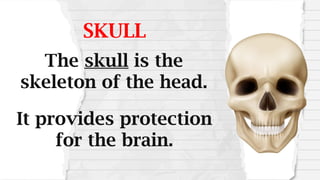
SKULL
The skull isthe
skeleton of the head.
It provides protection
for the brain.
13.
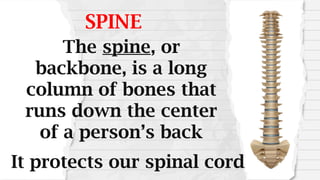
SPINE
The spine, or
backbone,is a long
column of bones that
runs down the center
of a person’s back
It protects our spinal cord
14.
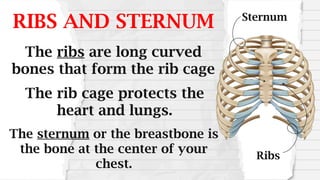
RIBS AND STERNUMSternum
Ribs
The ribs are long curved
bones that form the rib cage
The sternum or the breastbone is
the bone at the center of your
chest.
The rib cage protects the
heart and lungs.
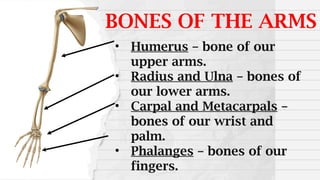
• Humerus –bone of our
upper arms.
• Radius and Ulna – bones of
our lower arms.
• Carpal and Metacarpals –
bones of our wrist and
palm.
• Phalanges – bones of our
fingers.
BONES OF THE ARMS
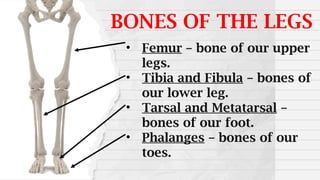
BONES OF THELEGS
• Femur – bone of our upper
legs.
• Tibia and Fibula – bones of
our lower leg.
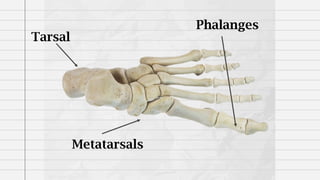
• Tarsal and Metatarsal –
bones of our foot.
• Phalanges – bones of our
toes.
#4 Major roles or functions
Ask them what do they think are the other role or function of the skeletal system.
Cartilage: Soft, gel-like padding between bones that protects joints and facilitates movement.
Ligaments: Elastic bands of tissue that connect bone to bone and provide stability to the joint.
Tendons: Bands of tissue that connect muscle to bone.
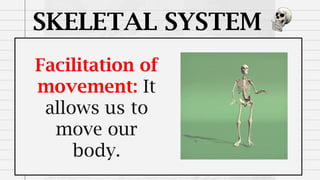
#6 Bones together with our muscles facilitate the movement of our body
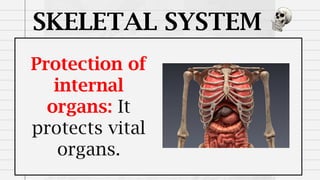
#7 Tell them that the bones acts as an armor inside our body.
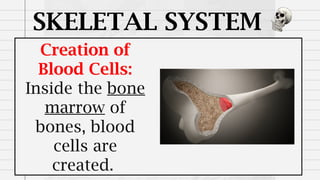
#8 Mention bulalo as an example of the bone marrow
#9 Before moving onto the next slide, ask them what were the four major functions of the skeletal system
Discuss about the bones fusing as we grow (make the babies skull as an example)
Adult human – 25 years old
#12 Ask them what major organ does the skull protects
Tell them that the skull has 22 bones in total but generally these bones are called the skull.
#13 There are 33 vertebrae for babies 26 vertebrae for adults
#14 There are 12 pairs of ribs which forms the rib cage
Ask them what major organ does the rib cage protects
Before moving to appendicular, recall the bones of the axial skeleton