HUMAN CULTURAL
VARIATIONS
Lesson 2
From Pre-Colonial
to Present
GENDER
AND
GENDER
ROLES
Note to Self
Gender refers to social,
cultural, and psychological
characteristics or traits related
to males and females based on
certain social contexts.
Gender roles refer to attitudes
and behaviors that the society
expects a person to exhibit
based on his/her sex.
NOTE TO SELF
During pre-colonial
Philippines, males and
females enjoy the
same rights and
privileges.
Gender roles during
the colonial period
had changed
drastically.
From Pre-
Colonial to
Present
SOCIO
ECONOMIC
CLASS
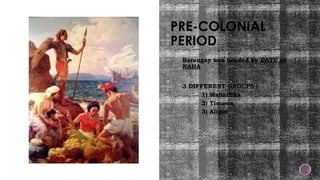
PRE-COLONIAL
PERIOD
 Barangay was headed by DATU or
RAHA
 3 DIFFERENT GROUPS :
1) Maharlika
2) Timawa
3) Alipin
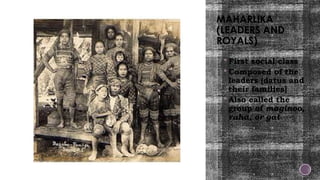
MAHARLIKA
(LEADERS AND
ROYALS)
 First social class
 Composed of the
leaders (datus and
their families)
 Also called the
group of maginoo,
raha, or gat
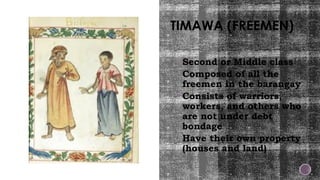
TIMAWA (FREEMEN)
Second or Middle class
Composed of all the
freemen in the barangay
Consists of warriors,
workers, and others who
are not under debt
bondage
Have their own property
(houses and land)
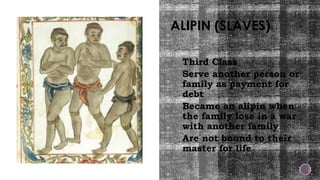
ALIPIN (SLAVES)
Third Class
Serve another person or
family as payment for
debt
Became an alipin when
the family lose in a war
with another family
Are not bound to their
master for life
2 KINDS OF ALIPIN
Aliping Namamahay
Has property
Often from timawa class and
became alipin because of
debt or as punishment for a
wrongdoing
Aliping Saguiguilid
Does not have the right to
own property
Captives in war
Can be sold or exchanged for
goods or other alipin
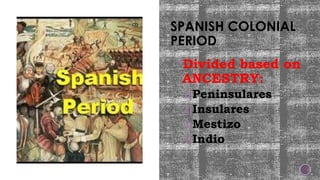
SPANISH COLONIAL
PERIOD
Divided based on
ANCESTRY:
1)Peninsulares
2)Insulares
3)Mestizo
4)Indio
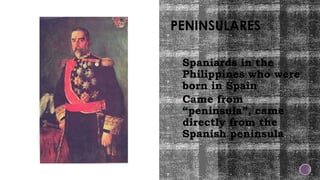
PENINSULARES
Spaniards in the
Philippines who were
born in Spain
Came from
“peninsula”, came
directly from the
Spanish peninsula
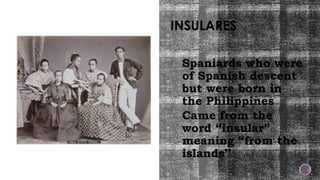
INSULARES
Spaniards who were
of Spanish descent
but were born in
the Philippines
Came from the
word “insular”
meaning “from the
islands”
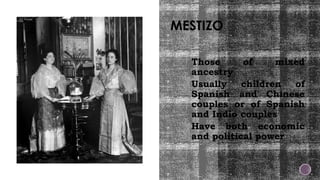
MESTIZO
• Those of mixed
ancestry
• Usually children of
Spanish and Chinese
couples or of Spanish
and Indio couples
• Have both economic
and political power
INDIO
• Consist of natives
• The lowest class in
the society
• Were stripped of
their rights and
freedom and were
forced to bow down
to the Spanish
colonizers
PRINCIPALIA
 Consist of native leaders in the government and
their families
The children of the principalia who usually studied
in Europe
ILUSTRADOS
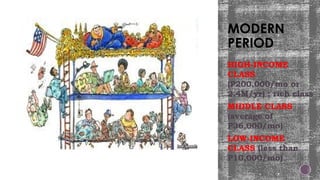
MODERN
PERIOD
HIGH-INCOME
CLASS
(P200,000/mo or
2.4M/yr) ; rich class
MIDDLE CLASS
(average of
P36,000/mo)
LOW-INCOME
CLASS (less than
P10,000/mo)
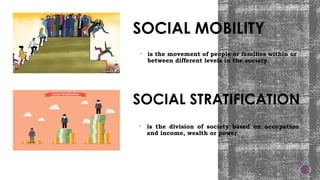
SOCIAL MOBILITY
• is the movement of people or families within or
between different levels in the society.
• is the division of society based on occupation
and income, wealth or power
SOCIAL STRATIFICATION
And Its Issues
ETHNICITY
ETHNICITY
refers to a group of people,
also called ETHNIC GROUP,
who have a common or
shared culture, language,
history, religion, and
tradition.
Ex. Filipinos, Malays,
Anglo-Saxons, and
Muslims
RACE
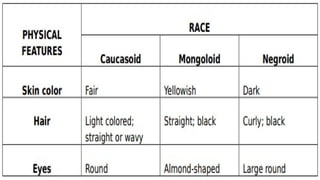
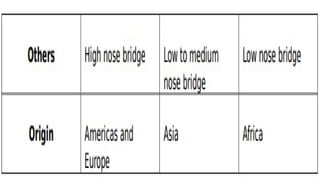
refers to a group of people
who share the same
physical attributes, such
as skin color, height,
facial features
RACES:
Caucasian, Mongoloid,
Negroid
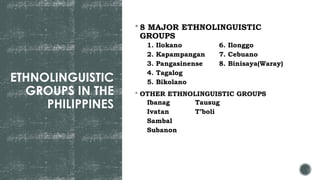
ETHNOLINGUISTIC
GROUPS IN THE
PHILIPPINES
 8 MAJOR ETHNOLINGUISTIC
GROUPS
1. Ilokano 6. Ilonggo
2. Kapampangan 7. Cebuano
3. Pangasinense 8. Binisaya(Waray)
4. Tagalog
5. Bikolano
 OTHER ETHNOLINGUISTIC GROUPS
Ibanag Tausug
Ivatan T’boli
Sambal
Subanon
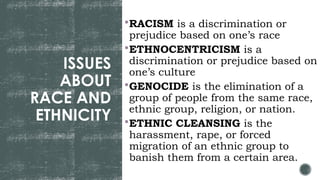
ISSUES
ABOUT
RACE AND
ETHNICITY
RACISM is a discrimination or
prejudice based on one’s race
ETHNOCENTRICISM is a
discrimination or prejudice based on
one’s culture
GENOCIDE is the elimination of a
group of people from the same race,
ethnic group, religion, or nation.
ETHNIC CLEANSING is the
harassment, rape, or forced
migration of an ethnic group to
banish them from a certain area.
Definition and
Kinds
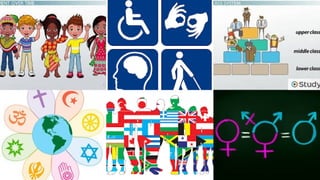
RELIGION
RELIGION
a set of practices and
behaviors that relate to
a group of people’s
belief in a God or a
group of Gods
Some Examples:
CHRISTIANITY, ISLAM,
HINDUISM, TAOISM,
BUDDHISM
Definition
EXCEPTIONALITY
EXCEPTIONALITY
a quality or a characteristic of
a person that makes him or
her different from an
established norm in a society
various physical and mental
interference or problems that
affect a person and which
makes it difficult for him/her to
function properly in society
OVERCOMING
CHALLENGES
AND PROBLEMS
REPUBLIC ACT
7277 or the
MAGNA CARTA
FOR PEOPLE
WITH
DISABILITIES
(PWDs) in 1991
Definition
NATIONALITY
NATION
is a large aggregate of
people united by
common descent,
history, culture,
language, and economic
life inhabiting a
particular country or
territory
NATIONALITY
a person’s instinctive
membership to a
specific nation or
country
Acquired by birth/blood
(jus sanguinis) or by
land or the country
where he is born (jus
soli)
NATIONALITY
An individual becomes
a citizen of a country
only when he is
accepted into that
country’s political
framework through
legal terms.
NATIONALITY
No one will be able to
change his nationality, but
one can have different
citizenships.
Administrative
Naturalization Law of
2000 (R.A. 9139)
Statelessness is not
having a nationality of any
country.
Q1-Lesson-2-Human-Culture-Variations.pptx