Q fever
VMD-Unit-5
Dr. Anil Kumar, Associate Professor
Department of Veterinary Medicine
BVC, Patna
Q fever
Introduction:
• Zoonotic febrile disease affecting workers involved in farming livestock
• Discovered first in Queensland, Australia, in 1935 among meat workers
Etiology:
• The causal agent, Coxiella burneti, a Gram-negative, an obligate intracellular
bacterium, which displays different morphological forms in its developmental cycle
Host affected:
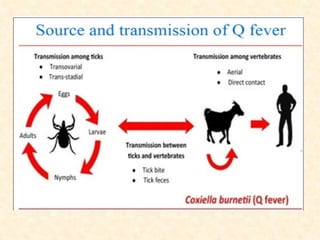
• Virtually all animal kingdoms, including arthropods (Ticks)
• But the disease affects mostly humans, cattle, sheep and goats
• Domestic ruminants are considered the main reservoirs
Transmission:
• Infection is principally transmitted by inhalation of desiccated aerosol particles
( contaminated fomites)
• Through exposure in the vicinity of infected animals, their reproductive tissues or
other animal products, like wool
• Ingestion-Ingestion of dairy products prepared from infected milk
• In human a very rare chance of transmission from person to person, but exposure
during childbirth, through sexual transmission or blood transfusion is possible
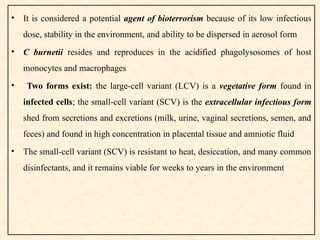
• It is considered a potential agent of bioterrorism because of its low infectious
dose, stability in the environment, and ability to be dispersed in aerosol form
• C burnetii resides and reproduces in the acidified phagolysosomes of host
monocytes and macrophages
• Two forms exist: the large-cell variant (LCV) is a vegetative form found in
infected cells; the small-cell variant (SCV) is the extracellular infectious form
shed from secretions and excretions (milk, urine, vaginal secretions, semen, and
feces) and found in high concentration in placental tissue and amniotic fluid
• The small-cell variant (SCV) is resistant to heat, desiccation, and many common
disinfectants, and it remains viable for weeks to years in the environment
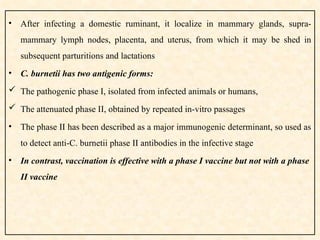
• After infecting a domestic ruminant, it localize in mammary glands, supra-
mammary lymph nodes, placenta, and uterus, from which it may be shed in
subsequent parturitions and lactations
• C. burnetii has two antigenic forms:
 The pathogenic phase I, isolated from infected animals or humans,
 The attenuated phase II, obtained by repeated in-vitro passages
• The phase II has been described as a major immunogenic determinant, so used as
to detect anti-C. burnetii phase II antibodies in the infective stage
• In contrast, vaccination is effective with a phase I vaccine but not with a phase
II vaccine
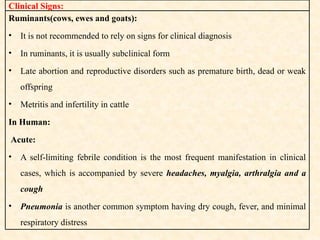
Clinical Signs:
Ruminants(cows, ewes and goats):
• It is not recommended to rely on signs for clinical diagnosis
• In ruminants, it is usually subclinical form
• Late abortion and reproductive disorders such as premature birth, dead or weak
offspring
• Metritis and infertility in cattle
In Human:
Acute:
• A self-limiting febrile condition is the most frequent manifestation in clinical
cases, which is accompanied by severe headaches, myalgia, arthralgia and a
cough
• Pneumonia is another common symptom having dry cough, fever, and minimal
respiratory distress
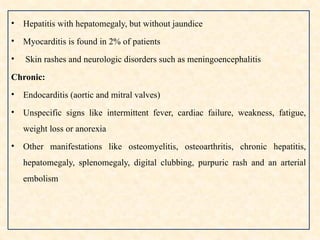
• Hepatitis with hepatomegaly, but without jaundice
• Myocarditis is found in 2% of patients
• Skin rashes and neurologic disorders such as meningoencephalitis
Chronic:
• Endocarditis (aortic and mitral valves)
• Unspecific signs like intermittent fever, cardiac failure, weakness, fatigue,
weight loss or anorexia
• Other manifestations like osteomyelitis, osteoarthritis, chronic hepatitis,
hepatomegaly, splenomegaly, digital clubbing, purpuric rash and an arterial
embolism
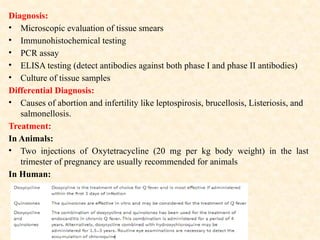
Diagnosis:
• Microscopic evaluation of tissue smears
• Immunohistochemical testing
• PCR assay
• ELISA testing (detect antibodies against both phase I and phase II antibodies)
• Culture of tissue samples
Differential Diagnosis:
• Causes of abortion and infertility like leptospirosis, brucellosis, Listeriosis, and
salmonellosis.
Treatment:
In Animals:
• Two injections of Oxytetracycline (20 mg per kg body weight) in the last
trimester of pregnancy are usually recommended for animals
In Human:
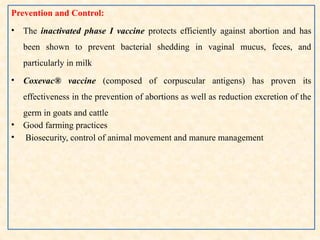
Prevention and Control:
• The inactivated phase I vaccine protects efficiently against abortion and has
been shown to prevent bacterial shedding in vaginal mucus, feces, and
particularly in milk
• Coxevac® vaccine (composed of corpuscular antigens) has proven its
effectiveness in the prevention of abortions as well as reduction excretion of the
germ in goats and cattle
• Good farming practices
• Biosecurity, control of animal movement and manure management
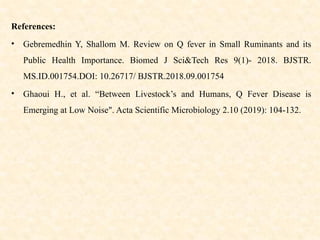
References:
• Gebremedhin Y, Shallom M. Review on Q fever in Small Ruminants and its
Public Health Importance. Biomed J Sci&Tech Res 9(1)- 2018. BJSTR.
MS.ID.001754.DOI: 10.26717/ BJSTR.2018.09.001754
• Ghaoui H., et al. “Between Livestock’s and Humans, Q Fever Disease is
Emerging at Low Noise". Acta Scientific Microbiology 2.10 (2019): 104-132.
Q-FEVER Power Point presentation .pptx

  • 1.
    Q fever VMD-Unit-5 Dr. AnilKumar, Associate Professor Department of Veterinary Medicine BVC, Patna
  • 2.
    Q fever Introduction: • Zoonoticfebrile disease affecting workers involved in farming livestock • Discovered first in Queensland, Australia, in 1935 among meat workers Etiology: • The causal agent, Coxiella burneti, a Gram-negative, an obligate intracellular bacterium, which displays different morphological forms in its developmental cycle Host affected: • Virtually all animal kingdoms, including arthropods (Ticks) • But the disease affects mostly humans, cattle, sheep and goats • Domestic ruminants are considered the main reservoirs Transmission: • Infection is principally transmitted by inhalation of desiccated aerosol particles ( contaminated fomites) • Through exposure in the vicinity of infected animals, their reproductive tissues or other animal products, like wool • Ingestion-Ingestion of dairy products prepared from infected milk • In human a very rare chance of transmission from person to person, but exposure during childbirth, through sexual transmission or blood transfusion is possible
  • 4.
    • It isconsidered a potential agent of bioterrorism because of its low infectious dose, stability in the environment, and ability to be dispersed in aerosol form • C burnetii resides and reproduces in the acidified phagolysosomes of host monocytes and macrophages • Two forms exist: the large-cell variant (LCV) is a vegetative form found in infected cells; the small-cell variant (SCV) is the extracellular infectious form shed from secretions and excretions (milk, urine, vaginal secretions, semen, and feces) and found in high concentration in placental tissue and amniotic fluid • The small-cell variant (SCV) is resistant to heat, desiccation, and many common disinfectants, and it remains viable for weeks to years in the environment
  • 5.
    • After infectinga domestic ruminant, it localize in mammary glands, supra- mammary lymph nodes, placenta, and uterus, from which it may be shed in subsequent parturitions and lactations • C. burnetii has two antigenic forms:  The pathogenic phase I, isolated from infected animals or humans,  The attenuated phase II, obtained by repeated in-vitro passages • The phase II has been described as a major immunogenic determinant, so used as to detect anti-C. burnetii phase II antibodies in the infective stage • In contrast, vaccination is effective with a phase I vaccine but not with a phase II vaccine
  • 6.
    Clinical Signs: Ruminants(cows, ewesand goats): • It is not recommended to rely on signs for clinical diagnosis • In ruminants, it is usually subclinical form • Late abortion and reproductive disorders such as premature birth, dead or weak offspring • Metritis and infertility in cattle In Human: Acute: • A self-limiting febrile condition is the most frequent manifestation in clinical cases, which is accompanied by severe headaches, myalgia, arthralgia and a cough • Pneumonia is another common symptom having dry cough, fever, and minimal respiratory distress
  • 7.
    • Hepatitis withhepatomegaly, but without jaundice • Myocarditis is found in 2% of patients • Skin rashes and neurologic disorders such as meningoencephalitis Chronic: • Endocarditis (aortic and mitral valves) • Unspecific signs like intermittent fever, cardiac failure, weakness, fatigue, weight loss or anorexia • Other manifestations like osteomyelitis, osteoarthritis, chronic hepatitis, hepatomegaly, splenomegaly, digital clubbing, purpuric rash and an arterial embolism
  • 8.
    Diagnosis: • Microscopic evaluationof tissue smears • Immunohistochemical testing • PCR assay • ELISA testing (detect antibodies against both phase I and phase II antibodies) • Culture of tissue samples Differential Diagnosis: • Causes of abortion and infertility like leptospirosis, brucellosis, Listeriosis, and salmonellosis. Treatment: In Animals: • Two injections of Oxytetracycline (20 mg per kg body weight) in the last trimester of pregnancy are usually recommended for animals In Human:
  • 9.
    Prevention and Control: •The inactivated phase I vaccine protects efficiently against abortion and has been shown to prevent bacterial shedding in vaginal mucus, feces, and particularly in milk • Coxevac® vaccine (composed of corpuscular antigens) has proven its effectiveness in the prevention of abortions as well as reduction excretion of the germ in goats and cattle • Good farming practices • Biosecurity, control of animal movement and manure management
  • 10.
    References: • Gebremedhin Y,Shallom M. Review on Q fever in Small Ruminants and its Public Health Importance. Biomed J Sci&Tech Res 9(1)- 2018. BJSTR. MS.ID.001754.DOI: 10.26717/ BJSTR.2018.09.001754 • Ghaoui H., et al. “Between Livestock’s and Humans, Q Fever Disease is Emerging at Low Noise". Acta Scientific Microbiology 2.10 (2019): 104-132.