Yawar Rasul
MCA Sem II
Subject - Python
Tokens in Python
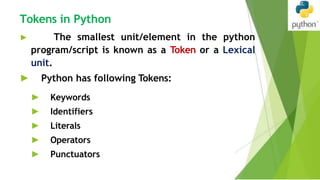
► The smallest unit/element in the python
program/script is known as a Token or a Lexical
unit.
► Python has following Tokens:
► Keywords
► Identifiers
► Literals
► Operators
► Punctuators
Keywords
Keywords are the reserve words/pre-defined words/special words
of python which have a special meaning for the interpreter.
False True None def if
lambda class yield continue else
assert or while break elif
del from is not pass
for global finally import as
in nonlocal return With And
int except Raise print
Identifiers(user defined names)
►Identifiers are the name given to the different
programming elements like variables, objects,
classes, functions, lists, dictionaries etc.
Rule
1
Non-
Rule
2
• Must be
Rule
3
• Cannot
keyword made up of begin
word only letters, with a
with no numbers Number,
space in and although
between Underscore(_) may
contain
numbers
Identifiers
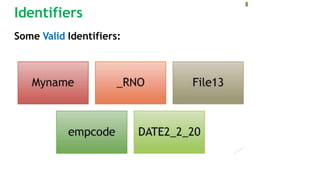
Some Valid Identifiers:
Literals
► Literals are the data items that have a fixed or
constant value
Single Line Strings
String Literals
►A string literal is a sequence of characters surrounded
by Quotes (Single, Double or Triple Quotes).
• Must
terminate
in one line
• Spread
across
multiple
lines
MultiLine Strings
String Literals
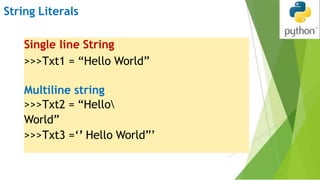
Single line String
>>>Txt1 = “Hello World”
Multiline string
>>>Txt2 = “Hello
World”
>>>Txt3 =‘’ Hello World”’
Numeric Literals
► Numeric Literals are numeric values like integer
floating point number or a complex number
float complex
• complex
number
literals
Numeric Literals
► integer literals
Decimal
Form
• Digits 0-9
• Base 10
• e.g. 1234
Octal Form
• Begin with Oo
• Base 8(0-7)
• e.g. 0o32
Hexadecimal
form
• Begin with Ox
• Base 16(0-9,a-f)
• e.g.OxAF
Numeric Literals
► Floating Point Literals/ Real Literals & Complex Numbers
Floating point
n
Complex Number
• Decimal point • a+bj form
divides the • a & b are real
integer and fraction
part
• j = v-1, imaginary
• e.g. 2+3j
• e.g. -13.0, 3.E2,
0.17E5
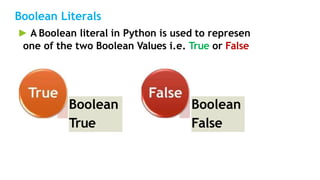
Boolean Literals
► A Boolean literal in Python is used to represen
one of the two Boolean Values i.e. True or False
Boolean
True
Boolean
False
Special Literal – None(empty legal value)
In python, None literal is used to indicate
absence of value
Identifiers
Some Invalid Identifiers:
• Contains special character -(hyphen)
• Starting with a Digit
• Reserved keyword
• Contains special character . (dot)
VID-REC
2020RNO
continue
Emp.Code
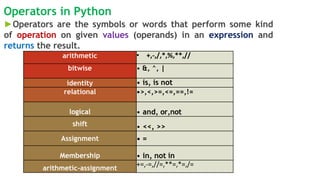
Operators in Python
►Operators are the symbols or words that perform some kind
of operation on given values (operands) in an expression and
returns the result.
arithmetic • +,-,/,*,%,**,//
bitwise • &, ^, |
identity • is, is not
relational •>,<,>=,<=,==,!=
logical • and, or,not
shift • <<, >>
Assignment • =
Membership • in, not in
arithmetic-assignment
+=,-=,//=,**=,*=,/=
Punctuators in Python
►Punctuators are the symbols that are used in
programming language to organize sentence structure,
indicate the rhythm and emphasis of expressions,
statements and Program Structure.
► Common Punctuators are:
( ) { } [ ] @ ,
# 
‘ ‘’ “”
, : . ;
Tokens in Python
Keywords are the reserve words of python which have a special meaning for
the interpreter.
Identifiers are the name given to the different programming elements like
variables, objects, classes, functions, lists, dictionaries etc.
Literals are the data items that have a fixed /constant value.
Operators are the symbols or words that perform some kind of operation on
given values (operands) in an expression and returns the result.
Punctuators are the symbols that are used in programming language
to organize sentence structure, indicate the rhythm and emphasis of
expressions, statements and Program Structure.

python_Yawar_Rasul.pptx

  • 1.
    Yawar Rasul MCA SemII Subject - Python
  • 2.
    Tokens in Python ►The smallest unit/element in the python program/script is known as a Token or a Lexical unit. ► Python has following Tokens: ► Keywords ► Identifiers ► Literals ► Operators ► Punctuators
  • 3.
    Keywords Keywords are thereserve words/pre-defined words/special words of python which have a special meaning for the interpreter. False True None def if lambda class yield continue else assert or while break elif del from is not pass for global finally import as in nonlocal return With And int except Raise print
  • 4.
    Identifiers(user defined names) ►Identifiersare the name given to the different programming elements like variables, objects, classes, functions, lists, dictionaries etc. Rule 1 Non- Rule 2 • Must be Rule 3 • Cannot keyword made up of begin word only letters, with a with no numbers Number, space in and although between Underscore(_) may contain numbers
  • 5.
  • 6.
    Literals ► Literals arethe data items that have a fixed or constant value
  • 7.
    Single Line Strings StringLiterals ►A string literal is a sequence of characters surrounded by Quotes (Single, Double or Triple Quotes). • Must terminate in one line • Spread across multiple lines MultiLine Strings
  • 8.
    String Literals Single lineString >>>Txt1 = “Hello World” Multiline string >>>Txt2 = “Hello World” >>>Txt3 =‘’ Hello World”’
  • 9.
    Numeric Literals ► NumericLiterals are numeric values like integer floating point number or a complex number float complex • complex number literals
  • 10.
    Numeric Literals ► integerliterals Decimal Form • Digits 0-9 • Base 10 • e.g. 1234 Octal Form • Begin with Oo • Base 8(0-7) • e.g. 0o32 Hexadecimal form • Begin with Ox • Base 16(0-9,a-f) • e.g.OxAF
  • 11.
    Numeric Literals ► FloatingPoint Literals/ Real Literals & Complex Numbers Floating point n Complex Number • Decimal point • a+bj form divides the • a & b are real integer and fraction part • j = v-1, imaginary • e.g. 2+3j • e.g. -13.0, 3.E2, 0.17E5
  • 12.
    Boolean Literals ► ABoolean literal in Python is used to represen one of the two Boolean Values i.e. True or False Boolean True Boolean False
  • 13.
    Special Literal –None(empty legal value) In python, None literal is used to indicate absence of value
  • 14.
    Identifiers Some Invalid Identifiers: •Contains special character -(hyphen) • Starting with a Digit • Reserved keyword • Contains special character . (dot) VID-REC 2020RNO continue Emp.Code
  • 15.
    Operators in Python ►Operatorsare the symbols or words that perform some kind of operation on given values (operands) in an expression and returns the result. arithmetic • +,-,/,*,%,**,// bitwise • &, ^, | identity • is, is not relational •>,<,>=,<=,==,!= logical • and, or,not shift • <<, >> Assignment • = Membership • in, not in arithmetic-assignment +=,-=,//=,**=,*=,/=
  • 16.
    Punctuators in Python ►Punctuatorsare the symbols that are used in programming language to organize sentence structure, indicate the rhythm and emphasis of expressions, statements and Program Structure. ► Common Punctuators are: ( ) { } [ ] @ , # ‘ ‘’ “” , : . ;
  • 17.
    Tokens in Python Keywordsare the reserve words of python which have a special meaning for the interpreter. Identifiers are the name given to the different programming elements like variables, objects, classes, functions, lists, dictionaries etc. Literals are the data items that have a fixed /constant value. Operators are the symbols or words that perform some kind of operation on given values (operands) in an expression and returns the result. Punctuators are the symbols that are used in programming language to organize sentence structure, indicate the rhythm and emphasis of expressions, statements and Program Structure.